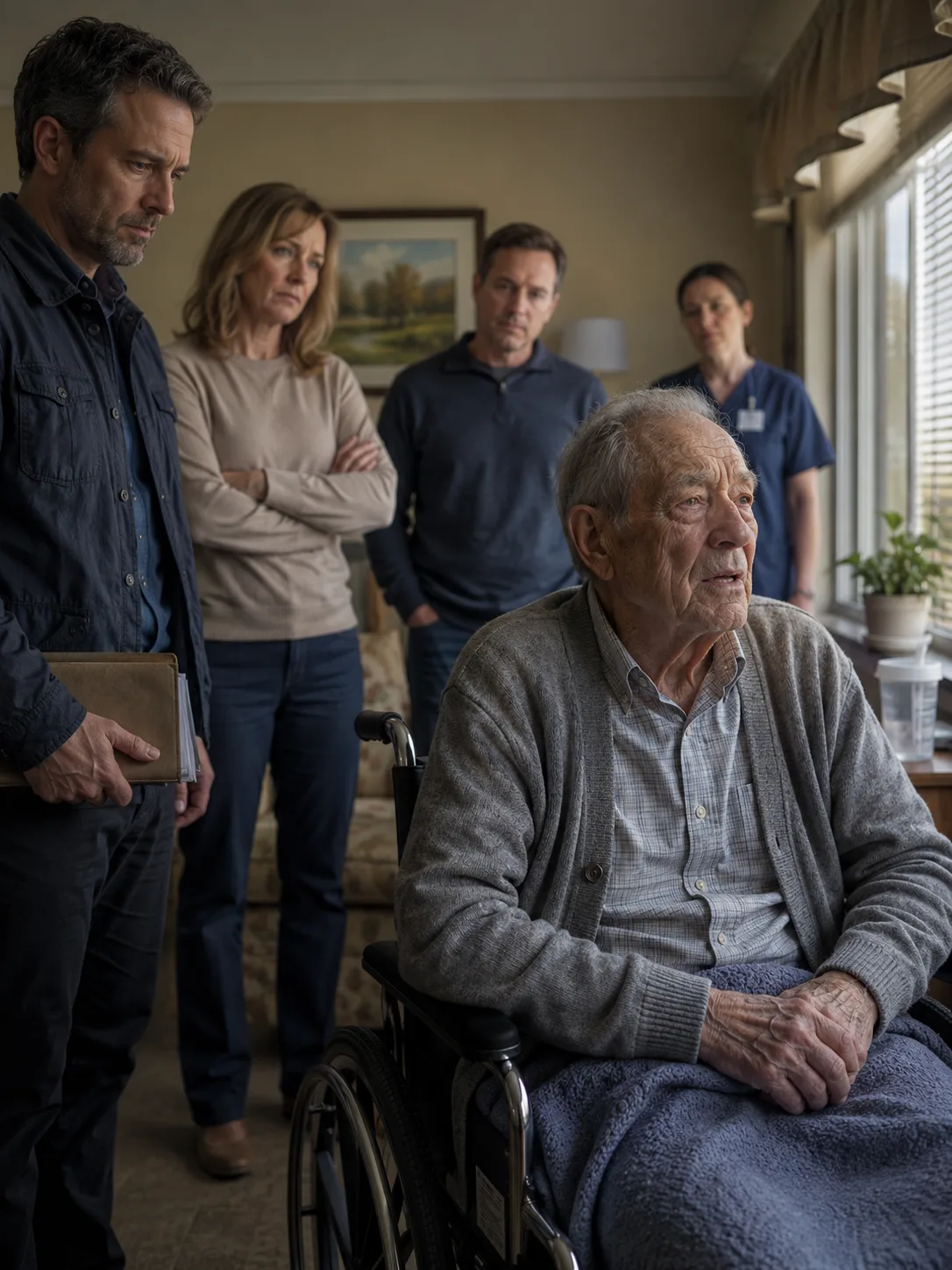
My father pressed two fingers against the window glass and said a woman’s name none of us knew.
Chapter 1
My father pressed two fingers against the window glass and said a woman’s name none of us knew.
Again.
The nurse had just set his dinner tray in front of him: turkey cut into small squares, green beans, applesauce in a plastic cup. A paper napkin lay folded beside the fork. He did not touch any of it.
“Lena,” he said.
My sister Linda closed her purse with a snap.
Not now.
The room at the care home was small enough that every sound had edges. The wheels of his chair clicked when he shifted. The blinds tapped lightly against the sill. Somewhere down the hall, a television laughed through a sitcom that nobody in that hallway seemed to be watching.
I stood beside the dresser, holding the cardigan he had worn before his afternoon bath. It still smelled faintly of shaving cream and the cedar blocks my mother used to keep in his drawers.
“Dad,” I said, “do you want me to help with dinner?”
He kept
looking out at the dry Utah light beyond the window.
“Lena,” he said again.
Linda rubbed her thumb along the strap of her purse.
“There it is,” she said. “Same thing every day.”
My brother Mark leaned against the wall near the door. He had driven in from Provo, still wearing his work boots, dust on the cuffs of his jeans. He looked at the tray, then at the clock.
“Maybe he knew someone at church,” Mark said.
“He didn’t,” Linda said.
She said it fast.
Too fast.
My father had been Thomas Walker to everyone outside the family. Tom to my mother. Staff Sergeant Walker in the box of papers in my garage, though none of us had ever called him that. To us, he had been Dad, the quiet man who measured twice before cutting, who kept a coffee can of screws in the basement, who never raised
his voice unless one of us ran near the street.
Korea stayed sealed.
He never talked about the war. Not on Veterans Day. Not when the news showed old footage. Not even when Mark bought him a navy-blue hat that said KOREAN WAR VETERAN across the front in gold stitching.
Dad wore it once.
Then it disappeared.
Now he sat in a care home outside Salt Lake City, his shoulders narrow beneath a gray sweater, saying a name with the careful patience of a man leaving something on a doorstep.
“Lena.”
Linda walked to the window and pulled the blind cord until the slats shifted.
“Dad, stop,” she said. “You’re wearing yourself out.”
He turned his head toward her, but his eyes did not settle.
“Korea,” he said.
The room went quiet.
Even Mark stopped shifting his boots.
I took one step closer.
“What about Korea?”
Dad’s hand moved on
the blanket covering his knees. His fingers searched the fabric, pinched it, released it, pinched again.
“Promise,” he said.
One word.
Linda picked up his fork and set it back down beside the tray.
“He needs to eat.”
Mark cleared his throat.
“Maybe we should ask the nurse.”
“No,” Linda said.
She turned toward me. Her mouth had gone thin, the way it did when she had already decided what everyone else should do.
“Daniel, don’t start.”
I looked at my father. His lips moved, but no sound came out. His right hand lifted from the blanket, only an inch, then fell back down.
The applesauce cup had a tiny crack in the lid.
I noticed that.
I still remember it.
Linda signed the visitor log at the front desk before I did. She wrote with sharp strokes, pressing so hard the pen left grooves in the next page.
“Memory care patients repeat things,” she said. “Names, phrases, places. The doctor explained it.”
Mark held the door open for us.
Outside, the parking lot shimmered under a pale sun. A maintenance man dragged a hose across the strip of grass near the entrance. Water darkened the concrete in uneven lines.
“I know what the doctor said,” I told her.
“Then listen.”
She put her sunglasses on.
“Mom is gone. Dad is almost gone. We do not need another ghost at the table.”
Mark looked between us.
“Linda.”
“No.” She pointed her keys at him, then at me. “Every family has things that don’t mean anything. Let it be.”
Let it be.
That had been her answer since our mother died three years earlier. Let the house sell. Let the boxes go to storage. Let the old photographs stay unsorted. Let Dad’s medals remain in the cedar chest because nobody wanted to ask why some nights he used to stand barefoot in the hallway at 3 a.m., one hand pressed against the wall.
I had been twelve the first time I saw him do that.
He did not see me.
He only stood there, breathing through his nose, staring at the floorboards until my mother came out in her robe and touched his elbow. She did not ask him what he was seeing.
She said, “Tom. Kitchen.”
Then she led him away.
That night had lived inside me without a name.
Now there was one.
Lena.
I drove home to Ogden with the radio off. At a red light, I found myself repeating the name under my breath, testing it against old memories, old Christmas cards, old church directories, old neighbors who used to bring casseroles when someone got sick.
Nothing fit.
At home, my wife had left soup on the stove and a note beside the bowl.
Don’t forget to eat.
I read it twice.
Then I walked past the kitchen and into the garage.
The cedar chest sat beneath a metal shelf stacked with paint cans and extension cords. Dust had collected on the lid in a soft gray film. My mother had kept quilts in it for years. After she died, Linda packed Dad’s military things inside and told me to take it because I had more storage space.
I knelt in front of it.
The brass latch stuck at first. I pulled harder. It opened with a small wooden groan.
Inside were folded flags from two Memorial Day parades, a cracked leather shaving kit, a bundle of letters tied with twine, and the medals Dad had once let me touch when I was ten. The ribbons had faded. One pin was bent.
At the bottom, under a stack of discharge papers, I found a manila envelope stiff with age.
It had no address on the front.
Only my father’s handwriting.
KOREA — NOT FOR LINDA.
I sat back on my heels.
The garage light hummed above me.
Not for Linda.
For a while, I did not open it. I held it with both hands and stared at the words until they stopped looking like handwriting and became cuts.
My phone rang on the workbench.
Linda.
I let it ring.
The envelope was sealed, but the glue had dried so much that the flap lifted when I slid one finger beneath it. Inside was another envelope, smaller, with the Department of the Army seal in the corner and a folded note paper-clipped to it.
The note was in my mother’s handwriting.
Daniel, if he starts saying her name, bring this to the table. Make them sit down first.
My mouth went dry.
Make them sit down first.
I read that line until the garage seemed too narrow.
The next morning, I called the care home director, Mrs. Alvarez, and asked if we could use the family conference room after lunch.
“For paperwork?” she asked.
“For family history,” I said.
There was a pause.
Then she said, “I’ll make sure it’s private.”
Linda arrived fifteen minutes late, wearing a cream sweater and gold earrings, the kind she wore to church when she wanted people to know she had things handled. Mark came right behind her with coffee in a paper cup. He avoided my eyes.
Dad was already in the room by the window.
Mrs. Alvarez had rolled him in herself. The blue blanket lay over his knees. His hands rested on top of it, fingers slightly curled.
The conference room smelled like cold coffee and lemon cleaner.
A tissue box sat in the center of the round table, though nobody had asked for one. A framed watercolor of red cliffs hung crooked on the far wall. The clock above it ticked too loudly.
Linda saw the file under my arm and stopped.
“No,” she said.
I placed it on the table.
Not yet.
“Sit down,” I said.
She laughed once through her nose.
“Don’t talk to me like I’m one of your kids.”
“Mom said to sit down.”
That did it.
Mark looked up.
Linda’s hand moved to the back of a chair, but she did not pull it out.
“What are you talking about?”
I opened my jacket and took out my mother’s folded note. I placed it beside the manila envelope.
Linda picked it up before I could stop her.
Her eyes moved across the handwriting. Her jaw shifted. Then she set it down as if it had dirt on it.
“Mom was protecting him,” she said.
“From what?”
“From this.” She tapped the envelope. “From you digging.”
Mrs. Alvarez stood near the door with her clipboard held against her chest. She had told us she would step out if we wanted, but she had not moved.
Dad made a sound by the window.
Not a word. A breath caught on something.
I turned.
He was looking at the table.
“Lena,” he said.
Linda shut her eyes for one second.
“Please.”
Mark pulled out a chair. The legs scraped across the floor.
“Let him open it,” he said.
Linda turned on him.
“You don’t know what you’re asking.”
“No,” Mark said. “I don’t.”
Three words.
They landed.
For the first time all week, Linda did not answer right away.
I untied the string around the file. My fingers did not work cleanly. The knot had tightened with age, and one end frayed apart when I pulled it.
Inside were military records, old photographs, a copy of Dad’s discharge papers, and a brown envelope with a service archive stamp from North Carolina. I had requested a copy of his full record months earlier when the care home asked for proof of veteran status. It had arrived, but I had never opened it fully. Linda said the pension office only needed the basic page.
She had taken the rest from my hand.
Now it was back.
I spread the papers on the table.
Linda stayed standing.
The first pages were ordinary enough: dates, units, ranks, places. Dad had served with the 2nd Infantry Division. He had been twenty-one when he shipped out. His signature at the bottom of one page looked too young, a boy pretending his hand did not shake.
Mark leaned closer.
“I never knew his unit.”
“Because he never talked,” Linda said.
I turned another page.
Then another.
A photograph slid out from between two forms and landed face down near the tissue box. It was small, curled at the edges, black-and-white with a white border.
I reached for it.
Linda’s hand came down over mine.
“Stop.”
Her ring clicked against the table.
I looked at her hand. She did not move it.
“What did you know?”
Her throat moved.
“Enough.”
Dad said the name again.
It was softer this time.
Mrs. Alvarez lowered the clipboard.
The clock kept ticking.
Mark stood up so fast his coffee tipped, spilling across the table in a brown sheet. He grabbed napkins from beside the tissue box and pressed them down, missing half the spill.
Nobody helped him.
“Linda,” he said. “What did you know?”
She pulled her hand back from mine and stepped away from the table.
“I was trying to keep this family intact.”
The words came out clean, prepared.
Too clean.
The mini blinds beside Dad shifted in the heating vent. Lines of light moved across his blanket.
I turned the photograph over.
A young woman looked back from the faded paper. She was maybe eighteen, maybe twenty, standing beside a chain-link fence with mountains behind her. Her hair was dark, pinned back from her face. She wore a plain dress and held a small book against her chest.
On the back, in my father’s handwriting, was one word.
Lena.
Under it, in smaller letters:
Sam’s girl.
Mark sat down.
The chair groaned.
Linda reached for the photo again, but I moved it out of her reach.
“Who is Sam?”
No one answered.
Dad’s hand lifted from the blanket. His fingers opened, closed, opened.
I opened the brown service archive envelope.
There were two items inside.
One was a copy of a battlefield report dated February 1951.
The other was a letter, folded into thirds, the paper thin enough that the pencil marks showed through the back.
The handwriting was not my father’s.
It slanted badly, the letters uneven, as though written in a place where the ground would not hold still.
At the top, someone had written:
To Thomas Walker, if I don’t make it.
I did not unfold it yet.
Linda backed toward the wall.
“You don’t have the right.”
I looked at her.
“Mom left it for me.”
“She left it because she knew you would make a spectacle.”
Mrs. Alvarez took one step farther into the room.
“This is a private family matter,” Linda said, turning toward her.
Mrs. Alvarez did not leave.
Dad whispered something. It was not clear enough to catch.
Mark moved closer to him and bent down.
“What, Dad?”
Dad’s eyes stayed on the folded letter.
“Promise.”
His hand trembled in the air.
Mark straightened.
Linda’s phone buzzed inside her purse. She did not reach for it.
I put the photo in the center of the table.
Then I unfolded the letter.
The paper made a sound like dry leaves.
No one spoke.
The first line was difficult to read. The pencil had faded in places, and a stain cut across the corner. I leaned closer, flattening the edges with both palms.
Tom, if God lets you walk out of this valley, find my Lena.
I stopped there.
The room pulled inward.
Linda’s shoulders dropped a fraction, only enough for me to see.
Mark took off his cap and held it against his leg.
Dad’s hand lowered to the wheel of his chair. His thumb rubbed one spot on the metal rim, back and forth, back and forth.
I read the line again without speaking.
Find my Lena.
There was more.
The letter said Sam Whitaker had a daughter in Tacoma with no mother left, no grandparents who wanted her, and no one who would tell her where her father died. It said he had carried her picture in his breast pocket through mud, cold, shelling, and nights when the men slept sitting up because lying down meant freezing harder.
It said he knew Thomas Walker would survive because Thomas had promised him out loud while the hills were burning.
Not in church.
Not at home.
There.
In Korea.
The letter grew harder to read near the bottom. Some words had been pressed so deep they tore the paper. Others faded into ghost lines.
Tell her I tried.
Tell her she had family.
If you cannot bring her home, then be the family.
I placed the letter flat beside the photograph.
Dad made a small sound.
His mouth moved once before the word came.
“Lena.”
This time, nobody corrected him.
Linda’s face had changed color. She reached behind her for the chair, missed it, then found the edge with her fingertips. The purse slipped from her shoulder and hit the floor against her ankle.
Mark looked at her.
“You knew about this.”
She bent to pick up the purse, but her hand stopped before touching it.
“Mom knew.”
“That’s not what I asked.”
Linda straightened.
“She found letters after he had that spell in ’98. He was writing to someone. Sending checks. Birthday cards. Christmas money.” She swallowed, then adjusted one earring with two fingers. “Mom thought it would break things.”
“What things?”
“Our family.”
Mark let out a breath through his teeth.
“She was a child.”
“She was not his child.”
Dad’s wheelchair creaked.
I turned slowly, the letter still under my hand.
Linda seemed to hear herself then. She looked at Dad, then away.
Mrs. Alvarez set her clipboard on a side cabinet. The small sound carried.
I picked up another paper from the file. It was a copy of a notarized statement, dated 1974. Dad had written it for an attorney in Washington State. The document described Sam Whitaker’s request, Lena’s placement with a widowed aunt, and Dad’s continuing support. It did not ask for credit. It did not claim rights. It did not use the word adoption.
But one sentence had been underlined.
For all moral purposes, I accept responsibility for Lena Whitaker as family.
My mother had written in the margin:
He meant it.
Two words.
I set that page beside the letter.
The table was no longer a table. It was a map.
Military report.
Photograph.
Battlefield letter.
Notarized statement.
My mother’s note.
The repeated name had crossed decades to arrive between a coffee stain and a tissue box in a beige conference room.
Linda pressed her palm against the back of the chair.
“So what now?” she said.
Her voice had lost its clean edge.
I did not answer.
I turned the battlefield photograph so Dad could see it.
His eyes followed the movement, slow but certain. His hand rose again, shaking harder now. The blanket slid from his knee and bunched near the footrest.
Mark stepped toward him, then stopped.
Dad reached across the empty space between the wheelchair and the table. He could not reach the photograph. Not close.
I picked it up by the edges and held it out.
His fingers touched the corner.
Not the woman’s face.
The corner.
His thumb rested on the white border where the paper had curled.
“Sam,” he said.
His first clear word all day besides her name.
The room stayed still.
Linda lowered herself into the chair at last. It was the chair she had refused to pull out when I told her to sit. She sat without grace, one hand still gripping the purse strap, the other flat on the table near the coffee spill.
Mrs. Alvarez turned fully toward Dad.
Not toward me.
Not toward Linda.
Toward him.
For years, we had treated his silence like absence. We had mistaken it for emptiness. We had filled it with our own explanations because he had not handed us better ones.
Now the proof sat under fluorescent light.
Dad had been carrying a promise longer than any of us had been alive.
Linda’s phone buzzed again.
She did not touch it.
Mark walked to the side cabinet and brought back a fresh paper towel. He wiped the spilled coffee carefully around the edge of the letter, not letting the towel touch the paper. His hands were too large for the delicate work.
No one helped.
I looked down at the documents and saw another small envelope tucked beneath the notarized page. It was newer than the rest. Cream-colored, sealed, with Dad’s name on the front and my mother’s handwriting beneath it.
For Daniel, if Linda refuses.
Linda saw it too.
Her mouth opened.
I broke the seal.
Inside was a single sheet, folded once.
My mother’s handwriting had changed by then, grown looser, but the words were steady.
Daniel,
Your father did not betray us. He kept a promise before he knew us.
I was young when I found out, and I was not generous. Later I understood. Linda never did.
Lena visited once, when you were four. She stood on our porch with a yellow suitcase and a letter from your father. Linda was thirteen. She heard enough to decide what kind of story she wanted this to be.
I sent Lena away.
That is mine to carry.
Your father wrote anyway. He never stopped. If his mind brings her name back, it is not because the rest of us mattered less.
It is because promises know where to wait.
There was more, but I could not keep reading aloud.
Not then.
I set the page down.
Linda stared at the last line.
Mark moved behind Dad’s chair and gripped the handles. He did not push.
My father still held the corner of the photograph. His hand had gone still.
Outside the window, a white pickup rolled through the parking lot and stopped near the entrance. Someone unloaded a walker from the back seat. The ordinary world kept moving, careless and exact.
Mrs. Alvarez crossed to the door and closed it.
The latch clicked.
Linda looked at me then.
“What do you want from me?”
The question should have sounded large.
It did not.
I gathered the battlefield letter, the photograph, and the notarized statement into a neat line.
“Her address,” I said.
Linda’s fingers tightened around the purse strap.
“I don’t have it.”
I opened my mother’s note again and turned it toward her.
“Yes, you do.”
Her eyes moved to the bottom of the page.
There it was, written in a separate line.
Lena Whitaker Mercer
Tacoma, Washington
Last Christmas card returned, 2016
Ask Linda for the box
Mark turned his head slowly.
“The box?”
Linda stood too quickly. The chair bumped the wall behind her.
“There are things you don’t understand.”
“Then explain them.”
She looked toward Dad.
He was not looking at her.
He was looking at Lena’s photograph.
Linda picked up her purse from the floor. Her keys jingled inside it. She held them in her hand and then put them back, as though leaving required permission from a room that no longer offered it.
“I kept the cards,” she said.
Four words.
Mark’s hand moved on the wheelchair handle.
“Where?”
“In my basement.”
“For how long?”
She looked at the crooked watercolor on the wall.
“Since Mom died.”
No one moved for several seconds.
Then Dad’s fingers slipped from the photograph. His hand lowered to the blanket. The corner of the picture lifted slightly, then settled again on the table.
I placed it back beside the letter.
The photograph had a faint crease across Lena’s dress. It did not touch her face.
After that day, Linda did not come to the care home for nearly two weeks.
Mark came every other evening.
He brought coffee he never finished and sat with Dad beside the window, reading aloud from the old service papers as if Dad had asked for them. Sometimes Dad slept through it. Sometimes his mouth moved when Mark reached Sam’s name.
Mrs. Alvarez made copies of everything for us. She used the office scanner, page by page, feeding the old papers in with both hands. She put the originals in archival sleeves she found from a volunteer project no one had completed.
The tissue box remained on the conference table.
So did the coffee stain.
I drove to Linda’s house on a Saturday morning. She met me at the front door with the box already in her arms.
It was a shoebox from a department store that had closed fifteen years ago.
The lid was taped at the corners.
“She wrote every December,” Linda said.
I took the box.
She did not let go right away.
“Dad never asked to see them after Mom died,” she said.
“Did you tell him they came?”
Her hands loosened.
No.
She stepped back into the house and closed the door without another word.
In my car, I opened the box on the passenger seat.
There were Christmas cards, birthday notes, school photographs, graduation announcements, a wedding photo, two pictures of children, then grandchildren. Lena had written in clean blue ink. She signed some cards Lena. Others Your daughter in promise. One card, dated 2009, had a note inside that made me sit without starting the engine.
Dear Mr. Walker,
I know your children may never want me near them. I do not blame them. Families have walls, and walls have reasons.
But I still have the photograph you sent me of my father. I still have the letter where you told me how he held your sleeve when he asked about me.
I have never been fatherless because of you.
The card rested against the steering wheel.
I read that last line again.
Then I called the number written on the back of the newest returned envelope.
It had been disconnected.
The search took nine days.
A public records site gave me an old address. A church secretary in Tacoma remembered the Mercer family but said Lena had moved after her husband died. A veterans’ group knew the name Whitaker and put me in touch with a retired nurse who had served coffee at memorial breakfasts for twenty years.
“She’s in Boise now,” the nurse said. “With her daughter.”
I wrote the number down on the back of a grocery receipt because it was the only paper near me.
My hand left a dent in the counter.
When I called, a woman answered on the fourth ring.
Her voice was older than the photograph, but the shape of it fit the name.
“Mrs. Mercer?”
A pause.
“Yes?”
“My name is Daniel Walker.”
Silence.
Then a breath.
“Tom’s son?”
I looked toward the garage door, toward the cedar chest behind it, toward all the years stacked in boxes.
“Yes.”
She did not speak for a while.
Neither did I.
At the care home, Dad was awake when we brought the tablet in.
Mark stood behind his chair. I sat beside him. Mrs. Alvarez adjusted the volume twice, then stepped back.
Linda came too.
She stood near the door, holding a small gift bag with tissue paper sticking out the top. She had brought the cards. All of them. She placed the box on the dresser in Dad’s room before entering the conference room.
On the tablet screen, Lena Mercer appeared wrapped in a pale blue shawl, seated in what looked like a kitchen. A younger woman stood behind her, one hand resting on the chair. On the wall behind them hung framed photographs: children, a wedding, a soldier in uniform.
Dad blinked at the screen.
Lena leaned closer to her camera.
“Tom?”
His hand moved on the blanket.
The room held its breath.
She lifted something into view.
A black-and-white photograph.
Sam Whitaker, young and narrow-faced, stood beside my father in a place of mud and tents and hard light. My father looked impossibly young. His arm was around Sam’s shoulder.
Dad stared at the tablet.
Then he said her name.
Not broken.
Not lost.
“Lena.”
She covered her mouth with the back of her hand. Her daughter touched her shoulder but did not interrupt.
Linda turned her face toward the wall.
Mark reached for the tissue box and missed it the first time.
I watched my father lift his fingers toward the screen, the same way he had reached for the photograph in the conference room. He could not touch her. Not really.
Still, Lena lifted her own hand.
Their palms faced each other across glass.
Afterward, Linda walked to Dad’s dresser and took the shoebox of cards into the room. She did not give it to me. She carried it to Dad herself and set it on the blanket across his knees.
“I should have given these to you,” she said.
Dad looked at the box.
Then at her.
Then back at the box.
He did not answer.
Linda sat beside him until visiting hours ended.
The next month, Lena came to Utah with her daughter.
She arrived with a cane, a navy coat, and the same small book from the old photograph tucked in her purse. It was a pocket Bible Sam had mailed home before shipping out. Dad had sent it to her when she turned sixteen.
She walked into the care home room and stopped three feet from his wheelchair.
No one rushed her.
The blue blanket lay over his knees. A plastic cup of water sat on the tray beside him, untouched, catching light from the window.
Lena took one more step.
Dad lifted his hand.
She put both of hers around it.
Neither of them said anything for a long while.
Linda stood behind us near the dresser, holding the shoebox against her stomach. Mark kept his eyes on the floor. Mrs. Alvarez waited by the doorway with a visitor badge in her hand.
I looked at the window glass.
For months, my father had spoken to that light as if someone stood inside it.
Now she did.
Dad died in late spring.
At the service, we placed two photographs near the folded flag. One showed him in uniform. The other showed him beside Sam Whitaker in Korea. Lena stood with us at the graveside, her daughter on one side, Linda on the other.
When the honor guard folded the flag, the wind caught the edge once and snapped it flat.
Linda flinched.
Lena did not.
After the service, Linda handed Lena the shoebox. She had removed the old tape and replaced it with a ribbon. It was not a grand gesture. No speech came with it.
Lena took the box and ran her palm across the lid.
“Thank you,” she said.
Linda nodded.
Two women stood there with a cardboard box between them, both holding pieces of a man who had spent his life trying not to choose one promise over another.
I kept the battlefield letter in an archival sleeve inside the cedar chest.
Not hidden.
Not buried.
Beside it, I placed a copy of Lena’s newest photograph: gray-haired, smiling slightly, standing next to my father’s wheelchair with one hand on his shoulder and one hand holding Sam’s old Bible.
Sometimes, when my own children visit, I open the chest and show them the papers.
I show them the underlined sentence.
For all moral purposes, I accept responsibility for Lena Whitaker as family.
They read it quietly.
The youngest always asks the same question.
“Was she really our aunt?”
I look at the photograph of my father’s hand touching the corner of Lena’s picture, and I think of the care home window, the cracked applesauce lid, the name everyone tried to correct.
Then I close the file.
“Yes,” I say.
A promise made her ours.
Chapter complete
You have reached the end of this chapter.
Continue reading
A few more worlds to get lost in after this chapter.




