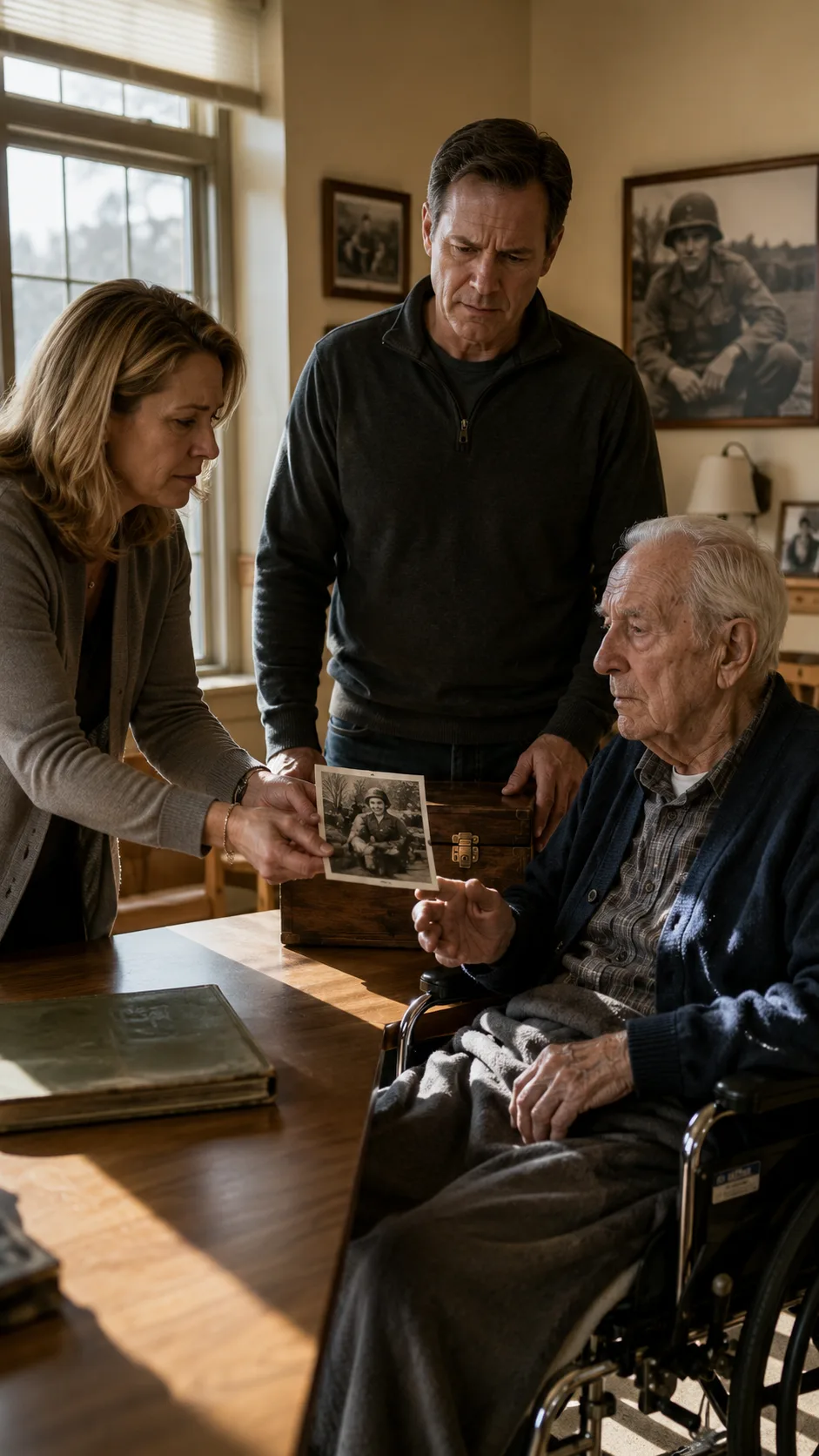
The first time my father asked about Anna, I thought he was dreaming.
Chapter 1
The first time my father asked about Anna, I thought he was dreaming.
He was sitting in a worn recliner beside the window of the small care home in Colorado Springs, staring at a patch of snow collecting on the railing outside.
“Did anyone find Anna yet?”
I looked up from my phone.
“Who?”
He blinked.
“Anna.”
Then he looked away and asked what day it was.
At the time, it felt like one more strange moment in a long series of strange moments.
My father, Robert Hayes, had spent most of his life being the kind of man who remembered everything.
Birthdays.
Addresses.
License plate numbers.
The names of neighbors who had moved away twenty years earlier.
Then dementia arrived and began stealing pieces of him one at a time.
First came forgotten appointments.
Then forgotten conversations.
Then forgotten faces.
By eighty-eight, some days he struggled to recognize his own reflection.
But somehow the name Anna survived.
It survived everything.
Weeks passed.
Then months.
The name kept returning.
Sometimes during breakfast.
Sometimes while nurses helped him walk.
Sometimes in the middle of conversations that had nothing to do with the past.
“Did Anna ever come back?”
“Has anyone heard from Anna?”
“I promised him.”
Always those three words.
I promised him.
Nobody knew what they meant.
My brother Michael thought it was probably someone Dad had known before meeting Mom.
A girlfriend.
An old friend.
Maybe a relative.
But when we searched family records, we found nothing.
No Anna.
No distant cousin.
No aunt.
No family friend.
Nothing.
The mystery should have ended there.
Instead it grew.
Because the more my father's memory faded, the more often he repeated the name.
It became impossible to ignore.
One afternoon I sat beside him while snow drifted past the windows.
His hands rested on a blanket across his knees.
Thin hands now.
The hands
that once rebuilt engines in our garage.
“Dad,” I said quietly. “Who is Anna?”
For a moment something shifted.
His eyes focused.
Not completely.
But enough.
The room seemed to disappear around him.
“She's waiting.”
“Waiting where?”
His jaw tightened.
“I was too late.”
Then the moment vanished.
He looked at me blankly.
“Have we met?”
I went home that night with a knot in my stomach.
Something about the way he had answered felt different.
Not random.
Not confusion.
Memory.
Real memory.
The next morning I called Michael.
“We need to search everything.”
He arrived that afternoon carrying coffee and three cardboard storage bins from his garage.
Dad had never thrown anything away.
The basement of his old house looked like a museum of forgotten decades.
Military uniforms.
Fishing equipment.
Boxes of photographs.
Old Christmas cards.
Stacks of faded newspapers.
For hours we searched.
Nothing.
Then Michael found the
Bible.
It was sitting inside an old cedar chest beneath several blankets.
The leather cover was cracked.
The pages smelled like dust and age.
Inside was a black-and-white photograph.
Four young soldiers stood together in front of a military truck.
They looked barely old enough to shave.
One of them was Dad.
I recognized him instantly.
The same eyes.
The same jaw.
The same stubborn expression.
Behind the soldiers stood a young woman.
Maybe twenty.
Dark hair.
Small smile.
The only civilian in the photograph.
On the back someone had written:
To Tommy. Keep your promise.
—A
Michael stared at the handwriting.
“Tommy?”
“That was Dad's nickname in Korea.”
“How do you know?”
“Mom told me once.”
We looked at each other.
The room suddenly felt smaller.
For the first time we had something real.
A photograph.
A woman.
A promise.
And a letter A.
Still, it wasn't enough.
Not yet.
Then Michael noticed something strange.
The cedar chest had a raised wooden panel at the bottom.
He tapped it.
Hollow.
We removed the panel carefully.
Beneath it sat a thin bundle wrapped in cloth.
My pulse quickened.
Inside were letters.
Dozens of them.
Most tied together with military string.
Some unopened.
Some folded so many times they seemed ready to disintegrate.
And beneath them all sat a single envelope.
No stamp.
No address.
Just one word.
Robert.
My father's name.
The handwriting wasn't his.
We opened it.
The letter was dated 1953.
Near the end of the Korean War.
The writer identified himself as Thomas Callahan.
The name meant nothing to me.
Until Michael found it again in the photograph.
One of the soldiers.
The man standing beside Dad.
The letter began simply.
If you're reading this, then I didn't make it home.
Michael stopped reading.
Neither of us spoke.
Outside the basement window, wind pushed snow across the yard.
He continued.
The words described patrols.
Mountains.
Fear.
Cold.
Friends trying to stay alive one more day.
Then the letter changed.
If I don't come back, find Anna.
She's all I have left.
Make sure she knows I kept my promise.
Dad never told us about any of this.
Not once.
Not in seventy years.
Michael kept reading.
I trust you more than anyone.
You're the only man I'd ask.
For several seconds neither of us moved.
The mystery suddenly felt larger.
Anna wasn't Dad's sister.
She wasn't his lover.
She belonged to Thomas.
The dying soldier.
But why had Dad spent his entire life hiding it?
And had he actually kept the promise?
We searched through the rest of the letters.
Some were from Thomas.
Some were from military friends.
Most talked about ordinary things.
Then we found another clue.
A receipt.
Dated 1958.
A money transfer.
Recipient: Anna Callahan.
Chicago, Illinois.
Michael looked at me.
“Dad found her.”
Apparently he had.
And that changed everything.
Because the transfers didn't stop.
There were more.
Small amounts.
Then larger ones.
Year after year.
For decades.
Our father had been quietly sending money to someone we'd never heard of.
Without telling anyone.
Including our mother.
That discovery led us into a deeper search.
And what we uncovered shocked us.
Anna had never married.
She worked as a seamstress.
Lived alone.
Raised two children.
Neither child was biologically hers.
They were adopted after their parents died in a car accident.
There were dozens of records.
Enough to piece together a life.
But one question remained.
Why had Dad hidden all of it?
The answer arrived unexpectedly.
Three weeks later.
Dad's condition worsened.
The care home called.
“Your father is asking for you.”
When I arrived, he was sitting upright in bed.
Alert.
More alert than I'd seen in months.
Michael stood beside me.
Dad looked from one of us to the other.
Then he whispered:
“You found her.”
It wasn't a question.
We froze.
“Yes.”
His eyes closed briefly.
The relief on his face appeared almost physical.
Then he held out his hand.
I took it.
His grip remained surprisingly strong.
“She waited.”
“For Thomas?”
He nodded.
“He asked me.”
The words came slowly.
Broken pieces.
But they came.
For the next hour, fragments of the story emerged.
A battle.
A mountainside.
Heavy snow.
Thomas badly wounded.
The realization he wouldn't survive.
A photograph handed to Dad.
A promise demanded.
Find Anna.
Tell her I tried to come home.
Tell her I never stopped thinking about her.
Dad had agreed.
Then Thomas died before sunrise.
My father carried that promise across an ocean.
Back to America.
And spent years searching.
No internet.
No databases.
No shortcuts.
Just letters.
Phone calls.
Train tickets.
Dead ends.
Persistence.
Eventually he found her.
Chicago.
A small apartment.
A woman who had spent years waiting for news.
Dad told her everything.
Every detail he could remember.
Anna cried.
Then thanked him.
That should have been the end.
It wasn't.
Because Thomas had left something else.
A second promise.
One Dad had never mentioned.
“She needed help,” he whispered.
“After Thomas?”
Dad nodded.
“No family.”
So he helped.
At first with money.
Then with practical things.
Recommendations.
Jobs.
Contacts.
Anything he could do.
For decades.
Not because he loved her.
Not because he owed her legally.
Because he gave his word.
And my father belonged to a generation that treated promises differently.
They carried them.
Even when nobody was watching.
Even when nobody knew.
Even when keeping them cost something.
The next morning we returned with the photograph.
Dad sat beside the window.
Snowflakes drifted outside.
The same chair.
The same blanket.
The same room.
Michael placed the photograph on the table.
I opened the old letter from Thomas.
Dad's eyes locked onto the image.
Slowly his trembling finger rose.
Then pointed directly at Anna.
Not Thomas.
Not himself.
Anna.
Michael unfolded the final page.
The paper crackled.
Then he read aloud.
If I don't come home, don't just tell her goodbye. Make sure she never stands alone.
The room fell silent.
For the first time, the mystery ended.
Everything made sense.
The name.
The money.
The letters.
The secrecy.
The decades.
My father hadn't been haunted by a forgotten relative.
He had been carrying a promise.
One made beside a dying friend.
One he had never allowed himself to break.
Dad nodded once.
A tiny movement.
Then leaned back into his chair.
His eyes never left the photograph.
Three days later, he passed away peacefully in his sleep.
After the funeral, Michael and I made a decision.
We drove to Illinois.
Neither of us knew what we would find.
The address from the records still existed.
A modest brick house.
A small garden.
Wind chimes hanging from the porch.
The woman who answered wasn't Anna.
It was her adopted daughter.
Anna had died two years earlier.
For a moment, I thought we were too late.
Then the woman invited us inside.
When she learned our father's name, her eyes widened.
“You're Robert's children?”
I nodded.
She disappeared into another room.
When she returned, she carried a worn wooden box.
Inside were photographs.
Letters.
Cards.
Receipts.
Every piece of correspondence Dad had ever sent.
Carefully preserved.
Protected.
Remembered.
At the bottom sat a photograph.
Anna and Dad.
Standing together in front of a diner in 1962.
Friends.
Nothing more.
Two people connected by a promise neither wanted to forget.
The daughter handed me one final envelope.
Anna had written it before her death.
It was addressed:
To Robert's family.
My hands shook as I opened it.
The letter was short.
Your father kept every promise he ever made.
Most people remember heroes for what they did during war.
I remember him for what he did after it.
He gave a dying man peace.
Then spent the rest of his life making sure that peace was deserved.
Thank you for sharing him with the world.
Love,
Anna
I folded the letter carefully.
Nobody spoke.
Outside, the wind chimes moved softly above the porch.
Months later, I returned to the care home one last time.
The room had been repainted.
The chair was gone.
New residents occupied the space.
But the window remained.
Snow was beginning to fall again.
I stood there for a long time.
Then I took the photograph from my coat pocket.
The same photograph.
The one that started everything.
The one my father had carried for seventy years.
The one that survived when so many memories didn't.
I looked at Thomas.
Then Anna.
Then my father.
Three lives tied together by a promise made on a frozen battlefield.
A promise stronger than memory itself.
Outside, the snow continued falling.
And for the first time, the name Anna felt like part of our family.
Chapter complete
You have reached the end of this chapter.
Continue reading
A few more worlds to get lost in after this chapter.




