My Father Humiliated My Adopted Son At His Birthday Dinner, Forgetting Every Family Bill Was Paid By Me
Noah asked me three times if his hair looked weird before we even stepped inside the restaurant.
Chapter 1
Noah asked me three times if his hair looked weird before we even stepped inside the restaurant.
The first time was in the car, while we were stopped at a red light and he was leaning toward the mirror on the passenger-side sun visor, trying to flatten the stubborn little piece sticking up at the back of his head.
The second time was in the parking lot, after he climbed out of his booster seat and smoothed both hands down the front of his blue striped button-up shirt. One side was already untucked. I had tucked it in twice at home. Noah moved through the world like his clothes were always trying to escape him.
The third time was right outside the glass doors of Bellavista, the kind of restaurant where the host wore a suit better than most men wore at weddings and where the menu did not put dollar signs beside the prices.
“Mom,” Noah said, pulling lightly on my hand. “Is it still sticking
up?”
I looked down at him.
He was seven years old, small for his age, all elbows and careful eyes, holding a little cardboard box of crayons under one arm because he had decided fancy dinners needed backup plans. His shirt collar sat crooked. His hair still had that one piece standing up. His shoes were polished because he had polished them himself with a damp paper towel and too much determination.
“You look perfect,” I said.
He narrowed his eyes. “Perfect like normal perfect or perfect like you’re my mom so you have to say it?”
I bent down and fixed his collar. “Perfect like a CEO.”
His face opened into a grin so wide that, for one second, I let myself believe the night might go well.
That was my mistake.
My father’s sixty-second birthday dinner was supposed to be simple. A private room. A cake. Family photos.
My mother had called it “important for everyone to be together,” which was how she said, Please do not fight with your father tonight.
I had promised her I would behave.
I had not promised I would let my son be hurt.
Still, as Noah and I walked through the doors, I carried a small, foolish hope with me. Maybe tonight would be different. Maybe my father would look at Noah and see what I saw: a little boy who had already survived more goodbyes than most adults, a child who still flinched when voices rose too quickly, a child who asked permission before taking the last roll from a basket because some part of him still believed food could be temporary.
Noah had been legally mine for two years.
Mine in every way that mattered.
The judge had signed the adoption papers on a rainy Thursday morning. Noah had
worn a bow tie that kept sliding sideways. When the judge asked if he understood what was happening, he had looked at me before answering.
“I get to stay,” he said.
That was all.
Not, I get a mom.
Not, I get a family.
Just, I get to stay.
I had cried in the courthouse bathroom afterward with my hand pressed over my mouth so he would not hear me. He had spent too long learning that happiness could make adults uncomfortable. I wanted him to have one day that belonged only to him.
My family had attended the adoption lunch afterward. My mother brought flowers. My sister Jenna took photos. My father shook my hand instead of hugging me and said, “Well, you always were determined once you made your mind up.”
Then he looked at Noah and added, “Welcome aboard, kid.”
Kid.
Not grandson.
Not family.
Just kid.
I told myself it would take time.
People used that phrase like it was medicine. Give him time. Give them time. Give the family time to adjust. So I gave time. I gave months. Then years. I gave smiles when my father introduced Noah as “Diana’s boy.” I gave polite silence when Christmas gifts were different. Mia and Tyler, my sister’s children, received expensive toys wrapped in thick paper with ribbon. Noah received a twenty-five-dollar gift card in an envelope with no name written on it.
He still said thank you.
He always said thank you.
At Easter, when we posed for family photos in my parents’ backyard, my mother sent Noah inside to fetch napkins. By the time he came back, the photos were done. Jenna said we could take another, but nobody moved back into place.
Noah stood beside me with a stack of napkins in both hands.
“It’s okay,” he said.
That became the sentence I hated most.
It’s okay.
He said it when Tyler got the bigger slice of cake. He said it when my father forgot his birthday but remembered Mia’s piano recital. He said it when someone asked whether I wanted “children of my own someday,” while Noah sat three feet away drawing dinosaurs on a paper placemat.
It’s okay.
Every time, I told myself I was keeping peace.
Peace is expensive.
I was about to learn exactly how expensive it had been.
The hostess led us down a narrow hallway toward the private dining room. The carpet was deep burgundy, soft underfoot. Framed black-and-white photographs of Italy lined the walls. Somewhere behind the kitchen doors, plates clattered, and garlic butter scented the air.
Noah swung our joined hands once.
“Do you think Grandpa will like the card?” he asked.
I looked at the envelope tucked carefully under his arm, right beside the crayons. He had made the card himself. On the front, he had drawn my father wearing a birthday hat while standing beside a giant chocolate cake. Inside, in careful block letters, he had written:
Happy Birthday Grandpa Richard. I hope your wish comes true. From Noah.
He had asked whether to write Grandpa or Mr. Walker.
The question had cut through me so quickly I had to turn away before answering.
“Write Grandpa,” I had told him. “That’s what he is.”
Now, standing outside the restaurant room, I hoped the world would be kind enough to let that be true.
The hostess opened the door.
Warm light spilled out first, followed by laughter.
My family was already there.
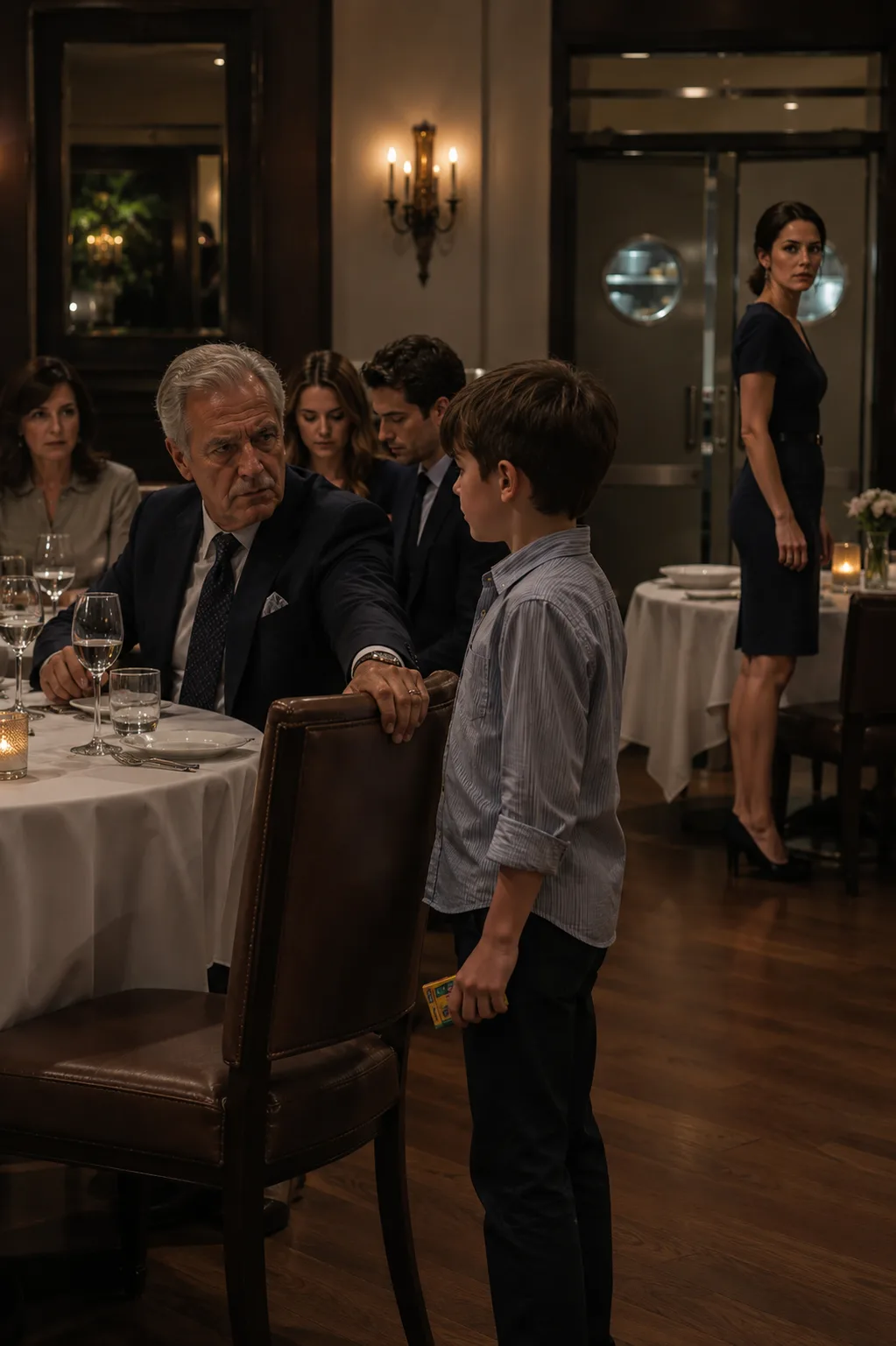
My father sat at the head of the table in a navy blazer and a pale blue shirt, his silver hair combed back, his watch shining under the chandelier. He looked like a man who believed every room naturally arranged itself around him.
My mother sat to his right, pearls at her throat, one hand resting on a folded napkin. Jenna sat beside her husband Brandon, adjusting the bow in Mia’s hair. Tyler sat across from them, already tearing the paper sleeve off a pack of crayons from the restaurant. Candles flickered along the center of the table. A chocolate cake waited on a side table with gold candles shaped like numbers.
It should have looked beautiful.
And it did.
That was part of the cruelty.
Beautiful rooms can hold ugly things.
Noah saw Tyler and brightened.
“Tyler has crayons,” he whispered.
“Go say hi,” I said.
He looked up at me for permission, the way he always did before entering joy. Then he walked toward the main table, clutching his card and crayons, his shoes making tiny squeaks on the polished floor.
I noticed the smaller table a second too late.
It stood near the kitchen doors, slightly apart from the main table. Two place settings. Two water glasses. Two folded napkins. Close enough to see everyone. Far enough to understand the message.
My stomach tightened.
Maybe it was for extra dishes.
Maybe it was for serving plates.
Maybe.
Noah reached the empty chair beside Tyler and pulled it out.
The chair moved six inches.
Then my father’s hand came down on the back of it.
Not hard.
Not loud.
Just certain.
The chair stopped.
Noah looked up.
My father smiled.
“Whoa there, sport.”
The room quieted, but not fully. Not at first. Jenna’s laugh faded halfway through. Brandon’s thumb paused over his phone. My mother looked down at her menu, even though it was still closed.
Noah stood with one hand on the chair.
My father kept his hand where it was.
“This table is for adults and real grandkids,” he said. “You understand, right?”
Something left the room.
Not sound exactly.
Permission.
Noah did not cry.
That was worse.
If he had cried, maybe someone would have remembered he was seven. If he had thrown the crayons, if he had shouted, if he had asked what real meant, then the adults at that table would have been forced to look directly at what my father had done.
But Noah knew better than to make adults uncomfortable.
His shoulders pulled in. His fingers tightened around the little cardboard crayon box until one corner bent. He looked at the chair, then Tyler, then my mother, then Jenna, then my father’s hand still blocking the seat.
Finally, he looked at me.
There are looks children should never have to give their mothers.
That one asked me whether the world had just confirmed his oldest fear.
Am I temporary?
Am I less?
Am I only yours, and not theirs?
I stood near the doorway with my purse still on my shoulder. For one frozen second, I saw every small injury I had tried to rename.
Not exclusion.
Adjustment.
Not cruelty.
Awkwardness.
Not rejection.
Time.
I saw Noah standing in the kitchen during the family photo. I saw the blank gift envelope at Christmas. I saw my father’s mouth forming “Diana’s boy” at the country club barbecue. I saw my mother gently removing Noah’s hand from the dessert tray and saying, “Let the grandchildren go first,” then pretending she meant all the children.
My father finally looked at me.
“Diana,” he said, lightly, as if he had just corrected a seating error. “You’re here. Sit down.”
He gestured to the empty chair beside him.
The chair at the family table.
The chair for his daughter.
Not for my son.
I looked at the small table near the kitchen doors. Then I looked at Noah.
His face was still. Too still. His mouth was closed tightly, his chin lifted just enough to hold himself together.
I walked forward.
Jenna straightened. “Diana?”
I passed the main table.
My father’s eyebrows drew together.
I reached the small table, pulled out one chair, and sat down.
The legs scraped across the floor with a sharp, ugly sound. It cut through the silence better than anything I could have said.
Brandon looked up from his phone.
My mother lowered her menu.
Noah still had not moved.
I put my purse on the chair beside me and unfolded my napkin. Then I looked at my son and patted the chair across from me.
“Come here, sweetheart.”
He blinked once.
Then he walked to me.
Slowly.
Every step across that private dining room became its own accusation. His shoes squeaked. The crayon box hung at his side. His birthday card for my father remained tucked under his arm.
No one spoke.
Not my mother.
Not Jenna.
Not Brandon.
Not my father.
Noah sat across from me at the small table and placed the card beside his plate. He smoothed his napkin across his lap with both hands, the way I had taught him.
When you do not know what to do, begin with the small thing in front of you.
My father set his glass down harder than necessary.
“Don’t be ridiculous,” he said. “It’s my birthday. Come sit at the table.”
I picked up my menu.
“I am sitting at the table you chose for my family.”
A muscle moved in his jaw.
“I set that up so the kids could be comfortable.”
“There are two place settings.”
“That’s because you always hover over him.”
I looked over the top of the menu. “I protect him.”
Jenna leaned forward. “Diana, please don’t start.”
I turned to her.
She looked away first.
That told me enough.
The server entered with the bright smile of someone who had not yet learned she had walked into a battlefield.
“Good evening, everyone. Can I start you off with drinks?”
My father recovered instantly. That was one of his talents. In public, he could put a clean cloth over a broken table and expect everyone to dine on it.
“We’ll have the Barolo,” he said. “And sparkling water for the table.”
The table.
Not our table.
The table.
Jenna ordered a cocktail. Brandon ordered bourbon. My mother said white wine. The children at the main table ordered lemonade.
When the server turned to me, I said, “Water for both of us, please.”
Noah looked down at his folded hands.
The server hesitated, then nodded.
“Of course.”
Dinner began.
Or rather, the performance began.
At the main table, my father told a story about golf. Jenna laughed too loudly. Brandon nodded at the wrong moments. My mother asked Mia about dance practice in a voice so gentle it felt like an apology meant for someone else.
Ten feet away, Noah and I sat beside the kitchen doors while servers came and went behind us carrying plates that smelled of basil, butter, and roasted garlic.
Noah cut his chicken into tiny pieces.
One row. Then another.
He did not eat them.
“Buddy,” I said, keeping my voice low. “You don’t have to make them perfect.”
“I know.”
He kept cutting.
The knife was too dull to cut well. The breading tore instead. He pressed harder.
At the main table, my father laughed at something Tyler said. A real laugh. Full and warm. The kind Noah had never received from him.
Noah looked at the sound.
Then back at his plate.
“Mom?”
“Yeah.”
“Why doesn’t Grandpa like me?”
I set down my fork.
The question did not come with tears. It came like a fact he was trying to organize. That hurt more than panic would have.
I looked at him, at the little boy who had once hidden crackers under his pillow because foster homes did not always feel permanent, at the little boy who still asked whether he could keep clothes that were already in his dresser, at the little boy who had spent the entire afternoon making a birthday card for a man who had just ranked him publicly below blood.
“Grandpa has things he needs to fix inside himself,” I said. “That does not mean anything is wrong with you.”
“But he said real grandkids.”
“He was wrong.”
Noah’s eyes moved toward the main table.
“They didn’t say he was wrong.”
I had no answer that would not expose the whole room.
So I gave him the truest thing I had.
“Sometimes adults stay quiet because telling the truth would cost them something.”
Noah absorbed that with the grave seriousness of a child learning another rule.
“What does it cost?”
I reached across the table and covered his hand with mine.
“Comfort.”
He looked at our hands.
“Are we uncomfortable?”
I smiled without feeling it.
“Not as much as they should be.”
Dessert came after an hour of sharpened silence.
The restaurant staff dimmed the lights. The cake was carried in with gold candles burning on top. Everyone at the main table sang. My mother clapped lightly. Jenna recorded on her phone. Tyler sang too loudly and Mia corrected the rhythm. Brandon raised his glass.
Noah watched.
“Should I sing?” he asked.
“If you want to.”
He sang under his breath.
Happy birthday to you.
His voice barely crossed the little table between us.
My father closed his eyes and blew out the candles while everyone applauded.
Then came the cake slices. The main table received thick pieces on decorated plates with chocolate drizzle. A server brought two smaller slices to our table a few minutes later. Plain plates. No drizzle. No birthday candle crumbs. Just cake.
Noah looked at his slice.
He picked up his fork.
Then he put it down.
“What’s wrong?” I asked.
He slid the birthday card toward me.
“I don’t think I should give it to him.”
I looked at the envelope.
Grandpa Richard.
The letters were uneven, each one pressed too hard into the paper because Noah wrote carefully when something mattered.
“You don’t have to,” I said.
“He won’t want it.”
I looked at my father, who was smiling for Jenna’s camera with Tyler on one side and Mia on the other.
“No,” I said. “He doesn’t get to decide what your kindness is worth.”
Noah looked at me.
“Can I keep it?”
“Yes.”
He pulled the card back and tucked it beside his crayons.
Then the check arrived.
A black leather folder placed beside my father’s plate.
I watched him open it.
His eyes moved to the total. He did not flinch. He never flinched when he expected someone else to absorb the impact.
He closed the folder and slid it down the table toward me.
A smooth motion.
Practiced.
Not a request.
A command dressed as habit.
The folder came to rest at the edge of my place setting.
For a moment, I simply looked at it.
Inside that folder was not just dinner.
It was every country club payment my father had claimed was a temporary issue with his bank account.
It was Mia’s dance academy tuition, which Jenna had said she would “pay back next Friday” in March, then April, then never.
It was Tyler’s soccer fee.
It was the family phone plan I still paid for because my mother said switching accounts would be “too confusing.”
It was the birthday gifts I purchased and signed from all of us.
It was the graduation checks, the anniversary flowers, the emergency transfers, the quiet little rescues that had become so normal no one had to thank me anymore.
It was years of buying peace at the cost of my son’s dignity.
I opened my purse.
My father leaned back, satisfied.
I removed my wallet.
Jenna relaxed.
My mother looked down.
I counted cash.
Not enough for the bill.
Enough for two meals, two waters, two slices of cake, tax, and a generous tip.
I placed the bills inside the folder and closed it.
Then I stood.
“Noah,” I said. “We’re leaving.”
He looked at his cake, then at me.
“Okay.”
He gathered his crayons and the birthday card. He did not ask to say goodbye.
That told me everything.
I walked to the main table and placed the folder in front of my father.
“There’s cash for Noah and me,” I said. “The rest is yours.”
My father stared at me.
Then he opened the folder.
For the first time that night, his face changed completely.
“What is this?”
“Separate bills.”
Jenna sat forward. “Diana, don’t.”
I looked at my father.
“You wanted separate tables,” I said. “You got separate bills.”
The words landed harder than I expected.
Mia’s fork paused halfway to her mouth.
Brandon set down his glass.
My mother whispered, “Diana, please.”
My father’s face turned red from his collar upward.
“It’s my birthday.”
“I know.”
“You are embarrassing me.”
I looked at Noah.
His hand held mine now. The card for my father was pressed against his chest.
“No,” I said. “You embarrassed yourself when you told my son he was not real family.”
My father pushed his chair back.
The sound cracked through the room.
“Sit down.”
I turned fully toward him.
For most of my childhood, that tone had worked. It could stop me in hallways, freeze me at dinner tables, turn my opinions into swallowed stones. Richard Walker did not need to yell often. He had built a house where everyone learned the weather from his jaw.
But I was not sixteen anymore.
And Noah was watching.
“I’m thirty-two,” I said. “You don’t command me.”
Jenna’s face went pale.
“Diana,” she hissed. “You’re making this worse.”
“No,” I said. “I’m making it honest.”
My father pointed toward Noah.
“That boy has made you impossible.”
The room went still.
Even Jenna stopped moving.
Noah’s fingers tightened around mine.
I stepped closer to my father.
“That boy,” I said, “is my son.”
My father looked around the table, as if searching for an ally. My mother lowered her eyes. Brandon suddenly found his napkin interesting. Jenna pressed her lips together.
No one rescued him.
He was not used to that.
“You’ll regret this,” he said.
I nodded once.
“Not tonight.”
Then I turned and walked out with Noah.
The hostess opened the door for us. Her eyes flicked to Noah, then to me, and her face softened in a way that almost broke me.
Cold air hit us outside.
In the parking lot, Noah climbed into the car without speaking. I buckled him in, though he could do it himself. He let me.
When I started the engine, my phone began buzzing.
First Jenna.
Then my mother.
Then my father.
Then Jenna again.
Noah looked at the screen.
“Are they mad?”
“Yes.”
“Because of me?”
I put the car in reverse, then stopped.
“No.”
He looked out the window.
“They’re mad because I stopped pretending what they did was okay.”
He turned back. “Are we in trouble?”
I almost laughed. It came out too sharp and too sad.
“No, sweetheart. We are not in trouble.”
“But Grandpa said you’ll regret it.”
I pulled out of the parking space.
“Grandpa says many things when people stop obeying him.”
Noah was quiet until we reached the highway.
Then he said, “Thanks for sitting with me.”
I kept both hands on the wheel.
The road blurred for one second.
“Always,” I said.
He held the birthday card in his lap all the way home.
That night, after Noah fell asleep, I sat at the kitchen table with my laptop open.
My phone continued to pulse beside me.
Jenna: You ruined Dad’s birthday.
Mother: Please call me. This has gone too far.
Brandon: The bill thing was unnecessary.
Father: You made a scene like a spoiled child.
Father: After everything I did for you.
Father: You will fix this.
I opened my banking app.
Country Club Walker — autopay active.
Elite Dance Academy — autopay active.
Tyler Youth Soccer — autopay active.
Walker Family Wireless — autopay active.
Monthly transfer to Mom — scheduled.
I stared at the list.
Each line had once felt small.
Manageable.
A kindness.
A favor.
A way to make life easier.
Together, they formed a cage I had built around myself and called family responsibility.
My finger hovered over the first cancel button.
I did not press it.
Not yet.
I wanted my father to feel the restaurant bill first.
Tomorrow, I would let the rest fall.
Sunday morning, he arrived while I was making pancakes.
Not knocking.
Pounding.
Noah sat at the kitchen table in dinosaur pajamas, coloring a T-Rex purple. He looked up at the first hit against the door.
His shoulders tightened.
“Is that Grandpa?”
“Probably.”
Another pound.
“Diana!” my father barked from the hallway. “Open the door.”
Noah looked at me.
I flipped a pancake.
“Eat first.”
The pounding continued.
“Shouldn’t we open it?”
“No.”
“Will he get madder?”
“Probably.”
Noah looked at his plate, then picked up his fork.
We ate pancakes while my father wore out his knuckles against my door.
After I rinsed the plates and wiped syrup from Noah’s sleeve, I opened the door.
My father stood there red-faced in a golf polo tucked too tightly into khaki pants. He held his car keys in one fist like they were evidence.
He stepped forward.
I blocked the doorway.
That surprised him.
“What are you doing?” he snapped.
“You don’t enter unless I invite you.”
For a second, he looked genuinely confused, as if doors had never applied to him before.
Then he laughed.
“Don’t start this nonsense.”
“Goodbye, Dad.”
I began to close the door.
His hand shot out and caught it.
“Fine,” he said. “May I come in?”
The words tasted bad in his mouth. I could see it.
I opened the door wider.
He walked in, looked around my apartment as if assessing whether anything in it had come from him, and found nothing to claim.
“What the hell was last night?”
Noah slipped quietly from the table and disappeared into his room.
I waited until I heard his door close.
Then I opened my laptop on the kitchen counter and turned the screen toward my father.
“What is this?” he demanded.
“Six months of payments.”
He leaned closer.
His expression changed by degrees.
Country club dues.
Dance fees.
Soccer fees.
Phone plan.
Transfers.
Dinner charges.
Emergency payments.
The total at the bottom sat highlighted in yellow.
$8,940.
Not counting last night.
My father stared at it.
Then he straightened.
“You were keeping records?”
“Yes.”
“Of family?”
“Of money leaving my account.”
His face hardened. “That’s ugly, Diana.”
“No,” I said. “Ugly is using my money while telling my son he isn’t family.”
He looked away first.
Only for a second.
“I didn’t know you were paying all that.”
“You knew enough not to ask who was.”
“Your mother handles some things.”
“Mom doesn’t have my banking password.”
He rubbed the back of his neck.
That was new.
My father rarely showed discomfort unless he could weaponize it.
“You don’t understand what retirement does,” he said. “A man spends his whole life building something, and suddenly everyone looks past him.”
“And so you made a seven-year-old feel small?”
His hand dropped.
“I didn’t mean it that way.”
“How exactly did you mean ‘real grandkids’?”
Silence.
A truck passed outside my building. Somewhere down the hall, a neighbor’s dog barked.
My father’s eyes moved toward Noah’s closed bedroom door.
“He’s not blood.”
There it was.
Not shouted.
Not dressed up.
Just placed on the counter between us like an unpaid bill.
I nodded slowly.
“Then neither is my money.”
His eyes snapped back to me.
I clicked the first cancel button.
Country Club Walker — autopay canceled.
“Diana.”
I clicked the second.
Elite Dance Academy — autopay canceled.
“Stop.”
I clicked the third.
Tyler Youth Soccer — autopay canceled.
“You’re punishing children now?”
I looked at him.
“No. I’m returning their expenses to their parents.”
I clicked the fourth.
Walker Family Wireless — autopay canceled.
My father’s mouth opened, then closed.
For once, he had no clean sentence ready.
I closed the laptop.
“You need to leave.”
“This is not over.”
“It is for today.”
He walked toward the door, then turned.
“You think that boy will thank you when he grows up without a family?”
I opened the door.
“He already has one.”
He left.
I locked the door behind him.
Noah’s bedroom door opened a crack.
“Mom?”
“Yes?”
“Are we still going to the park?”
I rested my forehead briefly against the door, then turned around.
“Absolutely.”
At Riverside Park, Noah ran toward the jungle gym like he needed to prove the world still held ordinary things.
I sat on a bench and watched him climb.
My phone rang.
Unknown number.
I almost ignored it.
Then something made me answer.
“Diana? It’s Uncle Mike.”
My father’s younger brother. The one relative who never made Noah feel like an extra place setting.
“Hi, Uncle Mike.”
He sighed.
“I heard there was trouble last night.”
“Jenna’s version or the truth?”
“That bad?”
“Worse.”
I told him.
The small table.
The chair.
Real grandkids.
The bill.
The silence.
Uncle Mike did not interrupt.
When I finished, he exhaled slowly.
“Kids don’t get ranked.”
The sentence hit me harder than comfort should.
“No,” I said. “They don’t.”
There was a pause.
“Your dad borrowed three thousand from me in July,” he said. “Said it was temporary. Hasn’t paid it back.”
July.
The same month my father told me his bank had frozen his card and asked me to cover the country club dues.
My stomach tightened.
“Did Mom know?”
“I don’t know. Janet thinks she does.”
Noah ran over then, breathless, cheeks flushed.
“Can we get ice cream?”
I covered the phone. “Yes.”
Uncle Mike heard him.
“Tell Noah we have apple pie at Thanksgiving,” he said. “If you two want somewhere to go.”
I swallowed.
“We do.”
“Good. No small tables at my house.”
The following week, the consequences began arriving like late fees.
Jenna found me at the grocery store on Wednesday evening, near the yogurt section. She wore designer sunglasses on top of her head and yoga clothes too expensive to sweat in.
“The dance academy called me,” she said without greeting. “Mia’s payment declined.”
I placed strawberries in my cart.
“Yes.”
Her mouth tightened.
“What do you mean yes?”
“I canceled the autopay.”
“You can’t just cancel it.”
“I can. I did.”
“She has a recital in three weeks.”
“Then pay them.”
Jenna glanced around, lowering her voice.
“You know Brandon’s hours were cut.”
“I know you bought a new handbag last month.”
Her face flushed.
“That’s none of your business.”
“My bank account was your business until last Saturday.”
Noah stood beside the cart holding a box of cereal. His eyes moved between us.
Jenna noticed him and softened her voice in the fake way adults do when they want children to believe the room is safer than it is.
“Noah, sweetheart, can you go look at cookies for a second?”
“No,” I said.
Jenna stared at me.
“He can stay.”
“This is adult conversation.”
“Funny,” I said. “He was old enough to be humiliated in front of adults.”
She took a step closer.
“Dad didn’t mean it.”
“Then what did he mean?”
Jenna’s lips parted.
Nothing came.
I waited.
The yogurt refrigerators hummed behind us.
Noah held the cereal box against his chest.
Finally, Jenna said, “He’s from a different generation.”
I laughed once.
It startled even me.
“He knows how to use Venmo when he wants money.”
Jenna’s face hardened.
“You’re going to tear this family apart.”
“No,” I said. “I stopped paying to keep it stitched together.”
At home that night, while Noah ate grilled cheese at the kitchen table, I opened the website for an elite soccer camp he had stopped asking about.
He had mentioned it every week for two months. Then, after I said “maybe” too many times, he let it disappear.
I understood now that he thought wanting things was risky.
I filled out the form.
Name: Noah Walker.
Age: 7.
Preferred number: 12.
Skill level: intermediate.
Parent contact: Diana Walker.
The price appeared at checkout.
It was almost exactly two months of my father’s country club dues.
I entered my card.
Submitted.
Noah looked up.
“What’s that?”
“You’re going to soccer camp.”
His sandwich slipped from his hand onto the plate.
“The good one?”
“The good one.”
He ran to me so fast the chair tipped backward.
I caught him before the chair hit the floor.
He wrapped both arms around my waist.
For a long time, he said nothing.
Then, into my shirt, he whispered, “I wanted it so bad.”
I held the back of his head.
“I know.”
“I didn’t want to ask again.”
“I know.”
The tipped chair lay on the floor beside us.
Neither of us picked it up right away.
Two days later, my mother came to my office.
Reception called me downstairs with a careful voice.
“There’s a woman here who says she’s your mother.”
My mother sat in the lobby holding her purse with both hands. Without my father beside her, she looked older. Smaller. The pearls were gone. She wore a gray cardigan and shoes meant for comfort.
“Diana,” she said.
“You have ten minutes.”
We went to the café across the street.
She stirred her coffee though she had not added sugar.
“Your father is struggling.”
“I know.”
Her hand stopped.
“You know?”
“Uncle Mike called.”
Her face gave her away.
“You knew about the debt,” I said.
She looked toward the window.
“I knew some.”
“How much is some?”
“Enough.”
“And you still let me pay.”
Her eyes closed briefly.
“I didn’t know how to stop it.”
“You could have told me.”
“He was ashamed.”
I sat back.
“Noah was ashamed at that table. He’s seven. Did that matter less?”
My mother’s mouth trembled.
“He told me it was a misunderstanding.”
“You were there.”
She looked down.
That was the truth she could not move around.
“You sat there,” I said. “He blocked the chair. He said real grandkids. You heard it.”
“I didn’t want to make a scene.”
“You made one by staying quiet.”
A tear slipped down her cheek.
I did not hand her a napkin.
She found one herself.
“What can I do?” she asked.
I looked at the woman who had taught me to smooth tablecloths after arguments, to lower my voice when men raised theirs, to call silence grace when it was really fear.
“Tell the truth,” I said.
“To who?”
“To Dad. To Jenna. To Noah. To yourself first.”
She nodded, but it was small. Uncertain.
“And if Noah doesn’t want to see me?”
“Then you wait.”
“For how long?”
“As long as he needs.”
Her fingers tightened around the napkin.
“That could be years.”
“Yes.”
She looked at me then, and for the first time I saw her understand that forgiveness was not a family heirloom passed down on command.
At school the next week, Noah brought home a family tree project.
He handed it to me without comment and went to wash his hands.
I opened the folder at the kitchen table.
Construction paper.
Crayon lines.
At the center stood two figures: one tall, one small. Me and Noah. He had drawn my dark dress and his striped shirt. Above us, he had drawn a sun. Beside us, a purple dinosaur.
No grandparents.
No aunt.
No cousins.
No great-uncle Mike either, but that did not hurt in the same way. This was not a complete family record. This was a map of safety.
When he came back, I asked gently, “No grandparents?”
He dried his hands on his shirt, missing the towel completely.
“Teacher said draw your family.”
I waited.
He shrugged.
“Grandpa said I’m not real.”
I set the paper down.
“And Grandma?”
“She didn’t say I was.”
Simple.
Logical.
Devastating.
I signed the form attached to the folder.
That night, I took a photo of the family tree and sent it to my mother.
No message.
Just the picture.
She did not reply for three hours.
Then she sent one sentence.
I am sorry I made him erase me.
I read it twice.
Then I put the phone down.
Thanksgiving came cold and bright.
Noah and I drove to Uncle Mike and Aunt Janet’s house with an apple pie on the back seat. Noah had drawn a small turkey on the pie box because Janet said homemade things tasted better with art.
Their house was loud before we reached the door.
Children shouting.
A dog barking.
Someone inside yelling that the rolls were burning.
Noah paused on the porch.
“What if it’s weird?”
I adjusted the pie box in his hands.
“Then we leave.”
“Really?”
“Really.”
The door flew open.
Aunt Janet appeared wearing an apron dusted with flour.
“There he is,” she said. “My apple pie consultant.”
Noah blinked.
“Me?”
“Yes, you. I need an expert.”
She took the pie from his hands and kissed the top of his head without making a ceremony of it.
He looked at me.
I smiled.
He stepped inside.
There were no assigned seats. No polished silence. No table meant to prove anything. One chair had a wobbly leg and made a clunk every time someone leaned back. Uncle Mike burned the rolls. Janet blamed the oven. The dog stole a slice of turkey and became the most wanted criminal in the house for nine minutes.
Noah laughed so hard at dinner that cranberry sauce came out of his nose.
He was embarrassed for half a second.
Then everyone laughed with him, not at him, and he laughed again.
On the drive home, he fell asleep holding a leftover roll in a napkin.
At a red light, he opened one eye.
“Can this be Thanksgiving now?”
“Yes.”
“Every year?”
“As long as you want.”
He smiled and drifted off again.
Christmas passed without my father.
My mother mailed Noah a gift with a handwritten card. Not expensive. A science kit about volcanoes. Noah read the card twice, then set it on his desk instead of throwing it away.
That was something.
Jenna sent nothing.
Brandon texted me once asking whether I had “cooled off enough to talk.” I did not answer.
My father sent one envelope.
No return address, but I knew his handwriting.
Inside was a check.
No note.
I tore it in half.
Not because I did not need money.
Because I knew bait when it came in paper form.
In February, Noah turned eight.
We kept the party small. Soccer friends from school. Uncle Mike. Aunt Janet. Pizza boxes on the counter. Blue balloons taped crookedly to the wall because I had no talent for decorations. A chocolate cake from the grocery store because Noah liked the frosting roses even though they stained everyone’s tongue.
He wore a navy jersey with a temporary number 12 sticker on the back.
He opened gifts with the careful gratitude of a child still learning presents could be kept.
That morning, before the party, a package arrived.
Brown cardboard.
Noah Walker written across the label in handwriting I knew too well.
I opened it in the kitchen before Noah saw.
Inside was a professional-quality soccer jersey. Navy blue. Number 12 sewn on the back, not printed. His name across the shoulders.
WALKER.
There was a photograph beneath it.
My father stood in Noah’s school gym beside a folding table, holding a check. The soccer coach stood across from him. No cameras. No banner. No handshake pose. Just a blurry photo someone must have taken from across the room.
On the back, my father had written:
Donated cleats and camp fees for children who need help. I did not tell them I was your grandfather.
Beneath that was a card.
Noah,
Happy eighth birthday.
I remember when you were five and told me number 12 mattered because you would be twelve when you became a professional soccer player. I heard you then. I am sorry I stopped listening.
I do not ask you to forgive me today. I am asking permission to earn the chance someday.
Grandpa Richard.
I stood at the counter for a long time.
Noah came in rubbing his eyes.
“Is that for me?”
I handed him the jersey.
He unfolded it.
His mouth opened.
“It has my name.”
“Yes.”
“And my number.”
“Yes.”
He read the card slowly. Some words took him longer. Permission. Forgive. Professional.
Then he looked at the photograph.
“Grandpa was at my school?”
“Yes.”
“Why didn’t he say hi?”
I sat beside him.
“Maybe he knew he had not earned that yet.”
Noah traced the stitched letters of his name.
“Do you think he’s sorry?”
“I think he’s trying to act sorry.”
“What’s the difference?”
I looked at him.
“Words are easy. Actions take longer.”
He nodded, considering that like a coach had given him a strategy.
“Do I have to see him?”
“No.”
“If I want to?”
“Then I’ll be there.”
“If he says something bad?”
“We leave.”
“If I want to leave even if he doesn’t?”
“We leave.”
That seemed to matter most.
He put the jersey on over his pajamas and wore it through the entire birthday party.
Three days later, I unblocked my father’s number.
I did not call.
I did not text.
I simply removed the wall and waited to see whether he would knock or break through.
He called that evening.
I let it ring twice.
Then answered.
“Hello.”
Silence.
Then his voice.
“I wasn’t sure you’d pick up.”
“I wasn’t either.”
He breathed in.
“I was wrong.”
I sat down on the edge of my bed.
Not “you misunderstood.”
Not “I was under pressure.”
Not “you embarrassed me too.”
Just wrong.
I waited.
He continued.
“I said something cruel to a child because I felt small and wanted someone else to feel smaller.”
My hand tightened around the phone.
“You said it to my son.”
“I know.”
“He heard you.”
“I know.”
“He believed you.”
My father’s voice changed then. Not enough to become dramatic. Enough to become real.
“I know.”
I looked toward Noah’s room. His door was open. He was asleep with the soccer jersey folded on the chair beside his bed.
“What do you want?”
“A chance to apologize to him,” my father said. “Not at your apartment. Not by surprise. Not unless you say yes and he says yes. I will follow whatever rules you set.”
Rules.
My father had never liked rules he did not make.
“Rule one,” I said. “You don’t touch him unless he chooses it.”
“Yes.”
“Rule two. You do not explain yourself in a way that makes him responsible for your guilt.”
A pause.
“Yes.”
“Rule three. If he wants to leave, we leave immediately.”
“Yes.”
“Rule four. If you ever make him feel like he has to earn a place in this family again, you won’t see either of us.”
His answer came quietly.
“I understand.”
I believed him just enough to be careful.
The first meeting happened at Riverside Park.
Public.
Open.
Neutral.
No restaurant tables. No family audience. No candles, no bills, no hierarchy disguised as tradition.
My father arrived early. I saw him from the parking lot, standing beside a bench in a gray coat, both hands folded in front of him. He looked older than he had at the birthday dinner. Not weaker exactly. Less polished. Like the air had finally reached places pride used to cover.
Noah stood beside me holding a soccer ball.
“We can go home,” I said.
He shook his head.
“Just a little.”
“Just a little.”
We walked toward the bench.
My father did not step forward. Good.
He did not open his arms. Better.
He looked at Noah and said, “Thank you for agreeing to see me.”
Noah pressed the soccer ball against his stomach.
“You can talk.”
My father swallowed.
“I was cruel to you at my birthday dinner.”
Noah watched him.
“I said you were not a real grandchild. That was wrong. You are real. You were real before I said it. You are real whether I say it or not.”
Noah’s fingers moved against the ball.
My father took a folded paper from his coat pocket, then seemed to think better of it and put it away.
“I wrote things down,” he said. “But I don’t think reading makes it braver.”
Noah looked at me.
I gave nothing away.
My father continued.
“I was ashamed because I had lost money and lied about it. I let your mom carry things I should have carried. That is not your fault. None of it was your fault.”
Noah looked down at his shoes.
For a long moment, the only sound was a dog barking near the basketball courts.
Then Noah said, “I made you a birthday card.”
My father’s face shifted.
“I know.”
“No, you don’t. You didn’t open it.”
My father looked at me.
I reached into my bag and took out the card.
Noah had kept it.
He had asked me to bring it.
I handed it to him, and he handed it to my father.
My father accepted it with both hands.
He opened it.
Happy Birthday Grandpa Richard. I hope your wish comes true. From Noah.
The drawing of my father in a birthday hat looked nothing like him. Somehow, that made it worse.
My father stared at the card.
His mouth tightened. His hand trembled once.
Noah said, “I don’t know if I want you to be Grandpa.”
My father nodded.
“That is fair.”
“But maybe Richard first.”
My father looked up.
“I would be grateful for Richard.”
Noah bounced the soccer ball once.
“You can kick with us for five minutes.”
My father looked at me.
I nodded.
Five minutes became seven.
Then ten.
My father was terrible at soccer. Noah corrected his stance twice. My father listened.
Actually listened.
When we left, he did not ask for a hug.
He said, “Thank you for the time.”
Noah nodded.
In the car, he was quiet.
Then he said, “Richard is not good at soccer.”
“No.”
“He tried.”
“Yes.”
“Trying is different from fixing.”
I glanced at him in the rearview mirror.
“It is.”
He looked out the window.
“But it can be the start.”
The next weekend, Noah learned to ride his bike without training wheels.
We were at the same park. The air was cold enough to make his nose red, but he refused to stop. He wore his number 12 jersey over a hoodie. The bike was new, bought with money that used to disappear into other people’s unpaid obligations.
I ran beside him with one hand on the back of the seat.
“Don’t let go,” he said.
“I’ve got you.”
“Promise?”
“I promise I’m right here.”
He pedaled.
The bike wobbled.
His sneakers pushed harder.
“Keep looking forward,” I said.
“I am!”
He was not. He kept checking whether my hand was still there.
So I waited.
One more push.
One more.
Then, when his balance settled beneath him and his shoulders dropped from fear into focus, I let go.
He rode six feet before noticing.
Then twelve.
Then twenty.
“Mom!”
“I’m here!”
“You let go!”
“You’re doing it!”
He laughed so loudly that a woman walking a stroller turned and smiled.
Noah circled back, braked badly, and jumped off before the bike fully stopped. He ran to me, breathless, cheeks bright.
“I did it.”
“You did.”
He looked over my shoulder.
My father stood near the path.
I had invited him to watch from a distance. Noah knew. That was part of the rule.
Noah looked at him for a long time.
Then he lifted one hand.
Not a wave exactly.
Not forgiveness.
A signal.
My father lifted his hand back.
Small.
Careful.
Noah got on the bike again.
He pedaled away, the number 12 bright against his back, the wheels cutting clean lines through the pale winter sunlight.
I stood on the path and watched him ride.
Seven months earlier, my father had stopped a chair from moving and told my son where he did not belong.
Now Noah moved under his own power.
No blocked chair.
No small table.
No one deciding whether he was real enough to sit down.
My family did not become perfect.
Jenna took longer. Much longer. She sent one apology text that began with “I’m sorry you felt,” and I deleted it without answering. My mother attended therapy for the first time at sixty. Uncle Mike remained Uncle Mike, loud and steady and always ready with apple pie. My father stayed Richard to Noah for nearly a year before Noah chose something else.
Not Grandpa.
Not at first.
He chose “Grandpa Richard.”
A title with a door left open but a lock still visible.
That was enough.
As for me, I stopped paying for silence.
I paid for soccer camp.
I paid for bike helmets.
I paid for science kits, rainy-day movies, shoes Noah outgrew too quickly, and a savings account with his name on it.
I paid for the life we were building instead of the approval I had been renting.
Sometimes, late at night, I thought about that private restaurant room. The white tablecloths. The gold candles. The small table near the kitchen doors. My father’s hand on the chair. Noah’s face when he looked at me.
I used to wish I had spoken sooner.
Now I know I stood up at the exact moment Noah needed to see me choose.
Not later.
Not privately.
Not politely.
Right there.
In front of everyone.
Because children remember where you sit when the world tells them to stand aside.
And my son will never sit alone again.
THE END.
Chapter complete
You have reached the end of this chapter.
Continue reading
A few more worlds to get lost in after this chapter.




