MY FATHER CALLED ME UNGRATEFUL IN FRONT OF EVERYONE, UNTIL MOM’S FINAL WARNING DESTROYED HIS LIE
PART 3
My father stared at the letter as if it had come back from the grave to accuse him.
Chapter 2
MY FATHER CALLED ME UNGRATEFUL IN FRONT OF EVERYONE, UNTIL MOM’S FINAL WARNING DESTROYED HIS LIE
PART 3
My father stared at the letter as if it had come back from the grave to accuse him.
For once, he was not crying.
For once, his hands were not shaking on command.
For once, he looked exactly like the man my mother had tried to warn me about.
Aunt Carol whispered, “Frank, what did Linda mean?”
Dad turned on her. “Stay out of this.”
The sharpness in his voice made her flinch.
That was when the room truly changed.
Not when I showed the bank records. Not when I laid out the casino receipts. Not even when I read Mom’s warning.
It changed when everyone heard his real voice.
The one he used when the audience stopped clapping.
I looked down at the letter and read the final part.
“I am leaving the house to you, Julia, not because walls matter more than blood, but because I want you to have one place where guilt cannot evict you. Love does not mean handing someone the key to
your own destruction.”
My voice broke on the last line, but I did not cry.
I had cried enough in private.
I had cried over unpaid invoices at the flower shop. I had cried after sending Dad money I needed for rent. I had cried the night my refrigerator broke and I still paid his “emergency” bill because he said, “Your mother would have helped me.”
Now, standing in her living room, I finally understood.
Mom had not left me a house because she wanted me to own something.
She left me a boundary.
Dad pointed at the letter. “She turned you against me.”
“No,” I said. “She prepared me for you.”
His face twisted.
Mark placed the casino receipt back on the table. “You told me Julia never answered your calls.”
Dad glared at him. “I didn’t owe you every detail.”
“You borrowed eight hundred dollars from me last
winter,” Mark said. “You said your heater broke.”
Aunt Carol slowly reached into her purse.
Her hands were trembling as she pulled out an old folded paper.
“You told me you needed money for a doctor,” she whispered. “I gave you twelve hundred dollars.”
Dad looked trapped.
Then angry.
Then small.
“That was different,” he said.
I almost laughed.
Every lie had always been different.
Every debt had always been special.
Every apology had always come with another request.
Aunt Carol’s eyes filled, but her voice stayed steady. “Frank, how many of us did you use?”
He did not answer.
That was answer enough.
The room went quiet.
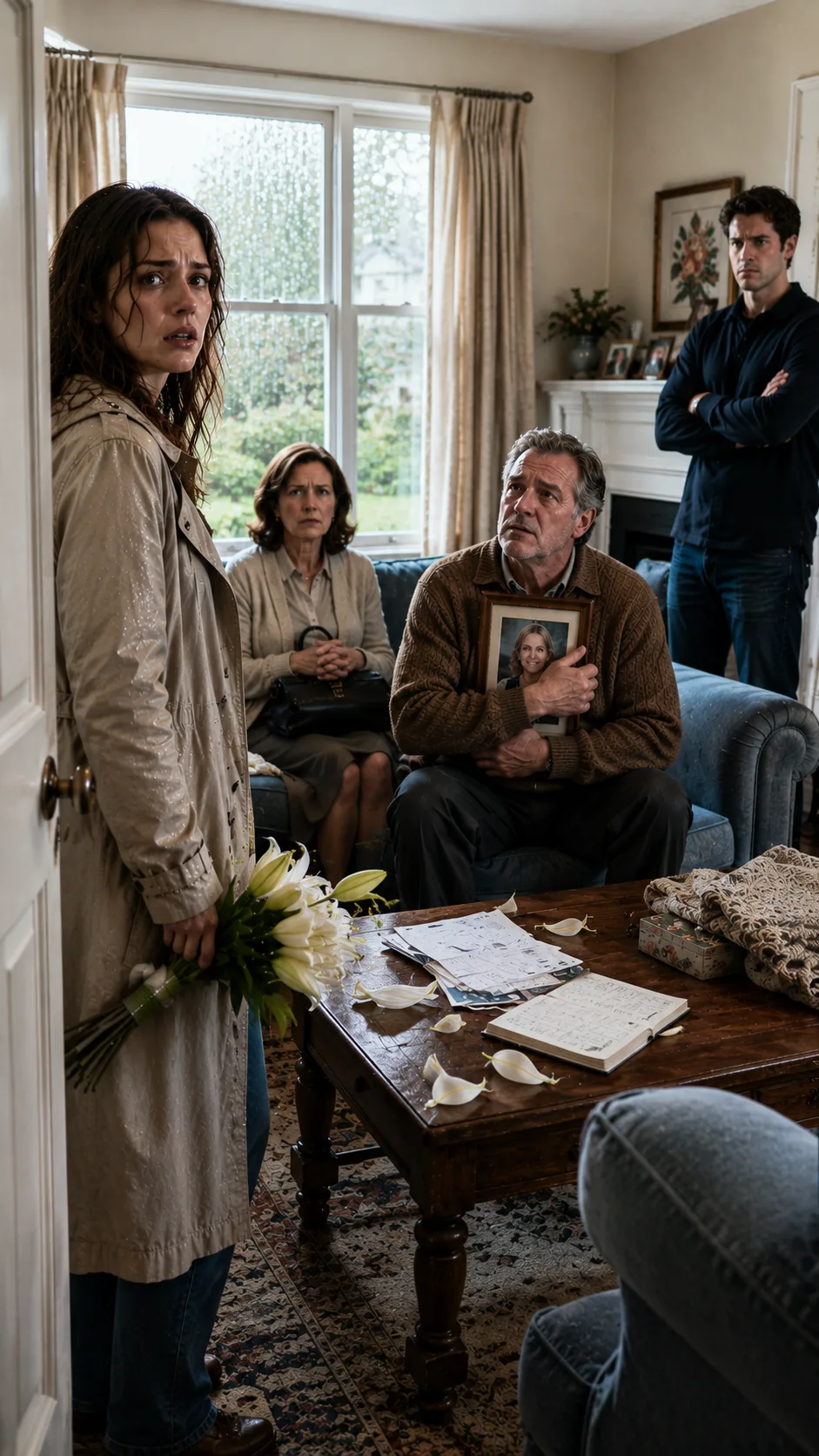
I placed Mom’s letter flat on the coffee table, beside the bank statements, beside the receipts, beside the lilies. The white petals looked bruised now, but they were still beautiful.
Dad looked at me.
“So what now?” he asked. “You cut off
your own father?”
I took a breath.
“No. I stop paying for your lies.”
“You’re abandoning me.”
“I’m stepping out of the story you wrote for me.”
He laughed bitterly. “You think they’ll stay on your side? Families forget. People get tired. Eventually, they’ll say you should forgive me.”
I looked at Aunt Carol, then Mark, then the neighbors standing silently near the window.
Maybe he was right.
Maybe someday people would soften the truth because time makes cruelty easier to decorate.
But I was done living by what people might say.
“I don’t need everyone on my side,” I said. “I need myself back.”
His jaw tightened.
For one second, I saw fear cross his face.
Not fear of losing me.
Fear of losing access.
Dad grabbed his coat from the armchair.
“Keep the house,” he snapped. “Keep your little flower shop. Keep pretending your mother was some saint.”
I stood still.
He wanted me to defend her. He wanted me to shout. He wanted one last doorway back into the fight.
I gave him nothing.
At the front door, he turned.
“You’ll regret this when I’m gone.”
For years, that sentence would have destroyed me.
That day, it only made me tired.
“I already grieved you,” I said quietly. “I just didn’t know that was what I was doing.”
His hand tightened around the doorknob.
No one spoke for him.
No one chased him.
No one said, “Frank, wait.”
So he left.
The door slammed behind him so hard the picture frames on the wall shook.
For a long moment, nobody moved.
Then Aunt Carol bent down and began gathering the lilies from the coffee table. Her fingers were careful, like the flowers were something wounded.
“I’m sorry,” she said.
I nodded, but I couldn’t answer yet.
Mark stepped closer.
“I should have asked you,” he said. “Before I judged you.”
“Yes,” I said.
He swallowed. “I’m sorry.”
That time, I believed him.
One by one, everyone left. Some apologized. Some looked ashamed. Some could only touch my shoulder before walking out.
When the house was empty, I sat on the floor beside the coffee table.
The bank records were still there. The casino receipts. The letter. My mother’s photograph.
I picked up the frame and looked at her face.
She was smiling in that picture, standing in the garden with dirt on her knees and sun on her hair. She had looked so gentle. People always mistook gentle women for weak ones.
But my mother had built a house, raised a daughter, survived my father, and left a warning strong enough to protect me six years after she died.
The next morning, Dad called eleven times.
I did not answer.
Then came the messages.
You embarrassed me.
Your mother would hate this.
I have nowhere to go.
You are making a mistake.
I read every word.
Then I put the phone face down and opened Linda’s Garden.
The bell over the shop door rang at noon.
Aunt Carol walked in carrying a small envelope.
“I found these last night,” she said.
Inside were two receipts. Money she had given Dad years ago.
“He lied to me too,” she whispered.
“I’m sorry.”
She shook her head. “No, honey. I’m sorry we let him make you the villain.”
That was the beginning.
Not revenge.
Truth.
Over the next month, people started calling. A cousin admitted Dad had borrowed money for a car repair that never happened. A neighbor had paid his electric bill twice. A family friend said Dad told her I had become greedy after inheriting the house.
Every person had received a different version.
I had received the biggest bill.
Three months later, I returned to Mom’s house on a bright Saturday morning.
I opened every curtain. Natural light poured across the living room. Dust floated in the air. The blue couch looked softer. The coffee table looked ordinary again. The house no longer felt like a courtroom.
It felt like home.
I cleaned the mantel. I washed the windows. I trimmed the roses outside the fence. Then I placed Mom’s letter in a simple wooden frame and set it on her writing desk.
Not for visitors.
For me.
That evening, my phone buzzed.
Dad.
I’m still your father.
I stared at the message for a long time.
Then I typed back.
I know. But I am still my mother’s daughter.
I set the phone down and locked the front door.
For six years, I thought keeping the house made me selfish.
But I was wrong.
The house was never the reason my family broke.
It was the place where the breaking finally stopped.
Mom had not left me walls.
She had left me permission.
Permission to say no.
Permission to stop paying for someone else’s destruction.
Permission to close a door without calling it cruelty.
That night, I placed fresh white lilies beneath her photograph.
Then I whispered, “I kept it, Mom.”
And for the first time since she died, I felt like the house had kept me too.
THE END.
Chapter complete
You have reached the end of this chapter.
Continue reading
A few more worlds to get lost in after this chapter.




