My Family Skipped My Courthouse Wedding, Then My Husband’s Fortune Made Them Beg at My Marble Table in Panic
I married the love of my life beneath buzzing courthouse lights in a dress that cost less than most women spend on shoes.
Chapter 1
I married the love of my life beneath buzzing courthouse lights in a dress that cost less than most women spend on shoes.
Eighty-nine dollars.
That was the price tag still tucked inside the scratchy white lace when I stood in the county clerk’s hallway, trying to smooth the skirt over my knees and pretending I did not care that the fabric itched every time I moved.
There were no roses.
No violin music.
No flower girls.
No row of relatives turning around to watch me walk in.
No mother dabbing her eyes.
No father taking my arm.
No brother making an inappropriate joke because he could not handle emotional moments.
There was only a tired judge, my best friend Cassandra clutching a crooked grocery-store bouquet, and Julian Vale standing beside me in a charcoal suit, looking at me as if the cracked tile floor under our feet had turned into the aisle of a cathedral.
The hallway smelled like old paper, floor polish, weak coffee, and the kind of fluorescent lighting that
made everyone look like they had not slept enough.
My name is Gwen Overton.
And on March fifteenth, while I became a wife in a government building with vending machines humming behind us, every person I had once called family was across town, raising glasses beneath gold balloons for my sister Brooke’s thirtieth birthday.
Forty people.
Maybe more.
My mother, Meline.
My father, who had perfected the art of silence.
My brother Austin.
My grandmother.
Aunts, uncles, cousins, people who had held me as a baby and still somehow forgot I existed once Brooke entered a room.
They were all in a banquet hall with champagne, a hired DJ, gold streamers, and a custom sign Brooke had ordered that said, Brooke’s Golden Era.
My era, apparently, could fit between a metal detector and a clerk’s counter.
The ridiculous part was that Julian and I could have afforded a real wedding.
A beautiful one.
The kind with a glass tent, white orchids, a string quartet, and photos that looked like they belonged on the front page of a bridal magazine.
Julian was not flashy. He hated talking about money and hated being introduced by his job title even more. But he was the co-founder and chief technology officer of a software company that had been quietly growing into something serious.
At the time, most people did not know how serious.
The company was preparing to go public. The lawyers knew. The investors knew. Julian’s partners knew. I knew enough to understand that life was about to change, though I did not yet understand how loudly the world would suddenly start saying his name.
We did not choose a courthouse because we were helpless.
We chose it because I was tired.
Tired of begging.
Tired of negotiating for scraps of attention.
Tired
of watching the people who were supposed to love me turn every important moment of my life into an inconvenience they expected me to solve.
But even then, foolishly, painfully, I still wanted them there.
That was the part I hated admitting.
I wanted my mother to see me sign my name.
I wanted my father to stand near the door and look proud, even if he did not know what to say.
I wanted my brother to show up late with a coffee stain on his shirt and pretend it was funny.
I even wanted Brooke there, wearing something slightly too dramatic and asking whether the lighting made her look washed out.
I wanted a family.
Not a perfect one.
Just one that could manage to appear for me once.
Growing up, I learned early that love in our house came with a seating chart.
Brooke was always center stage.
Austin was the emergency.
I was the helper.
My mother had a word for me that she used so often it started to sound like a name.
Flexible.
When Brooke threw a tantrum before prom because her hair appointment ran late, my mother missed my academic award ceremony and called me afterward from the salon.
“You understand, don’t you, Gwen? You’re my flexible girl.”
When Austin borrowed my savings to fix a car he had crashed and forgot to pay me back, my mother said, “You’ve always been flexible with your brother. He needs support right now.”
When my college graduation dinner got moved because Brooke had a breakup and could not bear to sit in public, I was told, “This family survives because you don’t make everything harder.”
Flexible sounded sweet when she said it.
Like I was mature.
Like I was generous.
Like I was loved for being easy.
It took me years to realize flexible meant disposable.
So when Julian proposed, I let myself believe marriage might reset something.
Maybe a wedding invitation would force my family to look directly at me.
Maybe my mother would finally understand that this was not a small achievement. This was my life beginning in a new shape.
I bought thick cream stationery from a small shop downtown and sat at our kitchen table for two evenings, addressing every card by hand.
Aunt Clara.
Uncle Dennis.
Grandma Ruth.
Cousins I barely spoke to anymore but still remembered from childhood summers.
My mother.
My father.
Brooke.
Austin.
Forty-two save-the-dates in total.
I sealed them carefully, pressed stamps into the corners, and carried them to the mailbox myself.
For three days, I was stupid enough to feel hopeful.
Then Brooke posted her birthday announcement online.
Same date.
March fifteenth.
Gold background.
Champagne tower graphic.
Live DJ.
Cocktail dress code.
Open bar.
The caption said, Thirty only happens once.
I stared at the screen, rereading the date until my vision blurred.
When I called my mother, she answered in the airy tone she used when she had already decided I was unreasonable.
“Mom,” I said, keeping my voice level, “Brooke’s party is on my wedding date.”
There was a pause, but not the kind that meant guilt.
The kind that meant irritation.
“Oh, sweetheart,” she said. “Brooke has been under so much pressure about turning thirty. You know how sensitive she gets.”
“It’s my wedding.”
“And Brooke’s birthday is a milestone.”
“My wedding is also a milestone.”
“Well, of course it is. But yours is very small, isn’t it? You and Julian aren’t even doing a big church ceremony. You can move it without much trouble.”
I pressed my fingers against the edge of the counter.
“We already booked the date.”
“At a courthouse, Gwen. Be realistic.”
The words landed softly, which made them worse.
“Everyone already knows about the party,” she continued. “Brooke found a venue last minute, and that was the only Saturday they had available. You don’t want to put the family in an awkward position.”
“I sent invitations first.”
“She is turning thirty.”
“I am getting married.”
My mother sighed, long and heavy, as if I had brought her a burden instead of a heartbreak.
“You have always been the reasonable one,” she said. “Please don’t stop now.”
There it was.
Not the exact word this time.
But the same cage.
I told her I was not moving the wedding.
She told me I was making things difficult.
The next week, the RSVP cards began returning.
At first, I thought maybe a few people genuinely had conflicts.
Then the pattern became impossible to ignore.
Regretfully unable to attend.
So sorry, already committed.
Hope we can celebrate later.
Envelope after envelope arrived like a quiet little funeral for my expectations.
I tried not to cry in front of Julian. I failed every time.
Then Aunt Clara’s response came.
Her handwriting was neat, careful, familiar.
I opened it standing in the driveway.
Inside, she had written, Your mother said the wedding was postponed. Send the new date when you have it.
For several seconds, I heard nothing.
Not the street.
Not a passing car.
Not even my own breathing.
Postponed.
My mother had not merely chosen Brooke’s party over my wedding.
She had erased my wedding so no one else could choose me.
She had called relatives, shaped the story, and turned my marriage into a scheduling issue. She had told them something went wrong with our plans. That we were delaying. That everyone should go celebrate Brooke without feeling guilty.
She knew exactly what she was doing.
She knew there was a chance someone might pick me if they understood the truth.
So she removed the choice.
That evening Julian found me on the living room floor with the rejected cards spread around me like evidence from a crime scene.
The apartment was dark except for the kitchen light.
I had not cooked.
I had not changed clothes.
I had simply sat there for hours, opening the same cards again and again, waiting for them to stop hurting.
Julian lowered himself beside me without speaking.
That was one of the first things I loved about him. He did not rush to fill pain with noise.
After a while, he picked up Aunt Clara’s note and read it.
His face changed.
Not dramatically. Julian never performed anger.
But something in his jaw locked.
“Did she tell them this?” he asked.
I nodded.
“All of them?”
“I think so.”
He exhaled slowly and placed the card back down.
“What do you want to do?”
No lecture.
No advice about forgiveness.
No suggestion that I make peace because family was complicated.
Just that.
What do you want?
It was the first time anyone had asked me that about my own life and meant it.
I looked around at the cards. At the names. At all those polite little rejections stacked around me because my mother had decided my wedding was less important than Brooke’s fear of aging.
Something inside me went very still.
“I want to marry you on March fifteenth,” I said. “In the courthouse. In a hallway. In a broom closet. I don’t care. I am done rearranging my life so they don’t have to feel uncomfortable.”
Julian took my hand.
“Then that’s what we’ll do.”
And we did.
At 8:03 in the morning, with Cassandra crying so hard the judge had to pause before finishing the paperwork, I married Julian Vale.
His hands were warm.
Mine were shaking.
When the judge pronounced us husband and wife, Cassandra let out a broken little laugh and covered her mouth with the bouquet.
Julian kissed me carefully, like he was making a vow with more than his lips.
There were no relatives clapping.
No reception.
No photographer.
No one shouting, “Finally!”
But when we stepped outside, the spring wind caught my cheap bouquet and scattered two petals across the courthouse steps, and Julian looked at me as if the entire world had narrowed down to my face.
We bought spicy breakfast tacos from a truck two blocks away.
Cassandra insisted on taking pictures of us on the hood of Julian’s car, even though my skirt kept sticking to the windshield and the bouquet looked like it had survived an argument with a lawn mower.
I laughed until my stomach hurt.
For a few hours, I forgot to be abandoned.
That night, I made the mistake of opening my phone.
Brooke’s birthday party filled my screen.
Gold lights.
Gold balloons.
Gold dress.
Gold cake.
My mother stood at a microphone with champagne in one hand and tears sparkling on her cheeks.
“To my beautiful firstborn,” she said in a video someone had posted. “You have always been the heart of this family. We would drop everything for you.”
People clapped.
Brooke dabbed at her eyes.
My father stood behind them, smiling weakly, as if he had not skipped his younger daughter’s wedding that morning.
I closed the app before I could hear more.
No one texted me.
Not my mother.
Not my father.
Not Austin.
Not Brooke.
Not even a cousin with a guilty, Sorry, heard things changed.
In the family group chat, there were dozens of photos from the party.
My wedding did not exist.
Three weeks later, Julian’s company went public.
We watched it happen from our couch in sweatpants, eating noodles from takeout cartons because neither of us felt like pretending we understood how to celebrate becoming rich on paper.
The financial channel ran a segment about the startup.
A business site published Julian’s photo beneath a headline about the leadership team behind a fifty-million-dollar valuation.
Julian muted the television.
“I hate that picture,” he said.
I stared at him.
“Julian, your company just changed our entire financial future, and your reaction is that the photo is bad?”
“It is a bad photo.”
I laughed because if I did not, I might cry.
Not because of the money.
Because some part of me knew what was coming.
My family had ignored a wedding.
They would not ignore a fortune.
It took forty-eight hours.
Brooke was the one who posted the article in the family chat.
Wait. Is this Gwen’s Julian???
A cousin responded with a row of shocked emojis.
Austin sent three money bag icons and a gif of someone fainting.
My mother wrote, Oh my God. I need to call her.
I looked at the screen until Julian gently took the phone from my hand and set it facedown.
“You don’t have to answer,” he said.
“I know.”
But when my mother called the fifth time, I did.
“Gwen,” she said, bright and breathless, as though no time had passed and no lies had ever been told. “Honey, I have been trying to reach you.”
“I saw.”
“I just read the article. Julian must be so proud.”
“He is.”
“And you too, of course. We are all so happy for you.”
I waited.
The silence stretched.
Then her voice softened into the tone she used when she wanted something wrapped in guilt.
“There is something we need to discuss as a family.”
My heart did not break this time.
It hardened.
“What do you need, Mom?”
She paused, surprised that I had skipped the dance.
“Well,” she said carefully, “your brother has been going through a very difficult season.”
Austin.
Of course.
Not an apology.
Not, I am sorry I lied to our relatives.
Not, I missed your wedding and I have not slept since.
Not, I should have been there.
Just Austin.
Always Austin.
I let her talk.
She hinted before she confessed.
He had made mistakes.
He had borrowed from the wrong people.
He was under pressure.
He was ashamed.
He did not want to worry anyone.
Then, finally, the number came.
One hundred and eighty thousand dollars.
I actually laughed.
Not loudly.
Just once.
A dry, strange sound that surprised both of us.
“Gwen,” my mother said sharply. “This is not funny.”
“No,” I said. “It really isn’t.”
She asked to come over in person.
I gave her our new address.
Not because I intended to help.
Because I wanted them to see the life they had assumed I would never build.
That Saturday afternoon, four people arrived at my front door.
My mother in cream linen and pearls.
Brooke in oversized sunglasses and a gold bracelet that probably cost more than my wedding dress fifty times over.
Austin in a wrinkled button-down, sweating through the collar.
My father standing behind them, looking as though he wished he had remained in the car.
When I opened the door, none of them greeted me first.
They looked past me.
The entryway rose two stories high, washed in sunlight. Wide windows overlooked the back garden. The kitchen opened into the living area with a white marble island, brass fixtures, and pale oak floors.
My mother’s mouth tightened.
Brooke removed her sunglasses slowly.
Austin stared like a starving man shown a bakery window.
My father noticed the framed certificate near the hallway table.
Our marriage certificate.
The courthouse seal.
The date.
March fifteenth.
His face flushed.
For one brief second, I thought he might say something.
He looked at me.
Looked away.
And followed the others inside.
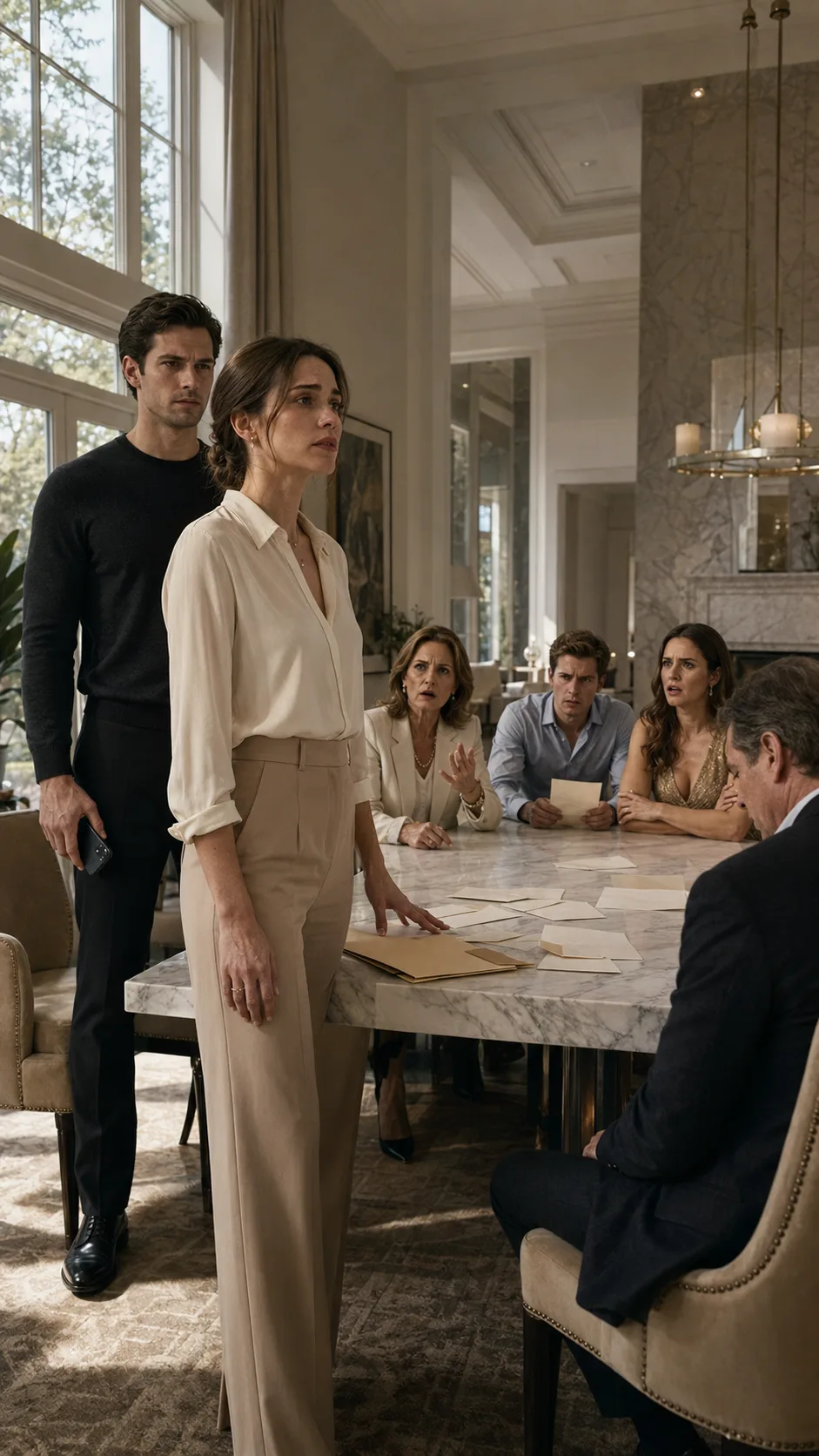
I led them to the dining room.
The marble table had already been set.
Not with food.
With four white envelopes placed neatly at four chairs.
Julian was not in the room when they sat down, but I knew he was nearby. He had asked whether I wanted him beside me from the start.
I told him no.
Not because I did not need him.
Because I needed to begin this myself.
My mother placed her purse beside her chair and smiled with frightening brightness.
“This is a beautiful home, Gwen.”
“Thank you.”
“You must be very comfortable here.”
“I am.”
Brooke gave a small laugh, glancing at the windows. “Comfortable is one word.”
Austin leaned forward, unable to keep himself still.
“Can we just talk about why we’re here?”
My mother shot him a warning look, then folded her hands.
“Family helps family,” she began.
I almost admired the confidence it took to say those words in my house.
She explained Austin’s “situation” as if she were describing an unfortunate weather delay.
Bad investments.
Bad timing.
Bad influences.
Debt that had grown beyond his control.
People pressing him.
People making threats.
A mistake that could ruin his future if someone did not step in quickly.
My father stared at the table.
Brooke touched her bracelet and sighed.
“Look,” Brooke said, leaning forward, “nobody is saying Austin handled everything perfectly. But this is serious. And for you now? One hundred and eighty thousand dollars is not life-changing.”
I looked at her.
She shrugged.
“You married well. Some of us didn’t get that lucky.”
The room went so quiet I could hear the faint hum of the refrigerator from the kitchen.
I reached down beside my chair and lifted a manila folder onto the table.
Austin’s eyes snapped to it.
“What is that?”
“Something interesting.”
I opened it and slid out a printed screenshot.
His face drained before anyone else understood.
It was from an underground gambling forum.
A post under a username he clearly thought no one in the family would ever find.
The timestamp was March fifteenth.
My wedding day.
The message was not long, but it was enough.
He had written that his sister had just married a tech founder, and once the money landed, he would be fine.
I did not read it aloud.
I did not need to.
Austin grabbed the paper, then dropped it as if it burned him.
My mother looked at him.
“Austin?”
He swallowed.
“It was a joke.”
“No,” I said. “It was a plan.”
Brooke rolled her eyes, but her voice was thinner now.
“So you hired someone to dig up dirt on him?”
“No. I listened when people told me who he was. Eventually, proof becomes easy to find.”
My mother sat straighter, recovering herself.
“Gwen, this is not the point. Your brother is frightened. We can talk about his poor judgment later.”
“Open the envelopes,” I said.
No one moved.
I smiled faintly.
“You came here for an answer. It is inside.”
Austin was first. He tore his open with shaking hands.
Brooke followed, annoyed but curious.
My mother opened hers carefully, as if she expected a check.
My father held his envelope for several seconds before sliding a finger under the flap.
Inside each one was a cream card.
The same kind I had mailed months earlier.
The same thick stationery I had chosen by hand.
Their wedding RSVP cards.
Returned.
Ignored.
Declined.
On each card, across the blank space where love should have been, I had written one word in black marker.
Declined.
My mother stared at the card.
Her expression changed in layers.
Confusion.
Recognition.
Irritation.
Then anger.
“What is this supposed to mean?”
“It means I am responding,” I said.
Austin pushed back from the table. “This is insane.”
“No,” I said. “It is consistent.”
Brooke threw her card down.
“You are punishing us over a courthouse wedding?”
I looked at her for a long moment.
“You had a birthday party.”
“It was my thirtieth.”
“It was my wedding.”
“You could have moved it.”
“My mother told everyone it was already moved.”
Brooke’s eyes flicked toward our mother.
For once, she had nothing ready.
My mother placed both palms on the table.
“I was trying to keep the peace.”
“You were trying to keep Brooke from sharing attention.”
Her mouth tightened.
“That is a cruel thing to say.”
“Cruel was telling our family that my wedding was postponed so they would not have to decide whether to show up for me.”
My father shifted in his chair.
I turned to him.
“And you. You saw the date on that certificate in the hall. You know exactly what you missed. You did not call. You did not text. You did not even ask if I was alright.”
He opened his mouth.
Closed it.
A lifetime of silence sat between us.
My mother reached across the table.
“Gwen, please. We made mistakes. Fine. We should have handled it differently.”
“You lied.”
“I said we made mistakes.”
“You erased my wedding.”
Her face hardened.
“And now you want to erase your brother?”
Austin slammed his hand against the marble, not hard enough to break anything, but loud enough to make Brooke flinch.
“I could lose everything!” he shouted.
“You gambled everything,” I said. “That is different.”
“You have no idea what these people are like.”
“I know what you are like.”
His nostrils flared.
“You think you are better than me because your husband got lucky?”
Before I could answer, Julian stepped into the doorway.
He did not rush.
He did not raise his voice.
He simply entered the room with his phone in one hand and stood behind my chair.
The effect was immediate.
Austin stopped leaning forward.
Brooke looked away.
My mother’s anger sharpened into embarrassment.
Julian’s presence always did that. Not because he intimidated people by trying. Because he never tried. He simply occupied space with a calm that made performance look ridiculous.
“This is family business,” my mother said.
Julian glanced at me, not her.
“Gwen decides what business happens in her home.”
The word her landed exactly where it needed to.
My mother blinked.
Then she turned back to me, desperate enough to reach for the old weapon.
“You can afford compassion,” she said. “You can afford to be flexible.”
There it was.
At last.
The word that had followed me from childhood into adulthood like a leash.
Flexible.
I stood.
My chair slid back with a soft scrape.
Everyone looked up.
For the first time in my life, I saw them from above while they sat waiting for something from me.
Money.
Forgiveness.
Obedience.
A version of Gwen they could still bend.
“I spent my whole life believing flexibility made me good,” I said. “I thought if I gave up my seat, my money, my time, my birthdays, my graduations, and finally my wedding, one day you would decide I had earned a place in this family.”
No one interrupted.
“You never wanted me flexible. You wanted me useful.”
My mother’s lips trembled, but it was anger, not sadness.
“That is not fair.”
“No,” I said. “What happened to me was not fair. This is simply the first fair answer I have ever given.”
Austin’s voice broke.
“Gwen, please.”
I looked at him.
Not with hatred.
That would have required too much energy.
With clarity.
“You wrote about my marriage like it was a future withdrawal from an account.”
“I was panicking.”
“You were counting.”
He lowered his eyes.
Brooke scoffed, but it was quieter now.
“So that’s it? You get rich and cut everyone off?”
“I got married and learned who came.”
The sentence settled over the table.
My father covered his face with one hand.
My mother stood abruptly.
“You are making the biggest mistake of your life.”
“No,” I said. “I already made that mistake. I kept believing you.”
Her cheeks flushed.
“You will be lonely without your family.”
I looked around the dining room.
At Julian behind me.
At the sunlight moving across the marble.
At the envelopes that had once made me cry and now looked like evidence of my survival.
“I was lonely with you,” I said.
That one hurt her.
I saw it.
For a second, the mask slipped, and beneath all her control was a woman who had never imagined the quiet daughter might one day say the truth out loud.
Austin stood, shaking.
“What am I supposed to do?”
“Take responsibility.”
“They’ll come after me.”
“Then call a lawyer. Call the police. Declare bankruptcy. Sell something. Do anything except look at me like I was born to rescue you.”
He turned to Julian.
“Tell her this is crazy.”
Julian’s expression did not change.
“I think she has been very clear.”
Austin cursed under his breath.
Julian lifted his phone slightly.
“Security is easy to reach from here.”
My mother froze.
Not because she feared danger.
Because she feared humiliation.
The image of being escorted out of my house by neighborhood security clearly disturbed her more than the possibility of losing her daughter had ever done.
She snatched her purse from the chair.
“Come on,” she said sharply.
Brooke rose, collecting her sunglasses with a shaking hand.
“This is disgusting,” she muttered.
“Yes,” I said. “It has been.”
My father stood last.
He held the RSVP card in his hand.
For a moment, he looked like he might put it in his pocket.
Then my mother glared at him, and he set it back on the table.
He gave me a weak shrug.
A pathetic little apology without words.
I did not accept it.
They walked out one by one.
Austin first, furious and frightened.
Brooke next, wounded by the loss of a world where she always won.
My mother after them, shoulders stiff, head high, determined to look like the victim until the final second.
My father last.
At the door, he turned.
“Gwen,” he said softly.
It was the first time he had spoken my name all afternoon.
I waited.
He looked at me, then at Julian, then at the floor.
“I didn’t know,” he whispered.
“Yes,” I said. “You did. You just did what you always do. Nothing.”
He flinched.
Then he left.
The front door closed with a heavy click.
For a while, I did not move.
The silence that followed was not empty.
It was clean.
Julian came up behind me and rested his hands gently at my waist.
Only then did my knees start to tremble.
“You were incredible,” he said.
“I don’t feel incredible.”
“What do you feel?”
I looked at the table.
At the cards.
At the evidence of every time I had been expected to disappear politely.
“Free,” I said.
Then I started crying.
Not the quiet, controlled kind.
The ugly kind that bends your body forward and makes breathing difficult.
Julian turned me into his arms and held me until the room blurred and my face pressed into his sweater.
I cried for the wedding I had not had.
For the mother I had wanted.
For the father who had watched from the edges of my life and called it peace.
For the girl who had thought being easy to love meant being easy to ignore.
When I finally stopped, Cassandra arrived with wine because Julian had texted her one word.
Done.
She stepped into the dining room, saw the envelopes, and said, “Please tell me somebody flipped a table.”
“No,” I said, wiping my face.
She looked disappointed.
“Fine. Emotional growth, I guess.”
I laughed through the last of my tears.
Aunt Clara contacted me two months later.
Her message was long.
Careful.
Ashamed.
She said she had believed my mother because she had no reason not to. She said she should have called me. She said when the truth came out, several relatives felt terrible, though most of them were too embarrassed to say so.
I believed the embarrassed part.
I did not need the apologies.
By then, I had learned something important: an apology that arrives only after the story changes is not always love. Sometimes it is just reputation management.
Still, I answered Aunt Clara.
Not because I owed her comfort.
Because she had at least found the courage to knock.
Through her, I learned what happened after that Saturday.
Austin did not get the money.
The people he owed did not make his life easy, but the disaster he had predicted did not destroy him in the dramatic way he tried to sell us. He declared bankruptcy, lost his apartment, and moved into my mother’s basement.
For once, Meline’s golden boy became her daily responsibility.
Brooke’s lifestyle began cracking around the same time.
The credit cards.
The events.
The rented image of success.
My parents, who had skipped my wedding for her birthday, ended up covering bills from a celebration she had not been able to afford in the first place.
My father retired earlier than planned.
My mother stopped posting family photos for a while.
I never heard directly from them again.
There were no Christmas calls.
No birthday messages.
No invitation to repair what they had broken.
And strangely, after the first sting passed, I felt no urge to chase them.
Julian and I did not throw a lavish second wedding.
People suggested it.
Cassandra wanted at least one party where she could wear “something aggressive.”
But I did not want to recreate the day for people who had missed it.
The courthouse wedding had become sacred to me.
Not because it was grand.
Because it was honest.
On our first anniversary, Julian asked where I wanted to go.
I told him the truth.
So we drove back to the same county building.
The paint still chipped near the entrance.
The hallway still smelled like wax, coffee, and paperwork.
The vending machine still made a terrible grinding noise before dropping a cup.
We bought two coffees that tasted like burnt cardboard and walked outside into the morning wind.
Then we found a taco truck and ordered the same spicy breakfast tacos as before.
Julian sat beside me on the hood of the car, his shoulder touching mine.
My dress was not white this time.
There was no bouquet.
No one was missing.
Because for the first time, I understood that a wedding is not measured by how many people fill the room.
It is measured by whether the right person is standing there when everyone else leaves.
I looked at Julian, at the courthouse steps, at the place where my old life had ended without applause.
“Do you ever wish we had done it differently?” he asked.
I thought about gold balloons.
Returned envelopes.
A marble table.
My mother’s face when I finally stopped bending.
Then I smiled.
“No,” I said. “It was small. It was quiet. And it was mine.”
Julian took my hand.
The wind pushed across the parking lot, warm and wild, lifting my hair from my cheek.
For years, I had believed love meant making myself easier for others to carry.
But on that hood, under the same plain courthouse sky, I finally knew the truth.
I was never hard to love.
I had only been surrounded by people who preferred me useful.
And they were gone now.
The bank was closed.
The door was locked.
And my life, at last, belonged to me.
THE END.
Chapter complete
You have reached the end of this chapter.
Continue reading
A few more worlds to get lost in after this chapter.