My Family Ordered Me To Kneel At My Sister’s Wedding, Then My Mother’s Hidden Will Destroyed Them Before Sunset Forever
The slap landed before the first violin note had finished trembling through the ballroom.
Chapter 1
The slap landed before the first violin note had finished trembling through the ballroom.
For one impossible second, everything stopped.
The chandeliers above us glittered like frozen fire. Three hundred wedding guests sat beneath them in silk, diamonds, tuxedos, and stunned silence. Somewhere behind me, a champagne flute slipped from someone’s hand and struck the marble floor with a bright, delicate crack. The sound echoed through the grand hall as if the room itself had flinched.
My cheek burned.
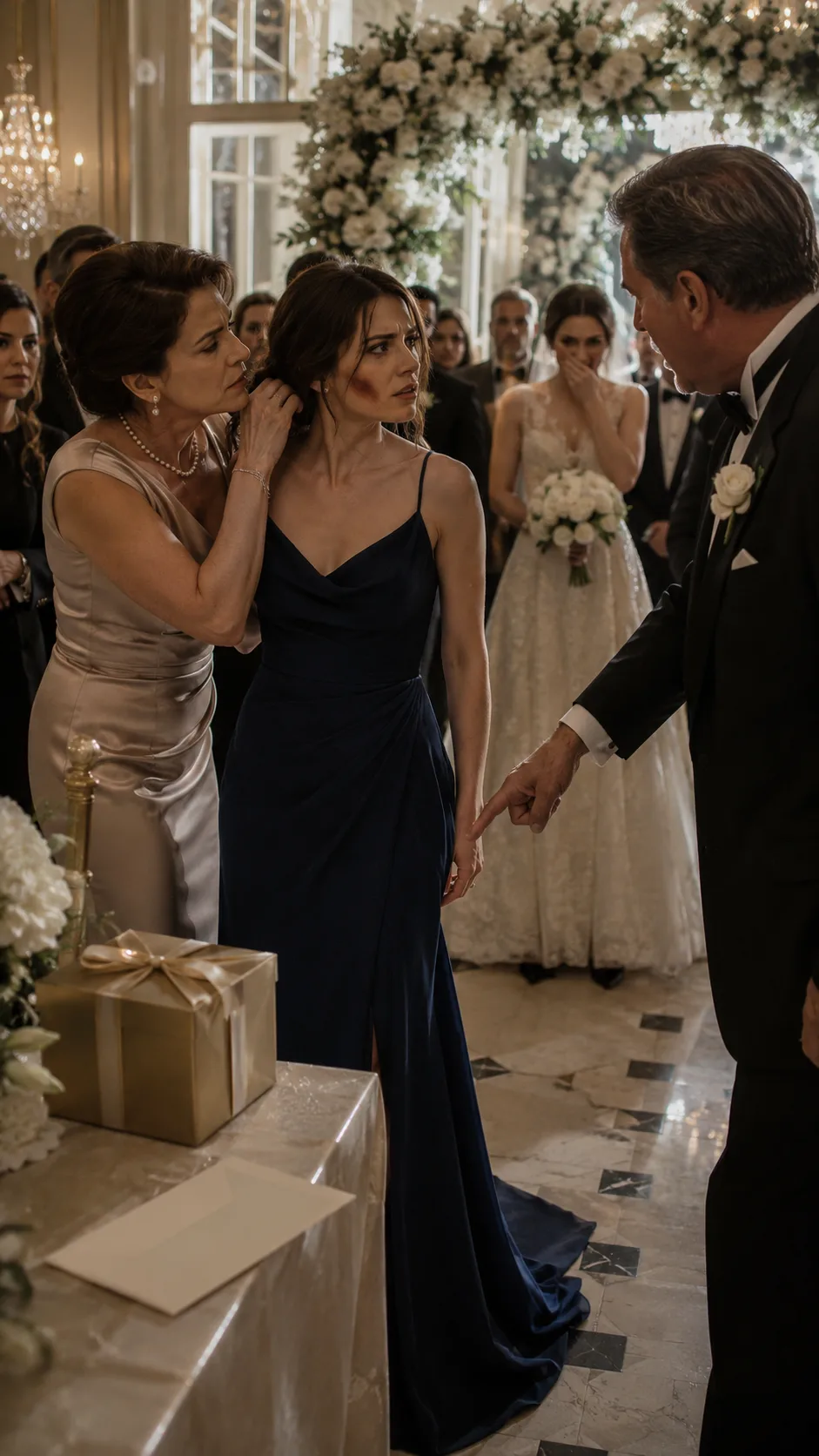
My hair was caught in Marlene’s fist.
And my sister, Vanessa, stood beneath a mountain of white flowers near the altar, dressed like a fairytale bride, smiling like a girl watching her favorite enemy finally bleed.
“Don’t you dare,” Marlene whispered, her lips barely moving. Her perfume wrapped around me—expensive, powdery, suffocating. “You will not ruin my daughter’s wedding.”
My daughter.
Not our daughter. Not your sister.
Hers.
That had always been the line she drew in the house my mother built, with the money
my mother earned, under the roof my mother had chosen because the morning light fell beautifully across the kitchen tiles.
I had only stepped through the ballroom doors.
That was my crime.
I had not shouted. I had not interrupted the ceremony. I had not approached the altar or touched the cake or said Vanessa’s name. I was wearing a simple navy dress, my hair pinned neatly, a small ivory envelope tucked inside my clutch. I had arrived quietly, even respectfully, because I wanted to give them one final chance to behave like human beings.
Marlene took my silence as weakness.
She always had.
Her fingers twisted harder in my hair, pulling my head slightly back, not enough to make a scene worse than it already was, just enough to remind me she still believed she had the right to put her hands on me.
“You should have stayed away,”
she hissed.
The guests stared. Some with pity. Some with hunger. A few had already lifted their phones, pretending to hold them low while recording every second. The wedding planner froze beside a golden chair, her headset glowing red, her face pale with professional panic.
At the altar, Vanessa tilted her bouquet up to her mouth.
Not to hide shock.
To hide laughter.
The man standing beside her—her groom, Andrew—looked between us with the helpless confusion of someone who had been told only one version of a family story and was now watching the truth crawl out from under the carpet.
Then my father came rushing down the aisle.
For one stupid, fragile heartbeat, I thought he was coming to stop Marlene.
Even after twenty years, even after every forgotten birthday, every ignored report card, every dinner where he let them mock me until I excused myself and cried in
the laundry room, some tiny, starving part of me still hoped my father would remember I was his daughter.
He stopped in front of me, red-faced and shaking with anger.
Not at Marlene.
At me.
“Claire,” he snapped.
Marlene’s hand was still in my hair. My cheek was still hot from her palm. Every person in the room could see it.
My father looked down at the marble floor and pointed.
“Kneel.”
The word hit harder than the slap.
A ripple moved through the guests. Someone gasped. Someone whispered my name. The violinists lowered their bows and stared at their sheet music like the notes had suddenly become dangerous.
I looked at my father.
“What?”
His jaw clenched. “You heard me.”
“No,” I said quietly. “I don’t think I did.”
He stepped closer, lowering his voice as if that made his cruelty private. “You walked into this wedding carrying your old jealousy like a weapon. You have embarrassed your sister enough in this lifetime. Today, you are going to show respect.”
Respect.
That word, from him, was almost funny.
Marlene’s nails scraped my scalp as she leaned in close. “Do what your father says.”
Vanessa’s smile grew wider.
My father pointed again. “Get on your knees and apologize to your sister.”
The silence became so complete I could hear my own pulse.
I remembered another floor.
Our kitchen floor, twenty years earlier.
I was eight years old, sitting under the table while adults filled the house after my mother’s funeral. Everyone said my father was grieving. Everyone said he needed help. Everyone said Marlene was kind for bringing casseroles and staying late to wash dishes.
Eight months later, Marlene moved into my mother’s bedroom.
Nine months later, her daughter moved into the room with the bay window that had always been mine.
One year later, my mother’s pearl necklace appeared around Marlene’s throat at a charity dinner.
When I asked for it back, my father told me not to be dramatic.
When Vanessa cut holes in my school blazer and blamed me for being careless, my father told me I needed to learn responsibility.
When Marlene called me “the leftover” for the first time, she did it while placing a second slice of cake on Vanessa’s plate and telling me sugar would make my face worse.
My father heard.
He kept reading the newspaper.
By seventeen, I had stopped asking for money. Scholarships paid my school fees. Part-time jobs paid for my books. I cleaned offices at night and studied before dawn while Vanessa received a new car because she had “survived junior year.”
By twenty-one, I understood the truth.
They had not forgotten me.
They had chosen to erase me.
And now, at twenty-eight, standing in the middle of my sister’s wedding with my stepmother’s hand in my hair and my father ordering me to kneel, I felt something inside me go perfectly still.
Not broken.
Still.
Like a blade held flat in the dark.
I lifted my eyes to my father’s face.
“No.”
The word was soft.
But the room heard it.
Marlene jerked my hair. “Ungrateful little parasite.”
I raised my hand slowly and placed my fingers over hers.
For the first time in my life, I did not pull away in fear. I did not beg. I did not lower my voice. I peeled her hand from my hair finger by finger, calm enough to make her look suddenly ridiculous.
Then I smoothed the front of my navy dress.
Vanessa laughed from the altar.
“Oh, Claire,” she said, voice sweet enough to poison tea. “This is embarrassing. Just leave. Nobody wants you here.”
The guests shifted uncomfortably.
My father looked relieved when she spoke, as if Vanessa’s cruelty had restored the world to its proper shape.
I turned my head and looked at my sister.
She was beautiful. I would give her that. Marlene had made sure of it. Her gown was custom lace, her diamonds borrowed from a vault that did not belong to her, her flowers imported from three countries. She stood beneath an arch of white roses paid for by an account she had never questioned.
I wondered if she knew.
I wondered if she cared.
Then I reached into my clutch.
Marlene stiffened. “What is that?”
I did not answer her.
I walked to the gift table.
Every heel click against the marble seemed louder than the last. The guests watched me cross the room. The envelope felt almost weightless between my fingers, but it carried twenty years of lies, signatures, bank transfers, stolen dividends, forged authorizations, and one last instruction from a woman everyone in that room had underestimated.
My mother.
I placed the ivory envelope among the wrapped crystal bowls and silver frames.
It looked harmless there.
Elegant, even.
Then I turned back.
“You should open this before sunset.”
My father’s face darkened. “Get out.”
Marlene lifted her chin. “Security.”
“No need,” I said.
I looked one final time at Vanessa, glowing under stolen flowers.
Then I walked out of her wedding.
No tears.
No screaming.
No dramatic collapse.
Behind me, the musicians tried to restart the processional. The melody returned thin and nervous, like even the violin understood the ceremony had already begun to rot.
Outside, the afternoon sun struck my face.
My cheek throbbed in the open air. The mark would darken by morning. Maybe it would hurt more later. Maybe I would cry when everything was quiet. But not yet.
My phone buzzed before I reached the parking lot.
A message from Mr. Calloway, my attorney.
Ready when you are.
I stood beside my car, looking back at the white stone venue where my family was pretending nothing had happened.
For years, I had collected their secrets quietly.
Not because I was vengeful.
Because no one believes a girl like me unless she brings receipts.
I had copied statements Marlene left half-hidden in kitchen drawers. I had photographed letters my father forgot in his study. I had saved emails from company accounts he thought I could not access because he still believed I was the same frightened child who apologized when Vanessa broke her things and blamed me.
I had learned patience from loneliness.
I had learned strategy from being ignored.
And I had learned, most importantly, that stolen money always leaves fingerprints.
I typed one word.
Execute.
Then I got into my car and drove away.
The roads were golden with late afternoon light. Summer heat shimmered above the pavement. People walked dogs, pushed strollers, laughed outside cafés. The city continued as if my entire life had not just turned on a hinge.
At a red light, I looked at myself in the rearview mirror.
A red mark stretched across my cheek. A few strands of hair had fallen loose. My lipstick was intact.
I looked almost calm.
That frightened me more than anger would have.
When I reached my apartment, I locked the door, removed my heels, and stood barefoot in the silence.
My apartment was small. One bedroom. Old floors. A radiator that clanked in winter. A kitchen window that overlooked the brick wall of another building. Nothing about it was glamorous, but every piece of furniture in it was mine. Paid for by my own work. Chosen by my own hands.
No one had ever called it home except me.
I filled a bowl with cold water, dipped a towel into it, and pressed it gently against my cheek.
The pain sharpened, then dulled.
I made tea because my mother used to say tea gave the hands something to do when the heart was too full.
While the kettle warmed, I opened the locked drawer in my desk and took out the letter I had read so many times the folds had softened.
My mother’s handwriting ran across the page in neat blue ink.
My dearest Claire,
If you are reading this, then I was right to be afraid.
The first time Mr. Calloway placed that letter in front of me, I had been sitting in his office on my twenty-eighth birthday, wearing a gray blouse and shoes that pinched. I expected some minor paperwork. Maybe an insurance policy. Maybe a sentimental keepsake my father had “forgotten” to mention.
Instead, the old lawyer looked at me with eyes full of apology and said, “Your mother gave me strict instructions to wait until today.”
My mother had known.
Maybe not everything.
But enough.
Before her sudden death, she had created a trust so carefully protected that even my father could not fully access it. He had temporary control of certain assets only until my twenty-eighth birthday, under the assumption that he would manage the estate responsibly for my benefit.
If he complied, the company would transfer to me peacefully.
If he attempted to alter, conceal, forge, sell, drain, redirect, or misrepresent any part of the estate, the temporary control would be revoked. Every asset would freeze. Every account would be reviewed. Every suspicious transaction would be turned over to authorities.
My father had not simply crossed the line.
He had built a mansion on the other side of it.
With Marlene’s help, he had forged documents claiming my mother revised her wishes before her death. He had redirected profits from the company into shell accounts. He had transferred properties into Marlene’s name. He had used corporate funds for private luxuries and disguised them as “client development,” “event costs,” and “family office expenses.”
Vanessa’s cars.
Marlene’s jewelry.
The house renovations.
The country club fees.
The wedding.
All of it had a paper trail.
All of it led back to my mother’s money.
And for the past six months, Mr. Calloway and a forensic accountant named Elena Ruiz had followed every dollar.
The ivory envelope I left at the wedding contained only a summary.
A polite summary.
The real report had gone to the bank, the trustees, the district attorney, and the federal investigators that morning.
By four o’clock, while Marlene was dragging me by my hair in a ballroom full of witnesses, the first hold notices were already being processed.
By five, their cards would begin to fail.
By five-thirty, the venue manager would stop smiling.
By six, my father would understand that the floor beneath him had disappeared.
I carried my tea to the window and sat down.
For a while, nothing happened.
The city moved below me. A bus sighed at the curb. Somewhere in the building, a baby cried and then quieted. The sky shifted from gold to amber.
At five twelve, my phone rang.
Dad.
I watched his name glow on the screen.
It rang until it stopped.
At five fourteen, he called again.
At five fifteen, Vanessa texted.
What did you do?
At five sixteen, Marlene called.
At five seventeen, Dad again.
Then Vanessa.
Then Marlene.
Then an unknown number.
Then Dad.
I placed the phone face down beside my teacup.
It buzzed so violently against the table that the spoon trembled.
For twenty years, I had wanted them to say my name like it mattered.
Now they could not stop.
At five twenty-three, I turned the phone over and listened to the first voicemail.
My father’s voice filled the room, but it was not the voice I knew. Gone was the cold authority. Gone was the polished confidence of a man who believed money could smooth every surface.
He sounded breathless.
“Claire. Call me immediately. Whatever game you think you’re playing, stop it now. The venue is saying the payment didn’t clear. The bank has locked the event account. Do you understand what this looks like? Vanessa is crying. Marlene is hysterical. You need to fix this.”
He paused.
When he spoke again, the anger cracked and something uglier came through.
“You owe this family at least that much.”
I deleted it.
The next voicemail was Vanessa.
At first, there was only noise. Voices. Someone crying. A man saying, “Ma’am, please step aside.” Then Vanessa came on the line.
“Claire, this is insane. I don’t know what you think you proved, but Andrew’s family is here, the press is outside, and the photographer says he won’t continue until someone pays the balance. Do you understand how humiliating this is for me?”
I almost laughed.
Humiliating.
That was the word she chose.
Not wrong. Not criminal. Not cruel.
Humiliating.
Her voice sharpened. “If this is about earlier, fine. Mom shouldn’t have touched you. Dad shouldn’t have said that. Whatever. But you can’t destroy my wedding because you’re bitter.”
I set the phone down.
Bitter.
They loved that word.
It turned theft into resentment. Abuse into sensitivity. Exclusion into jealousy.
A bitter person complains.
A wronged person brings evidence.
At five thirty-one, Marlene left a voicemail.
She did not bother pretending.
“You vicious little snake,” she spat. “Do you think you’ve won? Do you think some old papers make you important? Your father handled everything because your mother trusted him.”
There was a crash in the background.
Then Marlene’s voice dropped, shaking now.
“The police are asking about the offshore accounts. They’re asking about signatures. Listen to me carefully. You will tell them this is a misunderstanding. You will tell them your father had authorization. You will not drag me into this because you were never loved enough as a child.”
I listened to that line twice.
Not because it hurt.
Because it confirmed something I had suspected for years.
Marlene did not think she had done anything unforgivable.
She thought my unforgivable act was finally objecting.
At five forty-two, Mr. Calloway called.
I answered.
“Claire,” he said gently. “Are you somewhere safe?”
The question nearly undid me.
Not “Are you satisfied?”
Not “Are you ready for the next step?”
Safe.
I swallowed. “I’m home.”
“Good. I’ve spoken with the bank, the trustees, and the investigator assigned to the case. The asset freeze is in effect. The corporate accounts are secured. Personal accounts linked to the suspicious transfers are under review.”
I closed my eyes.
“And the wedding?”
A pause.
“I’m told the venue halted services once the final payment failed. Several officers arrived shortly afterward to serve warrants and request interviews. Your father and Mrs. Whitaker were escorted to a private room first, then taken for formal questioning.”
“What about Vanessa?”
“She is not named in the primary warrant at this time. However, if she knowingly benefited from misappropriated funds, that may change.”
I looked at the bruise darkening across my cheek in the window reflection.
“She knew enough.”
Mr. Calloway sighed. “Many people know enough when the money is convenient.”
For the first time all day, I felt my throat tighten.
“My mother really planned for this?”
“She planned for your protection,” he said. “I don’t know if she imagined the full extent of what they would do. But she knew you might need a way back to what was yours.”
I gripped the mug with both hands.
“She thought I’d be strong enough?”
“She was certain of it.”
A tear slipped down my uninjured cheek before I could stop it.
I wiped it away quickly, annoyed with myself, though there was no one there to see.
Mr. Calloway continued. “There is one more thing. The property notice has been delivered.”
I knew which property he meant.
The house.
My mother’s house.
The blue-gray house with the wide porch, the garden she planted with lavender, the kitchen where she taught me to measure flour with my hands instead of cups because baking was supposed to be felt. The house where Marlene moved the furniture, painted over my mother’s study, and once told me I should be grateful she allowed me to keep “sentimental clutter” in the attic.
“What did they say?” I asked.
“The officer serving the notice reported that Mrs. Whitaker became extremely upset.”
I could imagine it.
Marlene reading the formal demand to vacate. Marlene realizing that the walls she had redecorated, the dining room where she hosted charity committees, the bedroom where she wore my mother’s pearls, none of it belonged to her.
“They have thirty days,” Mr. Calloway said. “After that, legal removal begins.”
I nodded though he could not see me.
“Thank you.”
“Your mother chose well,” he said.
The line went quiet after we hung up.
Outside my window, the sky was beginning to burn.
Sunset.
At six fourteen, exactly as predicted, the last edge of the sun touched the rooftops.
My phone buzzed again.
This time it was a photo from an unknown number.
Someone at the wedding had sent it to me.
The image was slightly blurred, taken from behind a row of guests. In it, the ballroom looked nothing like a fairytale anymore. The floral arch still stood, ridiculous and perfect, but the guests were on their feet. Officers in dark suits stood near the aisle. Marlene’s face was twisted with rage. My father looked smaller than I had ever seen him.
Vanessa sat on the steps beneath the altar, still in her wedding gown, bouquet abandoned beside her.
And on the gift table, glowing in the warm light of the dying day, was the ivory envelope.
For a long time, I stared at that photo.
I expected triumph to feel louder.
I expected music, maybe. Some cinematic swell in my chest.
But victory, real victory, was quieter than revenge.
It felt like breathing after years underwater.
My phone rang once more.
Dad.
I almost ignored it.
Then I answered.
For several seconds, neither of us spoke.
The silence between us was enormous. It held childhood breakfasts, missed graduations, locked doors, unpaid tuition, Christmas mornings where Vanessa opened ten gifts and I opened one envelope with a department store card inside. It held every time I had looked at him and waited for him to choose me.
He cleared his throat.
“Claire.”
I said nothing.
His voice was hoarse. “You need to call your lawyer off.”
“No.”
“This has gone too far.”
“No,” I said again. “It started too long ago.”
He inhaled sharply. “You don’t understand what you’re doing.”
“I understand exactly what I’m doing.”
“That company was impossible to manage. Your mother left me with responsibilities you can’t comprehend.”
“My mother left you temporary control,” I said. “You turned it into theft.”
“You think you’re qualified to judge me?”
“I’m qualified to own what she left me.”
His voice hardened, reaching for the old authority out of habit. “You are still my daughter.”
I looked out at the sunset.
That sentence would have shattered me once.
Now it sounded like a man trying to unlock a door with a key he had thrown away years ago.
“Am I?” I asked.
He said nothing.
“When Marlene called me the leftover, was I your daughter then? When Vanessa destroyed my things and you punished me for reacting, was I your daughter then? When I paid my own school fees while you bought her a car, was I your daughter then? When you told me to kneel today in front of strangers after your wife hit me, was I your daughter then?”
His breathing changed.
“Claire—”
“No,” I said. “You don’t get to use that word now because the accounts are frozen.”
“You want us homeless?”
“I want you out of my mother’s house.”
A sound came through the phone. Not quite anger. Not quite fear.
Maybe recognition.
“You’re being cruel.”
I almost smiled.
“Then I learned from family.”
I ended the call.
The room settled around me.
For the first time in years, I did not feel like a ghost haunting someone else’s life.
I walked to the desk and opened my mother’s letter again. The last paragraph had always been the hardest to read.
Do not let them make you small, my darling girl. People who steal love will often steal money too, because both require the same belief—that what belongs to someone else can be taken if no one stops them. I am sorry if I am not there to stand beside you. But I have left you the truth. Use it when you are ready.
I pressed the paper gently against my chest.
“I was ready,” I whispered.
That night, the story spread before midnight.
At first, it was only whispers from wedding guests. Then clips. Then screenshots. Then an article from a local business blog asking why police had appeared at the Whitaker-Hale wedding. By morning, Vanessa’s perfect wedding hashtag had turned into a trail of speculation she could not delete fast enough.
I did not post.
I did not explain.
I did not defend myself to strangers.
The evidence would speak in court.
The company board called an emergency meeting two days later. I attended in a black suit, my hair neatly pinned, the bruise on my cheek covered but not completely hidden. Mr. Calloway sat to my right. Elena Ruiz sat to my left with a folder thick enough to frighten every guilty person in the room.
By noon, my father was removed from all operational authority.
By three, Marlene’s access to company properties was revoked.
By five, the board unanimously recognized me as the controlling heir under my mother’s trust.
The chairwoman, a severe older woman who had worked with my mother for fifteen years, stood after the vote. Her eyes were wet.
“Your mother would have wanted to see this day,” she said.
I looked around the conference room.
At the portraits on the wall.
At the long table my mother had once commanded.
At the empty chair where my father no longer sat.
“She did,” I said softly. “In her own way.”
Thirty days later, I returned to the house.
Marlene had left scratches on the hardwood where furniture had been dragged out. Vanessa had taken the chandelier from the dining room until Mr. Calloway sent a legal notice demanding its return. My father left behind boxes of documents he probably thought were useless.
They were not.
The lavender in the garden was overgrown.
The kitchen tiles were cracked near the sink.
My mother’s study had been painted a glossy beige I hated.
But the morning light still fell across the floor exactly as I remembered.
I stood in the doorway for a long time.
For years, they had told me I did not belong there.
They called me the leftover.
The burden.
The jealous one.
The outsider.
They dressed theft in silk and called it family. They turned cruelty into tradition and expected me to kneel before it.
But the truth does not disappear because powerful people hide it.
And inheritance is not always money.
Sometimes it is a letter.
Sometimes it is patience.
Sometimes it is the moment you stop begging to be loved by people who only understand ownership.
I moved back into my mother’s house in autumn.
The first thing I did was restore her study.
The second was donate Marlene’s champagne-colored curtains.
The third was place my mother’s pearl necklace in a glass case above the fireplace, not because I wanted to wear it, but because some things should never again hang around the wrong throat.
Weeks later, Vanessa sent me a message.
You destroyed my life.
I read it while sitting at my mother’s kitchen table, drinking tea from a chipped blue mug.
For a moment, I considered replying.
Then I set the phone down.
Some people mistake consequences for cruelty because they have never been forced to meet either one.
I did not destroy Vanessa’s life.
I simply stopped paying for the lie that decorated it.
As for my father, he tried once more to see me before the preliminary hearing. Mr. Calloway advised against it, but the choice was mine.
I agreed to meet him in the garden.
He looked older when he arrived. Smaller. The expensive suit hung differently on his shoulders. Without the house, without the company, without Marlene’s sharp voice beside him, he seemed like a man made mostly of excuses.
He stood near the lavender and looked at the porch.
“Your mother loved this place,” he said.
I waited.
He swallowed. “I made mistakes.”
“No,” I said. “You made choices.”
His eyes flicked to mine.
For a second, I saw anger rise in him, familiar and ugly. Then it faded. Maybe because he had no power left to feed it.
“I did love you,” he said.
I wanted that to mean something.
I really did.
But love that never protects, never listens, never chooses, and only appears after the money is gone is not love. It is nostalgia wearing a mask.
I looked at the garden my mother planted.
“No,” I said gently. “You loved the version of me that stayed quiet.”
He had no answer.
When he left, I did not cry.
Not because I felt nothing.
Because grief had already taken enough years from me.
That evening, I sat on the porch as the sun went down, the same hour that had ended Vanessa’s wedding and begun the return of my life.
The sky turned gold.
Then orange.
Then deep violet.
I thought about the marble ballroom. Marlene’s hand in my hair. Vanessa’s hidden laugh. My father’s finger pointing to the floor.
Kneel.
That was what he had said.
As if humiliation could become obedience if spoken loudly enough.
But I had learned something they never understood.
There are people who spend their lives building thrones out of stolen things.
Stolen money.
Stolen rooms.
Stolen names.
Stolen love.
And there are people they expect to remain on the floor forever.
I was never meant to be one of them.
By sunset, the wedding had collapsed.
By morning, their empire had cracked open.
By the end of the month, my mother’s house was mine again.
And after twenty years of being treated like the leftover piece of someone else’s family, I finally understood the truth.
I had not been left behind.
I had been waiting.
And when the moment came, I did not kneel.
I stood.
THE END.
Chapter complete
You have reached the end of this chapter.
Continue reading
A few more worlds to get lost in after this chapter.




