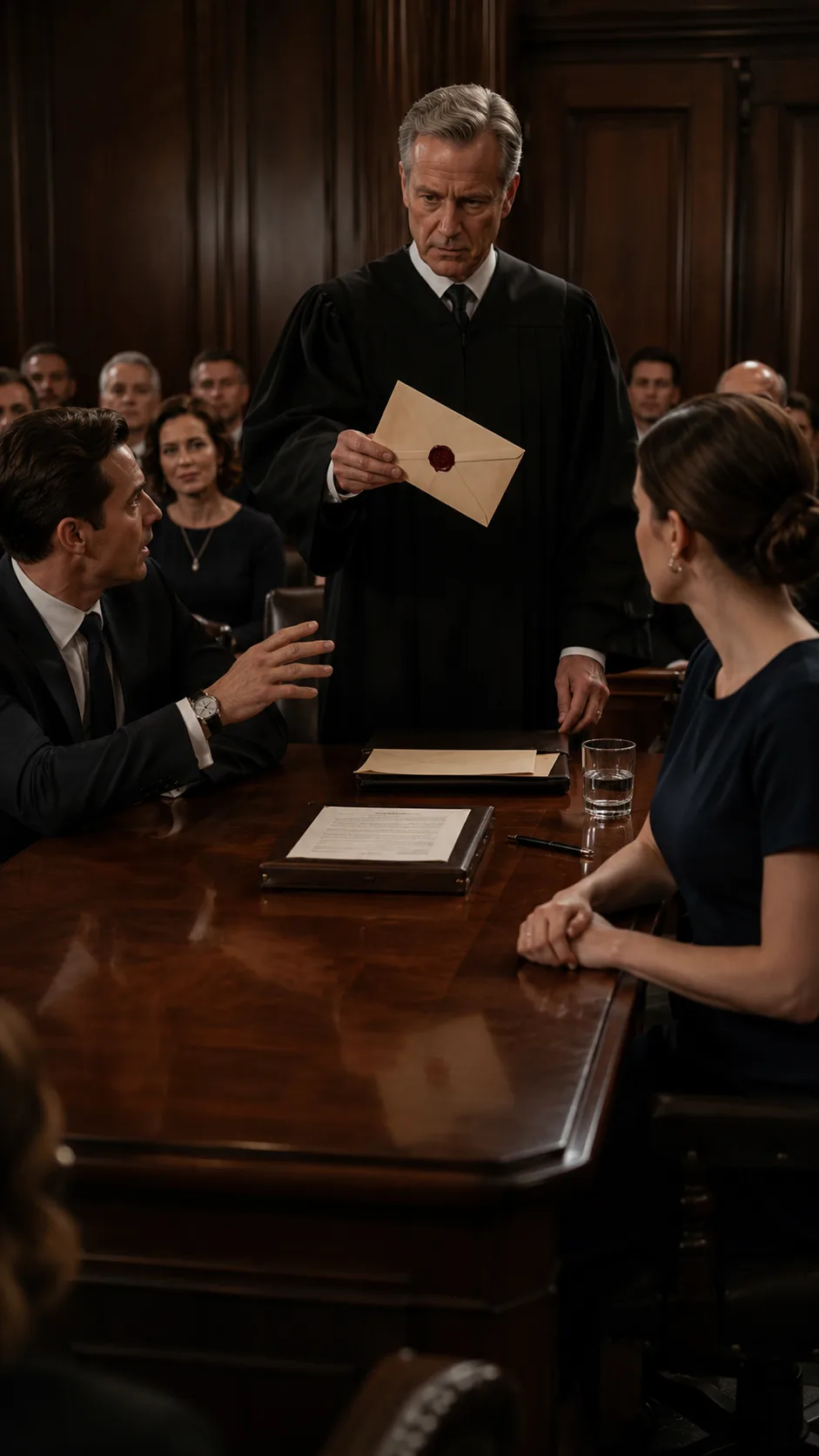
Brandon wore my father’s watch to probate court.
Chapter 1
Brandon wore my father’s watch to probate court.
Not the black suit. Not the polished shoes. Not the expression he had practiced in the mirror, the one that said grief had made him noble instead of impatient. The watch was what I saw first when I walked into Courtroom 4B and found my brother already seated at the family table, his left wrist angled toward the room as if he had earned the right to carry time itself.
Dad had worn that watch every Sunday.
He wore it to church when Mom was alive. He wore it to the company picnic every June, even after the company grew too big for picnic blankets and paper plates. He wore it the afternoon he taught me how to drive a stick shift in the back lot behind Keller Foods, his hand braced on the dashboard while I stalled the truck six times and tried not to cry.
Brandon used to
hate that watch.
He said it made Dad look old.
Now he sat beneath the courtroom lights with the watch face catching every flicker of attention, his fingers resting near a leather folder he had not brought but seemed determined to own.
I took the seat on the right side of the long legal table.
No one saved it for me. It was just the last chair left.
My younger sister, Melissa, sat two seats away from Brandon, her legs crossed at the ankle, pearl bracelet sliding down her wrist every few seconds. She had not looked at me since the funeral. Not properly. She had given me the same small nod she gave the florist, the minister, and the woman who delivered trays of sandwiches to Dad’s house afterward.
Aunt Carol sat behind Brandon. Uncle Ray beside her. Two cousins I had not seen in four years whispered near
the back row, dressed in black and smelling faintly of expensive cologne.
They all looked rested.
That was a strange thing to notice in a room built for loss.
Judge Whitman entered through the side door at exactly ten o’clock. He was not our father’s lawyer, but Dad had known him for decades through charitable boards, zoning disputes, and some old land preservation argument that had ended with both men laughing over coffee. He wore his robe like it was part of his body, not a costume. Silver hair. Straight posture. The kind of face that made people lower their voices without being told.
The clerk placed a stack of documents before him.
One thick folder.
One narrow folder.
One cream envelope.
I noticed the envelope because it was placed underneath the rest, half hidden, with only the corner visible.
Then the clerk slid the top folder forward, and the
corner disappeared.
Judge Whitman looked over the room. His eyes passed over each of us, pausing nowhere too long.
“This hearing concerns the final will and testament of Samuel Keller,” he said.
Brandon lowered his chin like the name belonged more to him than anyone else.
I folded my hands in my lap.
My right thumb pressed into the inside of my left wrist. An old habit. Dad used to tap that exact place when I was little and afraid of storms.
“Here,” he would say. “Count five beats. Then breathe.”
I counted five.
The judge began.
The main house on Greystone Drive went to Brandon.
Aunt Carol’s shoulders lifted once, like she had been waiting for permission to breathe. Brandon did not smile. That would have been too obvious. He only adjusted his cuff, letting the gold watch slide further into view.
The majority shareholding interest in Keller Foods went to Brandon, subject to board approval and certain conditions.
Melissa’s trust received the lake property and a separate investment account.
A college fund was created for two of our cousins’ children, which made both cousins sit up straighter.
A vintage car went to Uncle Ray.
Mom’s jewelry was divided between Melissa and Aunt Carol.
The cabin in Vermont went to a family charitable foundation Brandon controlled.
I waited for my name the way a person waits for a doorbell after already seeing headlights in the driveway.
The page turned.
Judge Whitman read three smaller bequests. A scholarship. A donation. A set of antique books to the town library.
Then he closed the folder.
The sound was soft.
Paper against leather.
A full life reduced to a table going quiet.
No one moved at first.
I looked at the closed folder. I looked at the judge. I looked at the empty space in front of me where there should have been something. A letter, maybe. A box. Dad’s fountain pen. The dented brass key to the lake cabin shed. A note in his square handwriting telling me he had not forgotten who sat beside him during the worst months of his life.
There was nothing.
Brandon leaned back.
A small breath came through his nose.
Not quite a laugh yet.
Then his mouth tilted.
Aunt Carol saw it and looked down at her purse. Uncle Ray rubbed the side of his face. Melissa’s pearl bracelet clicked once against the table.
Brandon tapped two fingers against the polished wood.
“Father finally knew who deserved everything.”
The words landed cleanly.
Not shouted.
Not dramatic.
Just sharp enough for the back row to hear.
My cousin Paul made a sound he tried to swallow. Aunt Carol’s lips pressed together, then loosened. Someone behind me shifted in the pew.
Brandon turned toward me.
“You should have managed expectations.”
I did not answer.
He liked answers. They gave him something to step on.
The judge had not risen.
That was the first thing that kept my hands from shaking.
The second was the clerk.
She reached beneath the bench and touched the narrow folder again. Not fully. Just enough to align it with the edge of the larger file.
Brandon was still looking at me.
“Dad was sentimental,” he said. “Not stupid.”
Aunt Carol whispered, “Brandon.”
It did not sound like a warning. More like a request to keep the cruelty tasteful.
My sister looked at her bracelet.
I lowered my eyes to the table and saw a scratch in the varnish near my right hand. Thin, pale, crescent-shaped. I wondered how many families had sat at this same table and watched blood turn into paperwork.
Judge Whitman opened the larger folder again.
Only one inch.
Brandon noticed.
His smile stayed, but it tightened at the corners.
“Your Honor,” he said, “is there a procedural matter?”
“There is an instruction.”
The judge’s voice did not rise.
Brandon’s fingers stopped tapping.
“From my father?”
“From Samuel Keller.”
Aunt Carol’s purse clasp snapped shut in her lap.
The judge lifted the narrow folder.
It was black leather, old, worn at the edges. I knew it before it fully cleared the bench.
Dad’s travel portfolio.
He had carried it on every business trip, every hospital visit where he insisted on reviewing invoices between scans, every meeting with suppliers who thought a man in his seventies would not notice rounded numbers.
Brandon leaned forward.
“That folder belongs with the company records.”
Judge Whitman looked at him over the top of his glasses.
“It was delivered to my chambers with sealed instructions.”
Melissa’s bracelet stopped moving.
My throat tightened, but my hands stayed folded.
The judge opened the travel portfolio and removed a cream-colored envelope.
Wax seal.
Dark red.
Unbroken.
The room seemed to lean toward it.
Brandon’s face changed before he spoke. Not much. A thinning around the mouth. A small pull in his jaw. The watch slipped beneath his cuff as his wrist bent.
“That’s not part of the estate file.”
Judge Whitman placed the envelope on top of the first will.
“It is part of your father’s instructions.”
“My father had one will.”
“One public reading,” the judge said. “And one conditional instruction.”
A cousin in the back row stopped whispering.
Brandon’s chair scraped back half an inch.
The sound made Clara Keller, age twenty-nine, daughter, caregiver, unpaid errand runner, emergency contact, and apparently legal stranger to everything her father owned, sit straighter without deciding to.
I did not mean to move.
My body did it first.
The judge turned the envelope so the wax seal faced upward.
Brandon stared at it.
He knew that seal. We all did. Dad used it on Christmas cards after Mom died, a ridiculous old-fashioned habit Melissa used to mock until recipients started posting photos of the envelopes online. The seal had a tiny oak tree pressed into the wax. Keller roots, Dad used to say, though Brandon once told him it made the family look like a vineyard label.
I remembered Dad sealing one envelope at the kitchen table six months before he died.
I had brought him tea.
Chamomile. Too much honey.
He covered the page with his hand when I came in, not quickly, not like he was hiding guilt. More like he was protecting a prayer before it was finished.
“Work?” I had asked.
“Family,” he said.
Then he smiled in that tired sideways way and asked me to find the blue blanket from the dryer.
I forgot about it.
Or I told myself I did.
Brandon reached toward the envelope.
Not fast.
That would have made him look guilty.
He extended his hand as if correcting an administrative mistake, his palm open, his expression pulled back into control.
The bailiff moved.
One step.
That was all.
A tall man in a navy uniform, quiet until that second, shifted closer to the table. He did not touch Brandon. He did not need to.
Brandon’s hand stopped above the envelope.
“Counsel should review that before it’s opened,” Brandon said.
“You are not counsel,” Judge Whitman said.
“I represent the primary beneficiary.”
“No,” the judge said. “At this table, you represent yourself.”
The first real silence arrived then.
Not the respectful kind.
The kind with teeth.
Melissa looked at me for the first time that morning. Her eyes moved from my hands to my face, then away again before I could decide whether there was regret there or just calculation.
Judge Whitman picked up a small silver letter opener.
The blade slid beneath the wax seal.
A tiny crack.
Aunt Carol flinched.
I watched Brandon watch the envelope.
His throat moved once.
Judge Whitman opened the flap and pulled out a folded document. Only one page at first. Then another. Then a smaller note, handwritten, which he set aside without reading aloud.
Brandon pointed at it.
“What is that?”
The judge did not answer him.
He unfolded the first page and smoothed it against the table.
I saw the top line, but not enough to read. The paper was thick. Cream. Dad’s kind of paper. He always said cheap paper made serious words feel temporary.
Judge Whitman adjusted his glasses.
“The document I am about to read was executed by Samuel Keller eight months before his passing and witnessed by two independent parties.”
Brandon’s face went still.
Eight months.
That was before the first infection. Before the second surgery. Before Brandon started telling people Dad was confused on bad days. Before Melissa stopped answering hospital texts unless they involved signatures.
Uncle Ray leaned forward.
Judge Whitman continued.
“This document does not revoke the prior instrument. It supplements it pursuant to the conditional instruction attached.”
Brandon’s hand curled into a fist.
“What condition?”
The judge turned one page.
“The conduct of the heirs during the public reading.”
No one moved.
Not even Brandon.
I felt my pulse in my wrist, under my thumb.
Five beats.
Then breathe.
Judge Whitman read the next line.
“My children will hear a distribution that favors those who have asked most loudly. Before any final transfer is made, the court shall observe whether they respond with dignity or with greed.”
Aunt Carol’s face lost color from the cheeks down.
Melissa’s lips parted.
Brandon gave one short laugh.
Too late.
“That’s absurd.”
Judge Whitman kept reading.
“If any heir uses the first reading to degrade, mock, threaten, or pressure Clara Anne Keller, then that conduct shall satisfy the condition described below.”
My name entered the room like someone opening a locked window.
Clara Anne Keller.
Full name.
Dad only used my full name when he wanted me to stop pretending I was fine.
Brandon turned toward me.
For half a second, he looked twelve years old again, standing in the pantry with chocolate on his mouth and telling Dad I had eaten the missing cake.
Then the man in the tailored suit came back.
“This is theatrical,” he said.
The judge looked up.
“It is legal.”
Brandon’s mouth closed.
The relatives behind him had gone silent. One cousin lowered his phone into his lap, screen dark. Aunt Carol’s purse sat open now, lipstick and tissues visible inside. Melissa’s hand had tightened around her bracelet so hard the skin beneath her fingers turned pale.
Judge Whitman lifted the second page.
“The true controlling distribution shall therefore proceed as follows.”
Brandon stood.
The chair knocked the table leg.
Not hard enough to fall.
Hard enough for everyone to hear.
“Your Honor, this has to be reviewed.”
“It has been.”
“By whom?”
“By this court.”
Brandon’s eyes flicked to the document.
Then to me.
Then to the bailiff.
The room had changed shape around him. He was still standing, still in the expensive suit, still wearing our father’s watch, but the center had moved. It no longer sat beneath his hand.
It sat under Judge Whitman’s palm.
On cream paper.
With Dad’s signature at the bottom.
I saw it then.
Not clearly enough to read every word.
But enough to know the slant of the S. The long cross on the t. The slight pressure at the end of Keller where his hand had always dragged lower after the arthritis worsened.
Dad.
My fingers loosened in my lap.
Judge Whitman turned the page slightly toward me.
Brandon saw the direction of the movement and reacted before he could hide it.
His hand shot forward.
The bailiff stepped in front of him.
“Sit down, Mr. Keller.”
Brandon did not sit.
He stared at the judge.
The watch was fully visible now.
It looked too large on his wrist.
Judge Whitman read.
“All company voting shares, real property, personal accounts, and controlling interests not specifically assigned to charitable trusts shall pass to Clara Anne Keller.”
A sound came from the back row.
Not a gasp. Smaller. Someone taking in air and forgetting to let it out.
Melissa’s bracelet slipped from her hand onto the table.
The pearls scattered in a short white line.
Nobody reached for them.
Judge Whitman continued.
“This transfer is made not as reward for silence, but as recognition of stewardship already performed.”
Stewardship.
Dad’s word.
He had used it in the kitchen the night Brandon argued that selling the north warehouse would free capital for expansion.
“You don’t own what feeds people,” Dad had said. “You steward it.”
Brandon had rolled his eyes.
I had been washing dishes.
I remembered the soap drying on my wrists.
I remembered Dad looking at me after Brandon left, like there was something he wanted to say but could not yet trust the room with it.
The judge laid the document flat.
“Samuel Keller further states that any beneficiary who attempts to interfere with this conditional transfer shall forfeit all discretionary gifts under the first instrument.”
Uncle Ray sat back.
Aunt Carol closed her purse.
Melissa looked at Brandon.
Not at me.
At Brandon.
That was when I understood how much of their confidence had been borrowed from him.
Brandon’s mouth opened.
No words came.
For a man who had always known what to say in front of a room, the absence was almost louder than the reading.
Then he found something.
“That is not what that document means.”
It came out low.
Too low.
Judge Whitman removed his glasses.
“Mr. Keller, your father anticipated that response as well.”
Brandon’s face shifted again.
The judge picked up the handwritten note.
He did not unfold it yet.
“This was written in your father’s own hand and attached only to the court copy.”
My aunt pressed one hand to her necklace.
Melissa whispered, “Brandon.”
He did not look at her.
Judge Whitman unfolded the note.
The paper made the smallest sound.
I heard it anyway.
The judge read.
“Clara will not fight them. She never has. That is why this must be done where everyone can hear it.”
My eyes dropped to the table.
The scratch in the varnish blurred for one second, then sharpened again.
I did not cry.
I did not give them that.
The judge continued.
“If my son laughs, if my family joins him, if they show her that kindness counted for nothing, then let the record show they have answered the question I could not ask while alive.”
Brandon stepped back from the table.
Only half a step.
But everyone saw it.
The bailiff did not move this time.
He did not need to.
Judge Whitman lowered the note.
A clock ticked above the door.
The courtroom had one of those old government clocks with a second hand that moved too loudly, like time itself had been called as a witness.
Tick.
Tick.
Tick.
Aunt Carol was the first to look at me directly.
Her face tried to arrange itself into something soft.
It failed.
Melissa stared at the pearls scattered across the table, each one separated from the next, the string invisible now that it had broken.
Brandon looked at the watch.
Then at the judge.
Then at me.
He did not apologize.
That would have required him to understand who he had been apologizing to.
Judge Whitman slid the second document toward the center of the table.
“Ms. Keller,” he said.
I almost turned around.
Nobody called me that in the family. I had been Clara, Claire, sweetheart when Dad was tired, the responsible one when someone needed a key, the dramatic one when I said I could not keep doing everything alone.
Ms. Keller belonged to someone else.
Someone with legal standing.
Someone seated at the table on purpose.
I lifted my hand and placed it beside the document.
Not on it.
Beside it.
The paper did not need me to grab it.
It had already arrived.
“Yes, Your Honor,” I said.
My voice sounded like it came from the room, not from my chest.
Judge Whitman nodded once.
“The court will enter the supplemental instruction into the record.”
Brandon sat down.
Slowly.
No one told him to.
His chair made no sound this time.
The rest of the hearing continued in pieces. The judge spoke to the clerk. The clerk confirmed filings. Terms were read. Dates were set. Words like executor, transfer, injunction, and fiduciary moved through the room like furniture being rearranged in a house after someone died.
I heard all of it.
I understood most of it.
But what I remember most is Brandon’s hand covering the watch.
Not removing it.
Not giving it back.
Just covering it.
As if hiding Dad’s time from the room might still protect him from what Dad had seen.
When the judge rose, everyone stood except Aunt Carol, who fumbled with her purse strap before pushing herself up. The cousins left quickly, all murmurs and avoided eyes. Uncle Ray paused near Brandon, then chose the aisle without touching his shoulder.
Melissa stayed.
She gathered the loose pearls one by one from the table.
Her fingers shook on the last two.
I did not help her.
That felt cruel for about three seconds.
Then it felt honest.
Brandon remained seated, staring at the closed first folder. The folder that had given him everything for twelve minutes.
Twelve minutes was longer than some people deserved.
Judge Whitman stepped down from the bench after the room had thinned. Without the height of the bench between us, he looked older. Not weak. Just human.
He carried the handwritten note in a clear protective sleeve.
“Your father asked that you receive this privately after the record was made,” he said.
I took it with both hands.
The paper inside had one crease down the middle.
Dad’s handwriting crossed the page in dark blue ink.
Clara,
If you are reading this, they showed you who they were before the court showed them who you are.
I am sorry I could not protect you from that moment.
I needed the truth to happen in a room no one could rewrite.
You were never forgotten.
You were trusted.
Dad
I read it once.
Then again.
The second time, I noticed a small tea stain near the bottom left corner.
Chamomile, probably.
Too much honey.
I pressed the sleeve flat between my palms and looked toward the table.
Brandon was watching me now.
For the first time all morning, he looked less like someone deciding what he owned and more like someone counting what had just moved out of reach.
“You knew?” he said.
I almost laughed.
Not because it was funny.
Because after all of that, he still needed me to be the villain in the only version of the story he could survive.
“No,” I said.
One word.
It was enough.
Melissa approached me near the aisle, pearls cupped in one hand.
“Clara,” she said.
I stopped.
She looked at the note in my hand, then at the courtroom doors.
“I didn’t laugh.”
I looked at her palm.
At the broken bracelet.
“No,” I said. “You waited to see who won.”
Her fingers closed around the pearls.
She did not follow me out.
The hallway outside Courtroom 4B smelled like floor wax and old paper. A vending machine hummed near the elevators. Two lawyers argued quietly beside a bulletin board covered with notices no one was reading.
Life continued in government beige.
I stood near the window at the end of the hall and opened Dad’s note one more time.
The city looked gray below.
I could see the corner of Greystone Avenue from there, the road that led eventually toward the house Brandon had been so sure would be his. The house where I had slept on a couch beside Dad’s hospital bed because the nurse said he sometimes woke confused after midnight. The house where Melissa visited once with flowers and left before the vase was filled. The house where Brandon held meetings in the dining room while Dad slept upstairs and told investors he was “handling the transition.”
Handling.
That was Brandon’s favorite word.
He handled grief by scheduling it.
He handled family by ranking it.
He handled me by assuming I would keep showing up even when there was nothing promised at the end.
Dad had known.
That did not make the morning painless.
It made it witnessed.
Three weeks later, the first formal transfer papers arrived.
I signed them in Dad’s old study.
The room still smelled faintly of cedar and dust. The shelves held tax binders, supplier gifts, framed photos, and a ceramic mug I had made in sixth grade with Keller Foods painted badly on one side. Dad had kept it behind his desk for seventeen years, cracked handle and all.
The company lawyers were careful with me at first. Too careful.
People speak differently to an heir than to a daughter who answers medication alarms.
They said “Ms. Keller” a lot.
They explained things slowly, then stopped when they realized I already knew where half the missing operational files were because I had been the one bringing them to Dad’s bed for review.
I did not fire Brandon immediately.
That surprised everyone.
It surprised Brandon most.
He arrived at the first board meeting after probate wearing a different watch.
Silver.
New.
Too bright.
I sat at the head of the table because the bylaws said I could, and because Dad’s empty chair at home had taught me that avoiding a seat does not make it less yours.
Brandon waited until the board secretary finished reading minutes before speaking.
“For the sake of continuity,” he said, “I’m prepared to remain in an advisory capacity.”
Several board members looked down.
One coughed into his hand.
I opened the folder in front of me.
Not the black travel portfolio. That stayed at home.
This one was plain blue, with clean tabs and no drama.
“No,” I said.
Brandon blinked.
I slid one page across the table.
“Your consulting access ended this morning.”
His jaw tightened.
“You are making a mistake.”
“Maybe.”
The room waited.
I placed Dad’s fountain pen beside the paper.
“But it will be mine.”
No one laughed.
Brandon did not sign at first. He stared at the page as if the words might rearrange themselves into a version where he still mattered most.
Then he picked up the pen.
His signature looked smaller than Dad’s.
After that, things did not become simple.
Stories like ours never do.
Aunt Carol called twice. I let both go to voicemail. Uncle Ray sent a note, handwritten, apologizing for “not understanding the full context.” I placed it in a drawer and did not answer for nine days.
Melissa asked to meet for coffee.
I chose a place with paper cups and no family history.
She came without pearls.
We sat near the window while rain tapped the glass.
“I should have said something,” she said.
I stirred my coffee, though I had not added sugar.
“Yes.”
She looked at me.
That was all I gave her.
No comfort. No speech. No door slammed for effect.
Just enough truth to make her sit with it.
Brandon fought the transfer for four months through motions, letters, and calls to people who no longer returned them quickly. Each attempt ended the same way: with Dad’s second envelope entered into record, with witness signatures, with Judge Whitman’s order, with Brandon’s own words from the hearing noted in transcript.
Father finally knew who deserved everything.
He had said it himself.
By winter, the Greystone house was mine.
I did not move in right away.
I changed the locks first.
Not because I wanted to keep everyone out forever.
Because for once, entering my father’s house needed to require permission from me.
The locksmith was a quiet woman with silver rings on every finger. She worked fast, humming under her breath. When she handed me the new keys, they were warm from the machine.
“Big house,” she said.
“Yes.”
“Good luck with it.”
I looked at the brass key in my palm.
Not shiny. Not symbolic. Just a key.
“Thank you,” I said.
Inside, the house was colder than I remembered. Brandon had removed some paintings from the hall before the court order froze the property, leaving pale rectangles on the walls. Melissa’s old room still had a cracked switch plate. Dad’s study still held the chair with one loose wheel.
I found the blue blanket folded in the laundry room.
The same one he had asked me to get the day he sealed the envelope.
I carried it to the study and placed it over the back of his chair.
Then I sat behind his desk.
For a long time, I did nothing.
No calls.
No papers.
No plans.
The afternoon light moved across the floorboards, slow and gold, touching the edge of the desk, the old mug, the empty space where Dad’s watch used to rest when he worked late.
I opened the top drawer.
Inside was a small velvet box I had missed before.
Not hidden.
Just waiting.
The watch was not there.
Of course it wasn’t.
But Dad’s old cufflinks were. Plain silver. Scratched at the edges. The ones he wore on ordinary workdays, when nobody important was coming and he still dressed as if the warehouse deserved respect.
A note sat beneath them.
One line.
For the days you build quietly.
I closed my hand around the box.
Outside, a car passed through wet leaves on the street. Somewhere in the walls, the old heating system clicked to life, stubborn and imperfect and still working.
I did not need the watch.
I had the time.
Chapter complete
You have reached the end of this chapter.
Continue reading
A few more worlds to get lost in after this chapter.