My mother folded the hospital bill into a square small enough to hide under her saucer.
Chapter 1
My mother folded the hospital bill into a square small enough to hide under her saucer.
I saw the corner of it before she moved her hand.
Blue ink.
A Montana address.
She kept stirring her tea long after the sugar had dissolved, the spoon tapping the side of the cup in small, uneven beats. My brother Alan was talking about insurance premiums from the other side of the kitchen table, waving a fork like he had won a trial instead of burned another Sunday lunch.
Mother did not look at him.
She never did when he used that tone.
“Medicare doesn’t cover secrets,” Alan said.
The fork stopped moving.
My sister Denise looked up from her phone. My wife Claire leaned back in her chair and crossed one ankle over the other. Caleb, my nephew, stood at the sink rinsing plates that were already clean.
Too clean.
My mother slid her saucer half an inch to the left. The folded paper disappeared beneath it.
“I
don’t have secrets,” she said.
Alan laughed once.
No one joined him.
My mother’s name was Margaret Carter, though almost everyone in our family still called her Mom, even the in-laws who had earned that right and the ones who had not. She was sixty-six then, silver hair brushed straight to her shoulders, small hands, careful steps, and a way of listening that made careless people talk more than they should.
She lived in the same Montana house my father had painted yellow when I was eight. The paint had faded into the color of old butter, but she kept the porch swept and the curtains washed. The mailbox leaned after every winter. She straightened it every spring.
That was her way.
Fix it quietly.
Four years before that Sunday, she had disappeared for three weeks.
No warning.
She had told us she was going to visit an old friend
near Billings. Then she stopped answering calls for days at a time. When she came back, she was thinner, pale around the mouth, and moving like each step had been negotiated in advance.
We asked.
She gave us the same answer every time.
“It was personal.”
At first, we accepted it. My mother had always been private. She once drove herself to urgent care with a broken wrist because she did not want to “make a production.” She mailed birthday cards two weeks early and refused to discuss her blood pressure at dinner.
But three weeks became a story. The story became a suspicion. Suspicion, in our family, always found Alan first.
He said she was hiding a diagnosis.
Denise said maybe she had borrowed money.
Claire said it was strange for an older woman to vanish unless there was a man involved.
I told them to leave it alone.
I said that twice.
Not enough.
The only person who never asked was Caleb.
He was twenty-one when Mother disappeared, and by the time she returned, he had changed too. He stopped staying late at parties. He quit football at the community college. He took a job at a feed store outside Livingston and came by Mother’s house every Thursday with groceries.
He never explained that either.
Mother never asked him to.
On the Sundays when we gathered at her house, Caleb always helped in the kitchen. He carried heavy things before she could reach them. He opened jars. He shoveled the walkway. When Alan made a joke about Mother getting fragile, Caleb’s jaw tightened and he left the room.
Small things.
Nobody counted them.
That hospital bill under the saucer changed the shape of the day.
Alan saw it after lunch when Mother stood to refill the kettle. The saucer shifted. The folded corner slipped out. He reached across the table before anyone else moved.
“Alan,” Mother said.
Too late.
He unfolded the paper, smoothed it with both palms, and read the header.
“St. Agnes Regional Medical Center,” he said. “Bozeman.”
The kitchen went still.
Even the tap stopped.
Caleb had turned it off with one wet hand.
Mother stood by the stove, one hand on the kettle handle. Steam rose around her wrist.
“Give that back,” she said.
Alan read down the page. “This is from four years ago.”
Denise came around behind him. Claire leaned forward, her lipstick print still on the rim of her glass.
“What kind of procedure?” Denise asked.
Mother set the kettle down without pouring.
“It was personal.”
Alan held up the bill. “You keep saying that like it ends the conversation.”
“It does.”
“No,” he said. “It doesn’t.”
Caleb dried his hands on a dish towel. Once. Twice. Then he folded it over the sink divider and stepped toward the hallway.
Alan saw him.
“Where are you going?”
Caleb stopped.
No answer.
Alan looked from the bill to Caleb, and something hard settled into his face.
“You know something.”
Caleb’s hand closed around the hallway trim.
Mother turned. “Leave him out of this.”
That was the first crack.
Not the bill.
Not the date.
The way she protected Caleb before anyone had accused him.
Alan noticed.
So did Claire.
Denise folded her arms and watched Caleb like he had become a locked drawer.
The rest of that afternoon broke into pieces. Alan took a photo of the bill before Mother could get it back. Denise tried to call the hospital, but of course no one would tell her anything. Claire sat in the living room with her phone low in her lap, typing faster than she spoke.
Mother washed teacups by hand.
One cup at a time.
I stayed beside her.
“You should tell them something,” I said.
She rinsed a spoon. “I told them enough.”
“They’re not going to stop.”
“No,” she said. “Alan never does.”
Through the kitchen doorway, Caleb stood near the coat hooks, his jacket half on. He looked at Mother. She shook her head once.
He stayed.
Two days later, Alan called a family meeting without calling it one. He sent a text to all of us, including Caleb.
Sunday. Mom’s house. 3 p.m. We’re clearing this up.
My mother did not reply.
Caleb did.
Can we not do this?
Alan answered in the group chat.
Then tell the truth.
No one typed for a long time.
I watched the dots appear under Caleb’s name and vanish three separate times.
Then nothing.
That week, the family turned my mother into a case file. Alan found old bank withdrawals from the same month she had disappeared. Denise remembered that Mother had missed her granddaughter’s spring recital. Claire said Mother had been taking pills from a bottle with the label scratched off.
“She’s hiding something big,” Claire said in our bedroom on Friday night.
I took my shoes off by the closet. “She’s allowed to have private medical records.”
“She lied.”
“She said it was personal.”
“That’s lying with nicer shoes.”
I looked at her.
She did not blink.
Claire had never liked silence unless she owned it. In every room, she knew where to stand, what to say, how to make people look at her. My mother made her nervous because Mother could sit through a whole accusation without giving away a handle.
On Saturday morning, I drove to Mother’s house alone.
The porch light was on though the sun was already up. A bag of potting soil sat unopened by the steps. The mailbox leaned again.
Inside, the house smelled like lemon cleaner and cold coffee. Mother sat at the dining table with a stack of envelopes in front of her. Not bills. Cards.
Birthday cards.
She was writing one to Caleb.
His birthday was seven months away.
“Planning ahead?” I asked.
She capped her pen.
“Some things are better done while your hands are steady.”
I stood behind the chair across from her. “Mom.”
She looked up.
I wanted to ask the same question Alan had asked, only gentler. I wanted to earn the answer by not sounding like him. But her eyes moved to the hallway before I spoke, toward the narrow closet where she kept winter coats and old wrapping paper.
The closet door was open one inch.
Inside, on the top shelf, I saw a corner of a gray hospital folder.
Montana blue label.
Mother followed my gaze.
Then she stood.
Not quickly.
She closed the closet door and rested her palm against it.
“David,” she said, using my name the way she did when I was twelve and about to lie badly, “don’t make me choose who gets hurt first.”
I let go of the chair.
Enough.
On Sunday, Alan arrived ten minutes early with Denise and Claire. Caleb arrived late, his truck tires crunching over gravel after everyone had already taken their places.
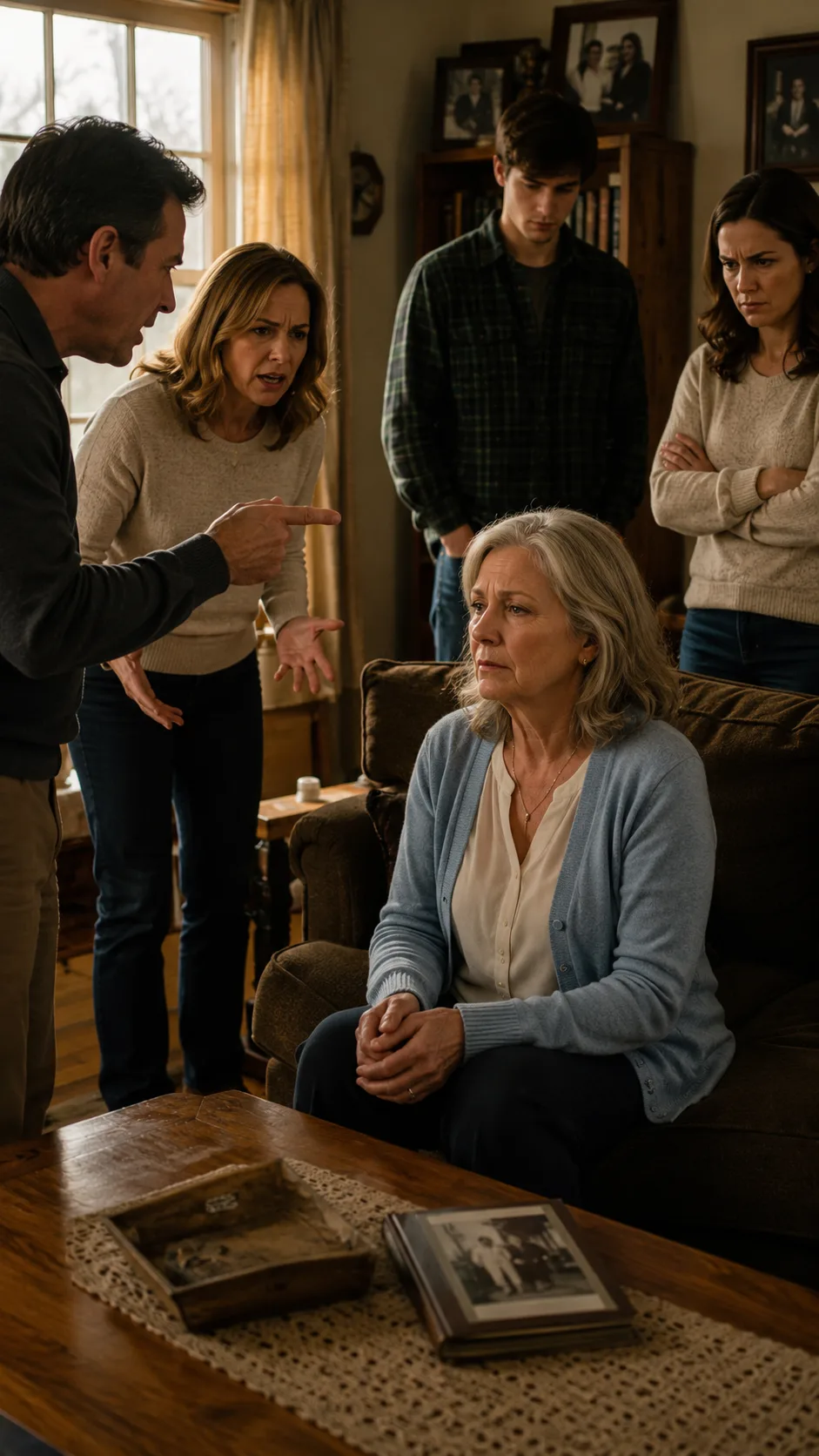
Mother had not changed anything in the living room. Same brown couch. Same crocheted runner on the coffee table. Same framed photo of my father in his fishing vest beside a ceramic dish full of wrapped peppermints nobody ate.
But the room felt arranged for judgment.
Alan stood near the fireplace, one elbow on the mantel, as if the house belonged to him because he was the loudest man inside it. Denise sat in the armchair by the window with her purse on her knees. Claire stood behind me, her arms folded, one thumb tapping her sleeve.
Caleb stayed near the bookshelf.
Half shadow.
Mother sat on the couch in her pale blue cardigan over a cream blouse. Her hands were folded in her lap. A small leather handbag rested beside her foot.
I noticed it.
Alan noticed the silence.
He filled it.
“We’re not here to attack you,” he said.
Mother looked at the coffee table.
The ceramic dish had one peppermint wrapper open at the edge. The candy inside had gone cloudy.
“No?” she said.
Alan pulled the folded bill from his pocket. He had printed the photo. Of course he had. “Then explain this.”
Mother did not reach for it.
Denise leaned forward. “Mom, we’re your children. We had a right to know.”
“A right,” Mother said.
Claire’s thumb stopped tapping. “People worry when someone disappears.”
Mother looked at her then. Just looked.
Claire adjusted her bracelet.
Alan put the bill on the coffee table, right beside the peppermint dish. “Four years. You let us think you were sick. You let us wonder if you were dying. You let Caleb run errands like your private nurse while the rest of us looked like fools.”
Caleb flinched at his name.
Small.
But enough.
Mother turned her head toward him.
Alan saw that too.
He pointed at Caleb. “You knew, didn’t you?”
Caleb stared at the floor.
“Answer me,” Alan said.
Mother’s hands separated in her lap.
“Leave him out of this.”
“No,” Alan said. “He’s in it.”
Denise looked between them. “Caleb?”
The old clock near the hallway clicked twice before he spoke.
“I promised.”
Alan pushed away from the mantel. “Promised what?”
Caleb swallowed. His hand went to his side, just below his ribs, then dropped.
I saw it.
So did my mother.
Claire stepped forward. “Oh my God. This is about him.”
No one corrected her.
The room tightened around those six words.
Alan turned on Mother. “What did you do?”
Mother reached down and lifted the leather handbag onto her lap. The brass clasp clicked open.
Nobody moved.
She took out the gray hospital folder I had seen in the closet. It was sealed with a white paper band, the corner softened from being handled too many times. Across the top was the hospital label.
St. Agnes Regional Medical Center.
Bozeman, Montana.
Alan’s mouth closed.
Mother set the folder on her knees first. Her palm rested flat over the label.
“For four years,” Alan said, quieter now, “you kept that in the house?”
She stood with care, holding the folder against her cardigan. Caleb took one step forward, then stopped when she glanced back.
Mother walked to the coffee table.
Three steps.
Four.
The floorboard near the couch gave its old complaint beneath her left foot.
She placed the folder in the center of the table.
Not beside the bill.
Over it.
Alan reached for it at once.
Mother’s hand came down on top of the folder before his fingers touched the seal.
“It was my surgery to tell,” she said.
No one spoke.
The refrigerator hummed from the kitchen. A car passed outside on the road, tires hissing over dust and gravel. Somewhere in the wall, the old furnace clicked like it was trying to start, though the house was already warm.
Alan withdrew his hand an inch.
Mother slid the folder toward him.
“Open it.”
He looked at Caleb first.
Caleb had moved from the bookshelf. He now stood behind Mother’s right shoulder, his face pale, one hand gripping the back of the couch.
Alan broke the seal.
Paper rasped against paper.
The first page came out folded. He opened it with the stiff impatience of a man who expected proof of someone else’s fault.
His eyes moved once across the header.
Then stopped.
Denise stood from the armchair. “What is it?”
Alan did not answer.
Claire came closer, heels pressing into the rug.
I could see the page from where I stood.
Donor compatibility report.
Margaret Elaine Carter.
Recipient: Caleb Thomas Carter.
My brother’s fingers tightened around the paper until the edge bent.
Denise took it from him.
She read the names.
Her purse slipped from the chair and hit the floor with a soft thud.
Mother sat back down on the couch. The movement was small, almost ordinary, as if she had only carried groceries too long. Caleb stepped beside her without being asked.
Alan looked at him.
This time, Caleb did not look away.
“What is this?” Alan said.
Mother opened the folder herself and removed another page. Surgical consent. Discharge summary. Follow-up restrictions. A photograph slipped out with the documents and landed near the peppermint dish.
Caleb in a hospital bed.
Younger.
Thinner.
Mother beside him in a gown, her hair tucked under a blue cap, her hand raised in a weak little wave at whoever had taken the picture.
I had never seen that photograph.
None of us had.
Mother touched the edge of it with one finger.
“My mother spent four years hiding a secret surgery from us,” I said, though I did not mean to say it out loud.
The sentence sat there.
No one picked it up.
Alan stared at the reports. “You donated a kidney?”
Mother kept her eyes on the photograph. “Yes.”
Denise pressed the paper against her chest like she needed both hands to hold it. “To Caleb?”
“Yes.”
Claire’s lips parted, but no sound came.
Alan turned on Caleb. “You let us accuse her?”
Caleb’s shoulders lifted once, then lowered. “She asked me not to tell.”
“Why would she ask that?”
Mother raised her head.
“I asked him to keep it quiet.”
Alan’s jaw worked. “Why?”
She looked at each of us then. Not quickly. Not pleading. First Denise. Then Claire. Then me. Last, Alan.
“Because he needed to live.”
Caleb covered his mouth with his hand.
Mother reached for him without looking. He took her hand and held it between both of his.
The room had belonged to Alan ten minutes earlier. His voice had filled it. His printed bill had sat on the table like evidence. His finger had pointed. His questions had arranged everyone else into witnesses.
Now he stood with the paper hanging from one hand.
No one looked at him.
Denise lowered herself back into the chair but missed the center of the cushion. The wooden frame creaked under her hip. Claire stepped backward until her heel touched the rug’s edge.
Alan looked down at the folder again.
The second page listed post-surgical limitations. No heavy lifting. Restricted travel. Follow-up care. Risk factors.
Four years of slow steps.
Four years of loose cardigans.
Four years of Caleb carrying grocery bags before she could reach them.
I remembered every joke we had allowed to pass.
Every one.
Mother drew her hand from Caleb’s and rested it against the left side of her abdomen beneath the cardigan. Not dramatically. Not for display. Just where the scar lived.
Alan saw the movement.
His face changed by inches.
“What happened to him?” Denise asked.
Caleb sat on the arm of the couch beside Mother. He did not ask permission.
“My kidneys were failing,” he said. “It got bad fast.”
Denise shook her head. “You were in college.”
“I left because I was sick.”
Alan still did not sit. “Why didn’t your father tell us?”
Caleb looked at the floor. “He couldn’t pay. He didn’t want anyone knowing how bad it got.”
His father was Alan’s ex-brother-in-law, a man our family had discussed only in practical complaints: missed child support, unpaid bills, promises broken in parking lots. Caleb had spent half his childhood passing between houses with a backpack and a careful face.
Mother had always kept a spare toothbrush for him.
I remembered that too.
Caleb touched the folder. “Grandma found out from a nurse at the dialysis center. She drove me to Bozeman. She got tested. Then she told me I wasn’t allowed to argue.”
Mother gave him a look.
For the first time that afternoon, his mouth almost moved into a smile.
Almost.
Alan set the donor report down. “You should have told us.”
Mother’s fingers closed around the edge of her cardigan.
“And then what?” she asked.
He opened his mouth.
She did not let him fill it.
“You would have told me I was too old. Denise would have called three doctors. Claire would have asked what it cost. David would have tried to drive me everywhere and forget he had a job.” She looked at me when she said it, and I had to lower my eyes. “And Caleb would have heard all of you discuss whether his life was worth the risk to mine.”
Caleb’s head dropped.
Mother squeezed his wrist.
“I was the donor,” she said. “Not the committee.”
Silence moved through the room by pieces.
First Denise stopped shifting papers.
Then Claire stopped touching her bracelet.
Then Alan stopped breathing through his nose like he was preparing another argument.
The old clock clicked again.
Mother gathered the documents into one stack, but she did not put them away. She left them in the open on the coffee table, the hospital label facing up, the photograph beside it.
Alan sat down at last.
Not on the couch.
On the wooden chair near the fireplace, the one with the loose rung.
It squeaked under him.
“You let me call you a liar,” he said.
Mother looked at the peppermint dish.
“You called me that on your own.”
He rubbed one hand over his mouth.
Denise leaned forward, elbows on her knees. “Mom, I didn’t know.”
“No,” Mother said. “You didn’t.”
Claire looked at me. I did not look back.
Caleb stood again and moved behind Mother’s chair, one hand resting lightly on the back of it.
Not hiding now.
Guarding.
Alan picked up the hospital bill, the one that had started all of this, and compared it to the donor report like the papers might change if he held them together.
They did not.
Mother reached for her handbag and took out a small envelope. She placed it beside the folder.
“What’s that?” I asked.
“Copies,” she said. “For anyone who needs proof before speaking again.”
No one reached for it.
The coffee on the side table had gone cold. A thin skin had formed across the top of Alan’s cup. The peppermint wrapper beside the folder lifted at one corner when the furnace finally started and pushed warm air through the floor vent.
Mother stood.
Caleb immediately moved, but she touched his arm to stop him.
“I’m making tea,” she said.
Denise rose too quickly. “Let me.”
Mother looked at her.
Denise sat down again.
Mother walked to the kitchen alone. We listened to the cabinet open, the kettle fill, the spoon clink once against ceramic.
Alan stayed in the chair by the fireplace with the reports on his knees.
He had built the afternoon like a trial.
He had not prepared to be the exhibit.
For several minutes, no one followed Mother.
Then Caleb went.
Not to help.
Just to stand in the doorway while she reached for the mugs.
I watched them from the living room. Mother took down five cups, then paused and took down a sixth. She set Caleb’s in front of him first. The same blue mug with a chipped handle he had used since he was thirteen.
He wrapped both hands around it.
Back in the living room, Denise picked her purse off the floor. She checked the clasp twice. Claire walked to the window and pulled the curtain aside though there was nothing to see except the leaning mailbox and the road beyond it.
Alan folded the donor report along its existing crease.
Mother came back with the tea tray.
She served everyone.
Even Alan.
Especially Alan.
He stared at the cup she placed in front of him.
“I don’t know what to say,” he said.
Mother straightened.
“Then don’t start with anything.”
He nodded once.
It was not an apology.
Not yet.
The family did not break apart that day with shouting. It broke by subtraction. Claire asked me for the car keys and waited outside. Denise hugged Mother too long in the hallway and left with red marks from the purse strap across her palm. Alan stood on the porch for nearly five minutes, one hand on the railing, before he drove away.
Caleb stayed.
I stayed too.
Mother collected the cups after everyone left. I tried to take the tray from her, but she gave me the kind of look that had ended arguments since I was a boy.
“Sit,” she said.
I sat.
Caleb dried the cups. Mother washed them. I watched the two of them move around that kitchen with the quiet rhythm of people who had already survived something together.
A private language.
A private cost.
When Caleb left after sunset, he kissed Mother on the forehead. He had not done that in front of us since he was little.
She locked the door behind him and stood with her hand on the knob.
The hallway lamp threw her shadow long across the floor.
“I would have helped,” I said.
She did not turn around.
“I know.”
“Then why not tell me?”
Her hand dropped from the door.
“Because helping is not the same as letting someone choose.”
I had no answer for that.
Outside, Caleb’s truck backed down the driveway. His headlights swept across the front window, over the framed family photo on the wall, across my father’s fishing vest, across the coffee table where the Montana folder still sat open.
Mother walked over and closed it.
She did not put it away.
In the weeks after, the family learned how to speak around the scar it had made. Alan called Mother every Tuesday and said practical things first. Gutters. Prescriptions. Snow tires. Then, one afternoon, he came by with a new mailbox post and installed it without announcing the favor to anyone.
Mother watched from the porch with a blanket over her knees.
The mailbox stood straight for the first time in years.
Denise began driving up every other Saturday with groceries she pretended were extras from her own pantry. Claire came twice, both times with store-bought muffins and careful sentences. Mother accepted the muffins. She did not eat them.
Caleb kept coming on Thursdays.
That did not change.
But now he came through the front door instead of the side. He brought his girlfriend one evening in May, a schoolteacher named Hanna who shook Mother’s hand and called her Mrs. Carter until Mother pointed to the blue mug on the shelf.
“Family uses cups,” Mother said.
Hanna used the blue one.
I started visiting alone more often. Not to interrogate. Not to repair everything at once. I fixed the loose rung on the chair by the fireplace. I replaced the porch bulb. I sat at the kitchen table while Mother wrote birthday cards too early.
One afternoon, I found the gray hospital folder in the bottom drawer of the dining room cabinet. Not hidden now. Filed between tax records and appliance manuals.
Ordinary paper.
Heavy paper.
Mother saw me looking and slid a roll of stamps across the table.
“Put one on Caleb’s card,” she said.
His birthday was still two months away.
I peeled off a stamp and pressed it into the corner of the envelope. My thumb stayed there an extra second, sealing nothing, holding everything in place.
On Caleb’s birthday, the whole family came to Mother’s house again.
No one mentioned the folder.
No one needed to.
Alan brought the cake. Denise brought candles shaped like numbers. Claire washed dishes without being asked and did not tell anyone she was doing it.
Mother sat at the head of the table, Caleb beside her.
When the candles were lit, Caleb looked down at the flames, then at her.
“Make a wish,” Denise said.
Caleb shook his head.
Mother reached over and tapped the table once with her finger.
He blew them out.
All at once.
After dinner, Alan carried the trash outside. Denise wrapped leftovers. Claire put the blue mug in the wrong cabinet, and Mother moved it back without a word.
Small things.
Better things.
Before I left, I stepped onto the porch and found Mother standing by the new mailbox post. The evening air smelled like cut grass and dust. She rested one hand on the wood, testing its steadiness.
“Alan did a good job,” I said.
She nodded.
The road was quiet. Caleb’s truck sat at the end of the driveway, tailgate down, Hanna laughing at something he had said. Inside the house, plates clattered, and Denise told someone not to use the good towel for the counter.
Mother looked smaller in the porch light.
Not weaker.
Just less hidden.
“Do you regret it?” I asked.
She kept her eyes on Caleb.
“No.”
One word.
Enough.
She turned back toward the house, moving slowly but without waiting for anyone to offer an arm. At the door, she paused and looked at the mailbox one more time.
Straight post.
Steady box.
Her hand touched the scar beneath her cardigan, so briefly I almost missed it.
Then she went inside.
The porch light stayed on.
Chapter complete
You have reached the end of this chapter.
Continue reading
A few more worlds to get lost in after this chapter.




