Claire Whitaker, the responsible daughter.
The reliable one.
The quiet wallet.
The one who answered calls at midnight, covered shortfalls, ordered flowers, drove people to appointments, fixed things that were not my fault, and apologized when other people felt embarrassed.
I had learned that role early.
Madison was the delicate one. The pretty one. The dramatic one. The one who needed “support.”
I was the steady one. The one who could “handle it.”
And for years, I had handled it.
I handled Madison’s missed car payments.
I handled Mom’s “temporary” mortgage gaps.
I handled Rick’s medical bills after he ignored three insurance notices.
I handled birthday dinners, Christmas gifts, family vacations I was barely thanked for, and emergencies that somehow always became mine.
But this time, I was standing in my own driveway, looking at the word chaos, while my little girl sat in the back seat wondering whether she had done something wrong by existing.
Something inside me went very still.
Not loud.
Not dramatic.
Just still.
I opened the message thread and typed:
Okay. I’ll cancel the food.
I hit send before I could talk myself out of it.
For almost a full minute, there was nothing.
Then the storm began.
Mom: Claire, don’t start.
Madison: Are you serious right now?
Rick: Bad timing. This is not the way to make a point.
I looked through the windshield at the quiet street. A neighbor’s dog barked once. Somewhere down the block, a garage door groaned open.
My phone kept buzzing.
I did not answer.
Instead, I searched for Bella Roma and called the restaurant.
A woman picked up on the third ring.
“Bella Roma, this is Priya speaking.”
“Hi, Priya. This is Claire Whitaker. I’m calling about the Madison Whitaker birthday reservation tonight.”
Her tone brightened. “Of course. Party of twelve at six thirty. Everything is ready. The cake arrived this morning, and the private package is set.”
I closed my eyes.
“I need to make a change.”
There was a pause.
“What kind of change?”
“I want to remove everything billed to my card.”
Another pause. Longer this time.
“You mean the prepaid catering package?”
“Yes.”
“That would include the appetizer platters, the family-style entrées, the decorated cake presentation, the private room service fee, and the birthday setup.”
“I understand.”
Priya lowered her voice slightly. “Do you still want the table held?”
“Yes. Keep the reservation. Just remove my payment information and cancel anything attached to my card.”
She was professional enough not to ask questions, but I heard the question anyway.
After a few seconds, she said, “All right, Ms. Whitaker. I’ll update it now. The guests may still order from the regular menu, but payment will be due at the restaurant.”
“That’s fine.”
“Would you like a confirmation email?”
“Yes, please.”
When I hung up, Lily was watching me from the back seat.
“Are we still going?” she asked.
I opened the back door and unbuckled her seat belt.
“No, baby.”
Her face fell, but she tried to hide it.
“Oh.”
I reached for the handmade card sitting beside her.
“We’ll keep this,” I said. “Maybe someday we’ll give it to someone who knows how much love went into it.”
She nodded, but her lower lip trembled.
I hated my mother for that.
Not for excluding me. I had been excluded emotionally long before that morning.
But Lily?
Lily had done nothing except love people who treated her like a problem.
I carried the cupcakes back inside.
We spent the afternoon at home.
I put the birthday gift in the hall closet. Lily changed out of her dress and into pajamas with tiny clouds on them. We watched a movie she had already seen ten times. She laughed in all the same places, but every now and then, I caught her looking toward my phone.
At six twenty, the first photo appeared online.
Madison in a champagne-colored dress, smiling like the world had been designed around her.
My mother stood beside her, one hand on Madison’s shoulder, looking proud and polished.
Rick held up a glass of red wine.
My aunt Carol commented under the picture:
Such a beautiful family evening. Happy birthday, Madison!
I stared at the photo for longer than I should have.
There was an empty chair at the far end of the table.
A chair with nothing in front of it.
No child’s menu.
No purple card.
No little girl in a lavender dress.
I put my phone face down on the kitchen counter.
“What do you want for dinner?” I asked Lily.
She shrugged. “Grilled cheese?”
“Grilled cheese it is.”
So that was what we had.
No candlelight. No velvet booth. No private dining room. No champagne dress.
Just tomato soup from a can, grilled cheese cut into triangles, and my daughter sitting cross-legged at the kitchen table, drawing stars on a sheet of construction paper.
At 8:47, my phone rang.
Mom.
I watched it vibrate against the counter until it stopped.
Then Madison called.
Then Rick.
Then Mom again.
The fifth call came from Madison, and when it ended, Mom called immediately after.
I finally answered.
Before I could say hello, my mother’s voice sliced through the line.
“Claire, what did you do?”
I leaned against the counter and looked toward the living room. Lily was coloring on the floor, her knees tucked under her.
“What are you talking about?” I asked.
“Your card isn’t going through.”
“My card isn’t attached to that reservation anymore.”
The silence on the other end was sudden.
Not quiet.
Dead.
Then I heard Madison in the background, sharp and panicked.
“What does that mean?”
Mom lowered her voice, the way she always did when she wanted to sound reasonable while being unreasonable.
“The bill is over nine hundred dollars.”
I let that number sit between us.
Nine hundred dollars.
For the dinner I had arranged.
For the table they had posted.
For the evening they wanted me to fund without attending.
“That sounds like something the people at the table should handle,” I said.
My mother inhaled like I had slapped her.
“Claire.”
“No.”
Rick’s voice came on next. He must have taken the phone from her.
“Listen,” he said, trying to sound calm. “This got out of hand. Every card we’ve tried has declined. The restaurant is being difficult.”
“The restaurant is asking you to pay for what you ordered.”
“We thought it was covered.”
“It was. Until you made it clear Lily and I weren’t welcome.”
In the living room, Lily looked up.
Her eyes met mine.
I turned away and lowered my voice, but not out of shame. Out of protection.
Rick said, “You’re really going to embarrass your family over a misunderstanding?”
“A misunderstanding?” I repeated.
Mom grabbed the phone back. “Madison was upset. She wanted one grown-up evening. You know how children can be.”
My body went cold.
Not angry.
Cold.
“Lily is not chaos,” I said.
My mother did not answer.
That silence told me everything.
I covered the phone with my hand and smiled softly at my daughter.
“No, sweetheart,” I said. “We’re not the chaos.”
Then I ended the call.
The phone rang twice more.
I powered it off.
And for the first time all day, the house became peaceful.
Not empty.
Not lonely.
Peaceful.
The refrigerator hummed. Rain tapped lightly against the kitchen window. Lily’s crayon moved across paper in small, steady strokes.
She did not ask another question for a while.
Then, without looking up, she said, “Is Grandma mad at us?”
I walked over and sat beside her on the floor.
“Grandma is having a hard night,” I said.
“Because of us?”
“No,” I said, and this time my voice was stronger. “Because of choices she made.”
Lily thought about that.
Then she picked up a blue crayon and filled in the roof of a little house.
I barely slept badly that night.
That surprised me.
I expected guilt. Panic. The old familiar twisting in my stomach. I expected to lie awake rehearsing apologies I did not owe, explanations no one would hear, compromises that would only make me smaller.
Instead, I slept deeply.
Like someone had opened a locked room in my chest and let the air in.
When I turned my phone back on at eight the next morning, the screen exploded.
Seventeen missed calls.
Eleven text messages.
Three voicemails.
My mother had written first.
How could you do that to us? Everyone was staring.
Madison followed.
You ruined my birthday. I cried in the parking lot. I hope you’re proud of yourself.
Rick’s message came later.
You crossed a serious line. We need to sit down and talk.
There were more.
Too many.
Each one was a different version of the same accusation.
I had embarrassed them.
I had made them look bad.
I had been cruel.
Not one message mentioned Lily.
Not one.
Then I saw a message from Aunt Carol, sent just after midnight.
I opened it.
Claire, I paid the restaurant. Priya explained that the prepaid package had been removed after you and Lily were disinvited. I am so sorry. I didn’t know. I would never have gone along with that. Your mother and I will be speaking. Please hug Lily for me.
I sat down slowly at the kitchen table.
Aunt Carol was not wealthy. She had taught fourth grade for thirty-two years and lived carefully on a pension, coupons, and discipline. She was generous, but she was not careless. Nine hundred dollars to her was not a minor inconvenience. It was medication money. Car repair money. Emergency money.
And my family had let her pay.
Of course they had.
Because when my card vanished, they simply looked for the next person with a conscience.
I was still sitting there when I heard tires grinding over the gravel at the edge of my driveway.
I looked through the front window.
Rick’s SUV pulled in fast.
My stomach did not drop this time.
My hands did not shake.
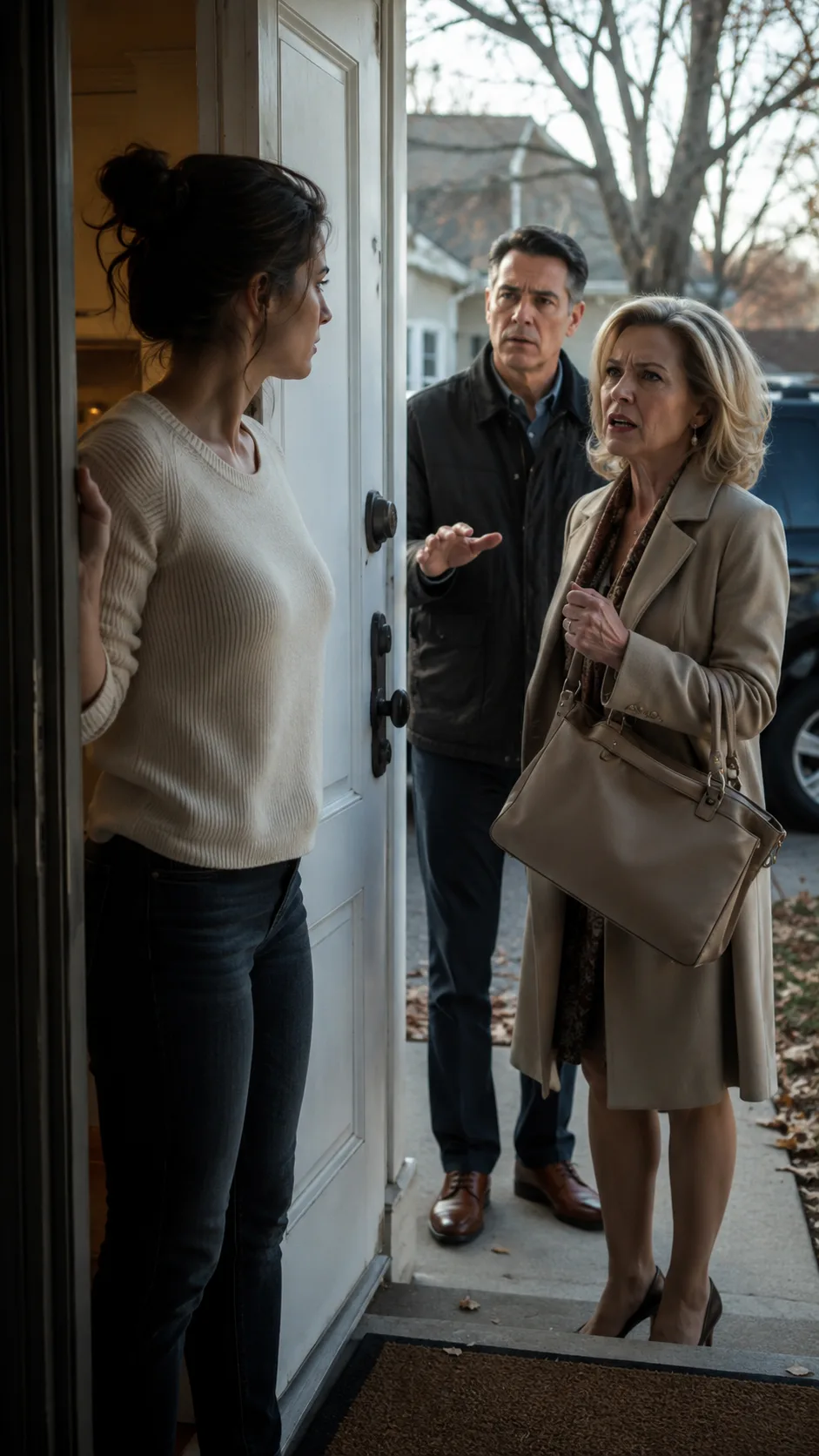
I walked to the door before they could knock.
My mother was already halfway up the front steps.
She looked perfectly dressed, because Diane Whitaker always looked perfectly dressed when she came to do something ugly. Her hair was styled. Her beige coat was belted at the waist. Her purse hung from her arm like armor.
Rick followed behind her, face tight, eyes avoiding mine.
I stepped onto the porch and pulled the door almost shut behind me.
Lily was still inside at the kitchen table.
She would not hear this.
My mother reached the top step and started immediately.
“You selfish, spiteful girl.”
There it was.
Not “Good morning.”
Not “Can we talk?”
Not “I’m sorry.”
Straight to the wound.
I leaned against the doorframe.
“Lower your voice,” I said.
That seemed to shock her more than anything else.
“You humiliated your sister in front of half the family,” Mom hissed. “Do you know what that felt like? Do you have any idea what you put us through?”
“Yes,” I said. “A dinner bill.”
Her mouth opened.
Rick stepped forward. “Claire, this doesn’t need to become uglier.”
“It became ugly when my daughter asked if she was chaos.”
My mother’s expression flickered.
For one second, something like discomfort crossed her face.
Then pride swallowed it.
“You are twisting my words.”
“No,” I said. “I’m finally hearing them clearly.”
“She’s a child,” Mom snapped. “Children can be disruptive. Madison wanted a nice evening. A mature evening. You should have understood that instead of turning it into some dramatic punishment.”
I stared at her.
The woman who had asked me to pay for the cake.
The woman who had reminded me twice to confirm the appetizer trays.
The woman who had told me Madison deserved to feel loved.
The woman who had looked at my daughter and decided she was the thing to remove from the picture.
“You didn’t want a mature evening,” I said. “You wanted a free one.”
Rick sighed loudly. “That’s unfair.”
“What part?” I asked. “The reservation I made? The deposit I paid? The cake I ordered? The catering package I covered? The decorations you approved after sending me three different photos?”
My mother’s face tightened.
“That was helping family.”
“No,” I said. “That was using me.”
Her eyes sharpened. “You have always been bitter about Madison.”
I almost laughed.
That old line.
The family emergency exit.
Any time Madison hurt someone, I was bitter.
Any time Mom favored her, I was jealous.
Any time I asked for basic respect, I was difficult.
“No,” I said quietly. “I was trained to keep paying so nobody had to admit Madison is irresponsible and you enable her.”
Rick’s hand lifted slightly. “Careful.”
I looked at him.
“Or what?”
He lowered his hand.
My mother’s voice cracked into outrage. “After everything I did for you?”
I nodded slowly.
“There it is.”
“What?”
“The bill you always bring out when I stop paying yours.”
Her face flushed.
“I raised you.”
“And I have been repaying that debt since I was sixteen.”
“That is a cruel thing to say.”
“What’s cruel is watching an eight-year-old girl make a birthday card and then letting her believe she was unwanted.”
Mom looked toward the door.
For the first time, she seemed to remember Lily was inside.
But instead of softening, she straightened.
“You should not have involved your daughter in adult matters.”
“You involved her when you called her chaos.”
“I did not mean it that way.”
“You meant it enough to send it.”
The porch went silent.
A car passed behind Rick’s SUV. Somewhere nearby, leaves scraped across pavement.
My mother looked at me like she was waiting for the old Claire to return.
The one who would exhale, apologize, smooth things over, offer coffee, promise to call Aunt Carol, maybe even send Madison money “just to end the drama.”
But that version of me felt very far away.
Maybe she had disappeared the moment Lily asked that question in the driveway.
Maybe she had been disappearing for years.
Either way, she was gone.
Rick cleared his throat.
“Claire, look. Last night was embarrassing for everyone. Carol had to cover a huge amount of money. Your mother cried all the way home. Madison was devastated. We need to fix this.”
“Great,” I said. “Here is how you fix it.”
Mom blinked.
I stood straighter.
“One: Aunt Carol gets repaid in full.”
Rick’s jaw tightened.
“Claire—”
“Every dollar,” I said. “Not half. Not later. Not when things calm down. All of it.”
Mom scoffed. “Carol offered.”
“No. Carol rescued you because that is what decent people do when other people create public messes.”
“She didn’t have to tell you,” Mom muttered.
That made my decision even easier.
“Two,” I continued, “you do not ask me for money again. Not for Madison’s rent. Not for her car. Not for your mortgage. Not for emergencies that are only emergencies because you ignored them for six months.”
Rick looked away.
Mom’s eyes widened. “So now you’re abandoning your family?”
“I’m resigning from a job I never applied for.”
“You sound ridiculous.”
“I sound awake.”
Her lips pressed together.
I could see her searching for the right weapon.
Guilt.
Shame.
History.
Family.
She had used them all before.
Finally, she chose the oldest one.
“Your father would be ashamed of you.”
The air changed.
Rick looked sharply at her, even he knew she had gone too far.
My father had died when I was twelve. My mother had spent the years after his death turning him into whatever argument she needed. If she wanted me obedient, Dad would be disappointed. If she wanted me generous, Dad would have helped. If she wanted silence, Dad would not have liked conflict.
I used to fold every time she said his name.
Not that morning.
“No,” I said.
My mother froze.
“You don’t get to borrow Dad’s voice anymore.”
Her face drained of color.
I stepped closer, just enough for her to hear every word without me raising my voice.
“My father would have opened the door for Lily. He would have pulled out her chair. He would have eaten a burnt cupcake if she made it with love. He would not have let a child sit in a car wearing a party dress and wonder if she was too much.”
Mom’s mouth trembled, but whether from guilt or rage, I didn’t care.
“Do not use him against me again.”
For once, she had no reply.
Rick shifted his weight. “This is getting out of control.”
“No,” I said. “This is the most controlled I have ever been.”
I turned back to my mother.
“Three: until you apologize to me and to Lily, directly and without excuses, you do not call me. You do not text me. You do not come here. You do not send Madison to cry at me. You do not tell relatives half a story and expect me to stay quiet.”
Mom gave a sharp, bitter laugh.
“Oh, so now there are rules?”
“Yes.”
“I am your mother.”
“And I am Lily’s.”
That shut her up.
For a moment, the only sound was Rick breathing through his nose.
Then Mom whispered, “You are really going to throw away your family over a restaurant bill?”
I looked at her.
All my life, she had named things incorrectly.
Control was concern.
Favoritism was sensitivity.
Using me was family.
Excluding my daughter was sophistication.
And now she wanted to call my boundary a betrayal.
I opened the door behind me.
Warm air brushed my back.
Inside, Lily’s small voice drifted faintly from the kitchen. She was singing to herself while she colored, completely unaware that her grandmother was standing six feet away trying to rewrite her hurt.
I looked at my mother one last time.
“No,” I said. “I’m throwing away the chaos.”
Then I stepped inside and closed the door.
Not slammed.
Closed.
Firmly.
The deadbolt turned with a clean, final click.
My mother knocked once.
Then again.
I did not answer.
Rick said something I could not hear.
A minute later, footsteps moved down the porch steps.
The SUV doors opened.
Closed.
The engine started.
And then they were gone.
Lily appeared in the hallway holding a picture.
It was a house with two people inside and a giant pizza on the roof for some reason.
“Was that Grandma?” she asked.
I crouched in front of her.
“Yes.”
“Is she still mad?”
I looked at my daughter’s small face, at the way she was trying to understand adult cruelty without letting it become hers.
“She’s upset,” I said. “But that doesn’t mean we did anything wrong.”
Lily nodded slowly.
Then she held up the picture.
“This is us,” she said. “It’s our house. The pizza is because I got hungry.”
I laughed.
A real laugh.
The kind that loosened something.
“It’s beautiful,” I said. “Let’s put it on the fridge.”
Aunt Carol got her money back three weeks later.
She sent me a photo of a cashier’s check sitting on her kitchen table beside a mug that said Retired Teachers Know Everything.
Her message read:
Paid in full. Don’t worry about me. I’m proud of you.
I never asked how my mother and Rick managed it.
Maybe Rick borrowed against something.
Maybe Madison returned one of her designer bags.
Maybe my mother finally had to move money around instead of moving guilt onto me.
However it happened, Carol was repaid.
Madison did not apologize.
She posted vague quotes online for a while about “toxic people ruining milestones” and “family showing their true colors.” A few relatives liked them. A few did not.
Then Aunt Carol commented under one of them:
Some people confuse being loved with being funded.
The post disappeared within an hour.
My mother tried calling twice during the first week. I let both calls go unanswered.
Then she sent a message.
I hope you’re satisfied.
I deleted it.
Rick texted once.
Your mother is having a hard time.
I replied with one sentence.
So did Lily.
He did not answer.
Thanksgiving came six weeks later.
For the first time in my adult life, I did not ask what time dinner was.
I did not offer to bring sides.
I did not send money for groceries.
I did not coordinate who was picking up Grandma’s old serving dishes or whether Madison was bringing her boyfriend of the month.
My mother sent one message two days before the holiday.
Dinner is at four if you’re done punishing everyone.
I stared at it for a moment.
Then I blocked her number for the weekend.
On Thanksgiving morning, Lily and I slept late.
We made pancakes at ten. We stayed in pajamas until noon. We ordered the largest pizza the restaurant would deliver and built a blanket fort in the living room with every pillow in the house.
She chose the movies.
I chose not to check social media.
At one point, she crawled into the fort beside me with a slice of pizza on a paper plate and said, “This is better than fancy dinner.”
I looked at the blanket ceiling sagging above us, the crumbs on the carpet, the soft glow of the television, and my daughter’s peaceful face.
“You think so?”
She nodded.
“No one is mad here.”
That almost broke me.
But not in the old way.
Not the way my family used to break me.
This was different.
This was grief leaving the body.
I put my arm around her and kissed the top of her head.
“No,” I said. “No one is mad here.”
Later that night, after Lily fell asleep on the floor wrapped in a quilt, I sat in the quiet living room and thought about the word my mother had used.
Chaos.
For years, I thought chaos meant conflict. Raised voices. Hurt feelings. People not getting along.
But I had been wrong.
Chaos was not my daughter.
Chaos was not a boundary.
Chaos was not refusing to pay for people who had excluded me.
Chaos was a family system where love came with invoices, where respect depended on usefulness, where one child was protected from consequences and the other was praised for absorbing them.
Chaos was being invited only when a credit card was needed.
Chaos was a little girl in a lavender dress asking if she was the problem.
I looked over at Lily sleeping peacefully beside the remains of our blanket fort.
The house was warm.
The dishes could wait.
My phone was silent.
For once, no one needed saving.
For once, no one was making their crisis my responsibility.
For once, I was not holding up a table where there had never really been a seat for me.
And if that was what my mother called throwing away family, then maybe she was right.
I had thrown something away.
But it was not love.
It was not loyalty.
It was not my daughter’s chance at belonging.
I had thrown away the role they gave me.
The guilt.
The fear.
The endless unpaid bill of being the “good daughter.”
And in the quiet of my living room, with pizza boxes on the coffee table and my child asleep under a pile of blankets, I finally understood something that should have been simple from the beginning.
Peace does not always arrive softly.
Sometimes it sounds like a phone powering down.
Sometimes it looks like an empty chair at a restaurant table.
Sometimes it arrives as a locked front door, a deadbolt clicking into place, and a woman deciding she is done paying for people who only call her family when the bill comes due.
That Thanksgiving, there was no screaming.
No guilt.
No performance.
No perfect table.
No champagne dress.
No empty seat waiting to remind me what I was worth to them.
Just me.
Just Lily.
Just a quiet house.
And not one trace of chaos.
THE END.