arrangement strategic.
My mother called it sensible.
I called it a cage.
The night I refused, Richard did not shout at first. He simply stared at me across the dining room table, one hand resting beside his wine glass, and told me I was confused. When I refused again, his face hardened.
Within days, my accounts were frozen. My credit cards stopped working. My health insurance disappeared. My name was removed from documents I had helped prepare. Friends stopped answering calls after receiving invitations to parties my parents hosted without me. Relatives became strangely busy. My mother sent one text that said, You are making this harder than it needs to be.
Caroline, my younger sister, watched it happen.
She did not defend me.
A year later, she married Gavin herself.
Everyone called it loyalty.
I called it surrender.
I left with two suitcases, a phone full of silence, and one investor who had seen my work before my father tried to erase it. I spent years buying distressed buildings through companies no one connected to me. I learned which contractors lied, which bankers panicked, which cities were growing before wealthy people admitted they wanted to live there. I worked through hunger, humiliation, and exhaustion until rage stopped feeling like fire and became something colder.
Focus.
I bought what my father ignored.
I rebuilt what he dismissed.
I created trusts, holding companies, management groups, and acquisition firms layered so carefully that the Hale name never appeared near mine. By the time my parents decided I was dead, I was already more powerful than they knew.
Six months before the reunion, one of my companies purchased Azure Crest.
It was a private coastal resort built into the cliffs above the Pacific, the kind of place where wealthy families paid ten thousand dollars a night to pretend privacy was the same as peace. Glass walls overlooked the ocean. White stone terraces hung above the water. The ballroom had chandeliers imported from Italy and marble floors polished so brightly they reflected every lie spoken above them.
That was where my parents had chosen to host the Hale family reunion.
My mother believed she had pressured an anonymous luxury agency into giving her special treatment. She had no idea that agency belonged to me. She had no idea that every demand she made had been forwarded to my office.
Imported orchids.
A champagne wall.
Private security.
A grand ballroom podium.
Custom floral arrangements.
A dedicated staff team.
Ocean-view suites for fifty-one relatives.
She wanted a stage where Richard Hale could stand in front of the family and perform generosity.
I decided to give him one.
So when my mother told me not to come, I only nodded.
“I understand,” I said.
Her eyes narrowed, searching my face for weakness.
“Good,” she whispered. “We already buried you once.”
Then she turned away, heels clicking against the shelter floor, leaving behind the smell of perfume and contempt.
I watched the door close behind her.
For a moment, the shelter noise returned around me: trays moving, voices murmuring, soup being poured. Everything ordinary continued. But inside me, something shifted into place with the clean precision of a lock turning.
That night, I drove to Azure Crest.
The resort was glowing when I arrived, all glass and gold against the darkening ocean. Daniel Ross, my general manager, met me in the conference room overlooking the cliffs. Daniel had worked in luxury hospitality for twenty years and possessed the calm, unreadable face of a man who could handle billionaires, scandals, and drunken heirs without blinking.
He knew exactly who I was.
He also knew who my parents thought I was not.
We sat at the long glass table while the Pacific struck the rocks below. He placed the event folder in front of me and walked through every detail: guest arrivals, room assignments, dinner service, security placements, audio checks, billing authorization, and the evening program.
Then he slid the printed timeline across the table.
Welcome reception.
Family tribute.
Opening remarks by Richard and Eleanor Hale.
I stared at that line for a long time.
Family tribute.
The words were almost funny.
“What would you like changed?” Daniel asked.
I looked out at the ocean. The water was black now, restless beneath the moonlight.
“Nothing,” I said. “Just make sure the microphone works perfectly.”
Daniel’s expression did not change, but his eyes sharpened.
“Of course.”
I tapped one finger against the timeline.
“Tomorrow night,” I said, “I’m coming back from the dead.”
The next evening, the Hale family gathered inside the grand ballroom as if they had been born beneath chandeliers.
Fifty-one relatives sat at round tables covered in ivory linen. Silverware flashed beside crystal glasses. White orchids towered over each centerpiece. Waiters moved silently between chairs, pouring champagne that cost more per bottle than some families spent on rent. Beyond the glass wall, the Pacific rolled beneath the cliffs, dark blue and endless.
My father sat at the front table like a king.
Richard Hale wore a black tuxedo and the expression of a man already preparing his speech. My mother sat beside him in a silver silk gown, diamonds at her ears, one hand wrapped around a champagne flute. She smiled at relatives as if she had not stood in a homeless shelter the day before and called her living daughter a disgrace.
Caroline sat two seats away.
She looked beautiful in a pale dress, but tired in a way beauty could not hide. Her shoulders were too still. Her smile appeared only when someone looked directly at her. Gavin Mercer sat beside her with one arm draped over her chair like ownership.
Daniel stepped onto the small stage.
The conversations softened.
“Good evening,” he said into the microphone. “On behalf of Azure Crest, welcome to this private estate celebration. Our employer is honored to host the Hale family tonight. Before dinner continues, she would like to say a few words.”
A ripple of confusion moved through the room.
My father frowned.
My mother lifted her glass halfway to her mouth.
Then the side doors opened.
I walked in.
Not in an apron.
Not in borrowed clothes.
Not as the dead daughter they had invented.
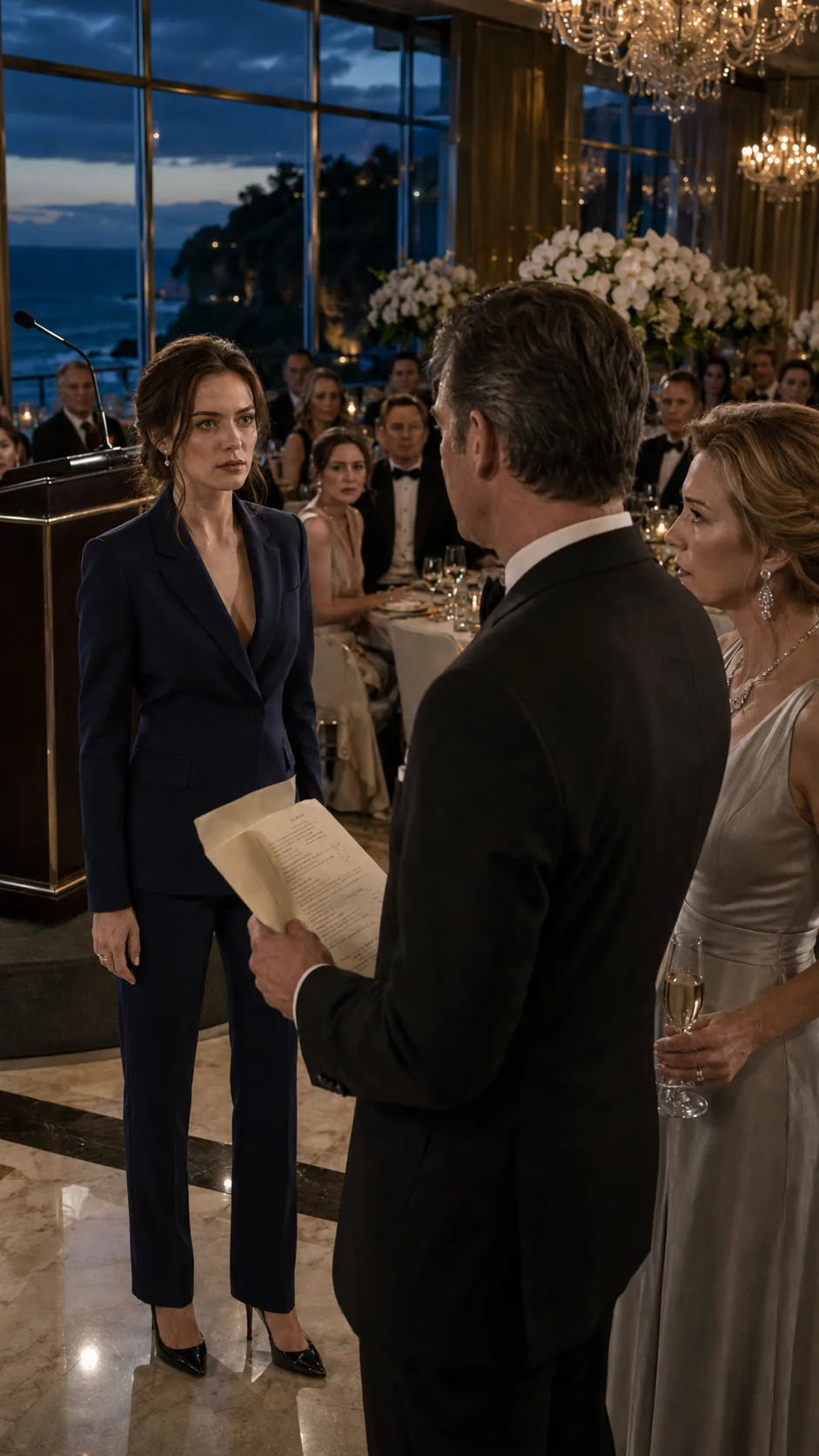
I wore a deep navy tailored evening suit, sharp at the shoulders, simple and expensive without needing to announce itself. My hair was swept back. My heels struck the marble with steady, deliberate sound. Every step seemed to pull more air from the room.
At first, no one spoke.
Then a cousin dropped a fork.
My mother’s champagne flute tilted sharply. A pale stream of champagne slipped over the rim and landed on her silk gown.
My father’s hand moved to the edge of the table and gripped it hard.
I climbed the stage and took the microphone from Daniel.
The room was silent now. Not polite silent. Afraid silent.
“My name is Victoria Hale,” I said. “And three years ago, my mother looked me in the eye and told me I was dead.”
A gasp came from the back of the ballroom.
Someone whispered, “Victoria?”
Another voice said, “But they said—”
“Yes,” I continued. “I know what they said. A car accident. A terrible tragedy. A clean little story that allowed everyone to avoid asking uncomfortable questions.”
I looked at my mother.
“No one had to ask why my accounts were frozen. No one had to ask why my name disappeared from family records. No one had to ask why a daughter who refused an arranged marriage was suddenly treated like an embarrassment instead of a person.”
My father stood.
He smiled.
It was impressive, really, how quickly he tried to regain control of a room that had already slipped out of his hands.
“Victoria,” he said warmly, spreading his arms. “This is an incredible surprise. Clearly there has been a terrible misunderstanding. Your mother and I were told certain things, and grief can create confusion. But look at you. You’ve done well. Very well. That resilience — that is a Hale quality.”
He began walking toward the stage.
He was already rewriting the moment. I could almost hear the version he planned to tell later. His lost daughter had returned. The family had healed. Azure Crest was proof of Hale strength. My success would become his achievement before dessert arrived.
“Stop there, Richard,” I said.
He froze.
Not because I yelled.
Because I used his name.
A shocked murmur passed through the tables.
“You do not get to touch this,” I said. “You do not get to claim it. You did not build me. You tried to bury me.”
His face tightened.
I turned toward the room.
“For five years, I worked under names none of you bothered to learn. I bought properties your companies rejected. I turned debt into leverage. I acquired assets through trusts your attorneys never traced. I bought pieces of businesses connected to Hale holdings while Richard was still telling people I had failed.”
My father’s expression changed.
Now he understood this was not only emotional.
It was financial.
“And six months ago,” I said, “I bought Azure Crest.”
The silence that followed was different.
Heavier.
My mother stared at me as if I had reached across the room and taken the bones out of her body.
“The suites you booked,” I said to her. “The imported orchids. The champagne wall. The security. The ballroom. The podium. Every email, every demand, every entitled correction you sent for months — all of it went through my staff. You were so busy ordering excellence that you never bothered to ask whose excellence you were buying.”
Eleanor stood so fast her chair scraped the marble.
“You did this to humiliate us?” she snapped, her voice sharp enough to cut through the room. “After everything we gave you?”
I stepped down from the stage.
“You gave me a funeral while I was still breathing,” I said. “Do not confuse exposure with cruelty.”
Daniel approached with a silver tray.
On it rested a single cream-colored envelope.
He stopped beside my father and held it out.
Richard snatched it from the tray and tore it open.
His eyes moved across the page.
“What is this?” he demanded.
“The final bill,” I said.
The room held its breath.
“The reunion package, suite upgrades, private service, security, imported flowers, premium alcohol, staff overtime, and the special family discount I personally approved. Total due tonight: four hundred and fifty thousand dollars.”
Aunt Lydia made a strangled sound.
One cousin whispered, “Four hundred and fifty?”
My father’s face went red.
“This is absurd,” he barked. “You cannot charge us like strangers.”
I looked at him for several seconds.
Then I said, “You told the world I was dead. I assumed you preferred not to have obligations to me.”
His jaw clenched.
“We are family.”
“No,” I said quietly. “We were a business arrangement. And I have opted out.”
For the first time in my life, Richard Hale had no answer.
I walked past him.
Past my mother, who was now trembling with rage and humiliation.
Past the aunts who had ignored my calls.
Past the cousins who had laughed about my exile.
Past Gavin, who could not quite meet my eyes.
Then I stopped beside Caroline.
She looked up at me, and for a moment I saw the girl she had been before our parents taught her silence was safer than truth.
I leaned down so only she could hear.
“There is a car waiting outside,” I whispered. “It will not take you back to Gavin. It will take you to an apartment in the city. The deed is in your name. If you want to stop being a ghost too, the door is open.”
Her lips parted.
Tears gathered in her eyes.
I did not ask for an answer.
Some doors have to be walked through alone.
I straightened and continued toward the ballroom exit.
Behind me, chaos finally broke loose. My father shouted Daniel’s name. My mother cried about scandal and betrayal. Relatives began arguing over who knew what, who owed what, and whether the bill could truly be enforced. Chairs scraped. Glasses clinked. Voices rose.
The Hale family had spent decades using money as a weapon.
Tonight, the weapon had changed hands.
I stepped through the grand double doors and out onto the terrace.
Cold ocean air wrapped around me. Below, waves struck the rocks with steady, brutal rhythm. The sky had gone dark, but the water still carried thin lines of silver moonlight.
For years, I had been the daughter they cast out, the disgrace they renamed, the ghost they invented because my survival made them uncomfortable.
But standing there above the Pacific, with their lies collapsing behind me, I no longer felt like a Hale tragedy.
I no longer felt like Richard’s failed transaction or Eleanor’s shame.
I was Victoria.
Alive.
Unowned.
And finally impossible to bury.
THE END.




