My Family Asked Me to Move My Wedding for My Sister—Until They Learned Who My Groom Really Was
Chapter 1: The Wedding They Tried to Take From Me
The first time my mother asked me to move my wedding, she did it while smiling.
Chapter 1
The first time my mother asked me to move my wedding, she did it while smiling.
That was what hurt the most.
Not the words themselves, though they were cruel enough. Not the timing, though my wedding was only six weeks away. Not even the fact that my sister, Brielle, was sitting right there at the dining table, pretending to study her phone while obviously waiting for my reaction.
It was my mother’s smile.
Soft. Reasonable. Almost tender.
As if she were asking me to pass the salt.
“Lena,” she said, folding both hands beside her untouched tea, “you know your sister’s engagement announcement is very important to us.”
I looked from her to my father.
Dad did not meet my eyes. He stood near the window with one hand in his pocket, staring out at the backyard like the maple tree had suddenly become fascinating.
Brielle was the only one who looked directly at me.
She wore a pale pink sweater, diamond studs, and the
expression she had always worn whenever she knew the room would bend around her.
Sweet on the surface.
Hungry underneath.
“My wedding is important too,” I said carefully.
My mother sighed, the way she always did when I forced her to say the unpleasant part out loud.
“No one said it isn’t.”
“But you want me to move it.”
“We are asking you to consider the family,” she corrected.
There it was.
The family.
In our house, “the family” usually meant Brielle.
When Brielle wanted my bedroom because it had better sunlight, I had been told to consider the family. When Brielle cried because I received a scholarship to a private university while she was waitlisted, I had been told not to “make a display” of my success. When she lost interest in ballet, my parents sold my piano to pay for her fashion program because her dreams were “fragile”
and mine were “practical.”
I had grown up learning that Brielle’s feelings were weather.
Mine were furniture.
Useful. Present. Easy to rearrange.
I sat very still at my parents’ mahogany dining table, the same table where I had celebrated birthdays with smaller cakes, graduations with shorter speeches, and achievements that were always softened so my sister would not feel left behind.
My fiancé, Adrian, was at work. He had offered to come with me that afternoon, but my mother had insisted it was “just family.”
Now I understood why.
If Adrian had been there, she never would have dared say it.
“What exactly are you asking?” I said.
Brielle finally lowered her phone.
“Don’t make it sound dramatic.”
I looked at her. “I’m asking for clarity.”
She gave a little laugh. “Fine. My engagement party is the same weekend as your wedding. Marcus’s parents are flying in from New York.
His grandmother is coming too, and she never travels. His family wants to meet everyone properly.”
“My wedding date has been set for eleven months.”
“I know,” Brielle said. “But things changed.”
I waited.
She smiled.
“I got engaged.”
For a second, all I could hear was the slow ticking of the clock above the china cabinet.
I had known Brielle was engaged. Of course I had. She had called everyone within ten minutes of Marcus proposing in front of a fountain downtown, complete with a photographer, violinist, and rose petals that had been arranged by a planner she swore she “had no idea about.”
I had congratulated her.
I had even sent flowers.
What I had not known was that she had decided my wedding weekend now belonged to her.
My father finally turned away from the window.
“Lena, your wedding is smaller. More intimate. You and Adrian always said you didn’t want anything too extravagant.”
“That doesn’t mean it’s disposable.”
“No one is saying that,” my mother said quickly.
I stared at her.
“Then say what you mean.”
Silence.
That was another thing my family was good at.
Silence until I filled in the painful parts for them.
But I was tired.
So I let the silence sit.
It stretched across the table until even Brielle became uncomfortable.
Finally, my father spoke.
“We think you should postpone the wedding by a few months.”
A strange calm went through me.
Not peace.
Something colder.
“By a few months,” I repeated.
“It would give everyone breathing room,” Mom said. “Your sister could have her engagement weekend, and then later, we could focus on you.”
Later.
I almost smiled.
There had always been a later for me.
Later, Lena.
After Brielle calms down.
After Brielle’s recital.
After Brielle’s breakup.
After Brielle’s graduation.
After Brielle’s engagement.
After, after, after.
My entire life had been scheduled in the margins of my sister’s importance.
Brielle leaned forward, her voice softening into something almost kind.
“Honestly, Lena, it might even be better for you. Your wedding plans seem kind of… rushed.”
“They are not rushed.”
“I just mean Adrian’s family hasn’t really been involved, right? Nobody knows much about them. You said they’re private.”
“My wedding is not a public business arrangement.”
Brielle’s smile sharpened.
“No, but people will talk. And if my engagement party and your little ceremony happen at the same time, it will look messy.”
My little ceremony.
I felt something inside me crack, but not in the way they expected.
Not like glass.
Like a door opening.
I pushed my chair back slightly.
“Let me make sure I understand. You chose my wedding weekend for your engagement party. Now you want me to move my wedding because your fiancé’s family is flying in.”
Brielle rolled her eyes. “When you say it like that, you make it sound selfish.”
“It is selfish.”
My mother gasped softly. “Lena.”
“No,” I said. “Do not say my name like that. Not today.”
Dad’s brow tightened. “Watch your tone.”
“My tone?” I looked at him then. “You are asking me to postpone my marriage because Brielle wants uninterrupted attention, and you’re worried about my tone?”
Brielle stood up.
“That is not fair.”
I stood too.
For once, I did not shrink when she did.
“I agree. It isn’t.”
Her mouth parted, but no words came out.
My mother looked shaken, as if she had never imagined I might speak plainly and survive it.
Dad’s face hardened.
“This family has done a great deal for you.”
I laughed once.
Not because it was funny.
Because I knew that sentence had been waiting somewhere in his mouth for years.
“What exactly have you done for me that you haven’t done twice as loudly for Brielle?”
His eyes flashed.
“That’s enough.”
“Yes,” I said quietly. “It is.”
I picked up my purse.
Mom rose halfway from her chair. “Lena, don’t leave like this.”
“How should I leave? Grateful?”
No one answered.
I walked toward the door.
Behind me, Brielle said, “You always have to make yourself the victim.”
I stopped with my hand on the brass doorknob.
For a moment, I considered turning around and listing every birthday, every award ceremony, every family vacation, every hospital visit when I had sat in waiting rooms alone because Brielle had “needed Mom more.”
But I did not.
I had already wasted enough of my life trying to make people confess what they had done when they remembered it perfectly.
So I turned back only long enough to say one thing.
“My wedding is not moving.”
Then I left.
Outside, the late afternoon air felt cold enough to sting.
I sat in my car for several minutes with both hands on the steering wheel, staring through the windshield at my parents’ house. The house where every brick seemed to know the sound of me swallowing my feelings.
My phone buzzed.
Mom: Please don’t make this harder than it has to be.
Then Dad.
Dad: We will discuss this when you are calmer.
Then Brielle.
Brielle: You embarrassed yourself.
I turned the phone face down.
Then I drove.
I did not go home immediately.
I drove past the bakery where Adrian and I had chosen a lemon elderflower cake because he said it tasted like sunlight. I drove past the florist where we had ordered white garden roses and blue hydrangeas, the kind my grandmother had grown in her yard before she died. I drove past the little chapel with the ivy-covered stone walls, where I had stood with Adrian months earlier while the coordinator talked about aisle runners and candles, and he had whispered, “I can see you here.”
I pulled into the parking lot across the street and finally cried.
Not loudly.
Not dramatically.
Just the quiet, exhausted crying of someone who had held herself together for too many years.
When my phone rang again, I expected my mother.
It was Adrian.
I wiped my face quickly, as if he could see me through the phone.
“Hi,” I said.
He was silent for one second.
That was all it took.
“What happened?”
“Nothing.”
“Lena.”
The way he said my name made the lie fall apart.
I pressed my fingers to my eyes.
“They want us to move the wedding.”
There was a pause.
Not shocked.
Still.
Dangerously still.
“Who is they?”
“My parents. Brielle. Apparently her engagement party is more important.”
“Where are you?”
“At the chapel parking lot.”
“I’m coming.”
“You don’t have to—”
“I’m coming.”
Twenty minutes later, his black car pulled into the lot beside mine.
Adrian Vale never rushed.
That was one of the first things I noticed about him when we met at a charity literacy event two years earlier. He moved with calm intention, as if the world could be burning around him and he would still hold the door open for someone behind him.
But that evening, he crossed the parking lot fast.
He opened my door, crouched beside me, and took my hands without saying anything.
That undid me more than any speech could have.
“I’m sorry,” I whispered.
His eyes narrowed slightly.
“For what?”
“For dragging you into my family.”
He looked genuinely offended.
“You’re not dragging me anywhere. I chose you.”
I let out a breath that shook.
“They think we should postpone.”
“And what do you think?”
“I think I’m tired.”
He brushed his thumb across my knuckles.
“That’s not an answer.”
I looked at him.
“I don’t want to move our wedding.”
“Then we won’t.”
I laughed weakly. “You say that like it’s simple.”
“It is simple. Painful, maybe. Messy, definitely. But simple.”
I rested my head back against the seat.
“They’ll punish me for it.”
Adrian’s expression changed.
Not anger exactly.
Recognition.
“Then they should learn that punishment doesn’t work on someone who isn’t asking permission anymore.”
I stared at him, and for the first time that day, something inside me steadied.
Adrian had never pushed me to cut off my family. He had never told me what to do. He had simply watched, quietly and carefully, as I explained away insult after insult.
But he remembered.
That was what made him different.
He remembered every time I pretended something did not hurt.
He remembered every time my mother interrupted me to praise Brielle.
He remembered every time my father called me “sensitive” when I asked to be respected.
He remembered the Thanksgiving dinner when Brielle introduced Marcus, and my mother spent twenty minutes asking about his law firm while Adrian was treated like a polite guest someone had forgotten to research.
Adrian had not minded.
Or at least, he had not shown it.
My family had assumed that meant he had nothing to mind about.
They were wrong.
That night, Adrian took me home, made tea I did not drink, and sat with me on the couch while I ignored twenty-three messages.
At 10:14 p.m., Brielle sent a screenshot.
It was not to me directly.
It was from the family group chat — the one I had muted months ago.
Aunt Celia: Wait. Lena’s fiancé is Adrian Vale?
Uncle Thomas: Vale as in Vale International?
Cousin Maren: I thought his family owned half the port terminals down the coast.
Dad: This is not something to discuss in a group chat.
Brielle: Are you serious right now?
Aunt Celia: How did no one know this?
Mom: Lena never explained.
Brielle: She hid it on purpose.
I stared at the screen.
Adrian, sitting beside me, saw my face change.
“What is it?”
I handed him the phone.
He read quietly.
His mouth tightened, but he did not look surprised.
I was surprised.
Not because my relatives recognized his name. I knew Adrian’s family was wealthy. He had told me early, not dramatically, not as a performance, but because he believed I deserved to know the shape of his life before I entered it.
But we had not built our relationship around his family’s name.
He lived in a simple townhouse. He cooked on weeknights. He forgot expensive watches in desk drawers and wore an old leather bracelet his grandmother gave him. He drove himself. He hated networking events. He once spent three hours helping my elderly neighbor carry boxes after a pipe burst upstairs.
To me, he was Adrian.
To my family, he had been a quiet man with good manners and no obvious importance.
Until now.
My phone rang.
Dad.
I did not answer.
It rang again.
Mom.
Then Brielle.
Then Dad again.
Adrian placed the phone face down on the coffee table.
“You don’t have to respond tonight.”
I watched the screen glow against the wood.
“They didn’t care about our wedding until they learned your last name.”
“I know.”
The simplicity of his answer hurt.
Because he did know.
He had seen it before I was ready to admit it.
Another message appeared.
Dad: Come over tomorrow morning. We need to talk before this gets out of hand.
Out of hand.
Not “we hurt you.”
Not “we’re sorry.”
Out of hand.
As if my dignity were a vase wobbling near the edge of a table and he, generously, was offering to catch it before I made a mess.
I picked up the phone and typed.
There is nothing to discuss. The wedding date stays the same.
For once, I pressed send before fear could stop me.
The next morning, my mother came to my apartment without warning.
I opened the door still wearing slippers and one of Adrian’s old sweatshirts. Her eyes immediately flickered over my clothes, my messy hair, the half-packed wedding favors on the dining table behind me.
“Can I come in?”
I almost said yes automatically.
Then I stepped into the hallway and closed the door behind me.
“No.”
She blinked.
“Lena.”
“I’m not doing this inside my home.”
Her mouth tightened.
“This isn’t like you.”
“No,” I said. “It probably isn’t.”
She looked down the hallway, embarrassed, though no one was there.
“We were shocked last night.”
“I noticed.”
“Why didn’t you tell us who Adrian was?”
I leaned against the door.
“I told you who he was. You never cared until his name meant something to you.”
“That is unfair.”
“Is it?”
She folded her arms, defensive now.
“We welcomed him.”
“You were polite to him.”
“There’s a difference?”
“Yes. A big one.”
My mother looked away.
For a moment, I saw not the elegant woman who could make an entire room feel judged with one glance, but someone cornered by a truth she did not want to hold.
Then her expression hardened again.
“Your father is concerned about appearances.”
I laughed softly.
“Of course he is.”
“This wedding may attract attention now. People may expect a certain standard.”
“The standard is already set. Adrian and I are getting married in the chapel we chose, with the guests we invited, on the date we planned.”
“But his family—”
“His family respects our choices.”
She flinched at the word respects.
Good.
“Brielle is devastated,” Mom said.
I stared at her.
“My sister is devastated because my wedding is happening?”
“She feels blindsided.”
“By my fiancé’s family background?”
“By all of it.”
“All of what, Mom?”
She pressed her lips together.
I waited.
Her voice became quieter.
“She feels like you’ve been keeping this from everyone so you could humiliate her.”
I almost laughed again, but this time it stuck in my throat.
That was Brielle’s gift.
She could injure herself with someone else’s good fortune and call it an attack.
“I am not responsible for what Brielle invents to stay offended.”
My mother’s eyes flashed.
“That is your sister.”
“I know. I’ve been reminded every time I was expected to disappear for her.”
The hallway went very still.
Mom looked as though I had slapped her.
I had not.
I had only stopped lowering my voice.
She swallowed.
“You think we love her more.”
I said nothing.
Because the answer was not something I had to think.
It was something I had lived.
My mother’s face softened for the first time.
But softness was not repair.
“I didn’t come here to fight,” she said.
“Then why did you come?”
“To ask if you would consider changing the reception arrangements.”
I closed my eyes for one brief second.
There it was.
“What arrangements?”
“Your father thinks perhaps the guest list should be expanded. If the Vales are involved, certain people may expect to be invited. Your father has business connections. It could be beneficial for everyone if—”
“No.”
“You didn’t let me finish.”
“I didn’t need to.”
“Lena, don’t be childish.”
That word.
Childish.
I opened my eyes.
“Childish is planning an engagement party on your sister’s wedding weekend and expecting everyone to applaud. Childish is panicking because the man you ignored turns out to be important. Childish is treating my marriage like a networking opportunity.”
My mother’s face paled.
“I raised you better than this.”
“No,” I said quietly. “You raised me to be quieter than this. There’s a difference.”
For a long moment, neither of us spoke.
Then she stepped back.
“I hope you don’t regret shutting us out.”
I opened my apartment door.
“I hope you don’t regret giving me practice.”
After she left, I stood in the entryway with my hand still on the lock, shaking.
Not because I was sorry.
Because freedom, when it first arrives, can feel a lot like fear.
Three days passed.
Then the first article appeared.
It was not a real article, not exactly. More like a society blog post written by someone who had too much access to guest lists and too little concern for privacy.
VALE HEIR TO WED UNKNOWN LOCAL BRIDE IN INTIMATE CEREMONY
Unknown local bride.
I read those words at my desk during lunch and felt heat crawl up my neck.
By 2 p.m., my inbox had three interview requests.
By 4 p.m., my father called twelve times.
By 5 p.m., Brielle posted a photo of her ring with the caption:
Some people need famous names. Some of us are chosen for who we are.
She deleted it after nineteen minutes.
Not before half the family saw it.
Adrian came to my office at six. He did not come inside. He waited across the street, leaning against his car, coat collar turned up against the wind.
When I stepped out, I could tell from his face that he knew.
“I’m sorry,” he said.
“You didn’t write the blog.”
“No, but my name made you visible to people you never asked to be visible to.”
I walked into his arms.
“For years, my own family made me invisible. This is not worse. Just louder.”
He held me carefully.
That evening, he took me to dinner at a small Italian restaurant where the owner knew him by name but did not make a fuss. We sat in the back beneath warm yellow lights, and for an hour, I almost forgot.
Then his mother called.
Adrian looked at me before answering.
“Hi, Mom.”
I could hear a woman’s voice, calm and refined.
He listened.
Then his eyes shifted to me.
“Yes,” he said. “I’ll ask her.”
He hung up.
“What?”
“My parents would like to invite yours to dinner.”
My stomach sank.
“Why?”
“Because my mother thinks if everyone is going to behave badly, they should at least do it in the same room where she can see them.”
I blinked.
Then, despite myself, I laughed.
Adrian’s mother, Vivienne Vale, was not cruel.
But she was terrifying in the way calm women can be terrifying when they have excellent posture and no fear of uncomfortable silence.
I had met her four times. Each time, she had been kind to me. Not performatively warm, not sugary, but observant and respectful. She asked questions and listened to the answers. She remembered details. She sent me a handwritten note after our engagement that said:
A family name can open doors, but character decides whether one deserves to enter. Adrian chose well.
I still kept it in my nightstand.
Dinner was set for Friday at the Vale residence.
My parents arrived fifteen minutes early.
That alone told me everything.
My father wore his best navy suit and the stiff smile he used around bankers. My mother wore pearls. Brielle came in a cream dress that was close enough to bridal to be insulting, but not close enough for anyone to accuse her cleanly.
Adrian saw the dress.
His jaw moved once.
I touched his sleeve.
“Don’t.”
He looked at me.
“I wasn’t going to say anything.”
“I know. Your face was.”
The Vale home was not a mansion in the flashy sense. It was old stone, ivy, tall windows, quiet lawns, and art that probably belonged in museums but was hung casually along the hallway.
My father became smaller the moment he stepped inside.
Not humble.
Calculating.
Vivienne greeted him with a smile that did not quite reach her eyes.
“Mr. Hart. Mrs. Hart. Brielle. Welcome.”
My mother looked relieved to be recognized.
Brielle looked around as if she were already imagining photographs.
Dinner began politely.
Too politely.
The kind of politeness that sits over a table like frost.
Adrian’s father, Malcolm Vale, asked my father about his import business. Dad answered with more confidence than accuracy. Malcolm listened without interrupting, which somehow made the exaggerations sound louder.
Vivienne asked my mother about the wedding preparations.
Mom smiled.
“Oh, Lena has always been independent. She handles things her own way.”
Translation: she did not let us control this.
Vivienne took a sip of wine.
“How fortunate. A bride who knows what she wants saves everyone from unnecessary interference.”
My mother’s smile twitched.
Brielle leaned forward.
“I think family involvement is important though. Weddings are about more than just two people.”
“Only when the two people getting married invite that involvement,” Vivienne said.
Silence fell.
Adrian lowered his eyes, but I saw the corner of his mouth move.
Then Malcolm turned to me.
“Lena, Adrian said you chose the chapel because your grandmother once sang there.”
I nodded, startled that he knew.
“She did. She wasn’t famous or anything. Just a church singer. But my happiest memories of her are tied to that place.”
“That seems like an excellent reason to marry there,” he said.
Across from me, my father shifted.
Brielle’s expression tightened.
It was a small thing, but it pierced me.
Because Adrian’s father, a man I barely knew, had accepted my reason without ranking it, correcting it, or making it useful to anyone else.
After dessert, Vivienne invited my mother and Brielle to see the garden conservatory.
I knew a strategic separation when I saw one.
Malcolm asked my father to join him in the library.
Which left Adrian and me alone in the dining room.
“You okay?” he asked softly.
“No.”
He nodded.
“Want to leave?”
I looked toward the hallway where my family had gone.
“No. I want to stay.”
In the conservatory, I later learned, Brielle made her mistake.
She thought Vivienne was charmed by beauty.
Most people were.
Brielle stood among the orchids beneath the glass ceiling and spoke in her sweetest voice.
“It must be strange for your family,” she said, “Adrian choosing someone so outside your circle.”
My mother apparently went pale.
Vivienne only adjusted a leaf on a white orchid.
“Outside our circle?”
Brielle gave a delicate laugh.
“I don’t mean anything rude. Lena is lovely. Very simple. Grounded. But Adrian could have married anyone.”
Vivienne looked at her then.
“That is precisely why his choice matters.”
Brielle’s smile faltered.
Vivienne continued, “Powerful families often make the mistake of valuing polish over substance. I have spent much of my life watching beautiful people enter rooms with empty hands and leave with things they did not earn.”
My mother whispered, “Brielle.”
But Vivienne was not finished.
“Lena does not grasp. She does not perform. She does not mistake attention for worth. That makes her rare.”
Brielle’s face turned pink.
“I wasn’t insulting her.”
“No,” Vivienne said. “You were testing whether I would.”
When my mother told me this years later, she admitted that was the moment she first felt ashamed.
Not embarrassed.
Ashamed.
In the library, my father made a different mistake.
He tried to talk business.
Malcolm let him speak for nearly ten minutes about expansion, investment, connections, timing, opportunities. Then Malcolm set his glass down and said, very gently:
“Mr. Hart, my son is marrying your daughter. That is not an acquisition.”
My father had no answer.
By the end of the dinner, something had shifted.
Not healed.
Shifted.
My family walked out of the Vale home with the stunned silence of people who had entered a room expecting to be upgraded and left knowing they had been measured.
The next morning, Brielle called me.
I almost did not answer.
Then I did.
She did not say hello.
“Do you hate me?”
I sat up in bed.
Adrian was still asleep beside me, one arm across his eyes.
“What?”
“Do you hate me?”
Her voice sounded smaller than I had heard it in years.
I looked toward the window where morning light had started to touch the curtains.
“No.”
She exhaled shakily.
“I think I would hate me.”
I said nothing.
She laughed once, miserable.
“That’s usually where you’re supposed to comfort me.”
“I know.”
“You’re not going to?”
“No.”
Another silence.
Then she said, “I don’t know how to not be jealous of you.”
The honesty stunned me.
“Brielle.”
“No, listen. I know how awful that sounds. I know. But when we were little, I thought you were better at everything without trying. You read faster. Teachers liked you. Grandma liked you more.”
“That’s not true.”
“It felt true.” Her voice cracked. “And then I learned that if I cried, Mom and Dad came to me. If I made something a crisis, everyone looked at me. So I kept doing it. And then one day I wasn’t pretending anymore. I just became that person.”
I closed my eyes.
Part of me wanted to forgive her right then because the apology was close.
But another part of me, the part I had ignored for years, knew that understanding a wound did not erase the damage.
“I’m sorry you felt that way,” I said. “But you made me pay for it.”
“I know.”
“Do you?”
“Yes.”
“Because this isn’t just about the wedding.”
“I know.”
“It’s about my whole life.”
Her breathing changed.
“I know.”
I believed her.
Not completely.
But enough to stay on the phone.
“What do you want from me?” I asked.
“I don’t know. I thought maybe if I said sorry, you’d tell me how to fix it.”
“I can’t do that for you.”
“I know.”
“Start by not turning my wedding into your stage.”
She gave a watery laugh.
“Fair.”
“And change the date of your engagement party.”
“I already did.”
I opened my eyes.
“What?”
“I moved it. Marcus was annoyed, but I told him if he wanted to marry me, he should know I’m trying not to be a nightmare.”
Despite myself, I smiled.
“That sounds almost healthy.”
“Don’t get used to it.”
For the first time in weeks, I laughed without bitterness.
But peace did not last.
The final test came three nights before the wedding.
It came in the form of an envelope slipped under my apartment door.
No return address.
Inside were photographs.
Adrian with a woman I recognized immediately.
Celeste Ward.
His ex-fiancée.
Tall, elegant, born into the kind of family that never needed to raise its voice because money had already spoken for them generations ago.
In one photograph, she stood close to him in a hotel lobby.
In another, her hand rested on his arm.
In the third, she kissed his cheek.
My chest tightened so hard I had to sit down.
There was also a note.
Ask him where he really was two weeks ago.
No signature.
No readable threat.
Just enough poison.
I placed the photos on the coffee table and stared at them until Adrian came home.
He knew something was wrong the moment he saw me.
“What happened?”
I pointed to the table.
He picked up the photos.
His face went blank.
Not guilty.
Controlled.
That was almost worse.
“Explain,” I said.
He sat across from me.
Not beside me.
Across.
As if he understood that closeness was not something he was owed in that moment.
“This was at the Meridian Foundation gala. Celeste was there with her father. She approached me when photographers were nearby. She touched my arm. She kissed my cheek before I stepped back.”
“Why didn’t you tell me?”
His eyes lowered.
“Because I thought it was irrelevant.”
“Was it?”
“No.” He looked up. “Not if someone could use it to hurt you.”
My fingers curled around the edge of the couch.
“Did you meet her privately?”
“No.”
“Did you talk about me?”
“Yes.”
That hurt more than I expected.
“What did she say?”
He hesitated.
“Do not protect me from the answer.”
His face tightened.
“She said you weren’t built for my family. That the attention would crush you. That I was confusing peace with love because you didn’t challenge me the way she did.”
I swallowed.
“And what did you say?”
“I told her not to contact me again.”
“Did she?”
“Yes.”
He handed me his phone.
There were messages.
Celeste: You know this wedding is beneath you.
Celeste: She will never understand the life you’re part of.
Celeste: When she runs, remember I warned you.
Adrian’s reply:
Do not contact me again. If you involve Lena, my attorney will handle it.
I read it twice.
Then I set the phone down.
“You should have told me.”
“I know.”
“You don’t get to decide what might hurt me just because you want to avoid the conversation.”
“I know.”
His voice was quiet.
No defense.
No anger.
No accusation that I was overreacting.
That mattered.
I stared at the photos again.
“Who sent them?”
“I assume Celeste.”
“I assume too.”
He leaned forward, elbows on knees.
“Lena, I am sorry. Not for what she did. For leaving space where doubt could enter.”
That was the difference between him and my family.
My family apologized when they wanted consequences to stop.
Adrian apologized by naming the wound.
I let out a slow breath.
“I’m scared.”
His expression softened.
“Of Celeste?”
“No. Of becoming part of a world where everyone smiles while holding knives.”
He nodded.
“That fear is fair.”
“Don’t say fair like that makes it easier.”
“It doesn’t.”
I looked at him.
“Promise me something.”
“Anything.”
“No more managing the truth for me.”
“I promise.”
“If your family has secrets, if your ex appears, if someone tries to humiliate me, if something ugly is coming, I hear it from you first.”
He nodded once.
“Yes.”
The next evening was the rehearsal dinner.
For most of the night, everything was beautiful enough to feel unreal.
The chapel garden glowed with lanterns. White roses climbed the archway. The tables were set beneath magnolia trees, and somewhere beyond the hedges, musicians played softly.
My father seemed nervous but sincere. He asked if I needed water. He complimented the flowers. He did not mention guest lists, business contacts, or appearances.
My mother cried quietly when she saw me in my cream rehearsal dress.
Brielle stood beside me most of the evening, watchful and protective in a way I had never seen before.
“I don’t trust Celeste,” she whispered while pretending to adjust my bracelet.
“You barely know Celeste.”
“I know women like Celeste.”
I lifted a brow.
She sighed.
“I have been women like Celeste.”
That was fair.
Dinner began under a sky streaked violet and gold.
Malcolm gave a toast that made Adrian uncomfortable, which meant it was honest. Vivienne spoke about marriage as partnership, not possession. My father stood after her, glass shaking slightly in his hand.
“I have spent too much of my life assuming my older daughter would understand when I failed her,” he said.
The table went quiet.
I froze.
Dad looked directly at me.
“Lena, I confused your patience with permission. I confused your strength with lack of need. I am sorry. Not just for the wedding. For every time before it.”
My throat tightened.
Beside me, Adrian took my hand under the table.
Dad’s voice broke.
“You deserved to be celebrated without negotiation.”
For a moment, I could not breathe.
Then Brielle began crying.
Loudly.
Of course.
But this time, when everyone looked at her, she waved a hand.
“Sorry,” she said, sniffling. “Continue. This is not about me. I’m evolving.”
People laughed.
Even I did.
And for one fragile, shining moment, I thought maybe we had made it through.
Then the garden gate opened.
Celeste Ward walked in wearing black.
Not dramatic black.
Expensive black.
The kind of dress that looked simple until you realized simplicity was the point.
The musicians faltered.
Conversation died row by row.
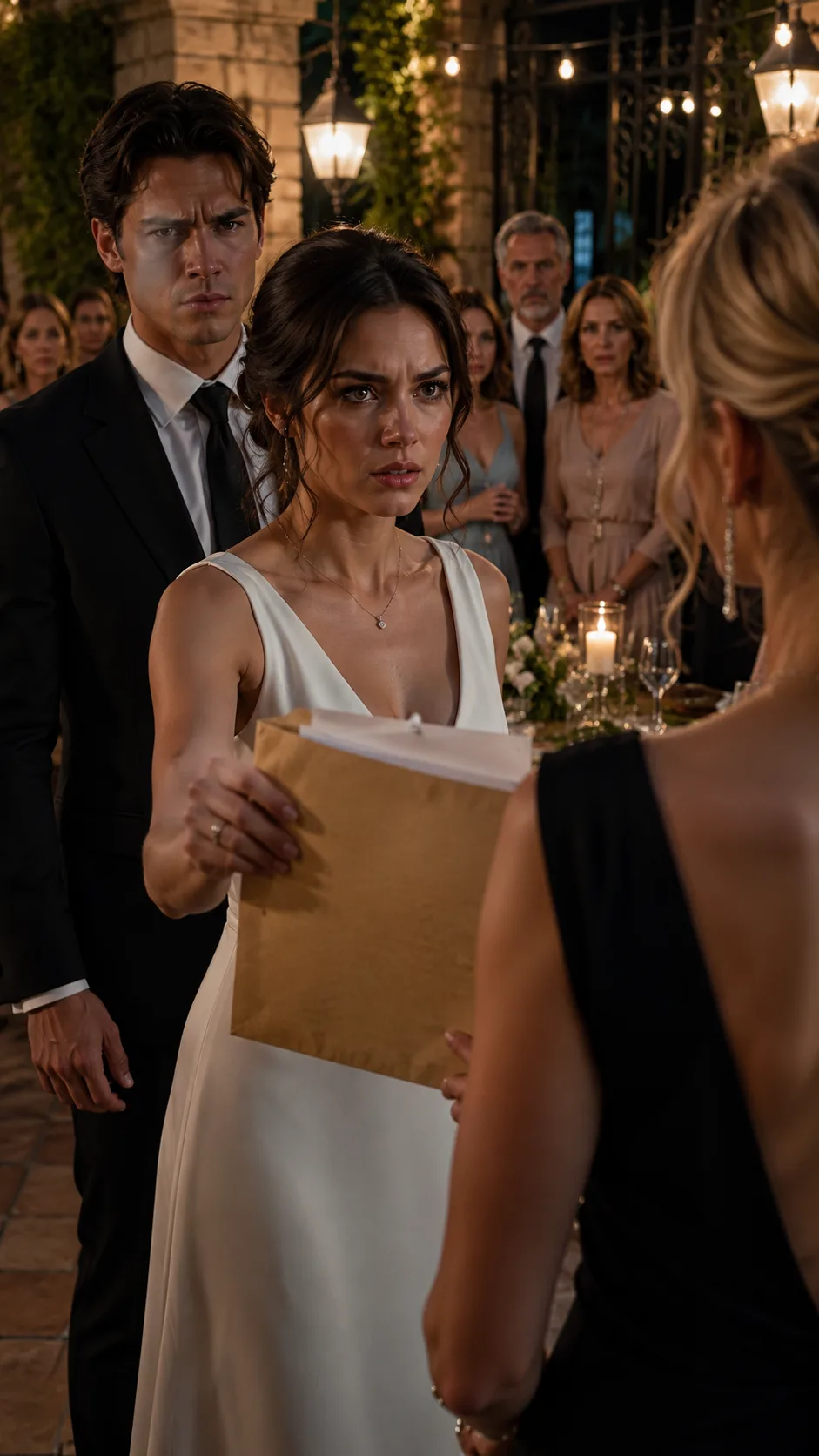
Celeste moved toward our table with a cream envelope in one hand.
Adrian stood.
So did Malcolm.
Vivienne’s face became perfectly calm, which somehow frightened me more than anger.
Brielle whispered, “Oh, absolutely not.”
But I stood too.
Because I knew, suddenly and completely, that if I sat down and let everyone else handle Celeste, I would spend the rest of my life being protected from battles fought in my name.
I stepped away from the table.
Adrian moved with me.
Celeste smiled.
“Lena. You look lovely.”
“No.”
Her smile flickered.
“No?”
“You don’t get to begin like this is polite.”
The garden went silent.
Celeste’s eyes sharpened.
“I came to help you.”
“No. You came to perform.”
A few guests shifted.
Celeste lifted the envelope slightly.
“There are things you deserve to know before you marry into this family.”
Adrian’s voice was cold.
“Leave.”
But I held out my hand.
“Give it to me.”
He looked at me.
I looked back.
“I hear it now,” I said softly. “Not later.”
Celeste placed the envelope in my hand.
Inside were copied documents. Old articles. Business filings. A private loan agreement.
And my father’s signature.
I looked at him.
His face had gone gray.
“Dad?”
My mother covered her mouth.
Celeste’s voice slid through the silence.
“Fifteen years ago, your father’s company was days from collapse. The Vale family saved him quietly. Very quietly. Interesting, isn’t it? Your entire life may have been shaped by the family you’re marrying into, and no one thought to mention it.”
The papers trembled in my hand.
I turned to Malcolm.
“Is this true?”
He stood very still.
“Yes.”
A murmur moved through the guests.
Adrian turned to his father.
“You knew?”
“I knew of the loan,” Malcolm said. “I did not know until recently that Thomas Hart was Lena’s father.”
Dad gripped the back of his chair.
“That’s true,” he said hoarsely. “He didn’t know. Not then.”
I looked at my father.
“Why didn’t you tell me?”
His eyes were wet.
“Because I was ashamed.”
The answer was so small.
So human.
So insufficient.
My mother whispered, “We almost lost everything. The business, the house, your college fund. Your father couldn’t sleep. I thought he was going to break.”
Dad’s voice shook.
“Malcolm’s company bought out the debt and gave me terms I could survive. I repaid it over twelve years. There was no arrangement. No plan. No connection to you.”
Celeste laughed softly.
“How convenient.”
I turned to her.
And in that moment, all my fear became clear.
Not gone.
Clear.
Celeste did not care whether I was hurt.
She cared whether the hurt could be useful.
“You waited until tonight,” I said.
Her expression cooled.
“You deserved the truth.”
“No,” I said. “You wanted an audience.”
The envelope felt heavy in my hand.
“You didn’t send this to me privately. You didn’t come to me with concern. You walked into my rehearsal dinner in front of my family, my friends, and my future husband because humiliation was the point.”
Celeste’s jaw tightened.
“You are being naive.”
“Maybe,” I said. “But not about you.”
Adrian stepped closer, but I kept speaking.
“For most of my life, people made decisions around me and called it love. They asked me to move, shrink, wait, forgive, understand. They hid things because they thought I could not handle them, or because handling me was inconvenient.”
My father closed his eyes.
I looked at Malcolm.
“You should have told us when you realized the connection.”
He bowed his head once.
“Yes. I should have.”
I looked at Adrian.
“You should have told me about Celeste the moment she approached you.”
“I should have,” he said.
Then I looked back at Celeste.
“But their mistakes do not make your cruelty noble.”
The garden was completely still.
Celeste’s cheeks colored.
Brielle stepped beside me.
“And just for the record,” she said, voice sharp, “if your plan was to make Lena feel like she doesn’t belong here, you picked the wrong week. We already tried that. It didn’t work.”
A stunned laugh rippled through the guests.
Celeste’s eyes flicked to Brielle with contempt.
“Who are you?”
Brielle smiled sweetly.
“The sister who used to be the problem. Keep up.”
For the first time all night, Celeste looked uncertain.
Vivienne stood.
Her voice was quiet, but it carried to every corner of the garden.
“Celeste, you entered my son’s rehearsal dinner uninvited, attempted to shame his bride, and exposed private financial history to wound people who once trusted you. You will leave now.”
Celeste looked at Adrian.
“Adrian.”
He did not move toward her.
His voice was calm.
“You mistook access for importance.”
Her face changed.
Just once.
Just enough.
Then security came through the side path and escorted her toward the gate.
No one spoke until she was gone.
When the gate closed behind her, the garden seemed to exhale.
I looked down at the envelope in my hand.
Then at my father.
“I need the full truth. All of it. Not tonight in pieces. Not after the wedding. Now.”
He nodded immediately.
“Yes.”
Malcolm stepped forward.
“And you will have it from me as well.”
Vivienne added, “From all of us.”
I looked at Adrian.
His eyes held mine.
“No more managed truth,” he said.
I believed him.
Not because everything was fixed.
Because this time, the truth had not made him run.
It had made him stand still and let me choose.
We did not finish the rehearsal dinner the way it had been planned.
The cake sat untouched for nearly half an hour. The musicians took a break and did not know when to resume. Guests whispered into their glasses. My aunt fanned herself like she had witnessed a courtroom drama instead of a family disaster under magnolia trees.
Then Brielle picked up her fork, tapped her glass, and stood.
Everyone stared at her.
She wiped beneath one eye.
“I had a toast prepared,” she said. “It was very beautiful and made me sound generous, so obviously it was dishonest.”
A few people laughed cautiously.
She looked at me.
“My sister spent most of her life making space for me because I demanded it and everyone else allowed it. When she got engaged, I somehow decided even her wedding was something I could rearrange.”
Her voice wavered.
“I am ashamed of that.”
My mother began crying silently.
Brielle continued.
“But Lena did not disappear. She stood here tonight while someone tried to use old secrets to break her, and she still somehow became the most honest person in the room.”
She lifted her glass.
“So here is my real toast. To my sister, who does not need anyone’s permission to be chosen. And to Adrian, who better spend the rest of his life proving he knows what she is worth.”
Adrian raised his glass.
“I intend to.”
People laughed, warmer this time.
I cried then.
Not because everything was perfect.
Because for once, my tears did not feel like defeat.
They felt like release.
Later that night, after the guests had gone and the lanterns were being taken down, I sat alone on the chapel steps.
Adrian found me there.
He sat beside me, leaving enough space that I could decide whether to close it.
I did.
I leaned against his shoulder.
“Are you still marrying me tomorrow?” he asked.
I looked at him.
“You thought I might not?”
“I thought you deserved the option.”
That answer settled something inside me.
“Yes,” I said. “I’m marrying you tomorrow.”
He exhaled, slow and quiet.
“But,” I added.
He straightened.
“We do counseling.”
“Yes.”
“We talk through hard things before they become weapons.”
“Yes.”
“And if your world tries to swallow me, you don’t ask me to become smaller so I fit.”
His expression softened.
“I married you in my heart the first time you corrected a grant proposal in red pen and made three executives apologize to a librarian. Small was never your gift.”
I laughed.
Then he took my hand.
The next morning, rain tapped lightly against the chapel windows.
Not enough to ruin anything.
Just enough to make the stone walls shine and the garden smell alive.
I woke calm.
That surprised me.
I had expected nerves. Panic. Some final disaster.
Instead, I felt steady.
My dress hung near the window, ivory silk with long sleeves and tiny buttons down the back. My grandmother’s blue brooch was pinned inside the lining where no one could see it, close to my heart.
My mother knocked before entering.
That was new.
“Come in,” I said.
She stepped inside carrying a small velvet box.
Her eyes were red, but her makeup was careful.
“You look beautiful,” she said.
“Thank you.”
For once, she did not compare me to Brielle.
She opened the box.
Inside was a pair of pearl earrings.
“My mother wore these on her wedding day,” she said. “I should have offered them earlier.”
I looked at the earrings.
Then at her.
“Why didn’t you?”
Her mouth trembled.
“Because I was saving them for Brielle.”
The truth sat between us.
Ugly.
But clean.
I nodded slowly.
“Thank you for telling me.”
“I’m sorry.”
“I know.”
She swallowed.
“I don’t expect you to pretend everything is healed.”
“Good.”
A sad little smile crossed her face.
“I suppose I earned that.”
“Yes.”
She came closer.
“May I help you put them on?”
I thought about it.
Then I nodded.
Her hands shook as she fastened the pearls.
In the mirror, I saw us both.
A mother who had failed me.
A daughter who had stopped pretending failure was love.
But also something else.
A beginning, maybe.
Not forgiveness yet.
But the first brick of something more honest.
Brielle entered ten minutes later in a soft blue maid-of-honor dress, carrying emergency tissues, lip gloss, safety pins, and a face like she had been crying in the hallway.
“Do not make me emotional,” I warned.
She held up both hands.
“I’m here strictly for logistics and controlled compliments.”
“You look nice.”
“You look like the main character.”
I smiled.
“I am.”
She grinned.
“Finally.”
When it was time, my father waited outside the chapel doors.
He looked older than he had six weeks ago.
Not weaker.
Just less certain of his right to command every room.
He offered his arm.
I took it.
Before the doors opened, he leaned close.
“I was wrong,” he whispered. “Not just recently. For a long time.”
I looked ahead at the closed doors.
“I know.”
“I don’t know how to repair all of it.”
“You start by not asking me to carry the repair alone.”
He nodded, tears gathering in his eyes.
“I can do that.”
The doors opened.
Everyone stood.
The chapel was warm with candlelight and rain-gray daylight. White roses lined the aisle. The air smelled faintly of wax, flowers, and old stone.
And at the end of the aisle stood Adrian.
Not Vale heir.
Not society headline.
Not a name my relatives suddenly wanted to claim.
Adrian.
The man who looked at me as if the room had disappeared.
My father walked me halfway, then stopped.
We had agreed on it that morning.
He did not give me away.
I walked the final steps alone.
Not because I had no one.
Because I belonged to myself first.
When I reached Adrian, his eyes were bright.
“You okay?” he whispered.
I smiled.
“I’m not moving.”
His mouth curved.
“Good.”
The ceremony was simple.
No dramatic interruption.
No woman in black.
No family confession.
Just vows spoken beneath old wooden beams while rain softened the world outside.
Adrian promised honesty before comfort.
I promised courage before resentment.
He promised to stand beside me without standing over me.
I promised not to disappear just to keep peace.
When the officiant pronounced us married, I heard Brielle sob loudly from the front row.
Everyone laughed.
Even the officiant.
At the reception, my father did not network.
My mother did not manage.
Brielle did not compete.
Or at least, she tried very hard not to, which counted.
Malcolm gave me a folder after dinner. Not secretly. Not dramatically. Just quietly, with Adrian beside him.
“Full documentation of the old loan,” he said. “Copies for you, your father, and Adrian. Nothing hidden.”
I accepted it.
“Thank you.”
He looked ashamed.
“I should have done this sooner.”
“Yes,” I said. “You should have.”
He nodded.
No excuses.
Another brick.
Later, I danced with my father.
He cried halfway through.
“I kept thinking you didn’t need as much from me,” he said.
“I needed the same.”
“I know that now.”
I rested my hand on his shoulder.
“Then remember it after today.”
“I will.”
Across the room, Brielle danced with Marcus. For once, she was not watching to see who watched her.
Maybe she was learning.
Maybe we all were.
Near midnight, Adrian led me outside beneath the covered terrace. Rain still fell beyond the lantern light. The garden shimmered silver.
Behind us, music and laughter drifted through the open doors.
In front of us, the night was quiet.
He took my hand and turned me gently into a slow dance with no audience.
“Do you regret any of it?” he asked.
I thought of the dining room where my family asked me to move my wedding.
The messages.
The dinner.
The envelope.
The secrets.
The way my whole life had seemed to gather itself into one final demand:
Move.
Make room.
Wait.
Understand.
Disappear.
Then I looked at my husband.
“No,” I said. “But I’m done being the easiest person to hurt.”
His hand tightened around mine.
“Good.”
Inside, someone called for us.
The photographer wanted one final picture.
For once, I did not rush back to keep everyone comfortable.
I stayed where I was for one more breath.
Rain beyond the terrace.
Warm light behind me.
Adrian’s hand in mine.
My family waiting, not commanding.
My life no longer postponed.
Then I stepped forward.
Not into someone else’s spotlight.
Into my own.
THE END.
Chapter complete
You have reached the end of this chapter.
Continue reading
A few more worlds to get lost in after this chapter.




