Robert left one coffee ring on the kitchen counter the morning he moved out.
Chapter 1
Robert left one coffee ring on the kitchen counter the morning he moved out.
I wiped around it first.
Not through it.
The mug was already gone, along with the gray shaving kit he kept under the sink, the blue cashmere sweater I bought him for our twentieth anniversary, and the framed photo from Cape May where he had his arm around my waist and his sunglasses hiding half his face. He had taken the silver letter opener from his desk, too, though he always told me it was too dull to use.
Small things.
That was how Robert emptied a life.
He did not slam doors. He did not curse. He did not leave drawers hanging open or clothes scattered on the stairs. He moved like a man checking out of a hotel he had never planned to visit again.
By seven-thirty, his side of the closet was hollow.
By eight, Diane Keller knocked on my front door.
She stood on the porch
in a beige cardigan, holding a white casserole dish with both hands. Her pearl earrings caught the weak morning light. Behind her, across the narrow strip of lawn between our houses, her own front door stood open.
“I heard,” she said.
That was all.
I looked at the casserole. The foil had been pressed carefully around the rim, one corner folded into a sharp little triangle.
“Thank you,” I said.
She stepped closer, but not over the threshold.
“You shouldn’t be alone today.”
I moved the casserole from her hands into mine. The dish was warm.
“I have my sister coming later.”
Diane nodded once. Her eyes went over my shoulder, toward the hallway, toward the empty space where Robert’s suitcase had scraped the wall and left a thin black mark near the baseboard.
“He always was restless,” she said.
I looked at her.
She adjusted the strap of her
purse.
“Men,” she added.
The word sat between us.
Then she smiled.
Neighborly.
I closed the door with the casserole still warm in my hands and set it on the kitchen counter beside Robert’s coffee ring. The foil reflected the ceiling light in a trembling strip.
I threw the casserole away without opening it.
Not that day.
I had been married to Robert Ellis for thirty-one years. Twenty-five of those years, Diane Keller lived next door. She borrowed sugar from me in 1999, pruning shears in 2003, our ladder after a windstorm in 2008, and a folding table for her nephew’s graduation party in 2016. She returned everything clean, labeled, and sometimes with cookies wrapped in wax paper.
Robert called her harmless.
“Diane likes company,” he would say when I noticed him standing too long by the side fence.
Or, “She has no one, Margaret.”
Or, “Don’t make a story
where there isn’t one.”
I stopped asking after a while.
That was marriage, at least the kind I had. You learned where the floorboards creaked and walked around them.
Our house sat on Maple Hollow Lane in a part of New Jersey where people still waved while backing out of driveways and knew which family had switched lawn services. The houses were colonial, the yards clipped, the mailboxes painted black with brass numbers. Everything looked accounted for.
It wasn’t.
Robert handled the investments. He liked order, columns, statements, passwords I was allowed to know and passwords he said would only confuse me. I paid the utilities, bought groceries, remembered birthdays, replaced the towels, scheduled the dentist, mailed checks to contractors, and hosted Thanksgiving for people who praised Robert’s carving knife while I washed dishes behind them.
Money came in.
Money disappeared.
Robert always had a sentence ready.
“The market dipped.”
“The business needed liquidity.”
“That account matured into another vehicle.”
He said vehicle a lot when he meant a locked door.
I signed what he put in front of me. Not blindly. That is too easy. I read enough to understand the shape of things, but Robert knew how to make a page look harmless. He tapped dates with his pen. He circled totals. He said, “Here,” and I looked where he pointed.
One mistake.
It lasted years.
When the divorce papers arrived, they came in a cream envelope from Robert’s lawyer. He had filed first. Cruel men often like clean timing. He waited until our youngest grandson’s baptism had passed, until my sister’s surgery was over, until our property taxes were paid from the joint account.
Then he left.
The papers said our marital assets had been reduced by “market events and business obligations.” The retirement account was smaller than I remembered. The savings account was almost bare. The investment statements listed losses that looked legitimate if you read fast and cried later.
I did neither.
I hired Abigail Reed three days after Robert moved out.
Her office was on the second floor of a brick building over a pharmacy that smelled faintly of menthol and paper bags. She wore thin glasses and never filled silence for comfort. During our first meeting, she read the asset disclosure twice.
Then she tapped one line with her pencil.
“Who is Keller Holdings?”
I looked at the page.
The name was almost hidden inside a transfer schedule, one of those gray blocks of legal language meant to make tired people nod and sign.
“Keller?” I said.
“Yes.”
“My neighbor’s last name is Keller.”
Abigail did not look up.
“Diane Keller?”
My fingers tightened around my purse handle.
“Yes.”
The pencil stopped.
There.
The first crack was not loud. It was a pencil no longer moving over paper.
Abigail asked me for tax returns, bank statements, mortgage documents, old check registers, insurance papers, and anything with Robert’s signature. I brought her two banker’s boxes from our basement, one from the attic, and a metal recipe tin where I had stored receipts Robert used to laugh at me for saving.
“You keep everything,” he used to say.
I did.
Not enough, but enough to start.
For six weeks, my dining room became a place where the past lay in piles. I sat at the table with a yellow legal pad and wrote dates until my hand cramped. The chandelier above me buzzed when the dimmer switch was turned halfway down. I left it there anyway because full light made the papers look too white.
A small thing.
Every few days, Abigail called with one more question.
“Did Robert travel to Delaware in March 2006?”
“Did he ever mention a consulting fee to Northshore?”
“Do you know why your home equity line was drawn down twice in 2011?”
No.
No.
No.
After the third no, I stopped apologizing.
One afternoon, I found an old bank envelope tucked inside a folder labeled Landscaping. Robert had written that label. His handwriting leaned right when he was in a hurry and stayed upright when he wanted to impress someone.
Inside were copies of checks.
Most were ordinary. Tree removal. Stone edging. Lawn repair.
One check was not.
It was made out to D.K. Property Services.
The memo line read: privacy fence.
We never had a privacy fence.
I placed the check on the table and sat with both palms flat beside it.
No wind moved the curtains.
Across the lawn, Diane’s kitchen light clicked on.
I could see her through the side window, standing at her sink, rinsing a mug. She lifted her hand to the glass and waved.
I did not wave back.
Not that time.
The next morning, I called Abigail before brushing my teeth.
She asked me to bring the check in.
I drove with it inside a plastic sleeve on the passenger seat. At every red light, I looked down to make sure it was still there. A man in a pickup honked at me when the light turned green.
Let him.
Abigail read the check, then pulled another document from a folder.
“Look at this transfer.”
The paper showed money leaving one of our investment accounts in 2011. The receiving entity had been abbreviated. D.K.P.S. LLC.
D.K. Property Services.
The registered address was not printed on that page. Abigail had written it in the margin from a corporate database search.
17 Maple Hollow Lane.
Diane’s house.
I did not touch the paper.
Abigail turned it around so it faced me.
“Margaret.”
I heard the pharmacy bell downstairs as someone walked in below us. The sound was thin through the floorboards.
“How many years?” I asked.
“We don’t know yet.”
Not yet.
That became the rhythm of the next months.
Did Diane know Robert was married when the first transfer was made?
Not yet.
Did Robert move marital money through a company connected to her?
It appeared so.
Could the divorce settlement be stopped?
Not yet.
Could the money be recovered?
Maybe.
That was Abigail’s cruelest word. She never used it unless she had to.
Robert’s confidence grew as the hearings approached. He sent emails through his lawyer, but the phrasing was his.
Margaret has always been confused about finances.
Margaret is prolonging this unnecessarily.
Margaret should accept the generous terms already offered.
Generous.
I printed that email and placed it beside the fake privacy fence check.
Diane stayed next door.
She watered her hydrangeas in the morning. She wore gardening gloves with tiny blue flowers on the cuffs. She took her trash bins in before sunset. She waved at delivery drivers. On Sundays, she drove to church and returned before noon.
A woman could live ten yards from you and still be a sealed room.
One Thursday in October, I came home from Abigail’s office and found Diane standing in my driveway.
She had a paper grocery bag hooked over one arm.
“Margaret,” she said. “May I speak with you?”
I kept my hand on the car door.
“No.”
Her mouth tightened. Only for a second.
“I know this has been hard.”
The grocery bag made a soft crinkling sound against her coat.
“Move away from my car.”
She glanced toward the street. A jogger passed with earbuds in, not slowing.
“I don’t want this to become ugly.”
I opened the back door and lifted out my purse.
“It already is.”
Diane stepped closer.
“Robert is not well.”
That stopped me.
She saw it.
“He’s under pressure. You know how he gets.”
No.
I knew how he performed pressure. He loosened his tie. He sighed near doorways. He made other people carry what he had packed himself.
“Tell him to cooperate,” I said.
Her eyes dropped to my purse.
“He only wants peace.”
I shut the car door.
“Then he should stop hiding money.”
The grocery bag slipped in Diane’s grip. Something inside it tapped against glass.
She did not deny it.
A sparrow landed on the mailbox between our houses and stayed there, head jerking left, right, left.
I walked past Diane and into my house.
Behind me, she said one sentence.
“You don’t know what you’re opening.”
I locked the door.
Then I wrote it down.
The mini twist came from a receipt so faded I almost threw it away.
It was tucked inside the metal recipe tin behind an index card for lemon bars. The receipt was from a small title company in Camden, dated twenty-five years earlier. Robert’s name appeared halfway down. Diane Keller’s name appeared near the bottom as an authorized recipient.
The property description was not ours.
It was a storage unit.
Abigail found the rest.
The storage unit had been paid from a joint account for three years, then transferred to Diane’s company. Inside the old title packet was a forwarding address connected to a bank account that had received regular deposits from Robert starting the same month Diane moved into the house next door.
Twenty-five years.
Not a mistake.
A system.
Abigail spread the documents across her conference table and arranged them by year. The trail looked almost delicate in her neat stacks. First, small transfers. Then larger ones. Then home equity withdrawals. Then consulting fees. Then property notes. Then checks.
All of them dressed as something else.
“You need to be ready,” Abigail said.
“For what?”
“For him to say you’re confused.”
I laughed once.
It sounded like a cough.
“He has been saying that since 1998.”
Abigail closed one folder.
“Then we’ll bring paper.”
The final asset hearing was scheduled for a Tuesday morning in January. The night before, I ironed my navy blazer and hung it on the back of the bedroom door. I placed my cream blouse beneath it, then black slacks, then shoes. I packed the brown folder myself, even though Abigail had copies of everything.
I wanted the weight of it in my hands.
At ten past nine, I stood in my kitchen with the folder on the counter and looked at the place where Robert’s coffee ring had been.
The counter was clean now.
Still, I knew the circle.
I ran one finger over the spot, picked up the folder, and left.
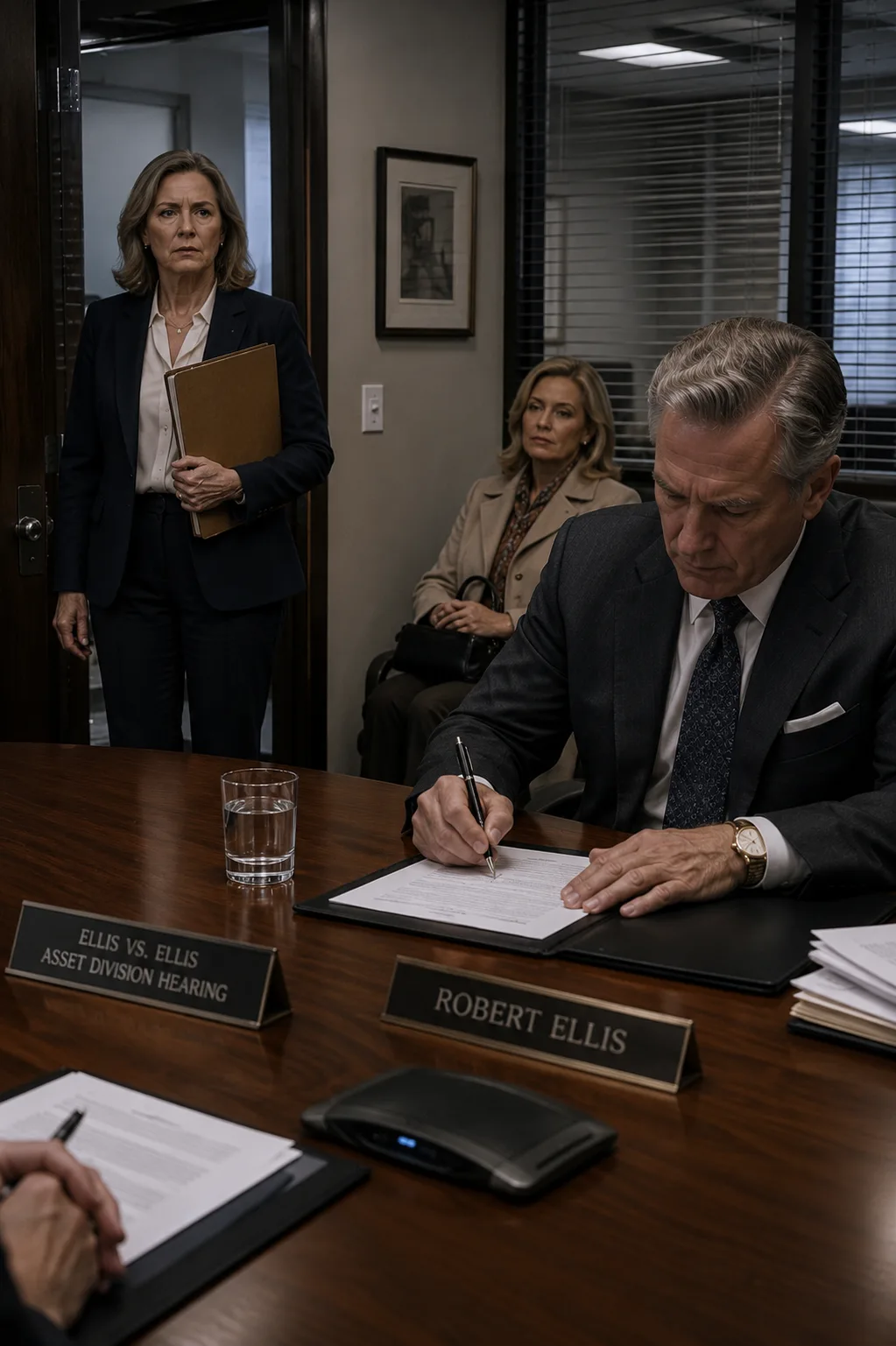
The courthouse hearing room was smaller than I expected. Not a courtroom with a judge elevated above everyone, but a private conference room with a long wooden table, rolling chairs, a wall clock, and blinds that cut the winter light into gray stripes. A black recorder sat in the center of the table. Someone had left a paper cup of coffee near the window, half full, with a skin forming on top.
Robert was already there.
Of course.
He wore a charcoal suit and a gold watch. His hair had been trimmed recently. He sat beside his lawyer, Martin Hale, and signed a document with the careful flourish he used on Christmas cards.
Diane sat behind him.
Not beside him.
Behind him, where a helpful witness might sit. Beige coat. Pearl earrings. Black purse on her lap. Her legs crossed at the ankles. She looked like a woman waiting for a zoning board meeting.
Robert did not stand when I entered.
His eyes touched the folder in my arms and moved away.
“Margaret,” he said.
I placed my hand on the back of the empty chair.
Robert kept writing.
Scratch. Scratch.
The sound filled the room.
Diane gave me the same porch smile she had given me the morning Robert moved out.
I sat down.
Abigail sat beside me and opened her legal pad. She did not greet Robert. She did not greet Diane. She placed her pen parallel to the edge of the table.
Martin Hale cleared his throat.
“We are here to finalize the remaining asset division,” he said.
Robert slid one signed page toward him.
Martin glanced at it, then at Abigail.
“As stated, all disputed funds have been accounted for.”
Robert leaned back.
There it was.
The old wall.
Abigail looked at me.
I opened the folder.
Not fast.
The paper edges made a dry sound beneath my fingers. I removed the first bank statement and placed it flat on the table. The top corner had been marked with a blue tab.
Martin did not reach for it at first.
Abigail did.
She slid it into the center.
“This is from May 2011,” she said.
Robert’s pen stayed between his fingers.
Martin glanced at the page.
“A transfer,” he said. “Already disclosed.”
“No,” Abigail said.
One word.
Robert’s thumb moved along the pen clip.
I removed the second document.
A property transfer receipt.
The room clock clicked once above the door.
I placed the receipt beside the bank statement.
Diane’s purse strap creaked.
Martin leaned forward.
Abigail turned the receipt so the address faced him.
“Please read the receiving address.”
Martin’s eyes moved down the page.
Robert stopped moving the pen.
He did not put it down.
Not yet.
Martin looked once at Robert, then back at the page.
“I don’t see the relevance.”
Abigail took a second receipt from me and placed it beside the first.
“Then read this one.”
I watched Diane’s hand close around the purse strap. Her knuckles pushed pale against the leather. She looked toward the door without moving her head.
Robert saw her do it.
He shifted in his chair.
Martin picked up the second receipt.
The silence changed shape.
“This appears to be an address,” Martin said.
“It is,” Abigail said.
Robert set the pen down.
Too carefully.
I removed the third document. Then the fourth. Then a copy of the check made out to D.K. Property Services, the memo line still pretending we had built a fence that never existed.
I placed it on top.
Martin’s face went still in pieces. First his mouth. Then his hand. Then his shoulders.
Abigail slid another page forward.
“D.K.P.S. LLC. Registered to 17 Maple Hollow Lane.”
Diane stood halfway from her chair.
The chair legs scraped the carpet.
Everyone looked at her.
She stopped.
Robert reached for the settlement papers.
Abigail placed one hand over them before he could pull them back.
“No.”
It was the first time she had raised her voice all morning.
Robert’s fingers hovered above the paper.
I pushed the entire folder into the center of the table.
The folder opened as it moved. Old checks slid out. Receipts fanned across the wood. Transfer records overlapped account statements. Copies of signatures, routing numbers, property records, and corporate filings spread between Robert’s unsigned pages and Martin’s legal pad.
A paper clip bounced once and landed near the recorder.
Small sound.
Huge room.
Martin picked up one document. Then another. His eyes moved between the dates.
Abigail pointed to the first account number.
“Same source.”
She pointed to the transfer receipt.
“Same chain.”
Then she pointed to the address.
“Same house.”
Diane remained half-standing, purse clutched against her stomach, one knee pressed against the chair as if it were holding her up.
Robert looked at the documents but not at me.
That was how I knew.
Martin turned toward Diane.
“Mrs. Keller, why is your name on these transfers?”
Diane opened her mouth.
No words came.
Robert picked up his pen again.
Then he put it down.
Abigail closed the settlement folder in front of him.
“This agreement is frozen.”
The recorder’s blue light blinked between us.
Martin did not object.
He was still holding the receipt with Diane’s address printed across the middle.
Robert’s watch caught the overhead light and flashed once against the wall.
Diane took one step back, but the chair blocked her. She looked toward Robert. Robert looked at Martin. Martin looked at Abigail.
Nobody looked away from the papers for long.
Abigail placed the fake privacy fence check at the top of the stack.
“Twenty-five years,” she said.
Robert’s jaw moved.
“You don’t understand the structure.”
I looked at him then.
I had heard that sentence in a hundred forms. At the dining room table. In the bank parking lot. On tax nights. At retirement meetings. In bed, with his back turned and his voice flat in the dark.
I reached into the folder and removed the final page.
It was a copy of the first storage unit receipt, the one dated twenty-five years earlier, with Diane’s signature at the bottom.
I set it in front of Martin.
“The structure lived next door,” I said.
The wall clock clicked again.
Diane sat down.
Not gracefully.
The chair took her weight with a dull sound.
Robert’s face had gone the color of old paper. He touched his watch, then his cuff, then nothing. His hands settled on the table, palms down, fingers spread beside the settlement he had expected me to sign away.
Martin placed the storage receipt beside the others and removed his glasses.
“Mr. Ellis,” he said, “we need to recess.”
Robert turned toward him.
“No.”
Martin was already gathering the papers.
“Yes.”
That word did more than any speech could have done.
Abigail kept her hand on the settlement folder. I kept my hands in my lap. Diane’s purse sat open now, a lipstick and folded tissue visible inside. The tissue had a small red mark on one corner.
No one moved to help her.
The hearing room emptied in pieces.
Martin stepped into the hallway with his phone pressed to his ear. Robert followed him after a few seconds, but not close enough to speak. Diane remained seated until Abigail asked the clerk to note her presence on the record. Then Diane stood, adjusted her coat, and walked past me.
She smelled like powder and winter wool.
At the door, she stopped.
“Margaret,” she said.
I did not answer.
She left.
Robert stayed in the hallway behind the glass panel. Through the blinds, I could see only parts of him: one shoulder, one hand, the side of his face. He was speaking now. His mouth moved quickly. Martin did not nod.
Abigail stacked the papers in order.
“Don’t leave these behind,” she said.
“I won’t.”
She slid the brown folder back to me.
It was lighter now.
Not because the papers weighed less. Because they were no longer mine to carry alone.
The legal process did not end that day. People who steal with paper know how to hide behind more paper. Robert denied intent. Diane denied knowledge. Their attorneys used words like misunderstanding, administrative assistance, shared investment vehicle, and poor documentation.
Abigail used dates.
Then account numbers.
Then signatures.
The court froze the settlement. A forensic accountant was appointed. Diane’s company records were subpoenaed. The storage unit trail opened into two more accounts, then a property note, then an insurance payout I had never seen. Robert’s lawyer withdrew three months later.
By summer, the house on Maple Hollow Lane was quiet.
Robert moved into a rented condo near the marina. He sold the gold watch. My grandson saw it listed online before Robert took the listing down.
Diane stopped watering her hydrangeas.
For a while, her blinds stayed closed all day. Then a moving truck arrived one humid morning in August. Two men carried out her dining chairs, then boxes marked kitchen, bedroom, office. Diane stood on the porch holding a clipboard. She did not look toward my house.
I stood at my kitchen sink and rinsed a mug.
No wave.
The recovery took nearly two years. I did not get everything back. That is not how courts work. Money leaves footprints, but footprints can fade under enough lies. Still, I recovered enough to keep the house, enough to rebuild my retirement, enough to pay Abigail without selling my mother’s wedding band.
Robert paid penalties. Diane settled before trial. Neither of them admitted what the documents had already said for them.
Fine.
Paper does not need permission.
The first spring after Diane left, I hired a landscaper to tear out the dying hedge between our properties. The new owners next door were a young couple with a baby and a golden retriever that kept escaping through a gap in the fence.
There was no privacy fence.
There never had been.
The landscaper found a rusted garden shear buried near the property line. Blue handle. Bent hinge. It might have been mine. It might have been Diane’s. Years ago, I would have cleaned it and walked next door to return it.
This time, I dropped it in the trash.
On the anniversary of the hearing, Abigail mailed me the final stamped order with a sticky note attached.
Closed.
One word.
I placed the order in the brown folder, then put the folder on the top shelf of my hall closet. Not hidden. Just stored.
That evening, I made coffee in the kitchen and set the mug on the counter. It left a ring near the place Robert’s had been.
I looked at it for a while.
Then I wiped it clean.
Chapter complete
You have reached the end of this chapter.
Continue reading
A few more worlds to get lost in after this chapter.




