The phone rang while I was rinsing one coffee mug in the kitchen sink.
Chapter 1
The phone rang while I was rinsing one coffee mug in the kitchen sink.
It was the old blue mug Emily had bought me when she was sixteen, the one with a crooked painted fish on the side and a tiny chip near the handle. She had found it at a school fundraiser and told me it looked “professionally ugly,” which meant she was proud of it. I had used it for nine years.
My hand was still under the tap when her name lit up my phone.
11:42 p.m.
Emily never called that late anymore.
At first, there was only breathing. Not the kind after running. The kind someone takes when they are trying not to be heard.
“Em?”
A small sound came through. Fabric. A door. Maybe a hand over the receiver.
Then my daughter said, “Dad, please come get me.”
Three words after that were lost under a sharp crackle. I heard a man’s voice in the distance, not clear enough
to catch. Emily breathed once more, hard and uneven.
The line went dead.
The mug slipped in the sink and hit the stainless steel with a sound too loud for my quiet house.
I called back.
No answer.
Again.
Nothing.
I dried my hands on the dish towel without looking down. The towel still had a coffee stain near one corner from breakfast. I folded it. Then unfolded it. Then left it on the counter.
My keys were in the ceramic bowl by the door. My coat was still damp from earlier rain. I put it on anyway, pulled the recorder from the top drawer of my desk, and held it in my palm for half a second before sliding it into the inside pocket.
Habit.
Twenty-six years in the prosecutor’s office had taught me that people lied loudest when they believed no one was keeping proof.
I drove through
red lights that looked smeared by rain on the windshield. The wipers slapped back and forth, too slow for the storm, too loud for the car. I should have called the police first. I knew that. I had told a thousand frightened families to call before they came in person.
But this was Emily.
My daughter, who had once refused to sleep unless I checked under her bed for “business ghosts.” My daughter, who had cried at every sad dog commercial until she was twenty-two. My daughter, who used to fill my fridge with sticky notes when I worked late.
Eat something.
Call me.
Your tie is ugly.
Love you anyway.
Then Mark Holloway married her, and the sticky notes stopped.
At first, she said married life was an adjustment. Then she said his mother was intense. Then she said Sundays were difficult because the Holloways expected “family dinners.” Then
she stopped coming at all.
Every month, her voice sounded smaller.
I had asked direct questions.
“Does he scare you?”
She would pause too long.
“No, Dad.”
“Has anyone touched you?”
Another pause.
“Don’t make this bigger than it is.”
That sentence was not hers. I knew it the first time I heard it.
The Holloway estate sat behind iron gates at the end of a private road. The house was all warm windows and perfect stone, a place built to glow against bad weather. The kind of house people photographed from the street and whispered about. Old money liked to look quiet. The Holloways had mastered quiet.
I stopped crooked in the circular driveway and left the engine running.
Vivian Holloway opened the door before I knocked.
She wore cream silk, trousers without a wrinkle, and a pearl necklace that caught the foyer light like tiny moons. Not one strand of hair was out of place. Behind her, the house smelled of cedar, fireplace smoke, and expensive wine.
Her face did not change when she saw me soaked through.
“She’s not leaving,” Vivian said.
Not “hello.”
Not “what happened?”
Not “is everything all right?”
Just that.
I stepped forward.
She raised one hand and placed it against my chest.
“This is a private family matter.”
“She called me crying.”
“Young wives cry.” Her fingers stayed pressed against my coat. “It’s how they learn.”
I looked at her hand.
Vivian removed it, but not because she wanted to. She removed it because I kept walking.
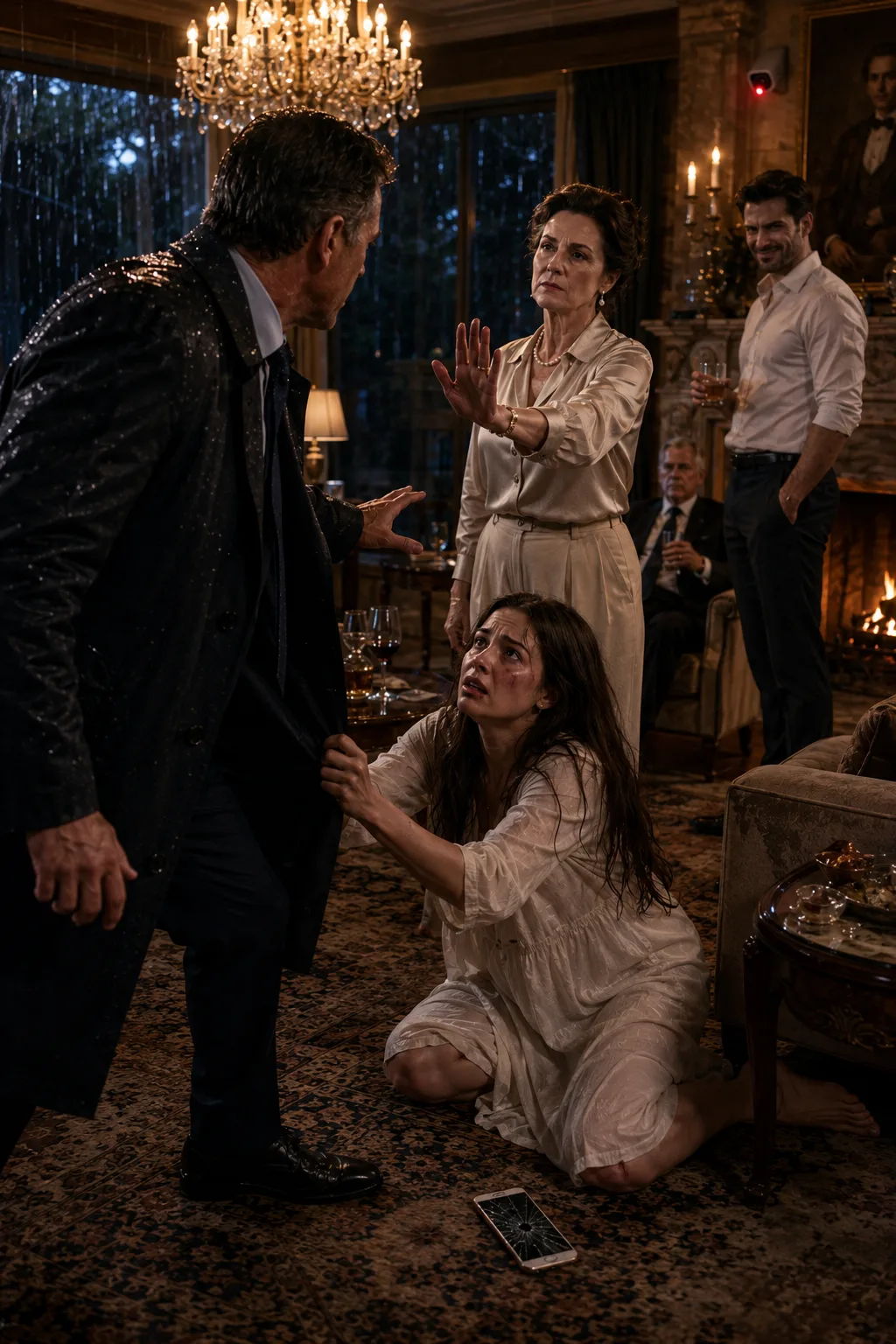
The foyer opened into a living room large enough to host a fundraiser. A marble fireplace burned at the far wall. Crystal glasses sat on a low table beside a half-empty bottle of red wine. A cream rug covered most of the dark wood floor, the kind of rug nobody owned unless they had staff to clean it.
Mark stood near the fireplace with his sleeves rolled to his forearms, his hair damp at the temples, his jaw tight. Richard Holloway sat in a deep leather chair with a drink in his hand, one ankle crossed over the other. He looked like a man watching a play he had already seen.
Then I saw Emily.
On the floor beside the sofa.
Barefoot.
Her hair hung loose around her face. One side of her cheek was swollen, and there was a small dark mark near the corner of her mouth. Her dress was wrinkled, pale, and damp at the hem as if she had been kneeling too long on a wet patch of floor.
Her wedding ring was gone.
A broken phone lay near her knee.
For one second, the whole room narrowed to the shape of my daughter’s hand on the rug.
I knelt beside her.
“Baby.”
She reached for my coat with both hands and held on like the coat was the only solid thing in the house.
“Dad, I tried to leave.”
Mark gave a short laugh.
“She’s dramatic.”
Emily flinched at his voice. Not much. Just enough.
I noticed.
Vivian walked in behind me and folded her arms.
“She had a panic episode. We were helping her.”
Richard swirled his drink once. The ice knocked softly against the glass.
I looked at the broken phone again. The screen was cracked from corner to corner. A little line of light still glowed under the glass, trying to stay alive.
“Her phone broke during a panic episode?” I asked.
Mark’s mouth tightened.
“She threw it.”
Emily shook her head once against my coat.
Vivian’s eyes moved to her.
That was all.
Emily stopped shaking her head.
The room gave me the rest.
A missing ring. A broken phone. Bare feet. A daughter trained to stop moving when one woman looked at her.
I slid my hand under Emily’s elbow.
“We’re leaving.”
Mark stepped away from the fireplace.
“No, she isn’t.”
I stood slowly, keeping myself between him and my daughter.
“You want to say that again?”
Mark looked at his mother first.
That was when I understood who ran the house.
Vivian moved to the center of the room, between me and the foyer. Her palm lifted again, elegant and practiced. She did not look angry. Anger would have made her human. Vivian looked inconvenienced.
“Mr. Carter,” she said, “you need to control yourself.”
Emily’s fingers twisted in the fabric of my coat.
Richard leaned back farther in his chair.
“The system records every common area,” he said, nodding toward the corner of the ceiling. “So let’s all behave.”
I followed his gaze.
A small security camera sat high near the molding. A red light blinked calmly above all of us.
Good.
Then Richard smiled.
“Don’t worry. Our system deletes after twenty-four hours.”
There it was.
A detail offered too quickly.
Not reassurance.
Policy.
Vivian noticed that I had noticed. Her chin lifted a fraction.
“You’re making assumptions,” she said.
“No,” I said. “I’m counting.”
Mark laughed under his breath.
“Counting what?”
I looked around the room without turning my head too much. The broken phone. The missing ring. The camera. Richard’s drink. Mark’s rolled sleeves. Vivian blocking the exit while my daughter sat barefoot on the floor.
“Enough.”
Mark’s eyes narrowed.
“You don’t get to walk into my house and talk like that.”
My house.
The words sat there, polished and ugly.
Emily pulled herself closer to me. Her bare foot slipped on the edge of the rug. She was trying to stand without asking for help.
I bent and put one arm behind her back.
Vivian stepped forward.
“Careful. She’s unstable.”
I looked at her.
Vivian stopped, but only for a second.
“She needs rest,” she said. “Not more drama.”
“My daughter called me.”
“She is my son’s wife.”
“She was my daughter first.”
That sentence hit something. Mark’s face changed. Richard stopped moving the ice in his glass.
Vivian smiled.
Small.
Sharp.
“Take her if you want.”
Emily went still.
Vivian took one step closer, lowering her voice just enough to make it sound intimate, though everyone in the room heard every word.
“But she signed a prenup. She has no money, no house, no claim, and no reputation once we’re done.”
Mark came up behind her, his confidence returning now that she had spoken the family language.
“She’ll come crawling back.”
Emily’s grip turned painful.
I did not answer.
People often mistake silence for shock. I had seen it in courtrooms, in conference rooms, in police interviews with men who thought a quiet person was a weak one.
Silence is a drawer.
You put things in it.
Names. Dates. Exact words.
I lifted Emily carefully from the floor. She was lighter than she should have been. Her knees bent once, and I held her tighter. The sleeve of my wet coat brushed her cheek. She did not let go.
Vivian reached toward Emily’s arm.
I turned my shoulder between them.
Vivian’s hand stopped in the air.
The first crack.
Mark stepped forward.
“Don’t touch my mother.”
I looked at him over Emily’s head.
“You should sit down.”
Mark blinked.
Richard laughed once from the chair.
“You hear that, Mark? He’s giving orders now.”
I moved Emily behind me, close enough that she could keep one hand on my coat. My other hand slipped inside the left pocket.
The recorder was small, silver, and old. I had bought it fifteen years earlier after a witness recanted in a hallway because nobody had captured the threat that made her do it. Technology had moved on. Phones were better. Apps were easier.
But phones died.
Batteries failed.
Cloud accounts disappeared.
A recorder with a red light and one button had never failed me.
My thumb found the edge of it.
It had been running since the driveway.
Vivian saw the movement first.
Her raised hand lowered a few inches.
Mark saw her see it.
That was the second crack.
Richard’s glass stopped halfway to his mouth.
I brought the recorder out just enough for the chandelier to catch the metal. Not high. Not theatrical. I held it low at my side, where the room could see it if the room knew where to look.
Vivian knew.
Mark did not. Not yet.
“What is that?” Vivian asked.
Her voice changed on the last word.
Emily looked up.
I kept my eyes on Vivian.
“Say that again.”
No one moved.
The fire shifted in the fireplace, one log settling under another with a soft collapse. Rain tapped the tall windows. Somewhere behind me, the front door had not fully closed, and wind moved through the gap with a thin, steady sound.
Mark looked from my hand to his mother.
“What is that?”
Richard stood.
Slowly.
“Mr. Carter,” he said, “I think we should all take a breath.”
I turned my wrist.
The red recording light was visible now.
Mark’s face emptied.
Vivian’s mouth opened, then closed.
Emily’s hand pressed harder into my coat. Not pulling now. Holding.
I looked at Richard.
“Your system deletes after twenty-four hours.”
His eyes went to the camera in the corner.
I lifted the recorder one inch.
“Mine doesn’t.”
The room changed without a sound.
Mark’s shoulders dropped. Vivian stepped back half a pace, catching herself before it became obvious. Richard set his glass on the table, but the base hit too hard and wine jumped against the rim.
Vivian recovered first. She always would.
“You recorded us in our home.”
“You threatened my daughter in front of me.”
“That recording is illegal.”
“No,” I said. “Not in this state.”
Richard’s eyes sharpened. He knew. Or he knew enough to fear I knew.
Mark pointed at the recorder.
“Give me that.”
Emily made a small sound behind me.
I did not move.
Mark took another step.
Richard snapped, “Mark.”
The name cracked across the room.
Mark stopped.
That was the third crack.
The son obeyed the father. The father watched the recorder. The mother calculated what had already been said. The house, for the first time since I had entered it, no longer belonged completely to them.
Vivian tried a softer face.
“We are all upset,” she said. “Emily has been fragile for weeks. You came in here ready to accuse people. That device proves nothing except that you intended to provoke a private family.”
Emily’s fingers slipped from my coat.
I felt her shift beside me.
For the first time, she spoke without looking at Vivian.
“They took my ring.”
Mark’s head turned.
“Emily.”
She swallowed. Her voice was thin, but it stayed.
“They took my phone when I called him. I grabbed it back. Mark stepped on it.”
Mark’s nostrils flared.
“I told you to stop lying.”
I angled my body more fully between them.
“Careful.”
Mark looked at me like he wanted to laugh and could not remember how.
Vivian’s hand touched her necklace.
It was the first nervous thing she had done.
Richard moved toward the side table. Not toward us. Toward the phone there.
“Who are you calling?” I asked.
“My attorney.”
“Good.”
He paused.
“I’d like yours to hear the recording too.”
Richard’s fingers tightened around the receiver.
Then Emily said, “There’s more.”
Every face turned to her.
She kept one hand on my sleeve. Her other hand moved to the pocket of her dress. It shook badly, but she got the folded paper out.
A receipt.
Small. Crumpled. Damp at one edge.
She handed it to me.
I looked down.
A pharmacy address. A date. A prescription number. Not enough by itself, but enough to ask better questions.
Vivian saw the paper and went pale in a way makeup could not hide.
“Where did you get that?”
Emily looked at the floor.
“Your bathroom trash.”
Mark stared at his mother.
“What is that?”
Vivian did not answer.
Richard put the phone down without calling anyone.
The quiet after that was different. Not empty. Full.
I folded the receipt once and placed it in my coat pocket beside the recorder.
“We’re leaving now.”
Vivian’s voice came out flat.
“She signed a prenup.”
I looked at her for a long second.
“You keep saying that like it’s a shield.”
I helped Emily toward the doorway. She limped once, and I slowed immediately. Mark watched us pass. His hands opened and closed at his sides, but he did not reach for her again.
At the foyer, Vivian spoke.
“You’ll ruin her life.”
I stopped.
Emily stopped with me.
I turned halfway, enough to see them all in the gold light of their perfect room: Vivian standing too straight, Mark near the fireplace like a boy waiting for instructions, Richard beside the phone he had not used, the broken glass glitter of Emily’s phone still on the rug.
“No,” I said. “I think you already tried.”
Outside, the rain had eased into a fine mist. I guided Emily into the passenger seat and wrapped my coat around her shoulders before closing the door. She kept staring at her hands.
In the driveway, my phone buzzed.
Unknown number.
Then another.
Then Mark’s name appeared.
I did not answer.
I drove away from the Holloway estate with both hands on the wheel, slower than I had driven there. Emily leaned against the window, the recorder on the console between us, its red light still glowing.
Halfway down the private road, she spoke.
“Are you mad at me?”
I pulled the car to the shoulder.
The wipers moved once. Twice.
I looked at my daughter.
She was twenty-six years old, married eight months, barefoot under my coat, asking if rescue came with blame.
“No.”
The word was too small for what I meant, but it was the only one I trusted myself to use.
She nodded once and looked down again.
At my house, I did not turn on all the lights. Just the kitchen lamp and the small hall light. Too much brightness would have made everything feel like an interrogation. Emily sat at the table wrapped in a blanket while I put water on for tea neither of us drank.
The blue mug with the crooked fish still sat in the sink.
I washed it.
My hands needed something ordinary.
Emily noticed.
“I bought you that.”
“I know.”
“It’s ugly.”
“Professionally.”
For the first time that night, her mouth moved almost like a smile. Almost.
Then it vanished.
We called the police from my kitchen. We called a doctor. We called an attorney I trusted because she never used ten words when two would cut cleaner. By morning, the recorder had been copied twice, the receipt photographed, Emily’s phone bagged, and the Holloways had left eleven messages.
Vivian left only one.
Her voice was smooth again.
“Mr. Carter, this has gone too far. For Emily’s sake, call me.”
I saved it.
Two days later, a formal letter arrived from the Holloway family attorney. It accused Emily of emotional instability, theft of family property, and malicious defamation. It demanded the return of personal items, including “any unauthorized recordings.”
My attorney read it at my kitchen table, took off her glasses, and smiled without warmth.
“They’re scared.”
Emily sat beside me in one of my old sweatshirts, sleeves covering half her hands.
“They don’t sound scared.”
“Rich people rarely do in writing.”
The first hearing was temporary and quiet. The Holloways arrived with two attorneys, Mark in a navy suit, Vivian in gray, Richard polished enough to look innocent from across the room. Emily wore a simple black dress and flat shoes. She had found her wedding ring in the pocket of the coat she wore that night. Someone had put it there after taking it from her hand.
She did not put it back on.
Mark looked at it on the table between the attorneys and then looked away.
When the recording played, Vivian sat perfectly still.
Until her own voice filled the room.
“She has no money, no house, no claim, and no reputation once we’re done.”
Mark’s attorney closed his eyes.
Richard rubbed one hand across his mouth.
Emily stared at the table. I watched the judge.
Judges are trained not to show much, but they hear patterns. They hear ownership disguised as concern. They hear threats dressed as family values. They hear the difference between a frightened person and a rehearsed one.
The protective order came first.
Then the investigation.
Then the prenup began to fall apart, not because it existed, but because of how it had been signed, what had been hidden, and who had been in the room when Emily was told she had no choice.
The Holloway name did not collapse in one dramatic headline. Real consequences rarely arrive with music. They came as sealed filings, canceled invitations, board members asking careful questions, charities removing Vivian from committees “during review,” and Mark learning that charm did not work when everyone had already heard his voice.
“She’ll come crawling back.”
That line followed him.
People remember cruelty when it is short.
Emily stayed with me for three months. She took the guest room that still had a dent in the baseboard from when she had thrown a tennis ball indoors at twelve and blamed “wind.” She slept with the lamp on for the first week. Then with the hall light on. Then with no light at all.
One Sunday morning, I came into the kitchen and found sticky notes on the fridge.
Not many.
Three.
Buy eggs.
Stop drinking bad coffee.
Your tie is still ugly.
I stood there longer than necessary.
Emily walked in behind me wearing socks that did not match.
“Don’t make it weird,” she said.
“I wasn’t.”
“You were.”
I took the blue mug from the cabinet and filled it with coffee.
She looked at it.
“You still use that thing?”
“Every day.”
“It’s chipped.”
“So am I.”
She leaned against the counter. Outside, rain tapped lightly against the window, nothing like the storm from that night. Softer. Almost polite.
Her divorce finalized eleven months after the call.
Mark signed because the alternative involved testimony his family could not afford to have heard in open court. Vivian did not come to the final meeting. Richard did. He looked older, smaller somehow, his expensive coat hanging off him in a way that made him seem borrowed from his former life.
He did not apologize.
Men like Richard rarely do.
But when Emily walked past him, he stepped aside.
That was enough for the hallway.
Afterward, Emily and I went to a diner because the courthouse coffee tasted like burnt paper. She ordered pancakes at two in the afternoon and ate half of mine too. Her phone, new and uncracked, sat faceup beside her plate.
When it buzzed, she looked at it.
Then she turned it over and kept eating.
I did not ask who it was.
She would tell me when she wanted to.
That night, I put the recorder back in the top drawer of my desk. The silver casing was scratched from years of pockets, courtrooms, and hands that had held it too tightly. I thought about retiring it.
I didn’t.
Some things earn their place.
Emily moved into her own apartment in the spring. Not large. Not fancy. Third floor, no elevator, one window that stuck when it rained. She loved it because every key on the ring belonged to her.
On moving day, she handed me the blue mug wrapped in newspaper.
“I stole it,” she said.
“You can’t steal from your father.”
“I just did.”
I let her keep it.
A week later, she sent me a photo.
The mug sat on her kitchen counter beside a small plant and a stack of books. The crooked fish faced the camera.
Under the photo, she wrote:
Professionally ugly.
I saved it.
Then I put my phone down, opened the drawer, and looked at the empty space where the mug used to be.
It looked right.
Chapter complete
You have reached the end of this chapter.
Continue reading
A few more worlds to get lost in after this chapter.