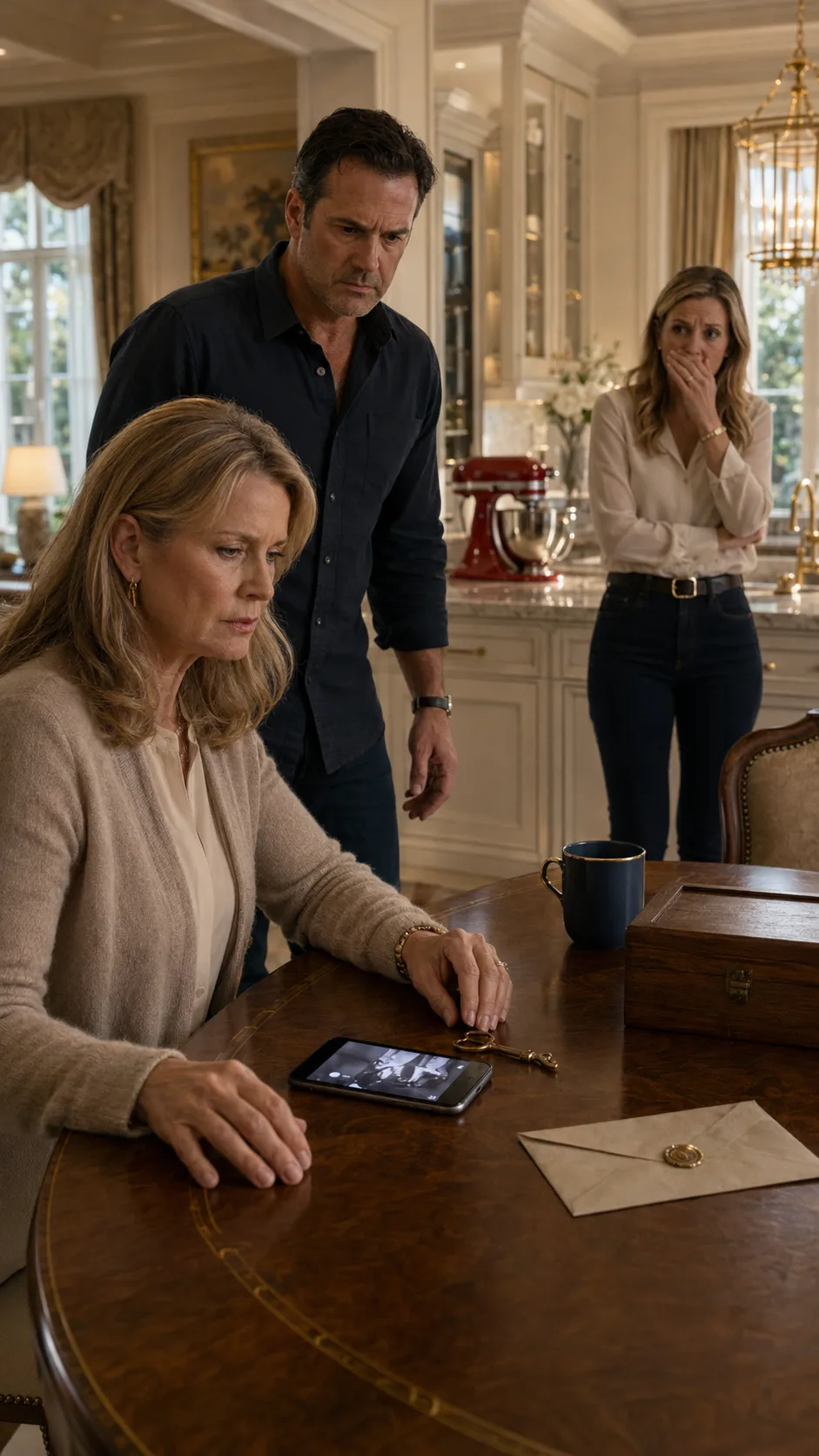
My Daughter-in-Law Told Me to “Take What Was Mine” When She Threw Me Out—So I Did, and by Sunset Her Perfect Life Was Falling Apart
The first thing my daughter-in-law did after kicking me out of my own home was hand me a black trash bag.
Chapter 1
The first thing my daughter-in-law did after kicking me out of my own home was hand me a black trash bag.
Not a suitcase.
Not a box.
A trash bag.
She stood in the marble foyer I paid for, wearing the pearl earrings my late husband bought me for our thirtieth anniversary, and smiled like she had finally won a game I never knew we were playing.
“Take what’s yours, Linda,” she said. “And don’t be dramatic.”
My son, Daniel, stood behind her with his eyes fixed on the floor.
That hurt worse than the bag.
The chandelier above us threw little shards of light across the walls. The house smelled like lemon polish and expensive flowers. Outside, sprinklers hissed over the front lawn like nothing important was happening.
But something important was happening.
My daughter-in-law, Brooke, had just decided I was no longer welcome in the home where I had raised my son.
The home my husband, Harold, had built with his own hands before his construction company became something
big enough for people to respect.
The home whose mortgage had been paid off twelve years ago.
The home whose deed she apparently had never bothered to read.
“Mom,” Daniel said softly, “maybe just for a little while…”
I looked at him.
He stopped talking.
Brooke sighed, as if my silence was exhausting her.
“We’ve been over this,” she said. “The baby needs space. Daniel needs peace. I need to run this household without being watched.”
She said household like she owned the walls.
I glanced toward the living room, where her friends had gathered for brunch. Three women in cream sweaters, holding mimosas, pretending not to listen. One of them had her phone angled down, but I could see the camera lens shining.
Recording.
Of course.
Brooke liked an audience.
She liked soft lighting, clean countertops, and witnesses who would repeat her version first.
I took the trash bag
from her hand.
It crackled loudly in the foyer.
“You’re sure?” I asked.
Brooke’s smile twitched.
“Sure about what?”
“That you want me to take what’s mine.”
She laughed once. Small. Sharp.
“Yes, Linda. Take whatever dusty little things you brought into this house and go.”
Daniel finally looked up.
There was fear in his eyes.
Not fear for me.
Fear of Brooke.
Fear of conflict.
Fear of losing the life she had convinced him he couldn’t survive without.
I nodded.
“All right.”
Brooke blinked. She had expected tears. Maybe shouting. Maybe some trembling speech about family and respect and everything I had sacrificed.
I gave her none of that.
I walked past her into the living room.
Her friends went quiet.
I picked up the silver-framed wedding photo from the mantel. Mine and Harold’s. July 1984. I was twenty-two, wearing a dress my mother had sewn. Harold had cake
frosting on his thumb because he kept stealing bites before the reception.
I put the photo in the trash bag.
Brooke smirked.
“That’s a start.”
I moved to the sideboard and opened the top drawer.
Inside were Harold’s cufflinks, the house blueprints, three spare keys, and a small velvet pouch containing my grandmother’s gold watch.
I took all of it.
Brooke’s smirk faded just a little.
I walked into the dining room and took the crystal candlesticks Harold gave me after Daniel was born.
Then the antique tea set.
Then the family Bible with every birth and death written in my mother’s handwriting.
Then the framed photo of Daniel’s first Little League game.
Then the quilt from the upstairs guest room, the one my sister had made before chemo thinned her hands too much to hold a needle.
Every time something slid into the bag, Brooke’s face tightened.
Not because she cared about the things.
Because she was realizing I knew exactly what belonged to me.
And that scared her.
I did not rush.
I did not raise my voice.
I did not give her a scene she could edit into a sob story later.
I took what was mine.
I took the past she had been using as decoration.
I took the memories she had mistaken for clutter.
I took the proof that this house had a life before her.
I took the silence she thought meant weakness.
By the time I reached the kitchen, Daniel was following me.
“Mom,” he whispered, “please don’t make this harder.”
I opened the cabinet above the refrigerator and took out Harold’s old cigar box.
“I’m not making anything,” I said. “Your wife gave me instructions.”
Brooke came in behind him, heels clicking on the tile.
“Linda, don’t get cute.”
I turned.
That was when I noticed my KitchenAid mixer on the counter.
Red.
Bright cherry red.
A gift from Daniel when he was sixteen and working weekends at a grocery store. He saved for three months to buy it for my birthday. The first thing I made with it was his favorite chocolate cake.
Brooke used it now for Instagram baking reels.
I walked over and unplugged it.
Her mouth fell open.
“Excuse me?”
“You said take what’s mine.”
“That’s an appliance.”
“It’s my appliance.”
“It matches my kitchen.”
“Not anymore.”
One of Brooke’s friends made a tiny sound from the doorway.
Brooke spun toward her. “Chelsea, can you not?”
I wrapped the cord around the mixer and set it carefully on the island.
Daniel rubbed his forehead.
“Mom, come on.”
I looked at him again.
He used to be brave.
At seven, he had stood between me and a stray dog because he thought it was going to bite me. At eleven, he had told a teacher the truth when his friends cheated on a test. At nineteen, he had cried into my shoulder when his father died and promised he would never let me feel alone.
Now he stood in a kitchen I had designed, asking me to surrender a mixer so his wife wouldn’t be embarrassed.
Something settled in me then.
Not anger.
Clarity.
I opened the drawer beside the stove and took my recipe box.
Brooke stepped forward.
“No.”
I paused.
There it was.
The first real crack in her.
“No?” I asked.
“That stays here.”
“Why?”
“Because those are family recipes.”
“They are my family recipes.”
“I’m Daniel’s family.”
“You married into a family,” I said. “You didn’t erase the woman who kept it alive.”
Brooke’s cheeks flushed pink.
Daniel said, “Mom…”
But I was already lifting the box out of the drawer.
The wood was scratched at the corners. Inside were cards written by my mother, my sister, Harold’s mother, and me. Lemon pie. Pot roast. Christmas rolls. Funeral potatoes. Strawberry jam. Daniel’s birthday cake.
Brooke had photographed those recipes for her little lifestyle page and called them “heirloom traditions from our home.”
Our home.
I tucked the box under my arm.
Brooke’s voice dropped.
“If you walk out with that, don’t expect to walk back in.”
I almost smiled.
Almost.
“Brooke,” I said, “you still think this is about the door.”
She stared at me.
For the first time that morning, she looked unsure.
Good.
I carried the mixer to the foyer and set it beside the growing pile. The trash bag was already full, so I went to the hall closet and took out three leather suitcases.
Mine.
Brooke watched me like I was robbing a bank.
“What are you doing?”
“Packing.”
“You don’t need three suitcases.”
“That’s not your decision.”
Her friends had crept closer. They weren’t pretending anymore.
Chelsea was still holding her phone.
I looked directly at the lens.
“Make sure you get my good side.”
Chelsea lowered it immediately.
Brooke’s face went hard.
“Daniel, say something.”
Daniel swallowed.
“Mom, maybe we can talk about this later.”
“No,” I said. “We’re talking now.”
I zipped the first suitcase.
The sound was clean and final.
Brooke crossed her arms over her expensive cream blouse.
“You’ve made Daniel feel guilty for years,” she said. “You act helpless, but you’re manipulative. You keep things in this house like little hooks. Every photo, every dish, every story—it’s all control.”
That was her motive.
Not space.
Not peace.
Control.
She wanted a clean slate. A husband without history. A baby without a grandmother who remembered what came before Brooke.
She wanted to be the first woman in every room.
That would have been sad if it hadn’t been so cruel.
I looked at Daniel.
“Is that what you think?”
He opened his mouth.
Closed it.
Brooke answered for him.
“He thinks you need boundaries.”
I nodded slowly.
“Boundaries are good.”
Brooke looked relieved for half a second.
Then I walked to the wall beside the front door and removed the framed document hanging there.
Harold’s original sketch of the house.
Brooke made a choking noise.
“Why are you taking that?”
I held it against my chest.
“Mine.”
“That belongs with the house.”
“No,” I said. “It belongs with the man who drew it and the woman he drew it for.”
Daniel’s eyes shone.
I thought maybe he might say something real then.
Maybe he might remember his father hunched over the dining table with a ruler and pencil. Maybe he might remember how Harold had let him draw a crooked little tree beside the porch. Maybe he might remember that love was not something you could redecorate out of a room.
But Brooke touched his arm.
He looked away.
So I kept packing.
I took the hallway mirror from my mother’s house.
I took Harold’s record player from the den.
I took the framed letter from the county thanking Harold for rebuilding the community center after the flood.
I took the brass lamp from my reading corner.
I took the little blue ceramic bird Daniel made in second grade, even though one wing had broken off twenty years ago.
When I carried that bird past him, his face changed.
“Mom,” he said, barely audible.
I stopped.
He reached toward it, then let his hand drop.
Brooke noticed.
Her jaw clenched.
“Enough,” she snapped. “This is ridiculous. You’re stripping the house.”
I turned slowly.
“No,” I said. “I’m revealing it.”
She didn’t understand.
Not yet.
The movers arrived twenty minutes later.
That was my first mini-payoff.
Brooke had expected me to fit my life into a trash bag.
I had called professionals.
Two men in navy shirts stepped into the foyer with clipboards and furniture blankets. Brooke looked from them to me.
“You called movers?”
“Last week.”
Daniel’s head snapped up.
“Last week?”
I met his eyes.
“Yes.”
Brooke’s face went pale under her makeup.
Because now she knew.
I had known this was coming.
Maybe not the exact shape of it. Maybe not the trash bag. But I had known.
A woman knows when the temperature in her own home changes.
She knows when conversations stop as she enters a room.
She knows when her son repeats phrases that do not belong to him.
She knows when her daughter-in-law starts measuring walls, not for paintings, but for erasure.
Three weeks earlier, Brooke had suggested I move into a “senior-friendly community.”
Two weeks earlier, Daniel had asked if my bank account was “organized.”
One week earlier, I found my good china boxed in the basement with a sticky note that said DONATE.
So yes.
I called movers.
Brooke recovered quickly. She always did when people were watching.
“You are not removing furniture,” she said.
I opened my purse and took out a folder.
“Actually, I am.”
She stared at it.
The folder was blue. Old. Ordinary.
The kind of thing people ignore until it opens.
Inside were receipts, appraisals, photos, and a copy of Harold’s will.
I handed the first page to the lead mover.
“These items are listed and photographed. Start with the den.”
Brooke lunged forward.
“What list?”
I did not hand it to her.
“You told me to take what was mine.”
Daniel stepped closer.
“Mom, what is on that list?”
I looked at him.
“The furniture your father left to me. The art I inherited from my parents. The appliances I purchased. The family pieces documented before Brooke moved in.”
Brooke laughed, but it came out wrong.
“You documented your furniture?”
“Yes.”
“Who does that?”
“A woman whose husband built a company,” I said, “and taught her that paperwork is what keeps polite thieves from smiling while they rob you.”
That landed.
Even Chelsea’s eyebrows went up.
The movers headed toward the den.
Brooke moved to block them.
“You cannot just walk in here and take things.”
I looked at Daniel.
“Tell her.”
He stared at me.
His lips parted.
Brooke turned to him. “Daniel.”
He looked trapped between us.
So I helped him.
“The den furniture is mine,” I said. “The Persian rug is mine. The grandfather clock is mine. The painting over the fireplace is mine. The library shelves are built-ins, so those stay. The books on them are mine.”
Brooke whispered, “The books?”
“Yes.”
“But they make the room.”
“Not anymore.”
The movers passed her.
She didn’t stop them.
The first thing they carried out was Harold’s leather chair.
That chair had sat in the den for thirty-one years. Harold read the newspaper in it. Daniel slept curled across his lap in it. I sat in it after Harold died because the leather still smelled like him.
Brooke had used it as a prop.
A cozy background for videos about “slow living.”
When the movers carried it through the foyer, Daniel finally spoke.
“Mom, wait.”
I waited.
He touched the back of the chair.
“Dad loved this.”
“Yes,” I said.
His throat moved.
“I thought… I thought it belonged here.”
“It belonged where he was loved.”
Brooke snapped, “Are you saying we don’t love him?”
I did not look at her.
“I’m saying you forgot whose chair it was.”
The movers took it out.
The room changed immediately.
Empty space has a sound.
That morning, it sounded like truth.
Brooke’s brunch guests left one by one.
No dramatic goodbye.
Just murmured excuses and hurried purses.
Chelsea was last. She paused near Brooke and whispered something I couldn’t hear.
Brooke hissed back, “Delete it.”
Chelsea didn’t answer.
She just left.
That was the second mini-payoff.
Brooke had invited witnesses.
She got them.
By noon, the house looked different.
Not ruined.
Honest.
Without my things, Brooke’s perfect home had gaps everywhere.
The mantel was bare except for a pale rectangle where my wedding photo had protected the paint from sunlight.
The dining room sideboard looked cheap without the candlesticks and tea set.
The den echoed without the rug, the chair, the books, and Harold’s records.
The kitchen looked staged and cold without the red mixer, my copper pots, my recipe box, and the row of blue glass jars I had collected from flea markets across three states.
Brooke walked room to room like she was inspecting damage after a storm.
“You are being vindictive,” she said.
“No,” I replied. “I’m being accurate.”
Daniel sat on the bottom stair, elbows on his knees.
He had not helped.
He had not stopped me.
Maybe that was the most honest thing he had done all day.
The movers were carrying out the antique hall table when Brooke noticed the envelope.
It had been taped underneath the drawer for years.
Harold’s hiding place.
I had forgotten it existed until the table tilted and the envelope slid loose, fluttering to the floor like a white flag.
Brooke saw it first.
Her hand shot down.
Mine was faster.
I picked it up.
The paper had yellowed at the edges. My name was written across the front in Harold’s handwriting.
Linda—only if they forget.
The foyer went very still.
Daniel stood.
“What is that?”
I stared at the envelope.
My husband had been dead for six years.
For six years, I had dusted that table, polished its legs, left grocery receipts in its drawer, set Christmas garland across it, and never once known he had left something beneath it.
Brooke’s eyes locked on the words.
Only if they forget.
Her face changed.
Fear again.
But sharper this time.
I slid the envelope into my purse.
Brooke’s voice rose.
“No. Open it.”
I looked at her.
“You don’t give orders anymore.”
Daniel stepped forward.
“Mom, please. If Dad wrote something—”
“I’ll read it when I’m ready.”
Brooke laughed, brittle and high.
“That is convenient.”
I leaned closer, lowering my voice so only she and Daniel could hear.
“Brooke, the only thing convenient today was you saying exactly the sentence I needed.”
Her eyes narrowed.
“What does that mean?”
“It means I didn’t have to fight to leave. You invited me to remove my property in front of witnesses.”
The color drained from her face.
Daniel looked between us.
“Mom…”
The doorbell rang.
Brooke jumped.
No one moved.
It rang again.
I opened the door.
A woman in a gray suit stood on the porch holding a slim leather briefcase. Her hair was silver, cut blunt at her chin, and her expression had the calm cruelty of someone who bills by the hour.
“Mrs. Whitaker?” she asked.
“Yes.”
“I’m Evelyn Price. Mr. Whitaker’s estate attorney.”
Daniel took a step forward.
“Dad’s attorney?”
Evelyn looked past me into the foyer.
“Daniel. Good to see you again.”
He looked confused.
Again.
Brooke noticed that too.
I stepped aside.
Evelyn entered the house and glanced around at the half-empty rooms. Nothing in her face moved, but I saw her understand the situation instantly.
Good attorneys do not need long explanations.
They read rooms.
Brooke folded her arms.
“I’m sorry, why is an attorney here?”
Evelyn looked at me.
“Mrs. Whitaker called my office last week and asked me to review the ownership documents concerning this property and several family assets.”
Brooke’s laugh returned.
“This property? Daniel inherited this house.”
“No,” Evelyn said.
One word.
Clean as a blade.
Daniel went still.
Brooke blinked.
“What?”
Evelyn opened her briefcase.
“Daniel inherited a conditional future interest in the property, subject to Mrs. Whitaker’s lifetime occupancy and control. The deed remains in the Whitaker Family Trust. Mrs. Whitaker is the primary trustee.”
Brooke stared like Evelyn had switched languages.
Daniel whispered, “Mom owns the house?”
Evelyn’s eyes flicked to me.
“Mrs. Whitaker controls the trust that owns the house.”
Brooke turned to me slowly.
I could almost see her rearranging every conversation we had ever had.
Every time she said my house.
Every time she called me a guest.
Every time she told contractors to ignore me.
Every time she smiled while changing curtains, paint colors, locks, passwords, routines.
All of it resting on a lie she had told herself because Daniel never corrected her.
I said nothing.
Brooke did the damage herself.
“That’s impossible,” she said. “Daniel said the house would be his.”
“Would be,” Evelyn repeated. “Not is.”
Daniel’s face crumpled.
“I didn’t know the details.”
I believed him.
That was the saddest part.
Daniel had not plotted.
He had drifted.
Brooke had steered.
Evelyn removed another document.
“There is also the matter of the unauthorized lease listing.”
Brooke froze.
There it was.
The first twist.
I looked at Daniel.
His confusion was real.
“What lease listing?” he asked.
Brooke’s lips parted, but no sound came out.
Evelyn said, “A short-term luxury rental listing for this residence was created under an account connected to Mrs. Daniel Whitaker. The property was advertised as available for private events and weekend stays beginning next month.”
Daniel turned to Brooke.
“Brooke?”
She recovered fast.
Too fast.
“That was just an idea. I was testing the market.”
“You listed my home,” I said.
She looked at me.
For one second, her mask slipped completely.
Underneath it was not shame.
It was resentment.
Hot, old, hungry resentment.
“You have no idea what it costs to live like this,” she said.
Daniel flinched.
Brooke didn’t stop.
“Everyone thinks we’re rich because of this house. Because of your name. Because Daniel walks around with Whitaker attached to him like a gold card. But your company isn’t his. Your money isn’t his. Your old furniture isn’t a bank account.”
Daniel’s voice was hollow.
“Brooke, what did you do?”
She turned on him.
“What I had to.”
The movers stopped working.
Even Evelyn watched carefully now.
Brooke lowered her voice, but the fury stayed.
“You wanted the promotion. You wanted the private school waitlist. You wanted the club membership. You wanted people to stop treating us like we were playing pretend. I tried to make this work.”
“By renting out Mom’s house?” Daniel asked.
“Our house.”
“No,” I said.
She looked at me.
“Our image,” she snapped. “Your house gave us an image. And you were in the way of it.”
There it was again.
The truth, but not the whole truth.
She hadn’t meant to confess everything.
People like Brooke rarely do.
They let motive leak out through anger.
Evelyn slid the document back into her briefcase.
“Mrs. Whitaker, I recommend we discuss this privately.”
Brooke laughed.
“No, let’s discuss it right here. Since Linda wants a performance.”
I looked around the foyer.
The bare walls.
The packed suitcases.
The mover holding Harold’s table.
My son standing like a boy lost in a grocery store.
“No,” I said. “I’m done performing in my own house.”
Brooke’s eyes flashed.
“Then leave.”
“Gladly.”
I turned to the movers.
“Finish with the listed items. Then lock up the truck.”
Evelyn touched my arm lightly.
“Linda.”
I knew that tone.
Legal caution.
But I was not done.
Not quite.
I walked to the staircase and removed the small brass plaque mounted near the bottom rail.
Brooke frowned.
“What is that?”
I held it up.
It read:
Built by Harold Whitaker for Linda Whitaker, 1992.
Daniel stared at it.
His voice broke.
“I forgot that was there.”
“I know,” I said.
And that was the sentence that finally got him.
Not a shout.
Not a curse.
Just I know.
His eyes filled, and he turned away.
Brooke looked disgusted by his weakness.
That told me more than anything else had.
I carried the plaque outside myself.
The moving truck sat in the circular driveway. The May sun was bright, clean, almost indecently cheerful. A robin hopped near the flower bed where Harold had planted tulips the first spring we lived there.
I placed the brass plaque on the passenger seat of my car.
Then I stood beside the open door and allowed myself one breath.
Just one.
Because if I took two, I might start shaking.
Behind me, Evelyn stepped onto the porch.
“She is in deeper than she’s admitting,” she said quietly.
“I know.”
“Do you have somewhere to go?”
“Yes.”
“Where?”
I looked toward the end of the driveway.
A black SUV had just pulled up.
My sister’s son, Mark, got out.
Forty-two, broad-shouldered, wearing jeans and a work shirt with his contracting company logo. He had Harold’s practical eyes and my sister’s temper.
Brooke had always disliked him.
That was another reason I trusted him.
Mark walked up the driveway, looked at the moving truck, then at me.
“Aunt Linda.”
“I’m all right.”
“Didn’t ask.”
His jaw tightened as he looked past me into the house.
Daniel appeared in the doorway.
Mark’s expression hardened.
“Danny.”
Daniel looked ashamed.
“Mark.”
Brooke came up behind Daniel and saw Mark.
“Oh, perfect. More family drama.”
Mark smiled without warmth.
“Actually, I’m here for the piano.”
Brooke’s entire body stiffened.
“No.”
I looked at her.
“The piano is mine.”
“No,” she said again. “Absolutely not. That piano is staying.”
The piano sat in the front room.
A black baby grand.
Harold bought it for me after I beat breast cancer at forty-seven. I wasn’t good. I played simple songs badly, and Harold said every wrong note was proof I was alive.
Daniel learned Christmas carols on it.
Brooke used it for holiday photos.
No one had played it in years.
She wanted it because it made the room look expensive.
Mark stepped past her.
“I brought padding.”
Brooke blocked him.
“You are not taking that piano.”
Evelyn cleared her throat.
“Mrs. Whitaker has documentation of ownership.”
Brooke ignored her.
“Daniel,” she snapped.
Daniel looked at the piano.
Then at me.
Then at Brooke.
For one long moment, the old Daniel flickered.
The boy with frosting on his mouth.
The teenager carrying a red mixer in both arms.
The grieving son clinging to me at Harold’s funeral.
He whispered, “Let her take it.”
Brooke turned slowly.
“What?”
He swallowed.
“It’s Mom’s.”
She looked like he had struck her.
But he hadn’t.
He had simply stopped letting her use his silence.
Mark and the movers took the piano.
It was careful work. Slow. Sweaty. Nearly an hour.
Brooke stood on the porch the entire time, arms folded, eyes burning.
The neighborhood noticed.
Of course they did.
A moving truck in a rich cul-de-sac is never invisible.
Mrs. Adler from across the street pretended to water her hydrangeas for forty minutes.
The Bennetts slowed their golf cart twice.
Someone’s curtains moved.
Brooke cared deeply about being seen.
So I let them see.
Let them see the piano leave.
Let them see the chair leave.
Let them see the rug, the paintings, the lamps, the boxes of books, the candlesticks, the silver frames, the old life she thought she could inherit by standing inside it long enough.
At 2:13 p.m., the moving truck doors rolled shut.
The sound echoed down the driveway.
Brooke stood in the doorway of a house that suddenly looked borrowed.
Daniel stood behind her.
Evelyn handed me a business card.
“We should talk today.”
“We will.”
Mark touched my shoulder.
“Ready?”
I looked at the house.
I expected grief to hit me like a wave.
Instead, I felt something stranger.
Space.
For six years after Harold died, I had stayed because leaving felt like betrayal.
Because Daniel still came by for dinner.
Because the roses needed pruning.
Because every room held a memory, and I thought memories needed walls.
But memories are not loyal to walls.
People are supposed to be.
I got into my car.
Brooke walked down the steps.
“You’re really doing this?” she asked.
I rolled down the window.
“You told me to take what was mine.”
Her voice lowered.
“You will regret humiliating me.”
There it was.
Not us.
Me.
Daniel heard it too.
I saw his face change.
I looked at Brooke one last time.
“No,” I said. “I will regret waiting this long.”
Then I drove away behind the moving truck.
I did not look back until we reached the stop sign.
In the rearview mirror, I saw Brooke standing in the driveway, small and furious, with Daniel beside her and the house behind them full of holes.
For the first time all day, I smiled.
Not because I had won.
Because I had left with my hands steady.
Mark followed me to the storage facility on Route 9. It was clean, climate-controlled, and owned by a retired couple who had known Harold. The unit was large enough for the furniture, the piano, the boxes, and the pieces of my life that had survived Brooke’s little coronation.
As the movers unloaded, I sat in Mark’s truck with the air conditioning running and took Harold’s envelope from my purse.
Linda—only if they forget.
My thumb traced his handwriting.
Mark noticed.
“What’s that?”
“I don’t know.”
“You want me to step out?”
“No.”
My voice surprised me.
I wanted someone there.
Not Daniel.
Not yet.
Someone who still remembered Harold as more than a portrait on a wall.
I opened the envelope carefully.
Inside was one sheet of paper and a small brass key taped to the bottom.
The letter was written in Harold’s blocky hand.
My Linda,
If you are reading this, then I was right about one thing and wrong about another.
I was right that someday someone might forget what this house is.
I was wrong because I hoped it would not be Daniel.
Do not let sentiment make you homeless.
Do not let guilt make you quiet.
The house is protected. The company is protected. Your name is protected.
But there is one thing I did not put in the trust.
I kept it separate because I wanted you to decide when the time came.
Box 417. First National on Harbor Street.
If they forget love, show them paper.
If they forget sacrifice, show them ownership.
If they forget you, show them the door.
I love you more than every nail in that house.
H.
The paper blurred.
I pressed my fingers to my eyes, hard.
Mark was silent.
Good man.
After a moment, he said, “Box 417?”
I nodded.
“I didn’t know he had one.”
“What do you think is in it?”
I looked at the brass key.
“I don’t know.”
But I knew one thing.
Harold had not written that letter for nothing.
By late afternoon, the furniture was stored, the paperwork signed, and Mark insisted on driving me to his guesthouse.
He and his wife, Amanda, lived on twelve acres outside town, where the road dipped between old oaks and the air smelled like cut grass. The guesthouse had a little porch, white curtains, and a kitchen just big enough for one woman and a red mixer.
Amanda met me at the door with no pity in her face.
That was why I loved her.
She hugged me hard, then said, “I made coffee and there’s banana bread. You don’t have to talk unless you want to.”
I almost cried then.
Not in the foyer.
Not when Brooke handed me the trash bag.
Not when Daniel looked at the floor.
But at banana bread.
Because kindness is what breaks you after cruelty fails.
I set my recipe box on the kitchen counter.
Amanda saw it and smiled.
“Good. You got the important thing.”
“Yes,” I said. “I did.”
My phone started ringing at 5:08 p.m.
Daniel.
I let it ring.
Then again at 5:11.
Then 5:15.
Then a text.
Mom please call me.
Then another.
Brooke is freaking out.
Then another.
I didn’t know about the rental listing.
Then another.
Please.
I put the phone face down.
Amanda poured coffee into a blue mug.
Mark leaned against the counter.
“You don’t have to fix him today.”
That sentence was a gift.
I wrapped both hands around the mug.
“I know.”
But knowing and feeling are not the same.
At 5:42, Evelyn called.
I answered.
“Linda,” she said, “I pulled the trust file and checked the county records again.”
Something in her voice made me sit straighter.
“What is it?”
“There was an attempted filing two days ago.”
“Filing?”
“A quitclaim deed.”
My fingers tightened around the phone.
“By whom?”
“It was prepared online. It appears to transfer your interest in the property to Daniel.”
My mouth went dry.
“I didn’t sign anything.”
“I know. The signature was rejected by the clerk because the notarization was incomplete.”
Mark moved closer.
Amanda’s hand went to her mouth.
Evelyn continued, “But Linda, the signature resembles yours.”
The room went very quiet.
Brooke had not just wanted me gone.
She had tried to take the house.
There was the second twist.
Not ten twists.
Not chaos.
Just one deeper truth under the first.
The rental listing was not desperation.
It was preparation.
Get me out.
Transfer the house.
Use it for money.
Maybe sell later.
Maybe tell everyone I agreed because I was old, confused, emotional.
A clean story.
A pretty lie.
I asked, “Does Daniel know?”
“I can’t say.”
“Can’t or won’t?”
A pause.
“Won’t.”
That told me enough.
Evelyn said, “We need to secure your documents and contact the bank about Box 417. If Harold separated something from the trust, we need to know what it is before Brooke makes another move.”
My gaze dropped to the brass key on the counter.
“I have the key.”
“Good. Do not go alone.”
I looked at Mark.
“I won’t.”
When I hung up, my phone buzzed again.
This time, it was not Daniel.
It was a number I didn’t recognize.
A video message.
Amanda looked at me.
“Don’t open that unless you’re ready.”
I almost set it down.
Almost.
Then I thought of Brooke handing me that trash bag.
I opened it.
The video was from Chelsea.
Brooke’s friend.
The one who had recorded.
The message beneath it read:
You should see what she said after you left the room.
My pulse slowed.
That happens to me in moments of danger.
The world does not speed up.
It sharpens.
I tapped play.
The video showed my foyer from earlier that morning. The angle was low, half-hidden, probably from Chelsea’s phone near her purse.
I saw myself walking toward the dining room.
Brooke stood near the stairs with Daniel.
She thought no one was recording.
Her voice came through clearly.
“Let her take the junk. Once she’s gone, she’ll be too embarrassed to fight. Then we file the papers again with a real notary.”
Daniel said something I couldn’t hear.
Brooke snapped, “Your mother signs whatever you put in front of her when you act helpless enough.”
The screen tilted slightly as Chelsea’s hand moved.
Daniel’s face was pale.
“I don’t want to trick her.”
Brooke stepped closer to him.
“Then enjoy being the forty-year-old man whose mommy still owns his life.”
The video ended.
No one spoke.
Amanda sat down slowly.
Mark’s face had gone dark.
I replayed the last ten seconds.
Then again.
Then one more time.
Not because I needed to hear it.
Because I needed to stop my heart from trying to protect Daniel from what he had allowed into the room.
My son had known about papers.
Maybe not all of it.
Maybe not the fake notary.
Maybe not the rental listing.
But enough.
Enough to make my grief sit down and my caution stand up.
At 6:03 p.m., Daniel called again.
This time, I answered.
“Mom,” he breathed. “Thank God.”
I said nothing.
He rushed on.
“I’m so sorry. I didn’t know she had gone that far. I swear. I thought it was just about getting you to let us manage things. Brooke said you were stressed. She said the house was too much. She said—”
“Daniel.”
He stopped.
I could hear him breathing.
I could hear Brooke yelling in the background, muffled but furious.
“Did you know there were papers?”
Silence.
That was answer enough.
“Mom,” he whispered.
“Did you?”
“She said it was for estate planning.”
“Did you ask me?”
“No.”
“Did you bring me papers?”
A longer silence.
My chest hurt.
Not sharp.
Deep.
Like an old bruise pressed by a thumb.
“Daniel.”
“Yes,” he said.
Amanda closed her eyes.
Mark turned away.
My son began crying.
Not loudly.
Not dramatically.
Just one broken sound.
“I didn’t think of it like that. She said you’d say no because you don’t trust us. She said if the house was in my name, we could refinance, fix everything, pay debts, prepare for the baby. She said it would still be your home.”
I looked at the little guesthouse kitchen.
My red mixer sat on the counter, absurd and brave.
“No,” I said. “She said what you needed to hear so you would do what she wanted.”
“I’m sorry.”
“Sorry is not a broom, Daniel. It doesn’t sweep this clean.”
He cried harder.
In the background, Brooke’s voice cut through.
“Is that her? Put it on speaker.”
I almost laughed.
Still giving orders.
Still thinking every room belonged to her if she raised her voice.
Daniel said, “Brooke, stop.”
That was new.
Small.
Late.
But new.
She shouted something I couldn’t make out.
Then Daniel said, louder, “I said stop.”
I waited.
He came back to the phone.
“Mom, what do I do?”
There it was.
The question he should have asked before the trash bag.
Before the papers.
Before letting his wife turn my life into a problem to solve.
I kept my voice calm.
“You start by not destroying evidence.”
“What?”
“Do not delete texts. Do not touch files. Do not let Brooke touch the computer she used for the rental listing. Do not sign anything. Do not speak for me.”
He swallowed.
“Okay.”
“And Daniel?”
“Yes?”
“If you lie to me again, I will stop being your mother in every legal way I can.”
The silence on the line was enormous.
I had never spoken to him like that.
Never.
But love without boundaries had become an unlocked door, and Brooke had walked right through it.
“I understand,” he said.
“I hope so.”
I hung up.
Then I put my head down on Amanda’s kitchen table and breathed.
One breath.
Then another.
I did not scream.
I did not shatter.
But I let myself be tired.
That night, I slept in the guesthouse under a quilt my sister had made, with Harold’s letter folded on the nightstand and the brass key beneath it.
At 3:17 a.m., I woke to headlights sweeping across the ceiling.
For a second, I forgot where I was.
Then I heard tires on gravel.
Not Mark’s truck.
Not Amanda’s car.
I got out of bed quietly.
The guesthouse window faced the driveway. Through the curtains, I saw a white sedan parked near the oak tree.
Brooke’s car.
She sat inside with the engine running.
Alone.
My phone buzzed.
A text from Daniel.
Don’t open the door if she comes. I’m on my way.
Then another.
She took my laptop.
Then another.
Mom, I think she’s going to the bank in the morning.
I looked at Harold’s brass key on the nightstand.
The bank.
Box 417.
I stood in the dark, watching Brooke’s white sedan.
She didn’t get out.
She just sat there.
Watching the guesthouse.
Maybe she wanted to scare me.
Maybe she wanted to see if I was alone.
Maybe she wanted the key.
The old Linda might have opened the door.
The old Linda might have said, Brooke, let’s talk.
The old Linda might have believed a pregnant woman in distress deserved softness, even after cruelty.
But the woman standing in that dark guesthouse had carried her life out in suitcases.
That woman knew better.
I took a photo of Brooke’s car.
Then I sent it to Evelyn.
Then to Mark.
Thirty seconds later, Mark’s porch light came on across the yard.
Brooke’s sedan reversed so fast gravel sprayed behind her.
She sped away without headlights for the first hundred feet.
By morning, she had posted online.
Of course she had.
A soft-focus photo of herself on the front steps of my half-empty house, one hand resting on her pregnant belly, eyes lowered.
The caption read:
Heartbroken today. Sometimes family chooses possessions over people. Protect your peace, even when it hurts.
By 8:00 a.m., she had 312 comments.
Poor mama.
So toxic.
Boundaries are hard but necessary.
Some mothers-in-law never let go.
I stared at the post while Amanda made eggs.
There was a time when public humiliation would have made me hide.
Brooke counted on that.
She thought women my age feared being misunderstood more than being mistreated.
She was wrong.
At 8:11, I posted one photo.
No caption.
Just the black trash bag she had handed me in the foyer, sitting beside my red mixer in the guesthouse kitchen.
Then I posted the first ten seconds of Chelsea’s video.
Only the part where Brooke said, “Let her take the junk.”
Not the forged papers.
Not yet.
Mini-payoff.
By 8:30, Brooke’s comments had changed.
Wait is this about Linda Whitaker?
Is that the Whitaker house?
Brooke what is this?
Why did you give her a trash bag?
Chelsea commented one sentence:
I was there. Linda is not lying.
Brooke deleted her post at 8:41.
Screenshots lived forever.
At 9:00, Evelyn met Mark and me at First National on Harbor Street.
The bank sat downtown between a bakery and a florist. Old brick. Brass handles. American flag moving gently in the morning wind.
Harold had used this bank for everything.
The manager, Mr. Collins, recognized me immediately.
“Mrs. Whitaker,” he said, standing too fast. “I’m sorry for your loss.”
People still said that six years later.
I didn’t mind.
It meant Harold had existed.
We showed identification. Evelyn showed paperwork. I showed the brass key.
Mr. Collins’ professional smile slipped when he saw the box number.
“417,” he said.
“Yes.”
He looked at Evelyn.
“Has there been another inquiry?”
Evelyn’s eyes sharpened.
“Another?”
Mr. Collins cleared his throat.
“A woman called yesterday asking about access requirements for a family box. She said her mother-in-law had dementia and misplaced the key.”
Mark muttered something under his breath.
I looked at the bank manager.
“Did she give her name?”
“Brooke Whitaker.”
There it was again.
Not subtle.
Not smart enough.
Just entitled.
Evelyn asked, “Did you provide information?”
“No. We told her she would need legal authority.”
“And?”
“She asked what kind.”
My stomach tightened.
Mr. Collins glanced at me.
“I’m sorry, Mrs. Whitaker. We did not disclose box details. But she knew the number.”
I felt the key bite into my palm.
Brooke knew the number.
But I had only found the letter yesterday.
So how?
We went into the vault.
The air inside was cool and dry. Rows of metal boxes lined the wall like secrets waiting their turn.
Mr. Collins and I used our keys together.
Box 417 slid out with a soft scrape.
It was heavier than I expected.
He carried it to a private viewing room and left us.
For a moment, none of us touched it.
Evelyn said, “Whenever you’re ready.”
I opened the lid.
Inside were four things.
A sealed envelope.
A small external hard drive.
A stack of property documents.
And a photograph.
Not old.
Recent.
Maybe seven years old.
Harold stood beside another man in front of a construction site. Both wore hard hats. Harold was smiling, but his eyes looked tired.
On the back, in Harold’s handwriting, were three words:
Ask about Mercer.
I looked at Evelyn.
“Who is Mercer?”
Her expression changed.
Not confusion.
Recognition.
“Thomas Mercer,” she said carefully. “He was Harold’s business partner before the company split.”
“I thought Harold bought him out.”
“He did.”
“When?”
“About a year before Harold died.”
Mark leaned forward.
“What does Mercer have to do with Brooke?”
Evelyn did not answer immediately.
That scared me more than if she had.
I picked up the sealed envelope.
This one had no loving note on the front.
Just my name.
Linda.
I opened it.
Inside was another letter from Harold.
Shorter.
Harder.
My Linda,
If Box 417 has been opened, then something has gone wrong around Daniel.
I hope I am wrong.
Thomas Mercer believed I cheated him when I bought out his share. I did not. The documents here prove that.
But Mercer made threats.
Not loud ones. Quiet ones. The kind men make through lawyers, bankers, and sons who want approval.
He once told me no family keeps a house forever if the next generation is hungry enough.
I did not tell you because you had already survived enough.
That was my mistake.
If anyone connected to Mercer comes near Daniel, the house, or the company, call Evelyn. Trust paper. Trust dates. Trust signatures. Do not trust charm.
And sweetheart, forgive me for leaving you one more mess.
H.
The room tilted.
Mark took the letter from my hand before I dropped it.
Evelyn was already reaching for the stack of documents.
“Linda,” she said, “I need you to think carefully. Has Brooke ever mentioned the name Mercer?”
I shook my head.
Then stopped.
A memory rose.
Small.
Almost nothing.
Three months earlier, at Sunday dinner, Brooke had been showing us photos for the nursery. Pale green walls, white crib, gold-framed animal prints.
Daniel mentioned money was tight.
Brooke had touched his shoulder and said, “Tom says there are ways to unlock dead equity.”
Tom.
I had thought she meant someone from the bank.
I whispered, “Tom.”
Evelyn looked up.
“What?”
“She said Tom. Not Thomas. Just Tom.”
Mark’s jaw tightened.
“Tom who?”
I reached for the hard drive.
Evelyn stopped me.
“Let me have someone image that properly.”
“Why?”
“Because if Harold put this in a safe deposit box with a warning about Thomas Mercer, we need to preserve chain of custody.”
I sat back.
Chain of custody.
Forgery.
Unauthorized listing.
Attempted deed transfer.
Brooke watching the guesthouse at three in the morning.
This was no longer a family fight.
This was something with roots.
And roots meant there might be more hands in the dirt.
At 10:22, my phone rang.
Daniel.
I answered on speaker.
His voice was ragged.
“Mom, Brooke is gone.”
Mark stood straighter.
“What do you mean gone?” I asked.
“She packed a bag while I was in the shower. Her car’s gone. Her laptop’s gone. The folder with the papers is gone.”
Evelyn closed her eyes.
I asked, “Where would she go?”
“I don’t know.”
“Daniel.”
“I swear, I don’t know.”
Then he went quiet.
Too quiet.
“What?” I asked.
He breathed shakily.
“There’s something on the kitchen counter.”
“What?”
“An envelope.”
My hand tightened around Harold’s letter.
“What does it say?”
Daniel’s voice broke.
“It has your name on it.”
“Don’t open it.”
“I already did.”
Every person in that little bank room froze.
I closed my eyes.
“What’s inside?”
Daniel swallowed.
“A sonogram picture.”
My stomach dropped.
“And?”
He started crying again.
“And a note.”
I gripped the edge of the table.
“Read it.”
His voice shook as he read Brooke’s handwriting aloud.
Linda,
You took what was yours.
Now I’m taking what’s mine.
Ask your husband what he did to my father.
The line went dead.
For a moment, there was no sound in the room except the faint hum of the bank lights overhead.
Then Evelyn whispered the name before I could.
“Mercer.”
I looked down at the photograph from Box 417.
Harold and Thomas Mercer.
Two men in hard hats.
One smiling.
One watching.
And for the first time since Brooke handed me that trash bag, I understood something that made my blood go cold.
My daughter-in-law had not married into my family by accident.
She had come for it
THE END.
Chapter complete
You have reached the end of this chapter.
Continue reading
A few more worlds to get lost in after this chapter.