card, and placed it on top of the bill.
The server swallowed. “Whenever you’re ready, ma’am.”
“I’m ready,” I said.
Madison gave a small laugh. “See? Was that so hard?”
“No,” I said. “Not at all.”
But while the server walked away with my card, I reached into my purse and slid my phone into my lap.
There was a message waiting from my banker.
One line.
Evelyn, the documents are ready whenever you give the word.
I typed back with my thumb under the table.
Tonight.
Then I put my phone away, folded Madison’s unopened birthday card back into my purse, and watched my son pretend he had not just allowed his wife to humiliate the woman who had raised him alone.
I did not cry.
I did not raise my voice.
I did not give Madison the satisfaction of seeing a single crack.
I just paid.
And by sunrise, Madison would understand that I had paid for everything.
Including the rope.
She had only tied the knot herself.
The house lights were still on when I pulled into my driveway at 9:47 p.m.
Not my porch light.
Their lights.
The upstairs guest room glowed soft gold behind linen curtains I had purchased in Charleston fifteen years earlier. The kitchen windows were bright. The garage door was open, and Madison’s white Range Rover sat halfway inside like it owned the place.
My house looked occupied.
Not lived in.
Occupied.
There is a difference.
A lived-in house carries warmth. Shoes by the door. A coffee mug beside a favorite chair. A sweater forgotten over the back of the couch.
An occupied house has commands.
Boxes stacked where they do not belong.
A thermostat changed without asking.
A vase moved from the mantel because “it looked old.”
A woman’s voice calling from upstairs, “Evelyn, can you keep it down? Noah’s sleeping.”
In my house.
The house my late husband, Robert, built with his own hands before his construction company became anything more than two men, a pickup truck, and a dream.
The house where Brandon took his first steps.
The house where Robert died in the downstairs study with his reading glasses still on his nose and a half-finished crossword puzzle on his lap.
The house Madison had started calling “the family house” six months after they moved in “just until their renovation was finished.”
That renovation had no permits.
I knew because I checked.
That renovation had no contractor.
I knew because I called.
That renovation had no end date.
I knew because Madison had stopped pretending.
When they first came, she arrived with luggage, a toddler, and tears.
“Just two weeks, Evelyn,” she had said, standing in my foyer in a cream cashmere coat I later learned I had paid for through Brandon’s emergency credit card. “The dust is terrible at our place. Noah’s coughing. I know this is inconvenient.”
It was inconvenient.
It was also my grandson.
So I opened the door wider.
Two weeks became a month.
A month became Christmas.
Christmas became spring.
By June, Madison had replaced my blue hydrangeas with white roses because “blue flowers make the front look dated.”
By August, my pantry had been reorganized with labels in a font Madison called “coastal minimal.”
By Thanksgiving, she was hosting dinner in my dining room and introducing me to her friends as “Brandon’s mom, Evelyn, who lives here too.”
Lives here too.
I should have stopped it then.
I should have taken my house back the first time she made me ask where my own mixing bowls had gone.
But guilt is a slow thief.
It does not break in.
It convinces you to unlock the door.
I turned off my engine and sat in the driveway.
Through the kitchen window, I could see Madison moving around with a glass of wine in her hand. She had changed out of the black silk blouse she wore to dinner and into one of my robes.
My robe.
Pale blue, with white piping.
A gift from Robert on our last anniversary.
Madison wore it loose, barefoot, laughing at something on her phone.
I looked at my hands on the steering wheel.
Still steady.
Then I opened my glove compartment and took out a thin red folder.
Inside were copies.
Not originals.
Never originals.
I had learned that from Robert.
Originals sleep in safes.
Copies walk into rooms.
I walked into my house at 9:56 p.m.
Madison glanced over from the kitchen island. “Oh. You’re back.”
“Yes,” I said, hanging my coat in the hall closet.
She looked at my empty hands. “Did you forget the leftover cake?”
“No.”
She blinked. “You didn’t bring it?”
“I did not.”
“That was a ninety-dollar cake.”
“I’m sure the restaurant enjoyed it.”
Madison set down her wine glass a little too hard. “Are you seriously being petty because I asked you to pay for dinner?”
I walked past her to the kettle.
My kettle.
Still in the wrong cabinet.
“I paid for dinner, Madison.”
“You made everyone uncomfortable.”
“No,” I said, filling the kettle. “You did.”
Her mouth opened.
Then shut.
That was new for her.
She recovered quickly. “You know, I don’t understand why you act like being generous is some huge burden. You have more money than you can spend.”
“Is that what Brandon told you?”
“It’s obvious.”
“Obvious things can still be misunderstood.”
She laughed once. Sharp. “Please. Don’t do the mysterious old-money widow routine with me.”
I turned on the burner.
She hated when I moved slowly.
It made her feel like she was not controlling the speed of the room.
“Where is Brandon?” I asked.
“Putting Noah to bed.”
“In my room?”
Her eyes narrowed. “The primary suite works better for us. You said you didn’t mind.”
“I said you could use it while Noah was sick.”
“He likes the bigger bathroom.”
“Children like many things they are not entitled to.”
Madison stepped closer. The silk of my robe shifted around her knees.
“You’re in a mood tonight.”
“No,” I said. “I’m in my house.”
Her face hardened.
There it was.
The flash beneath the polish.
Not anger.
Entitlement interrupted.
“Evelyn,” she said, lowering her voice as if speaking to a difficult employee. “Let’s not turn this into some dramatic thing. We all know how this works.”
I looked at her.
She smiled again, but thinner now.
“You help Brandon. Brandon helps me and Noah. Everyone stays comfortable. That’s what family does.”
The kettle began to hum.
“What family does,” I repeated.
“Yes.”
I placed one teacup on the counter.
Only one.
Madison noticed.
“You’re not making me one?”
“No.”
She stared.
I opened the red folder and slid one document across the island.
“What is that?” she asked.
“An accounting.”
“Of what?”
“Every payment I have made for you and Brandon in the last thirty-eight months.”
Madison looked at the paper but did not touch it.
Smart enough to be suspicious.
Not smart enough to be afraid.
“That’s weird,” she said. “Really weird, Evelyn.”
“Mortgage assistance. Credit card transfers. Private school deposits. Vehicle payments. Contractor deposits that were never used for contractors. Medical bills. Insurance premiums. Utility payments at your house while you were living here. The down payment on the Range Rover.”
Her lips parted.
“Don’t be ridiculous,” she said.
“The total is seven hundred and forty-two thousand, nine hundred and eighteen dollars.”
For the first time all night, Madison said nothing.
The kettle whistled.
I turned off the burner.
The silence afterward was clean and bright.
Then she laughed.
Not because anything was funny.
Because laughter is what people use when denial is cheaper than fear.
“You kept a list?” she said. “That’s sick.”
“No. That’s bookkeeping.”
“It’s family money.”
“No,” I said. “It is my money.”
“You gave it to us.”
“Some of it.”
She stared at the papers.
“Some?”
“Yes.”
“What does that mean?”
“It means gifts are gifts. Loans are loans. Business advances are business advances. And fraudulent charges are fraudulent charges.”
Color drained from the top of her cheeks before she could stop it.
Tiny.
Almost nothing.
But I saw it.
Robert used to say money tells the truth because people forget it has a memory.
Receipts.
Dates.
IP addresses.
Signatures.
Bank cameras.
Credit card authorizations.
Money remembers.
Madison folded her arms. “I don’t know what Brandon has told you, but we’re married. We make financial decisions together.”
“I know.”
“So if he borrowed something—”
“He didn’t.”
Her eyes flicked toward the staircase.
There.
Another little truth.
“Then what are you accusing me of?”
I poured hot water over my tea bag.
“Nothing yet.”
“Yet?”
I let the tea steep.
Madison hated waiting.
She picked up the first page, scanned it, then tossed it down.
“This is pathetic. Are you lonely? Is that what this is? You want Brandon dependent on you forever?”
I stirred my tea.
Once.
Twice.
Three times.
“No,” I said. “I wanted him to become a man.”
That landed harder than I expected.
Maybe because I did not raise my voice.
Maybe because it was true.
Madison leaned across the island. “Then stop treating him like a child.”
“I will.”
Something in my tone made her freeze.
Footsteps sounded on the stairs.
Brandon appeared in the kitchen doorway, pale and tired, wearing the sweater I bought him last Christmas.
He looked from Madison to me to the red folder.
“What’s going on?”
Madison spoke first.
“Your mother has decided to make a spreadsheet of everything she’s ever done for us because apparently paying for dinner was traumatic.”
Brandon did not laugh.
He looked at me.
Then the folder.
Then Madison.
“Maddie,” he said quietly, “go upstairs.”
Her head snapped toward him. “Excuse me?”
“Please.”
That please was the wrong word.
It gave her room.
She took it.
“No. Absolutely not. If your mother wants to attack our family, I’m going to stand here and listen.”
“Our family,” I said softly.
Madison turned on me. “Yes, Evelyn. Our family. You don’t get to keep Brandon as your little substitute husband because Robert died.”
Brandon flinched.
So did I.
But only inside.
Outside, I lifted my tea and took a sip.
The tea was too hot.
It burned my tongue.
Good.
Pain is useful when you need focus.
Brandon said, “Madison, stop.”
“No, you stop.” She pointed at him. “You always do this. You let her sit there like some saint while she controls everything with money.”
I set down my cup.
“Brandon.”
He looked at me.
I slid the second document across the island.
His eyes dropped to the page.
He read the first line.
Then the second.
His face changed.
Not confusion.
Recognition.
Shame came in behind it.
Slow and gray.
Madison watched him. “What is that?”
Brandon did not answer.
“What is that?” she repeated.
I said, “A copy of the corporate card authorization from the account attached to Robert’s old holding company.”
Madison went still.
Brandon whispered, “Mom…”
“You told me that card was locked in your safe,” I said.
“It was.”
“When?”
He swallowed.
“Mom.”
“When, Brandon?”
He rubbed both hands over his face. “I don’t know. A while ago.”
Madison’s voice was light now. Too light. “This is boring. I’m going to bed.”
“No,” I said.
She looked at me with pure hatred.
There it was at last.
No more sugar.
No more daughter-in-law smile.
Just the woman who had stood in my dining room for months, measuring the drapes and waiting for me to become inconvenient enough to move.
“You don’t tell me no,” Madison said.
“I just did.”
“This is my home too.”
“It is not.”
“My child sleeps here.”
“That can change.”
Her mouth twitched. “Careful.”
Brandon’s head lifted. “Maddie.”
But she kept her eyes on me.
“Careful, Evelyn. Courts don’t love rich grandmothers who threaten to throw children into the street.”
I smiled then.
A real one.
Small.
Almost sad.
“You should not have said that.”
Madison’s confidence flickered.
Only for a second.
But it flickered.
I reached into the folder and removed the third document.
Not a spreadsheet.
Not a bank record.
A notarized agreement.
Signed six months earlier.
By Brandon.
And by Madison.
She recognized it immediately.
I saw the moment she remembered.
The champagne brunch at the club.
The white linen tablecloth.
The way she barely read the papers because she was too busy posting a photo of her mimosa.
The way I said, “It is just a temporary occupancy agreement for insurance purposes.”
The way she waved her hand and said, “Brandon understands this stuff.”
The way she signed her name.
Big looping M.
Sharp little tail at the end.
I placed the copy in front of her.
“You and Brandon are not tenants,” I said. “You are temporary guests. You signed that acknowledgment on March 14.”
Madison’s face tightened.
“That was not explained properly.”
“It was explained by my attorney.”
“You tricked us.”
“I protected myself.”
“You’re going to evict your grandson?”
“No,” I said. “I am going to stop financing two adults who use him as a human shield.”
Brandon looked like he might be sick.
Good.
Some sickness is the body recognizing poison.
Madison pushed away from the island. “You know what? Fine. Do your little legal stunt. But you’ll regret it when Brandon wants nothing to do with you.”
I looked at my son.
For a moment, the kitchen was gone.
He was six years old again, standing in rain boots in the backyard, holding a worm in both hands and asking if worms had mothers.
He was twelve, crying in the garage after Robert yelled because he dented the mower.
He was nineteen, leaving for college with too many towels and not enough courage.
He was thirty-six now.
A husband.
A father.
A man who had watched his wife tell his mother to shut up and pay.
“Brandon,” I said. “Do you want nothing to do with me?”
His eyes filled.
Madison snapped, “Don’t answer that.”
And because he was still my son, because there was still a boy under all that fear, he whispered, “No.”
One word.
Barely air.
But it changed the room.
Madison stared at him like he had slapped her.
I almost felt sorry for her.
Almost.
Then my phone rang.
The screen said: MR. HAYES.
My attorney.
I put it on speaker.
“Evelyn,” he said. “I have the bank confirmation. All discretionary transfers from the trust account have been frozen as of 10:18 p.m. The corporate card ending in 4107 has been canceled. The family office card ending in 9922 has been canceled. The tuition account has been converted to direct-pay only. No cash withdrawals.”
Madison’s face went white.
Not pale.
White.
I watched her calculate.
Range Rover payment.
Credit cards.
Private school donation account.
Household payroll.
Interior designer.
Wine club.
Pilates membership.
Storage unit.
The secret storage unit I was not supposed to know about.
I said, “Thank you, Daniel.”
He continued, “The fraud review begins tomorrow morning. I recommend nobody touches any account connected to the holding company tonight.”
Madison’s eyes darted to her purse on the counter.
So fast most people would have missed it.
I did not.
“Understood,” I said.
“Also,” Daniel added, “the occupancy termination notice is ready for service at your discretion.”
Madison exploded.
“You evil old witch.”
Brandon stepped between us.
“Don’t.”
Madison shoved his arm away. “No. No, I’m not going to stand here and let her ruin us because she had one bad dinner.”
“One bad dinner?” I said.
My voice was quiet.
Too quiet.
The house seemed to lean in.
“You wore my dead husband’s robe.”
Madison froze.
I took one step toward her.
“You moved his books into storage.”
Another step.
“You took down his photograph in the study because you said it made the room feel heavy.”
Another step.
“You told my grandson I was forgetful because I could not find the silverware you moved.”
Her jaw tightened.
“You told your friends I lived here too.”
Brandon closed his eyes.
“You asked my housekeeper whether I had memory issues.”
Madison’s eyes sharpened.
Caught.
Yes.
I knew that too.
“You changed the gate code.”
The air shifted.
Brandon looked at her.
“What?”
Madison said nothing.
I looked at my son.
“She changed the gate code on April 9. I know because I sat in my own driveway for eleven minutes while it rained. When I called her, she said the system must be glitching.”
Brandon turned slowly toward his wife.
“Maddie.”
She rolled her eyes. “It was one time. The old code was unsafe.”
“You didn’t tell me,” he said.
“I manage the house.”
“My mother’s house.”
Her face cracked.
There he was.
Not strong yet.
But awake.
That was enough for tonight.
Madison grabbed her purse. “I need air.”
I said, “Leave the cards.”
She stopped.
“What?”
“The cards in your wallet that are attached to my accounts. Leave them on the island.”
She laughed. “You can’t be serious.”
“I am.”
“They’re canceled anyway.”
“Then you won’t miss them.”
Her eyes burned.
For a moment, I thought she might throw something.
Instead, she opened her purse and removed one black card.
Then another.
Then a silver one.
Then the emergency debit card I had given Brandon and had not known she carried until my banker sent me the usage report from a boutique in Nashville.
She slapped them on the marble.
The sound was sharp.
Beautiful.
“Happy?” she said.
“No.”
That answer startled her.
I looked at my robe around her shoulders.
“Take it off.”
Her mouth opened.
Brandon whispered, “Mom.”
I did not look at him.
“Take. It. Off.”
Madison stared at me.
The kitchen clock ticked.
Once.
Twice.
Then she slowly untied the belt.
She slid the robe off her shoulders and threw it onto the counter.
Underneath, she wore black leggings and a white tank top.
Small.
Ordinary.
Without my house, my money, my robe, my silence, she looked exactly like what she was.
A frightened woman who had mistaken access for ownership.
She grabbed her car keys.
“You’ll hear from my lawyer.”
“Good,” I said. “Tell him to call Daniel.”
She marched toward the garage.
At the doorway, she turned back.
“Brandon,” she said.
One word.
A command.
My son looked at me.
Then at the stairs.
Noah.
Then at Madison.
“I’m staying here tonight,” he said.
Madison went very still.
“You’re what?”
“Noah’s asleep.”
“So wake him up.”
“No.”
There it was again.
A tiny word.
A door opening.
Madison stared like she could not understand the language.
Then she smiled.
Not victorious this time.
Cruel.
“Fine,” she said. “Stay with Mommy.”
She walked into the garage.
The door slammed.
The Range Rover started.
Tires squealed against concrete.
Then she was gone.
For twelve seconds, neither Brandon nor I moved.
Then my son sat down at the kitchen island and put his face in his hands.
I did not comfort him.
Not yet.
There is a difference between pain and consequence.
A mother must know which one she is interrupting.
I picked up my robe from the counter.
It smelled like Madison’s perfume.
Orange blossom.
Smoke.
Something expensive trying too hard.
I carried it to the laundry room, dropped it into the sink, and poured in detergent.
When I came back, Brandon was crying silently.
“I’m sorry,” he said.
I sat across from him.
“I know.”
“I didn’t know about all of it.”
“I know that too.”
He looked up. “You don’t believe me.”
“I believe you did not know the whole truth.”
He flinched.
Outside, headlights swept across the kitchen window, but they kept going.
Not Madison.
Brandon wiped his face. “I thought she was just… stressed.”
“Stressed people do not change gate codes.”
He nodded.
“I thought if I kept things calm, it would get better.”
“You mean if I kept paying.”
His eyes dropped.
That answer was enough.
I opened the folder again and removed the final sheet.
Brandon stared at it.
“What is that?”
“A choice.”
He looked at me, afraid.
Good.
Fear can be useful when it finally points in the right direction.
“You and Noah may stay here for seven days,” I said. “Not Madison. You. Noah. Seven days.”
He swallowed.
“After that?”
“After that, you either move into the townhouse on Mercer I offered you two years ago, with a lease in your name and a budget you can afford, or you move somewhere else.”
“Mom—”
“I am not finished.”
He closed his mouth.
“I will pay Noah’s school directly through the end of the year. Not because Madison demands it. Because Noah is eight. He did not choose any of this.”
Brandon nodded hard, tears falling again.
“I will not pay your credit cards. I will not pay Madison’s cards. I will not pay for cars, trips, decorators, parties, or emergencies that are only emergencies because two adults spent like heirs and worked like guests.”
His face twisted.
“I know.”
“No, Brandon. You don’t. Not yet.”
He looked at me.
I leaned forward.
“The fraud review begins tomorrow. If your name appears where it should not, Daniel will find it. If Madison used your passwords, Daniel will find that. If you lied to me, he will find that too.”
His breathing changed.
That told me something.
Not guilt exactly.
But knowledge.
There was more.
I let the silence do its work.
Finally, he whispered, “She said it was temporary.”
“What was?”
He shook his head.
“Brandon.”
He looked toward the stairs again.
“I don’t want Noah to hear.”
“He is asleep.”
He lowered his voice anyway. “She took money from the college account.”
The room narrowed.
My pulse stayed even.
Only because I made it.
“How much?”
“I don’t know.”
“Brandon.”
“I don’t know exactly. Maybe eighty thousand.”
The number sat between us.
Cold.
Heavy.
Noah’s college account.
Robert’s last gift.
We had opened it the week Noah was born.
Robert had been dying by then.
He knew it.
I knew it.
Brandon pretended not to.
Robert held baby Noah in the hospital, looked at that wrinkled red face, and said, “This boy gets a clean start.”
Then he funded the account from his personal shares.
Not mine.
His.
Madison had not stolen from me.
She had reached into the last promise Robert ever made.
I stood.
Brandon reached for my hand. “Mom.”
I stepped back.
Not cruelly.
Carefully.
“Go to bed.”
“Please.”
“Go to bed, Brandon.”
He looked like a child again.
But I could not carry him tonight.
I had a different ghost to sit with.
After he went upstairs, I walked into Robert’s study.
Or what was left of it.
Madison had “brightened” the room.
That was her word.
Brightened.
She removed the leather chair with the cracked arm where Robert used to read.
She replaced the dark green curtains with white linen.
She moved his law books into storage and put gold-framed abstract prints on the shelves.
On the desk, where Robert once kept a brass compass, Madison had placed a glass bowl full of decorative moss balls.
Moss balls.
I stood in the doorway until anger sharpened into something useful.
Then I crossed the room and opened the bottom drawer of the desk.
Empty.
Of course.
I moved to the built-in bookcase and pressed the small knot under the third shelf.
Robert had built that hidden compartment himself during what he called his “spy novel phase.”
The panel clicked open.
Inside was a small fireproof lockbox.
Still there.
Madison had touched the surface of my life.
She had not known where the bones were buried.
I opened the lockbox with the key around my neck.
Inside were Robert’s original will, trust documents, deed records, old family photographs, and a sealed envelope with my name written in his handwriting.
Evelyn — if the house ever stops feeling like home.
I had never opened it.
For five years, I told myself I did not need to.
Tonight, I slid my finger under the flap.
The paper inside smelled faintly of cedar.
His handwriting was weaker than usual, slanted from the illness, but still his.
Evie,
If you are reading this, someone has made you feel like a guest in the life we built.
I hope it is not Brandon.
But if it is, remember this: love without boundaries becomes an inheritance people spend before you are gone.
The house is yours.
Not his.
Not theirs.
Yours.
I made sure of it because I know your heart. You would give away the roof over your head if someone you loved said they were cold.
Do not do that.
A house can shelter a family.
It should never become a hostage.
There is one more thing.
I never told Brandon because I did not want him to grow up measuring love in dollars. But if there is ever a question of pressure, fraud, manipulation, or anyone trying to force your hand, call Margaret Vale at First Carolina Trust.
Ask her about the blue ledger.
She will know what it means.
Trust your eyes.
Trust the paper.
And when people tell you to be quiet, Evie, let the documents speak.
Always yours,
Robert
I read it once.
Then again.
The blue ledger.
My husband had been dead five years, and still he had managed to reach out of the dark and put a match in my hand.
I sat at his brightened desk, under Madison’s ugly gold art, and laughed once.
It was not a happy sound.
It was the sound a locked door makes when the key finally turns.
At 6:12 the next morning, Madison came back.
I knew because the gate camera sent a notification to my phone.
She was wearing oversized sunglasses though the sun had barely risen.
Her hair was pulled back.
No makeup.
No armor.
She stood at the gate punching in the old code.
It failed.
She tried again.
Failed.
Then she looked directly into the camera.
For one moment, she dropped the act.
Her face twisted.
Not with fear.
With rage.
I pressed the intercom.
“Good morning, Madison.”
She jerked back, then leaned close.
“Open the gate.”
“No.”
“My child is in there.”
“He is sleeping.”
“Open the gate, Evelyn.”
“You may come back at nine with Daniel present.”
“I’m not waiting for your lawyer to enter my home.”
“My home.”
She slapped the gate keypad with her palm.
“You are making a huge mistake.”
“No,” I said. “I made it three years ago. I’m correcting it now.”
She leaned closer to the camera.
“Brandon doesn’t know everything.”
There it was.
The hook.
The little poisoned bait.
I kept my voice neutral.
“Then he can learn at nine.”
Her mouth tightened.
“I’m serious.”
“So am I.”
She lowered her voice. “Ask him where he was the night Robert changed the trust.”
My thumb stilled over the intercom button.
Madison smiled.
She saw it.
Tiny reaction.
Too tiny for most people.
Enough for her.
“You didn’t know that, did you?”
I said nothing.
She stepped back, satisfied.
“I’ll be back at nine.”
Then she walked to the Range Rover, got in, and drove away.
I stood in my kitchen with my phone in my hand.
Upstairs, the floor creaked.
Brandon.
I turned.
He stood at the bottom of the stairs in yesterday’s clothes.
His face told me he had heard.
Not all of it.
Enough.
“Mom,” he said.
I looked at my son.
“My father changed the trust the night before he died,” he said.
“I know.”
That was a lie.
A small one.
Necessary.
Brandon looked relieved.
That was not good.
Then Noah appeared behind him, rubbing his eyes, hair sticking up in every direction.
“Grandma?” he whispered.
The anger left my body so quickly I almost sat down.
“Good morning, sweetheart.”
He came down the stairs slowly, clutching the stuffed fox Robert had bought him as a baby.
“Is Mommy mad?”
Brandon closed his eyes.
I walked to Noah and crouched.
“Mommy is having a hard morning.”
“Because of me?”
“No.” I touched his cheek. “Never because of you.”
His eyes moved to the kitchen island where Madison’s canceled cards still lay in a neat little stack.
“What are those?”
“Grown-up mess,” I said.
He nodded like that made perfect sense.
Children understand more than adults deserve.
I made pancakes.
Not because anyone deserved pancakes.
Because Noah did.
He sat at the island swinging his legs, pouring too much syrup while Brandon stood by the window pretending not to watch the driveway.
At 8:03, I called First Carolina Trust.
Margaret Vale was not retired, as I expected.
She was still there.
Her assistant put me through after I said two words.
Blue ledger.
Margaret came on the line breathing hard, as if she had been walking quickly.
“Evelyn?”
“Yes.”
There was a pause.
“Oh, thank God,” she said.
Not hello.
Not nice to hear from you.
Thank God.
I looked through the kitchen doorway at Brandon.
He was helping Noah cut pancakes.
His hands shook.
I turned away.
“Margaret,” I said, “what is the blue ledger?”
She exhaled.
“Not over the phone.”
My spine tightened.
“Why?”
“Because Robert made me promise.”
“Robert is dead.”
“Yes,” she said softly. “And he was afraid he would be.”
The house seemed to tilt.
I gripped the counter.
“What does that mean?”
“It means you need to come here. Today. Bring identification. Bring Daniel Hayes if you trust him. And Evelyn?”
“Yes?”
“Do not bring Brandon.”
I closed my eyes.
There are moments in life when the floor does not collapse.
It simply disappears.
You remain standing only because your body has not yet realized there is nothing beneath it.
I opened my eyes.
Through the doorway, Brandon laughed softly at something Noah said.
My son.
My child.
Do not bring Brandon.
“I’ll be there by ten,” I said.
Margaret’s voice lowered.
“One more thing.”
I waited.
“If anyone asks, Robert never kept a blue ledger.”
The call ended.
I stood very still.
Then I turned and found Brandon watching me.
“What was that?” he asked.
“The bank.”
His eyes changed.
Too quickly.
Not surprise.
Alarm.
“About Madison?”
“Yes.”
Another small lie.
They were becoming easier.
I hated that.
At 8:41, Daniel Hayes arrived in a charcoal suit with two copies of every document and the expression of a man who had expected this day for a long time.
Daniel had been Robert’s attorney before he was mine.
He was seventy-one, silver-haired, precise, and impossible to bully.
Madison had once called him “the undertaker with a briefcase.”
She was not entirely wrong.
He sat at my kitchen table and looked at the canceled cards.
“Well,” he said, “that is dramatic.”
“I learned from Madison.”
His mouth twitched.
Brandon hovered near the doorway.
Daniel looked at him over his glasses. “Brandon.”
“Mr. Hayes.”
“You look terrible.”
“Thank you.”
Daniel opened his leather briefcase.
“Noah is in the den with cartoons,” I said. “He cannot hear us.”
“Good.” Daniel removed a document. “Then we begin.”
Brandon sat.
I stayed standing.
Daniel placed the first sheet down.
“Madison Elizabeth Carter Whitmore has charged approximately one hundred and twelve thousand dollars to cards connected to Evelyn’s personal accounts in the last fourteen months.”
Brandon’s head jerked up. “What?”
Daniel continued.
“That does not include the Range Rover, the school donation, household staff payments, luxury retail transfers, or withdrawals from the education account.”
Brandon looked at me.
I did not soften it for him.
Daniel slid another sheet forward.
“The education account is worse.”
Brandon whispered, “How much?”
“One hundred and ninety-three thousand dollars.”
He went gray.
“No.”
“Yes.”
“No, I checked it.”
“When?”
Brandon opened his mouth.
Closed it.
Daniel answered for him.
“Eight months ago.”
Brandon stared at the table.
Daniel tapped the page.
“Funds were moved in increments. Many transfers were routed through an LLC called Magnolia Harbor Interiors.”
My head lifted.
Madison’s decorating company.
The one she claimed she was “building.”
The one with no website.
No clients I had ever met.
Brandon said, “That’s her business.”
Daniel looked at him. “Is it?”
The question landed like a knife set gently on a table.
Brandon had no answer.
At 8:58, Madison entered through the front door with a locksmith.
That was her mistake.
Not coming back.
Not bringing help.
Bringing a locksmith into my house while my attorney was sitting at my kitchen table.
The man wore a navy work shirt and carried a tool bag.
He looked uncomfortable before he even saw me.
Madison swept in behind him wearing white slacks, a beige sweater, and the kind of calm people put on like makeup.
“Good,” she said. “Everyone’s here.”
Daniel slowly removed his glasses.
“Mrs. Whitmore.”
Madison ignored him and spoke to the locksmith. “The primary suite and office locks need to be changed first.”
The locksmith looked from her to me.
I said, “Do not touch a door.”
He stopped.
Madison laughed. “She’s confused. I live here.”
Daniel stood.
“Sir,” he said to the locksmith, “this property is solely owned by Mrs. Evelyn Whitmore. You do not have authorization to alter any locks.”
The locksmith’s eyes widened.
Madison snapped, “I’m her daughter-in-law.”
“That is not a legal status,” Daniel said.
The locksmith took one step backward.
Smart man.
Madison turned on him. “Don’t leave.”
He said, “Ma’am, I’m not getting involved.”
Then he walked out.
Madison’s face flushed.
Daniel placed a document on the table.
“You have been served electronically and will be served physically within the hour. You are not authorized to enter this property except to retrieve personal belongings at a scheduled time.”
Madison looked at Brandon.
“Are you going to let them do this?”
Brandon stood.
He looked worse than terrible now.
He looked awake.
“Noah’s college money,” he said.
Madison froze.
Just enough.
“I can explain.”
I almost laughed.
The oldest sentence in the world.
“I can explain” means the truth has arrived before the costume is ready.
Brandon’s voice broke. “One hundred and ninety-three thousand dollars.”
Madison’s gaze snapped to Daniel.
“You had no right to dig through my business.”
Daniel’s eyebrows rose. “Your business?”
She caught herself.
Too late.
Brandon stepped back from her as if she had changed shape.
“Maddie,” he said, “where is it?”
Her eyes filled with tears instantly.
Too instantly.
“Everything I did, I did for us.”
“No,” I said.
She whipped toward me. “Stay out of my marriage.”
“I paid for it. I can audit it.”
Daniel coughed once.
Madison’s tears vanished.
“You think you’re so clever,” she said to me. “Sitting there with your documents. Your lawyer. Your dead husband’s money.”
I walked to the island and picked up the birthday card I had brought her last night.
Still unopened.
I placed it in front of her.
“This was for you.”
She stared at it.
“Open it.”
She hesitated, then tore the envelope.
The two hundred dollars slid onto the counter.
So did the card.
Inside, I had written:
Madison,
I know we have not always understood each other, but I hope this year brings peace, honesty, and a fresh start.
Evelyn
Madison looked at the words.
For one second, something human moved across her face.
Then she crushed it.
“You want applause for a card?”
“No,” I said. “I wanted peace.”
She threw the card down.
“Peace is what rich women offer when they want control.”
I looked at Brandon.
“Take Noah upstairs.”
He hesitated.
“Now.”
This time he listened.
When he was gone, Madison’s posture changed.
Looser.
Darker.
The performance shifted because the audience had changed.
“Tell me something,” I said. “When did you decide I was the obstacle?”
She smiled faintly. “Don’t flatter yourself.”
“When?”
“You were never the obstacle, Evelyn. You were the bank.”
Daniel’s face tightened.
Mine did not.
There it was.
The truth, not confessed in a villain speech, but slipped out because contempt had gotten tired of wearing gloves.
I said, “And Robert?”
Her smile faded.
That name bothered her.
Interesting.
“What about him?”
“The trust.”
She looked at Daniel.
Daniel looked at me.
Madison saw the exchange.
And smiled again.
“Oh,” she said. “So you don’t know.”
Daniel’s voice sharpened. “Mrs. Whitmore, I advise you to say nothing further.”
Madison laughed. “You advise everyone. That’s your problem.”
I stepped closer.
“What don’t I know?”
Madison picked up her purse.
“You’ll find out soon enough.”
Daniel moved toward the door. “You need to leave.”
Madison backed away, still smiling.
“Ask Brandon why Robert changed the trust.”
“Leave,” Daniel said.
She reached the foyer.
Then she looked back at me.
“And ask Daniel why he signed the witness page.”
The room went cold.
Not because I understood.
Because Daniel did.
I saw it.
A flicker.
Gone almost instantly.
But there.
Madison opened the front door.
Two sheriff’s deputies stood on the porch.
One of them held papers.
Madison stopped.
For a beautiful second, she had nowhere to put her face.
The deputy said, “Madison Whitmore?”
Her chin lifted. “Yes?”
“You’ve been served.”
He handed her the envelope.
Daniel said, “You may collect essential personal items under supervision for fifteen minutes. Further arrangements will be made through counsel.”
Madison looked at me over the deputy’s shoulder.
No tears.
No rage.
Just calculation.
Then she said something so soft I almost missed it.
“You should’ve stayed quiet.”
And for the first time all morning, I believed she was not only angry.
She was afraid.
Not of losing the money.
Not of losing the house.
Of what I might find next.
By noon, Madison was gone with two suitcases, one jewelry roll, and a garment bag so full the zipper strained.
She did not take Noah.
She tried.
The deputy asked whether she had a custody order.
She did not.
Brandon stood in the hallway, pale but firm.
“Noah stays until we speak to attorneys,” he said.
Madison looked at him like she was memorizing where to cut later.
Then she kissed Noah on the top of his head and whispered something in his ear.
He cried after she left.
Not loud.
Worse.
Quietly, into the stuffed fox.
I sat beside him on the den sofa while cartoons flashed blue and red across the room.
“Is Mommy bad?” he asked.
I took a breath.
Children ask simple questions that adults ruin with complicated lies.
“Mommy made some bad choices,” I said.
He rubbed his eyes. “Did Daddy?”
I looked toward the hallway where Brandon was speaking with Daniel.
“Yes,” I said softly. “Daddy did too.”
“Did you?”
That one found the bone.
I brushed hair off his forehead.
“Yes, sweetheart. I did too.”
He leaned against me.
“What did you do?”
“I let things go too far because I wanted everyone to be happy.”
He thought about that.
“That doesn’t sound bad.”
“It can be,” I said. “When happy means pretending.”
Noah nodded slowly.
Then he said, “Mommy told me not to tell you about the blue book.”
Every muscle in my body stopped.
“What blue book?”
He looked up at me.
Innocent.
Trusting.
Destroyed me.
“The one in the closet.”
“What closet?”
He pointed toward the stairs.
“Your room.”
My room.
The primary suite Madison had claimed.
I stood too quickly.
Noah startled.
I softened my voice.
“Stay here, sweetheart.”
I found Brandon and Daniel in the kitchen.
“Noah said something about a blue book in my closet.”
Daniel’s expression changed.
Not much.
Enough.
Brandon looked confused.
“A blue book?”
I looked at Daniel.
He avoided my eyes.
That was answer enough.
We went upstairs together.
My old bedroom smelled like Madison.
Perfume.
Hair spray.
New candles.
She had replaced my quilt with a white duvet. Removed Robert’s framed photo from the nightstand. Filled my dresser tray with her gold bracelets.
Daniel opened the walk-in closet.
Madison’s clothes lined the left wall.
Mine had been pushed into the back corner.
Brandon muttered a curse.
I said nothing.
Noah had said the closet.
Not where.
I checked shelves.
Shoe boxes.
Drawers.
Nothing.
Daniel stood near the built-in safe.
“Evelyn,” he said carefully, “when did you last open this?”
“Three months ago.”
“Who knows the combination?”
“Me.”
“And Robert?”
“He’s dead, Daniel.”
He did not smile.
My stomach turned.
I opened the safe.
Inside were jewelry boxes, passports, insurance papers, and a small stack of cash I kept for emergencies.
No blue book.
Then Brandon said, “Mom.”
He was kneeling near the bottom of the closet island.
A panel was loose.
Not hidden.
Broken.
Behind it was a narrow space.
He reached in and pulled out a navy leather ledger.
Blue.
The cover was worn at the edges.
Robert’s initials were embossed in the lower right corner.
R.W.
Daniel whispered, “Dear God.”
I took the ledger.
It was heavier than it looked.
Inside, the pages were filled with Robert’s handwriting.
Names.
Dates.
Numbers.
Initials.
Not household accounts.
Not company books.
Something else.
Something private.
Something dangerous enough for my dead husband to hide in the one place he knew I would someday reclaim.
I turned the first page.
Then the second.
Then I saw Brandon’s name.
Not once.
Again and again.
My son grabbed the closet island to steady himself.
“What is this?” he whispered.
Daniel said, “Evelyn, close it.”
I looked at him.
His face was gray.
“Why?”
“Because we need to do this properly.”
I turned another page.
There was Madison’s maiden name.
Carter.
Written five years before she met Brandon.
My breath stopped.
Under it were three words.
Settlement — sealed — pregnancy claim.
Brandon whispered, “What?”
The house became very quiet.
Too quiet.
Then my phone rang.
Unknown number.
I answered without speaking.
For two seconds, there was only breathing.
Then Madison’s voice came through, calm as glass.
“You found it.”
I looked at the ledger in my hand.
Daniel reached for the phone.
I stepped away from him.
Madison laughed softly.
“I told you, Evelyn. You should’ve just shut up and paid.”
A car door slammed somewhere outside.
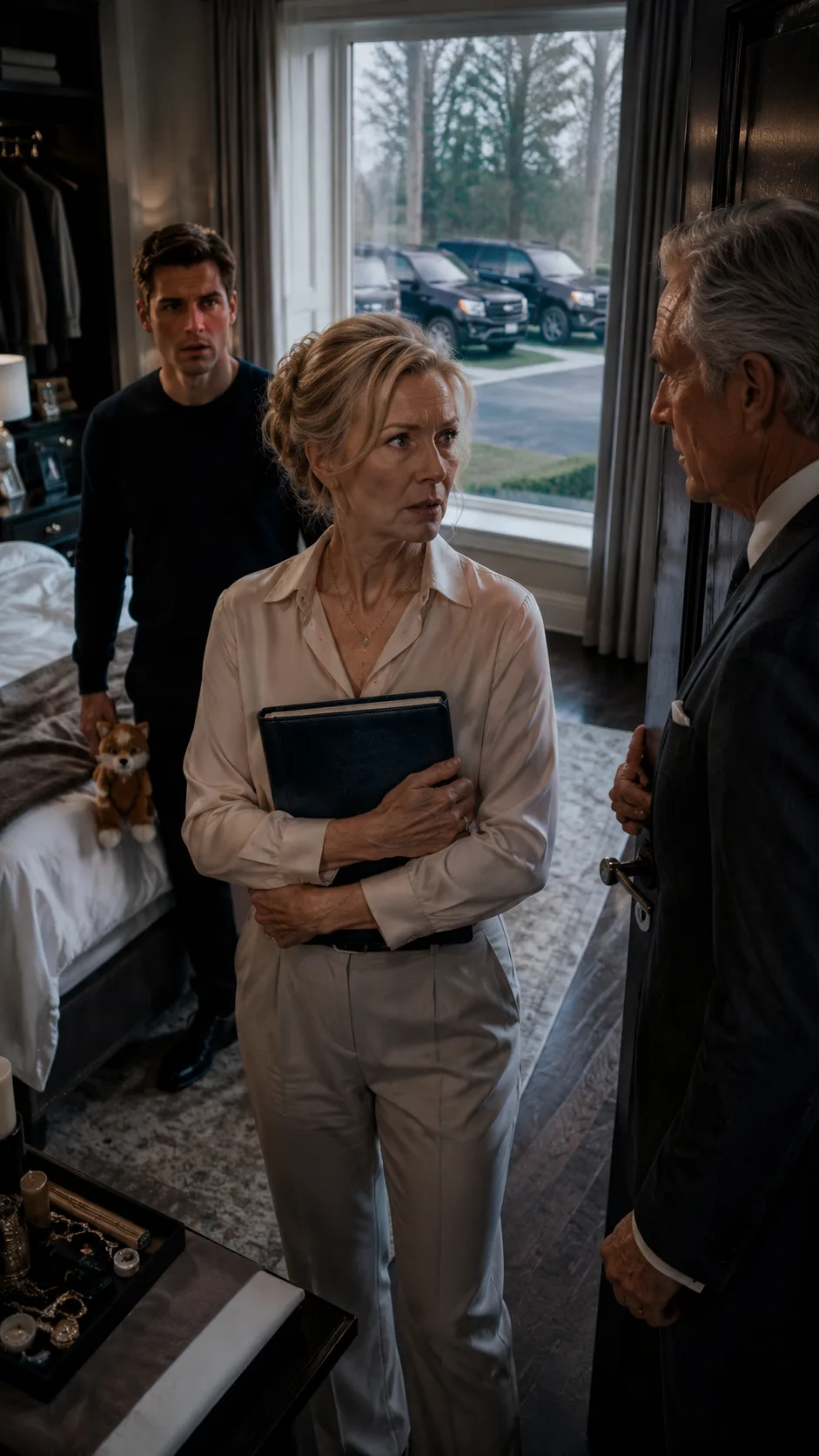
Through the bedroom window, I saw a black SUV stop at the end of my driveway.
Then another.
Then a third.
Men in suits stepped out.
Not police.
Not deputies.
Daniel moved to the window and whispered a word I had never heard him say before.
Brandon grabbed Noah’s stuffed fox off the bed like it was the only thing in the room he understood.
Madison said, “Now listen carefully. You have ten minutes to give me the ledger.”
I looked down at Robert’s handwriting.
At Brandon’s name.
At Madison’s old name.
At the truth my husband had buried before his heart gave out.
Then the gate buzzer screamed through the house.
Once.
Twice.
Three times.
Madison’s voice dropped to a whisper.
“And Evelyn?”
“Yes?”
“Don’t trust Daniel.”
Behind me, Daniel locked the bedroom door.
And from the other side of it, my grandson screamed.
THE END.
-My daughter-in-law told me to “shut up and pay” in front of an entire restaurant.-