Mason knocked like he still had the right to be let in.
Chapter 3
Mason knocked like he still had the right to be let in.
Three hard knocks.
A pause.
Then three more.
“Mom, open the door.”
I stood in my half-empty living room with packing tape in one hand and a box of old photographs at my feet. The walls were bare where family pictures had hung for years. Mason’s kindergarten portrait was wrapped in newspaper beside his college graduation frame.
I looked around and realized how much of my home had been a shrine to someone who had stopped visiting it.
“Mom.”
I opened the door.
Mason stood on the porch in yesterday’s navy suit, wrinkled now, his hair messy, his face tight with sleepless irritation. Behind him, Harper sat in their black SUV with sunglasses on, even though the morning was cloudy.
Of course she hadn’t come to the door.
That would have required humility.
Mason stepped inside without asking, then stopped when he saw the boxes.
“So it’s true.”
“Yes.”
“You
sold the townhouse?”
“I sold it months ago. This is a rental.”
His face changed. That detail hurt his pride more than I expected. Not because he missed the house, but because he had not known.
“You should have told me.”
I folded the tape over itself slowly. “Why?”
“Because I’m your son.”
“You were my son last night too.”
He flinched, then looked away.
For a second, I saw the little boy who used to crawl into my bed during thunderstorms. The one who cried when he lost his first tooth. The one who promised, at ten years old, that when he grew up he would buy me a big house with a red door.
Then he said, “Harper was joking.”
And the little boy disappeared.
“No,” I said. “Harper was honest. That was the problem.”
Mason rubbed his forehead. “Mom, you embarrassed me in front of my colleagues.”
I stared at him.
Not angrily.
Almost curiously.
After everything, that was still where his mind went.
“I embarrassed you,” I repeated.
“You announced you were moving across the country at my promotion dinner.”
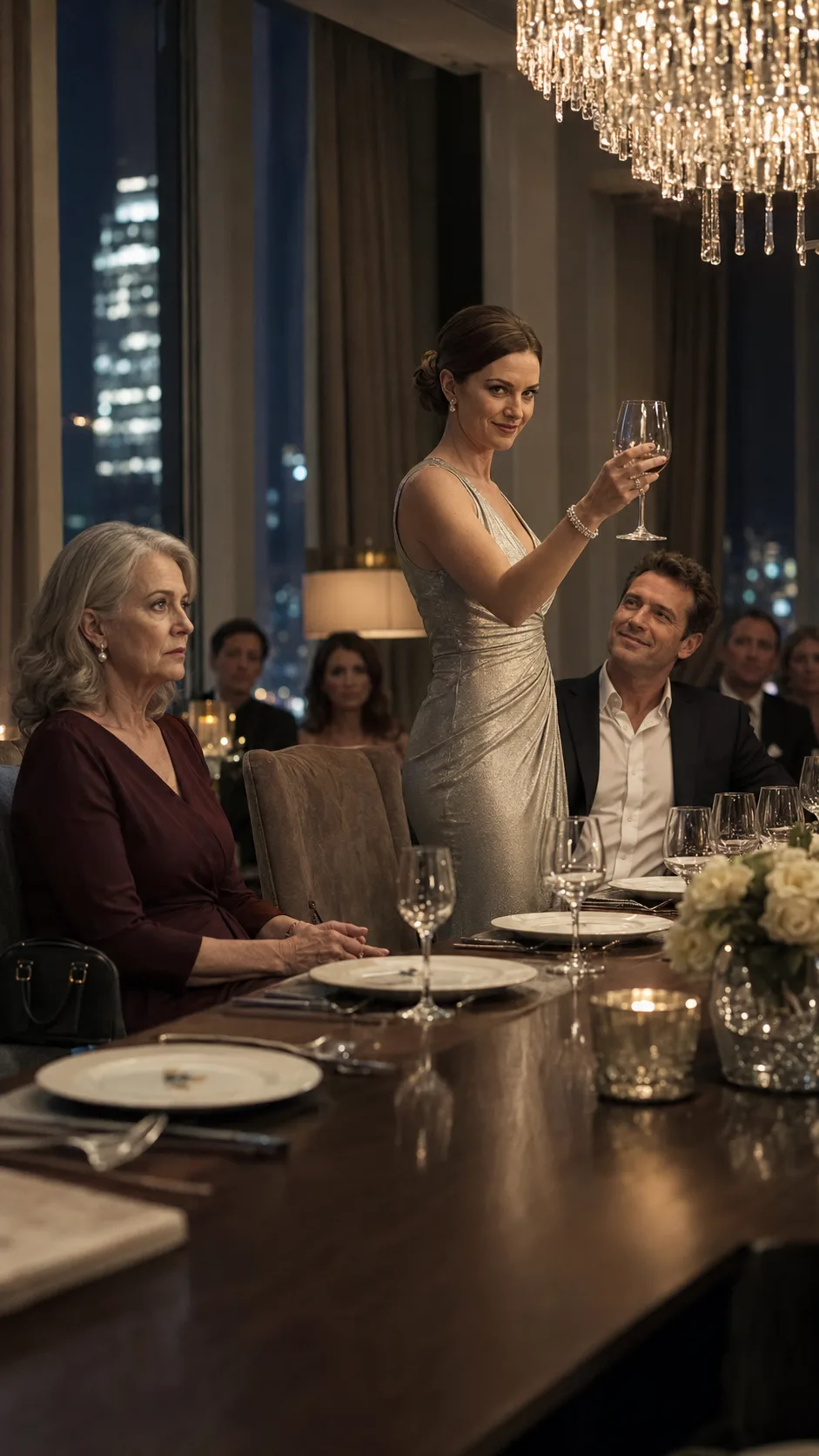
“Your wife announced I was useless at your promotion dinner.”
His jaw tightened. “She didn’t say useless.”
“She said I take up space.”
“It was a toast.”
“It was a warning shot.”
He had no answer for that.
Outside, Harper got out of the SUV. Her heels clicked up the walkway like punctuation. She entered without greeting me and removed her sunglasses.
“Eleanor,” she said, cool and controlled, “this has gone far enough.”
I almost admired her confidence.
In my house, surrounded by my boxes, after mocking me in front of strangers, she still believed she was the adult in the room.
“You don’t get to weaponize a joke because you’re sensitive,” Harper continued. “Mason has
worked too hard for you to create drama around his promotion.”
There it was.
My pain was drama.
Their cruelty was humor.
“I’m not creating anything,” I said. “I’m leaving.”
Harper laughed once. “To a mansion.”
“Yes.”
“With what money?”
Mason looked at her sharply. “Harper.”
But I smiled.
Because that question was the truest thing she had ever asked me.
“With the money I earned,” I said. “The money I saved. The money I invested while both of you assumed I had nothing because I didn’t show it off.”
Harper’s face flushed.
Mason stared at me. “Invested?”
“Your father’s life insurance. My retirement accounts. The townhouse sale. Years of extra work. Years of not buying things I didn’t need to impress people who didn’t respect me.”
He swallowed.
For the first time, shame touched his face.
“I didn’t know,” he said quietly.
“No,” I answered. “You didn’t ask.”
That sentence landed harder than any shout could have.
Harper crossed her arms. “So what is this? Punishment?”
I looked at her for a long moment.
“No, Harper. Punishment would be staying nearby and making you watch me stop caring. This is peace.”
Her mouth opened, but nothing came out.
Mason stepped closer. “Mom, please. We can fix this.”
I wanted to believe him.
Even then.
A mother’s heart is a stubborn, foolish thing. It keeps one candle burning long after the house has emptied.
“How?” I asked.
He looked relieved, as if the question meant negotiation.
“We’ll have dinner. Just us. We’ll talk. Harper can apologize.”
Harper’s eyes snapped toward him.
“Can?” I asked.
Mason exhaled. “Will.”
But Harper said nothing.
There it was again.
The truth in the silence.
I picked up a framed photograph from the box. Mason at seven, missing his front tooth, wearing a paper crown from school. I handed it to him.
“Do you remember this day?”
He looked down. His face softened despite himself.
“Second grade,” he said. “Mother’s Day breakfast.”
“You stood in front of your class and said I was your hero.”
His eyes grew wet.
“I meant it.”
“I know.” My voice almost broke, but I held it steady. “That’s why last night hurt. Because I know you were capable of loving me better.”
He pressed his lips together.
Harper shifted near the doorway, uncomfortable now. Not sorry. Just uncomfortable.
“I am not asking you to choose me over your wife,” I said. “I should never have had to compete. I am only choosing myself before there is nothing left of me to choose.”
Mason covered his mouth with one hand.
“Mom.”
I stepped back.
The conversation was over.
The movers came three days later.
Mason returned twice.
The first time, he brought flowers. Harper stayed in the car.
The second time, he came alone and cried in my kitchen.
“I don’t know how we got here,” he whispered.
I did.
But I let him cry.
Because love does not always mean reopening the door.
Sometimes love means refusing to let someone keep breaking what they are not ready to repair.
On the tenth day, I boarded a plane with one checked suitcase, one carry-on, and my wedding ring on a chain beneath my blouse.
June met me at the Oregon house with keys and a basket of lemons from her own garden.
The mansion was even more beautiful than I remembered.
Morning light spilled across the blue tile kitchen. Sea wind moved through the open windows. The garden was wild with lavender, rosemary, and roses climbing an old stone wall.
For the first week, I woke up expecting guilt.
Instead, I woke up to waves.
I painted the front door deep red because Mason had once promised me one. Not for him. For the woman I had been when I still believed promises could save me.
I turned one bedroom into a library.
Another into a sewing room.
Another into a guest room with soft white curtains, though I did not know who would sleep there yet.
Then people began arriving.
Not Mason.
Not Harper.
Neighbors.
June invited me to a book club. A widower named Paul brought over fresh bread and pretended he had made too much. A retired teacher named Naomi asked if I wanted help restoring the garden, then showed up every Saturday with gloves and gossip.
For the first time in my life, I was not useful because I served someone.
I was welcome because I existed.
Three months later, Mason called on a Sunday morning.
I almost let it go to voicemail.
Then I answered.
His voice was different.
Quieter.
“Mom,” he said. “I left Harper.”
I closed my eyes.
Not from victory.
From exhaustion.
“I’m sorry,” he continued. “Not just for last night. For all of it. For letting her make you small. For helping her do it.”
Outside, the ocean moved under gray light.
“I can’t fix it fast,” he said. “But I want to try.”
I looked at the red door. At the garden. At the life that no longer trembled around his approval.
“You can try,” I said. “But from where you are. Not by moving into my peace.”
He was quiet for a long time.
Then he said, “That’s fair.”
It was the first fair thing between us in years.
I did not invite him to visit that day.
I did not send money.
I did not soften the consequence just because he finally felt it.
But I left the door unlocked for possibility.
Not the front door.
That belonged to me now.
I mean the smaller door inside the heart, the one that opens only when respect knocks first.
One year later, Mason came to Oregon.
Alone.
He stood on my porch holding no excuses, no wife, no performance. Just a small paper bag.
Inside was a Christmas ornament from his childhood. A chipped wooden angel I thought Harper had thrown away.
“I kept it,” he said.
I took it carefully.
Then I stepped aside.
Not because everything was healed.
Because some things can begin again without pretending they were never broken.
That evening, we ate dinner on the porch while the sun dissolved into the Pacific. Mason cried once when he thought I wasn’t looking. I let him have the dignity of believing I didn’t see.
After he left, I stood in the doorway of my mansion, listening to the ocean.
For years, people had told me in a hundred quiet ways that I took up too much space.
So I finally found a place large enough for my whole self.
And I filled it.
Not with revenge.
With peace.
THE END
Chapter complete
You have reached the end of this chapter.
Continue reading
A few more worlds to get lost in after this chapter.




