MY DAUGHTER-IN-LAW PRETENDED TO LOVE ME FOR MY INHERITANCE… BUT SHE NEVER KNEW I WAS TESTING HER
PART 1
My name is Rose Bennett, and for most of my life, I believed kindness could soften almost anything.
Chapter 1
My name is Rose Bennett, and for most of my life, I believed kindness could soften almost anything.
A hard marriage.
A grieving child.
A cold room.
A broken promise.
Even an ungrateful heart.
I was sixty-eight years old when I finally learned that kindness, when given to the wrong people for too long, does not soften them.
It teaches them how much they can take.
I lived alone in a beautiful two-story house in Maple Ridge, Connecticut. It had white columns, blue shutters, a wide front porch, and a red maple tree that my late husband, Thomas, planted the year our son Daniel was born.
Every October, that tree turned the color of fire.
Thomas used to stand beside me in the yard, holding his coffee, and say, “Rosie, when I’m gone, don’t sell this place too quickly. This house remembers us.”
He died six years before everything happened.
After his funeral, people told me to move into something smaller.
“A condo would be easier.”
“You don’t
need all this space.”
“Rose, you’re alone now.”
But I was not alone.
Not really.
Thomas was in the worn leather chair by the bay window.
He was in the tiny scratch on the kitchen doorframe where Daniel had measured his height every birthday.
He was in the rose bushes he used to trim badly but proudly.
He was in every corner of that house.
So I stayed.
My only child, Daniel Bennett, had his own life by then. He was forty, handsome, polished, and successful in the way people admire from a distance. He worked in finance, wore expensive shirts, drove a black SUV, and checked his watch more often than he checked my face.
I told myself he was busy.
Mothers are very good at creating gentle explanations for painful things.
Daniel had a wife named Ashley.
Ashley Bennett was thirty-five, blonde, elegant, and always dressed like she
was about to be photographed. She had a bright smile that appeared instantly whenever Daniel looked at her and disappeared just as quickly whenever he turned away.
The first time Daniel brought her home, she hugged me with both arms and said, “I’ve always wanted a mother-in-law I could be close to.”
I believed her.
I wanted to believe her.
At that time, Thomas had only been gone for a year. My house felt too quiet. My evenings felt too long. The thought of having another woman in the family, someone to cook with, shop with, laugh with, seemed like a small gift.
But Ashley never wanted closeness.
She wanted access.
I noticed it slowly.
At first, it was the little comments.
If I brought homemade pie to dinner, she would smile in front of Daniel and say, “That’s so sweet, Mom.”
Then, when he stepped into another room, she
would slide the pie aside and whisper, “We’re trying to avoid heavy food. You don’t have to bring these old-fashioned things every time.”
If I offered to help with Christmas decorations, she would say, “Oh, don’t worry, Mom, you should rest.”
But her eyes would move over my coat, my shoes, my purse, as if measuring whether I still belonged in her world.
Once, I overheard her tell a friend on the phone, “Daniel’s mother is nice, but she’s very attached. Widows can be like that.”
I stood in the hallway holding a plate of cookies I had baked for her.
I turned around quietly and took them home.
Daniel never saw any of it.
Or maybe he saw pieces and decided not to look closely.
That was the first betrayal I forgave too easily.
When my granddaughter Lily was born, I thought things would change. Lily was tiny and pink and perfect. I held her in the hospital, and for the first time since Thomas died, I felt something inside me bloom again.
Ashley was grateful then.
Or she acted grateful.
She called me constantly.
“Mom, can you watch Lily for two hours?”
“Mom, can you come early? I barely slept.”
“Mom, Daniel and I need a weekend away. You understand.”
I always said yes.
I canceled plans.
I skipped church lunches.
I rearranged doctor appointments.
For six years, I became the reliable grandmother, the free babysitter, the woman who never complained.
Lily loved me. That was enough.
At least, I told myself it was.
Then one Sunday afternoon, everything changed.
I had invited Daniel, Ashley, and Lily over for lunch. I made roasted chicken, mashed potatoes, green beans, and Thomas’s favorite apple cake.
Ashley arrived wearing a cream sweater, gold earrings, and a perfume so sharp it entered the room before she did.
She kissed my cheek.
“Mom, this smells amazing.”
A minute later, in the kitchen, she lifted the lid off the mashed potatoes and frowned.
“Do you use real butter?”
“Yes,” I said.
She sighed. “Daniel’s cholesterol has been a little high. You really should think about these things.”
Daniel walked in right then.
Ashley immediately smiled and touched his arm.
“Your mom made such a beautiful meal.”
I watched the change happen on her face.
It was so quick.
So practiced.
That night, after they left, I stood at the sink washing plates by hand even though I had a dishwasher. My reflection looked back at me from the dark kitchen window.
For the first time, I whispered out loud, “She doesn’t love me.”
The words hurt.
But not as much as what came later.
Three weeks after that lunch, I received a call from my longtime doctor, Dr. Samuel Howard.
He asked me to come in.
His voice was careful.
Too careful.
At my age, a careful doctor can make your hands go cold.
I drove to his office the next morning. He ran tests. He listened to my heart. He looked over my charts.
Then he sat across from me and folded his hands.
“Rose,” he said, “your heart is stronger than most women fifteen years younger.”
I blinked.
“That’s good, isn’t it?”
“It is.”
“Then why did you sound so serious on the phone?”
Dr. Howard leaned back.
“Because Margaret called me.”
Margaret Collins was my attorney and one of my oldest friends. She had handled Thomas’s estate, Daniel’s college trust, my house paperwork, everything.
I frowned. “Margaret?”
“She said you were worried about your family.”
I looked down at my hands.
Dr. Howard waited.
He had known me too long to rush me.
Finally, I said, “I don’t know if my daughter-in-law sees me as family or as a future check.”
He did not look surprised.
That made me feel worse.
“Rose,” he said gently, “why are you asking me this?”
I swallowed.
“Because I want to know the truth before I make my final estate decisions.”
Dr. Howard was silent for a long moment.
Then he said, “Sometimes people reveal themselves when they believe time is running out.”
That sentence stayed with me.
A week later, Margaret came to my house.
We sat in Thomas’s old study, surrounded by books he had underlined and never returned to the shelves properly.
Margaret was seventy-two, sharp-eyed, silver-haired, and impossible to intimidate. She wore a red blazer and carried a leather portfolio.
“Rose,” she said, “your current estate plan leaves most of your assets to Daniel, with a portion to charity.”
“Yes.”
“And you’re reconsidering.”
“I’m reconsidering everything.”
Margaret took off her glasses.
“Then we need clarity.”
That was when the plan began.
Not a cruel plan.
Not revenge.
A test.
Dr. Howard would call Daniel and tell him there were serious concerns about my heart. Nothing too specific. Nothing that required emergency action. Just enough to suggest that my health had become fragile.
Margaret would not lie in any legal document. She made that very clear.
“I will not falsify anything,” she said.
“I’m not asking you to.”
“But I can be present if your family requests discussions about your estate.”
“And Dr. Howard?”
“He can say you need reduced stress and support. That is true for every human being alive.”
I almost laughed.
But my throat tightened instead.
“What if they pass?” I asked.
Margaret looked at me softly.
“Then you’ll have peace.”
“And if they don’t?”
“Then you’ll have the truth.”
The next afternoon, Dr. Howard called Daniel.
By evening, my son was at my door.
He looked pale when I opened it.
“Mom,” he said, stepping inside quickly, “why didn’t you tell me?”
I touched his cheek. “Tell you what?”
“Dr. Howard said your heart—”
“He said we need to be careful.”
Daniel hugged me hard.
For a moment, I closed my eyes and let myself believe he was still my little boy.
Then Ashley walked in behind him.
Her face was arranged beautifully.
Concerned eyes.
Soft mouth.
Hand pressed to chest.
“Oh, Mom,” she whispered. “How could you keep this from us?”
I looked at her.
She hugged me too.
Her arms were warm.
Her perfume was sharp.
Her voice trembled.
But her eyes moved past me, into the house.
Toward the staircase.
Toward the dining room.
Toward Thomas’s study.
And that was when I knew the test had truly begun.
Ashley changed overnight.
That was the first thing that broke my heart.
Not because she changed.
Because it showed me she had always known how to be kind.
She had simply chosen not to.
The next morning, she arrived at my house with flowers, soup, vitamins, and a soft pink blanket I did not need.
“Mom,” she said, walking straight into the kitchen, “from now on, I don’t want you lifting a finger.”
I watched her place the flowers into my best crystal vase.
“You don’t have to do all this, Ashley.”
She turned with a warm smile.
“I want to.”
Daniel stood behind her, looking relieved.
“See, Mom? You’re not alone.”
Those words nearly undid me.
For years, I had been alone in ways nobody noticed.
Now that they thought I was fading, suddenly everyone had time.
Ashley began coming three days a week.
Then five.
Then every day.
She brought low-sodium meals, organized my medicine cabinet, folded laundry, dusted shelves, and posted pictures online.
One photo showed her holding my hand across the kitchen table.
The caption read: Taking care of family is the greatest honor.
People commented immediately.
“You’re such a wonderful daughter-in-law.”
“Rose is lucky to have you.”
“This is what family should be.”
I stared at those comments for a long time.
Then I turned the phone off.
Ashley’s kindness had an audience.
Real love usually does not need one.
Still, I gave her chances.
Too many.
One rainy Tuesday, she found me sitting in Thomas’s study, holding his old fountain pen.
She stood in the doorway.
“Mom?”
“Yes?”
“Were you crying?”
I had been, but I shook my head.
She came in and sat beside me.
For a second, she seemed almost human.
“This must be scary,” she said.
“It is.”
She reached for my hand.
“If anything ever happened to you, Daniel would fall apart.”
I squeezed her fingers.
“I worry about him.”
“I do too,” she said quickly. “That’s why I think everything should be… organized.”
There it was.
The turn.
I stayed quiet.
Ashley continued carefully.
“I don’t mean to sound insensitive. But when someone gets sick, families can get blindsided. Houses, accounts, decisions. It can become overwhelming.”
“My affairs are in order.”
“Oh, of course. I just mean… maybe they should be updated.”
I looked at her.
“Updated how?”
She smiled too fast.
“Well, Daniel is your only child.”
“Yes.”
“And Lily is your only grandchild.”
“Yes.”
“So naturally, you’d want everything protected for them.”
“Protected from whom?”
Her hand stiffened.
“I didn’t mean it like that.”
I pulled my hand away gently.
“How did you mean it?”
Ashley stood up and walked to the window.
Rain streaked the glass behind her.
“I just don’t want outsiders getting involved.”
“Outsiders?”
“Charities. Old friends. People who might influence you.”
I almost smiled.
“People like Margaret?”
Ashley turned.
Her face changed before she could stop it.
Only for half a second.
But I saw it.
“A lawyer can complicate things,” she said.
“Margaret has been my lawyer for thirty years.”
“I know. I just think family should come first.”
I looked down at Thomas’s pen.
“Family should come first,” I repeated.
Ashley thought I was agreeing with her.
But I was asking myself whether she had ever truly treated me like family at all.
That Friday, Daniel came over alone.
He sat at my kitchen table, shoulders heavy.
“Mom, Ashley said you seemed upset.”
“I’m fine.”
“She’s trying really hard.”
“I can see that.”
“She cares.”
I looked at my son.
“Daniel, did Ashley care this much before Dr. Howard called?”
His eyes dropped.
That silence answered for him.
“She didn’t know how serious things were,” he said finally.
“So kindness requires a deadline?”
His jaw tightened.
“That’s not fair.”
“No,” I said softly. “It isn’t.”
He rubbed his face.
“I’m scared, Mom.”
For the first time since the test began, I almost confessed everything.
I almost reached across the table and said, “Baby, I’m not dying. I just needed to know if you loved me without needing something from me.”
But then he said, “Ashley thinks you should make things simple.”
The words landed like a door closing.
“Simple,” I repeated.
“So there’s no confusion later.”
“What confusion?”
He shifted in his chair.
“With the house. The savings. Dad’s investments.”
I stared at him.
Daniel looked ashamed, but not ashamed enough to stop.
“You’re my son,” I said.
“I know.”
“Why are you speaking to me like a banker?”
He flinched.
“Mom, don’t do that.”
“Do what?”
“Make me feel guilty for asking practical questions.”
I laughed once.
It came out sadder than I intended.
“When I sold my anniversary ring to help pay your tuition, I didn’t call it practical. I called it love.”
His face crumbled for a second.
Then hardened again.
“I didn’t ask you to do that.”
That sentence cut deeper than anything Ashley had ever said.
Because he was right.
He had not asked.
Children rarely ask for the sacrifices that build their lives.
They simply grow up inside them and mistake them for air.
I stood slowly.
“I’m tired.”
Daniel rose too.
“Mom—”
“I said I’m tired.”
He left with guilt on his face and no apology in his mouth.
That night, Ashley called someone from my kitchen.
She thought I was asleep upstairs.
But old houses carry sound.
And old women learn to walk quietly.
I stood at the top of the staircase in my slippers and heard her voice below.
“She’s getting softer. Daniel almost had her today.”
A pause.
“No, I don’t feel bad. You don’t know what it’s like dealing with her.”
Another pause.
Then Ashley laughed.
A small laugh.
Cruel because it was relaxed.
“She keeps acting like this house is a shrine. It’s real estate, Mom. Valuable real estate.”
My hand tightened on the railing.
Ashley continued.
“If she changes everything now, Daniel gets the house, and I’ll make sure it doesn’t sit there collecting dust like a museum.”
My breath stopped.
She was talking to her mother.
Then came the sentence that erased the last of my doubt.
“I’m not nursing that old woman for free. If I’m playing the devoted daughter-in-law, I deserve the reward.”
I stood there until my knees hurt.
She hung up.
I went back to my bedroom.
I did not cry.
That surprised me.
I sat at my vanity and looked at myself in the mirror.
The woman looking back at me seemed older than she had that morning.
But her eyes were clear.
The next day, I called Margaret.
“I heard enough,” I said.
Margaret exhaled.
“I’m sorry.”
“So am I.”
“What do you want to do?”
I looked toward the framed photo of Thomas on my dresser.
“I want to let them finish showing me who they are.”
For the next two weeks, I played my part.
I moved slower.
I let Ashley help me stand.
I let Daniel fuss over my appointments.
I let them whisper in the hallway.
Ashley became bolder.
She brought brochures for senior living communities.
“Just in case you ever wanted less responsibility,” she said.
“My home is not a responsibility.”
“Of course not. I only meant it might be easier.”
“For whom?”
She blinked.
“For you, Mom.”
I smiled.
“Of course.”
A few days later, she asked where I kept “important papers.”
I told her Thomas’s study.
That afternoon, I found her standing in front of his desk with one drawer open.
She jumped when she saw me.
“Mom! I was just looking for your insurance card.”
“In Thomas’s private drawer?”
Her cheeks flushed.
“I thought maybe—”
“You thought what?”
She closed the drawer.
“I’m sorry. I overstepped.”
“Yes,” I said. “You did.”
For the first time, she looked afraid of me.
Not much.
Just enough.
That evening, I moved every important paper out of the house.
Margaret kept them in her office.
But I left one thing behind.
An old leather portfolio.
Inside it was not a will.
Not financial documents.
Just blank paper.
I wanted to see who would reach for it.
The answer came faster than expected.
On Saturday, Ashley arrived with Lily.
Lily ran into my arms.
“Grandma!”
I held her tightly.
My sweet girl smelled like strawberry shampoo and crayons.
Ashley kissed the air near my cheek.
“Lily wanted to see you.”
Lily pulled back and looked up at me.
“Mommy said we have to be extra nice because your heart is tired.”
The room went still.
Ashley’s face froze.
I crouched down slowly.
“Did she say that?”
Lily nodded.
“She said if you feel loved, you might give Daddy the house.”
Ashley stepped forward quickly.
“Lily, honey, that’s not what I said.”
Lily frowned.
“Yes, you did. In the car.”
I looked at Ashley.
Her mouth opened.
No words came.
Children do not understand inheritance.
But they understand when adults turn love into a task.
I kissed Lily’s forehead.
“Why don’t you go pick a cookie from the kitchen?”
When she left, Ashley whispered, “Rose, I can explain.”
The first time she dropped “Mom,” I noticed.
I said, “Don’t.”
Her eyes filled.
Real tears or useful ones, I could not tell anymore.
“You have to understand. Daniel is under pressure. The mortgage, Lily’s school, everything is expensive.”
“So you told a six-year-old to be nice to her grandmother for a house?”
“I didn’t mean it that way.”
“You keep saying that.”
Ashley’s face tightened.
“Maybe because you keep twisting everything.”
There she was.
The real Ashley.
Not the Facebook version.
Not the soup-making version.
Not the hand-holding daughter-in-law.
This woman had been waiting behind the mask the whole time.
I stood straighter.
“Ashley, invite your mother to dinner next Friday.”
She blinked.
“My mother?”
“Yes. And Daniel. And Lily can stay with her babysitter.”
“Why?”
“Because I’m ready to discuss my final wishes.”
Her expression changed instantly.
The fear vanished.
The softness returned.
“Oh, Mom,” she whispered. “Thank you for trusting us.”
I looked at her beautiful face.
“I trust the truth.”
She did not understand.
But she would.
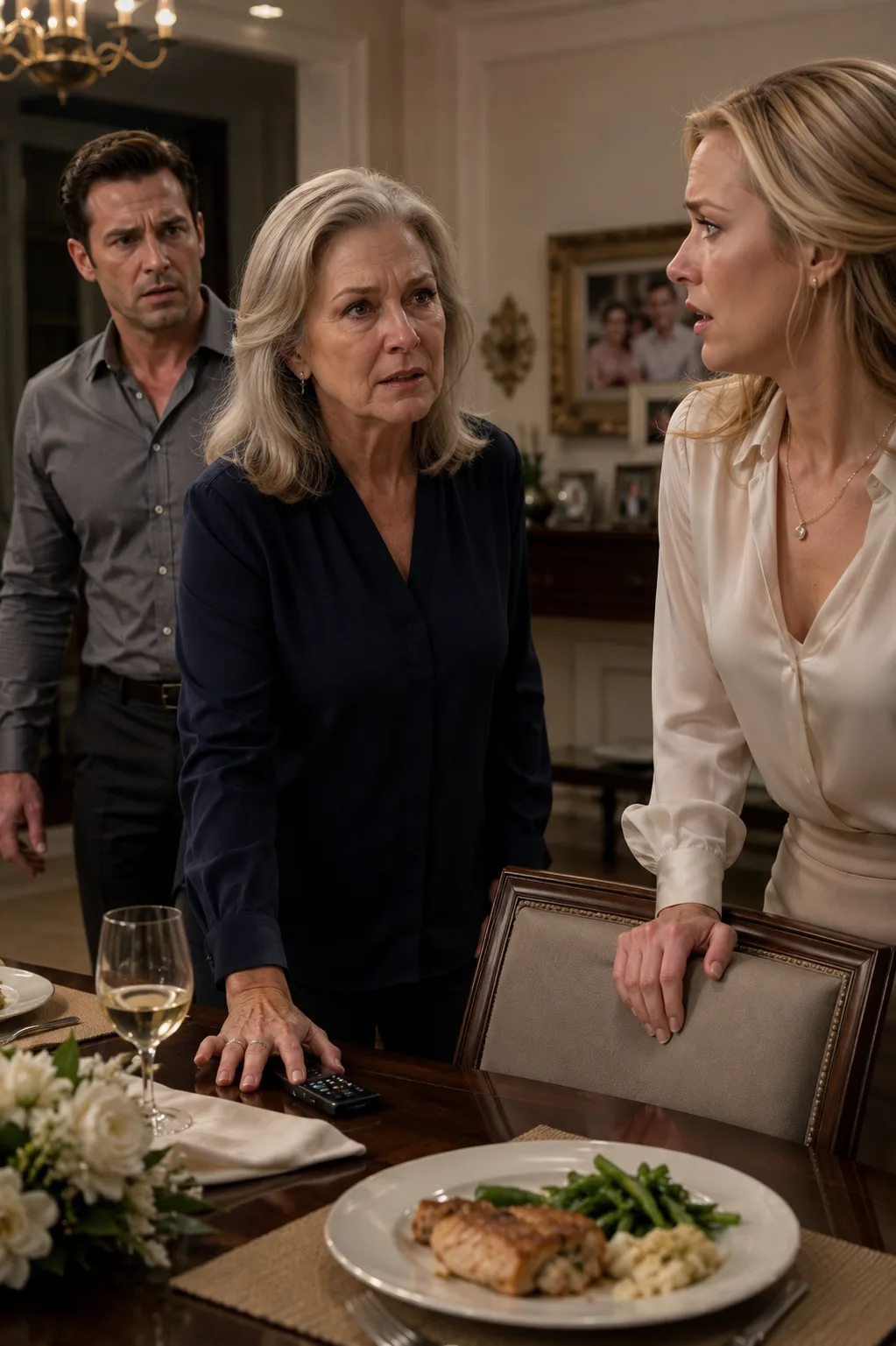
By Friday evening, my dining room looked like a photograph from a family magazine.
White roses in the center of the table.
Candles lit.
China plates.
Crystal glasses.
Thomas’s silverware polished until it reflected the chandelier.
Ashley arrived first, wearing a white silk blouse and a beige skirt. She brought another bouquet of white flowers, as if flowers could cover rot.
Daniel came behind her, quiet and tense.
Then Ashley’s mother, Patricia Lowell, walked in.
Patricia was sixty-two, with dyed auburn hair, sharp red nails, and the kind of smile that never reached her eyes.
She hugged me too long.
“Rose,” she said, “you look wonderful. So brave.”
I almost laughed.
Brave.
That is what people call you when they think you are close to disappearing.
Dr. Howard arrived next.
Ashley’s smile faltered.
“Doctor Howard?”
“He’s an old friend,” I said.
Then Margaret came.
With her red blazer.
Her leather portfolio.
And eyes sharp enough to cut glass.
Ashley went pale.
Daniel looked between all of us.
“Mom, what’s going on?”
“Dinner first,” I said.
Nobody enjoyed the meal.
Patricia tried.
She complimented the chicken.
Ashley touched my arm too often.
Daniel barely ate.
Margaret sipped water and watched everything.
Dr. Howard made polite conversation about the weather.
I looked at the empty chair at the end of the table.
Thomas’s chair.
For one second, I wished he were there.
Then I realized he was.
In the house.
In my spine.
In the part of me that had finally stopped bending.
After dinner, I placed my napkin on the table.
“Ashley,” I said, “you’ve been very attentive these past weeks.”
She smiled carefully.
“I meant every moment of it.”
Patricia nodded. “My daughter has such a big heart.”
Margaret’s eyebrow moved slightly.
I continued.
“You cooked for me. Cleaned for me. Held my hand. Posted about me online.”
Ashley’s smile tightened.
“I wanted people to pray for you.”
“How thoughtful.”
Daniel looked uncomfortable.
“Mom…”
I raised one hand.
“I’m not finished.”
The room went quiet.
I reached into the drawer of the sideboard and took out the small black voice recorder I had kept there for three weeks.
Ashley stared at it.
Her lips parted.
I set it in the middle of the table.
“What is that?” Patricia asked.
“The answer,” I said.
Ashley stood up so fast her chair scraped against the floor.
“Rose, whatever you think you heard—”
I pressed play.
Her own voice filled the dining room.
“I’m not nursing that old woman for free. If I’m playing the devoted daughter-in-law, I deserve the reward.”
Daniel’s face drained of color.
Patricia froze.
Ashley grabbed the edge of the table.
“Stop it.”
I did not.
The recording continued.
“She keeps acting like this house is a shrine. It’s real estate, Mom. Valuable real estate.”
Daniel turned toward his wife.
“Ashley…”
She shook her head wildly.
“No. No, I was venting.”
Then came the worst part.
“If she changes everything now, Daniel gets the house, and I’ll make sure it doesn’t sit there collecting dust like a museum.”
The recording ended.
Silence swallowed the room.
Ashley looked at Daniel.
Then at Patricia.
Then at me.
Her face changed three times in three seconds.
Fear.
Anger.
Calculation.
“Rose,” she said carefully, “you recorded a private conversation?”
I looked at her.
“You performed a private betrayal.”
Daniel stood slowly.
“You said that about Mom?”
Ashley spun toward him.
“Don’t act innocent. You wanted the house too.”
He flinched.
I closed my eyes briefly.
There it was.
The second truth.
Daniel turned to me.
“Mom, I never—”
“Yes,” I said. “You did.”
His mouth closed.
“You let your wife ask the questions you were too ashamed to ask.”
He looked down.
Ashley’s voice rose.
“This is ridiculous. Everyone talks about estate planning. Everyone thinks about the future.”
Margaret spoke for the first time.
“Most people do not train their children to be affectionate for property.”
Ashley’s face went white.
Daniel looked up sharply.
“What?”
I turned toward him.
“Lily told me what Ashley said in the car.”
Ashley whispered, “She misunderstood.”
“No,” I said. “She repeated it perfectly.”
Patricia slammed her palm on the table.
“My daughter has spent weeks caring for you.”
I looked at Patricia.
“And you were on the phone when she said she deserved to be paid for it.”
Patricia’s mouth snapped shut.
Daniel stared at Ashley’s mother.
“You knew?”
Patricia lifted her chin.
“I knew my daughter deserved security.”
“Security?” Daniel said. “You mean my mother’s money.”
Ashley started crying then.
Not softly.
Not prettily.
She pressed both hands to her mouth and sobbed as if she were the injured one.
“Everything is always on me,” she said. “The house, the bills, Lily’s school, Daniel’s stress. I was scared.”
I watched her.
That was the first honest thing she had said.
Fear does not excuse greed.
But it often feeds it.
Daniel stepped away from her.
“Ashley, why didn’t you talk to me?”
She laughed through tears.
“I did. You just didn’t want to hear how much we needed.”
“You wanted my mother to die.”
“I wanted us to survive.”
My son looked like someone had slapped him.
I stood.
Everyone turned toward me.
I did not lean on the table.
I did not tremble.
I did not place a hand over my heart.
Ashley noticed first.
Her crying slowed.
“Mom?”
I looked at Dr. Howard.
He opened his medical folder and placed one sheet on the table.
“My heart is fine,” I said.
Daniel blinked.
“What?”
Dr. Howard spoke calmly.
“Rose is not dying. Her heart is stable. Strong, actually.”
Ashley took one step back.
Her hip hit the sideboard.
“No.”
I looked straight at her.
“Yes.”
Daniel gripped the back of his chair.
“Mom, you’re not sick?”
“No.”
His eyes filled.
“Then why would you—”
“Because I needed to know whether my family loved me or my ending.”
Nobody spoke.
The chandelier hummed softly above us.
Ashley’s face crumpled.
“This was a setup?”
I shook my head.
“No. It was a mirror.”
Margaret opened her portfolio.
Ashley stared at it like it might save her.
It did not.
“I have changed my estate plan,” I said.
Daniel’s shoulders dropped.
He already knew.
But Ashley still had hope.
Greedy people often do.
I continued.
“The house will not be sold by Daniel. It will not be renovated by Ashley. It will not become a prize for whoever acted kindest while waiting for me to disappear.”
Ashley whispered, “Please.”
“The house will become The Thomas Bennett House.”
Daniel looked up.
“What is that?”
“A home for older widows and widowers who have been forgotten by their families,” I said. “Not a nursing facility. A real home. Meals, gardens, music, dignity.”
Margaret added, “Rose has already created the foundation structure. The property will transfer into the foundation upon her passing, but she remains in full control during her lifetime.”
Ashley sank into her chair.
Patricia stared at me with open dislike.
“You would give your home to strangers over your son?”
I looked at Daniel.
“No. I gave my son forty years.”
Daniel began to cry.
Quietly.
Like a boy trying not to make noise.
I walked to the mantel and picked up an old photograph.
It showed Daniel at eight years old, sitting on Thomas’s shoulders in front of the red maple tree.
I placed it in front of him.
“I gave you piano lessons when we could barely pay the electric bill. I gave you my savings for college. I gave you your father’s watch when you graduated. I gave you weekends, holidays, emergency checks, free childcare, forgiveness you never had to earn.”
Daniel covered his face.
“I know.”
“No,” I said softly. “You remembered only when I listed it.”
That broke him.
He bent forward, both hands over his eyes.
“I’m sorry, Mom.”
Ashley reached for him.
He moved away.
That one small movement destroyed her more than the recording had.
“Daniel,” she whispered.
He turned to her.
“You made our daughter think love was a strategy.”
Ashley shook her head.
“I was scared.”
“So was Mom,” he said. “And you circled her like an opportunity.”
Patricia stood.
“We’re leaving.”
“No,” Ashley said quickly. “Mom, please. Rose. Please. I can fix this.”
I looked at her.
For the first time, I saw beyond the polished hair and perfect blouse.
I saw a woman terrified of losing comfort.
I saw a mother afraid her child would have less than she wanted.
I saw a daughter raised by Patricia to believe security mattered more than decency.
But I did not see a daughter-in-law.
Not anymore.
“You can start fixing it,” I said, “by leaving my house without pretending you love me.”
Ashley’s mouth opened.
No sound came out.
Then she grabbed her purse and rushed toward the door.
Patricia followed, muttering, “Ungrateful old woman.”
Daniel shouted, “Don’t talk about her like that.”
Patricia stopped.
Ashley stopped too.
It was the first time in years that Daniel had defended me while it mattered.
But it came too late to save what had been broken.
After they left, Daniel remained in the dining room.
The candles had burned low.
The white roses Ashley brought were drooping in the vase.
Daniel stood beside the table like a guest in the house where he had grown up.
“Mom,” he said, “I don’t know what to say.”
“Then don’t say anything easy.”
He nodded.
A tear fell from his jaw onto his shirt.
“I let her make me smaller.”
“No,” I said. “You chose comfort over courage.”
He accepted it.
That surprised me.
“I did.”
We sat in the kitchen until midnight.
Not as mother and little boy.
As two adults looking at the wreckage of love neglected too long.
Daniel admitted things I had not known.
His investment firm had gone through cuts.
He had taken on debt to keep up appearances.
Ashley wanted Lily in a private school they could barely afford.
Their mortgage was bigger than they had told me.
“I was embarrassed,” he said.
“So you let your wife look at my life as a solution.”
He nodded.
“Yes.”
I asked the question that scared me most.
“If I had really been dying, would you have stopped her?”
Daniel cried harder.
“I don’t know.”
It was an ugly answer.
But it was honest.
And honest ugliness is still better than beautiful lies.
In the months that followed, Ashley moved out of their bedroom and into the guest room. Daniel began counseling. They did not separate immediately, but something between them had cracked in a way money could not repair.
Lily still came to see me every Saturday.
One morning, while we planted tulips near the red maple tree, she asked, “Grandma, are you still sick?”
I set down the trowel.
“No, sweetheart.”
“Mommy said you were.”
“I know.”
“Why?”
I looked at her small hands covered in dirt.
“Sometimes grown-ups say things because they want something.”
Lily frowned.
“That’s not nice.”
“No,” I said. “It isn’t.”
She thought for a moment.
“I love you even if you don’t give Daddy your house.”
My throat closed.
I pulled her into my arms.
“That is the best thing anyone has said to me in a long time.”
The Thomas Bennett House opened eighteen months later.
I was still alive.
Still walking.
Still making apple cake with real butter.
Daniel came to the opening ceremony wearing a simple navy suit and no expensive watch. Ashley did not come. By then, she and Daniel were living apart, trying to decide whether the life they built was love or just shared ambition.
Patricia sent no flowers.
That was fine.
The front porch had been repainted.
The downstairs rooms had been redesigned for community meals and quiet gatherings.
Thomas’s study became a library.
His chair stayed by the window.
The red maple tree stood in the yard, bright as fire.
At the ceremony, I stood before a small crowd of neighbors, volunteers, and older men and women who would soon call the place home.
Daniel stood in the back with Lily.
I saw him wipe his eyes before I began speaking.
“I used to believe the saddest thing about growing old was losing people,” I said. “But I was wrong. The saddest thing is discovering some people only become gentle when they think you are about to leave something behind.”
The crowd was silent.
I looked at Daniel.
He did not look away.
“But I also learned something else,” I continued. “A heart can be tested without being sick. A family can be revealed without a funeral. And a woman can choose, while she is still alive, what her love will build.”
Lily ran up to me after the speech and hugged my waist.
Daniel approached slowly.
“Mom,” he said, “Dad would be proud.”
I looked at the house.
At the porch.
At the tree.
At the new name carved into the wooden sign.
The Thomas Bennett House.
Then I looked back at my son.
“He would be proud of this,” I said.
Daniel nodded, accepting the difference.
Not proud of him yet.
Proud of this.
Healing is not the same as forgetting.
Forgiveness is not the same as handing someone the keys again.
I still loved my son.
But I no longer confused love with surrender.
As for Ashley, I saw her once more.
Six months after the opening, she came to the house on a cold afternoon.
She looked different.
No silk blouse.
No perfect smile.
No phone in her hand ready to document her goodness.
Just a tired woman standing on my porch, holding nothing.
“I’m not here to ask for anything,” she said.
I waited.
She swallowed.
“I saw the article about the house.”
I nodded.
“It’s beautiful.”
“It is.”
Her eyes filled.
“I was cruel to you.”
“Yes.”
“I was afraid of being poor.”
“That does not explain why you treated me like I was already gone.”
She flinched.
“No. It doesn’t.”
For the first time, Ashley did not defend herself.
That mattered.
Not enough to rebuild everything.
But enough for me to listen.
“My mother raised me to believe security was everything,” she said. “I thought if I didn’t grab it, someone else would. I looked at your house and saw safety. I should have seen you.”
The wind moved through the bare branches behind her.
I said, “That is the closest you have ever come to telling me the truth.”
She cried then.
Quietly.
Without performance.
“I’m sorry, Rose.”
Not Mom.
Rose.
For once, that felt right.
“I hope you become better than what you did,” I said.
“Do you forgive me?”
I looked at her for a long time.
Then I answered honestly.
“Not yet.”
She nodded.
A tear slid down her cheek.
“Thank you for not lying.”
I almost smiled.
“I’ve had enough lies.”
Ashley left.
I watched her walk down the path past the red maple tree.
I did not call her back.
Some endings are not doors slamming.
Some are just footsteps growing quieter.
Years ago, I thought my house remembered only the life Thomas and I built.
Now it remembers more.
It remembers the night my daughter-in-law’s mask fell.
It remembers the moment my son finally saw me as a person, not a safety net.
It remembers a little girl saying she loved me without wanting anything.
And it remembers the day I chose not to leave my life as a prize for greed.
I am Rose Bennett.
My heart was never failing.
But it did break.
And once it broke, I finally saw clearly enough to decide what deserved to be rebuilt.
THE END.
Chapter complete
You have reached the end of this chapter.
Continue reading
A few more worlds to get lost in after this chapter.




