For the first time in his adult life, Jason looked young.
Chapter 3
For the first time in his adult life, Jason looked young.
Not innocent.
Just young.
Like a boy who had built a tower from stolen blocks and was shocked when it collapsed.
“Mom,” he said again, softer this time. “Where are we supposed to go?”
I studied his face.
There were lines around his mouth that I had not noticed before. Stress. Pride. Debt. Maybe fear. For years, I had mistaken his distance for busyness. I told myself he was building a career, managing pressure, becoming the man Walter hoped he would be.
But distance can hide many things.
Resentment.
Entitlement.
Cowardice.
Last night, all three had sat at my Thanksgiving table.
“I don’t know,” I said.
His eyes flickered with disbelief, as if mothers were not allowed to say those words.
“But last night,” I continued, “neither did I.”
Brittany began crying then.
Not the delicate, controlled tears of a woman performing pain for a room. These were ugly tears.
Panicked tears. Tears with numbers behind them — mortgage numbers, loan numbers, promises made to parents who were now looking at her like an investment gone bad.
“Patricia,” she said, stepping toward me, “please. I know I hurt you.”
“No,” I said. “You humiliated me. There’s a difference.”
She stopped.
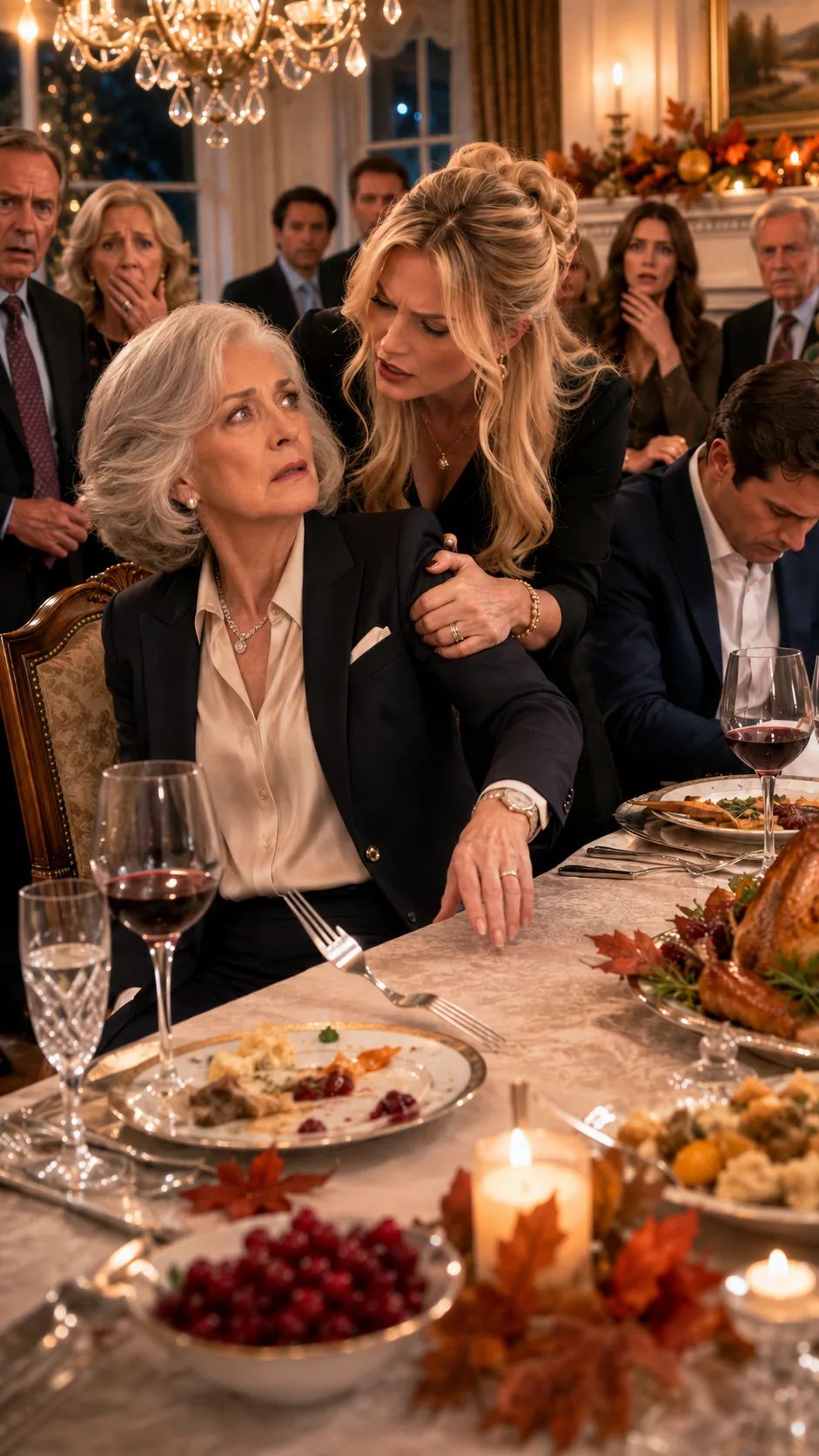
“You put your hands on a sixty-eight-year-old woman in front of guests,” I said. “You pulled me from a chair I had earned before you knew my son’s middle name. You smiled while you did it.”
Her face twisted.
“I was angry.”
“You were comfortable.”
That silenced her.
I turned to Jason.
“And you were silent.”
His shoulders dropped.
“I didn’t know she was going to grab you.”
“But you knew she wanted me gone.”
He looked down.
There it was again.
The truth in his silence.
Brittany’s mother spoke from the far end of the room.
“This is a
family matter,” she said stiffly. “Surely it can be resolved privately.”
I looked at her.
“It became a legal matter the moment your daughter and my son tried to use my home as collateral.”
Her husband’s jaw tightened. He did not defend her.
Marianne gathered the documents into a neat stack.
“Thirty days,” she said. “No extensions unless Mrs. Hayes approves them in writing.”
Jason flinched at the formality.
Mrs. Hayes.
Not Mom.
Not Patricia.
The rightful owner.
When Marianne and I left, Brittany was sitting at the table with her face in her hands. Jason stood in the doorway, staring at the floor. No one followed me outside.
This time, I did look back at the house.
Not because I was uncertain.
Because I was saying goodbye to the version of it that had died.
For the next thirty days, Jason called often.
I did not always answer.
When
I did, he sounded different each time.
First defensive.
Then desperate.
Then ashamed.
He asked if I would consider letting them stay through the holidays.
“No.”
He asked if I would release one investment account so he could stabilize the business.
“No.”
He asked if we could sit down “as a family” without attorneys.
“No, Jason. Families do not need attorneys when they behave like families.”
That was the last time he asked for money.
On the twenty-ninth day, I drove to Alder Ridge Road and watched movers carry boxes from the house.
Brittany did not come outside.
Her parents did.
They stood near the rented truck in expensive coats, their faces stiff with embarrassment. They did not speak to me. I did not speak to them.
Jason came down the steps last.
He carried one small box in his arms.
In it, I saw his childhood baseball glove, a framed photograph of Walter, and the blue ceramic mug he made for me in second grade.
MOMMY’S TEA, it said in uneven letters.
For one dangerous second, my heart weakened.
Then I remembered the wishbone.
I remembered his eyes fixed on his plate while Brittany dragged me from the table.
He stopped in front of me.
“I found this in the attic,” he said, looking at the mug.
“I wondered where it went.”
He nodded.
“I don’t deserve to keep it.”
“No,” I said. “You don’t.”
His face tightened.
Then I took the mug from the box.
“But I’m glad you remembered it existed.”
That was the closest thing to mercy I could offer.
After they left, the house felt enormous.
The first night back, I walked through every room with all the lights on.
The dining room smelled faintly of candle wax and old wine. I stripped the table bare. I washed the linen twice, but the stain near Jason’s seat would not come out.
So I stopped trying.
The next week, I donated the entire dining set to a women’s shelter Walter had supported quietly for years. The director cried when she saw it.
“This is too much,” she said.
“No,” I told her. “It’s finally enough.”
I replaced the long formal table with a round oak one.
No head.
No seat of honor.
No place where power could sit higher than love.
Then I changed the locks.
Not out of spite.
Out of peace.
By spring, Jason and Brittany had separated.
I heard it from Marianne first, then from Jason himself.
He called one Sunday afternoon.
“I’m in counseling,” he said.
I sat by the window with tea in my hand, watching rain slide down the glass.
“I’m glad.”
“I sold my car.”
“That sounds responsible.”
“I’m working with a debt advisor.”
“Good.”
He was quiet for a while.
Then he said, “I keep seeing your face from that night.”
I did not rescue him from the silence.
“I should have stood up,” he said.
“Yes,” I replied. “You should have.”
His breath broke.
“I don’t know how to fix that.”
“You don’t fix it by asking me to forget.”
“I know.”
That was new.
Jason had spent years treating apologies like receipts: hand one over, receive forgiveness.
But this time, he did not ask for anything.
So I stayed on the phone.
Not long.
But long enough.
The next Thanksgiving, I hosted dinner again.
Not for the old family circle. That circle had cracked, and I no longer pretended broken things were heirlooms.
I invited Marianne, my sister Elaine, two widowed neighbors, the young nurse who had cared for Walter during his last weeks, and a retired schoolteacher from the women’s shelter who had nowhere to go.
The house felt different with them in it.
Lighter.
Warmer.
There was laughter in the kitchen, real laughter, the kind that does not need wealth to sound full.
At 3:15, the doorbell rang.
Jason stood on the porch.
Alone.
He wore a simple navy sweater instead of a suit. His hair was damp from rain. In one hand, he held a bakery pie. In the other, a bunch of flowers wrapped in brown paper.
He looked nervous.
Good.
Nervous meant he understood this was not his house to enter by habit anymore.
“I know I’m early,” he said.
“You are.”
“I can come back later.”
I studied him.
There was no Brittany behind him. No performance. No business smile. No entitlement disguised as confidence.
Just my son, standing in the rain, waiting to be invited.
I stepped aside.
“Come in.”
At dinner, Jason did not sit near me.
He helped carry plates. He poured water. He cleared dishes before anyone asked. When conversation turned to Walter, he listened instead of trying to own the memory.
Near dessert, Ruth, my widowed neighbor, looked around and smiled.
“I love this table,” she said. “Round tables make everyone feel included.”
Jason lowered his eyes.
The room softened.
I could have ignored it.
I could have spared him.
But healing built on silence is just another kind of lie.
So I placed my fork down and said, “That was the point.”
Everyone grew quiet.
Not uncomfortable.
Present.
I looked at Jason.
“In this house, no one gets pushed away from the table again.”
His eyes filled.
“I know,” he whispered.
After dinner, while the others carried plates to the kitchen, Jason stayed behind.
“Mom,” he said, “thank you for letting me come.”
I looked at him for a long time.
There had been years when that word — Mom — felt like an obligation leaving his mouth.
Now it sounded like a man trying to earn the right to say it.
“I haven’t forgiven everything,” I said.
He nodded quickly. “I know.”
“But I’m willing to see who you become next.”
His face crumpled with quiet relief.
Not victory.
Relief.
That mattered.
Outside, rain tapped gently against the windows. Inside, the round table held empty plates, coffee cups, crumbs of pie, and the kind of silence that comes after people have finally told the truth.
I thought of Walter then.
His papers had protected me.
But his love had done something greater.
It had reminded me that a home is not measured by who inherits it.
It is measured by who is safe inside it.
And at my table, from that day forward, safety would never again depend on silence.
THE END
Chapter complete
You have reached the end of this chapter.
Continue reading
A few more worlds to get lost in after this chapter.




