My Daughter-in-Law Called Me the Housekeeper at Her Birthday Party—Six Months Later, a Lawyer Changed Everything
The moment my daughter-in-law called me the housekeeper, fifty people laughed.
Chapter 1
The moment my daughter-in-law called me the housekeeper, fifty people laughed.
Not one person in that room knew I was Daniel Mitchell's mother.
Not one person knew I had worked three jobs after his father died just to keep food on the table.
Not one person knew I had once gone without winter boots so my son could afford a college application fee.
They only saw what Victoria wanted them to see.
An old woman standing near the dining room wall, holding an empty serving tray, wearing a plain navy dress in a room full of diamonds and designer gowns.
Then someone asked, "Who is she?"
And Victoria smiled.
That smile told me everything before her mouth even opened.
"Oh, that's Rose," she said, lifting her champagne glass. "She lives with us and helps around the house."
A woman beside her laughed.
"So she's like the housekeeper?"
Victoria tilted her head.
"Basically."
The laughter came fast.
Polite laughter at first.
Then
louder.
Crueler.
I looked across the room at my son.
Daniel heard every word.
He was standing close enough to touch his wife.
Close enough to correct her.
Close enough to say, "That's my mother."
He didn't.
He lowered his eyes.
Raised his wine glass.
And took a drink.
That was the night I stopped begging to be loved by my own child.
But that wasn't where the story began.
It began six months earlier, on a rainy Tuesday afternoon in Ohio, when Daniel knocked on my front door and told me he wanted to take care of me.
I should have known better than to believe him.
But mothers are foolish that way.
Especially when it comes to sons.
My name is Rose Mitchell.
I'm sixty-eight years old.
A widow.
A mother.
A grandmother.
And for most of my life, I believed sacrifice was the purest form of love.
I learned too late that some people will accept your sacrifice for years and still call it nothing.
After my husband, Arthur, died, Daniel was only fifteen.
Old enough to understand loss.
Too young to understand bills.
I never told him how close we came to losing the house.
I never told him I worked breakfast shifts at a diner, evening shifts at a grocery store, and cleaned offices after midnight.
I never told him that on some nights, I sat in the parking lot outside the cleaning company and cried because I was so tired I couldn't turn the key in the ignition.
Daniel never knew any of that.
I made sure of it.
He had school.
He had baseball.
He had dreams.
And I had a responsibility.
When he got accepted into a private university, I hugged him in the kitchen and told him his father would be
proud.
Then I went into the bathroom, locked the door, and cried into a towel because I didn't know how I would pay for it.
But I paid.
Year after year.
Bill after bill.
Loan after loan.
I sold my wedding jewelry.
I skipped dental appointments.
I worked holidays.
And when Daniel graduated, I sat in the crowd wearing a dress from a thrift store, clapping so hard my palms hurt.
He became successful.
Very successful.
A financial consultant in Connecticut.
Big house.
Luxury cars.
Beautiful wife.
Two perfect children.
For years, Daniel called less and less.
At first, I told myself he was busy.
Then I told myself all sons drift away a little.
Then I stopped making excuses out loud because even I no longer believed them.
So when he appeared at my door after nearly eight months without visiting, I was shocked.
He stood on my porch in an expensive coat, rain dripping from his hair.
"Mom," he said, pulling me into his arms. "You shouldn't be alone anymore."
I laughed, because I didn't know what else to do.
"I've been alone for ten years, Daniel."
"That's exactly the problem."
His voice softened.
"You spent your life taking care of me. Let me take care of you now."
Those words went straight through me.
For one foolish second, I saw my little boy again.
The boy who used to bring me dandelions from the yard.
The boy who once saved his allowance for three months to buy me a birthday mug that said Best Mom Ever.
I didn't ask why now.
I didn't ask what Victoria thought.
I didn't ask whether there was another reason.
I just said yes.
Three weeks later, I packed up my small Ohio house.
The house wasn't fancy.
It had creaky floors, old cabinets, and a porch swing Arthur built with his own hands.
But it was mine.
Every corner held a memory.
Daniel helped load my boxes into a moving truck.
Victoria wasn't there.
She had sent a text that said:
So excited to have you with us, Rose.
No heart.
No "Mom."
No warmth.
Still, I ignored the feeling in my stomach.
I wanted this to work.
When I arrived at Daniel's mansion in Connecticut, I actually gasped.
The house looked like something from a magazine.
White stone exterior.
Tall windows.
Circular driveway.
A fountain in front.
Inside, the ceilings were high enough to echo.
Marble floors.
Crystal chandeliers.
Fresh flowers in every room.
Victoria greeted me in a cream silk blouse and pearl earrings.
"Rose," she said, kissing the air near my cheek. "Welcome."
Daniel carried my bags upstairs.
"You'll have the guest room near the back stairs," Victoria said.
"The back stairs?"
"It's quieter there."
I nodded.
At the time, I thought she was being considerate.
Later, I realized the room was near the laundry room, the pantry, and the service entrance.
My new life had been planned before I arrived.
I just hadn't been told what role I was playing.
The first two weeks were pleasant.
Almost too pleasant.
Victoria smiled at breakfast.
Daniel asked if I slept well.
My grandchildren, Lily and Noah, made everything easier.
Lily was ten, sharp-eyed and gentle.
Noah was seven, loud, sweet, and always sticky from something.
They called me Grandma Rose.
They were the reason I stayed longer than I should have.
At first, helping felt natural.
I made pancakes one morning because the kids asked.
Victoria praised me.
"You're a lifesaver."
I drove Lily to dance class because Victoria had a spa appointment.
Daniel thanked me.
"Mom, I don't know what we'd do without you."
I folded towels because I couldn't stand seeing them piled on the sofa.
Victoria smiled.
"You fold them so much better than Maria did."
"Maria?"
"Our nanny."
That was the first time I heard her name.
Two days later, Maria quit.
Victoria acted shocked.
Daniel acted stressed.
And suddenly, every small favor became an expectation.
The morning after Maria left, Victoria knocked on my bedroom door at 5:45.
"Rose, sorry to wake you. Could you make breakfast? I have an early call."
I got up.
Of course I did.
Mothers get up.
The next day she asked again.
Then she stopped asking.
By the third week, I had a schedule.
Breakfast at six-thirty.
Lunches packed by seven.
School drop-off by seven-forty-five.
Groceries after that.
Laundry before lunch.
School pickup at three.
Homework supervision.
Dinner.
Dishes.
Bath time.
Sometimes bedtime stories.
At first, I told myself I was useful.
Then I told myself I was needed.
Then one afternoon, I found a handwritten list taped to the refrigerator.
ROSE'S TASKS.
Not "family chores."
Not "things to do."
Rose's tasks.
Breakfast.
Laundry.
Dry cleaning pickup.
Kids' school bags.
Guest bathroom.
Pantry inventory.
Dinner prep.
I stared at the list for a long time.
Victoria walked in behind me.
"Oh good, you saw it."
I turned.
"You made a list for me?"
She smiled like I was being difficult.
"I just thought it would help you stay organized."
I wanted to say I had managed an entire household for decades without her help.
I wanted to say I was not an employee.
Instead, I swallowed my pride.
"All right."
That was my mistake.
Every time you swallow disrespect to keep peace, someone learns they can feed you more of it.
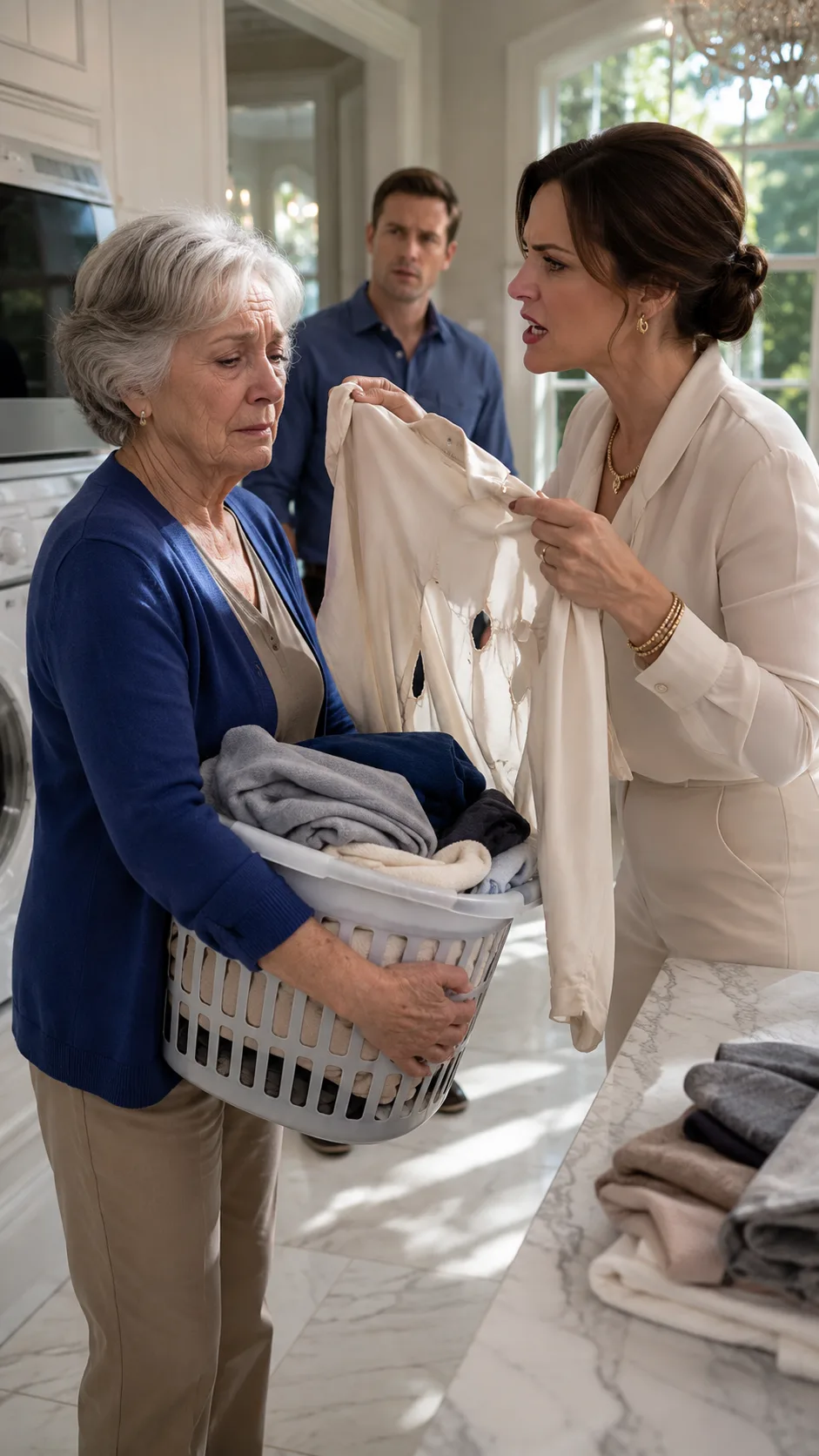
The first real argument happened over a blouse.
Victoria came into the laundry room holding a pale pink designer shirt between two fingers like it was contaminated.
"Rose, what happened to this?"
I wiped my hands on a towel.
"What do you mean?"
"It shrank."
I checked the tag.
Machine washable.
Cold water.
I had followed every instruction.
"I washed it exactly as the tag said."
Victoria inhaled sharply.
"Some garments require experience."
I felt my cheeks heat.
"I've done laundry for fifty years."
"Not this kind of laundry."
Daniel walked in at that exact moment.
I looked at him.
Maybe too hopefully.
Victoria held up the blouse.
"Your mother ruined this."
Daniel looked uncomfortable.
"Let's just replace it."
Replace it.
Not "Victoria, don't speak to my mother that way."
Not "Mom, are you okay?"
Just replace it.
Victoria smiled, satisfied.
I stood there holding a laundry towel, feeling smaller than I had felt in years.
That night, I knocked on Daniel's office door.
He was at his desk.
"Can we talk?"
He sighed before I even sat down.
"Is this about Victoria?"
That told me he already knew.
"She talks to me like I'm hired help."
"Mom, she has high standards."
"I'm your mother."
"I know that."
"Does she?"
He rubbed his forehead.
"Please don't make this into something bigger than it is."
I stared at him.
"It's already bigger than you want to admit."
His jaw tightened.
"Victoria has a lot on her plate."
I almost laughed.
On her plate?
I was the one cooking what went on the plate.
But I didn't say that.
I just stood up.
"Goodnight, Daniel."
As I left, I heard him exhale with relief.
That hurt too.
A week later came the first twist I didn't expect.
Lily had a school event called Grandparents Morning.
She came running into my room with a paper invitation.
"Grandma! You can come, right?"
My heart lifted.
"I'd love to."
She hugged me.
At breakfast, Lily announced it.
"Grandma Rose is coming to school Friday."
Victoria froze.
Only for a second.
Then she smiled.
"Oh, sweetheart, I don't think Grandma Rose wants to be bothered with school events."
"I do," I said gently.
Victoria looked at me.
Her smile sharpened.
"The school is very particular. Parents usually bring grandparents who are... well, involved socially."
I understood what she meant.
People from their world.
People in pearls and tailored coats.
Not me.
Lily frowned.
"Grandma is my grandmother."
Daniel stared into his coffee.
Again, I waited.
Again, he said nothing.
On Friday morning, I dressed carefully.
Navy cardigan.
Gray slacks.
Gold earrings Arthur had given me.
When I came downstairs, Victoria was waiting.
"Oh," she said. "You're still going?"
Lily grabbed my hand.
"Yes."
At the school, Lily introduced me proudly.
"This is my Grandma Rose."
For two hours, I felt human again.
Children asked me questions.
Teachers smiled.
Lily held my hand the whole time.
Then a mother near the refreshment table looked at me and said, "Are you with the family staff?"
I froze.
Before I could answer, Lily stepped forward.
"She's my grandma."
The woman looked embarrassed.
I squeezed Lily's hand.
That child defended me faster than my own son ever had.
When we got home, Victoria was furious.
Not openly.
Victoria's anger always wore perfume.
"I heard there was a misunderstanding at the school."
I said nothing.
She turned to Lily.
"You don't need to correct adults so sharply."
Lily lifted her chin.
"She called Grandma staff."
"She didn't mean anything by it."
"People keep not meaning things."
The room went silent.
Daniel was standing by the kitchen island.
For once, even he looked startled.
Victoria's face changed.
"You may go to your room, Lily."
Lily looked at me.
Then walked away.
That was the first time I realized Lily saw everything.
It would not be the last.
The second twist came in December.
Daniel and Victoria hired a photographer for family Christmas portraits.
Victoria spent days coordinating outfits.
Cream for her.
Navy for Daniel.
Plaid for the children.
No one mentioned me.
On the morning of the shoot, I came downstairs wearing my best green sweater.
Victoria looked surprised.
"Oh, Rose, are you going somewhere?"
I smiled weakly.
"I thought the photos were today."
"They are."
She paused.
Then said softly, "We were just doing immediate family."
Immediate family.
The words cut clean.
Daniel was adjusting Noah's collar.
He heard.
He didn't turn around.
I nodded.
"Of course."
I went back upstairs before anyone could see my face.
Later that afternoon, Lily came to my room.
She held a small instant photo.
It was blurry.
Off-center.
A picture she had taken herself.
Me sitting by the window with a book in my lap.
"Now I have one with you," she said.
I cried after she left.
Not because Victoria excluded me.
Because a ten-year-old child had more love in her than the adults running that house.
The third twist came on my birthday.
My sixty-ninth birthday.
I didn't expect much.
A card maybe.
Dinner with the children.
Daniel used to call me first thing every birthday.
That morning, nothing.
At noon, nothing.
At three, Victoria handed me a grocery list.
"We're having guests tonight."
I looked at the list.
"Tonight?"
"Yes. Just a small dinner."
I thought, foolishly, maybe it was for me.
So I cooked.
I made roasted chicken, mashed potatoes, green beans, apple pie.
By seven o'clock, guests arrived.
Victoria's friends.
Daniel's colleagues.
No one wished me happy birthday.
No one knew.
At nine-thirty, after everyone left, Noah ran into the kitchen.
"Grandma, Dad forgot your birthday."
The room went still.
Daniel looked up from his phone.
Victoria's face hardened.
I saw panic flash across Daniel's eyes.
"Mom," he said. "I—"
I shook my head.
"It's fine."
But Lily stood beside me and said, "No, it's not."
Daniel looked ashamed.
Victoria looked annoyed.
"It's been a busy week," she said.
I smiled.
The kind of smile women make when crying would be too inconvenient for everyone else.
Then I cut a slice of the apple pie I had baked for strangers and ate my birthday dessert alone at the kitchen counter.
That was when something inside me began preparing to leave.
I didn't know it yet.
But my heart did.
By the time Victoria's birthday arrived in spring, I had become invisible in every way except usefulness.
Victoria planned the party for weeks.
A garden-to-dining-room event.
Fifty guests.
Caterers.
Florists.
A violinist.
Custom cake.
Imported champagne.
But because Victoria loved control more than convenience, she still wanted me involved in everything.
"Rose knows where things are," she told the caterer.
"Rose can handle the pantry."
"Rose will coordinate the children's outfits."
"Rose, can you polish the silver?"
"Rose, can you check the powder room?"
"Rose, can you make sure the guest towels are folded properly?"
That day, I woke before sunrise.
By noon, my back was aching.
By four, my feet were swollen.
By six, I had changed into a simple navy dress and tried to look like I belonged.
Victoria saw me near the staircase.
"Oh, Rose."
I turned.
She looked me over.
"Maybe you should stay near the kitchen during the party. It's easier if guests need anything."
I understood.
She didn't want me mingling.
She wanted me available.
But hidden.
I almost walked upstairs.
Then Lily appeared beside me.
"Grandma is coming to the party."
Victoria blinked.
"Lily."
"It's family."
That word hung in the air.
Family.
Daniel walked past us, adjusting his cufflinks.
He looked at me, then at Victoria.
"Let's not make a thing out of it," he muttered.
Not "Mom should join us."
Not "Victoria, stop."
Just that.
Let's not make a thing out of it.
So I joined the party.
At least physically.
Emotionally, I stood outside it all night.
Guests passed me empty glasses.
One asked where the restroom was.
Another asked if I could take a plate away.
A woman handed me her coat.
I took it.
Because by then, I was too tired to explain that I was not hired help.
Then came the question.
A woman in a silver dress nodded toward me.
"Victoria, who is that older lady?"
Victoria laughed lightly.
The sound cut through the room.
"Oh, that's Rose."
"Family?"
"She lives with us and helps around the house."
Another guest chuckled.
"So she's basically the housekeeper?"
Victoria smiled.
"Basically."
Laughter.
Champagne laughter.
Cruel laughter.
Comfortable laughter from people who assumed kindness was something beneath them.
I felt my hands tighten around the serving tray.
My eyes moved to Daniel.
He had heard.
Everyone had heard.
For one second, his eyes met mine.
I saw embarrassment.
Not love.
Not outrage.
Embarrassment.
Then he looked away.
That was worse than everything Victoria had said.
Because Victoria had only confirmed what she believed.
Daniel confirmed what he allowed.
The tray trembled in my hands.
Lily suddenly appeared at my side.
Her face was pale.
"Grandma?"
I put the tray down.
"It's okay, sweetheart."
But it wasn't.
After the party, I went upstairs, closed my bedroom door, and sat on the bed in my navy dress.
I didn't cry immediately.
At first, I just sat there.
Listening to laughter downstairs.
Glasses clinking.
Music playing.
Then I looked at the small framed photo on my nightstand.
Arthur.
Daniel as a little boy.
Me in a yellow dress, younger, tired, hopeful.
I touched Daniel's face in the photograph.
And finally, I cried.
Quietly.
Not because Victoria called me the housekeeper.
Because my son let her.
The next morning, I called a senior living community thirty minutes away.
They had one apartment available.
I took it.
I didn't tell Daniel right away.
For the next week, I packed slowly.
One box at a time.
Books.
Photos.
Clothes.
Arthur's letters.
Lily noticed first.
"Are you leaving?"
I sat beside her.
"Yes."
Her eyes filled.
"Because of Mom?"
I held her hand.
"Because I need peace."
"Because of Dad too?"
I didn't answer.
She understood anyway.
On my last morning, Victoria appeared almost cheerful.
"Are you sure you'll be comfortable there?"
"Very."
Daniel stood by the door looking uneasy.
"You don't have to rush."
I smiled.
"You didn't ask me to stay."
His face changed.
Victoria looked away.
I hugged Noah.
Then Lily.
Lily whispered, "I'll visit."
"I know."
Then I turned to Daniel.
He looked suddenly young.
For a moment, I almost softened.
Then I remembered the party.
The laughter.
His silence.
"I hope one day," I told him, "you understand the value of family before it's too late."
He opened his mouth.
But no words came.
That had become his specialty.
I left.
The first month alone was strange.
The apartment was small.
One bedroom.
A tiny kitchen.
A balcony overlooking a courtyard.
But it was peaceful.
No lists taped to refrigerators.
No one handing me laundry.
No one correcting the way I folded towels.
I joined a book club.
I planted herbs.
I made friends with a widow named Marjorie who lived next door and swore too much during card games.
For the first time in years, I woke up and asked myself what I wanted to do.
Not what someone needed from me.
Meanwhile, Daniel's house fell apart in small, predictable ways.
I know because Lily told me.
The nanny quit after three weeks.
The new housekeeper refused to work weekends.
Victoria forgot Noah's school project.
Daniel missed Lily's recital because no one reminded him.
The laundry piled up.
The children ate takeout four nights a week.
Still, Daniel didn't call.
Not to apologize.
Not to ask if I was okay.
Not even on Mother's Day.
He sent flowers.
No message.
Just flowers.
I threw away the card and kept the vase.
Six months after I left, Daniel received a phone call from Whitman & Hale, a private law firm in Boston.
He called me immediately after.
For the first time in half a year.
"Mom, are you okay?"
Interesting, isn't it?
Some children only worry when a lawyer calls.
"I'm fine, Daniel."
"Why is a law firm contacting me?"
"You should attend the meeting."
"What's going on?"
"You should attend the meeting."
Victoria went with him.
Of course she did.
I was not there, but Mr. Hale told me later exactly what happened.
Daniel arrived nervous.
Victoria arrived excited.
She assumed, as people like Victoria often do, that old people only contact lawyers when money is about to move.
She was right.
Just not in the way she hoped.
Mr. Hale began with my father's name.
Charles Whitmore.
Daniel frowned.
He barely knew that name.
I had rarely spoken of my father.
Not because he wasn't important.
Because that part of my life never belonged to Daniel's story.
My father had founded Whitmore Precision Components in the 1960s.
A small manufacturing company that later became part of a larger industrial group.
Before he died, he left me shares.
A lot of shares.
I never lived like a wealthy woman because I didn't care to.
Money had never been my religion.
Security was enough.
And after Arthur died, I used only what I needed.
The rest sat untouched.
Growing.
Multiplying.
Becoming something Daniel and Victoria never imagined.
Mr. Hale placed the valuation in front of them.
Forty-three million dollars.
Victoria laughed.
A short, disbelieving laugh.
Daniel didn't.
He went completely still.
Mr. Hale explained the holdings.
The reinvestments.
The trust structure.
The private accounts.
Then Victoria asked the question she had been holding back.
"So what happens now?"
Mr. Hale looked at Daniel.
"Mrs. Mitchell reorganized her estate six months ago."
Daniel swallowed.
"After she moved out?"
"Yes."
Victoria's expression tightened.
Mr. Hale continued.
"The assets have been placed into a family trust."
Daniel exhaled.
For one brief second, hope returned to his face.
Then Mr. Hale said:
"You are not a beneficiary."
Silence.
Victoria leaned forward.
"Excuse me?"
"Neither of you are beneficiaries."
Daniel looked pale.
"That can't be right."
"It is."
Victoria's voice sharpened.
"Then who gets it?"
Mr. Hale turned the page.
"Lily and Noah Mitchell."
Daniel closed his eyes.
Victoria stared as if the room had tilted.
"There are conditions," Mr. Hale continued.
The grandchildren would not receive control at eighteen.
Not at twenty-one.
At twenty-five, they could receive distributions only if the appointed trustees believed they had demonstrated education, responsibility, compassion, respect for elders, and consistent service to others.
If they failed those conditions, a large portion would go to charities supporting elderly housing, education, and widowed parents.
Victoria looked furious.
"She can't control people from beyond the grave."
Mr. Hale calmly replied, "Mrs. Mitchell is very much alive."
That line, he told me, made Daniel flinch.
Because in that moment, he understood the worst truth of all.
I had not made the decision because I was dying.
I had made it because I was done being taken for granted while alive.
Then Mr. Hale handed Daniel my letter.
Daniel read it in silence.
Dear Daniel,
I once believed my greatest treasure was my son.
For many years, that belief carried me through exhaustion, loneliness, and sacrifice.
I gave because I loved you.
But love without gratitude becomes a wound.
You allowed your wife to treat me as a convenience.
Then you allowed strangers to laugh at me in your home.
A home where I cooked, cleaned, cared for your children, and tried to belong.
The money was never the lesson.
The lesson was always character.
Lily defended me when adults stayed silent.
Noah loved me without asking what I could do for him.
That is why the trust is for them.
Not as a reward for being my grandchildren, but as a responsibility to become better than the examples around them.
I hope one day you understand that silence can wound as deeply as words.
I still love you.
But love does not require me to keep standing where I am not respected.
Mom.
By the time Daniel finished, he was crying.
Victoria was not.
She was calculating.
That was the final twist Mr. Hale told me later.
Victoria asked if the trust could be challenged.
Daniel looked at her like he was seeing her for the first time.
"My mother is alive," he said.
Victoria snapped, "And she just cut us out of forty-three million dollars."
Daniel stood up.
"No. We cut ourselves out."
For once in his life, my son said the right thing too late.
The next morning, Daniel came to my apartment.
I saw him through the peephole before opening the door.
He looked terrible.
Unshaven.
Red-eyed.
Holding no flowers.
No gifts.
No performance.
Just shame.
When I opened the door, he broke.
"Mom."
One word.
Then he sank to his knees in the hallway.
"I'm sorry."
I stood there looking down at the boy I raised and the man who disappointed me.
"I'm so sorry," he said again. "I should have stopped her."
"Yes."
"I should have defended you."
"Yes."
"I should have remembered who you were."
That one hurt.
Because I had never forgotten who he was.
Even when he forgot me.
I let him inside.
We sat at my small kitchen table.
The same kind of table Victoria would have called cheap.
Daniel cried harder there than he had in years.
He told me he had been weak.
Comfortable.
Afraid of conflict.
He told me he had convinced himself silence was peace.
I told him silence was permission.
He nodded.
For once, he did not defend himself.
Hours passed.
Finally, he asked, "Can you forgive me?"
"I already have."
His face crumpled.
"Will you come home?"
I looked around my apartment.
At my plants.
My books.
My mug of tea.
My quiet little life.
Then I shook my head.
"No."
He lowered his head.
"I understand."
And I believed he finally did.
"I love you, Daniel," I said. "But I will not move back into a place where I had to beg to be seen."
He cried again.
This time, I did not rush to comfort him.
A mother can forgive her child without erasing the lesson.
Over the next few years, Daniel changed slowly.
Not perfectly.
But genuinely.
He visited every Sunday.
At first, we spoke awkwardly.
Then honestly.
Then warmly.
He brought groceries, even when I told him not to.
He fixed a loose cabinet.
He took me to doctor's appointments.
Not because he wanted anything.
Because he was learning.
Victoria did not visit.
Their marriage changed after the lawyer meeting.
I never asked for details.
That was Daniel's life.
But Lily told me once, quietly, "Dad talks about you differently now."
That mattered more than any apology.
Lily and Noah visited often.
Lily volunteered at my senior community during high school.
Noah learned to make soup because he said old people deserved better than bland food.
They grew into kind young adults.
Not perfect.
Kind.
And kindness, I have learned, is worth protecting.
Years later, when Lily turned twenty-five, the trustees approved her first distribution.
She came to my apartment before signing anything.
She sat across from me with tears in her eyes.
"Grandma," she said, "I don't want the money if it came from you being hurt."
I reached across the table and held her hand.
"Sweetheart, the money didn't come from pain. It came from a test."
"Did we pass?"
I smiled.
"You passed long before you knew there was one."
Daniel was there that day too.
Older now.
Quieter.
Humbler.
He looked at his daughter, then at me, and I saw the truth settle over him one final time.
The greatest inheritance I left was never forty-three million dollars.
It was the lesson he almost learned too late.
That family is not proven by blood.
It is proven in the moment someone disrespects the person who raised you.
It is proven when laughter fills a room and you decide whether to join it, ignore it, or stop it.
My son failed that test once.
But his children didn't.
And that is why, in the end, the fortune went exactly where it belonged.
Not to the people who wanted it.
To the people who understood what it meant.
THE END.
-The moment that destroyed Rose Mitchell's heart lasted less than five seconds.-
Chapter complete
You have reached the end of this chapter.
Continue reading
A few more worlds to get lost in after this chapter.




