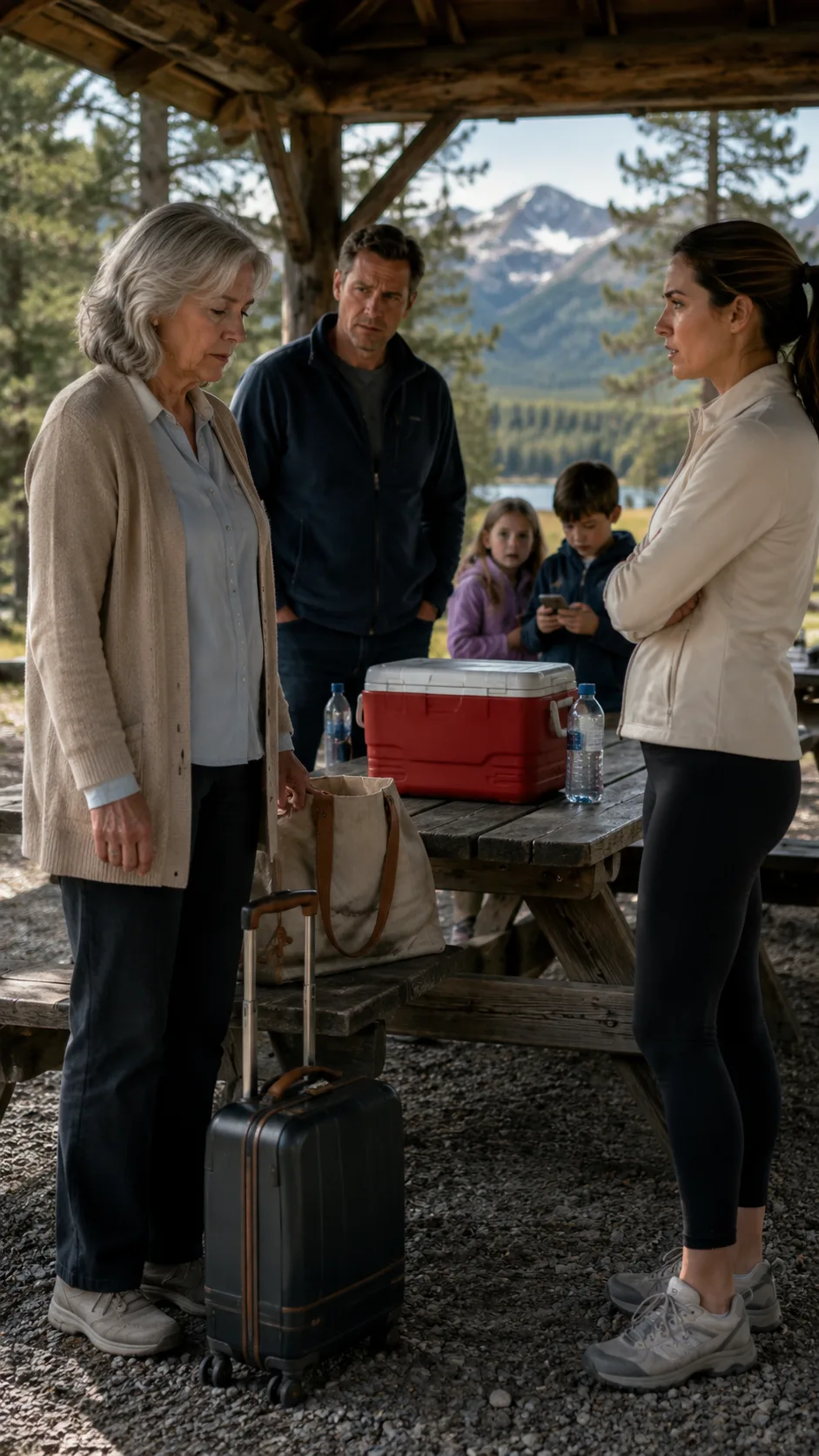
Daniel flinched when I said it.
Chapter 3
Daniel flinched when I said it.
Not because I was cruel. Because I was accurate.
For years, my son had come to my door with needs wrapped in affection. A hug before a favor. A smile before a request. A “How are you, Mom?” spoken only long enough to become, “Could you possibly…”
That afternoon, he did not even have the energy to wrap it.
Sophie shifted behind him, her suitcase handle clenched in one hand.
“Your mother fell,” Daniel said.
I looked at Sophie.
For the first time since I had known her, her polished face had cracks in it. Her hair was pulled back too tightly. Her eyes were swollen, not from sadness, but from the exhaustion of losing control.
“My mom broke her hip,” Sophie said. “She was supposed to watch the kids next week.”
There it was.
Not “We came because we hurt you.”
Not “We came because we were ashamed.”
Not
“We came because you deserved better.”
They came because the replacement childcare had failed.
Lily stepped around Daniel and whispered, “Grandma, I’m sorry.”
My heart nearly broke open.
I crouched in front of her. “You don’t have to apologize for grown-up mistakes.”
Sophie’s mouth tightened. “We didn’t come here to be insulted.”
I stood slowly.
“No,” I said. “You came here because you ran out of women to use.”
Daniel closed his eyes. “Mom…”
That one word used to soften me. It had been a key he carried his whole life, opening every locked place in me.
Not this time.
I stepped aside. “The children can come in. You and Sophie can sit on the porch.”
Daniel stared. “You’re serious?”
“Very.”
Lily walked in first and hugged my waist like she was afraid I might vanish again. Ethan followed quietly, his hands shoved deep in his hoodie pocket.
At the
doorway, he stopped.
“I heard what Mom said,” he mumbled. “At Yellowstone.”
Sophie snapped, “Ethan.”
He looked at her. “No. You said it.”
The silence after that belonged to my grandson.
For the first time, Ethan did not hide behind his phone. He looked at me like someone old enough to understand that adults can fail each other in ways children remember forever.
“I’m sorry, Grandma,” he said.
I touched his cheek. “Thank you.”
Outside, Daniel sat on the porch step like a man who had forgotten how to stand in his own life.
I poured the children lemonade. Lily showed me three drawings she had made since I left. One was of the mountains. One was of a butterfly. The third was of a woman pulling a suitcase down a gravel path.
At the bottom, in purple marker, she had written: GRANDMA WAS SAD BUT BRAVE.
I had to
turn away for a moment.
Through the screen door, I heard Sophie’s voice.
“She’s making us look like villains.”
Daniel answered, lower than I had ever heard him speak to her.
“No, Sophie. We did that ourselves.”
That was the first honest sentence my son had given me in years.
A few minutes later, I stepped onto the porch with my notebook in hand.
Daniel saw it and swallowed.
“What’s that?”
“A record,” I said. “Not a bill. Not a punishment. A record.”
I opened it.
“Forty-three school pickups in the last two years. Sixteen overnight stays. Nine weekends. Four holidays where I cooked or cleaned while Sophie’s family was treated as guests. One vacation where I paid my own airfare to be called childcare.”
Sophie’s face reddened. “You wrote all that down?”
“Only after I stopped pretending it wasn’t happening.”
Daniel put his head in his hands.
I looked at my son, and for a moment I saw the boy he had been. The little boy with scraped knees. The teenager who left dirty cereal bowls in the sink. The young man who cried the day his father missed his graduation.
I still loved him.
That was the tragedy.
Love did not disappear just because respect did. It stayed. It ached. It made boundaries harder, but also more necessary.
Daniel lifted his face. “I failed you.”
Sophie looked at him sharply.
He did not look back at her.
“I did,” he said. “I let you become convenient. I let Sophie talk to you like that because it was easier than fighting. And every time you swallowed it, I told myself you were fine because I needed you to be fine.”
His voice broke.
“I’m sorry, Mom.”
I believed that he meant it.
I also knew meaning it was not enough.
Sophie crossed her arms. “So what do you want? Money?”
I almost laughed.
Money would have been simple. Money could be counted, paid, forgiven.
What they had taken was harder to name.
“I want Sundays back,” I said.
Daniel blinked. “What?”
“Not every Sunday. Not forced. Not as a transaction. But when you come to my house, you come as family. You bring food sometimes. You wash dishes sometimes. You ask me how I am and stay long enough to hear the answer.”
I turned to Sophie.
“And I will not babysit in a house where I am spoken to as staff.”
She looked away.
I continued, “If you need childcare, ask respectfully. Give me notice. Accept no as an answer. And if I travel with you again, I travel as a grandmother, not unpaid help.”
Daniel nodded quickly. “Of course.”
Sophie said nothing.
I waited.
The old version of me would have filled the silence for her. I would have rescued her from discomfort. I would have made my own wound smaller so she did not have to look at it.
I did not.
Finally, Sophie looked at me.
“I shouldn’t have said that.”
It was not perfect. It was not warm. It was not enough to erase years.
But it was the first time she had admitted the sentence belonged to her.
“No,” I said. “You shouldn’t have.”
Daniel wiped his face. “Can we start over?”
I looked through the screen door at my grandchildren sitting at my kitchen table. Lily was laughing softly at something Ethan had drawn on a napkin.
“No,” I said.
Daniel’s face fell.
“We can start differently.”
That was not forgiveness. Not yet.
It was a door left unlocked, but not wide open.
Two weeks later, I took my own trip.
Maine coast. Seven days. Ocean air, lobster rolls, a little inn with blue shutters, and a group of women from the community center who did not once ask me to watch their children.
On the second morning, Daniel called.
Not texted.
Called.
“Hi, Mom,” he said. “Are you busy?”
I stood by the water with my coffee cooling in my hand, gulls crying overhead.
“Yes,” I said, smiling. “I’m sightseeing.”
There was a pause.
Then Daniel laughed softly, the way he used to when he was still my boy.
“Good,” he said. “Tell me everything when you get home.”
For the first time in years, I believed he wanted to hear the answer.
THE END
Chapter complete
You have reached the end of this chapter.
Continue reading
A few more worlds to get lost in after this chapter.




