My Daughter Came Home From Her Wedding Night Broken — Then One Courthouse Video Destroyed Her Husband’s Family
My daughter came back from her wedding night at 3:18 in the morning wearing a torn white dress and only one shoe.
Chapter 1
My Daughter Came Home From Her Wedding Night Broken — Then One Courthouse Video Destroyed Her Husband’s Family
My daughter came back from her wedding night at 3:18 in the morning wearing a torn white dress and only one shoe.
At first, I thought the knocking was part of a dream.
Three knocks.
A pause.
Then two more, weaker than the first.
I lived alone on the seventh floor of an old brick apartment building in Chicago, the kind with narrow hallways, tired carpet, and lights that buzzed whenever the rain pressed hard against the windows. No one knocked on my door at that hour unless something had gone wrong.
I looked through the peephole.
For one second, my mind refused to understand what my eyes were seeing.
Mara stood outside with one hand against the wall, her wedding dress ripped down one side, her hair falling loose from the pearl pins I had placed there that afternoon. Her veil hung from her elbow like torn netting. One cheek was swollen. The skin near her mouth was marked. Her arms were wrapped around herself as if she were trying to
hold her body together by force.
I opened the door.
She looked at me and tried to smile.
Nothing moved except her lips.
“Mom,” she said. “Please don’t let them take me back.”
Then her knees folded.
I caught her before she hit the floor.
For a few seconds, I was not Elena Whitaker, former wife, quiet accountant, mother of one grown daughter. I was only arms and breath and panic. I dragged Mara inside, kicked the door shut behind us, and locked both deadbolts with fingers that would not work properly.
“Mara.”
She made a small sound when I touched her shoulder.
I pulled back immediately.
“Who did this?”
Her eyes moved toward the hallway door.
Not toward me.
Not toward safety.
Toward the place they might come from.
“Valeria,” she said.
I did not need the last name.
Valeria Montez had entered my life six months earlier wearing
ivory silk, diamonds at noon, and a smile that never reached her eyes.
Her son, Adrian, had seemed perfect to everyone else. Thirty-two years old. Attorney. Educated. Tall, handsome, disciplined. The sort of man who opened doors, remembered names, and made older women at church whisper that Mara had done well.
I had not whispered anything.
The first time I met him, he brought flowers to my apartment and placed them on the counter without checking whether there was a vase. The second time, he corrected Mara’s pronunciation of a wine label in front of my friends. The third time, he answered a question meant for her.
Small things.
Needles, not knives.
Valeria was worse.
She had come to dinner once, looked around my modest apartment, and paused too long at the framed photo of Mara standing on the balcony of her Lakeview condo.
“Beautiful building,” she said.
“It is.”
“Mara owns it herself?”
Mara laughed then. “Mom helped me handle the paperwork.”
Valeria’s eyes shifted to me.
“How responsible.”
I remember the exact way she lifted her water glass. Two fingers at the stem. Gold bracelet sliding down her wrist.
“My family believes property should strengthen marriage,” she said.
I answered before Mara could.
“My family believes no one should need to lose property to prove love.”
Adrian had smiled and touched Mara’s hand.
“Mom uses old words. She means unity.”
Valeria’s smile did not move.
“Unity is a serious thing.”
That condo was serious too.
Mara’s father, Charles Whitaker, had signed it over after our divorce. It was one of the few decent things he had done without being dragged through a courtroom. A two-bedroom unit in Lakeview with floor-to-ceiling windows, bought years before the neighborhood became impossible. No mortgage. No shared ownership. No marital claim unless Mara herself chose to transfer it.
I had repeated that to her before the wedding.
Twice.
Maybe three times.
She had kissed my cheek, laughed, and told me I watched too many crime documentaries.
Now she sat shaking on my couch, her wedding dress stained with rainwater and dirt, her fingers curled around the edge of a gray blanket.
“What happened after the reception?” I asked.
She kept staring at the carpet.
“There was a folder in the suite.”
I closed my eyes.
“On the table?”
She nodded.
“Adrian said it was just housekeeping. He said his mother wanted us to sign before the honeymoon so everything would be clean before we left for Italy.”
“Sign what?”
“The condo transfer. A spousal consent form. Something giving him authority. I didn’t understand all of it.” Her breath hitched, but she forced the next words out. “I said no.”
The kitchen clock ticked behind me.
A cheap clock. Too loud.
“Where was Adrian?”
“He said he was going to get ice.”
I knew then.
A husband does not get ice when his new wife is handed property papers in a hotel suite.
Mara gripped the blanket harder.
“After he left, Valeria came in with three women. Her sister, Celeste. Her cousin. And a woman I saw at the wedding but didn’t know.”
“Did they touch you?”
Mara’s mouth tightened. Her eyes dropped.
“They locked the door.”
I sat down beside her, but not too close.
She had always hated being crowded when afraid, even as a child. When she was six and fell off her bike, she would sit on the sidewalk with one hand lifted, warning everyone to wait until she could breathe.
So I waited.
She spoke in pieces.
Valeria had told her that married women did not keep separate property. That Adrian came from a respected family and would not be embarrassed by a wife who acted like a tenant with a lease. That the condo was not “being taken,” only placed where it belonged.
Mara had refused.
Celeste had laughed.
The cousin had stood by the door.
Valeria had taken off her rings and set them beside the folder.
Mara stopped speaking there.
Her jaw worked.
I did not ask for the rest.
Her body had already told me enough.
I reached for my phone.
Mara moved faster than I expected. She grabbed my wrist with both hands.
“No police.”
“Mara.”
“They said they have doctors. They said they’ll tell everyone I’m unstable. They said Adrian will say I attacked his mother.”
Her voice dropped.
“They said if I make this public, I won’t survive what they do next.”
The room went silent.
Outside, rain hit the living room window in thin silver lines. A car passed below, tires hissing over wet pavement.
I looked at my daughter.
The girl I had raised alone for most of her life.
The woman I had watched walk down a wedding aisle twelve hours earlier.
The bride who had believed that patience could change people who had already decided what she was worth.
I took the phone from her hands gently.
“I won’t call the police yet.”
Her shoulders loosened by half an inch.
“Mom—”
“But I’m calling your father.”
Her eyes widened.
“No.”
“Yes.”
“Dad hasn’t spoken to me properly in years.”
“That is his failure. Not yours.”
I scrolled through contacts I had not opened in nearly a decade.
Charles Whitaker.
His number was still there.
My thumb hovered over it.
I remembered the divorce. The silence after. Mara’s birthday dinners where she watched the door. The graduation seat we kept empty until the ceremony began. The checks that arrived on time. The phone calls that did not.
Then I looked at the marks on my daughter’s face.
I pressed call.
Charles answered on the fifth ring.
“Elena?”
His voice was rough with sleep and age.
I did not greet him.
“Your daughter came to my apartment from her wedding night hurt.”
Nothing.
No breath.
No question.
Then: “Where is she?”
“With me.”
“How badly?”
I looked at Mara. She shook her head once, pleading.
“Bad enough that I’m calling you.”
A chair scraped on his end.
“I’m coming.”
“You remember the address?”
“I remember everything I pretended not to.”
He hung up.
Mara stared at me.
“He won’t come.”
I went to the sink and wet a towel.
“He already is.”
Thirty-three minutes later, someone knocked.
Not hard.
Three controlled taps.
I looked through the peephole.
Charles stood in the hallway wearing a dark overcoat over a wrinkled white shirt, no tie, rain in his silver hair. He looked older than the last time I had seen him close. Thinner, perhaps. Harder around the mouth. But his eyes were the same: pale gray, unreadable unless he was very angry.
When I opened the door, he did not look at me first.
He saw Mara over my shoulder.
Everything in his face stopped.
He walked into the apartment slowly, as if a wrong step might break the floor. Mara sat upright when she saw him, pulling the blanket to her chest.
“Dad.”
The word was small.
Charles crossed the room and knelt in front of her.
He did not touch her.
That surprised me.
He placed both hands on his knees, looked at her face, her torn dress, the wrapped towel against her mouth, and said, “Tell me who.”
Mara’s lips trembled.
“Valeria Montez.”
Charles closed his eyes once.
When he opened them, he was not the man who missed holidays anymore.
He was the man I had watched destroy a business partner in court without raising his voice.
“Did Adrian participate?”
Mara looked down.
“He stood outside.”
Charles’s hands curled against his knees.
“He knew?”
“He told her not to leave marks where people would notice.”
The refrigerator hummed.
A drop of water fell from Charles’s coat hem onto the carpet.
He stood.
Not quickly.
Not dramatically.
He simply rose, took out his phone, and walked into my kitchen.
I followed him.
“Don’t make promises you can’t keep,” I said.
He looked at me.
“I won’t.”
Then he made the first call.
“Anika. Private residence. Female patient. Assault documentation. No mandatory report until she consents unless required. Bring camera equipment. Quietly.”
The second call came ten seconds later.
“Marianne. Wake your team. I need emergency protection, evidence preservation, and every legal route available before sunrise.”
The third call was shorter.
“Elliot, start a full pull on the Montez family. Adrian. Valeria. Eduardo. Celeste. Hospitality holdings, lawsuits, sealed settlements, prior engagements, property transfers. Everything.”
He ended the call.
I folded my arms.
“You still have people who answer at four in the morning?”
“Elena,” he said, “I have more now.”
It was not pride.
It was warning.
The doctor arrived at 4:21 a.m.
Dr. Anika Rao was small, composed, and carried a black medical bag that looked older than she was. She examined Mara in my bedroom while I sat beside the bed holding my daughter’s hand, careful not to press too hard. Charles waited in the hallway. I saw his shadow move under the door twice. Then stop.
Every visible injury was documented.
Every mark photographed.
Every statement timed.
Dr. Rao did not ask questions as if Mara were on trial. She asked them like each answer belonged to Mara first.
“Can I examine your wrist?”
Mara nodded.
“Can I photograph this area?”
A pause.
Then another nod.
“Do you want your mother to stay?”
“Yes.”
When the doctor finished, she stepped into the living room and looked at Charles.
“She needs imaging. Nothing appears life-threatening, but I’m concerned about her ribs and wrist. She should not be alone. She should not communicate directly with her husband’s family.”
Charles nodded once.
“Private clinic?”
“I can arrange it.”
Mara sat in the bedroom doorway, wrapped in my robe now. Someone had cut the back of the wedding dress so the doctor could examine her without pulling fabric over her skin. The dress lay inside a plastic garment bag on my bed.
Evidence.
I hated that word.
The attorney arrived at 5:06 a.m.
Marianne Vale looked like she had been born in a courtroom. Sharp black bob. Charcoal suit. No jewelry except a plain silver watch. She carried two folders and was followed by two younger attorneys who looked terrified of disappointing her.
She saw Mara and stopped for half a second.
Only half.
Then she placed the folders on my dining table.
“We start with protection,” she said. “Then evidence preservation. Then criminal options when Mara is ready.”
Mara asked, “What about the condo?”
Marianne opened the first folder.
Inside were copies of the Lakeview deed, the trust documents, the separate property filings, and the prenuptial draft Mara had refused to sign.
“You own the condo alone,” Marianne said. “No marital claim exists unless you sign documents transferring interest, granting authority, or merging assets.”
“I didn’t sign.”
“Did they make you hold a pen?”
“Yes.”
“Did your hand touch paper?”
“No. I dropped it.”
“Did anyone record you?”
Mara froze.
The room noticed.
Charles turned.
“Mara.”
Her fingers tightened around the robe belt.
“Valeria’s phone was on the dresser. Facing the table.”
Marianne wrote something down.
“Good to know.”
“Good?”
“If she recorded coercion because she thought it would protect her, she may have recorded herself committing it.”
Mara stared at her.
Charles said, “Where are the documents now?”
“The hotel suite,” Mara said. “Unless they took them.”
Marianne looked at one of her assistants.
“Preservation letter to the hotel. Now. Hallways, elevators, suite entry logs, staff logs, cleaning records, valet, private security, everything.”
The assistant stepped away and began typing.
By sunrise, my apartment had become a command center.
Mara slept in short, broken pieces on the couch. Charles sat near the window with one phone in his hand and another on the table beside him. Marianne’s team worked from my dining table. Dr. Rao arranged a private clinic visit at nine.
At 6:38, Elliot sent the first file.
Montez Hospitality Group.
The Montez family owned three boutique hotels, two restaurants, a private event company, and enough charity boards to look respectable from a distance.
At 6:51, the second file arrived.
Debt.
Not ordinary debt.
Layered loans. Refinanced properties. Shell companies. Private lenders. A federal inquiry into Eduardo Montez’s development funds, not yet public.
At 7:09, a third file arrived.
Isla Herrera.
Former fiancée of Adrian Montez.
Engagement ended six years earlier.
Townhouse transferred to Montez Holdings two days before breakup.
Psychiatric hold three weeks later.
Family lawsuit withdrawn after settlement.
No public record after relocation.
Charles read the name twice.
“Find her,” he said.
Marianne looked up.
“We don’t know if she wants to be found.”
“Then find out safely.”
Mara had awakened.
She stared at the name.
“He was engaged before me?”
I sat beside her.
“He never told you?”
She shook her head.
“He said he had never come close to marriage. He said I was different.”
Marianne turned one page.
“Men like that often reuse the same script.”
Mara stood too quickly, winced, and sat back down.
“I’m going to be sick.”
I brought a bowl from the kitchen. She did not need it. She only held it in her lap, staring into it as if the bottom might explain how love became paperwork.
At 7:46 a.m., Adrian called.
The ringtone made Mara flinch so hard the bowl slipped. I caught it before it hit the floor.
Charles picked up the phone but did not answer.
He looked at Mara.
Her face went tight.
Then she nodded.
Charles pressed speaker.
Adrian’s voice came through smooth, worried, rehearsed.
“Mara? Baby, where are you?”
Charles said, “With her father.”
Silence.
Then Adrian adjusted.
“Mr. Whitaker. I didn’t realize you were involved.”
“You should have.”
“This is a private matter between husband and wife.”
“No.”
A pause.
Adrian tried again.
“Mara left in an emotional state. My mother is devastated. We were planning to handle this quietly.”
Charles looked at Mara’s face.
“Did you stand outside a locked suite while your mother threatened my daughter?”
Adrian gave a small laugh.
“That is an insane accusation.”
“Not an answer.”
“My mother was trying to help Mara understand family responsibilities.”
“Still not an answer.”
“Elena has always disliked us. I’m sure she filled Mara’s head with—”
Charles leaned closer to the phone.
“One more time. Were you outside the door?”
Adrian’s breathing changed.
“You don’t understand our culture.”
Mara’s eyes closed.
Charles said, “I understand cowardice in every language.”
Adrian’s voice sharpened.
“She humiliated my mother.”
Marianne’s pen stopped.
Charles looked at her.
She nodded once.
Charles said, “Thank you.”
“For what?”
“For saying the quiet part before your lawyer stopped you.”
He ended the call.
Mara covered her face.
“Mom.”
I sat beside her.
“I know.”
“No, you don’t.” She pulled her hands down. “I married him yesterday.”
No one had an answer that could fit inside that sentence.
At nine, we took Mara to the clinic through the building’s side entrance. Charles’s security had already placed two men in the lobby and one near the garage. Mara hated it. She kept her head down.
“I look ridiculous,” she said.
“You look alive,” Charles answered.
She did not respond.
At the clinic, imaging showed bruised ribs, a sprained wrist, and soft tissue injuries that would heal in time. That phrase angered me. In time. As if time were medicine poured from a bottle. As if bodies were the only things that needed repair.
When we returned to my apartment, a black SUV waited across the street.
I saw it before Charles did.
Then he saw it.
The driver looked away too late.
“Montez?” I asked.
Charles gave a small nod to one of his guards.
“Get the plate.”
At 11:32 a.m., Valeria called me.
Not Mara.
Me.
I answered because Charles gestured for me to.
“Elena,” she said. “You need to stop this.”
I put her on speaker.
Her voice filled my living room, polished and low.
“Mara is confused. She has embarrassed herself, my son, and both families. But we are willing to show mercy if she comes home today.”
I looked at Mara.
She sat wrapped in a blanket, her eyes fixed on the phone.
“Home?” I said.
“She is married now.”
Charles stepped closer.
Valeria continued, “Marriage requires correction. Some girls are taught too gently by their mothers.”
My fingers tightened around the phone.
“You touched my daughter.”
“I corrected my daughter-in-law.”
Mara’s face went pale.
Charles spoke.
“Valeria.”
The silence was immediate.
When she answered, the sweetness had thinned.
“Charles Whitaker.”
“You have ten seconds to leave Elena’s building and stop contacting Mara.”
She laughed.
“You always did speak like money made you law.”
“Nine.”
“You think I don’t know you?”
“Eight.”
“You think your past is clean enough to stand in sunlight?”
Charles stopped counting.
Valeria heard it.
Her voice dropped.
“Ask him, Elena. Ask him why he gave Mara that condo. Ask him who owned it before. Ask him why Isla Herrera’s name disappeared from court records after your husband made one phone call.”
The room went still.
Mara looked from the phone to Charles.
“Isla?”
Valeria continued, “Families like ours survive because we know where bodies are buried. Touch mine, and I dig up yours.”
The call ended.
No one moved.
Rain tapped against the window again.
Mara’s voice came out thin.
“Dad?”
Charles sat down slowly.
Marianne stood near the kitchen, expression unreadable.
I looked at him.
“What does she mean?”
He did not answer quickly.
That was enough to make the room colder.
“What does she mean?” I asked again.
Charles looked at Mara.
“The condo was purchased from the estate of Isla Herrera’s grandmother.”
Mara stared.
“The woman Adrian was engaged to?”
“Yes.”
“You knew her?”
“No. Not then.”
Marianne said, “Charles.”
He raised a hand.
“No.”
Then he turned to me.
“Years ago, after the divorce, I was approached about a distressed property. The family needed liquidity quickly. The deal was clean on paper. I bought it through a holding company, then transferred it to Mara when she turned twenty-one.”
Mara’s mouth parted.
“So my condo was hers?”
“Her grandmother’s. Not Isla’s directly.”
“But Valeria knew.”
Charles nodded.
“Apparently.”
Marianne’s phone buzzed.
She read the message.
“We found Isla.”
Mara sat upright.
“Where?”
“Milwaukee. Under her aunt’s surname. She refused the first call.”
Charles asked, “And the second?”
Marianne looked at Mara.
“We sent a photo of Mara from today. Isla called back.”
The meeting happened that evening in Charles’s office tower downtown.
I had not been there since before the divorce. The lobby was all black marble and glass. People moved quietly, as if loud footsteps cost money. Charles took us through a private elevator to the thirty-first floor, where a conference room overlooked the river.
Someone had placed coffee on a side table.
No one drank it.
Isla Herrera arrived at 6:12 p.m. with a woman I assumed was her aunt and a retired investigator Charles trusted. Isla was twenty-nine or thirty, with short dark hair and a gray coat buttoned to the throat. Her eyes went first to the exits.
Then to Mara.
She stopped.
“Oh God,” she said.
Mara removed her sunglasses.
Isla covered her mouth.
“They did it again.”
Mara did not cry.
She did not speak either.
Isla sat across from her.
For a while, she only looked at the table.
Then she began.
Adrian had met her at a charity auction. Valeria had adored her in public. Celeste had called her “little sister.” Eduardo had offered business advice. They had asked about her grandmother’s townhouse before dessert at the engagement dinner.
“I thought they were practical people,” Isla said. “Not romantic, maybe. But serious.”
Mara’s fingers moved toward mine under the table.
I took her hand.
“After the engagement, Adrian started talking about shared futures. Then shared accounts. Then shared property. When I refused, Valeria said I was insulting their name.”
“Did he leave the room?” Mara asked.
Isla looked at her.
“Yes.”
The answer sat between them.
Isla continued.
“The night it happened, they didn’t mark my face much. They were careful. They used threats more than force. Doctors. Reputation. My immigration paperwork for my aunt. My grandmother’s debts. Everything they could turn into a chain.”
Marianne asked, “Did you sign?”
Isla nodded.
“I signed after two days.”
Mara squeezed my hand.
“Then Adrian said I was unstable. Valeria had a doctor write a letter. I was placed on a psychiatric hold. By the time I got out, my townhouse was gone, my reputation was gone, and everyone thought I needed quiet.”
She reached into her bag and removed a flash drive.
“I kept what I could.”
Marianne took it.
“What’s on here?”
“Emails. Medical letters. A video Valeria made after I signed.” Isla swallowed. “She liked recordings. She said they protected the family.”
Mara looked at Charles.
His face had gone hard.
Isla turned back to Mara.
“They didn’t want your condo only because it was valuable.”
Marianne leaned forward.
“What else?”
“Eduardo is under federal investigation. Money laundering through hospitality assets. They need clean property under a clean person. A young bride with a valuable condo and no criminal record is useful.”
Mara’s voice was low.
“They were going to use me.”
“Yes.”
“And after?”
Isla looked down.
“They would have made you look like me.”
The room became too small.
Marianne plugged the flash drive into an isolated laptop.
The first folder opened.
Names.
Dates.
Scans.
Videos.
She clicked one.
A younger Isla sat at a desk, face pale, signing papers while Valeria stood behind her.
Valeria’s voice came through the speakers.
“Good girls understand family.”
Isla in the video cried without sound.
Marianne stopped playback.
Mara stood and walked to the window.
I followed her.
The river below reflected city lights in broken lines. Mara placed one hand on the glass.
“I was one signature away.”
I stood beside her.
“But you didn’t sign.”
She turned.
Not healed.
Not safe.
But something in her had shifted.
“No,” she said. “I didn’t.”
The first police report was filed that night.
The emergency protection order followed.
The hotel received preservation notices.
Charles’s investigator secured confirmation that Valeria had booked the bridal suite under her own name and that four women entered after Adrian left.
At 10:06 p.m., Adrian texted Mara.
Baby. Stop this now. My mother is willing to forgive you.
At 10:08.
You are making people ask questions.
At 10:11.
You are my wife. This is not how wives behave.
Marianne preserved every message.
At midnight, the first online article appeared.
PROMINENT MONTEZ FAMILY DEALING WITH WEDDING NIGHT “BREAKDOWN”
By morning, there were three more.
One claimed Mara had a history of instability.
One claimed she had tried to attack Valeria during a private blessing ceremony.
One claimed Adrian was “protecting his wife from public embarrassment.”
They used wedding photos.
Mara smiling beside Adrian.
Valeria adjusting Mara’s veil.
Me in the background, looking tired.
Charles standing alone near the bar.
A whole lie built from real images.
Mara read the headlines at my kitchen table.
She did not break.
She set the phone face down.
“They’re doing it.”
Isla, sitting across from her, nodded once.
“Yes.”
Charles picked up the phone and read in silence.
Then he laughed.
Not loudly.
Not with humor.
Like a man who had watched his enemy step into a room he had already locked.
Mara looked at him.
“Why are you laughing?”
“Because they went public first.”
Marianne entered from the hallway with her coat over one arm.
“Which means we can answer publicly.”
Mara looked between them.
“How?”
Charles’s eyes softened.
“With the truth, if you choose it.”
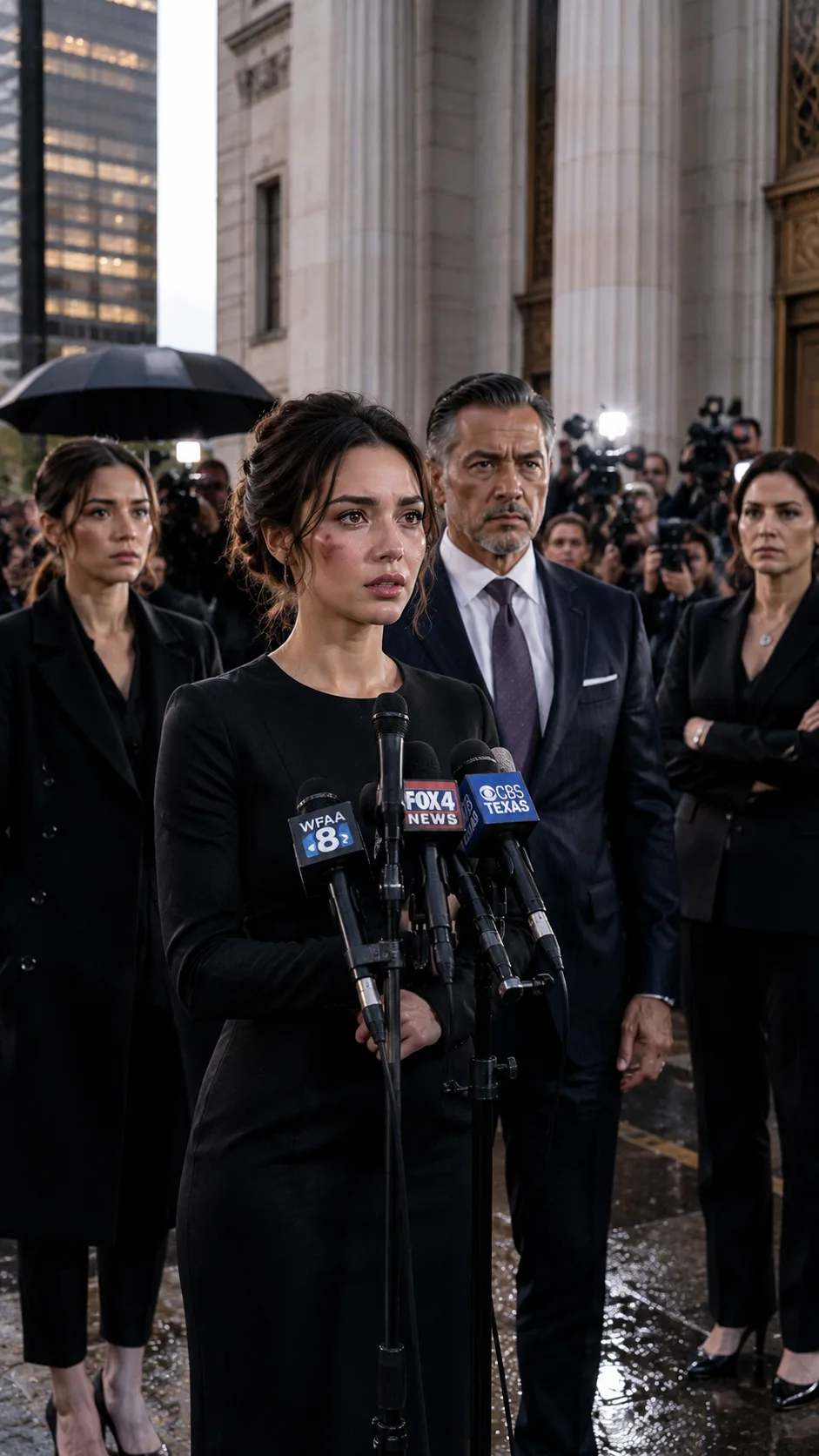
The courthouse press conference took place two days later under a gray sky heavy with rain.
Mara wore a simple black dress. No sunglasses. No veil. No jewelry except the small pearl earrings I had given her for college graduation. The bruise on her cheek had faded at the edges but was still visible. She asked the makeup artist not to cover it.
“I don’t want them saying I hid anything,” she said.
Charles walked on her left.
I walked on her right.
Isla stood behind us with Marianne.
Reporters crowded the courthouse steps behind metal barricades. Cameras stood under umbrellas. Microphones clustered on a black stand. The stone beneath our feet was wet and reflective.
Valeria arrived twenty minutes before we began.
She wore black.
Of course she did.
A grieving saint for the cameras.
Adrian came beside her in a navy suit, his face arranged into wounded concern. Celeste stood behind them, cream coat, red lipstick, eyes scanning the crowd. Eduardo Montez did not appear.
Mara saw them.
Her fingers brushed mine once.
Then she let go.
Marianne stepped to the microphones.
“My client, Mara Whitaker, was pressured on her wedding night to transfer separately owned property to members of her husband’s family. When she refused, she was threatened, restrained, and later defamed through planted media stories.”
The reporters erupted.
Marianne raised one hand.
“We will not present every piece of evidence here. However, because false claims have been circulated publicly, we are releasing limited verified footage.”
Valeria’s face did not change.
Adrian’s did.
A portable screen flickered on beside the courthouse entrance.
Hotel hallway footage appeared.
12:37 a.m.
Valeria Montez entered the bridal suite with Celeste and two other women. A folder was tucked beneath Valeria’s arm. Adrian stood outside the door. He looked down the hall. Then he stepped aside.
The door closed.
No one in the crowd spoke.
The footage jumped.
2:08 a.m.
The door opened.
Mara stumbled into the hallway in her torn wedding dress, one hand against the wall, trying to move away. Adrian reached for her arm. She pulled back. He followed two steps, then stopped when the elevator doors opened.
The footage ended.
Rain tapped against the microphones.
A reporter lowered his camera.
Valeria stepped forward.
“This proves nothing. A private family disagreement has been twisted by a girl who—”
Isla walked to the microphone.
Valeria stopped.
It was the first time I saw her lose timing.
Isla gripped the stand.
“My name is Isla Herrera. I was once engaged to Adrian Montez.”
Adrian went pale.
Isla continued.
“They took my property too. When I tried to speak, they called me unstable. They used doctors. Lawyers. Money. They made my family doubt me.”
Valeria snapped, “This woman is lying.”
Isla looked directly at her.
“Would you like them to see your video?”
The silence after that was larger than the crowd.
Mara stepped forward.
My knees nearly gave way, but I stayed still.
She placed both hands around the microphone stand.
Her lips parted.
For a second, no sound came out.
Then she spoke.
“I was married for less than twelve hours when my husband’s mother asked me to sign away my condo.”
Every camera moved toward her.
“When I refused, she told me I belonged to her family now.”
Adrian stepped forward.
“Mara, stop. You’re confused.”
Mara turned her head toward him.
The cameras followed her gaze.
“No,” she said. “I was confused when I thought love sounded like obedience.”
A murmur passed through the crowd.
Adrian’s face changed. The polished sorrow cracked at the edges.
“This is your mother’s doing,” he said. “She always hated us.”
Mara turned back to the microphones.
“I am filing for annulment. I am pressing charges. And I am keeping my condo.”
Behind Valeria, two officers moved up the courthouse steps.
Valeria saw them before Adrian did.
Her chin lifted.
Marianne turned slightly.
“Mrs. Montez.”
Valeria’s mouth tightened.
“What have you done?”
One officer answered.
“Valeria Montez, we have a warrant.”
“For what?”
“Coercion, witness intimidation, conspiracy, and assault-related charges.”
Cameras exploded in flashes.
Valeria laughed once.
“Do you know who I am?”
Charles spoke for the first time.
“Everyone does now.”
The officers placed cuffs on her wrists.
She stared at Mara then, and the mask slipped completely. There was no elegance under it. No tradition. No wounded pride. Only rage at a possession that had refused to behave like property.
Adrian tried to follow.
Another officer stopped him.
“Adrian Montez, you need to come with us.”
He looked around.
At the cameras.
At his mother.
At Mara.
The performance fell away.
“Mara,” he said. “Tell them this is a misunderstanding.”
Mara looked at him for a long time.
Then she said, “I don’t know you.”
That sentence ended the marriage before any judge could.
By nightfall, the clip was everywhere.
By morning, the Montez family was not a respected dynasty.
It was a headline.
Women began calling Marianne’s office.
A former hotel employee who said Valeria had locked her in a storage room after she refused to sign a false wage statement.
A cousin who had been forced to transfer inheritance shares.
A charity volunteer who claimed Celeste collected personal details about wealthy young women and widows.
A former girlfriend of Adrian’s who had accepted money to stay quiet after a “family incident” at a resort.
Each story came with something.
A photo.
An email.
A settlement check.
A phone recording.
The Montez empire did not fall in one clean piece.
It cracked.
Then split.
Then began dropping pieces nobody could catch.
Four days after the courthouse video, Marianne came to Charles’s office holding a sealed envelope.
Her face was different.
Careful.
Mara sat beside me at the conference table. Isla sat across from us, reviewing intake forms for other women. Charles stood near the window, phone in hand.
Marianne placed the envelope on the table.
“We found a preliminary transfer agreement for the Lakeview condo.”
Mara’s shoulders stiffened.
“From the bridal suite?”
“No.” Marianne opened the envelope. “From two weeks before the wedding.”
She slid the document across the table.
Mara’s signature appeared at the bottom.
Forged.
“I didn’t sign that,” Mara said.
“We know.”
Then Marianne placed down the notary page.
The name printed there made the room stop breathing.
Charles Whitaker.
My daughter stared at it.
Then at her father.
“Dad?”
Charles took the page.
His face went white.
“That isn’t mine.”
“It’s your name.”
“It isn’t my signature.”
Marianne added a photograph from the notary office’s security camera.
A man sat at a desk, head slightly lowered, signing paperwork. Silver hair. Dark suit. Broad shoulders. Similar watch.
Similar enough.
Mara stood slowly.
“No.”
Charles looked at her.
“Mara.”
“You disappeared for years,” she said. “And now your name is on the paper they used to steal from me?”
“I didn’t do this.”
“How do I know?”
The question hit him harder than shouting would have.
He opened his mouth.
No answer came fast enough.
Mara stepped behind me.
A small movement.
But Charles saw it.
His face changed in a way I had never seen before.
Marianne said, “This is exactly the kind of fracture Valeria would use.”
Mara’s eyes stayed on Charles.
“I need to leave.”
She walked out.
I followed her into the hallway, but she did not want to talk. She only stood by the elevator, arms folded, breathing through her nose like she had learned that too much air could break something.
For three days, Mara refused to speak to Charles.
He accepted it without protest.
He slept in a chair outside my apartment the first night. The second night, he sat in the lobby, pretending to read legal briefs while watching the elevator. The third night, I found him in the hallway with a paper cup of untouched coffee beside his shoe.
“You can go home,” I said.
He looked up.
“No.”
“She knows you’re here.”
“I know.”
“She also knows you’re not knocking.”
His mouth moved slightly.
“She deserves one man in her life who waits outside a door instead of forcing it open.”
I leaned against the wall.
“Did you sign that paper?”
“No.”
I believed him.
That made everything worse.
“Who could look enough like you?” I asked.
He stared at the coffee cup.
A long time passed.
Then his eyes lifted.
“My brother.”
I had not heard Victor Whitaker’s name in years.
Charles’s younger brother had charm where Charles had discipline and appetite where Charles had restraint. Victor could make a room laugh while stealing from the coat closet. The last I heard, he had vanished after an investor fraud scandal Charles paid to keep from becoming a family trial.
“Victor knew about the condo,” Charles said. “He knew my signature. He stole my IDs once. He had my old watch copied because he thought it looked expensive.”
By sunrise, Elliot had found him.
Victor was living under another surname outside Indianapolis and had met twice with Eduardo Montez in the past month.
By noon, the notary footage was enhanced.
The man looked like Charles until he lifted his right hand.
Charles wore his watch on the left.
Victor wore his on the right.
Marianne zoomed in.
A scar cut across the knuckle of his index finger.
Victor had that scar from childhood.
Mara watched the enhanced video in my living room, arms folded over her chest. Charles stood near the kitchen, giving her space.
Marianne paused the footage.
“It’s Victor.”
Mara did not turn around.
Charles said, “I didn’t know.”
She answered without looking at him.
“I wanted to believe you.”
“You had reasons not to.”
That made her turn.
He did not soften it.
“I gave you reasons.”
Mara’s face tightened. Then broke. Not loudly. Not dramatically. Her mouth simply lost its shape, and she crossed the room before pride could stop her.
Charles opened his arms.
She walked into them.
For a few seconds, he did not move. Then he held her like someone being forgiven by a miracle he knew he had not earned.
The reunion lasted less than a minute.
Marianne’s phone rang.
She listened.
Her face changed.
“What?” I asked.
She looked at Charles.
“Victor is dead.”
Mara stepped back.
“Dead?”
“Car crash outside Indianapolis. Early this morning. Local police think it may have been intentional.”
Charles’s face hardened.
“Cleanup.”
Marianne nodded once.
“Before he died, Victor mailed a package.”
“To whom?” Charles asked.
Marianne looked at Mara.
“To her.”
The package arrived the next afternoon in a plain brown box with no return address.
It sat on Charles’s conference table like something alive.
Mara stared at it from the far end of the room.
Charles stood beside her but did not touch her.
Marianne opened it wearing gloves.
Inside were a burner phone, a small ledger, and a handwritten letter folded into thirds.
Mara took the letter.
Her hands shook once.
Then steadied.
She read aloud.
Mara,
By the time this reaches you, I am either gone or running without a place left to run. I helped them because I needed money and because I hated your father. I told myself you were already rich, already protected, already someone life would forgive. That was a lie I used because I was greedy.
Your father did not know.
Your mother did not know.
Adrian knew everything.
The condo was not the final prize. It was the key. Once transferred into the marriage, Eduardo planned to move money through it and use it to challenge parts of the Whitaker family trust. Clean bride, clean asset, dirty money washed through both.
Valeria enjoyed breaking women. Celeste chose them.
Ask your mother who told Celeste about you.
Mara stopped reading.
The room turned toward me.
My hands went cold.
“Mom?”
I sat down slowly.
“I didn’t know.”
Charles said, “Elena.”
“I didn’t know.”
Mara’s voice sharpened.
“Know what?”
I gripped the edge of the table.
“Two years ago, I organized a literacy fundraiser. Celeste Montez was on the donor committee. She asked about you. About your work. Your apartment. Your father. I thought she was being friendly.”
Mara stared.
“You told her about the condo?”
“I mentioned you had your own place. I was proud. I didn’t say details.”
Marianne opened the ledger.
There were names, dates, notes.
Celeste M. appeared again and again.
Beside Mara’s name were several lines.
Mother isolated but talkative after wine.
Father absent.
Daughter romantic.
High-value Lakeview asset.
Adrian suitable.
I covered my mouth.
Mara read the notes.
Her face emptied.
“So they found me through you.”
“No,” I said.
The word came out too fast.
Then I said it again, slower.
“No. They found you because predators listen for doors people leave unlocked.”
But guilt does not care whether it is fair.
It landed anyway.
The burner phone buzzed.
Everyone froze.
A message appeared.
Storage Unit 88. Evanston. Code 9146. Everything is there.
Marianne took a photo of the screen.
Another message arrived.
Celeste will run before sunset.
Charles picked up his phone.
“Call the federal contact.”
Mara stood.
“I’m going.”
“No,” Charles and I said together.
She looked at both of us.
“This is my life. I am done hearing about it from other people.”
Marianne said, “We go with law enforcement. No heroics.”
Mara nodded.
“Fine. But I go.”
Two hours later, under a purple-gray sky, we stood outside a storage facility in Evanston while officers cut open Unit 88.
The door rolled up.
Inside were boxes.
Dozens.
Files labeled with initials. Photos. Copies of deeds. Medical letters. Passports. Burner phones. Wedding invitations. Charity seating charts. Background checks.
A whole machine built from other people’s private lives.
At the back stood a locked metal cabinet.
When the officers opened it, Isla made a sound and stepped forward.
Inside were personal items.
A bracelet engraved with I.H.
A silver hair comb.
A small envelope of old family photographs.
“They told me I lost these,” Isla said.
Mara took the bracelet carefully and placed it in Isla’s hand.
Neither woman spoke.
Marianne found the final folder on a metal shelf.
WHITAKER PROJECT.
Inside was Mara’s life reduced to strategy.
Photos of her condo entrance.
Her work schedule.
Her favorite coffee shop.
My fundraiser seating chart.
Charles’s old business disputes.
A copy of Victor’s forged ID.
A note in Celeste’s handwriting.
Emotional target. Quick marriage recommended. Asset transfer before honeymoon.
Mara read the note once.
Then placed it in an evidence bag herself.
Her hands no longer shook.
One officer called from the back of the unit.
“You need to see this.”
A laptop sat open on a small folding table, plugged into a backup power source. On the screen was a live video feed.
A private airport lounge.
Celeste Montez sat in a cream coat, sipping tea.
Beside her sat Adrian.
Mara stepped closer.
“I thought he was in custody.”
Marianne’s face hardened.
“He made bail.”
On screen, Adrian leaned toward Celeste.
The audio crackled.
“She’ll break before trial,” he said.
Celeste smiled.
“Girls like that always do.”
Mara took out her phone and recorded the screen.
Then she said, “No.”
Just that.
No.
Federal agents reached the private airport before the plane moved.
Celeste never made it to Mexico City.
Adrian was arrested beside her.
This time, no tailored suit could help him.
The trial lasted seven weeks.
Valeria blamed tradition.
Eduardo blamed accountants.
Celeste blamed Valeria.
Adrian blamed Mara, me, Charles, Isla, the media, the judge, and eventually his own mother.
No one believed the same lie long enough for it to survive.
Isla testified first.
She wore a gray suit and kept both hands flat on the witness stand. She described Adrian’s charm without making it romantic. She described Valeria’s pressure without giving it dignity. She described the psychiatric hold, the stolen townhouse, the years she spent letting strangers think silence meant weakness.
Then former employees testified.
A hotel manager.
A housekeeper.
A cousin.
A charity assistant who had copied Celeste’s donor notes because she feared one day she might disappear too.
Mara testified in the fourth week.
She walked into court wearing a navy dress and carrying her wedding gown sealed in a clear evidence bag.
The gallery went silent when they saw it.
Not because the dress was dramatic.
Because it was real.
A thing that should have belonged to music and champagne had become proof.
Marianne asked, “Why did you keep the dress?”
Mara looked at the jury.
“Because they wanted me to hide it.”
The defense attorney tried to make her sound confused.
He asked about stress.
About wedding pressure.
About her relationship with her father.
About whether she had been influenced by me.
Mara answered each question without giving him extra rope.
Then he asked, “Isn’t it true you were angry that your husband’s family wanted unity?”
Mara looked at him.
“A locked door is not unity.”
No one in the jury box moved.
Charles was called by the defense.
They wanted him to look like a vengeful rich father. They brought up his divorce. His absence. Victor. Business disputes. Old settlements.
Charles did not dodge.
“Yes,” he said. “I failed my daughter for years.”
The defense attorney stepped closer.
“So this case is your attempt to repair your guilt?”
Charles looked at Mara.
“No. This case is my attempt to make sure my guilt is not used as another weapon against her.”
The courtroom stayed quiet after that.
Valeria was convicted on coercion, witness intimidation, conspiracy, and related charges.
Eduardo’s financial case widened until it swallowed the family companies.
Celeste’s records turned the entire scheme into a pattern, not an incident.
Adrian cried when the judge described him as a willing participant.
Mara did not look at him.
After the sentencing, the Lakeview condo remained hers.
For a while, she could not enter it.
Then one Saturday, she asked Charles and me to go with her.
The condo looked exactly as she had left it before the wedding. A green mug in the sink. A stack of books beside the couch. A cardigan over the chair near the window. Sunlight across the floor.
Mara walked through each room without speaking.
In the bedroom, her wedding planning binder still sat on the desk.
She picked it up.
Opened it.
Closed it.
Then placed it in a trash bag.
Not angrily.
Carefully.
Two months later, she sold the condo for more than anyone expected.
Not because the Montez family had ruined it.
Because she wanted to choose what remained.
Part of the money became the Isla Herrera Foundation, offering emergency housing, legal support, and financial protection for women trapped in coercive marriages and family-controlled abuse. Isla became its director. Charles donated office space. I handled the books for free and made terrible coffee in the break room.
People drank it anyway.
Sometimes women arrived with nothing but a purse.
Sometimes with children.
Sometimes with bruises covered by sleeves.
Sometimes with no visible mark at all.
Mara learned to sit across from them without rushing their stories.
That was one of the changes I noticed.
Before, my daughter had filled silence because she feared what might grow there.
Now she let silence sit.
One year after the wedding night, Mara asked me to meet her at the courthouse.
I thought it was paperwork.
Charles was already there.
So was Isla.
So were nine women who had testified against the Montez family.
Mara arrived carrying a garment bag.
When she unzipped it, I saw the wedding dress.
Repaired.
Not restored. Not made perfect. Repaired with thin gold stitching across every torn seam, every cut place, every line that had once marked an ending.
The gold looked like lightning over snow.
“Mara,” I said.
She touched one seam.
“I didn’t want it to stay evidence forever.”
She changed inside a courthouse restroom with chipped tile and a soap dispenser that barely worked. When she came out, no one spoke at first.
The dress moved differently now.
Not like a bride asking to be chosen.
Like a woman returning something to herself.
Outside, a small group of photographers waited. Not a mob. Just enough to make the moment public because Mara wanted it public.
She stood on the courthouse steps in the repaired dress.
A reporter asked, “What does the dress mean now?”
Mara looked at me.
Then at Charles.
Then at Isla and the women behind her.
“It means I walked out.”
Charles pressed one hand over his mouth.
Mara turned to him.
“Dad?”
He stepped forward.
She held out her hand.
“Walk with me?”
For a moment, he could not move.
Then he took her hand as if it were something sacred.
Together, father and daughter walked down the courthouse steps.
Not toward Adrian.
Not toward a hotel.
Not toward a locked room.
Just down the steps.
Into the city.
Two years later, Mara married again.
Not a rich man.
Not a polished man.
Not anyone whose mother asked about property before dessert.
His name was Owen Reid. He was a paramedic who met her at a foundation fundraiser after one of the speakers fainted from low blood sugar. He brought orange juice, checked the woman’s pulse, then asked Mara whether the coffee was always that bad.
Mara laughed for the first time in a way I had not heard since before the Montez name entered our lives.
Owen did not ask for her story.
He waited until she offered pieces.
He never touched her wrist without letting her see his hand first.
He never stood between her and a door.
Their wedding was small.
A public garden.
Forty chairs.
Uneven grass.
No hotel suite.
No gold invitations.
No family blessing behind a locked door.
Mara wore a simple ivory dress. Inside the hem was one hidden line of gold stitching.
Before the ceremony, she stood between Charles and me beneath an oak tree.
The officiant smiled and asked who gave her away.
Charles inhaled.
I looked at Mara.
She answered for herself.
“No one gives me away,” she said. “I walk by choice.”
People laughed.
Some cried.
Owen cried before she reached him.
That afternoon, after the reception, Mara came to my apartment still wearing her wedding shoes, carrying a paper box of leftover cake. Owen waited downstairs because she said she wanted five minutes alone with her mother.
She knocked even though she had a key.
Three knocks.
A pause.
Then two more.
I opened the door.
My daughter stood in the hallway smiling.
No torn dress.
No bare feet.
No shaking hands.
Just Mara, holding cake.
“Mom,” she said. “I came home happy.”
I stepped aside.
She walked in. THE END.
Chapter complete
You have reached the end of this chapter.
Continue reading
A few more worlds to get lost in after this chapter.




