MY DAUGHTER CALLED ME HER FREE HELP UNTIL THE HOUSE SHE BRAGGED ABOUT TURNED OUT TO BE MINE
PART 3
The room went so silent I could hear Noah sniffle behind the couch.
Chapter 2
MY DAUGHTER CALLED ME HER FREE HELP UNTIL THE HOUSE SHE BRAGGED ABOUT TURNED OUT TO BE MINE
PART 3
The room went so silent I could hear Noah sniffle behind the couch.
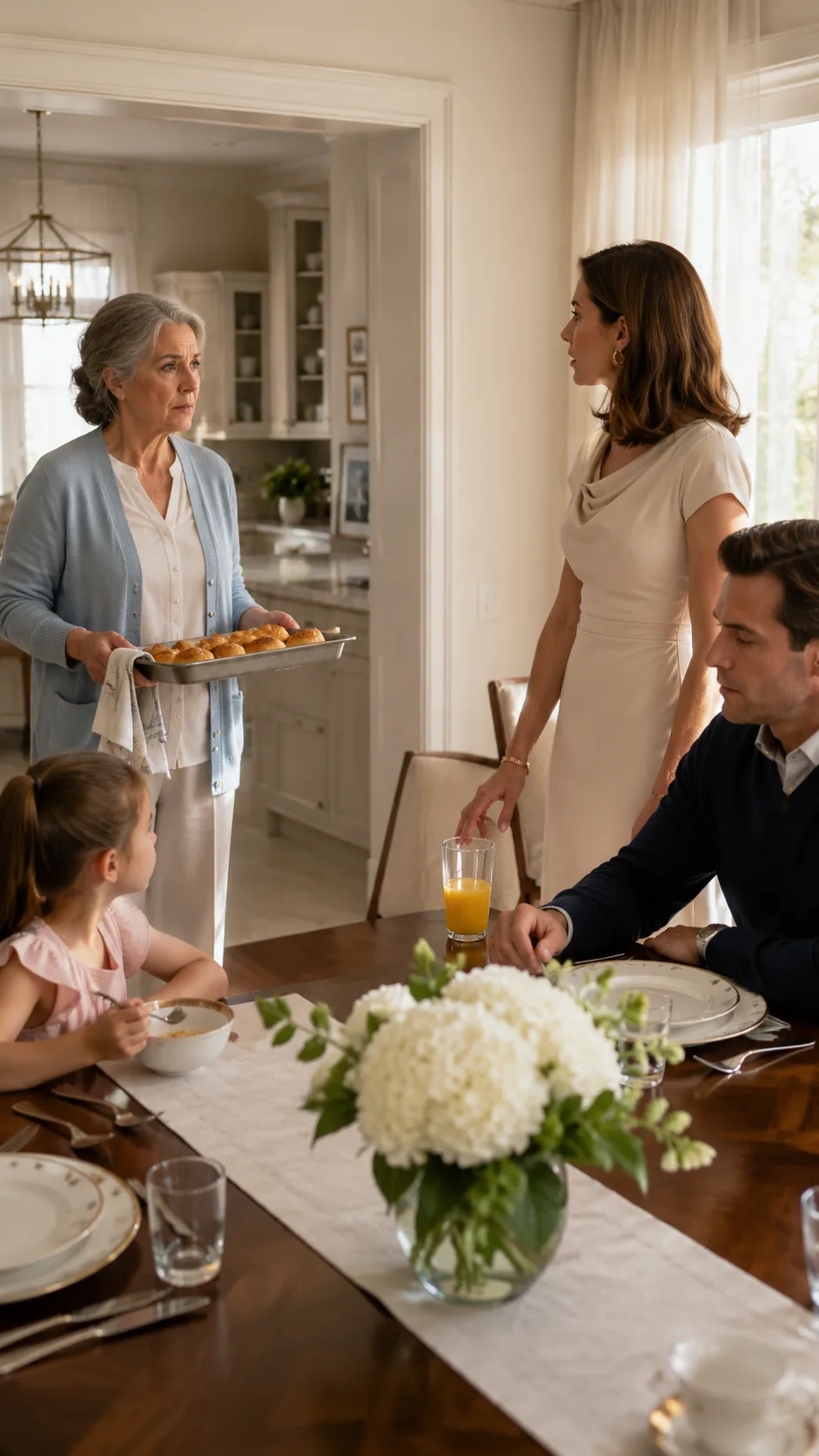
Claire stood in the middle of her bright living room, surrounded by white flowers, polished furniture, and neighbors who had come expecting cinnamon rolls and small talk. Instead, they were watching the life she had presented so carefully begin to split open.
She stared at the photograph in my hand.
My old blue house.
The house where she learned to ride a bike in the driveway.
The house where I measured her height on the pantry wall every birthday.
The house I sold so she could stand under these tall windows and tell people hard work had paid for everything.
“Mom,” Claire whispered. “Please.”
That word did something to me.
Please.
She had used it when she needed money.
Used it when she needed childcare.
Used it when she wanted me to move in.
But now, for the first time, please did not mean help me.
It meant stop telling
the truth.
I lowered the photograph.
“No, Claire.”
Her eyes filled, but she blinked hard, fighting the tears like they were another imperfection in the room.
Mark’s boss quietly set his plate down. The school board president murmured something about giving the family privacy. One by one, guests slipped out, taking their coats, their uncomfortable faces, and their new knowledge with them.
Patricia was the last guest standing.
She looked at Mark.
“You told us you handled the house yourself.”
Mark rubbed a hand over his mouth.
“I wanted you to be proud.”
Patricia’s face tightened. “At her expense?”
He said nothing.
Claire suddenly turned on him. “Don’t act like this is only me. You liked having her here. You liked clean shirts and free childcare and my mother covering what you couldn’t.”
Mark flinched.
“Claire,” he said quietly, “you made the list.”
“And you used it.”
That was the
second crack.
For months, I had thought Claire alone had built the cage around me. But Mark had stood beside it, comfortable, silent, benefiting from every bar.
Lily looked between her parents.
“Why didn’t anybody say thank you?” she asked.
No adult answered.
Because children have a way of asking the questions shame cannot survive.
Claire covered her mouth.
I knelt in front of Lily and Noah.
“I need you both to hear me,” I said. “Grandma helped because she loves you. You did nothing wrong.”
Noah’s little lip shook. “Are you leaving?”
My heart folded.
I glanced at Claire.
She looked terrified now.
Not because of the house.
Because the children were watching her become someone she did not want them to remember.
“I’m leaving tonight,” I said softly. “But I am not leaving you.”
Lily burst into tears.
Claire stepped forward. “Mom, don’t do this to them.”
I
stood slowly.
“Do not put this on me,” I said. “I stayed in a windowless room for three months so your children would not feel the tension in this house.”
Claire whispered, “I was overwhelmed.”
“I know.”
“I had bills. Mark’s income dropped. The school fees, the neighborhood, your medical scare—”
She stopped.
I froze.
“What medical scare?”
Claire’s face changed.
Mark looked away.
I turned fully toward her. “Claire.”
Her voice fell. “I saw a message on your phone once. From the clinic. I thought… I thought if I asked, everything would get harder.”
I stared at my daughter.
“You knew I was having tests?”
Tears spilled down her cheeks now.
“I didn’t know what they were for.”
“But you knew I was scared.”
She pressed both hands to her mouth.
“I couldn’t handle one more thing.”
That was the third crack.
And somehow, it hurt worse than the chores.
She had not missed my pain.
She had chosen not to look at it.
I nodded slowly, because if I spoke too quickly, my voice would break into pieces.
“I was waiting for biopsy results,” I said. “They came back clear.”
Claire sobbed once, hand still over her mouth.
“You never told me.”
“I tried,” I said. “You handed me the laundry list and asked if dinner could be low-carb.”
She bent forward like the words had struck her in the chest.
“Mom…”
“No,” I said. “Listen. I gave you money, time, labor, silence, and finally my home. But the one thing I should never have given you was permission to forget I was human.”
Mark lowered his head.
Patricia wiped her eyes.
Claire sank onto the sofa.
For the first time since I had moved in, she looked smaller than the house.
I walked down the hallway to the laundry room and opened the door to my little bedroom. My suitcase was already packed. I had packed it that morning before the brunch, before the photograph, before the truth finally stood up inside me.
Claire followed me to the doorway.
“You were really going to leave today?”
“Yes.”
“Even before all this?”
“Yes.”
She looked at the narrow bed. The single lamp. The stack of folded towels on top of my dresser because there was nowhere else to put them.
Her face crumpled completely.
“I put my mother here,” she whispered.
I picked up Lily’s drawings from the nightstand.
Claire took one step into the room and touched the wall like she had never seen it before.
“I told myself it was temporary,” she said.
“You told yourself many things.”
She turned around, crying openly now.
“I hated needing you,” she said. “Every time you helped, I felt like a child again. Like I had failed at being grown. So I made your help look small.”
I listened.
Not because it excused anything.
Because truth matters, even when it arrives late.
“I wanted people to think I built this life,” she continued. “And when you were here, cooking and folding clothes and loving the kids better than I was, I felt exposed.”
I looked at her.
“So you made me invisible.”
Her chin trembled.
“Yes.”
For a moment, I saw the girl she had been at thirteen, furious at being left, furious at being poor, furious at needing a mother who was already exhausted.
But she was not thirteen anymore.
And I was done paying for wounds I did not cause.
“I’m moving into an apartment Martin found,” I said. “It has windows. A balcony. No laundry machines beside the bed.”
Claire gave a broken laugh through tears, then covered her face again.
“Can I fix this?”
I zipped the suitcase.
“Not today.”
Her shoulders dropped.
“But you can start.”
She looked up.
I said, “You will tell Lily and Noah the truth. Not the adult details. Just enough. You will tell them Grandma helped this family and Grandma deserved respect.”
She nodded quickly.
“You will hire help if you need help. You will not call me for emergencies that are not emergencies.”
“I understand.”
“And Sunday dinners,” I said, “if I come, I come as a guest.”
Claire started crying again. “You should have always been one.”
“No,” I said gently. “I should have always been family.”
That broke her.
She stepped toward me, then stopped herself.
“Can I hug you?”
The question nearly undid me.
For years, Claire had taken access to me for granted. My time. My hands. My forgiveness. My body in a kitchen doorway waiting to be useful.
Now she asked.
I nodded.
She came into my arms and cried like a child.
“I’m sorry, Mom,” she whispered. “I’m sorry I made your love feel like a job.”
I held her, but I did not say it was okay.
Because it was not.
Forgiveness is not the same as pretending nothing happened.
That evening, I left the house with my suitcase in one hand and Lily’s drawings in the other. Lily cried on the porch, but I promised I would see her Sunday. Noah gave me his stuffed dinosaur “so I wouldn’t sleep alone.”
Claire stood behind them, eyes swollen, arms wrapped around herself.
As the car pulled away, I looked back at the house.
For a long time, I thought the house was my sacrifice.
But I understood now that the house was only wood, stone, windows, paint.
The real sacrifice had been my silence.
Three months later, I returned for Sunday dinner.
Claire cooked chicken. It was dry. The potatoes were too salty. The salad had too much dressing. But the table was set with five places, and mine was at the center, beside Lily.
No one asked me to serve.
No one asked me to clean.
After dinner, Claire carried the plates herself.
Mark washed them.
Noah gave me back my stuffed dinosaur and said, “You can borrow him only on weekdays.”
I laughed so hard I almost cried.
Then Lily brought me a new drawing.
It was the same big house.
But this time, I was not in the kitchen.
I was sitting at the table with everyone else.
Claire stood behind Lily, nervous.
“She said only you can decide if the picture is fixed,” Claire said.
I studied the drawing.
Then I looked at my daughter.
“It’s not fixed,” I said.
Claire’s face fell.
I touched the paper gently.
“But it’s honest now. That’s where fixing starts.”
Claire nodded, tears shining in her eyes.
I never moved back into that house.
I kept my apartment with the balcony and the morning sun. I bought yellow curtains. I planted basil. I learned the sound of my own quiet again.
And every Sunday, when I visited, Claire opened the door herself.
Not with a list.
Not with a chore.
But with a chair waiting for me at the table.
Because the greatest twist was never that the house belonged to me.
It was that after all those years of teaching my daughter how to receive love, I finally taught her what it costs when you forget to return it.
THE END.
Chapter complete
You have reached the end of this chapter.
Continue reading
A few more worlds to get lost in after this chapter.




