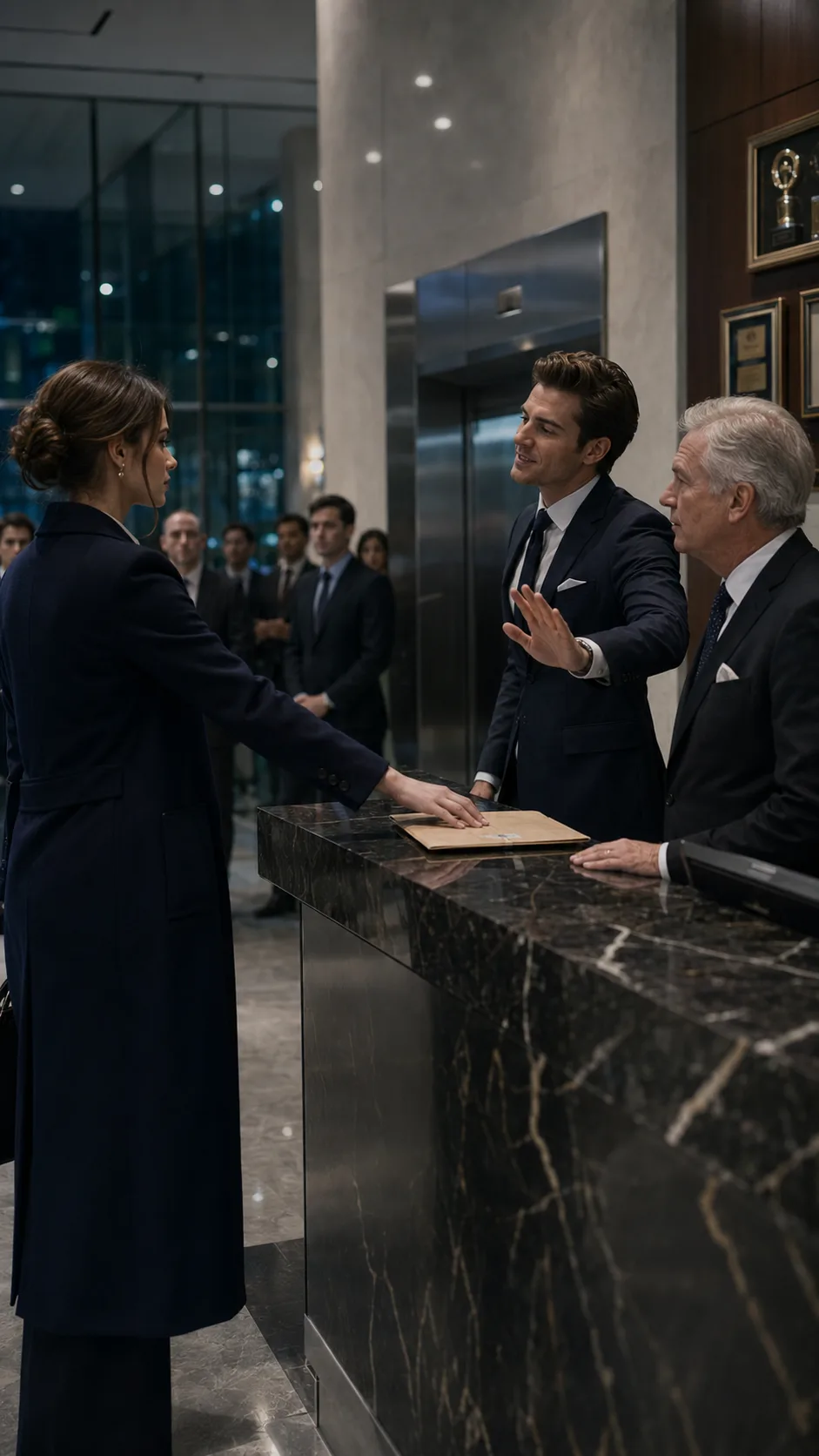
The first thing I noticed was that Marcus had changed the flowers in the lobby.
Chapter 1
The first thing I noticed was that Marcus had changed the flowers in the lobby.
Everline Holdings always kept white lilies near the reception desk, tall and clean and expensive, the kind that made the building smell like money even before the elevator doors opened. That night, someone had replaced them with red roses in black glass vases.
Marcus liked red.
He said it looked decisive.
I stood just inside the revolving doors with rain still clinging to the shoulders of my coat, watching him greet investors under the chandelier lights like a man receiving guests in his own house. His navy suit fit perfectly. His smile did too. Every person who shook his hand leaned in a little, as if proximity to him might turn into protection later.
I had been in that lobby hundreds of times before, but never as someone welcome.
Not really.
For years, I had entered through the side door, signed the visitor log even though my last name was
on the earliest shareholder drafts, and waited beside potted plants while Marcus made me feel like a woman who had wandered into a private club by mistake. He was my cousin by blood, but in public he treated me like a family footnote.
A quiet one.
That night, he saw me before I reached the marble counter.
His smile widened.
A few people followed his gaze. Two investors near the awards wall turned with their champagne glasses still halfway raised. A woman from accounting stopped beside the elevator and pressed her folder against her stomach.
Marcus didn’t come toward me.
He let me walk to him.
That was how he did things. He stood still and made other people cross the distance.
“Evelyn,” he said, as if my name was an inconvenience he had agreed to tolerate. “You picked a dramatic night.”
I shifted the slim brown folder under my
arm. The paper edge pressed against my ribs.
“I picked the night you invited everyone.”
He laughed once. Not loud. Just enough for the people closest to him.
My aunt, Celeste, stood behind him near the reception desk. She was wearing pearls and a black silk dress, her hair pinned into a silver knot. She looked at the folder first, then at me. Her fingers moved over her necklace.
Marcus noticed that too.
He always noticed weakness.
“This is an investor reception,” he said. “Not a family meeting.”
“No,” I said. “That’s why I came.”
His smile held, but his eyes changed.
There it was.
The first crack.
The lobby had been designed to make people lower their voices. Glass walls. Polished stone. A ceiling so high every sound seemed to rise away before it could become argument. Security stood near the elevator. Reception lights glowed along the edge of
the counter. Behind Marcus, the company awards shone inside black frames.
Growth Leader of the Year.
Regional Impact Award.
Family Enterprise Excellence.
My father had hated those awards.
He said plaques were for people who needed walls to remember what they had done.
Marcus loved them.
He had added three in the last year alone.
The year after my father died.
The year after my son’s school account was suddenly “under review.”
The year after a vendor invoice disappeared from the internal system and reappeared with Marcus’s initials on the approval line.
I had not understood the invoice at first. It looked ordinary. Consulting fees. Logistics reimbursement. A quiet number folded into a bigger number. The kind of thing Marcus expected everyone to miss.
Then I saw the beneficiary note.
Not in the public copy.
In the archived version.
My son’s name.
Noah.
Twelve letters in a field Marcus had never expected anyone outside finance to open.
I printed the file at 2:13 in the morning from an office that still smelled like burnt coffee and old carpet glue. I sealed it myself. Then I waited until Marcus gathered enough witnesses to make his own performance useful.
Now he had them.
He just did not know they were mine too.
“Evelyn,” Celeste said, stepping forward. “This is not appropriate.”
Her voice had always been smooth in public. At family dinners, it sharpened around the edges. She had once told me I should stop “using motherhood as leverage” after I asked why Noah’s education fund had been frozen for three months.
Noah was eight then.
He had sat at the far end of the table, pushing peas around his plate with the back of his fork.
Marcus had smiled that night too.
I looked at Celeste now. “You knew.”
Her face stilled.
Marcus turned his head slightly. “Careful.”
One word.
A warning dressed as advice.
Behind him, Mr. Collins stood at the reception counter, tablet in hand. He had managed the front desk since my father’s time. White hair. Dark suit. The kind of man who remembered which visitors took coffee and which ones only pretended to.
He had seen me cry once.
Not in the lobby. Never there.
In the freight hallway behind the old records room, the day after the memorial, when Marcus announced that my father had “left operational authority where it belonged.” I had been carrying a box of photographs. Mr. Collins had walked past with a cart of bottled water, stopped, and handed me a handkerchief without saying a word.
He looked at me now.
I gave him nothing.
Not yet.
Marcus stepped closer, lowering his voice so the room would lean in without meaning to. “You should have called before showing up.”
“I did.”
“To my office.”
“To accounts.”
His jaw moved once.
“Accounts doesn’t answer to you.”
“No,” I said. “Apparently it answers to my son.”
A few heads turned fully this time.
Celeste’s hand dropped from her pearls.
Marcus laughed again, but this one landed wrong. Too flat. Too quick.
“You’re confused.”
I had heard that sentence from him more times than I could count. When I questioned the changed trust schedule. When I asked why Noah’s name had been removed from a beneficiary notice. When I asked why the family foundation had paid a shell vendor registered two blocks from Marcus’s apartment.
You’re confused.
You’re tired.
You’re grieving.
You’re reading too much into things.
Women like me were always being told we had misunderstood paperwork written by men who hoped we would stop reading.
I adjusted my grip on the folder.
Marcus noticed.
His eyes went to it again.
“What’s in your hand?”
I looked at the awards wall behind him.
My father’s name was on the oldest plaque, half hidden by a newer frame Marcus had placed too close. It was a small thing. Petty. Exact.
“An invoice.”
Marcus blinked.
Celeste said, “For what?”
I looked back at Marcus. “He knows.”
The lobby changed in small ways. A glass lowered. Someone near the elevator stopped scrolling. A security guard shifted his weight and then stopped because he did not know whose authority mattered yet.
Marcus still had his smile.
But now he had to hold it up.
He spread both hands slightly. “If you brought a billing issue to an investor reception, I don’t know whether to be embarrassed for you or concerned.”
“You don’t have to choose.”
His eyes narrowed.
There were people in that room who had known me when I was twelve. People who had watched my father bring me to the office on Saturdays, sitting me at the end of conference tables with colored pencils while he reviewed vendor lists. People who had smiled at Noah at company picnics. People who sent flowers after my father’s funeral and then signed documents Marcus placed in front of them the next week.
Not bad people.
Just careful ones.
Careful people can be useful to men like Marcus.
They look away and call it professionalism.
Marcus lifted one hand toward the exit. “Go home.”
The old version of me might have moved.
Not because I was afraid of him. Because I had been trained to protect the room from discomfort. To smooth things over. To leave before anyone could say I had caused a scene.
Noah had changed that.
Two weeks earlier, he had come home from school with a folded permission slip and a careful face. The school had said his payment arrangement was incomplete again. He had placed the slip on the kitchen table beside his cereal bowl.
“Mom,” he said, “did Grandpa forget me?”
That was the sentence that sent me back into every archived file.
Grandpa had not forgotten him.
Someone else had tried to make it look that way.
I took one step toward the counter.
Marcus’s hand stayed up.
The gesture was casual. Almost lazy. Palm outward. Like I was an employee bringing the wrong form.
“Don’t,” he said.
There it was again.
A smaller word.
A tighter voice.
I kept walking.
The marble counter was cold under my fingertips when I reached it. Mr. Collins stood behind it, his tablet still open, his face giving nothing away.
The folder rested under my palm.
Marcus looked down.
For the first time that night, his smile had to work.
Celeste moved closer. “Marcus, what is she talking about?”
He did not answer her.
He was looking at the seal.
It was plain brown paper, closed with a white label. No logo. No flourish. Just a date, a vendor code, and the internal copy number printed in small black letters.
And below that, in the beneficiary field, the name Marcus had counted on staying buried.
Noah Hale.
My son.
My father’s grandson.
Marcus reached for the folder.
Fast.
Too fast.
I kept my hand where it was.
His fingers stopped an inch from mine.
The room saw that.
Not all of it. Enough.
Mr. Collins looked from Marcus’s hand to mine, then down at the folder.
“Mr. Collins,” I said, “would you read the label?”
Marcus turned to him. “Do not touch that.”
The words came out lower than before.
Not loud.
Worse.
The investor nearest the awards wall set his glass on the windowsill. It clicked once against the stone.
Mr. Collins did not move for a breath.
Then he placed his tablet down.
Marcus’s head snapped toward him.
That was the first time I saw it.
Not panic.
Calculation.
Marcus was running through the room, person by person, deciding who could still be controlled.
Mr. Collins was not on that list.
Not anymore.
“Collins,” Marcus said.
The old man placed one hand on the folder.
I lifted mine.
The folder belonged to the room now.
Mr. Collins turned it slightly toward himself. The white label caught the overhead light. He did not open it. He did not need to. The label was enough to begin the damage.
His eyes moved across the printed line.
Once.
Twice.
The lobby went quiet in sections.
The reception desk first.
Then the elevator bank.
Then the people near the roses.
Celeste stepped forward, but the sound of her heel against the marble made her stop.
Marcus whispered, “Don’t.”
It was not a command this time.
It was a leak.
Mr. Collins looked up.
“Beneficiary reference,” he said.
Marcus’s hand closed into a fist.
Mr. Collins continued, each word clean enough to cut glass. “Noah Hale.”
Nobody moved.
A woman from accounting pressed her lips together and looked down at the floor.
The investor by the window turned slowly toward Marcus.
Celeste’s face had gone pale beneath her makeup. She looked at Marcus the way people look at a door they had locked from the wrong side.
Marcus reached for the folder again.
A security guard stepped forward, then stopped because Mr. Collins lifted one hand.
Just one.
The guard stayed where he was.
That small movement did more than any speech could have.
Marcus saw it.
Everyone saw it.
He was no longer the center of the room.
He was only standing there.
“What exactly,” Mr. Collins said, “is this invoice doing under your approval chain?”
Marcus stared at him.
No answer came.
I watched his throat move.
For three months, I had imagined that I would speak when this moment came. I thought I would list every transfer, every changed entry, every night I stayed awake matching numbers while Noah slept down the hall with his stuffed dinosaur tucked under one arm. I thought I would finally tell Marcus what he had taken.
But the room did not need my speech.
The paper was doing its job.
I reached into my coat pocket and took out the second sheet.
Not sealed.
Not hidden.
Just folded once.
Marcus’s eyes dropped to it.
He knew before anyone else did.
That was the real proof. Not the invoice. Not the label. His face.
I unfolded the page and placed it beside the folder.
“This is the archived copy,” I said.
My voice sounded smaller than the lobby, but it reached.
“The copy before your revision.”
Celeste touched the counter with one hand.
Marcus said, “That is internal material.”
“No,” I said. “It is family material.”
His mouth tightened.
“You had no right to access that.”
I looked at him then. Really looked.
“You had no right to erase my son.”
The sentence landed against the glass walls and stayed there.
A man near the elevator lowered his phone completely.
Mr. Collins turned the archived page toward the nearest investor. “The approval line was changed.”
Marcus stepped forward. “Enough.”
The word had always worked for him.
It did not work there.
Mr. Collins did not move back.
Neither did I.
The investor by the window leaned in, reading the visible line. “Why is the child’s name in the original file?”
Marcus turned to him with a smile that did not belong on his face anymore. “A clerical issue.”
The accounting woman spoke before she could stop herself. “That field doesn’t auto-fill.”
Marcus looked at her.
She looked down.
But she did not take it back.
That was the second crack.
The room was learning it had a voice.
Celeste’s fingers trembled once against the marble. She pulled them into a fist. “Marcus.”
He did not look at her.
He was still trying to find the exit inside the situation.
“I will not discuss confidential records in a lobby,” he said.
“You brought the lobby,” I said.
His eyes cut to mine.
For a second, I saw the cousin I had grown up with. The boy who hated losing card games so much he would change the rules halfway through. The teenager who laughed when my father corrected him, then repeated the corrected answer later as if he had known it first. The man who learned that charm could cover a missing conscience if the room was polished enough.
He leaned toward me.
“This company survived because I knew how to make hard decisions.”
“No,” I said. “It survived because my father trusted the wrong people slowly.”
Celeste made a sound, small and sharp.
Marcus’s face changed.
Not much. Just enough to show the hit had landed somewhere he kept covered.
Mr. Collins opened the folder.
The paper seal tore with a soft sound.
No one spoke.
Inside were three pages. Invoice copy. Approval chain. Payment routing.
And at the back, the memo my father had attached before his final hospital stay.
Marcus had not known about the memo.
I knew because his hand went slack.
Mr. Collins lifted it carefully.
The paper was thin. Slightly yellow at the edge. My father had always printed important notes instead of trusting screens. He said screens could be changed by men with too many passwords.
Mr. Collins read the first line silently.
Then he looked at me.
I nodded.
He read aloud.
“Education and legacy reserve for Noah Hale, to remain untouched unless authorized by Evelyn Hale.”
Celeste sat down on the edge of the reception chair behind her.
No one offered her water.
Marcus stared at the paper.
His lips parted.
Nothing came out.
I had waited for that silence longer than I knew.
Not the silence of being ignored. Not the silence of men talking over me. Not the silence at family dinners when everyone knew something was wrong and chose dessert instead.
This silence belonged to him.
Mr. Collins placed the memo beside the invoice.
The three pages sat under the lobby lights like plain objects.
No gold frame.
No plaque.
No performance.
Just paper.
Marcus reached for his phone.
The security guard took one step closer.
Marcus stopped.
It was small.
Almost nothing.
But it told the room where power had moved.
The investor by the window turned to the others. “We need the finance committee.”
Marcus laughed once, but it broke halfway through. “You’re taking her word?”
Mr. Collins looked at the folder. “No.”
He tapped the memo with two fingers.
“We’re taking his.”
My father’s words stayed on the counter between us.
For the first time all night, Marcus looked at the awards wall.
The old plaque with my father’s name caught a strip of white light. The newer frame beside it tilted slightly, one corner lower than the other. I had noticed it when I walked in.
Now Marcus noticed too.
He stared at it like it had betrayed him.
Celeste stood slowly. “Marcus, tell me this is not what it looks like.”
He turned on her. “You knew enough.”
The sentence came out before he could dress it.
Celeste went still.
There it was.
The part he could not recover.
Not a confession. Not complete. But enough.
A woman behind me inhaled sharply through her nose. The sound vanished almost immediately, but Marcus heard it.
He looked around.
Every face had shifted.
No one was smiling with him now.
I picked up the archived copy and folded it once. My hands were steady. I had expected them not to be.
Mr. Collins gathered the other pages and placed them back in the folder.
“I’ll hold these at reception until the committee arrives,” he said.
Marcus stared at him. “You work for this company.”
Mr. Collins closed the folder. “I worked for its founder first.”
The lobby did not clap. No one gasped. No one rushed toward me with apologies.
Real rooms do not always give you that.
Sometimes they only stop lying.
That was enough.
Marcus stepped back from the counter.
Half a step.
His heel struck the base of the awards wall. One of the black frames rattled softly behind him.
He looked at me then, really looked, and for once there was no easy category ready for me. Not grieving daughter. Not inconvenient cousin. Not single mother. Not woman who would leave if the room became too cold.
Just Evelyn.
The person he should have counted.
“Evelyn,” he said.
My name sounded different in his mouth now.
I picked up my wet coat sleeve from the counter so it would not leave a mark.
“Noah asked if Grandpa forgot him,” I said.
Marcus blinked.
I let the sentence sit there.
Then I turned to Mr. Collins. “Please make a copy for my attorney.”
Marcus flinched at the word, but no one moved to protect him from it.
Celeste covered her mouth with one hand. Her pearls shifted against her throat.
I did not look at her again.
The elevator opened behind us with a clean silver chime. Nobody stepped in. Nobody stepped out.
For a few seconds, the lobby simply held itself together.
Then people began moving carefully, as if sudden motion might damage the truth. The accounting woman walked toward Mr. Collins. The investor by the window made a call in a low voice. One security guard moved away from the elevator and stood near the reception desk instead.
Marcus stayed by the awards wall.
The red roses beside him looked darker now.
I walked out through the revolving doors with the archived copy in my hand.
The rain had stopped.
The city pavement shone under the streetlights, black and silver, every passing car leaving a thin ribbon of reflected light behind it. I stood beneath the awning and called Noah’s babysitter first. Practical things. Always practical things.
He was asleep, she said.
He had left his dinosaur on the couch again.
I thanked her and ended the call.
Only then did I look back through the glass.
Inside, Marcus was still in the lobby.
But he was no longer standing at the center of anything.
Two weeks later, Everline Holdings announced an internal review of vendor payments and reserve accounts. The statement used careful language. Companies always do. Irregularities. Oversight. Temporary reassignment of responsibilities.
Marcus’s name did not appear in the announcement.
That was how I knew it was serious.
Celeste called me three times before leaving a message. I listened to half of it while packing Noah’s lunch. Her voice was smaller than I remembered. She said she had not known everything. She said family should not be broken over paperwork.
I deleted the message before she finished.
Some papers are not just papers.
Some papers are doors.
By the end of the month, Noah’s education reserve was restored. The committee created an independent trustee position and offered it to me. Marcus resigned from daily operations “to pursue private opportunities,” which was the kind of sentence rich men received when no one wanted to print what really happened.
I did not celebrate.
I took Noah to the old office on a Saturday.
The lobby flowers were white lilies again.
Mr. Collins met us at the reception desk with two visitor badges, even though he knew we did not need them anymore. Noah looked up at the awards wall, swinging his backpack against one leg.
“Was Grandpa here a lot?” he asked.
“Yes,” I said.
Mr. Collins pointed to the oldest plaque. “He hated that one.”
Noah laughed.
The sound moved through the lobby easily.
No one stopped it.
I looked at the marble counter where the invoice had landed. There was no mark there. No trace of the night the room had gone quiet. Just polished stone and a bowl of wrapped mints and Mr. Collins’s tablet glowing beside the lilies.
Noah reached for my hand.
I took it.
We walked past the reception desk, not toward the side hallway, not toward the waiting chairs, but straight to the elevators.
This time, no one asked me to sign in.
The doors opened.
Noah stepped inside first.
I followed.
And the lobby let us go up.
Chapter complete
You have reached the end of this chapter.
Continue reading
A few more worlds to get lost in after this chapter.