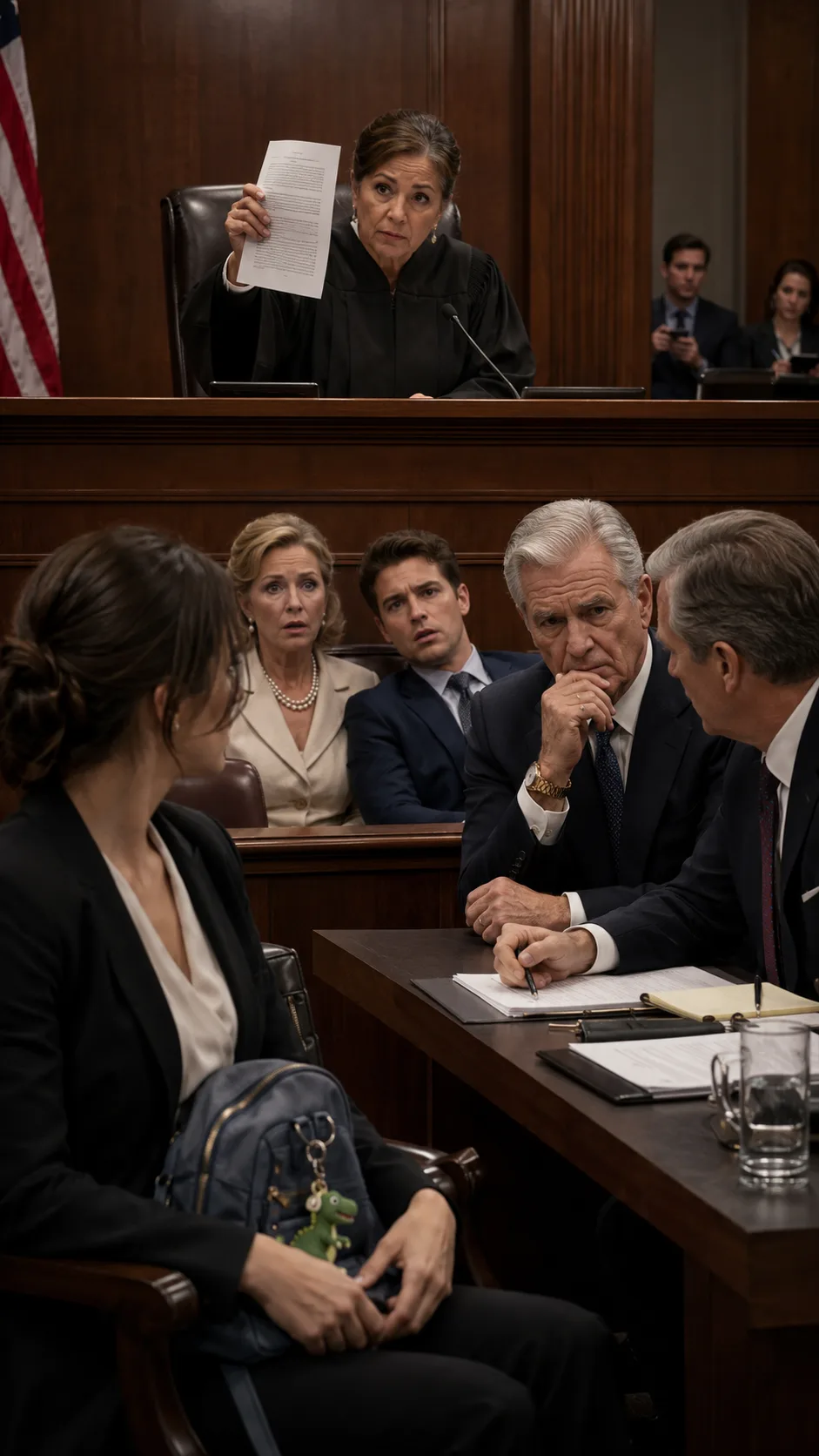
My Brother Smiled At My Custody Hearing Until One Hidden Court File Destroyed My Wealthy Family In Front Of Everyone
I knew my son was safe because his backpack was in my lap.
Chapter 1
I knew my son was safe because his backpack was in my lap.
That was what I kept telling myself in the courthouse hallway at 9:13 that morning, while the fluorescent lights hummed above my head and the lemon disinfectant burned through the smell of old paper, rain-damp wool, and coffee that had been sitting too long on a cart near the elevators.
Noah was not there.
He was seven years old, probably sitting at his second-grade desk with one sneaker untied, drawing dinosaurs in the margins of his math worksheet because numbers never held his attention for long unless I turned them into stories. He was supposed to be worrying about spelling words, lunch trades, and whether the class turtle was really asleep or just pretending.
He was not supposed to know that across town, his mother’s family had dressed in designer suits and pearls to argue that he should be taken from her.
I pressed his backpack harder against my stomach.
The blue fabric was worn at the bottom corner where Noah dragged it along the sidewalk no matter how many times I told him not to. A yellow pencil stuck halfway out of the front pocket. A green dinosaur keychain hung from the zipper, bobbing slightly every time my hand shook.
He had clipped it there himself.
“For protection,” he had said.
I had laughed then.
I was not laughing now.
Across the hall, my brother Daniel Cross stood near the courtroom doors with one shoulder against the wall, as if this were a private club and not a family court. He wore a navy suit cut so perfectly it made everyone else look unfinished. His hair was smooth, his shoes polished, his face relaxed in that polished Cross-family way that meant someone else was about to suffer.
Daniel had always looked best right before he did something cruel.
As
children, he had broken things and waited for me to apologize. He had lied with a steady voice and cried only when our mother was watching. He had learned very early that charm was not kindness. It was a weapon.
That morning, he looked at me like he had already won.
My parents sat behind him on a wooden bench: Richard and Pauline Cross. My father had his legs crossed, one hand resting over the face of his gold watch. He looked bored. Not nervous. Not ashamed. Bored, as if the possible loss of my son were a long board meeting he had agreed to attend because people expected it of him.
My mother sat beside him in a cream suit and pearls, every strand of hair pinned into place. She smiled at every person who recognized her. A city councilman’s wife passed by and squeezed her hand. A reporter
nodded politely at my father. Someone whispered the Cross name and looked toward us.
People in Austin knew the public version of my family.
They knew the buildings my father’s construction company had paid for. They knew the hospital wing with my mother’s name on a bronze plaque. They knew the charity lunches, the foundation dinners, the scholarship galas, the photographs where Richard Cross stood in the center and Pauline Cross smiled as if grace had been stitched into her skin.
They did not know what happened when the doors closed.
They did not know that my mother could lower her voice until it became a needle.
They did not know that my father never raised his hand because he had discovered something more efficient. Money. Silence. Fear. The kind of control that left no bruise anyone else could see.
Daniel pushed off the wall.
He crossed the hallway slowly, one hand in his pocket. His cologne reached me first, sharp and expensive. I looked down at Noah’s backpack. I did not want to give him the satisfaction of my eyes.
He stopped close enough that the cuff of his jacket almost brushed my shoulder.
“Elena,” he said.
I kept my fingers around the backpack strap.
He leaned in. His voice dropped until only I could hear it.
“I can’t wait to see your face when we take your son away.”
The zipper charm tapped my wrist once.
I did not answer.
Daniel’s smile widened, not because he had hurt me, but because I had not shown him how much.
Behind him, my mother shifted on the bench. The pearls at her throat clicked softly as she adjusted them. She leaned forward with a gentle social smile still fixed on her face, the kind she used at hospital fundraisers when she was asking women to write checks.
“Get ready to be publicly humiliated,” she said.
Then she leaned back.
My father did not look up from his watch.
The court doors opened before I could breathe.
“All rise when called,” the bailiff said from inside, but his voice was swallowed by the hallway movement.
My attorney, Marisol Grant, stood beside me and placed one hand on the table edge near my chair, not touching me, not comforting me, simply there. She was in a charcoal suit, hair pulled back, leather folder tucked under one arm. Nothing about her looked rushed.
That frightened my family more than if she had shouted.
Marisol had spent six weeks listening to me give her the pieces of a life I had tried hard not to examine too closely. Voicemails. Text messages. School forms. Bank statements. The custody petition. The private school contract my father had slid across my kitchen table two months earlier with a pen placed neatly on top.
She had read everything.
She had asked almost no emotional questions.
Only useful ones.
“Did he say that in writing?”
“Do you still have the voicemail?”
“Who witnessed the visit?”
“Did they put the school offer into a document?”
“Did your father insist on decision-making authority?”
At the time, each question had felt small. Dry. Legal. Almost cold.
Now she stood beside me like someone who had spent the night building a wall out of paper, and my family had no idea they were about to run into it.
“Elena,” she said.
I looked up.
“Bring the backpack.”
So I did.
I walked into the courtroom holding the only thing in that building that belonged to Noah.
The room was colder than the hallway. Wood paneling climbed the walls. A faded flag stood behind the bench. The seal above the judge’s chair promised justice in gold letters, though I had learned that promises painted on walls did not guarantee much.
Two reporters sat in the back row.
Of course they did.
Anything involving the Cross family attracted attention. My father had spent thirty years building towers, libraries, event centers, and connections. My mother had spent the same thirty years turning philanthropy into armor. They had friends who could get dinner reservations, zoning exceptions, and newspaper coverage by noon.
I had a mortgage, a remote job, a seven-year-old, and a file folder of receipts.
Howard Linton, my parents’ attorney, stood at their table arranging documents into perfect stacks. He was silver-haired, smooth-voiced, and expensive in the way some people are expensive before they speak. He glanced at me once and then looked away, already treating me like a legal inconvenience.
My parents sat behind him.
Daniel sat just to their side, his ankle crossed over his knee, one hand resting near his phone. He looked at me across the aisle and mouthed a word.
Ready?
I set Noah’s backpack beside my chair.
The dinosaur keychain faced the room.
Judge Evelyn Ramirez entered through the side door.
Everyone stood.
She was in her early sixties, with gray threaded through dark hair and eyes that did not drift. Some judges look tired before hearings begin. Some look impatient. Judge Ramirez looked awake. She looked at Howard, then at Marisol, then at my parents, then at me. Not warmly. Not unkindly. Carefully.
That gave me the first solid thing I had felt all morning.
We sat.
Howard rose first.
“Your Honor,” he began, buttoning his jacket, “this is a painful matter for everyone involved.”
Painful.
My mother looked down at her clasped hands.
Daniel lowered his eyes like a dutiful uncle.
My father stared at the bench.
They were good at this.
They had always been good at presenting cruelty with clean fingernails.
Howard spoke for almost fifteen minutes. He called my relationship with my family “strained.” He called my boundaries “hostility.” He called my refusal to accept financial conditions “instability.” He mentioned that my parents had offered to pay for Noah’s education, then paused long enough for the offer to sound generous.
He did not mention the contract.
He did not mention the paragraph requiring “shared educational authority.”
He did not mention my father’s note in the margin: “This is not optional.”
Howard held up a page.
“Ms. Cross has repeatedly isolated Noah from family resources,” he said. “She has rejected stable support. She has created unnecessary barriers. She has demonstrated a pattern of emotional volatility.”
Emotional volatility.
I looked at my hands.
My fingernails had left crescent marks in my palms.
Across the aisle, Daniel watched me closely. He wanted me to crack. I could feel him waiting for it. One tear, one raised voice, one tremor in my answer that Howard could point to and label unstable.
I gave them nothing.
Not because I felt calm.
Because Noah’s dinosaur keychain was staring at me from the floor beside my chair.
Daniel took the stand first.
He swore to tell the truth with the same face he used when lying to our mother about who had smashed the glass angel from her mantel when we were children.
Howard approached him gently.
“Mr. Cross, do you love your nephew?”
Daniel placed one hand over his chest. Not too much. Just enough.
“Very much.”
“And what concerns do you have about Elena’s ability to raise him?”
Daniel looked down.
He let the silence work for him.
“Elena has always been difficult,” he said. “She shuts people out. She refuses help. She makes decisions based on pride instead of what’s best for Noah.”
The words landed in the room like polished stones.
Not loud.
Heavy.
Howard nodded.
“Can you give the court an example?”
Daniel did.
He gave several.
He talked about the night Noah had the flu and I refused to bring him to my parents’ anniversary dinner. He did not say Noah’s temperature was 102. He talked about my refusal to let Pauline take Noah for an unsupervised weekend after my mother had driven him across town without telling me where they were going. He did not say I had called four times before she answered.
He talked about my father’s offer to enroll Noah in St. Bartholomew’s Academy.
He smiled faintly then.
“It’s one of the best schools in the state,” Daniel said. “My parents only wanted to help.”
My mother pressed a tissue to the corner of one eye.
She had not cried.
The tissue was for the room.
Marisol rose for cross-examination.
She did not carry a stack of papers. She carried one legal pad.
“Mr. Cross,” she said, “how many times have you picked Noah up from school?”
Daniel blinked.
“What?”
“How many times?”
He shifted in the chair. “That is not really—”
“Your attorney described you as part of Noah’s support system. How many school pickups?”
Daniel glanced at Howard.
Howard stood. “Objection. Relevance.”
“Overruled,” Judge Ramirez said.
Daniel’s jaw flexed. “I don’t know.”
“More than five?”
He looked at the judge. “No.”
“More than two?”
His mouth tightened.
“No.”
Marisol wrote something down.
“How many pediatric appointments have you attended?”
Daniel leaned back. “I have a demanding career.”
“That was not my question.”
“No.”
“How many parent-teacher conferences?”
“No.”
“How many nights has Noah slept at your home?”
Daniel looked toward my parents.
“One,” he said.
“Was Elena present?”
“Yes.”
Marisol nodded.
“And yet you testified that Noah is paying the price for Elena’s lack of support.”
Daniel’s fingers curled around the arm of the witness chair.
“I know what I’ve seen.”
“What you have seen,” Marisol said, “appears to be mostly family dinners Elena declined.”
A tiny sound moved through the gallery.
Daniel’s face changed.
Not much.
Enough.
Pauline took the stand next.
My mother knew how to enter a room even when she was already inside it. She adjusted her jacket before sitting. She placed her purse at her feet. She clasped her hands, careful to let the wedding ring show.
Howard’s voice softened for her.
“Mrs. Cross, what do you want for your grandson?”
My mother looked toward the judge.
“We want him surrounded by family,” she said. “We want him to have opportunities. Stability. Tradition. Elena has kept him from us in ways that are punitive and unnecessary.”
Her voice trembled on the last word.
I remembered that voice telling me, when I was sixteen, that scholarships were embarrassing because they made us look needy.
I remembered that same voice telling me after Noah was born that single mothers had to work twice as hard to look respectable.
I remembered her standing in my kitchen, opening Noah’s lunchbox, and saying, “You pack like someone who has accepted mediocrity.”
Howard asked about visits.
Pauline said I had denied them.
He asked about holidays.
Pauline said I had made them difficult.
He asked whether she believed Noah would benefit from more time with the Cross family.
My mother closed her eyes for half a second.
“Yes,” she said. “I believe that child deserves better than being used as a weapon.”
The room went quiet.
I felt Marisol move beside me.
She stood.
“Mrs. Cross,” she said, “has Elena ever harmed Noah?”
My mother’s face tightened.
“No.”
“Has Child Protective Services ever opened an investigation into Elena?”
“No.”
“Has Noah’s school reported concerns about neglect?”
“No.”
“Has his pediatrician?”
“No.”
“Is Noah fed?”
“Yes.”
“Clothed?”
“Yes.”
“Attending school?”
“Yes.”
“Doing well?”
Pauline looked at me.
I did not look away.
“Yes.”
Marisol let the word sit.
Then she asked, “So your concern is not that Noah is unsafe with his mother.”
Pauline’s mouth opened.
Closed.
Howard leaned forward.
My father stopped looking bored.
“My concern,” my mother said, each word careful now, “is that Elena has cut him off from his family.”
“There it is,” Marisol said.
Howard stood halfway. “Your Honor—”
“I heard the answer,” Judge Ramirez said.
Marisol turned one page on her legal pad.
“Mrs. Cross, do you recognize this transcript?”
Howard was on his feet before my mother could answer.
“Objection. We have not established—”
“It was included in the respondent’s exhibits,” Marisol said.
Judge Ramirez looked at Howard. “Sit down, Mr. Linton.”
Howard sat.
My mother’s fingers tightened around the edge of the witness stand as Marisol handed a page to the bailiff, who passed it to the judge.
“Mrs. Cross,” Marisol said, “on March 12, did you leave Elena a voicemail stating, ‘Family always wins in the end’?”
My mother’s face went pale under her makeup.
“I don’t recall the exact wording.”
“Did you leave the voicemail?”
“I may have.”
“Did you also say, ‘You cannot keep what belongs to us’?”
My father looked at her.
Daniel looked at his phone.
My mother did not answer quickly enough.
The reporters in the back began writing.
“Mrs. Cross,” Judge Ramirez said.
My mother swallowed.
“Yes.”
Marisol took the transcript back.
“No further questions.”
My father testified last.
Richard Cross did not pretend to be wounded. That was not his style. He performed certainty. He sat in the witness chair as if it belonged to him, one hand resting on his knee, chin slightly raised.
Howard guided him through the public version of himself.
Company founder.
Community donor.
Grandfather.
Man of discipline.
Man of values.
“Noah needs structure,” my father said. “He needs a proper foundation. Elena has always had trouble respecting authority. She takes any boundary as an attack.”
Any boundary.
I looked at the man who had once told me he would “review” my bank statements after Noah was born because I had clearly shown poor judgment by getting pregnant before marriage.
Marisol approached him with the same calm she had used on everyone else.
“What values does your family stand for, Mr. Cross?”
He seemed almost amused.
“Responsibility. Stability. Accountability.”
Marisol wrote each word down.
“Accountability,” she repeated.
“Yes.”
She nodded.
“No further questions at this time.”
At this time.
Howard noticed it.
His head turned slightly.
My father did too.
For the first time all morning, Daniel stopped smirking.
Howard returned to his table and gathered the petition documents, financial summaries, school brochures, and selected messages they had prepared to make me look ungrateful, unstable, and alone. He stacked them neatly and set them before the judge.
He looked at me as he did it.
Not with anger.
With pity.
That was worse.
My mother sat behind him, smoothing her skirt. My father whispered something to Daniel. Daniel smiled again, smaller than before but still there.
Across from them, Marisol opened her folder.
It was dark blue.
Nothing about it looked special.
Judge Ramirez reviewed Howard’s documents first. She turned one page. Then another. The room settled into a silence so complete that I could hear the tiny click of Noah’s dinosaur keychain against the metal zipper.
I reached down and held it still.
Judge Ramirez continued reading.
Howard’s expression relaxed.
My father glanced at his watch.
Daniel leaned back.
Then Judge Ramirez stopped.
One page sat between her fingers.
Her eyes narrowed.
Marisol did not move.
Howard noticed that she did not move.
That was the first crack.
Judge Ramirez lifted the page slightly.
“Before we proceed,” she said, “I have one question.”
The air changed.
Not loudly.
Like a door sealing shut.
Howard rose. “Of course, Your Honor.”
Judge Ramirez looked over her glasses at him.
“Mr. Linton, I am looking at the financial disclosure forms submitted by your clients, Richard and Pauline Cross.”
“Yes, Your Honor.”
“And I am also looking at Exhibit G, submitted by Ms. Grant.”
Howard’s eyes flicked toward Marisol.
“A series of bank records,” the judge said.
My father’s hand moved from his watch to the table.
Only an inch.
But I saw it.
So did Marisol.
Judge Ramirez turned her gaze toward him.
“Mr. Cross, you testified about the values your family stands for. Responsibility. Stability. Accountability. You emphasized that Noah needs a proper foundation.”
My father sat straighter.
“That is correct, Your Honor.”
Judge Ramirez held up the page.
“Then explain to this court why, for the past four years, funds connected to your family trust appear to have moved through a shell corporation registered in the Cayman Islands before being transferred to an off-the-books gambling operation in Nevada.”
No one breathed.
The sentence did not land all at once.
It moved through the courtroom piece by piece.
Family trust.
Shell corporation.
Cayman Islands.
Gambling operation.
Nevada.
My mother’s hand flew to her pearls.
Daniel sat forward.
Howard turned toward my father so sharply his pen slid off the table and hit the floor.
The reporters in the back row leaned in.
My father did not speak.
For the first time in my life, Richard Cross had no sentence ready.
Howard recovered first.
“Objection,” he said, but his voice came out too fast. “Irrelevant. This is a custody matter, Your Honor.”
Judge Ramirez did not blink.
“Overruled.”
“Your Honor, with respect—”
“Mr. Linton, your clients have placed their moral character, financial stability, and family environment at the center of their petition. They cannot ask this court to treat them as the safer home while hiding conduct that may expose that home to federal investigation.”
Federal.
My mother made a small sound.
Daniel whispered, “What?”
Not to anyone.
Just into the space in front of him.
Judge Ramirez looked back at the document.
“Ms. Grant.”
Marisol stood.
“Your Honor, Exhibit G contains bank records, corporate registration documents, and transfer summaries obtained through lawful investigation and public filings. The pattern suggests that Richard Cross has used a Cayman-registered entity to move substantial funds into an illegal gambling network.”
Howard stared at my father.
That was when I understood something.
He had not known.
My father had lied to his own lawyer.
Marisol continued.
“We are not asking this court to try a financial crime today. We are asking the court to consider whether the petitioners’ argument is built on a false representation of stability and character. They have claimed Elena Cross is financially reckless, socially isolating, and morally unfit. In reality, she has maintained her home, paid her bills, managed Noah’s schooling, and shielded him from people using access as leverage.”
My father’s face had lost its color.
He looked suddenly smaller in his tailored suit.
Marisol picked up another page.
“There is more.”
Howard’s head snapped toward her.
My mother’s fingers dug into the pearls at her throat.
“The private school offer,” Marisol said. “The one repeatedly presented today as evidence of generosity. St. Bartholomew’s Academy received a significant investment from the same Cayman entity. Enrollment would have allowed the petitioners to move additional funds through tuition commitments, board donations, and foundation pledges.”
My mother whispered my father’s name.
He did not look at her.
Daniel’s mouth opened, then closed.
The smugness was gone.
Nothing replaced it.
Judge Ramirez’s expression hardened.
“So the offer to pay for Noah’s education may have served a financial purpose unrelated to the child.”
“That is our concern, Your Honor,” Marisol said.
Howard stood again, slower this time.
“Your Honor, I need time to confer with my clients.”
Judge Ramirez looked at him.
“You may confer after I rule on the petition before me.”
My father finally spoke.
“Your Honor, these are allegations.”
His voice did not sound like him.
Judge Ramirez looked down from the bench.
“They are documented concerns, Mr. Cross. You invited this court to examine the family foundation you claim to provide. I am examining it.”
A woman in the back row lowered her pen.
Daniel looked at me then.
Really looked.
Not as a brother. Not as a man who had known me since childhood. As someone realizing the person he had mocked in the hallway had walked into court with more than silence.
I did not smile.
I did not move.
I held Noah’s backpack.
Judge Ramirez placed Exhibit G on top of the file.
“This court finds no evidence that Elena Cross has neglected, harmed, endangered, or failed her son. The court further finds that the petitioners’ argument rests primarily on their desire for access and control, not on the child’s safety.”
My mother shook her head once.
“No,” she said.
The judge looked at her.
“Mrs. Cross, you will not interrupt.”
My mother closed her mouth.
Judge Ramirez continued.
“The petition for custody modification is denied.”
The gavel did not fall yet.
That somehow made it worse for them.
“In addition,” the judge said, “given the documented pattern of coercive contact, threatening voicemail messages, and attempts to leverage financial support for parental authority, I am issuing a protective order. Richard Cross, Pauline Cross, and Daniel Cross are to have no contact with Elena Cross or Noah Cross unless modified by further order of this court.”
Daniel stood halfway.
“What? I didn’t—”
“Sit down,” the bailiff said.
Daniel sat.
His face flushed dark red.
Judge Ramirez looked at him until he lowered his eyes.
“Any violation will carry consequences,” she said. “Do you understand?”
My father’s lips pressed into a thin line.
My mother stared at me as if I had done something vulgar by surviving.
Daniel’s hands shook on his knees.
Howard had both palms flat on the table.
“Yes, Your Honor,” he said.
The gavel came down.
The sound cracked through the courtroom.
“All parties dismissed.”
For a second, no one moved.
Then the reporters moved first.
One stood. Another began typing into a phone. Howard turned on my father, speaking low and fast. My mother reached for my father’s sleeve, but he pulled his arm away. Daniel stood too quickly and knocked his chair back into the bench behind him.
The sound made everyone look.
He hated that.
I picked up Noah’s backpack.
The dinosaur keychain swung once.
Marisol closed her folder. Her face was still professional, but her eyes had softened.
“Go get your son,” she said.
That was when my knees nearly gave out.
Not in the courtroom.
Not in front of them.
I made it through the gate, past the tables, past the benches, past my mother’s frozen stare and Daniel’s open mouth. I made it into the hallway where the lemon disinfectant still cut through everything.
Behind me, my father said my name.
“Elena.”
I stopped.
Not because he had power.
Because for thirty-two years, my body had been trained to stop when Richard Cross spoke.
I turned halfway.
He stood just inside the courtroom doorway, Howard behind him, Pauline at his side, Daniel hovering like a boy who had lost his script.
My father’s face had rearranged itself into something almost gentle.
“We need to talk,” he said.
I looked at his gold watch.
Then at the courtroom behind him.
“No,” I said.
One word.
It fit perfectly.
I walked away before he could find another version of my name to use against me.
Outside, the Austin sun was too bright. It bounced off the courthouse steps and made the sidewalk glare white. I stood at the top for a moment with Noah’s backpack in both hands.
My phone buzzed.
A message from his teacher.
Noah had forgotten his lunchbox in the classroom again. She had added a smiling emoji.
I read it twice.
The normalness of it hit harder than anything that had happened inside.
I typed back with fingers that still did not feel like mine.
I’ll pick it up with him. Thank you.
Marisol came out behind me but did not interrupt. She stood a few steps away, letting the sunlight do what words could not.
Down near the curb, a reporter said my father’s name into a phone.
Another asked Howard whether the federal allegations were connected to the custody petition.
Howard did not answer.
My mother’s voice rose once, sharp and wounded, then disappeared behind the closing doors.
Daniel did not come outside.
I walked to the parking garage.
The backpack bumped against my hip with every step.
At 2:47 p.m., I stood outside Noah’s school.
The bell rang.
Children poured through the doors in bright bursts of noise, sneakers squeaking, backpacks bouncing, lunchboxes swinging against knees. I spotted Noah before he saw me. His hair stuck up at the crown. One shoelace dragged behind him. He was holding a crumpled paper ocean in one hand.
Blue.
All blue.
When he saw me, he ran.
“Mom!”
I crouched just in time.
He crashed into me with both arms around my neck. I held him so tightly he complained into my shoulder.
“Too squishy.”
I loosened my grip.
A little.
He pulled back and looked at the backpack in my hand.
“You brought Dino.”
“I did.”
“Did he protect you?”
I clipped the green dinosaur back onto the zipper and smoothed my thumb over its plastic head.
“Yes,” I said. “He did.”
Noah seemed satisfied with that. He took the backpack from me, slung it over one shoulder, and immediately let it slide halfway down his arm.
“Can we get pancakes for dinner?”
It was not a question he expected to lose.
I looked toward the street, toward the courthouse miles away, toward everything that had tried to reach us and failed.
“Yes,” I said.
He grinned.
On the walk to the car, he told me the class turtle was definitely pretending to sleep because turtles knew more than adults admitted. He told me Mason said oceans could not be purple, but Mason was wrong because nobody owned colors. He told me he had saved half a cookie in his lunchbox but then forgot where he put it.
I listened to every word.
That night, after pancakes and a bath and two dinosaur books, Noah fell asleep with one hand under his pillow and the green keychain on his nightstand.
I stood in his doorway for a long time.
My phone buzzed twice.
Unknown number.
Then another.
Blocked.
Then one email from Howard Linton’s office, formal and stiff, stating that any future communication would go through counsel.
I forwarded it to Marisol and turned the phone face down.
In the kitchen, Noah’s lunchbox sat open on the counter.
The half cookie was inside.
Wrapped in a napkin.
Perfectly intact.
I turned off the light.
The house went quiet.
For the first time in years, the silence belonged to us.
THE END.
Chapter complete
You have reached the end of this chapter.
Continue reading
A few more worlds to get lost in after this chapter.




