The silver spoon beside Grandma’s empty plate was crooked.
Chapter 1
The silver spoon beside Grandma’s empty plate was crooked.
I noticed it before anyone spoke, before the lawyer opened his folder, before my brother Daniel leaned back in our grandmother’s chair like the house had already signed itself over to him.
Grandma would have hated that spoon.
She used to tap the side of my hand with the edge of her napkin when I set the table too fast. “A table tells the truth before people do,” she would say. Then she would straighten every fork until the dining room looked like a photograph.
That night, no one fixed the spoon.
The whole family had gathered in the old estate dining room at five o’clock because Mr. Whitman, Grandma’s lawyer, said the reading of her final instructions had to be done with everyone present. Not at his office. Not over email. In her house, at her table, beneath the chandelier she had refused to replace even after two crystals
fell into Uncle Robert’s soup ten Thanksgivings ago.
Daniel arrived first.
Of course he did.
He liked to stand inside a room before anyone else entered it. That gave him time to decide where power would sit.
He chose Grandma’s chair.
Aunt Lydia saw him do it and lowered her eyes into her purse. Uncle Robert pulled at his cuff. My cousin Melissa pretended to study the framed portrait over the fireplace, the one of Grandma at thirty-two, pearls at her throat, one eyebrow lifted like she had just heard a man say something foolish.
I stood in the doorway for three seconds longer than I should have.
Daniel looked up from Grandma’s chair and smiled.
“Olivia,” he said. “You came.”
The way he said it made the room smaller.
I stepped inside.
The dining room smelled like beeswax polish, candle smoke, and the lemon oil Mrs. Hargrove still used
on the mahogany table. No one had asked Mrs. Hargrove to come after the funeral, but she had shown up that morning with a black dress and a shopping bag full of clean cloths. She had worked for Grandma for twenty-nine years. She knew which silver candlesticks wobbled, which drawer stuck in winter, which family members took two sugars and lied about taking none.
She had also left a cup of tea on the sideboard.
One cup.
Mine.
It sat near the wall, untouched, with a thin skin cooling over the surface.
Daniel followed my eyes and gave a small laugh.
“Still getting special treatment,” he said.
I did not answer him.
Not then.
I took the chair three seats down from Grandma’s place because it was the seat I had used since I was eight. Back then my feet did not touch the floor, and Daniel used to kick
the leg of my chair under the table until I cried. Grandma would never scold him in front of everyone. She would only set down her knife, look at him, and say, “Daniel, hands on the table.”
He hated that.
Hands on the table meant she saw him.
That night, his hands stayed hidden.
One in his pocket. One resting on the arm of Grandma’s chair.
Mr. Whitman entered last. He carried a black leather folder against his chest and walked with the careful steps of a man who had already decided the room would not like what he had come to say. His gray hair was combed flat. His tie was navy. His reading glasses hung from a cord around his neck.
He nodded to me before he nodded to Daniel.
Daniel noticed.
His thumb rubbed once against the carved wood of Grandma’s chair.
A small thing.
Enough.
Mr. Whitman sat at the head of the table, but not in Grandma’s chair. He chose the seat beside it. The empty chair remained where it had always been, tucked in neatly beneath the place setting Mrs. Hargrove had arranged out of habit.
A cream rose lay across the rim of Grandma’s plate.
Daniel reached over and moved it aside.
“Let’s not turn this into a shrine,” he said.
The rose rolled once and stopped against the crooked spoon.
Nobody moved it back.
Mr. Whitman opened his folder.
Paper shifted inside.
That sound made Aunt Lydia sit straighter.
Daniel smiled at the room. “Before we begin, I think it’s worth saying that Grandma trusted me with most of the practical things during her final years. Bills, repairs, property taxes, contractors. All of it.”
“You sent her handyman bills for things you never fixed,” I said.
The room went still.
Daniel turned his head toward me slowly. “Excuse me?”
I picked up my water glass. Put it down again. “The upstairs bathroom still leaks. You charged her twice.”
Melissa looked at me for the first time all evening.
Daniel’s mouth held the shape of a smile without becoming one.
“That’s an ugly accusation to make at a memorial dinner.”
“This isn’t dinner.”
“No,” he said. “It’s a legal proceeding. Which is exactly why you should be careful.”
Mr. Whitman closed one hand over the edge of his folder.
“Daniel,” he said.
Daniel lifted his palm. “I’m only saying what everyone is thinking.”
No one agreed with him.
No one stopped him either.
That had always been Daniel’s favorite kind of silence.
He leaned back in Grandma’s chair. “Olivia disappeared for years. She came back when Grandma got sick. Now she’s sitting here like the grieving favorite because she held a blanket and made tea.”
I looked at the tea on the sideboard.
The skin had wrinkled at the edge of the cup.
Grandma used to drink tea when the pain medicine made her mouth taste metallic. She would ask for lemon, then forget she had asked, then apologize as if forgetting were a moral failure. I would slice the lemon thin because she liked to see light through it.
Daniel visited twice a month.
Always in a suit.
Always with one phone call he had to take in the hallway.
Always with enough volume that Grandma could hear him telling someone, “I’m at my grandmother’s. Yes, handling family matters.”
He handled nothing.
The radiator knocked. The gutters clogged. The rose bushes went unpruned until I spent two Saturdays cutting them back with Grandma wrapped in a coat on the porch, pointing with her cane and pretending she was not tired.
Daniel sent invoices.
Grandma kept them in a blue biscuit tin under her bed.
I found them three days before she died.
That was the first crack.
The second came the morning after the funeral, when I returned to the house to pick up the cardigan Grandma had worn during her last winter. Mrs. Hargrove let me in through the kitchen. Her eyes were red, but her apron was tied straight.
“He came before sunrise,” she said.
“Daniel?”
She nodded toward the back staircase.
I found him in Grandma’s bedroom with two drawers open and a stack of papers spread across the quilt. He had removed her jewelry box from the wardrobe and set it on the floor between his shoes.
“What are you doing?” I said.
He did not turn around at first.
Then he slid one paper into his jacket.
“Looking for insurance forms.”
“She had a lawyer.”
“She had me.”
The room still smelled faintly of lavender soap and the menthol balm she rubbed on her wrists. Her slippers were under the chair, side by side. Daniel stepped around them without looking down.
I walked to the bed.
“What did you put in your pocket?”
He smiled. “Grief has made you bold.”
“Show me.”
He closed the drawer with his knee. “Go home, Olivia.”
“This was her room.”
“And this is my family.”
There it was.
Not new. Just finally said without decoration.
Mrs. Hargrove appeared in the doorway behind me. Daniel saw her reflection in the mirror and adjusted his cuffs.
“You can tell Mr. Whitman whatever you think you saw,” he said. “But be careful. Grandma wasn’t herself at the end.”
Mrs. Hargrove’s hand tightened around the doorframe.
I looked at Daniel then.
Not his face. His jacket.
The paper inside his pocket had a torn corner.
Cream paper.
Grandma’s stationery.
I did not tell him I had seen it.
I only bent down, picked up Grandma’s slippers, and placed them beneath the chair again.
That afternoon, I searched the blue biscuit tin.
Invoices. Receipts. Old birthday cards. A photo of Daniel and me as children standing beside Grandma’s hydrangeas, his hand clamped around my wrist so tightly that my fingers looked pale.
At the bottom was a folded note in Grandma’s handwriting.
Not a letter. Three words.
Ask about Margaret.
My mother’s name.
I sat on the edge of the bed until the radiator knocked twice.
My mother had died when I was six. The family never spoke of her unless someone needed to explain why I had no father at school events or why Grandma had raised me more than anyone else had. Daniel’s mother, my aunt by marriage, used to call me “the extra plate.” She stopped after Grandma heard her once.
Ask about Margaret.
I took the note to Mr. Whitman that same day.
His receptionist told me he was unavailable.
I waited in the lobby for forty-six minutes beneath a fake ficus with dust on the leaves. When Mr. Whitman finally came out, he looked at the note, then at me.
“Where did you find this?”
“In Grandma’s room.”
His jaw moved once.
“Did Daniel see it?”
“No.”
He folded the note carefully and placed it in his inner pocket. “Then keep it that way.”
“Why?”
He looked toward the receptionist, who suddenly became very interested in her keyboard.
“There is a sealed letter,” he said. “Your grandmother gave it to me six months ago.”
“For the will?”
“For after.”
“After what?”
He did not answer that.
Instead, he opened his briefcase and removed a cream envelope with my name on it. The wax seal was Grandma’s. The handwriting was hers. The paper smelled like the drawer in her writing desk.
“She instructed me to give you this only if Daniel began removing documents from the house before the reading.”
My fingers did not close around it right away.
Mr. Whitman held it out.
“She knew him,” he said.
I took the envelope.
It stayed in my lap the whole ride home.
I did not open it.
Not that night. Not the next morning. Not even when Daniel sent a group message to the family saying that he hoped I would “respect Grandma’s wishes with dignity and avoid unnecessary conflict.”
I placed the envelope in the top drawer of my dresser between two folded sweaters.
Every few hours, I opened the drawer just to check that it was still there.
On the day of the reading, I carried it in my purse.
Then, when Daniel took Grandma’s chair, I moved it to my lap.
The wax seal pressed against my palm beneath the table.
Mr. Whitman cleared his throat.
“This will be brief,” he said.
Daniel gave a small sigh, as if even brevity belonged to him.
Mr. Whitman removed the first document from his folder.
“Eleanor Parker executed her final will and testament on March ninth of this year. All prior versions were revoked.”
Aunt Lydia touched her necklace.
Daniel’s smile sharpened.
March ninth.
Grandma had still been lucid then. Frail, yes. Forgetful with small things, sometimes. But lucid enough to beat me at gin rummy and accuse me of letting her win when I absolutely had.
Mr. Whitman continued.
“The liquid accounts are to be divided according to the schedule attached.”
Daniel’s hand came out of his pocket.
“Schedule?” he said.
Mr. Whitman did not look up. “Yes.”
“I was told the accounts would be consolidated under my management.”
“No,” Mr. Whitman said.
One word.
Daniel’s fingers drummed once on the table.
Mr. Whitman read the amounts.
Aunt Lydia received enough to pay off the mortgage on her condo. Uncle Robert received a smaller sum, with a note that made his face go red and then pale. Melissa received Grandma’s pearl earrings and a fund for her daughter’s education.
Mrs. Hargrove received twenty-five thousand dollars.
At that, Aunt Lydia made a noise in her throat.
Mr. Whitman looked over his glasses. “Mrs. Hargrove worked in this home for twenty-nine years.”
No one argued.
Then he reached the house.
The mahogany table seemed to lengthen between us.
Daniel sat forward.
Mr. Whitman lifted the page. “The real property located at 118 Waverly Lane, including the primary residence, grounds, furnishings not otherwise specified, and attached land—”
Daniel smiled again.
He could not help it.
“—is to be held in trust pending completion of the attached conditions.”
The smile stopped.
“What conditions?” Daniel said.
Mr. Whitman placed the page down. “We will get to that.”
“No. We’ll get to it now.”
“Daniel.”
“This house is not a game.”
“No,” I said. “It isn’t.”
He turned on me so fast that Melissa’s glass clicked against her plate.
“You don’t get to speak about this house.”
I looked at Grandma’s empty chair.
The cream rose was still pushed against the spoon.
Daniel followed my gaze and laughed through his nose. “You think sitting beside her bed makes you the heir?”
“No.”
“Good.”
“I think stealing from her makes you nervous.”
Aunt Lydia said my name under her breath.
Daniel stood.
His chair legs struck the rug and stopped. He leaned both hands on the table, the old wood reflecting his face in a dark, broken line.
“You want to do this here?” he said.
I did not move.
He looked at the others. “Fine. Let’s do it here.”
Mr. Whitman began to rise.
Daniel lifted one finger toward him. “No. Let her speak. Let everyone hear what she’s trying to do.”
The lawyer stayed half out of his chair.
Daniel came around the table.
He moved slowly enough to look controlled. That was his trick. He never slammed doors when people were watching. He closed them gently and locked them later.
“You were always good at this,” he said. “Standing near Grandma and looking wounded. Making her feel guilty. Making everyone feel guilty.”
I kept one hand over the envelope in my lap.
He saw the movement.
His eyes dropped.
“What’s that?”
“Nothing for you.”
He laughed then.
A real one.
Sharp enough to make Uncle Robert look at the floor.
“Listen to her,” Daniel said. “She has props now.”
He stepped closer.
Mr. Whitman said, “Daniel, sit down.”
Daniel ignored him.
“You came here hoping there would be some secret letter,” he said. “Some sweet little confession from a dying woman who felt sorry for the stray she took in.”
My fingers tightened around the envelope.
The wax seal cut lightly into my skin.
Daniel lowered his voice, but not enough.
“Grandma left you nothing.”
The words landed on the table like a dropped knife.
Aunt Lydia closed her eyes.
Melissa’s husband shifted in his seat.
Mrs. Hargrove stood in the doorway with her hands folded so tightly the knuckles had gone white.
I stood.
My chair scraped back.
Daniel smiled because he thought standing meant I had broken.
I took the envelope from my lap.
His smile thinned.
It was the smallest change. A corner of the mouth. A blink held too long.
“You shouldn’t have that,” he said.
I placed my thumb under the edge, but I did not break the seal.
“Why?”
“Because it’s private.”
“It has my name on it.”
He reached for it.
I moved back.
The chair caught behind my knee. My hand struck the table edge. A glass trembled. The spoon beside Grandma’s plate jumped against the china.
Daniel’s hand hit my shoulder.
Not a shove meant for strangers on a sidewalk. Not enough to send me across the room.
Enough.
Enough for my hip to strike the chair. Enough for the room to see. Enough for Daniel to understand one second too late that he had done it in front of everyone.
Then he laughed.
“She can’t even stand up straight,” he said. “And you think she can own this house?”
The laugh stayed in the room longer than his words.
It touched the chandelier. The portraits. Grandma’s empty chair.
Mr. Whitman stood fully now.
“Daniel,” he said.
Daniel turned on him. “Don’t.”
I placed one hand on the back of the chair and straightened it.
Slow. Careful.
No one spoke.
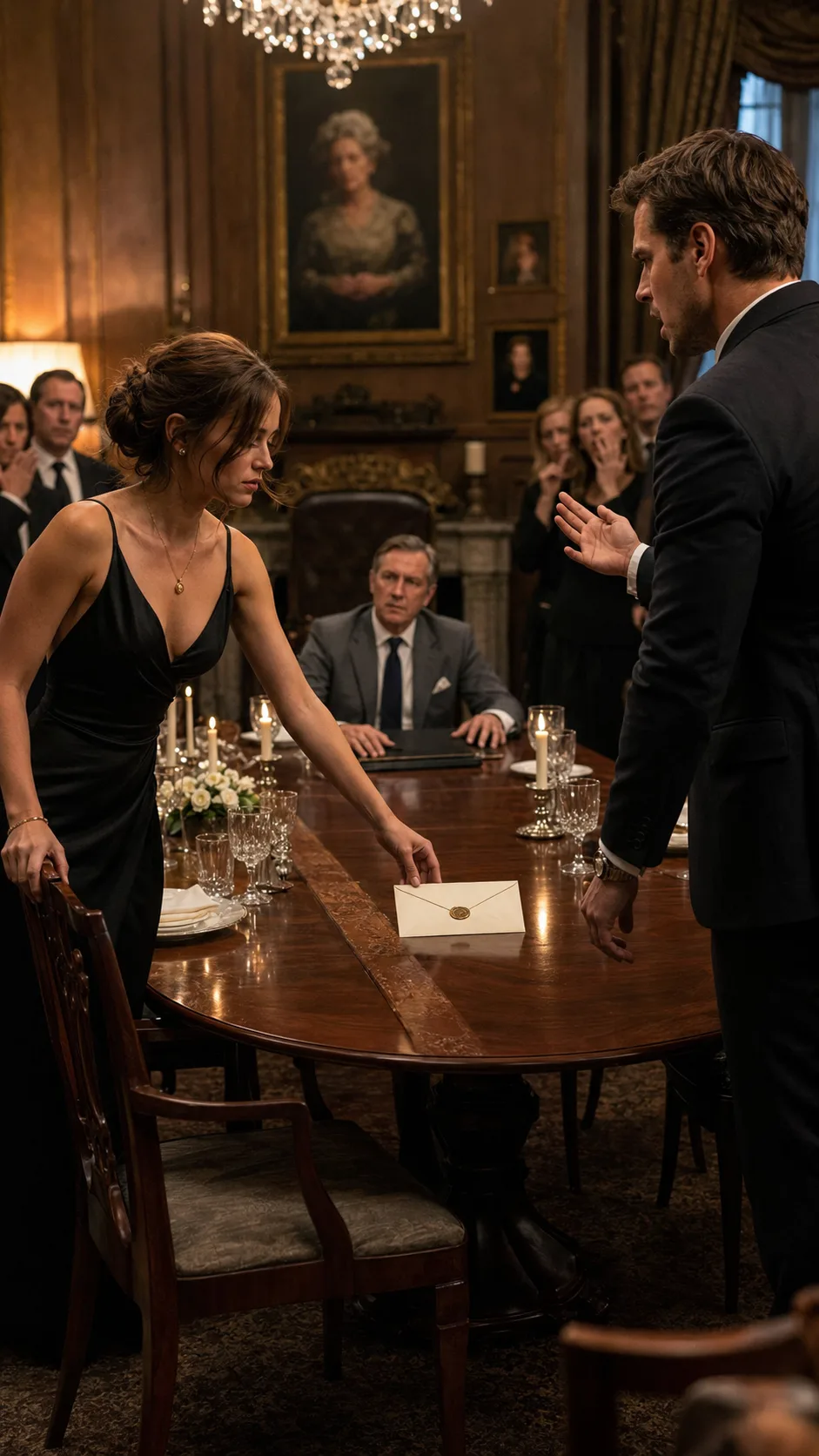
I set the cream envelope in the center of the mahogany table.
The wax seal faced up.
Grandma’s handwriting faced Daniel.
Olivia.
Just my name.
Not stray. Not problem. Not extra plate.
Olivia.
Daniel stared at it.
His hand moved first.
Mr. Whitman’s moved faster.
The lawyer took the envelope from the table before Daniel could touch it.
“I believe,” Mr. Whitman said, “this is the letter Mrs. Parker instructed me to read if Daniel attempted to interfere.”
Daniel’s face went flat.
Aunt Lydia opened her eyes.
Uncle Robert whispered something that did not become a word.
Mr. Whitman broke the seal.
The sound was small.
Paper separating. Wax cracking. A grandmother’s final instruction opening under warm chandelier light.
Daniel’s hand hovered above the table, empty.
The lawyer unfolded the pages.
There were three.
Grandma had written them by hand. I could tell from the uneven slope, from the places where the pen had rested too long and left darker spots of ink.
Mr. Whitman adjusted his glasses.
Daniel said, “This is absurd.”
The lawyer began.
“My dear Olivia,” he read.
Daniel’s jaw tightened.
“If this letter is being read aloud, then my grandson has mistaken my patience for blindness.”
Someone at the table drew in a breath and held it.
Mr. Whitman continued.
“I know about the invoices. I know about the contractor who was paid twice and never came. I know about the checks written from my account after I told Daniel no. I know about the document he asked me to sign when he thought the medication had made me too tired to read.”
Daniel’s palm flattened on the table.
“That is not legally relevant,” he said.
Mr. Whitman did not look at him.
“I also know what he told the family about Margaret.”
My mother’s name moved through the room without a body.
Aunt Lydia’s necklace slipped from her fingers.
I looked at her.
She looked away.
Mr. Whitman read slower.
“Margaret did not abandon this family. She did not leave Olivia for us to raise because she was selfish or unstable. She left because Daniel’s father threatened to bury the custody case until she had nothing left to fight with.”
Daniel’s chair stood behind him, empty.
He did not sit.
His eyes moved from the letter to Aunt Lydia, then back to me.
“Stop reading,” he said.
Mr. Whitman turned the page.
“I kept the records. I kept the checks. I kept the letter Margaret wrote before she died. Daniel found one copy. He did not find them all.”
Mrs. Hargrove made a sound near the doorway.
Not a sob. Not a word.
Just air leaving a room.
Daniel reached across the table.
Mr. Whitman pulled the letter back.
“Touch it,” the lawyer said, “and I call the police from this room.”
Daniel froze.
There it was.
The first crack everyone could see.
Mr. Whitman returned to the page.
“As for this house, I leave 118 Waverly Lane, the land, and all furnishings not otherwise specified to Olivia Margaret Parker, outright and without condition.”
A glass slipped from Aunt Lydia’s hand and struck the carpet without breaking.
Daniel did not look at it.
He looked at me.
For the first time that night, he did not seem to know where to put his hands.
Mr. Whitman was not finished.
“If Daniel contests this transfer, the attached evidence is to be submitted to the probate court, the district attorney, and the board of Parker Holdings. If he accepts it quietly, I leave the matter to Olivia’s discretion.”
The room changed without moving.
No one stood. No one shouted. No chair overturned.
But Melissa lowered her wine glass.
Uncle Robert leaned away from Daniel by half an inch.
Aunt Lydia’s mouth opened and closed once.
Mrs. Hargrove stepped into the dining room.
One step.
Enough.
Daniel looked around the table as if searching for the version of the family that had always looked back at him first.
It was not there.
He pointed at me.
“You planned this.”
I touched the back of the chair again.
The wood was smooth beneath my palm.
“No,” I said. “She did.”
Mr. Whitman placed the letter on the table, but kept two fingers resting on its edge.
Daniel stared at those fingers.
Then at the envelope.
Then at Grandma’s empty chair.
His laugh was gone.
The chandelier clicked softly above us, one crystal tapping another in the heat.
Aunt Lydia stood first.
Not fully. Just enough to reach down for the glass she had dropped. Her hand trembled against the carpet, but she did not look at Daniel when she came back up.
Melissa pushed her chair back next.
Her husband touched her elbow. She shook him off.
Daniel saw that.
His mouth tightened.
“Olivia,” he said.
It was the first time all evening he used my name without turning it into an insult.
I picked up the cream rose from Grandma’s plate and set it back across the rim.
The spoon was still crooked.
I straightened it.
Daniel watched me do it.
Mr. Whitman gathered the pages and slid them into a clear sleeve from his folder.
“Mrs. Parker also left instructions regarding immediate possession of the property,” he said.
Daniel’s head turned sharply. “Immediate?”
“Yes.”
“I live here.”
“No,” Mr. Whitman said. “You have been staying here.”
“That is the same thing.”
“It is not.”
Daniel let out a breath through his nose. He looked at Uncle Robert. “Say something.”
Uncle Robert picked up his napkin. Folded it. Put it down.
Daniel looked at Aunt Lydia.
She sat with both hands in her lap.
“Lydia.”
She did not answer.
His face changed then. Not much. A tightening at the temples. A pale line around the mouth.
He turned toward me again.
“You’re going to throw me out of my grandmother’s house?”
I looked at the portrait over the fireplace.
Grandma at thirty-two looked back with that lifted eyebrow.
“No,” I said. “You’re going to leave it.”
Mrs. Hargrove moved to the sideboard and picked up my cold tea. She carried it out without asking.
That small kindness nearly did what Daniel had failed to do.
I stayed standing.
Mr. Whitman closed his folder.
“I suggest you collect personal items only tonight,” he said to Daniel. “Any documents removed from the premises will be treated accordingly.”
Daniel gave a short laugh that had no strength in it.
“This family is insane.”
No one followed him when he walked out.
His shoes struck the hallway marble in hard, even beats. Then came the sound of the front door opening, the pause where he expected someone to call his name, and the heavy close after no one did.
The candles kept burning.
The food remained untouched beneath silver lids.
The cream envelope lay on the table between Mr. Whitman and me, its seal broken, its purpose finished.
Aunt Lydia began to cry without making noise. She pressed one tissue beneath each eye, then folded both into a square. Uncle Robert asked Mr. Whitman for water and poured it himself when no one moved.
Melissa came around the table.
She stopped two feet from me.
“I didn’t know about your mother,” she said.
I looked at her shoes. Black heels. One scuffed toe.
“No one asked.”
She nodded once.
It was not enough. It was something.
Mr. Whitman stayed until every page was returned to his folder except Grandma’s letter to me. That one he placed in a separate envelope and handed over with both hands.
“She wanted you to have the original,” he said.
I held it carefully.
The paper was heavier than it looked.
“What happens now?” Aunt Lydia asked.
Mr. Whitman glanced toward the hallway Daniel had used. “Now we follow the will.”
No one liked how simple that sounded.
An hour later, the dining room had thinned.
Uncle Robert left first, with a kiss pressed to the air near my cheek. Aunt Lydia lingered by the fireplace and touched the edge of Grandma’s portrait frame before she went. Melissa asked if I wanted her to stay. I said no. She accepted that without making me comfort her.
Mrs. Hargrove returned with a fresh cup of tea.
Steam curled over the rim.
“I put lemon in it,” she said.
“Thank you.”
She looked at Grandma’s chair, then at me. “She told me you’d fix the spoon.”
I looked down.
The spoon was straight now.
Mrs. Hargrove wiped one invisible mark from the table and left me alone.
The house sounded different after everyone went. Older. Less crowded. The radiator knocked in the wall. A pipe clicked somewhere upstairs. Outside, a car engine started, idled too long, then pulled away too fast.
Daniel.
I stood by the table until the candles burned low.
Then I took Grandma’s letter upstairs.
Her room had been cleaned after the funeral, but not changed. The slippers were still beneath the chair. The blue biscuit tin sat on the dresser where I had left it. The bedspread was smooth, except for one small crease near the pillow.
I opened the letter again under the bedside lamp.
Not the legal pages.
The last page.
The one Mr. Whitman had not read aloud.
Olivia,
I am sorry for every year I let silence sit at this table longer than truth. I thought keeping the peace would protect you. It only protected the people who knew how to use peace as a weapon.
Your mother loved you. I should have said that every day.
The house is not payment. It is not an apology. It is a place where no one gets to call you extra again.
Straighten the spoon if you want.
Or leave it crooked.
It is your table now.
I read that page once.
Then again.
Then I folded it along the same lines Grandma had made.
I did not sleep in her room that night. I could have. No one would have stopped me. The house was mine now, according to paper, law, and a dead woman who had planned more carefully than any of us knew.
But I went to the small guest room at the end of the hall, the one I had used as a child when thunderstorms shook the windows.
The wallpaper still had tiny blue flowers.
One corner near the baseboard had peeled.
I left it that way.
The next morning, Daniel sent seven messages before eight o’clock.
Then he called.
Then his attorney called Mr. Whitman.
By noon, Parker Holdings had received copies of Grandma’s evidence.
By three, Daniel’s name had been removed from two internal accounts pending review.
By the end of the week, the house locks had been changed.
He came once, two Saturdays later, to collect his clothes and a box of framed certificates from the study. Mr. Whitman was present. So was Mrs. Hargrove. Daniel walked through the rooms without touching the walls.
In the foyer, he stopped beside the portrait of Grandma at thirty-two.
“You think she chose you because she loved you more,” he said.
I held the front door open.
“No.”
He waited.
I looked at his box, at the corner of one certificate bent against the cardboard.
“She chose me because she knew what you would do when she couldn’t stop you anymore.”
He left without another word.
Spring came late that year.
The rose bushes had to be cut back harder than usual. Half the canes were dead from neglect. Mrs. Hargrove stood on the porch with tea while I worked, telling me which branches Grandma would have scolded me for missing.
I kept the old dining table.
I kept Grandma’s chair at the head of it, but I did not sit there right away.
For the first few weeks, I ate in the kitchen. Toast. Soup. Tea with lemon sliced thin enough to see light through it.
Then one Sunday, I invited Mrs. Hargrove, Melissa, and her daughter for dinner.
Only four places.
No silver lids. No speeches. No lawyer.
Melissa’s daughter set the table and placed one spoon crooked beside her plate.
Her mother reached to fix it.
I stopped her.
The little girl looked up at me, waiting to be corrected.
I smiled and set a cream rose in a glass jar at the center of the table.
“Leave it,” I said.
Chapter complete
You have reached the end of this chapter.
Continue reading
A few more worlds to get lost in after this chapter.