The first thing I noticed when I stepped into my parents’ backyard was the banner.
Chapter 1
The first thing I noticed when I stepped into my parents’ backyard was the banner.
Congratulations, Ethan!
Gold letters. White fabric. Two rented spotlights pointed at it like my brother had won a national election instead of a regional manager title at a logistics company where his boss still called him “kid.” Beneath the banner, Ethan Brooks stood with a glass of bourbon in one hand and my father’s approval resting on his shoulder like a tailored jacket.
My mother saw me from the patio doors.
She froze for half a second.
Then she smiled.
Not the kind of smile that reached anyone. The kind she used when a neighbor asked why I never came home anymore.
“Natalie,” she said, crossing the patio before my father noticed me. “You made it.”
“I said I would.”
Her hand touched my arm. Too light. Too quick. A warning disguised as affection.
“Tonight is important,” she said.
There it was.
I looked past her at the rows of
white rental chairs on the lawn, the cocktail tables wrapped in linen, the caterers carrying trays of shrimp and bourbon-glazed meatballs. Sixty-eight guests, if her text was accurate. Church friends. Neighbors. Ethan’s coworkers. A few local business owners who shook my father’s hand like Richard Brooks had personally poured the concrete under their lives.
My father had built half the town.
That was what people said.
He had built kitchens, offices, storefronts, additions, porches, and one courthouse entrance with his company name stamped discreetly into the donor plaque. He had also built a family where silence passed for loyalty and obedience passed for love.
No one put that on a plaque.
My mother squeezed my arm once, then dropped her hand.
“Just one peaceful night,” she said.
I looked at her.
She looked away first.
Across the yard, my father’s laugh rose above the music. Richard Brooks had a laugh
for crowds. Full-bodied. Warm. Expensive. It made men lean in and women forgive his interruptions. Tonight he wore a navy blazer, a white shirt open at the collar, and the kind of confidence that came from never being contradicted in public.
Then he saw me.
His laugh stopped only long enough for him to measure whether I looked dangerous.
I had chosen a dark blue dress, simple earrings, low heels, and no necklace. Nothing dramatic. Nothing he could point at and call attention-seeking. I had pulled my hair back at home, then taken it down in the car because the pins made my scalp ache.
My father raised his glass toward me.
Not a welcome.
A reminder.
Behave.
I gave him nothing back.
My brother noticed that part.
Ethan left the group around him with the ease of a man who believed every room opened for him. He had our
father’s height, our mother’s eyes, and none of the caution that should have come from growing up in our house. He wore a pale blue shirt rolled at the sleeves, dark trousers, and an expensive watch I knew he had not paid for himself.
“Natalie,” he said, loud enough for the two women beside him to hear. “Look at you. You came.”
“I got invited.”
His smile stayed in place.
“That never stopped you from making people regret it.”
One of the women gave a small laugh, then looked at her glass.
I almost walked away.
I had promised myself I would. In the car, with both hands on the steering wheel, I had said it out loud. If they start, leave. No speech. No argument. No old fight dragged into the open.
But Ethan leaned closer.
“Try not to ruin this one too.”
His breath carried whiskey.
I looked at the banner behind him. Congratulations, Ethan! The exclamation point tilted slightly because someone had tied the right corner too low. A small, stupid detail. It bothered me more than it should have.
“Your banner’s crooked,” I said.
His eyes narrowed.
Then he laughed.
“There she is.”
He turned away as if he had won something.
I moved to the drink table and took a glass of water. No alcohol. Not tonight. My father would smell it on me and turn it into a story by morning. Natalie got drunk and caused a scene. Natalie embarrassed everyone again. Natalie has always been difficult.
Difficult meant I remembered things correctly.
Difficult meant I knew which drawer my father hid cash in when a subcontractor came by after hours.
Difficult meant I had once driven my mother to urgent care and refused to tell the nurse she had slipped in the kitchen.
That was the year I moved out.
The first time I slept in my apartment, I woke at 3:00 a.m. because nobody was yelling downstairs. The silence was so unfamiliar I checked the lock twice.
A man I didn’t recognize approached me near the drinks.
“You’re Richard’s daughter, right?”
“One of them,” I said, then corrected myself. “His daughter.”
He laughed, not hearing the edge.
“Your brother’s big night. Your father’s been talking about him all evening.”
“I’m sure he has.”
“Good family,” the man said. “Hardworking people.”
I looked at his hand. There was drywall dust under one fingernail. He probably worked with my father. Or wanted to.
“Yes,” I said. “People do say that.”
My mother appeared again, carrying a plate she wasn’t eating from.
“Natalie, come sit with me for a minute.”
That meant my father was watching.
I followed her to the far side of the patio, near the herb planters she never used. Basil, rosemary, mint. All alive because the gardener watered them.
“You’re doing well?” she asked.
“I pay rent. I answer emails. I eat cereal over the sink some nights. So yes.”
Her lips pressed together.
“You know what I mean.”
“I do.”
She looked toward Ethan. He was laughing with a man in a gray suit, one hand on the man’s shoulder. My father stood beside them, smiling like he had personally manufactured success out of bone and blood.
“He worked hard,” my mother said.
“So have I.”
Her eyes flicked back to me.
“I didn’t say you haven’t.”
“You didn’t have to.”
The plate in her hand dipped. A shrimp slid toward the rim. She caught it with her thumb and looked down as if the shrimp had embarrassed her.
“I wanted you here,” she said.
“Why?”
“Because people ask.”
There it was.
Not because she missed me. Not because the family felt incomplete without me. Because my absence had become visible.
A glass clinked near the center of the yard. My father had moved to the small rented microphone stand. Of course there was a microphone. Ethan stood beside him, shoulders back, chin lifted, soaking in the shape of attention.
My mother set her plate on the stone ledge.
“Please,” she said. “Just listen.”
The music lowered.
My father tapped the microphone once.
Everyone laughed.
He smiled like he had meant to do it.
“I promise I won’t make this long,” he said, which meant he planned to.
The guests gathered closer. My mother stood beside me but not too close. She always calculated distance in public. Close enough to look loving. Far enough not to be pulled into anything.
My father began with Ethan’s first job, though he skipped the part where Ethan quit after three weeks because the manager had corrected him in front of customers. He talked about discipline, loyalty, work ethic. Every word landed in the yard and bounced off me.
“Some people run from responsibility,” my father said, one hand resting on Ethan’s shoulder. “Some people step up.”
Ethan looked at me.
Just for a second.
Enough.
My father continued.
“A family name means something. You either honor it or you drag it through the mud. Ethan has honored it.”
Polite applause.
My water glass felt slick in my hand.
I set it down.
A chair leg scraped behind me. Someone turned to see whether I would react. They knew more than they pretended. Small towns always did. They knew enough to enjoy the show and not enough to feel responsible for it.
Ethan took the microphone.
“Thanks, Dad.”
He looked out over the yard, then directly at me again.
“I couldn’t have done any of this without family support. Well, most of it.”
A few guests chuckled.
My mother’s shoulders rose.
Barely.
Ethan smiled wider.
“You all know every family has one person who keeps things interesting.”
More laughter.
I looked at the crooked banner.
“Some of us stay focused,” Ethan said. “Some of us make everything about ourselves.”
My hand moved before I decided to move it. I picked up my water again, then put it down without drinking.
Enough.
I stepped away from the planter.
My mother caught my wrist.
“Natalie.”
I slipped free.
Not hard. Just enough.
Ethan kept talking because people were still smiling.
“I’m just grateful my parents taught me the difference between loyalty and drama.”
My father laughed into his glass.
That was the sound that did it.
Not Ethan’s words. Not the crowd. Not the banner. My father’s laugh. That proud, public laugh he used whenever someone else did the cutting and saved him the effort.
I walked toward the microphone area.
Not fast.
People parted because they wanted to see.
Ethan saw me coming and lowered the microphone slightly.
“Careful,” he said. “You’re on schedule.”
I stopped a few feet away.
“I came because Mom asked me to.”
My mother’s face went pale.
Ethan tilted his head.
“And yet somehow I’m still nervous.”
A few more laughs.
I turned enough for the guests to hear me.
“The only reason this family looks respectable tonight is because nobody outside the house ever had to live inside it.”
The yard changed.
Not loudly. Not all at once.
A woman near the dessert table stopped lifting her fork. A man from my father’s construction circle looked at his shoes. Someone’s phone dipped, as if they had started recording and thought better of it.
Ethan’s smile vanished.
My father set down his glass.
The microphone gave a soft squeal when Ethan’s hand tightened around it.
“Apologize,” my father said.
He had not raised his voice yet.
That made it worse.
“Dad,” my mother said.
He did not look at her.
“Natalie,” he said. “Apologize to your brother.”
“For what?”
“For bringing your poison here.”
There was the real Richard Brooks. Not the contractor. Not the donor. Not the man who loaned neighbors tools and remembered birthdays when clients were watching.
My brother held the microphone near his chest.
He was no longer joking.
“You couldn’t let me have one night,” he said.
“I wasn’t the one who started talking about loyalty.”
“You don’t know anything about loyalty.”
“I know what you call loyalty.”
My father took three steps toward me.
The crowd widened around us. Not to protect me. To get out of his way.
“You will not do this here,” he said.
“I’m not the one pretending.”
His hand came up.
My body remembered before my mind caught up.
I flinched only slightly, but he saw it. So did half the yard.
That should have stopped him.
It didn’t.
The sound was smaller than I expected. A flat crack, swallowed by the string lights and summer air. My face turned with it. My earrings swung. Somewhere behind me, a woman made a soft noise and then covered her mouth.
My father had struck me before.
Never in front of sixty-eight people.
For one second, nobody breathed loudly enough to count.
Then Richard Brooks grabbed my arm and started walking.
I stumbled because my heel caught between two patio stones. My mother said his name. He kept moving. Ethan stepped aside. Of course he did. The guests shifted again, opening a path toward the side gate like they were watching someone carry out a broken chair.
“Dad,” I said.
He didn’t answer.
His fingers dug into my upper arm, not enough to leave a shape anyone could photograph clearly later, just enough to steer. That was his specialty. Damage that argued with evidence.
“Richard,” someone said.
A man’s voice.
My father turned his head.
The man looked away.
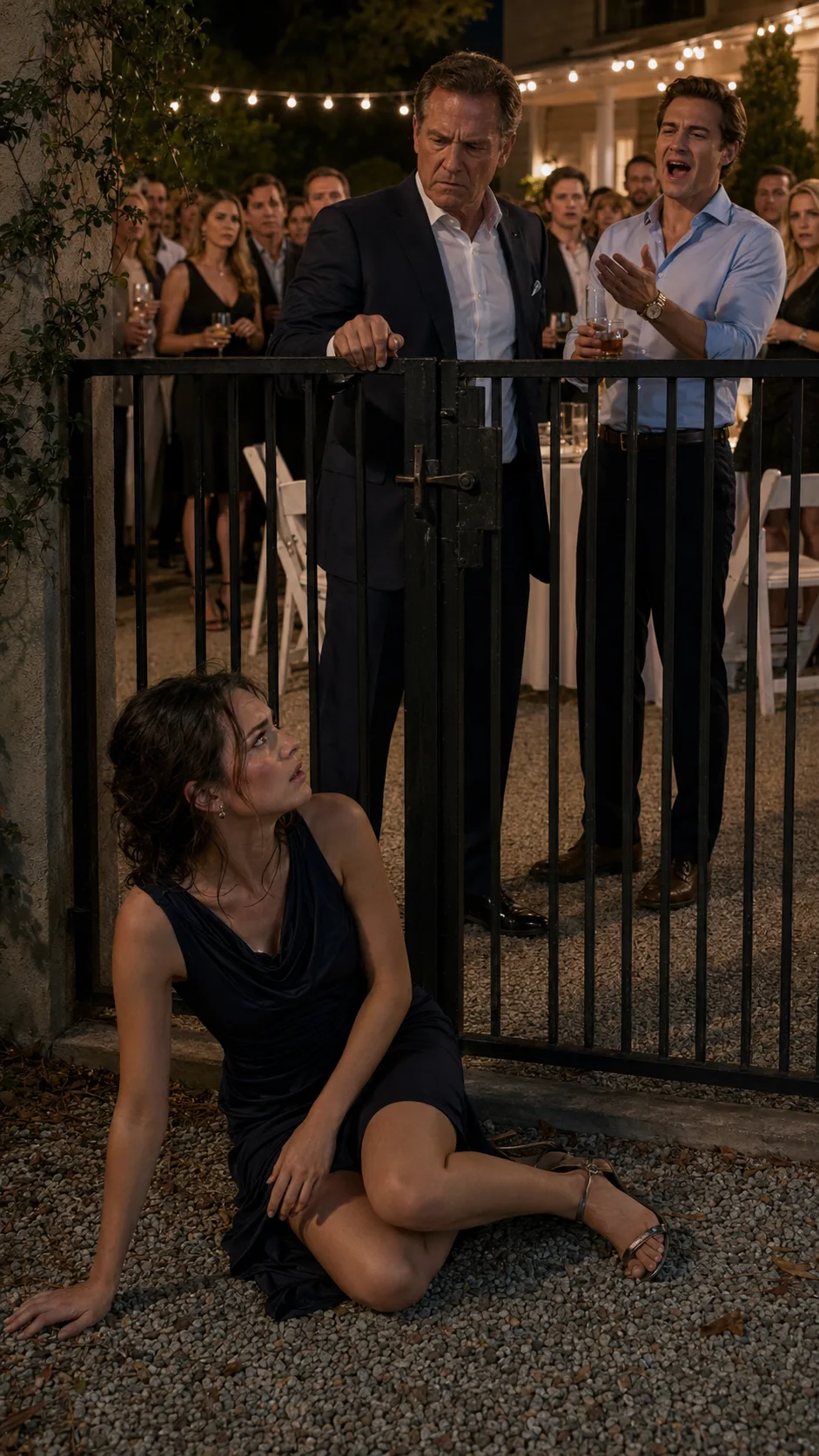
We reached the side gate.
Black iron. Vertical bars. A latch that stuck unless you lifted it first. I knew that gate. I had painted it with my mother when I was fourteen while Ethan sat inside playing video games and my father said boys weren’t meant for fussy work.
My father opened it with one hard jerk.
I twisted my arm free.
“Don’t touch me.”
That sentence had followed me since childhood. It had failed every time.
He shoved me through the opening.
I caught the post with one hand and stayed upright for half a second. Then my heel slipped on the gravel outside the gate and I went down on one knee, then one palm. Small stones bit into my skin. My dress pulled tight across my thigh.
Behind me, the gate slammed.
Metal against metal.
The latch snapped into place.
I was outside.
They were inside.
Warm lights glowed behind the bars. White chairs. Cocktail tables. The crooked banner. My brother’s promotion party continued to exist five feet away from me as if I had been removed from a photograph.
My father stood inside the gate with one hand still on the latch.
His face had changed. He knew. Not everything, but enough. He knew he had done something in public that could not be folded back into the family drawer.
So he did what he always did.
He tried to rename it.
“You were warned,” he said.
My mother stood near the patio steps, both hands clasped at her waist. Her mouth opened. Nothing came out.
Ethan moved beside my father.
He still held his drink.
That detail stayed with me later. The amber liquid in the glass. The ice barely melted. The watch catching the string lights. His clean shirt. His easy balance on the patio stones while I had gravel stuck to my palm.
Then Ethan started clapping.
Once.
Twice.
The sound cracked through the yard sharper than the slap had.
He smiled down at me through the gate.
“You had it coming.”
No one laughed this time.
That should have mattered to him.
It didn’t.
He turned slightly, making sure his coworkers heard. Making sure our father’s clients heard. Making sure the whole polished crowd understood which side they were supposed to stand on.
“You always do this,” Ethan said. “You push and push, then act like the victim.”
I looked at his hands.
Clap.
Glass.
Watch.
My cheek burned. My knee throbbed. A small bead of blood rose from a scrape on my palm, but I closed my hand around the gravel before anyone could see it clearly.
No spectacle.
Not for them.
My purse had fallen beside the gate, half on the gravel, half against the stone border. The clasp was open. Lip balm, receipt, keys, phone.
My phone lay face-down under the edge of the strap.
Richard saw my eyes move.
“Leave it,” he said.
His voice was lower now.
Not for the crowd.
For me.
That was how I knew he understood at least one thing.
Phones changed rooms.
Phones changed stories.
Phones did not sit at kitchen tables and agree to forget.
I reached for it.
The crowd shifted behind him. A woman in a black dress lowered her champagne flute. One of Ethan’s coworkers leaned closer to another man and said something I couldn’t hear. My mother lifted one hand again. It hovered near her throat.
“Natalie,” she said.
I picked up the phone.
The screen had a crack near the bottom corner from where it had hit the gravel. It still lit under my thumb.
Richard leaned toward the gate.
“Put that down.”
Ethan stopped clapping.
Finally.
I wiped dust from the screen with the side of my thumb. My hand shook once. I pressed it against my knee until it stopped.
My father’s fingers curled around one of the iron bars.
“Don’t make this worse.”
I looked up.
He hated that. He hated when I looked directly at him after he had done something ugly. He preferred bent heads. Averted eyes. Doors closing quietly. People giving him time to become reasonable again.
Not tonight.
Ethan gave a short laugh, but it came out wrong.
“What are you going to do, Nat? Call someone and say Dad embarrassed you?”
Several guests looked at him.
Not with approval now.
With calculation.
He noticed.
His shoulders tightened.
I unlocked the phone.
The keypad glowed white in my hand.
My father’s face hardened.
“You’re outside my house,” he said. “Remember that.”
“I know where I am.”
My voice did not sound like mine. It had less air in it. Less need.
I raised the phone just enough for him to see the screen.
“Sixty-eight witnesses,” I said. “One call.”
Nobody moved.
Even the caterers stopped at the edge of the patio with trays in their hands.
Ethan’s mouth opened, then closed.
Richard released the gate bar.
For the first time all night, he looked behind him.
Not at my mother.
Not at Ethan.
At the guests.
That was the crack. Not in his reputation yet. In his control. He had always believed a room belonged to the loudest man with the cleanest shirt and the longest history of being obeyed. But rooms are made of people. People have eyes. People have phones. People have memories they keep for themselves until someone asks.
I pressed the call button.
The ring tone sounded too loud in the quiet.
One ring.
Two.
My mother took a step toward the gate.
Richard held up one hand without looking at her.
She stopped.
Of course she did.
On the third ring, a woman answered.
“Montgomery County Sheriff’s Office, non-emergency line. How can I help you?”
I put the phone on speaker.
Ethan went still.
Richard’s eyes snapped back to me.
I looked through the gate at my father.
“My name is Natalie Brooks,” I said. “I’m outside 418 Hawthorne Lane. I was just assaulted and thrown out during a private party. There are witnesses.”
A sound moved through the guests.
Not a gasp.
Worse.
Recognition.
The kind that passes from face to face when people understand they are no longer watching family drama. They are standing inside a statement.
Richard stepped closer.
“Hang up.”
I didn’t.
The dispatcher asked if I was safe.
I looked at the closed gate.
“No,” I said. “He is still standing in front of me.”
My father’s face changed color.
Ethan set his glass down on the nearest cocktail table and missed the center. The base struck the edge, tipped, then steadied. Bourbon sloshed over his fingers.
A man near the back took out his phone.
Then another.
Then another.
My father saw them.
He turned, palms slightly open.
“Everyone calm down,” he said. “This is a family matter.”
No one answered.
A woman from church moved away from him as if the words had touched her sleeve.
The dispatcher’s voice came through the speaker again. She asked if there were injuries. I looked down at my palm, opened it, and saw red mixed with dust.
“Minor,” I said. “I need an officer.”
“Natalie,” my mother said.
This time she came all the way to the gate.
Richard caught her wrist.
Not hard.
Hard enough.
People saw.
That was the second crack.
My mother looked at his hand on her wrist. Then at the guests. Then at me.
For years I had waited for some great moment from her. Some speech. Some apology. Some door opening while I stood outside with a suitcase. Real life gave me something smaller.
She pulled her wrist free.
Richard stared at her like she had broken a law.
She did not speak.
She only stepped away from him.
The dispatcher told me officers were being sent.
I thanked her and stayed on the line.
Ethan pushed through the guests toward the gate, no longer smiling.
“You’re insane,” he said.
One of his coworkers touched his arm.
“Ethan.”
He shook him off.
“She does this,” Ethan said, louder now, but the microphone was gone and the yard did not belong to him anymore. “She twists everything.”
I stood slowly.
My knee objected. My palm stung. Gravel fell from the hem of my dress.
The phone stayed in my hand, speaker on.
“Say it again,” I said.
Ethan blinked.
“What?”
I looked at the phones pointed toward him. At the guests who had suddenly found the courage to hold their glasses low and their eyes open. At my father, whose hand hovered near the latch but did not touch it.
“Say I had it coming again.”
The yard went flat and silent.
Ethan looked at our father.
That was his mistake.
Everyone saw it.
The golden child checking for permission.
My father’s jaw worked once. No sound came out.
Sirens did not scream in the distance. Real officers do not arrive in stories exactly when the guilty person needs to hear them. It took time. Several minutes. Long enough for the party to curdle.
People began leaving in quiet clusters.
Not all of them. Some stayed because gossip has roots. Some stayed because they wanted to tell themselves they were witnesses now, which sounded cleaner than admitting they had watched and done nothing.
My mother opened the gate.
Richard didn’t stop her.
The latch stuck, as always. She lifted it first, then pulled.
The old motion.
The one I had taught her after we painted it.
She stepped outside and stood beside me on the gravel. Not touching me. Not asking forgiveness in front of a crowd where forgiveness would look too much like performance.
Just beside me.
That was enough for that minute.
Two sheriff’s deputies arrived through the side driveway with measured steps and neutral faces. One spoke to me. One spoke to Richard. Ethan tried to interrupt three times before the deputy turned his body slightly, blocking him without touching him.
My father kept saying the same thing.
“She caused a scene.”
The deputy asked, “Did you put your hands on her?”
My father looked at the guests.
No one rescued him.
The woman in the black dress said, “Yes.”
Her voice shook, but the word held.
Another man said, “I saw him throw her outside.”
Ethan pointed at me.
“She provoked him.”
The first deputy looked at me, then at Ethan.
“That’s not what I asked.”
My brother’s mouth shut.
There are different kinds of silence.
The one inside our house had been trained. Polished. Fed at holidays. Passed down like china.
This silence was new.
It stood on its own feet.
By midnight, I had given my statement at my apartment with an ice pack wrapped in a dish towel and my mother sitting at my kitchen table for the first time in four years. She did not know what to do with her hands. She kept folding and unfolding a napkin.
My phone would not stop lighting up.
Unknown numbers.
Old classmates.
One of Ethan’s coworkers.
A subcontractor I recognized by last name.
I answered none of them.
At 12:37 a.m., a message came from a number I had not seen in two years.
It was from Marcus Bell, a former bookkeeper at my father’s company.
I heard what happened. If you’re finally done protecting him, I have the invoices.
I stared at the message until the screen dimmed.
My mother watched me from across the table.
“What is it?”
I set the phone down.
A truck passed outside. Its headlights moved across my apartment wall and slid over the stack of unopened mail near the door.
“Something I should have asked for a long time ago.”
She closed her eyes.
She knew.
Not the details. Maybe not the numbers. But she knew there were invoices. Cash jobs. Permits adjusted after the fact. Materials billed twice. Men paid under tables and then blamed when corners cracked.
My father’s empire had not been built on one secret.
It had been built on everyone agreeing not to count.
By sunrise, three things had happened.
The first was practical. Ethan’s company put him on administrative leave pending review after several videos from the party reached people above him. The clip of him clapping traveled fastest. It always would. Cruelty looks smaller when written down. On video, it performs itself.
The second was public. My father’s largest commercial client canceled a breakfast meeting and sent a brief email saying all future work would be paused until “personal and legal concerns” were resolved. People love moral language when money is at risk.
The third came at 6:14 a.m.
Marcus sent a folder.
Not one invoice.
A folder.
Scanned checks. Change orders. Cash notes. A spreadsheet with dates, project names, and initials. Photos of envelopes. Copies of permits. Enough to make my father’s clean business look like what it had always been under the paint.
My mother stood behind me while I opened the first file.
She did not gasp.
She did not say she had no idea.
She touched the back of one kitchen chair and held it.
“That was the Millers’ house,” she said, pointing to a line item.
“Yes.”
“They had water damage after the addition.”
“I remember.”
My father had blamed the subcontractor. Refused to pay him. Called him unstable. The man moved out of town by winter.
My mother sat down.
The chair made a small sound against the floor.
“What are you going to do?” she asked.
I looked at my phone.
At the cracked corner.
At the dried dust still caught in the case.
“Make the second call.”
This one was not to the sheriff’s office.
It took longer. County offices open when they open, and consequences do not care how badly you want them to hurry. I made coffee. I did not drink it. My mother washed the same spoon three times. At 8:03 a.m., I called the state contractor licensing board and asked where to send documentation.
After that came the city inspector.
Then the client whose project name appeared most often in the folder.
Then the former subcontractor who had been blamed for the Millers’ house.
By noon, Ethan had called seventeen times.
My father called once.
I let it ring.
At 1:22 p.m., he texted.
You have no idea what you’re doing.
I looked at the sentence for a long time.
Then I deleted it.
Not because I wanted peace.
Because I did know.
The investigation did not move like a movie. No one kicked down a door the same day. No dramatic arrest interrupted dinner. Paperwork has its own weather. It gathers. It darkens. It waits.
But the town moved faster.
People stopped using “family matter.”
They stopped asking why I had upset my father.
They started saying they had always noticed something.
That part almost made me laugh.
Almost.
The woman in the black dress sent me a message two days later. Her name was Sheila. She apologized for not stepping forward sooner. She said she had been afraid of my father because her husband’s company depended on Brooks contracts.
I wrote back one sentence.
Thank you for saying yes when they asked.
It was all I had to give.
My mother stayed at my apartment for three nights. On the fourth morning, she went back to the house with a deputy and her sister to collect clothes, documents, and the small cedar box from her closet where she kept my grandmother’s ring.
Richard was there.
He did not speak to her.
He stood in the driveway while she carried out two suitcases and one laundry basket filled with shoes. A neighbor watched from behind a curtain and then pretended not to.
Ethan moved into a hotel.
Then out of the hotel when his card stopped working.
The promotion banner stayed in my parents’ backyard for over a week. Nobody took it down. Rain came through on Thursday and sagged the middle. The gold letters wrinkled. Congratulations, Ethan! became a damp strip of fabric hanging over empty white chair marks on the grass.
I drove past once.
Not slowly.
Just enough to see.
A month later, my father’s license was suspended pending the investigation. Two clients sued. Three more joined. The subcontractor from the Millers’ house returned with records of his own. My father’s lawyer issued a statement about “private family conflict being weaponized against a respected local business owner.”
The statement did not mention the video.
Statements rarely mention the thing everyone has already seen.
Ethan never returned to the logistics company. Officially, he resigned. Unofficially, one of his coworkers sent me a screenshot of a message he had written in their team chat three weeks before the party.
My sister is coming. If she starts anything, just enjoy the show.
I saved it.
Not because I needed it.
Because sometimes a person should keep proof that cruelty had a plan.
My mother rented a small apartment twelve minutes from mine. The first time I visited, she had no couch yet, only two folding chairs and a kettle on the counter. She opened the door wearing jeans I had never seen and an old gray sweater with a hole near the cuff.
“I bought mint,” she said.
On the windowsill sat one small herb pot from the grocery store.
The leaves leaned toward the light.
I touched one with my finger.
“You’ll overwater it,” I said.
She almost smiled.
“Probably.”
We drank tea from mismatched mugs. She did not ask me to forgive her. I did not offer it. We talked about practical things. Mail forwarding. Bank accounts. A lawyer she had called. The noise the refrigerator made.
A beginning does not always announce itself.
Sometimes it sits in a folding chair and lets the kettle boil.
The last time I saw my father was outside the courthouse annex, three months after the party. He looked smaller without a room arranged around him. Same navy blazer. Same white shirt. No crowd. No microphone. No son at his shoulder clapping on command.
He saw me near the steps.
For a second, I thought he might walk over.
He didn’t.
Ethan stood beside him, thinner now, his hair too neat, his watch gone. He looked at me like I had stolen something from him.
Maybe I had.
Not the promotion.
Not the applause.
The audience.
He turned away first.
My mother came out of the building behind me holding a folder against her chest. She walked past Richard without stopping. Her shoulder brushed mine as she reached the bottom step.
“Ready?” she asked.
I looked across the parking lot at my father and brother.
Then at my mother.
“Yes.”
That night, I finally cleaned my phone case.
I stood at my kitchen sink with warm water, a soft brush, and a dish towel. The crack in the corner of the screen was still there. I had not fixed it. Maybe I would. Maybe I wouldn’t.
A few grains of gravel had stayed wedged in the rubber edge.
I worked them loose one by one and let them fall into the sink.
Tiny stones.
Proof enough.
Chapter complete
You have reached the end of this chapter.
Continue reading
A few more worlds to get lost in after this chapter.