I taped the pharmacy receipt to the refrigerator with a magnet shaped like a crawfish, then counted what was left in my wallet.
Chapter 1
I taped the pharmacy receipt to the refrigerator with a magnet shaped like a crawfish, then counted what was left in my wallet.
Fourteen dollars.
Mama called from the bedroom before I could fold the receipt into the shoebox where I kept every bill, every copay slip, every note from the insurance company with words printed in blue ink that never seemed to mean help.
“Claire?”
“I’m here.”
Her voice had grown smaller that year, not weak exactly, just harder to find. It came from behind the half-open door, past the oxygen machine, past the quilt she refused to let me wash on hot because she said it ruined the softness.
I put the wallet back in my purse.
The house was quiet except for the machine and the old refrigerator kicking on. Our two-bedroom place in Louisiana had held three generations of Bennett noise once: my father’s radio, Mama’s church friends, Daniel’s boots slamming through the hallway, my own teenage arguments that always ended with a screen door hitting the frame.
Now
it held pill bottles.
And me.
Mama sat propped against two pillows, her reading glasses crooked on her face, a stack of church bulletins beside her. She had one sock on and one sock off because her ankles swelled by noon. I knelt without asking and slid the second sock over her foot.
“You paid too much again,” she said.
I kept my head down.
“It was covered.”
She touched my shoulder with two fingers.
“You never could lie smooth.”
I pulled the sock higher.
“That’s because you raised me wrong.”
That got a small sound from her. Not quite a laugh. Enough.
The phone rang before I stood.
Mama’s eyes moved toward the hallway.
I already knew.
Daniel never called the landline unless he needed Mama to answer first. He knew she would forgive the sound of his voice before she understood the reason for it.
I went to
the kitchen and lifted the receiver.
“Hey, baby sister.”
There it was.
The sweet voice.
“What do you need?”
A pause.
Then a breath through his nose, like I had insulted him by reading the script before he performed it.
“Can’t a man call his family?”
“Daniel.”
He laughed once.
“Truck’s down. I just need a little help until Friday.”
I looked at the refrigerator. The receipt curled slightly under the crawfish magnet. Beneath it was the electric bill, the water bill, a grocery list written on the back of a funeral home envelope because paper was paper.
“How much?”
“Eight hundred.”
I closed my eyes.
No.
Mama called from the bedroom, “Is that your brother?”
Daniel heard her.
“Put Mom on.”
I did not move.
“She’s resting.”
“She can talk to me.”
I turned so my back pressed against the counter.
“She needs her medicine this week.”
His voice
flattened.
“She gets a check.”
“She gets less than you think.”
“She always helped me before.”
The oxygen machine hummed down the hall.
I set my free hand on the counter. There was a coffee ring near the sink that would not scrub out, no matter what I used. Mama said it looked like a halo left by a tired cup.
“Not this time,” I said.
Silence.
Then Daniel spoke lower.
“Mom would want you to help me.”
I heard the bedroom door shift.
Mama had heard too.
That was the first time I should have written something down.
I didn’t.
I hung up and stood there with my hand still on the receiver until the dial tone went dead.
Mama did not ask what he wanted when I came back. She only patted the edge of the bed, so I sat beside her and let her lean against me while the evening light moved across the wallpaper.
The house smelled like lavender lotion.
And dust.
That was how our years passed. Receipts on the refrigerator. Envelopes in shoeboxes. Daniel’s calls arriving near the first of the month, sometimes after midnight, sometimes on Sundays when he knew I would be tired from getting Mama dressed for church on the television.
He had reasons.
Always.
A failed business partner. A bad transmission. A late mortgage payment. A son who needed baseball fees. A woman who had left with his debit card. A client who had not paid him yet.
“Just bridge me,” he would say.
Bridge.
Like I was standing on one bank of a river, holding out boards while he crossed and never looked back.
Mama defended him less as the years went on. She stopped saying, “He means well.” She stopped saying, “He’s just had bad luck.” She stopped saying anything when his name lit up the caller ID.
But sometimes, when I thought she was asleep, I would hear her murmur.
“My first baby.”
That was Daniel’s protection.
Birth order.
Memory.
A mother’s hand reaching backward to the boy he had been, not the man who kept calling.
I worked payroll at a feed supply company outside Lafayette. I knew numbers. I knew deductions, balances, late fees, and how long a person could stretch twenty-three dollars if there was rice in the pantry and sausage in the freezer.
I knew Mama’s Social Security check came on the third.
I knew what her prescriptions cost.
I knew the exact month her savings disappeared because the roof had leaked over her bed and the contractor wanted cash up front.
What I did not know was why her checking balance kept dipping lower than it should.
At first I blamed myself.
I had to.
I assumed I had miscounted. I assumed the pharmacy had processed something early. I assumed the insurance premium had gone up again and the notice was buried under coupons.
One afternoon, I found Mama at the kitchen table with her purse open and three dollar bills lined up beside her pill organizer.
“What are you doing?”
She covered the bills with her hand.
“Nothing.”
I sat across from her.
“Mama.”
She looked toward the window, where the neighbor’s crepe myrtle had dropped pink blossoms across the fence.
“I wanted to send Daniel a little something.”
I stared at the bills.
Three dollars.
She pushed them together with one finger.
“He sounded tired.”
I wanted to say he always sounded tired when money was involved. I wanted to say he was a grown man with a better truck than mine and a watch that cost more than our refrigerator.
I folded the bills and put them back into her purse.
“Keep it.”
She looked at my hands.
“He’s your brother.”
I nodded.
“I know.”
That night, after she fell asleep, I opened the shoebox and sorted receipts by month. The kitchen fan clicked above me. A mosquito had found its way inside and kept circling the bulb over the table.
I had bank statements too, but not all of them. Mama still insisted on opening her own mail, even when her hands trembled. She kept some papers in her nightstand, some in a Bible cover, some under the cushion of her recliner.
The statements I had showed ATM withdrawals I could not place.
Forty dollars.
Sixty.
Two hundred.
Then nothing for weeks.
Then more.
I asked Mama the next morning.
She blinked at the page through her glasses.
“I don’t go to the ATM.”
“I know.”
“I haven’t driven since Easter.”
“I know.”
She rubbed the side of her thumb against the table.
“Maybe Daniel got cash for me.”
The words came out too fast.
I looked at her.
She reached for her coffee.
The cup rattled against the saucer.
“Did you give him your card?”
She did not answer.
That was answer enough.
I pressed my palms flat on the table.
“When?”
“He said he would help with errands.”
“He lives forty minutes away.”
“He’s still my son.”
The mosquito landed on the window.
I wanted to crush it with the bank statement.
I didn’t.
I called Daniel from the porch because Mama had started folding and refolding the napkin in her lap.
He answered on the fourth ring.
“What now?”
“Do you have Mama’s debit card?”
A short laugh.
“No.”
“Daniel.”
“I picked up cash for her once.”
“There are several withdrawals.”
“Maybe you should keep better records.”
My grip tightened around the phone.
“I do.”
“Then figure it out.”
He hung up.
That afternoon, I drove Mama to the bank. She wore lipstick for it, a soft rose color that made her look like she was going to lunch instead of asking why money had disappeared.
The teller was young, with acrylic nails and a sunflower lanyard. She printed a balance slip and slid it across the counter. Mama tucked it into her purse without looking at me.
“Can we get past statements?” I asked.
Mama touched my wrist.
“Not today.”
The teller glanced between us.
I stepped back.
“Okay.”
Mama stayed quiet all the way home. At a red light, she opened her purse and looked at the balance slip. Her mouth moved as if counting.
I did not ask.
At home, she put the slip in the Bible on the table.
Not the nightstand.
Not the recliner.
The Bible.
Two weeks later, Daniel came by.
No warning.
His truck pulled into the driveway just after supper, tires crunching over the broken oyster shell path Mama had insisted on keeping because my father had laid it before I was born.
Daniel stepped into the kitchen carrying a plastic grocery bag.
“Brought y’all some things.”
Inside were bananas, canned soup, and a box of tea Mama did not drink.
She lit up anyway.
“My boy.”
He kissed her cheek and let her hold his hand longer than he wanted to. I saw that. He looked past her shoulder at the refrigerator, at the receipts under magnets, at the envelope marked PROPERTY TAX in my handwriting.
Then he looked at me.
“You still keeping Mom on a budget?”
I leaned against the counter.
“Somebody has to.”
Mama’s smile faded.
Daniel took a banana from the bag and set it in the fruit bowl like he had stocked the whole pantry.
“You always make everything sound like a sacrifice.”
I folded the grocery bag.
“No. I make the mortgage payment sound like a mortgage payment.”
He tilted his head.
“The house is paid off.”
“Insurance isn’t.”
“Taxes aren’t much.”
“Then pay them.”
Mama set her spoon down.
Enough.
Daniel smiled at her, the same smile he used when we were children and he had broken something, then convinced Mama I had done it because I was standing nearest the pieces.
“Mom, tell Claire she doesn’t have to act like a martyr.”
Mama looked at him.
Then at me.
Then at the bowl of soup in front of her.
“She takes care of me,” she said.
Daniel’s smile held for one more second.
Then it slipped.
Just a little.
After he left, I found Mama’s purse open on the chair beside her bed.
Her debit card was not in the front pocket where she kept it.
I checked again.
And again.
The card was gone.
I went to the porch and called Daniel.
No answer.
I called twice more.
Nothing.
Mama watched from her bedroom doorway, one hand on the frame.
“He just borrowed it,” she said.
I turned.
“For what?”
She did not answer.
The next morning, the card was back in her purse.
No note.
No explanation.
Daniel did not call for eleven days.
That was new.
Mama’s final winter came without much warning. One week she was complaining about the Saints defense from her recliner. The next week she could not make it from the bedroom to the bathroom without stopping at the hallway table to catch her breath.
I slept in the chair beside her bed.
The house shrank again.
The nurse from hospice came on Tuesdays and Fridays. Her name was Lorna, and she wore purple sneakers with tiny white moons on them. She taught me how to turn Mama without hurting her shoulder and how to listen for changes in her breathing.
Daniel came twice.
The first time, he stood at the foot of the bed and said, “You look good, Mom.”
Mama’s eyes moved toward him.
He stayed twenty minutes.
The second time, he brought flowers from a grocery store, still wrapped in plastic. He placed them in a vase without cutting the stems, so half the leaves sat below the waterline.
I fixed them after he left.
Mama watched me from the bed.
“Don’t hate him.”
I trimmed a stem over the trash can.
“I don’t.”
“Claire.”
The scissors stopped.
I looked back.
Her eyes were clear that day. Clearer than they had been in weeks.
“He was always good at needing.”
I waited.
She lifted one hand from the blanket, then let it fall.
“I made him that way.”
I wanted to tell her no.
I wanted to tell her mothers do not create every crack in their sons.
But her breathing had already changed. She closed her eyes, and the moment passed into the room with the dust and the lavender and the oxygen machine’s low rattle.
Mama died on a Thursday morning before sunrise.
The house made one sound after another afterward, each one too loud. The refrigerator. The floorboards. The blinds tapping the window because the ceiling fan was still on.
I called hospice.
Then the funeral home.
Then Daniel.
He did not answer.
I left a message.
“Daniel, Mama’s gone.”
That was all.
He called back at noon.
His first words were not about her.
“What time is the service?”
I stood in the hallway beside the framed school photos Mama never took down.
“Saturday.”
“I’ll be there.”
“I need help with arrangements.”
A pause.
“Claire, I can’t get there today.”
I looked at the oxygen machine.
Still plugged in.
“Okay.”
“Use Mom’s account.”
The hallway went still around me.
“What?”
“For the funeral. She had money coming in.”
I put my free hand on the wall.
“She didn’t have much.”
“She had enough.”
“How would you know?”
Silence.
Then his voice changed.
“Don’t start.”
The funeral was small but full. Church ladies brought casseroles in foil pans. Neighbors came with folded hands and stories about Mama lending sugar, sewing hems, watching children in emergencies. Lorna from hospice stood in the back with her purple sneakers hidden under black slacks.
Daniel wore a black suit I had never seen before.
He cried when people watched.
He stood beside the casket with his arm around me, his hand heavy on my shoulder. Each time someone came close, he squeezed.
Not comfort.
A signal.
Play along.
I stepped out from under his arm after the third person.
He noticed.
He always noticed.
At the house afterward, he moved through the rooms like a buyer at an open house. He touched the mantel. He checked the hallway closet. He opened the door to Mama’s room and stood there too long.
I followed him.
“What are you doing?”
He turned.
“Looking.”
“At what?”
He shrugged.
“Memories.”
His eyes moved to the nightstand.
I stepped into the doorway.
“No.”
His mouth tightened.
“Excuse me?”
“You’re not going through her things today.”
“She was my mother too.”
I held the doorframe.
“Yes.”
That stopped him for half a second.
Then he smiled.
“We’ll need to settle the estate.”
“The lawyer said we start with the bank.”
“Good.”
His smile widened.
“Set it up.”
I did.
Not because Daniel told me to.
Because I wanted every paper.
Every page.
Every answer Mama had folded into Bibles and purses and silence.
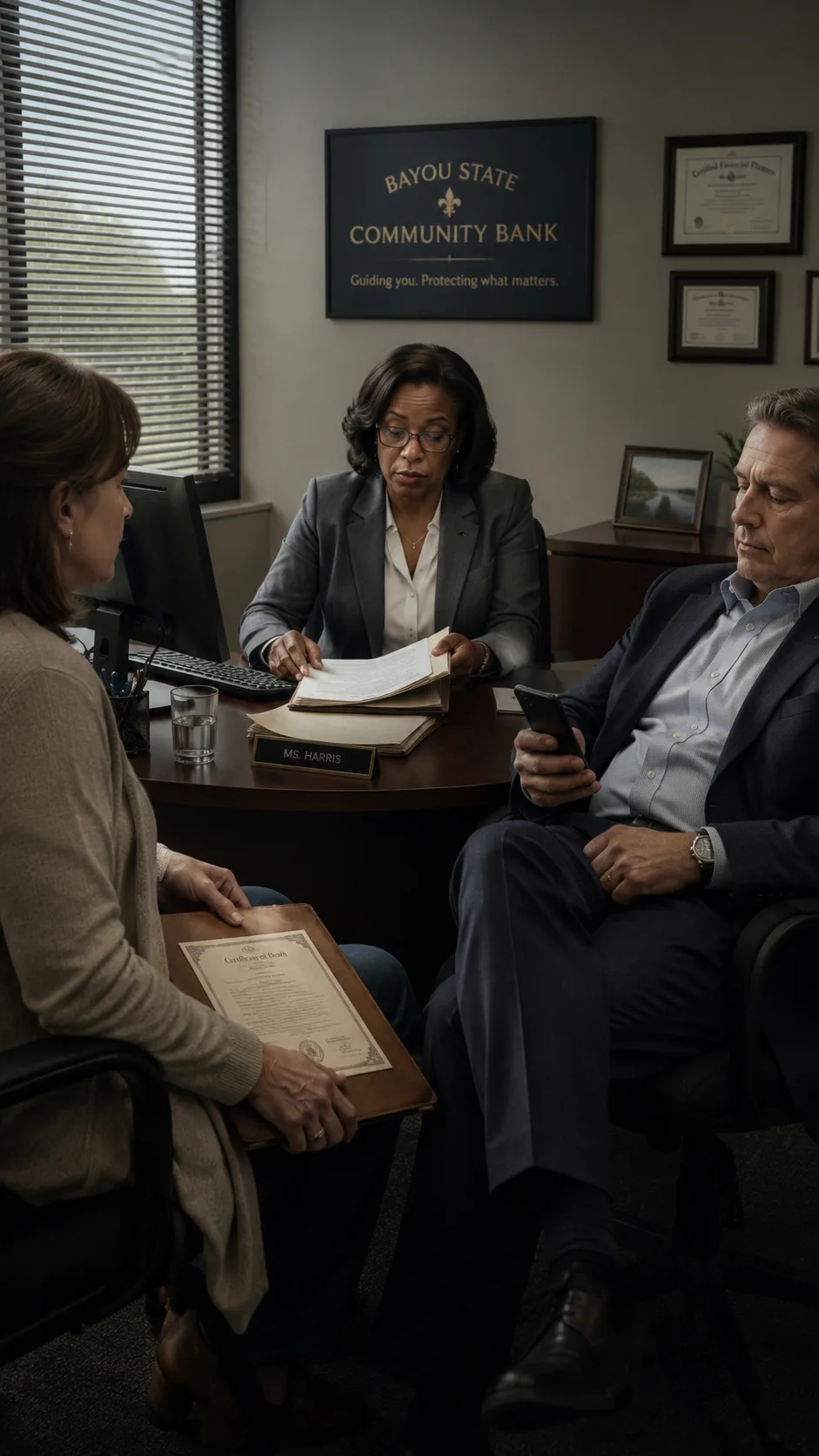
The appointment was at Bayou State Community Bank on a Tuesday afternoon. I chose that bank because Mama had used it since it was a one-room branch beside a bait shop. She said they knew our family before computers did.
I wore the navy blouse Mama liked and the beige cardigan with a missing inner button. I carried the brown estate folder against my ribs. Inside were her death certificate, my identification, the funeral invoice, and the last photograph I had of her sitting in the kitchen with curlers in her hair and a coffee cup raised like a toast.
Daniel arrived five minutes late.
He smelled like cologne and wintergreen mints.
“You bring the will?” he asked.
“There isn’t much of one.”
He frowned.
“What does that mean?”
“It means Mama didn’t have much.”
He looked toward the receptionist.
“Let’s see what the bank says.”
Ms. Harris called us back.
She was composed, mid-forties, with glasses on a silver chain and a gray suit that fit like armor. Her office had a dark wood desk, two visitor chairs, framed certificates, a computer monitor, and a glass of water set beside a coaster with the bank’s logo.
One small frame on the wall leaned left.
I noticed because my hands needed somewhere to put their attention.
Daniel took the chair to my right and lowered himself like a man settling into a restaurant booth. He crossed one ankle over his knee, pulled out his phone, and began scrolling.
Ms. Harris sat across from us.
“I’m sorry for your loss.”
“Thank you,” I said.
Daniel nodded without looking up.
I placed the estate folder on my lap.
Ms. Harris opened her file.
Paper shifted.
The sound filled the office.
She reviewed the death certificate first, then my identification, then Daniel’s. She asked about funeral expenses. I gave her the invoice. Daniel tapped his phone screen.
“We also need to know the remaining balance,” he said.
Ms. Harris looked at him.
“We’ll go through the account history first.”
Daniel gave a small laugh.
“For what?”
“Standard review.”
He leaned back again.
“Sure.”
I watched her hands.
She turned the first page. Then the second. Then she clicked something on her computer and waited while the printer behind her warmed up with a low mechanical cough.
The office smelled like toner.
And cold coffee.
Ms. Harris read the screen without moving anything except her eyes.
Then she reached for the printed pages.
One page.
Two.
Five.
She aligned them on the desk, tapped the edges straight, and looked at my mother’s name on the account header.
Margaret Elaine Bennett.
My throat tightened, but I swallowed it.
No sound.
Ms. Harris turned one statement toward herself and placed her finger halfway down the page.
She stopped.
Daniel’s phone made a soft clicking sound as he typed.
Ms. Harris turned another page.
Then another.
Her glasses slipped lower on her nose.
“Before we continue,” she said, “I need you to look at these withdrawals.”
Daniel’s thumb paused above his phone.
I leaned forward.
The statement showed familiar charges. Ochsner pharmacy. Entergy. Winn-Dixie. The draft for supplemental insurance. A check to St. Agnes Church for twenty-five dollars, because Mama gave even when I begged her to keep something back.
Then the withdrawals began.
ATM.
Transfer.
ATM.
External transfer.
Dollar amounts lined up like small doors opening into a dark hallway.
“What are these?” I asked.
Ms. Harris did not answer right away. She turned the page so I could see the column more clearly.
Daniel shifted beside me.
“Mom took cash out sometimes.”
I kept my eyes on the paper.
“Mama didn’t drive.”
“She had people.”
“She had me.”
Daniel’s chair creaked.
Ms. Harris reached into the folder and pulled out more statements.
“These are not isolated withdrawals.”
She placed the next pages beside the first.
The dates spread across years.
Not weeks.
Not months.
Years.
My hand moved before I told it to. I picked up the top sheet and held it closer. The transfer destination had a partial name, the way banks print just enough for you to know and not enough to hide.
D. Bennett.
I read it again.
D. Bennett.
Daniel reached for the stack.
Ms. Harris placed one hand near the papers.
“Please don’t touch those yet.”
His hand stopped above the desk.
The phone slid slightly in his other hand.
“Why not?”
“Because these are part of the estate review.”
I turned the next page.
Same pattern.
Same initials.
Different amounts.
Three hundred.
Five hundred.
One thousand two hundred.
My mother’s account had been opened like a pantry and emptied one shelf at a time.
Daniel set his phone face down.
“Mom helped me sometimes.”
I placed the page on the desk.
“Sometimes?”
He looked at Ms. Harris.
“My mother was free to give me money.”
Ms. Harris slid another page forward.
“This transfer was made from online access.”
Daniel’s mouth closed.
Online access.
Mama did not use online banking. She thought email was a machine that stole handwriting. She once called me from the kitchen because the microwave clock was blinking and she said it looked “accusatory.”
I looked at Daniel.
“How did she log in?”
He picked up his phone, then put it down again.
“She gave me permission.”
“When?”
He rubbed his jaw.
“A while ago.”
Ms. Harris opened a second folder.
The room tightened around the sound of that folder.
“What is that?” I asked.
She did not look at Daniel now.
She looked at me.
“We have authorization records.”
Daniel’s chair legs scraped the carpet.
“Those are old.”
Ms. Harris slid one form halfway across the desk.
It bore Mama’s name.
Her printed name.
Not her signature.
The signature line was a loose, uneven imitation of the way she used to write before arthritis bent her fingers.
But I knew my mother’s hand.
Every grocery list. Every birthday card. Every note on a covered dish.
This was not hers.
The last letter of Bennett curled the wrong way.
Small thing.
Enough.
I pointed to it.
“That’s not her signature.”
Daniel leaned forward.
“Don’t be dramatic.”
I turned the form toward him.
“Look at the B.”
He did not look.
Ms. Harris did.
Then she opened the next page.
“This authorization added online access and debit privileges.”
My mouth went dry.
“When?”
She checked the date.
“Six years ago.”
Six years.
I had been paying the property insurance then. I remembered because the renewal notice came the same week Mama’s blood thinner doubled in price. I remembered standing in the pharmacy parking lot with a declined card, then calling the utility company to ask for three more days.
Six years.
Daniel had bought a bass boat that summer.
He said a friend sold it cheap.
No one spoke.
The air conditioner clicked on above us.
A corner of the statement lifted in the breeze and settled back down.
Daniel laughed once.
Too loud.
“This is ridiculous. Claire’s been controlling Mom’s money forever.”
Ms. Harris turned another page.
“Ms. Bennett’s personal deposits came in regularly.”
Daniel pointed at me.
“She handled the bills.”
“I paid the bills,” I said.
“Exactly.”
I looked at him.
“What does that mean?”
He spread his hands.
“You had access too.”
I heard the old voice. The childhood voice. The one that moved blame like furniture until everyone tripped over it.
Ms. Harris slid the first statement back toward the center.
“These transfers did not go to Claire.”
Daniel’s jaw moved.
“She could have moved things around.”
Ms. Harris clicked her mouse.
The printer woke again.
No one moved while it printed.
One page emerged.
Then another.
Ms. Harris stood, collected them, and returned to the desk. She placed the new pages directly in front of us.
“These are destination account confirmations.”
Daniel’s face changed around the mouth.
Not much.
Enough.
I saw it because I had watched that face for fifty-four years. I had seen it over broken lamps, missing cash from Mama’s purse, unpaid loans, borrowed tools never returned, and apologies delivered with one eye on the exit.
Ms. Harris put her finger on the first confirmation.
Daniel Bennett.
Full name.
Full account.
Transfer history.
I lifted one statement.
The paper trembled once, then steadied.
“Daniel,” I said, “why is your name on every transfer?”
He looked at the desk.
Then the wall.
Then the leaned frame.
“Mom wanted to help me.”
“She was choosing between medicine and groceries.”
“She didn’t tell me that.”
I placed another statement on top of the first.
“She did.”
He looked up.
I kept my hand flat on the paper.
“I told you.”
Daniel’s nostrils flared.
“You always made her sound helpless.”
“She was sick.”
“She was still my mother.”
“And you used that.”
His hand came down on the armrest.
“Watch yourself.”
Ms. Harris straightened.
I turned away from him and faced the desk.
One by one, I took the bank statements and placed them in the center between us. I lined up the dates. The transfers. The confirmations. The authorization form with the wrong curl in the B.
The papers covered the polished wood.
A paper trail.
Plain.
Daniel’s phone lay face down near his knee.
Ms. Harris no longer addressed us as siblings together. Her chair angled toward me. Her pen rested beside the file, ready.
“These transfers continued for years,” she said.
I placed my palm on the records.
“While I was paying her bills.”
Daniel opened his mouth.
No words came.
Ms. Harris reached for the next folder.
Daniel’s hand shot forward.
“What’s that?”
Ms. Harris did not give it to him.
“A fraud review packet.”
His chair moved back.
The sound cut through the office.
I looked at the folder.
On the tab was Mama’s name.
Margaret Elaine Bennett.
Under it, in smaller print, was Daniel’s.
Ms. Harris opened the packet and removed a page with a bank letterhead. She turned it toward me first.
“Your mother came in three years ago with questions about missing funds.”
I stared at the date.
Three years ago, Mama had told me she was going to church with Mrs. Alvarez. She had worn her green dress and asked me to pin her brooch because her fingers would not close.
She had come here.
Without me.
Ms. Harris continued.
“She did not file a formal complaint that day.”
Daniel exhaled.
“There. See?”
Ms. Harris looked at him.
“She asked us to note the activity.”
His face tightened.
“What does that mean?”
“It means there is a record of her concern.”
The leaned frame on the wall seemed to tilt farther left.
I picked up the page.
At the bottom was a note written by Ms. Harris.
Customer states son may be using card and online access without clear permission. Customer does not wish to pursue action today. Customer requests printed statements.
Mama had known.
Maybe not all.
Enough.
I saw her at this desk, in her green dress, brooch pinned crooked because I had done it too fast. I saw her hands folded over her purse. I saw her trying to protect him while also trying to stop him.
That was Mama.
Both hands on the same blade.
Daniel stood.
“This meeting is over.”
“No,” I said.
My voice sounded different in that office.
Not louder.
Clearer.
He looked down at me.
“You don’t get to decide that.”
I picked up the authorization form and placed it on top of the statements.
“Neither do you.”
Ms. Harris closed the fraud packet halfway.
“Mr. Bennett, I need you to remain seated while I document this meeting.”
He gave a short laugh.
“You can’t keep me here.”
“No. But I can note that you refused to answer questions.”
He stayed standing.
For once, standing did not make him bigger.
It made him visible.
The receptionist passed the office window with a folder in her hands and slowed when she saw the scene through the glass. Daniel noticed. He buttoned his blazer with fingers that missed the first button and caught the second.
“I’m getting a lawyer.”
I nodded.
“Good.”
He looked at me.
That word hit him harder than any accusation could have.
Good.
He had expected begging. Explanations. Maybe one more plea for him to act like a brother in a room where our dead mother’s money lay printed in rows.
I gave him none of it.
He picked up his phone.
His screen lit his palm.
No one called.
No one rescued him.
Ms. Harris gathered the pages into three stacks. One for the bank. One for the estate. One for me.
She clipped mine with a black binder clip and set it in front of me.
“Keep these together.”
I touched the metal clip.
Cold.
Daniel looked at the packet, then at the door.
“You’re making a mistake,” he said.
I slipped the statements into my estate folder, on top of Mama’s death certificate.
“No.”
Ms. Harris handed me a business card.
“We can provide certified copies for your attorney.”
Daniel moved toward the door.
At the threshold, he turned back.
“She gave me that money.”
I closed the folder.
“Then why did you hide it?”
He did not answer.
The office door opened with a soft click.
Then he was gone.
The room did not fill back up after Daniel left. It stayed hollow in the places he had occupied.
Ms. Harris sat quietly for a few seconds. She did not offer comfort. I was grateful for that. Comfort would have made me put the folder down, and I needed to keep holding it.
The glass of water on the desk had a ring beneath it.
Ms. Harris noticed and moved it onto the coaster.
Small mercy.
“I’m sorry,” she said.
I looked at the closed door.
“He came for what was left.”
She folded her hands.
“There may be options.”
I nodded, but I was watching the binder clip inside my folder, black against white paper.
Options sounded like courts, attorneys, signatures, phone calls, waiting rooms, and more men telling me what could not be fixed.
Still, I took the card.
At the receptionist’s desk, Daniel was not there. The lobby had gone back to ordinary life. A man in a work shirt filled out a deposit slip. A woman bounced a toddler on her hip. Someone laughed near the coin machine.
Outside, Daniel’s truck was parked crooked across two spaces.
Mine sat beside the curb with a cracked windshield and Mama’s spare cane still in the back seat.
I opened the driver’s door and put the estate folder on the passenger seat.
Then I sat behind the wheel and held the keys without starting the car.
The bank doors opened.
Daniel came out fast, phone to his ear. He saw me and stopped under the awning.
I could not hear what he said.
I did not need to.
His free hand cut the air once. Then again. He turned away from me as if the parking lot itself had taken sides.
I started the car.
The engine coughed before it caught.
On the drive home, I passed the grocery store where I had bought Mama’s bananas one at a time near the end because she only ate half before they spotted. I passed the pharmacy. I passed St. Agnes, where her church friends had left casseroles in pans they did not ask me to return.
At the house, the afternoon light lay across the kitchen floor.
The crawfish magnet still held the old pharmacy receipt to the refrigerator.
I took it down.
Not because the debt had disappeared.
Because the receipt no longer belonged there.
Over the next three months, I learned how long paper can keep speaking after a person dies.
The attorney was named Helen Rourke. She had silver hair cut close to her jaw and a habit of removing her glasses before saying anything difficult. She read the bank statements at her conference table while I watched traffic move beyond the window.
She did not rush.
That helped.
“Some of this may qualify as financial exploitation,” she said.
I looked at Mama’s authorization form.
“The signature isn’t hers.”
Helen looked at it through a magnifier.
“No.”
One word.
Enough.
The bank cooperated. Ms. Harris provided certified copies and notes from Mama’s prior visit. The online access logs showed IP addresses tied to Daniel’s home internet. The debit card withdrawals matched ATMs near his job, his gym, his favorite gas station off Highway 90.
Daniel denied everything for seventeen days.
Then he claimed Mama had gifted him the money.
Then he claimed I had pressured her against him.
Then he stopped answering letters.
The civil suit came first. The criminal inquiry followed. I did not attend every hearing. I went when Helen told me I should. I sat in hallways with vending machines and polished floors and listened to Daniel’s attorney use phrases that made theft sound like confusion.
Family assistance.
Informal arrangement.
Lack of documentation.
Helen placed Mama’s bank note on the table.
Customer states son may be using card and online access without clear permission.
The phrases got smaller after that.
Daniel sold the bass boat.
Then the truck.
Then the house he had refinanced twice while telling Mama business was about to turn around.
I did not cheer.
I signed documents.
There is a difference.
The court ordered restitution from what could be recovered. It was not everything. Not even close. Money spent over years does not return whole. It comes back chipped, delayed, reduced by fees and arguments and the stubborn fact that some damage has already eaten.
But enough came back to pay the funeral balance, repair the roof properly, and cover the taxes without my stomach twisting every time I opened the mailbox.
The house remained mine under Mama’s will.
Daniel contested that too.
He lost.
The day Helen called to tell me, I was standing in Mama’s bedroom with a cardboard box labeled DONATE. Her green dress lay folded on the bed. The brooch was still pinned to it, crooked, just like the day she had gone to the bank without me.
I sat down beside it.
No tears.
Just my hand on the fabric.
Daniel left Louisiana before the summer ended. Someone said Texas. Someone else said Mississippi. His son called once, not to ask for money, but to ask what had really happened.
I mailed him copies.
Not all of them.
Enough.
The house changed slowly after that. I took the oxygen machine back. I washed the quilt on warm, then hot, then warm again because I could hear Mama scolding me in the laundry room. I painted the kitchen a soft yellow that looked terrible for two days and beautiful after the curtains went up.
I kept the refrigerator.
It still kicked on too loudly.
Some habits deserve to stay.
On the first of every month, I no longer waited for Daniel’s call. The phone would sit quiet on the counter, black screen blank, and I would drink coffee from Mama’s floral mug with the chipped handle.
The crawfish magnet held a new note now.
Not a bill.
A list.
Roof paid.
Taxes paid.
Pharmacy closed.
Call Lorna.
That last one mattered. I found Lorna’s number in the hospice folder and invited her for coffee. She came in purple sneakers and brought lemon cookies from a bakery I had never allowed myself to try because the prices were written on little chalkboards like dares.
She sat at the kitchen table and looked around.
“Your mama would like the yellow.”
“She would say it’s too bright.”
“Same thing.”
We drank coffee.
The house did not feel empty that afternoon.
Later, after Lorna left, I opened the shoebox where I had kept thirty-two years of paper. Receipts. Notices. Copies. Notes written in my own tired hand.
I did not throw them away all at once.
I took out one stack.
Then another.
The oldest pharmacy receipt had faded until the ink looked like a bruise. I folded it carefully and placed it in the trash.
The estate folder stayed in the top drawer of Mama’s dresser. Not hidden. Not displayed.
Kept.
On the anniversary of her death, I drove to St. Agnes with a check made out to the church’s elder care fund. It was not a grand amount. It did not need to be. The woman at the office tried to give me a receipt, and I almost laughed.
I took it anyway.
Old habits.
Before I left, I sat in the last pew and looked at the stained-glass window Mama loved, the one with blue light falling across the aisle in broken squares. Her purse used to sit beside her hip right there, clasp facing forward, tissues tucked into the side pocket.
I could still see it.
I went home before noon.
The house waited in the heat, small and plain and paid for. I unlocked the front door, stepped inside, and listened.
No oxygen machine.
No ringing phone.
No voice asking for money.
The refrigerator kicked on.
I smiled at that old, stubborn sound and hung my keys on the hook by the door.
They stayed there.
Chapter complete
You have reached the end of this chapter.
Continue reading
A few more worlds to get lost in after this chapter.




