Thomas Miller noticed the envelope before he noticed his coffee had gone cold.
Chapter 1
Thomas Miller noticed the envelope before he noticed his coffee had gone cold.
It sat in the center of his desk, square and white, too carefully placed to be ordinary. His name was printed on the front in company letterhead. Not handwritten. Not casual. Official.
He closed his office door behind him.
The latch clicked.
That small sound made the room feel sealed.
For a few seconds, Thomas stood there with his laptop bag still hanging from his shoulder. Outside the glass wall, the sales floor was already awake. Phones rang. Keyboards tapped. A junior account manager laughed too loudly near the printer, then lowered his voice when the finance director walked past.
Monday.
Just another Monday.
Thomas set his bag down, pulled the chair out, and sat.
The envelope was thick. Expensive. Richard Harmon didn’t use cheap paper, not even when firing someone. Thomas had seen enough of those envelopes over nine years at Harmon & Vale to know the difference between
routine paperwork and something meant to leave fingerprints.
He slid one finger under the flap.
Inside was a single letter.
Vice President of Sales. Effective the first of next month.
Thomas read the line once.
Then again.
Then a third time, slower.
Richard Harmon’s signature sat at the bottom, black ink pressed hard into the page. Bold. Deliberate. The signature of a man who believed every room would adjust itself around him.
Thomas leaned back in his chair.
Across the floor, through another layer of glass, Richard’s corner office faced the skyline. The CEO was already there, suit jacket off, sleeves still perfect, speaking into the phone with one hand in his pocket.
Richard looked comfortable.
He always did.
Three weeks earlier, Thomas had come home early because a client lunch had been canceled at the last minute.
He remembered everything about the drive.
A delivery truck blocking half the
street. A cyclist yelling at a taxi. The smell of rain even though the sky was clear. He had stopped at a bakery on West 18th and bought Natalie the almond croissant she liked, the one with too much powdered sugar.
It sat on the passenger seat the whole way home.
Then he turned into his driveway and saw Richard Harmon’s black Mercedes parked where Thomas usually parked his own car.
Not on the curb.
Not across the street.
In the driveway.
Thomas stopped with one hand on the steering wheel. The engine kept running. The croissant bag slid slightly when the car settled.
He did not call Natalie.
He did not call Richard.
He turned off the engine, took the bakery bag, walked to the front door, and unlocked it.
Inside, the house was too quiet.
No television.
No music.
No sound from the kitchen where Natalie usually played
old French songs while pretending not to sing along.
He moved down the hall.
Then he saw enough.
Not a full scene. Not a conversation. Not an explanation.
Enough.
The bakery bag slipped from his hand and landed on the rug without noise.
Thomas stepped backward.
One step.
Then another.
He closed the front door carefully behind him and sat on the porch steps.
For two hours, he stayed there.
A neighbor’s dog barked behind a fence. A blue sedan drove past three times. Mrs. Bell from next door watered the same dead plant she had been trying to save since spring.
She waved at him.
Thomas lifted his hand.
That was all.
At 7:14 p.m., Richard opened the front door.
He stopped when he saw Thomas sitting there.
The distance between them was maybe ten feet.
Richard did not speak first. Men like Richard waited for other people to reveal weakness.
Natalie appeared behind him wearing Thomas’s old gray sweatshirt. Her hair was tied back badly, the way she did it when she had been rushed.
Her mouth opened.
Nothing came out.
Thomas stood. He walked past Richard, past Natalie, into the house. The bakery bag still lay on the rug. White sugar dusted the dark fibers like ash.
He picked it up, carried it to the kitchen, and threw it away.
Then he showered.
Then he went to bed.
Natalie came in after midnight. She stood near the doorway for a long time before turning off the hall light. Thomas faced the wall.
The next morning, he made coffee for two out of habit.
He hated that most.
The habit.
His hand had reached for her mug before his mind caught up.
Natalie sat across from him at the kitchen table. She held the mug with both hands, but didn’t drink.
“Thomas,” she said.
He buttered his toast.
The knife scraped once against the plate.
“Please say something.”
He looked at her then.
She had no defense prepared. No performance. No tears. No speech. Just a woman sitting in a kitchen that had suddenly become too small for both of them.
Thomas placed the knife down.
“I have to go to work.”
That was the first sentence.
For three weeks, they survived on sentences like that.
“Did you move my keys?”
“The plumber called.”
“Your mother texted.”
“Don’t wait up.”
The house became a museum of things they used to be. Wedding photo on the hallway table. Two coats on the rack. Her hair clip near the bathroom sink. His watch on the dresser. A half-finished puzzle on the dining table they had started during a storm and never completed.
At night, Natalie slept on the far edge of the mattress. Thomas slept on his side, one arm under the pillow, facing away from her.
At work, Richard behaved exactly the same.
That was the part Thomas studied.
The steadiness.
The polished normalcy.
Richard still walked through the sales floor every morning at 8:40. Still greeted people by title more often than name. Still held meetings where he praised loyalty as if the word belonged to him. Still called Thomas into his office to discuss quarterly projections.
Once, Richard had looked at a spreadsheet and said, “Good work.”
Thomas had looked directly at him.
“Thank you.”
Richard’s pen paused for half a second.
Only half.
Thomas saw it.
That became his private measurement of guilt. Not apologies. Not confession. Not shame. Tiny pauses. Slight changes in breathing. A hand moved too soon. A gaze turned away from a window.
Three weeks of that.
Then the promotion letter.
By 9:30 that morning, people began noticing.
Mara, Thomas’s assistant, passed his office twice pretending to look for files. She was twenty-six, sharp, and too observant for her own comfort. She had worked under Thomas for three years and knew when to leave a room before men with larger titles started lying.
At 9:42, she knocked once and opened the door.
“Congratulations,” she said.
Thomas looked up.
She nodded toward the letter.
“I heard.”
“From who?”
“Everyone.”
Of course.
He folded the letter once and set it beside his keyboard.
Mara watched the paper like it might move.
“You don’t look happy.”
Thomas clicked his pen open. Closed. Open again.
“Do I usually?”
“No,” she said. “But you usually look annoyed. This is different.”
He almost smiled.
Almost.
“Cancel my eleven.”
“With Patterson?”
“With everyone.”
She took one step inside and lowered her voice.
“Is something wrong?”
Thomas looked past her to Richard’s office. The door was closed. Through the glass, Richard stood near his window with his phone to his ear.
His kingdom.
His glass box above the city.
“Not yet,” Thomas said.
Mara did not like that answer. He could tell by the way she held the folder tighter. But she nodded and left.
At 10:03, Thomas called Natalie.
She answered on the second ring.
“Hey.”
Behind her, the washing machine thumped in its uneven rhythm. They had meant to replace it for months. Richard had once joked at dinner that Thomas should “upgrade the whole house” after a good bonus year.
Thomas closed his eyes for one second.
“I got promoted.”
There was a pause.
“That’s… wow. Really?”
“Vice President of Sales.”
Another pause.
The washing machine filled it.
“That’s big.”
“Yes.”
“Thomas—”
“One question.”
She stopped.
He turned the folded letter over in his hand.
“Do you know why?”
The line stayed open. No answer came.
Thomas looked at Richard’s office again. His reflection in the glass looked older than it had that morning.
“Honest question,” he said. “Do you want me to accept it?”
Natalie breathed once, uneven.
“I… what do you want?”
It was the wrong answer.
Not cruel.
Not useless.
Just too late.
Thomas ended the call.
He stood and put the folded letter in his jacket pocket.
The hallway outside his office had changed. It still had the same carpet, the same framed awards, the same overpriced art Richard had bought after a consultant told him the company needed “visual confidence.”
But people were watching now.
A promotion created movement in an office. It made people smile at you for reasons that had nothing to do with kindness. It made people calculate distance. Who was rising. Who might be useful. Who might be dangerous.
“Big day,” said Mark Delaney from marketing, raising a paper cup.
Thomas walked past him.
“Thanks.”
The word landed flat.
Near the elevators, two junior associates stopped whispering when he approached. One pretended to check her phone. The other stared directly at the carpet.
Richard’s secretary, Evelyn, stood when Thomas reached the corner office.
“Mr. Harmon is on a call.”
Thomas did not slow down.
“Sir, he asked not to be interrupted.”
Thomas opened the door without knocking.
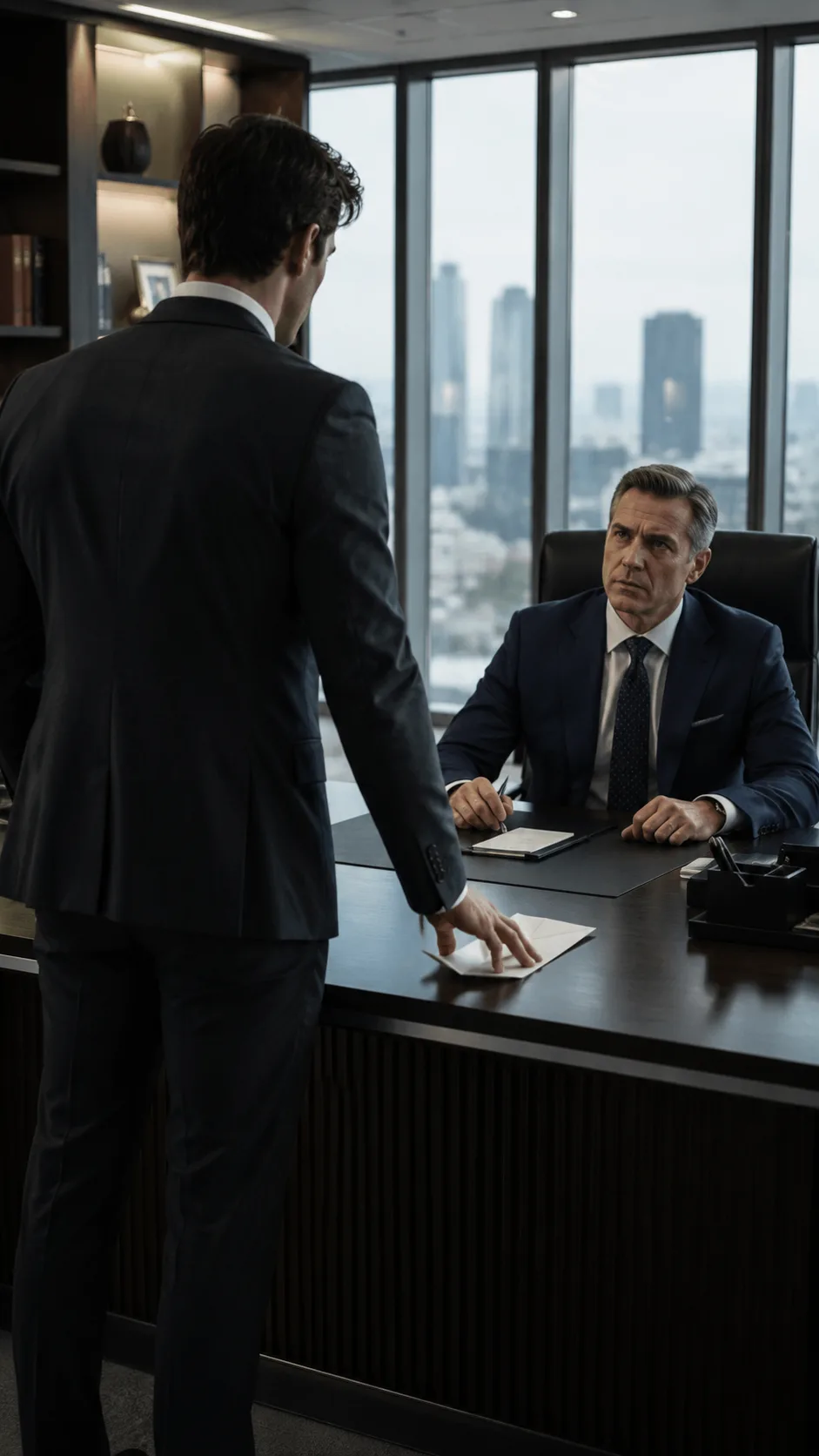
Richard stood behind his desk with the phone in his right hand. He looked irritated first. The way a man looks when his schedule is touched by someone beneath him.
Then he saw Thomas.
The irritation drained out, replaced by something smaller and faster.
Richard lowered the phone.
“I’ll call you back.”
He ended the call.
The office door remained open behind Thomas.
Evelyn stood just outside, stiff as a statue. Two executives had slowed in the hallway. Mara appeared near the far end, holding a tablet she wasn’t reading.
Richard noticed all of it.
That pleased Thomas in a grim way.
Richard cared about audiences. He always had.
“Thomas,” Richard said. “Close the door.”
“No.”
A small line appeared between Richard’s eyebrows.
Thomas walked to the desk and removed the folded letter from his jacket pocket. He placed it on the dark wood surface between them.
Not thrown.
Not slammed.
Placed.
Richard looked down at it.
His jaw shifted once.
“I assume you’ve read it.”
“I have.”
“It’s a strong offer.”
“It’s a payment.”
Richard’s eyes moved to the open door.
“Careful.”
Thomas rested one hand on the back of the chair in front of him. He did not sit.
“Is that advice or a threat?”
Richard took off his glasses and set them beside the letter. Every movement was measured. He was trying to slow the room down, pull it back under his control.
“You’ve earned this position.”
“No.”
“You’ve delivered results for nine years.”
“I did.”
“You built the Midwest accounts almost alone.”
“I did.”
“You trained half the people on that floor.”
“I did.”
Richard leaned forward.
“Then don’t insult both of us by acting like this is charity.”
Thomas looked at him for a long moment.
Then he nodded once.
“That’s fair. It’s not charity.”
Richard’s face eased by a fraction.
“It’s a bribe,” Thomas said.
The hallway went still.
A printer beeped somewhere outside and nobody moved toward it.
Richard’s hand closed around the edge of his desk. His wedding ring caught the cold light from the window. Thomas looked at it, then back at his face.
“Lower your voice,” Richard said.
“My voice is fine.”
“You don’t want to do this here.”
“No. You don’t.”
Richard stood.
He had always been tall, but the office was built to make him taller. Raised chair. Wide desk. Glass wall. Skyline behind him. Every detail chosen to frame power.
Thomas had once admired it.
Now he saw the stagecraft.
Richard buttoned his jacket.
“Whatever you think is happening, we can discuss it privately.”
Thomas let out a short breath through his nose.
“Privately. Like my house?”
Richard’s face changed.
Not much.
Enough.
Outside the office, Mara lowered the tablet. Evelyn looked away. The two executives near the hallway stopped pretending.
Richard spoke carefully.
“You’re angry.”
Thomas shook his head.
“No.”
“You’re hurt.”
“No.”
“Then what are you?”
Thomas placed his palm flat on the desk beside the letter.
“Done being priced.”
Richard stared at him.
For the first time since Thomas had known him, Richard had no prepared sentence ready.
That silence moved through the room like a crack through glass.
Thomas reached into his inner jacket pocket and removed a second envelope.
Richard’s eyes dropped to it.
This one was smaller. Plain. No company letterhead. No heavy paper. Just a standard white envelope with a crease near the corner.
Thomas placed it beside the promotion letter.
Richard did not touch it.
“What is that?” Richard asked.
“My resignation.”
Mara’s hand flew to her mouth and then dropped just as quickly. Thomas saw it from the corner of his eye.
Richard’s expression hardened.
“You’re making a mistake.”
“I’ve made plenty.”
“This is emotional.”
“No. This is documented.”
Another pause.
Richard looked at the envelope again.
Thomas continued.
“I sent copies to legal this morning. Not accusations. Not stories. Just the timeline of the promotion process, the sudden compensation change, the conflict of interest, and my decision to refuse.”
Richard’s eyes sharpened.
“You put this in writing?”
“Yes.”
“You have no proof of anything else.”
Thomas leaned slightly closer.
“I didn’t say I needed to prove everything today.”
Richard’s face lost color slowly, from the mouth outward.
That was new.
Thomas had seen him angry. Dismissive. Charming. Ruthless.
Not this.
Richard looked past him to the hallway.
“Everyone get back to work,” he said.
Nobody moved at first.
Then chairs scraped. Shoes shifted. The office began pretending to be alive again. But the door was still open. The words had already left the room.
Thomas picked up the resignation envelope and handed it to Richard.
Richard did not take it.
So Thomas placed it on the desk.
“I’m giving two weeks because my team deserves a handoff. Not because you do.”
Richard’s nostrils flared.
“You think you can walk out of here and damage my company?”
“No.”
Thomas straightened.
“I think you damaged it before I walked in.”
Richard stepped around the desk.
For a second, Thomas thought he might put a hand on his shoulder, do the executive thing, lower his voice, turn the confrontation into a performance of concern.
Instead, Richard stopped halfway.
Smart.
“You’ll regret this,” Richard said.
Thomas looked at the promotion letter.
Then at the resignation.
Two envelopes.
Two exits.
One bought.
One chosen.
“I already regret enough.”
He turned and walked out.
Mara was waiting near his office when he returned. She didn’t ask what happened. Not immediately. She followed him inside and closed the door behind them.
Thomas took the letter opener from his desk drawer, then remembered there was nothing left to open.
Mara stood by the window.
“Are you leaving?”
“Yes.”
“When?”
“Two weeks.”
She nodded. Her eyes stayed on the carpet.
“Do you want me to start transition notes?”
Thomas looked at her then.
That was Mara. Not drama. Not panic. Work first, feelings later.
“Yes,” he said. “And send me the list of accounts that need immediate coverage.”
She turned to leave, then stopped.
“For what it’s worth,” she said, “people know something’s wrong.”
Thomas rubbed one hand across his mouth.
“People always know more than they say.”
Mara nodded once.
“Yeah.”
After she left, Thomas sat down.
His hands were steady now.
That surprised him.
At noon, his phone buzzed.
Natalie.
He let it ring.
Then again.
Then a text.
Please come home tonight. We need to talk.
Thomas stared at the message until the screen went dark.
At 6:48 p.m., he parked in his driveway.
No black Mercedes.
The porch light was on even though it wasn’t dark yet. Natalie always turned lights on too early when she was nervous. It had annoyed him for years. Now it felt like evidence from another marriage.
Inside, the house smelled like lemon cleaner.
She had cleaned.
Of course she had.
The living room pillows were arranged too neatly. The puzzle on the dining table was gone. Their wedding photo was still on the hallway table, but slightly turned, as if someone had touched it and changed their mind.
Natalie stood in the kitchen.
She wore a blue sweater Thomas had bought her in Boston. Her hair was pulled back. No makeup.
There were two cups of tea on the table.
He did not sit.
“I heard what happened,” she said.
“I’m sure.”
“Richard called me.”
Thomas looked at her.
That was the first thing that landed.
Not the affair. Not the silence. Not the promotion.
Richard called her.
“When?”
“This afternoon.”
“What did he say?”
She folded her hands together, then unfolded them.
“He said you were unstable. That you might ruin your career. That I should talk sense into you.”
Thomas looked at the tea.
Steam rose from both cups.
She had made his with too much honey. She always did that when she wanted forgiveness and didn’t know where to begin.
“And are you going to?” he asked.
Natalie’s mouth tightened.
“No.”
Thomas waited.
She gripped the edge of the counter behind her.
“I don’t know how to fix what I did.”
“Don’t start there.”
She looked down.
“Where do I start?”
“With the truth.”
The refrigerator hummed. A car passed outside. Somewhere upstairs, the old pipes clicked.
Natalie nodded, but no words came right away.
Thomas pulled out a chair and sat. Not because he wanted comfort. Because standing made the room feel like a trial, and he was too tired to perform one.
Natalie sat across from him.
She told him enough.
Not every detail. He didn’t ask for every detail. He didn’t want images to replace the ones he already had.
It had started after the charity gala in March. A ride home. Messages. Lunches that were not really lunches. The kind of attention powerful men know how to give without seeming to ask for anything. The kind of weakness lonely people pretend is confusion.
Thomas listened.
Once, he stood and opened the kitchen window because the room felt too warm.
Once, Natalie stopped speaking because he pressed his thumb so hard against the table edge that the skin went white.
But he did not shout.
That was not mercy.
It was distance.
When she finished, the tea had gone cold.
“I’m sorry,” she said.
Thomas looked at the two mugs.
“Did you love him?”
Natalie shook her head.
“No.”
“Did you love me?”
Her answer came too quickly.
“Yes.”
He stood.
She reached across the table, but stopped before touching his hand.
Good.
“Thomas, please.”
“I’m sleeping in the guest room tonight.”
Her face folded inward, but she nodded.
He walked upstairs.
The guest room still had boxes from their last move. Books they never shelved. A lamp with no shade. One framed print leaning against the wall because Natalie had never decided where it should go.
Thomas made the bed with sheets that smelled faintly of cedar and dust.
He lay down fully dressed and stared at the ceiling.
The next two weeks were quieter than he expected.
At work, Richard avoided him.
Not completely. That would have looked like fear. Richard was too practiced for that. He attended meetings Thomas was in, spoke only when necessary, and let legal handle the resignation paperwork.
The promotion was never mentioned again.
But people knew.
They didn’t know everything. Offices rarely need everything. They live on fragments. A returned letter. An open door. Richard’s face. Thomas’s resignation. Natalie’s name whispered once by someone who should have known better.
On Thomas’s last day, Mara brought him a cardboard box.
“Traditional,” she said.
He looked at it.
“Depressing.”
“Also traditional.”
They packed his office together. Nine years reduced to objects. A photo from the Denver conference. A cracked mug. Three sales awards. A stack of notebooks filled with numbers no one would read now.
At the bottom drawer, Thomas found a birthday card from Natalie.
Two years old.
You always make impossible things feel steady.
He stared at it for a long time.
Mara pretended to organize paper clips.
Thomas placed the card in the box.
Not because he forgave her.
Because throwing it away would have been a kind of performance too.
At 4:30, his team gathered near the conference room. Someone bought cupcakes. Mark from marketing gave a speech that lasted too long and said nothing. Mara handed Thomas a small envelope from the team.
Inside was a gift card to a bookstore and a note with twelve signatures.
Mara’s note was at the bottom.
Don’t disappear.
Thomas folded it carefully.
When he walked past Richard’s office for the last time, the door was closed.
Through the glass, Richard sat behind his desk, speaking to no one, one hand resting near his mouth. The skyline behind him was gray with rain.
Thomas did not knock.
He kept walking.
Outside, the air smelled wet and metallic. The city moved like it always had. Taxis splashed through shallow puddles. A man in a brown coat argued into his phone. A woman laughed under a red umbrella.
Thomas stood under the awning with his cardboard box in both arms.
For the first time in nine years, he had nowhere to be the next morning.
That should have frightened him.
It didn’t.
At home, Natalie was waiting in the living room.
A suitcase stood beside the couch.
Thomas stopped in the doorway.
“Are you leaving?” he asked.
She nodded.
“For a while.”
He looked at the suitcase. One handle. Two wheels. The blue ribbon from their honeymoon still tied around it so they could spot it at baggage claim.
“Where?”
“My sister’s.”
He nodded.
Natalie held out an envelope.
Not another one.
He almost laughed.
Almost.
“What’s this?”
“A list. Bank accounts. Bills. Passwords. The lawyer I spoke to.”
Thomas took it.
Their fingers did not touch.
“I’m not asking you to forgive me,” she said.
“Good.”
“I’m not asking you to decide tonight.”
He looked at her then.
She seemed smaller without the house pretending around her.
“I don’t know what I’m deciding,” he said.
“I know.”
For a while, neither of them moved.
Then Natalie picked up her suitcase.
At the door, she turned back.
“The croissant,” she said.
Thomas looked up.
“What?”
“That night. I saw the bag in the trash later.”
His throat tightened once.
She looked at the floor.
“I’m sorry for that too.”
Then she left.
The door closed gently.
Thomas stood in the living room with the envelope in his hand. The house was quiet, but not the same quiet as before. This one did not feel like a punishment. It felt empty in a cleaner way.
He went to the kitchen.
On the table sat the unfinished puzzle. Natalie had taken it back out before leaving. The border was done, but the center was still scattered.
Thomas sat down.
He picked up one piece.
Blue.
Maybe sky. Maybe water.
He tried it in three places before it fit.
Then another.
Then another.
Outside, rain tapped against the windows. The washing machine sat silent in the laundry room, still broken, still waiting to be fixed or replaced.
Thomas worked on the puzzle until after midnight.
He did not finish it.
He didn’t need to.
The next morning, he woke before his alarm, then remembered he had turned it off.
No office.
No Richard.
No promotion letter.
Downstairs, the house held its breath around him.
Thomas made coffee for one.
This time, his hand did not reach for the second mug.
Chapter complete
You have reached the end of this chapter.
Continue reading
A few more worlds to get lost in after this chapter.




