MY BIRTH PARENTS CAME BACK CRYING AFTER THEY HEARD MY RICH ADOPTIVE FATHER LEFT ME EVERYTHING
PART 1
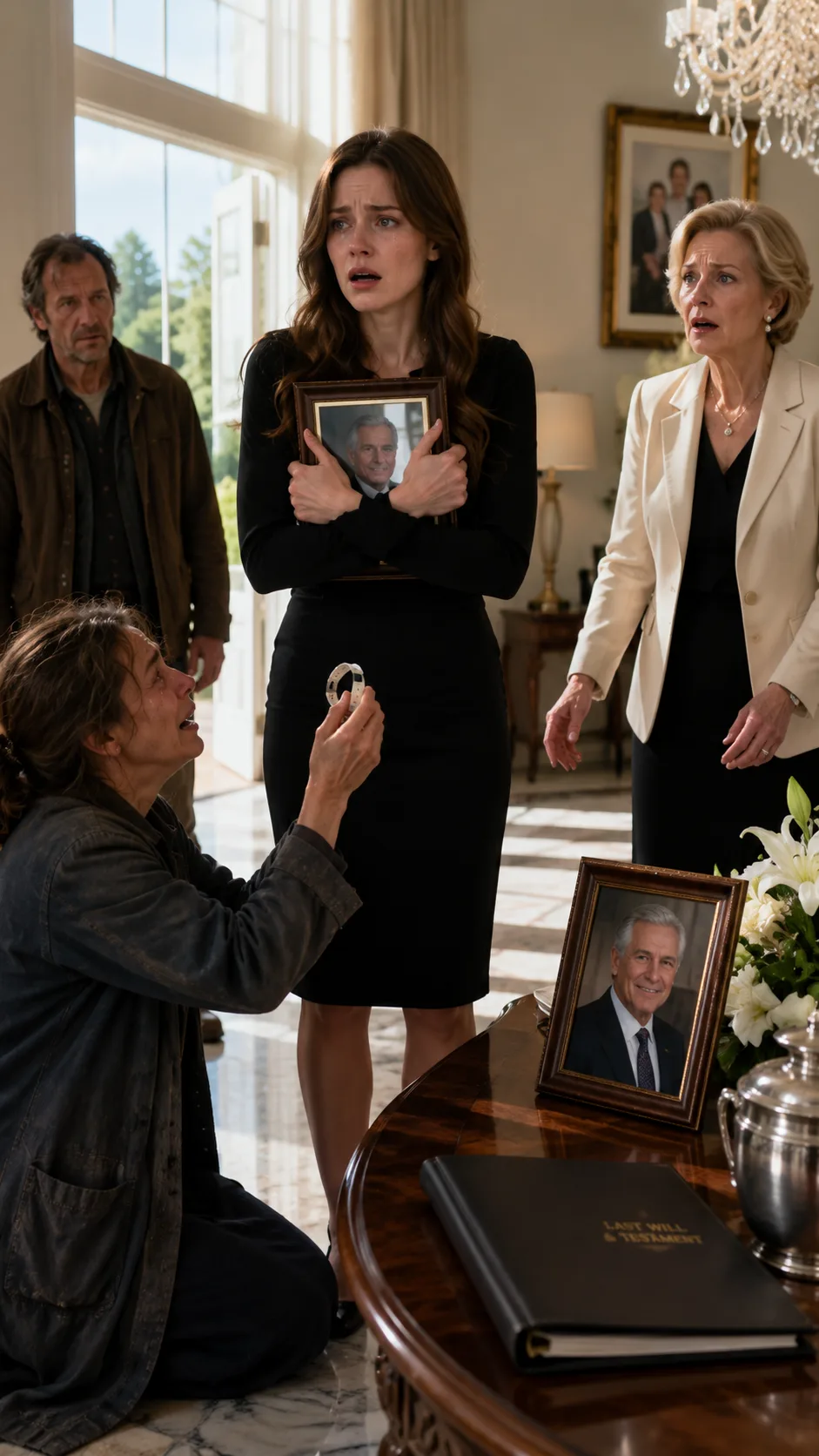
The first time I saw my birth mother, she was kneeling on the marble floor of my adoptive father’s mansion.
Chapter 1
MY BIRTH PARENTS CAME BACK CRYING AFTER THEY HEARD MY RICH ADOPTIVE FATHER LEFT ME EVERYTHING
PART 1
The first time I saw my birth mother, she was kneeling on the marble floor of my adoptive father’s mansion.
It was one hour after Robert Whitmore’s funeral.
I was still wearing my black dress, still holding his framed photo, still trying to understand how the only father I had ever known was gone, when the front doors opened and a woman I didn’t recognize rushed inside.
“Emily!” she cried. “My baby!”
Before anyone could stop her, she grabbed my hands and pressed her forehead against them.
The room froze.
My adoptive mother, Grace Whitmore, went so pale I thought she might faint.
Then a thin man in a brown coat stepped beside the crying woman and looked around the estate—the chandelier, the grand staircase, the oil paintings, the silver-framed family portraits.
His eyes stopped on me.
“We lost you once,” he said. “We won’t let rich people keep our daughter from us again.”
My chest tightened.
Daughter.
No one had ever called me that in that voice before.
The
woman looked up at me, tears shining on her cheeks. “I’m Linda Hayes,” she whispered. “I’m your real mother.”
Grace took one step forward. “Emily, please—”
I turned to her.
For twenty-six years, Grace had told me my birth parents gave me up because they had no choice.
But now my real mother was on her knees in front of me, sobbing like someone who had been robbed.
And suddenly, the woman who raised me looked like the one who had been hiding the truth.
PART 2
I did not sleep that night.
I sat on the edge of my childhood bed in the Whitmore estate, the same room Grace had decorated in pale blue when I was six, and listened to the silence of a house that suddenly felt too large.
On my nightstand sat two photographs.
One was of Robert Whitmore, my adoptive father, smiling beside me at
my college graduation. He had his arm around my shoulders, his gray hair messy from the wind, his face proud in that quiet way of his.
The other photo was brand new.
Linda had pushed it into my hand before Grace asked everyone to leave. It showed a young woman holding a newborn baby wrapped in a pink blanket. The woman’s hair was darker then, her face tired but soft.
On the back, written in faded blue ink, were four words.
My Emily. Three days old.
I read those words until my eyes burned.
At seven in the morning, I went downstairs.
Grace was already in the kitchen, still dressed from the night before. She had not slept either. Her coffee sat untouched in front of her.
“Emily,” she said softly.
I stopped at the doorway. “How long have you known they were alive?”
Her face folded.
“Always.”
The answer
hurt more because it came so quickly.
I gripped the doorframe. “You told me they couldn’t take care of me.”
“That was true.”
“You told me they never came back.”
Grace looked down.
My stomach dropped.
“They came back?”
Her silence was enough.
Before I could speak, the doorbell rang.
Grace closed her eyes. “Please don’t do this while you’re grieving.”
“I’m already grieving,” I said. “I’m just learning there’s more to bury.”
I opened the front door myself.
Linda stood there in a thrift-store navy dress, holding a paper bag. Carl stood behind her with his hands in his coat pockets. He looked tired, but his eyes moved past me into the foyer before he looked at my face.
“I made soup,” Linda said. Her voice trembled. “You used to love warm milk when you were a baby. I didn’t know what you like now.”
Something in me cracked.
She didn’t know what I liked.
She didn’t know my favorite color, my middle school nickname, the way I hated mushrooms, the fact that Robert used to call me “Emmy Lou” when he wanted to make me laugh.
But she had known me first.
I stepped aside.
Grace stood from the kitchen table when Linda entered.
The two women looked at each other like they were standing over the same wound.
Linda held the paper bag tighter. “I didn’t come to fight.”
Grace’s voice was low. “Then why did you come yesterday?”
Linda’s eyes filled instantly. “Because my daughter’s father died, and I found out from a newspaper.”
Carl cleared his throat. “The article said Robert Whitmore’s only daughter would inherit the family estate. That’s how we knew where to find her.”
The room went still.
I looked at him. “You found me because of an inheritance article?”
Linda spun toward him. “Carl.”
“What?” he said. “It’s true.”
He seemed to realize too late how it sounded.
Linda grabbed my hand. “Emily, no. I didn’t come because of money. I came because seeing your face in that article broke me. I thought I had lost the right to know you, but then I saw you, and I couldn’t breathe.”
I wanted not to believe her.
But she was crying again, and the child inside me—the little girl who used to ask why her first mother didn’t want her—was starving.
So I let her stay.
For three days, Linda became a storm in my life.
She cooked. She cried. She touched my hair. She told me I had her mother’s eyes. She said she had named me Emily because it sounded gentle, because she wanted me to have a gentle life.
Carl stayed quieter. Too quiet.
He asked questions that felt harmless until they didn’t.
“Do you live here alone with Grace now?”
“Did Robert leave the whole estate to you?”
“Who handles the accounts?”
“Does Grace make decisions for you?”
Each question was wrapped in concern, but I began to hear the weight beneath it.
On the fourth day, Linda brought a small bracelet from her purse. It was a hospital bracelet, yellowed with age.
EMILY HAYES.
I held it like it was a piece of a life I had never been allowed to touch.
Grace saw it and covered her mouth.
I turned sharply. “You’ve seen this.”
Grace whispered, “Yes.”
Linda stood. “Tell her.”
Grace shook her head. “Linda, don’t.”
“Tell her you knew I came back.”
I stared at Grace.
My voice barely came out. “You said they never tried.”
Grace began to cry. “I said they never tried to take you home.”
The sentence landed like a slap.
Linda let out a broken sound. “I was poor, Emily. I was sick. Carl had no job. We were living in one rented room. I gave you away because I thought it was the only way you would survive.”
Carl stepped in. “Then when we came back, the Whitmores had money, lawyers, everything. We had nothing.”
Grace stood straighter. “That is not what happened.”
Linda pointed at her. “You had my child.”
Grace’s voice shook. “You left her.”
The kitchen fell silent.
I looked between them, and suddenly I wasn’t twenty-six. I was ten again, sitting on my bedroom floor, wondering what was so wrong with me that someone could walk away.
“I need the records,” I said.
Grace closed her eyes.
That afternoon, I drove to the adoption agency.
A woman named Marlene found my file in a back archive. She remembered Robert and Grace. She remembered Linda too.
When I asked if Linda and Carl had ever contacted the agency to find me, Marlene’s face changed.
“Officially?” she said.
My hands tightened. “What does that mean?”
She opened the file and slid one page toward me.
“They came once when you were two.”
I stopped breathing.
“What did they want?”
Marlene hesitated.
“Please,” I said. “I have spent my whole life filling in blanks with pain. Just tell me.”
Her voice softened. “They asked whether the Whitmores would be willing to help them financially.”
I stared at her.
“Financially,” I repeated.
“They said they were struggling.”
“Did they ask to see me?”
Marlene looked down.
That was answer enough.
When I returned home, Linda and Carl were in the living room. Grace was standing by Robert’s desk with a leather-bound journal in her hands.
Linda saw it and went white.
“What is that?” she asked.
Grace looked at me. “Your father kept records because he was afraid one day you’d blame yourself.”
Carl stepped forward. “This is private family business.”
I laughed once, but it came out hollow. “Whose family?”
Grace opened the journal.
Robert’s handwriting filled the page.
Linda and Carl returned today. They did not ask whether Emily was happy. They asked how much help we could provide if they agreed not to disturb her life.
Linda shook her head violently. “No. He twisted it.”
Grace turned another page.
Robert had written one sentence darker than the rest.
I will never let Emily believe she was unwanted because of her worth to them.
I covered my mouth.
Linda began sobbing. “I was desperate.”
“For me?” I asked.
She couldn’t answer.
Carl’s jaw tightened. “We made mistakes. But blood still matters.”
The front door opened before I could respond.
A young man stepped inside wearing a delivery jacket, holding his phone.
“Mom?” he called. “Dad? I got your message.”
I froze.
Mom.
Dad.
The young man stopped when he saw all of us.
Linda whispered, “Brandon, not now.”
I looked at him. He had Linda’s eyes and Carl’s mouth.
“Who are you?” I asked.
He looked confused. “I’m Brandon.”
Carl’s son.
Linda’s son.
Their son.
The child they had kept.
Brandon shifted uncomfortably. “They told me you were my sister.”
The room tilted.
“Sister?” I repeated.
Brandon swallowed. “They said once you understood what happened, maybe you’d help us. With the debt.”
Linda let out a cry. “Brandon, stop talking.”
But he was already looking at me with dawning horror.
“They said you inherited millions,” he whispered. “They said family should share.”
I looked at Linda.
The woman who had cried on my hands.
The woman who had called me baby.
The woman who had waited until my adoptive father died and my inheritance was public before finding me.
And finally, the truth stood in the room without needing anyone to explain it.
They had not come back because they missed their daughter.
They had come back because their daughter had become valuable.
To be continued, Part 3 now
Chapter complete
You have reached the end of this chapter.
Continue reading
A few more worlds to get lost in after this chapter.




