a calm, measured voice. Donations were listed first: hospitals, veteran foundations, university programs, longtime employees. My parents sat straighter with every page, clearly waiting for the real announcement. Then it came.
“To my granddaughter, Emily Whitmore, I leave my controlling shares, liquid assets, private properties, and all remaining holdings, totaling approximately three point eight billion dollars.”
The room went still.
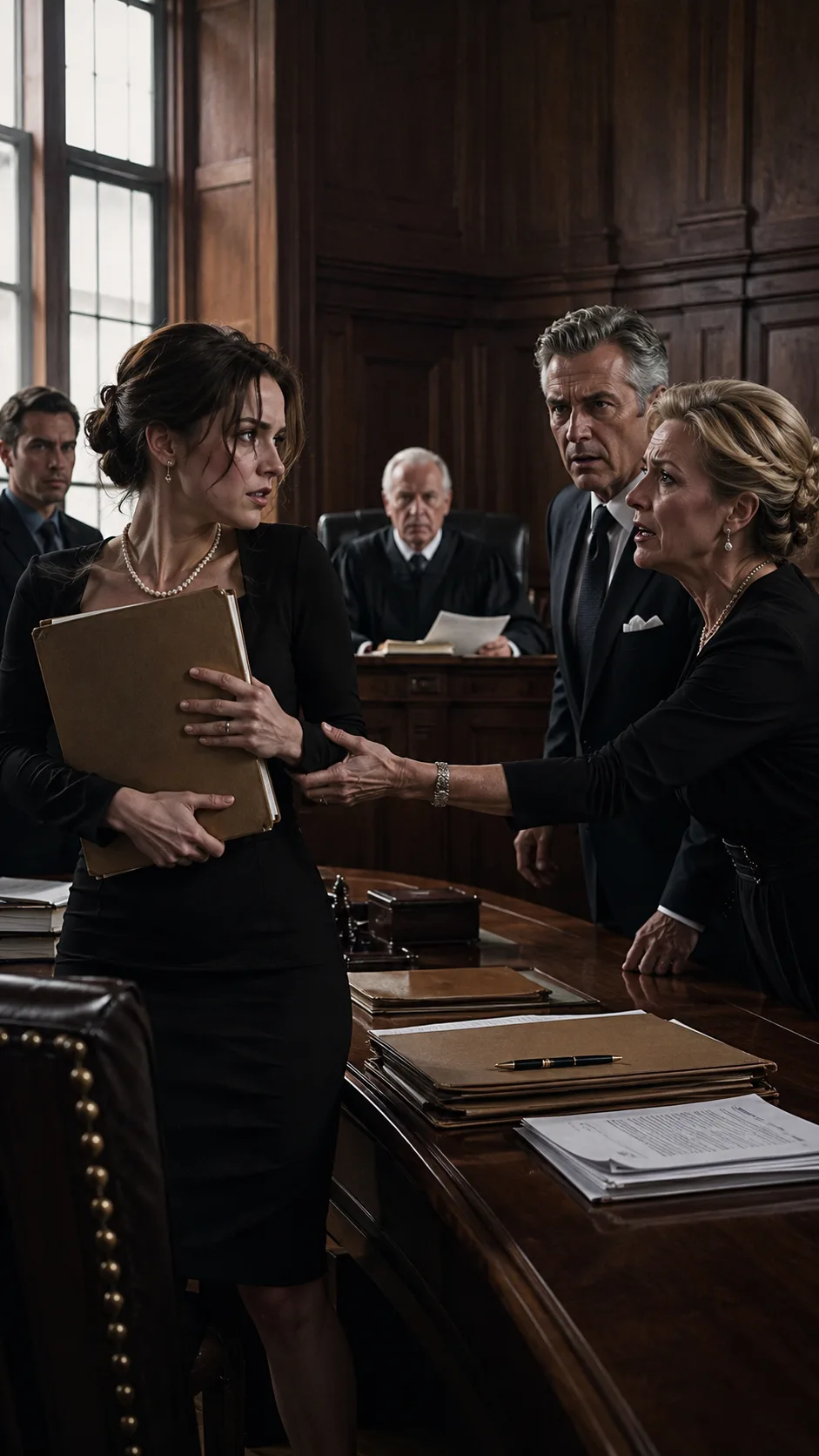
My mother grabbed my hand so fast it startled me. “Of course,” she said, smiling brightly now, “we’ll help you manage all this. It’s far too much for one young woman.”
My father nodded with the confidence of a man reclaiming what he believed was his. “You’ll need guidance. Legal protection. Experienced hands.”
I slowly pulled my hand away.
Then the judge turned to the next page.
His expression changed.
And when he began to read the attached statement my grandfather had added in his own words, the smiles on
my parents’ faces disappeared instantly.Part 2: “To my son Daniel, and to his wife Victoria,” the judge read, his voice now sharper, “you are to have no authority, temporary or permanent, over any asset transferred to Emily under this will.”
A ripple moved through the courtroom.
My father’s jaw tightened. My mother blinked as if she had misheard. But the judge continued.
“I make this declaration because I am of sound mind, and because I have observed over many years that my granddaughter has been treated as disposable whenever she refused to serve the ambitions of others. She is not naive, weak, or in need of parental control. If Daniel or Victoria attempt to coerce, manipulate, intimidate, or pressure her into surrendering financial authority, their trust distributions are to be permanently revoked and redirected to the Whitmore Foundation.”
My mother made a choked sound. “This is outrageous.”
The attorney lifted a hand. “Please let the judge finish.”
There was more.
My grandfather had not left my parents empty-handed. They had each been assigned annual trust payments—large enough to live comfortably, but nowhere near enough to control the family empire. Those payments came with strict conditions: they would continue only if they made no legal challenge to the will and no attempt to interfere with my management of the inheritance. If they violated either condition, the payments ended immediately.
My father stood up so abruptly his chair scraped the floor. “This is absurd. Emily has no experience running a fortune of this size.”
The judge glanced over his glasses. “Your father appears to have considered that.”
He turned another page.
My grandfather had arranged a private advisory board for me: a veteran estate attorney, an independent forensic accountant, the CEO of the company’s operating arm, and a fiduciary manager with a reputation for dismantling fraud. None of them reported to my parents. All of them were contractually obligated to protect my interests, not anyone else’s.
Then came the final blow.
For the previous three years, my grandfather had quietly documented attempts by my parents to influence his estate planning. Emails had been preserved. Phone records had been logged. There were even memoranda from staff describing private dinners where my parents discussed how quickly I would “fold” if enough emotional pressure were applied.
This time, I did laugh. Softly, but enough for my mother to hear.
She turned toward me, her face hardening beneath the polished grief. “You think this is funny?”
“No,” I said. “I think it’s clear.”
The hearing ended in icy silence. Outside the courtroom, however, the performance ended and the real battle began.
My father cornered me near the elevator. “Listen to me carefully, Emily. Wealth like this destroys people. You are not prepared.”
“For what?” I asked. “For you pretending to care?”
His expression darkened. “Don’t be childish.”
My mother stepped closer, lowering her voice. “We can still handle this privately. No public embarrassment. Sign temporary authority over the holdings while you learn.”
I stared at her. Eight years without a call, and now she was bargaining with concern she had never shown for free.
“I’d rather burn the paperwork,” I said.
That was when my father’s mask finally slipped. “You ungrateful little fool. Everything you have comes from this family.”
“No,” I replied. “From one man in this family.”
Two days later, the calls started. Then the messages. Then the articles. Anonymous sources began feeding gossip blogs claims that I was unstable, irresponsible, artistically impulsive, unfit to oversee a corporate fortune. Someone leaked old photos of me carrying coffee trays and implied I had “manipulated” my grandfather in his declining years.
They wanted me frightened enough to hand control over.
Instead, I hired every expert my grandfather had chosen.
And when my forensic accountant asked whether I wanted a full audit of every financial interaction my parents had ever had with Whitmore family entities, I answered without hesitation.
“Yes.”
Part 3: The audit began quietly, which was exactly how my grandfather had preferred important things to happen. No dramatic announcements. No threats. Just competent people pulling on loose threads until entire seams came apart.
Within three weeks, the first irregularities surfaced.
My parents had not merely expected access to my inheritance; they had apparently been preparing for it. Through shell consulting agreements and inflated vendor contracts, millions of dollars had been routed over the years from subsidiary budgets into companies connected to my father’s friends. My mother, meanwhile, had used a charitable arts initiative—one she publicly championed at galas—to funnel foundation money into “event costs” that largely paid for private travel, luxury hospitality, and personal staff.
It was elegant on the surface, ugly underneath.
The forensic accountant laid the preliminary report across the conference table and looked at me steadily. “This is enough to trigger civil action. Possibly criminal review, depending on intent and documentation.”
For a long moment, I said nothing. Not because I felt torn, but because I was remembering every time my parents had called me irresponsible. Every lecture about discipline, respectability, sacrifice. Every cold silence they had wrapped in the language of principle.
“Proceed,” I said.
The legal filings were submitted under seal first. My parents did not know how much had been uncovered until they received formal notice. I found out later that my mother screamed so loudly at her attorney that two assistants heard her through a closed office door. My father tried a different tactic. He requested a private meeting.
Against my advisors’ recommendations, I agreed—but only in a conference room at the family law office, with counsel present.
He arrived alone, without the polished confidence he wore in public. For the first time in my life, Daniel Whitmore looked older than his age. Smaller, too.
“This has gone far enough,” he said after sitting down.
“You should have stopped years ago.”
His mouth hardened. “Do not act righteous. You benefited from this family’s name whenever it suited you.”
“I worked for tips,” I replied. “That wasn’t exactly a trust fund lifestyle.”
He leaned forward. “If you continue, your mother and I will be ruined.”
I held his gaze. “You were comfortable ruining me when I was eighteen.”
A flicker of anger crossed his face, then calculation replaced it. “What do you want?”
There it was. Not an apology. Not accountability. A transaction.
“I want the truth on record,” I said. “I want every stolen dollar repaid where possible. I want resignations from every board position either of you still hold. And I want a signed statement that neither of you will contact me again except through legal counsel.”
He stared at me as if I had become someone unrecognizable.
Maybe I had.
The settlement took two months. My parents resigned quietly from the family foundation and several affiliated boards. Their trust distributions were revoked under the terms of the will once the court determined they had attempted coercion and concealed material financial misconduct. A portion of their remaining assets was liquidated to satisfy repayment agreements. To avoid a longer public case, they accepted terms that barred them from representing Whitmore interests in any capacity.
The press still got wind of it, of course. Newspapers framed it as a dynasty implosion. Commentators called me cold, brilliant, vindictive, disciplined. Strangers projected their own stories onto mine. I ignored them.
What mattered was simpler.
I kept the company, but restructured the advisory culture. I expanded employee profit-sharing. I funded the scholarship program my grandfather had once mentioned over soup and tea, the one for students whose families cut them off for choosing unconventional lives. I reopened the arts grant my mother had used as decoration, this time with transparent oversight and public reporting.
Six months after the hearing, I visited my grandfather’s grave alone.
“I didn’t let them take it,” I told the stone.
The wind moved through the trees, cold and clean. There was no miracle, no sign, no voice from beyond. Real life does not work that way. But for the first time, I understood something he had tried to teach me all along: money does not reveal character as much as it removes the excuses hiding it.
My parents came to the will reading expecting to seize my future with a smile.
Instead, they lost the last leverage they had over me.
And I inherited something far greater than billions.
I inherited the freedom to make sure their story ended with me.
THE END.