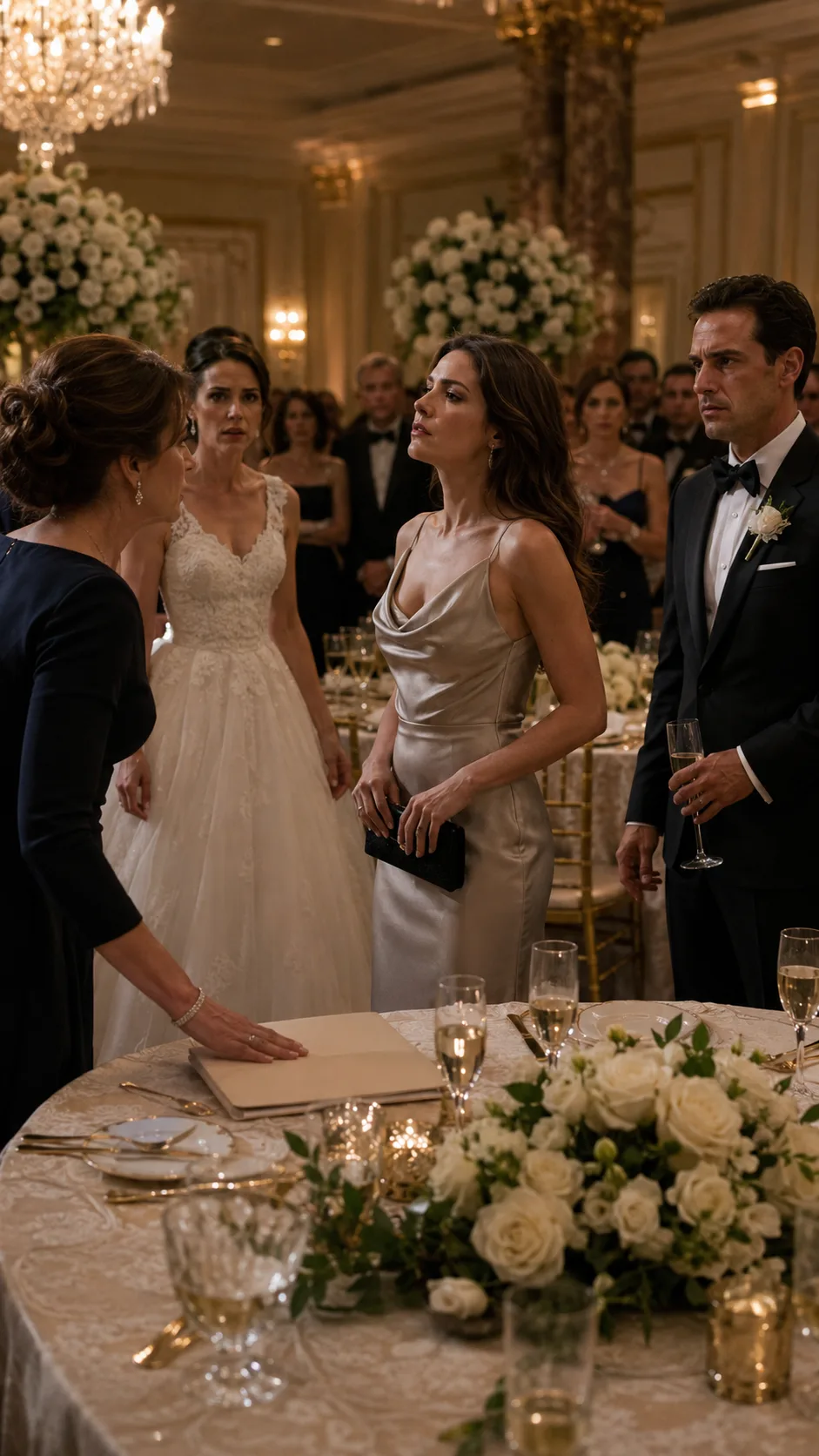
The cream portfolio landed beside my dinner plate hard enough to make the champagne flute tremble.
Chapter 1
The cream portfolio landed beside my dinner plate hard enough to make the champagne flute tremble.
For one second, all I saw was the silver clasp.
Not my aunt’s face. Not my husband standing behind her. Not my sister in her wedding gown, turning slowly from the cake table with one hand still holding the edge of her veil.
Just the clasp.
Small. Polished. Expensive. The kind Clara never bought unless she wanted everyone to know something had been chosen carefully.
She kept her palm on top of the portfolio, pressing it flat against the white linen tablecloth. Her bracelets clicked together as she leaned toward me.
“Open it,” she said. “Let everyone see what you lost.”
The guests closest to us stopped talking first.
My sister Sofia’s wedding had been designed to look untouchable. White roses climbed the gold arch near the dance floor. Crystal chandeliers hung over the ballroom like frozen rain. Every table had floating candles, pale orchids, and menus printed in silver
ink.
Clara had paid for none of it.
But she stood in the middle of it like she owned the room.
I sat with my hands in my lap, the satin of my dress catching against my knees. Across from me, my cousin Mateo stared at the portfolio like it might move on its own. Behind Clara, my husband Adrian held a champagne flute by the stem, untouched, his fingers too tight around the glass.
That was how I knew.
He had seen the portfolio before.
Clara had not surprised him.
Sofia took one step toward us. Her new husband, Daniel, touched her elbow gently, not stopping her, just asking her without words to wait. She pulled away from him anyway.
“Aunt Clara,” Sofia said. “Not here.”
Clara did not even turn around.
She looked at me instead, her chin angled down, her smile thin enough to cut thread.
“Your
sister deserves honesty today,” she said. “Everyone does.”
A few people shifted in their seats. The photographer lowered his camera. Someone at the next table whispered my name.
Isabel.
I had spent most of my marriage hearing my name said in different ways.
Adrian said it when he wanted me to be quiet.
Clara said it when she wanted me to remember my place.
My mother said it when she wanted me to forgive a thing no one had apologized for.
Sofia said it like it was still mine.
I looked at her then, standing in her wedding dress with the ballroom lights catching in the beads across her bodice, her face pulled tight with a question she should not have had to ask on that day.
I gave her the smallest shake of my head.
Not yet.
Clara mistook the gesture for weakness.
She slid the portfolio closer to
me. The corner touched the edge of my plate.
“Go on,” she said. “Open it. Or are you afraid the room will finally understand why Adrian has been so patient?”
Adrian’s jaw moved once.
He did not speak.
That had always been his gift. He let other people do the ugly work and then walked in later with clean hands.
When we first married, I thought his quiet meant gentleness. He listened more than he talked. He never raised his voice. He could sit through an entire dinner with my family and make everyone feel seen.
Clara had warned me about that, oddly enough.
“Quiet men are only quiet when someone else is speaking for them,” she told me the night before my wedding.
I had laughed then.
She had not.
Three years later, I understood she had not been warning me.
She had been claiming the position.
Clara lived two streets away from us, but she walked through our house like it was part of hers. She had keys. She knew the alarm code. She knew where Adrian kept his favorite cufflinks and which wineglass he used when he was trying to impress someone.
She also knew which drawers I used.
I learned that six months before Sofia’s wedding, when I came home early from a dress fitting and found the bottom drawer of my study desk open.
Nothing looked stolen.
That was what made me stand still.
A thief leaves a gap. Clara left order.
The drawer had been pushed back almost perfectly. The receipts were stacked. The old trial notes were aligned. My mother’s letters were tied with the same blue ribbon I used.
But the ribbon knot was different.
I tied square knots. Always had. Sofia used to tease me for it when we were children because I could never tie bows on gifts that looked soft.
The ribbon around my mother’s letters had been tied in a bow.
I stood there in the study with my dress bag still over one arm and listened to the air conditioner hum.
Then I closed the drawer.
I said nothing to Adrian that night.
At dinner, he asked how the fitting went. Clara called halfway through dessert and stayed on speaker for twenty minutes, talking about flower arrangements, Daniel’s family, the seating chart, and whether Sofia had enough “discipline” to handle a formal reception without becoming sentimental.
Adrian smiled at the table while she talked.
I watched his fork.
It stopped moving every time she mentioned my name.
After that, I started checking small things.
The study door. The drawer edges. The call logs on the house phone. The security camera above the bookcase that Adrian had installed after a delivery driver left a package at the wrong door.
He had forgotten about that camera.
Or maybe he had never thought I would use it.
The first recording I found was almost nothing. Clara walking into the study alone while we were out. She opened my desk drawer. She read two pages from my trial notes. She put them back. Then she stood by the window for nearly a minute with her arms folded, not moving.
The second recording showed Adrian with her.
They did not search. They talked.
The third recording was the one I saved to my phone, my laptop, a cloud drive, and a memory card I placed inside the lining of my black clutch.
That one was recorded at 11:47 p.m. the night before the court hearing.
Adrian had told me he was going to sleep early.
Clara had told Sofia she was exhausted from finalizing wedding details.
Both of them walked into my study after midnight.
With Mr. Voss.
People called Voss a family advisor because “private fixer” sounded cheap. He wore gray suits with no shine and spoke softly enough to make people lean in. He had helped Clara settle two inheritance disputes and one scandal involving Mateo’s business partner. No one ever introduced him by title.
In the recording, he stood beside my desk and held a folder against his chest.
Clara stood near the lamp.
Adrian sat in my chair.
That bothered me more than I wanted it to.
My chair.
His hands rested on my desk like he had finally taken his proper seat.
“I don’t care what she suspects,” Clara said in the video. “By tomorrow afternoon, it won’t matter.”
Voss said something about timing.
Adrian said my name.
Not with guilt. Not with regret.
With annoyance.
“She’ll fold if Sofia is involved,” he said. “She won’t risk embarrassing her sister.”
I had watched that part six times.
Not because it surprised me.
Because it explained too much.
Every time I had stepped back, every time I had swallowed an insult, every time I had chosen peace for Sofia’s sake, Adrian had not mistaken it for love.
He had studied it as leverage.
The recording went on.
Clara spoke about the hearing. Voss spoke about paperwork. Adrian spoke about my mother’s letters and the part of the family trust I had never shown him.
Then Clara said the line that made me set my coffee down and not pick it back up.
“The judge won’t care about a sentimental daughter. He’ll care who controlled the file.”
Voss corrected her.
Not loudly.
Just enough.
“You mean who altered the file.”
Clara turned toward him.
Adrian said, “Don’t use that word.”
Then the three of them stood there in my study, in front of the camera Adrian had installed, and discussed exactly what they had done.
I did not confront him that night.
The next morning, I went to court.
I wore a navy dress. I brought the wrong folder on purpose. I let Voss believe I had missed the missing page. I let Clara sit behind Adrian with her lips pressed together like she was waiting for my undoing. I let the judge ask his questions.
Then I let my attorney handle the first half.
Her name was Leona Marsh, and she had a way of making silence feel like a closed door.
She had warned me before we entered the courtroom.
“Do not react before I tell you to,” she said.
“I’m not planning to.”
She glanced at my hands.
They were steady.
“Good,” she said. “Keep them that way.”
The hearing lasted four hours.
Adrian watched me like he was waiting for some visible fracture.
Clara watched Leona.
Voss watched the judge.
By the time the missing page appeared, nobody in that room was smiling. By the time Leona requested the court review the original file history, Voss had stopped taking notes. By the time she mentioned there was video evidence, Adrian’s left hand disappeared under the table.
Clara did not look at him.
That was her mistake.
She looked at me.
And I smiled.
Not big. Not cruel.
Just enough for her to know I had heard everything.
The judge did not make a final ruling that day. He ordered review of the evidence, scheduled a follow-up, and warned both sides against any interference. His pen tapped the bench once while he said it.
Clara left the courtroom first.
Adrian tried to speak to me outside the elevators.
I walked past him.
He followed me down the hall.
“Isabel,” he said. “This is not how we should handle this.”
I stopped near the vending machines.
The hallway smelled like burnt coffee and floor polish.
I turned just enough to see him.
“How should we handle it?”
He looked tired suddenly. Not sorry. Tired.
“Privately.”
I almost laughed.
Instead, I said, “Then tell your aunt to stay home on Saturday.”
His face shifted.
One blink too slow.
Saturday was Sofia’s wedding.
He had already known.
That was when the last piece settled into place.
The papers were not a reaction.
They were the plan.
Clara would wait until Sofia’s reception, until the room was full, until cameras were present and my parents’ old friends were watching. She would hand me something in public. Not to end a marriage. Not really.
To frame me as the woman who brought disgrace into Sofia’s perfect day.
If I cried, I ruined the wedding.
If I shouted, I proved Clara right.
If I walked out, Adrian became the abandoned husband.
If I stayed silent, they controlled the story.
I went home that night and packed a small bag.
Not to leave.
To be ready.
Inside my black clutch, I placed three things: my phone, the memory card, and my mother’s blue ribbon, retied in my own square knot around the letters Clara had touched.
I slept in the guest room.
Adrian did not knock.
On the morning of Sofia’s wedding, he stood in the doorway while I fastened my earrings.
“You look nice,” he said.
I met his eyes in the mirror.
“Thank you.”
He adjusted his cufflink.
“You’re not going to make today difficult, are you?”
The earring slipped between my fingers and fell onto the vanity. A tiny sound. Almost nothing.
I picked it up.
“No.”
He smiled.
He believed me.
The church ceremony was beautiful.
Sofia cried before she reached the altar. Daniel cried before she did. Our mother dabbed her eyes with a lace handkerchief she had owned since our childhood, the one she used at funerals and graduations and every family moment too large for plain tissue.
Clara sat in the second row beside Adrian.
She wore dark blue.
Not black. She would never be that obvious.
During the vows, I kept my eyes on my sister.
Sofia deserved one untouched hour.
I gave her that.
At the reception, Clara moved through the ballroom with perfect timing. She kissed cheeks. She praised the flowers loudly enough for people to hear. She corrected the server about the wine temperature. She stood with Adrian near the bar for eight minutes while pretending not to speak to him.
I watched from Table Six.
Sofia came to me after the first dance, breathless and bright, her veil pinned back, lipstick slightly faded.
“You’re okay?” she asked.
I touched her wrist.
“I’m okay.”
“You and Adrian barely spoke during dinner.”
“He’s conserving his charm.”
She gave me a look.
I smiled first so she would.
“Don’t start today,” she said.
“I won’t.”
She studied my face.
Sofia had always been the better reader of people. As children, she knew when our mother had been crying even after the makeup came out. She knew when our father’s business calls were bad. She knew when I was lying.
She leaned closer.
“What did he do?”
Before I could answer, Daniel called her name from the dance floor. The photographer wanted another picture. She looked torn, one hand still on my wrist.
“Go,” I said. “Be the bride.”
Her fingers squeezed mine.
Then she went.
Clara approached seven minutes later.
I know because I looked at my phone when Sofia walked away.
9:18 p.m.
The cake had not been cut yet. Guests were warm with wine. The music had softened into something polite. The speeches were done. The room had reached that perfect hour when everyone felt safe.
Clara chose it well.
She came from the left side of the ballroom with the portfolio tucked under her arm. Adrian followed three steps behind. He had switched from wine to champagne. He always did that when he wanted to look relaxed.
My mother saw them before I did.
She stopped mid-sentence at the next table.
That was the first small crack.
Then Mateo saw.
Then Sofia, across the room, turned from the cake table and went still.
Clara stopped at my table.
The portfolio came down.
The champagne glass trembled.
“Open it,” Clara said. “Let everyone see what you lost.”
My hand stayed in my lap.
A chair scraped behind me.
“Clara,” my mother said.
Clara lifted one finger without looking at her.
One finger.
My mother stopped.
That told the room more than the papers did.
Clara leaned closer.
“You’ve hidden behind this family long enough.”
Adrian stood behind her, his face arranged into concern.
It was a good face.
He had practiced it in mirrors. I had seen him use it with donors, neighbors, Sofia, my mother, and me. A face that made cruelty look like patience.
He looked down at me.
“Isabel,” he said. “Just open it.”
Only my name.
Only that command folded inside it.
Sofia pushed through two guests and reached the edge of the table.
“What is this?” she asked.
Clara finally turned.
Her smile softened for Sofia.
That made it worse.
“Something your sister should have handled before today.”
Daniel came up behind Sofia. He looked from Clara to Adrian to me, and then to the portfolio.
He did not touch Sofia this time.
Good man.
Clara slid the portfolio closer.
The edge touched my plate.
A fork shifted, silver against porcelain.
“Go on,” she said. “You always wanted people to feel sorry for you.”
A woman at the table behind mine stood halfway, then sat down again. Two guests near the bar lowered their glasses. The photographer had stopped pretending not to aim his camera.
I looked at Adrian.
He gave a tiny shake of his head.
Not a plea.
A warning.
I opened my clutch.
His glass lowered by an inch.
Clara’s hand lifted from the portfolio.
She knew before he did.
Maybe because women like Clara survive by recognizing the moment a room stops belonging to them.
I took out my phone.
“Isabel,” Adrian said again.
Sharper this time.
I tapped the screen once.
The video thumbnail appeared: my study, the lamp on, Clara near the window, Adrian seated at my desk.
Clara reached toward me.
I raised the phone.
She stopped.
Not because she wanted to.
Because too many people were watching now.
“What is that?” Sofia asked.
I did not answer her.
I pressed play.
For one second, the audio caught only room tone from the recording. A low hum. A distant car outside the study window. The tiny crackle of the camera’s microphone.
Then Clara’s voice filled the space between the wedding tables.
“I don’t care what she suspects. By tomorrow afternoon, it won’t matter.”
The room changed in pieces again.
A man behind Adrian set his glass on the table without finding the coaster. My mother’s hand went to her mouth. Daniel moved closer to Sofia, not touching her, just standing there.
Adrian stepped toward me.
“Turn that off.”
I lifted the phone higher.
On the screen, Voss’s gray suit came into view.
His recorded voice followed.
“If the court reviews the original file history, this becomes a problem.”
Clara’s face emptied.
Adrian’s did not.
That told me something too.
He still thought he could manage it.
He turned toward the guests, one hand raised.
“This is private,” he said.
“No,” I said.
My voice did not rise.
The word carried anyway.
I turned the screen outward so the people nearest us could see. The camera caught Adrian in my study chair, leaning forward, saying what he had said the night before the hearing.
“She’ll fold if Sofia is involved. She won’t risk embarrassing her sister.”
Sofia made a sound behind me.
Small.
Not a sob. Not a gasp.
A cut breath.
I looked at her then.
Her wedding makeup was perfect. Her veil was perfect. The little pearl pins in her hair were perfect. Her eyes were fixed on Adrian like she was seeing a stranger wearing a familiar face.
Adrian looked at Sofia.
That was when his confidence moved.
Not gone.
Moved.
From his face into his hands. His fingers flexed around the champagne glass until the stem looked too thin.
Clara lunged for the phone.
I stepped back.
Not far. Just enough.
Her fingers caught air.
The movement was ugly and quick, nothing like the careful woman who had walked in with the portfolio. It showed the room what the video had not yet finished proving.
Daniel stepped forward.
He did not touch Clara.
He only placed himself between her and Sofia.
My mother stood up.
“Clara,” she said.
This time Clara heard her.
The recording continued.
Voss said, “You mean who altered the file.”
Adrian’s recorded voice snapped back.
“Don’t use that word.”
The ballroom had gone so quiet that the faint clink of a server’s tray near the kitchen doors seemed too loud.
Leona Marsh had told me not to play the full recording unless I had to.
“You already have the court,” she said. “You don’t need the ballroom.”
She had been right.
I did not need it.
But Clara had brought the ballroom to me.
So I let the next line play.
Clara on the video said, “The judge won’t care about a sentimental daughter. He’ll care who controlled the file.”
The last of Adrian’s color left.
Clara’s hand gripped the back of an empty chair.
Sofia turned to me.
“Isabel,” she said.
I stopped the video.
Not because Clara deserved mercy.
Because Sofia did.
The phone screen went dark in my hand.
For a second, no one moved.
Then the photographer lowered his camera completely.
That was the sound that ended it.
Not Clara.
Not Adrian.
Not me.
Just the strap of the camera shifting against his jacket as he let it hang useless at his chest.
Adrian set his glass down. Too hard. Champagne sloshed up the side.
“We can explain this,” he said.
I looked at the portfolio on the table.
The silver clasp caught the chandelier light.
“You brought papers to my sister’s wedding,” I said. “That was your explanation.”
He swallowed.
Clara found her voice first.
“You don’t understand what you’re doing.”
I picked up the portfolio with two fingers and placed it back in front of her.
“I do.”
She stared at it like the thing had betrayed her.
Maybe it had.
Objects are loyal only until someone puts them in the wrong room.
Sofia stepped around Daniel and stood beside me.
Her hand found mine under the edge of the table.
She did not look at Clara.
She looked at Adrian.
“You used my wedding?”
He opened his mouth.
No words came.
That did what the video had not.
It answered her.
My mother walked slowly from the next table. The lace handkerchief was crushed in her hand.
She stopped in front of Clara.
“You went into my daughter’s study.”
Clara’s lips parted.
My mother’s voice did not shake.
“You touched her letters.”
Clara looked at me then.
For the first time that night, she looked less angry than exposed.
The letters mattered to my mother because she had written them. Not all at once. Not for any court. She wrote them during the months after my father died, when the family began dividing grief into paperwork and no one wanted to say what had really happened to his trust.
They were not proof by themselves.
They were memory.
Clara had always hated memory. It had no stamp, no filing date, no official seal. It lived in people. That made it harder to control.
“You let her twist this,” Clara said to my mother. “You always let her.”
My mother stepped closer.
One inch.
Enough.
“No,” she said. “I let you.”
Clara went still.
The sentence was not loud.
It did not need to be.
Around us, guests looked away and then back again. They wanted to give privacy, but the scene had become too public to pretend.
Sofia pulled her hand from mine and faced the room.
“I’m sorry,” she said.
Her voice caught on the first word, then steadied.
“This reception is over for anyone who came here to hurt my sister.”
Daniel moved to her side.
No one clapped. No one made noise. It was not that kind of moment.
But three people stood up.
Then five.
Then Mateo.
Then my mother.
The movement was quiet and devastating in its own way. Chairs pushed back. Napkins dropped onto tables. Guests who had smiled at Clara an hour earlier now avoided brushing against her as they passed.
Adrian stayed where he was.
He looked smaller without the room behind him.
Clara looked furious enough to burn the flowers.
Sofia turned to me and took both my hands.
“I’m sorry,” she said again, this time only for me.
I shook my head.
“No. Today was yours.”
She looked around the ballroom.
The roses. The candles. The cake waiting untouched.
“It still is,” she said.
Then she did something I did not expect.
She walked to the band.
Everyone watched her cross the floor in her wedding gown, spine straight, veil trailing behind her like a pale flag. She spoke to the bandleader. He bent his head to hear her. Then he nodded.
A moment later, the music began again.
Soft at first.
Not cheerful.
Not grand.
Just music.
Sofia came back to Daniel and held out her hand.
He took it.
They danced.
Not for the guests.
Not for the photographs.
For themselves.
And somehow that was the first honest thing the room had seen all night.
I stood at the edge of the dance floor with my phone in one hand and the black clutch in the other. Adrian approached me when the first song ended.
He kept his distance.
Smart.
“Isabel,” he said.
I looked at him.
He had used my name all night like a handle.
This time it sounded like something he no longer knew how to hold.
“Please don’t send that to anyone.”
I waited.
He added, “Not until we talk.”
“There is no we.”
His mouth tightened.
“After everything?”
I almost answered.
Then I saw Clara behind him, still beside the table, gathering the portfolio with stiff fingers. My mother stood three feet away, watching her. Not arguing. Not pleading. Just watching.
The blue ribbon around my mother’s letters was still inside my clutch.
Square knot.
Mine.
I looked back at Adrian.
“You should leave before Sofia has to ask you.”
His face hardened.
There he was.
The man from the video. The man at my desk. The man behind the concern.
“You think this makes you clean?” he said.
“No.”
That stopped him.
I stepped closer.
“I think it makes me done.”
He searched my face for something familiar. Some old reflex. The part of me that used to soften before a fight became real.
He did not find it.
Adrian left through the side doors near the kitchen. Not the grand entrance. Not the marble staircase. The side doors where servers moved quietly with trays and spare linens.
Clara left ten minutes later.
My mother did not follow her.
The reception did not recover into the night Sofia had planned. No one could pretend it had. But it did not collapse either.
The cake was cut.
Daniel danced with his mother.
Sofia danced with mine.
Mateo made a toast so short it barely counted. He lifted his glass and said, “To choosing the people who stand beside you when the room gets ugly.”
Sofia laughed once.
Then she covered her face.
Then she laughed again.
Near midnight, I went back to Table Six.
The portfolio was gone.
But one mark remained on the tablecloth where Clara had slammed it down. A faint rectangular crease in the linen, visible only because the candlelight caught it from the side.
I touched it with two fingers.
The fabric was smooth.
The mark stayed.
Leona called me the next morning before eight.
“I saw the missed calls,” she said.
“You heard?”
“I heard enough. Tell me you didn’t post the video.”
“I didn’t.”
“Tell me you still have the original.”
“I do.”
“Tell me you’re ready for Monday.”
I looked across the guest room at the black clutch on the chair.
The memory card was still inside.
“I am.”
There was a pause.
Then Leona said, “Good. Because Mr. Voss’s attorney contacted the court at 6:12 this morning.”
I sat up.
“What did he say?”
“He wants to discuss cooperation.”
I looked toward the hallway.
Adrian’s side of the house was silent.
“He’s turning on them?”
“He’s trying to survive them.”
That sounded more accurate.
By Monday, Adrian had moved into a hotel.
By Wednesday, Clara had stopped calling my mother and started calling people who did not pick up.
By the next hearing, the original file history had been recovered, Voss had submitted a statement through counsel, and Leona placed the memory card on the table with the same calm precision Clara had used with the portfolio.
Only this time, the object belonged in the room.
The judge watched the recording.
Not all of it.
Enough.
Adrian sat two tables away from me and kept his eyes on the floor. Clara sat behind him with both hands clasped around her purse. No bracelets. No blue dress. No smile.
When the judge asked whether any party wished to make a statement, Clara leaned toward her attorney.
He shook his head once.
She sat back.
For a woman who had spent her life speaking over people, silence did not suit her.
The legal parts took months, because truth moves slower on paper than it does in a ballroom.
But it moved.
The altered file was reviewed. The missing page was restored. My mother’s letters were admitted for context, not proof, but hearing them read aloud made Clara stare at the wall until the judge asked if she needed a moment.
She said no.
Of course she did.
Adrian tried to settle privately.
I declined.
Then he tried to apologize publicly.
I declined that too.
Some apologies are not meant for the person receiving them. They are meant for the audience.
I had given him enough audiences.
Sofia and Daniel had a second reception three months later in my mother’s garden. Smaller. No chandeliers. No gold chairs. No Clara.
There were paper lanterns tied to the trees and a cake Sofia baked herself because she said the first one had tasted like stress. Daniel burned one tray of appetizers and pretended it was intentional. Mateo brought too much wine. My mother cried into the lace handkerchief and did not try to hide it.
At sunset, Sofia pulled me behind the old lemon tree where we used to sit as children.
“I need to tell you something,” she said.
I looked at her shoes first. Barefoot under the hem of her white dress.
“What?”
She took a breath.
“I saw Aunt Clara near your study months ago.”
I did not speak.
“She told me she was looking for Mom’s old address book. I thought it was strange. I should have told you.”
I leaned against the tree.
The bark pressed into my back.
Sofia twisted her wedding ring once.
“I hate that I didn’t.”
I reached for her hand.
“You were planning a wedding.”
“That’s not an answer.”
“No,” I said. “It’s not.”
She looked at me then.
Not like a bride. Not like my little sister.
Like someone willing to stand in the difficult part without decorating it.
“I’ll tell you next time,” she said.
“I know.”
“And you’ll tell me before you walk into a room with a loaded phone?”
I almost smiled.
“Maybe.”
She squeezed my hand.
“That means no.”
“That means maybe.”
Across the garden, Daniel called her name. Someone had dropped a lantern into the punch bowl.
Sofia closed her eyes for one second.
“My new life is chaos,” she said.
“Good.”
She opened one eye.
“Good?”
“Perfect things are suspicious.”
She laughed.
This time nothing covered it.
A year after the wedding, I sold the house Adrian and I had lived in.
Before the movers came, I walked through the study one last time. The bookcase was empty. The camera above it had been removed. Sunlight fell across the floor where my desk used to be.
I opened the bottom drawer.
Nothing inside.
No trial notes. No letters. No blue ribbon.
I had moved them to my new apartment two weeks earlier, into a wooden box on a shelf by the window.
The drawer slid shut with a clean sound.
At the closing appointment, Adrian arrived late. His tie was crooked. He looked at the papers, then at me, then at the pen.
For a strange second, I thought about the portfolio at Sofia’s wedding. The silver clasp. The trembling glass. Clara’s palm pressing the papers flat like the room already belonged to her.
Adrian picked up the pen.
His hand hovered.
I said nothing.
He signed.
Outside, the air smelled like rain on hot pavement. Leona shook my hand on the sidewalk and told me to go somewhere quiet for lunch.
I did not.
I drove to Sofia’s bakery instead.
She had opened it six weeks earlier with Daniel and a loan she refused from every relative except me. The front window had gold lettering, slightly crooked because Daniel insisted on helping install it.
Inside, Sofia was arguing with a mixer.
Flour dusted her cheek. A pencil held her hair up. She looked happier than any bride I had ever seen.
“You’re early,” she said.
“I’m unemployed from my old life.”
“That sounds dramatic.”
“It is.”
She handed me a lemon tart.
I took one bite and made the mistake of closing my eyes.
She pointed at me.
“That means it’s good.”
“It means you used too much butter.”
“Liar.”
I sat at the small table by the window. The tart plate was chipped on one side. Outside, people passed with umbrellas. Inside, the mixer rattled, the oven beeped, and Sofia hummed off-key under her breath.
My phone buzzed once.
A message from my mother.
Clara is leaving town.
No details.
No question.
No request to call.
I placed the phone face down on the table.
Sofia glanced over.
“Bad news?”
“No.”
“Good news?”
I looked at the rain sliding down the bakery window.
“Old news.”
She nodded like she understood.
Maybe she did.
That evening, I went home to the apartment with the wooden box on the shelf. I untied the blue ribbon around my mother’s letters, then tied it again.
Square knot.
The way I had always done it.
I placed the ribbon back inside, closed the lid, and left the box where the light could reach it.
No clasp.
No lock.
No one else’s hand on top.
Chapter complete
You have reached the end of this chapter.
Continue reading
A few more worlds to get lost in after this chapter.