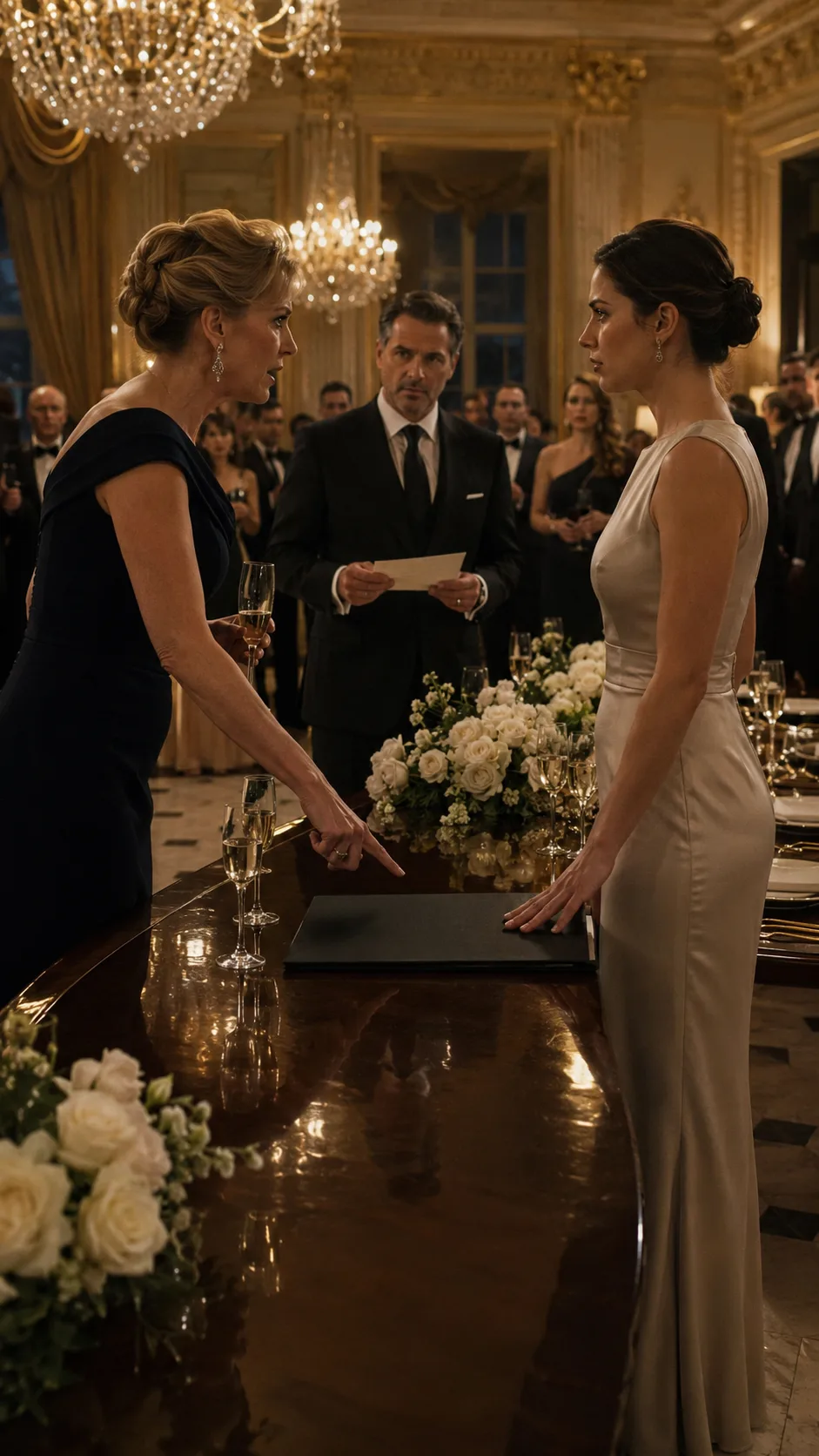
I kept my hand on the dark folder while my aunt Margaret smiled at the room like she had already won.
Chapter 1
I kept my hand on the dark folder while my aunt Margaret smiled at the room like she had already won.
The ballroom at Hawthorne House had been polished until it looked less like a family home and more like a museum pretending to breathe. Crystal chandeliers hung over the long banquet table. White roses sat in heavy silver bowls. Champagne glasses caught the light every time someone moved.
Nobody moved much.
Not after Margaret raised her glass.
“To family,” she said.
A few people repeated it.
Not me.
My cousin Daniel stood near the fireplace with his wife, both of them watching me over the rims of their glasses. My mother’s sister, Margaret, stood at the head of the table in a dark navy gown that made her look taller than she was. Her diamond earrings swung when she turned her head.
She had always known how to dress like an answer.
I stood near the center of the table in a champagne-colored dress I had bought three years earlier
for someone else’s wedding. The hem brushed the polished floor when I shifted my weight. Beneath my left palm sat the folder I had carried from my apartment in a grocery tote because I had not wanted anyone to see it before the right time.
A grocery tote.
At a gala.
My grandmother would have laughed at that.
Margaret had started speaking before dinner was served. First to small groups, then to larger ones, then to anyone within reach. She told them I had taken my grandfather’s passing badly. She told them grief made people “invent promises.” She said it with one hand on someone’s wrist, like she was protecting them from me.
By the time the first course arrived, I had heard the same sentence three times.
“Clara doesn’t understand the paperwork.”
Each time, someone glanced at me.
Each time, I lifted my water glass and did not drink.
Victor Hale, the family attorney, sat three seats away from Margaret. He was not family, but he had been in our house longer than half the people in that room. He had handled my grandfather’s small business, my grandmother’s medical forms, and every birthday envelope mailed to me until I turned eighteen.
He had a habit of folding napkins into perfect rectangles while listening.
That night, his napkin stayed untouched.
Margaret noticed.
Of course she did.
She had spent her life noticing the smallest signs of disobedience.
When the servers cleared the plates, she stood again. The room quieted before her glass even touched the air.
“I know tonight has been difficult,” she said. “We are here to honor my brother’s memory, not to argue over what he left behind.”
My grandfather had hated speeches.
He used to leave any room once the word “legacy” appeared.
Margaret continued anyway.
“There
have been questions about Hawthorne House,” she said. “Questions stirred up by confusion, by grief, and by people who were not fully aware of the final arrangements.”
A knife touched porcelain somewhere near the end of the table.
Then stopped.
I looked at Victor.
He looked at his hands.
Margaret turned toward me.
She didn’t point yet. That would come later.
“My niece has been under the impression that this house was promised to her,” she said. “I think we can all understand how a young person might hear what she wants to hear.”
A few people lowered their eyes.
Daniel smirked into his glass.
My grip stayed flat on the folder.
Not tight.
Flat.
Margaret smiled wider.
“But tonight, for the sake of peace, I want to make it clear. The estate has been settled. The ownership is final. Hawthorne House will remain under my care.”
Under my care.
She had always loved words that sounded clean.
Under my care meant she had already called a broker.
Under my care meant the blue room would become a guest suite for strangers.
Under my care meant the kitchen tiles my grandmother chose by hand would be ripped out for marble.
I saw it all without moving.
The old brass clock above the archway ticked loudly enough to cut through the silence. It had never kept perfect time. My grandfather refused to replace it because he said a house should be allowed one honest flaw.
Margaret hated that clock.
She had asked twice to remove it.
My grandfather always said no.
“Clara,” Margaret said.
Now the room belonged to her voice.
“Perhaps you should say something. Clear the air.”
That was the first mistake.
She thought silence meant I had nothing.
I looked down at the folder.
The leather edge had worn soft near the clasp. It had belonged to my grandfather. He used it for tax receipts, newspaper clippings, and recipes he pretended were business documents when my grandmother teased him.
Inside it sat two pages.
One old.
One newer.
Margaret believed only one existed.
Victor knew better.
He did not look at me when I opened my mouth.
“There’s nothing to clear,” I said.
My voice carried farther than I expected.
Margaret tilted her head.
“That would be a lovely attitude,” she said, “if you had not been telling people otherwise.”
“I haven’t told anyone anything.”
“No?” She gave a light laugh. “Then why did I hear from three separate people that you were asking questions about the deed?”
Three separate people.
That meant Daniel had talked.
Or his wife.
Or both.
The family never needed walls. It had ears.
“I asked Victor for copies,” I said.
Margaret’s smile paused.
Only for a second.
Then she recovered.
“That was inappropriate.”
Victor finally lifted his eyes.
I could see him choose not to speak yet.
Margaret turned toward him. “Wasn’t it?”
Victor adjusted the cuff of his shirt.
“It was her right to ask,” he said.
A small shift moved through the table.
Not loud.
Enough.
Margaret set her glass down.
The click was too hard.
“Her right to ask,” she repeated. “Not her right to make accusations.”
“I made none.”
“You didn’t have to.” She leaned forward slightly. “Your presence tonight does enough.”
There it was.
The thing beneath every polite sentence.
I was not supposed to be there as a granddaughter. I was supposed to be there as a problem. A loose thread. Something to be tucked away before the guests noticed.
I looked past Margaret toward the windows. Outside, the garden lights glowed against the dark lawn. When I was ten, my grandfather had hidden Easter eggs under those hedges in July because he had forgotten the real holiday and refused to admit it.
He gave me the last egg himself.
Inside was a folded note.
This house listens better than people do.
I kept that note in my desk for twelve years.
Margaret tapped one finger against the table.
“Clara.”
I looked back at her.
“You’ve had months to make peace with this.”
“No,” I said. “You’ve had months to prepare this room.”
Daniel stopped smiling.
Margaret’s shoulders held still, but her hand moved toward her glass again.
“You should be careful.”
Victor’s chair shifted.
A few guests turned toward him.
He did not stand.
Not yet.
Margaret saw the movement and changed tactics.
She softened her face.
That was always more dangerous.
“My brother loved you,” she said. “No one denies that. But love is not ownership. A memory is not a deed. A childhood promise is not a legal transfer.”
My mother’s friend Lydia brought one hand to her necklace.
She had taught me piano when I was little. She had also been the first person to stop calling after my grandfather’s funeral.
I wondered if she remembered.
Margaret took a folded sheet from Daniel’s hand and placed it on the table. The first deed. The one she had shown everyone in private pieces, one corner at a time, making sure the story formed before the proof was questioned.
“Here,” she said. “Since you insist on making this public.”
She slid it forward.
Not to me.
To the room.
The page stopped near the center of the table beneath the chandelier.
I could see the signatures from where I stood. My grandfather’s name. Margaret’s name. A date from eight years ago.
It was real.
That was the trick.
Lies work better when they borrow real paper.
Margaret looked at the guests. “This document transferred management authority to me when my brother’s health began to decline. It has been in place for years. There is no mystery.”
Victor’s jaw tightened.
One tiny motion.
Margaret missed it.
I didn’t.
“You’re showing them the first deed,” I said.
Her eyes moved back to me.
A pause.
Then she laughed once.
“The first deed?”
Daniel stepped forward. “Clara, enough.”
I looked at him.
He stopped.
Maybe it was my face. Maybe it was the folder. Maybe it was the way Victor had gone completely still.
Margaret’s voice thinned. “There is no second deed.”
The room accepted the sentence before it understood it.
That was her gift.
She could throw a statement into the air and make people arrange themselves beneath it.
I slid my palm over the folder clasp.
The metal was cold.
Margaret saw the movement.
Her eyes dropped to my hand.
For the first time that night, she looked at the object between us instead of through me.
“You brought props,” she said.
“No.”
I opened the clasp.
The sound was small.
The room heard it.
Inside the folder lay my grandfather’s handwriting across a note clipped to the top page. Thick black ink. Slanted letters. He had written the way he walked, leaning forward like the next step mattered.
Victor stood.
Margaret turned fast.
“Sit down,” she said.
Victor did not.
The guests looked from him to her, then to the folder.
The first crack had opened.
Margaret reached for control with both hands.
“Victor, I will not have this turned into a performance.”
“You already did,” he said.
A fork touched a plate near the far end of the table.
Then nothing.
Margaret stared at him as if he had spoken in a language she did not permit in her house.
But it was not her house.
Not anymore.
I lifted the top note.
Under it was the second deed.
Clean.
Stamped.
Recorded.
Dated eighteen months before my grandfather died.
Six months after Margaret had begun telling everyone he was no longer clear enough to make decisions.
I did not pick it up right away.
I let it sit in the open folder.
Margaret’s face changed in pieces. First the mouth. Then the eyes. Then the hand near her champagne glass.
She knew paper.
She knew stamps.
She knew that particular county seal.
“Where did you get that?” she said.
Not “what is that.”
Where.
Victor heard it too.
So did Daniel.
His glass lowered slowly until it touched the tablecloth.
I pulled the deed free and placed it on the polished wood.
Right beside Margaret’s first deed.
Two pages.
Two histories.
One lie standing between them.
Margaret took half a step closer.
“Do not touch that,” Victor said.
The line landed hard because he did not raise his voice.
Margaret stopped.
Her fingers hovered over the table, curved slightly, empty.
I looked at the page, then at her.
“You said there was no second deed.”
She swallowed.
A guest near the back shifted his weight.
The floor creaked.
It was a tiny sound, but Hawthorne House had always answered at the wrong time.
Margaret turned toward the room, searching for the version of herself they still trusted.
“This is absurd,” she said. “Anyone can bring a paper to a party.”
Victor reached into his jacket and removed a smaller ivory page.
The receipt.
The certified recording.
He placed it below the deed with two fingers.
Margaret’s face stayed lifted, but her throat moved again.
Daniel stepped closer to her.
“Mom,” he said.
She shot him one look.
He stepped back.
That said more than anything.
Victor turned the deed toward the guests.
“The transfer was recorded eighteen months before Mr. Hawthorne passed,” he said. “The property was moved out of Margaret’s authority.”
Lydia’s hand fell from her necklace.
My cousin Elise leaned forward.
Someone whispered my grandfather’s name.
Margaret’s voice came out too light.
“To whom?”
She knew.
She asked anyway because powerful people always believe the last word can reshape the page.
Victor looked at me.
He did not answer.
That was mine.
I touched the edge of the deed and turned it fully toward Margaret.
The chandelier light struck the line at the bottom.
She read it.
Not aloud.
Her lips moved once around my name.
Clara Elise Hawthorne.
The room followed her eyes.
Some people leaned in. Others did not need to.
The silence changed shape.
Before, it had belonged to Margaret.
Now it stood behind me.
I could feel it in the way the guests stopped looking at my dress, my hands, my face, and began looking at her.
Margaret set her champagne glass down.
Too close to the edge.
A thin line of champagne ran down the outside and gathered at the base.
“You knew,” she said to Victor.
Victor closed the folder.
“I witnessed it.”
“You let me host this evening.”
“You invited everyone.”
That line was not loud.
It did more damage than shouting could have.
Margaret looked at me then.
No smile.
No auntly softness.
Just the woman who had spent months arranging furniture in a house she already knew she might not keep.
“You don’t even know what this place costs,” she said.
There it was again.
Care dressed as contempt.
I picked up my grandfather’s note from inside the folder and unfolded it. I had read it enough times that the creases had begun to whiten.
“I know exactly what it costs,” I said.
Margaret’s jaw set.
I did not read the whole note.
Only the line he had circled.
“She stays because she remembered the house when everyone else remembered the value.”
Nobody breathed loudly after that.
Even the servers at the archway stood still, silver trays held at waist height.
Margaret looked down at the two deeds.
Her first one.
My second one.
The story she had built.
The truth sitting on top of it.
Her hand rose again, but this time it did not reach for the paper. It reached for the back of the chair nearest her. She gripped it once, then let go.
“That is not—” she began.
She stopped.
The sentence had nowhere to go.
Victor slid the first deed back toward himself, then placed it beneath the second.
The order mattered.
Everyone saw it.
Margaret saw it most.
I thought she would leave immediately. Sweep out with her head high. Make the exit another performance.
She didn’t.
She stood there while the room rearranged itself without moving.
Daniel took a step away from her.
Lydia turned toward me, then seemed to think better of speaking.
A man who had laughed at Margaret’s first toast stared down into his glass.
The clock above the archway ticked again.
Wrong time.
Honest sound.
I closed the folder and placed my grandfather’s note inside.
Victor gathered both deeds, but he did not remove them from the table.
Not yet.
Margaret looked at him. “You’ll regret this.”
Victor’s expression did not change.
“I regret waiting this long.”
That was the only apology anyone offered that night.
The gala ended without ending.
No one announced it. No one asked for another toast. The pianist in the corner kept his hands folded in his lap. Guests drifted toward the doors in quiet pairs, collecting coats and excuses.
Margaret stayed near the table until Daniel touched her elbow.
She pulled away from him.
Not sharply.
Enough.
I watched her walk past the white roses. One petal had fallen onto the polished wood near her glass. Champagne had spread into a small golden ring beneath it.
She did not look back at the room.
She did look once at the clock.
Then she left.
Victor remained beside me.
For a while, neither of us spoke.
The ballroom looked larger after people emptied from it. Too much gold. Too many flowers. Too many chairs pushed back at odd angles.
One chair near the end of the table had a napkin fallen beside it. I picked it up and folded it into a crooked rectangle.
Victor noticed.
“Your grandfather folded them better,” he said.
“He practiced more.”
Victor gave a small nod.
Then he placed the second deed back inside the folder and handed it to me.
“It’s yours,” he said.
I took it.
The folder felt heavier than before.
Not because of the paper.
Because of what people had tried to attach to it.
By morning, half the family had called.
Some left messages. Some sent long texts that began with my name and ended without apology. Daniel wrote only one sentence.
Mom didn’t tell us everything.
I did not answer.
Margaret did not call.
Three days later, her assistant emailed Victor requesting “a private conversation about transition arrangements.” Victor forwarded it to me without comment.
I read it in the kitchen of Hawthorne House while the old brass clock ticked from the hallway, still wrong by seventeen minutes.
The kitchen smelled faintly of lemon oil and dust. Someone had removed my grandmother’s blue teapot from the shelf and boxed it with silverware that did not belong in storage. I unwrapped it and put it back where it had always been.
Then I walked through every room.
The blue room.
The library.
The sunroom where my grandfather used to fall asleep with one newspaper open and another one under his elbow.
Margaret had already changed things. Flowers too large for the mantels. New curtains still pinned with tags. A stack of catalogs on the desk marked with sticky notes.
Replace.
Upgrade.
Modernize.
I took the sticky notes off one by one and dropped them into the trash.
Not angrily.
One by one.
That afternoon, Lydia came by.
She stood on the porch holding a pie like an apology she had not figured out how to say.
“I should have called,” she said.
I looked at the pie.
Apple.
My grandfather hated apple pie and ate it anyway if someone brought it.
“Yes,” I said.
Lydia nodded.
No defense.
That helped.
I let her in.
We sat at the kitchen table, the same one with the nick near the corner from when I dropped a soup pot at thirteen. She touched that mark with two fingers while we talked around the things neither of us wanted to start with.
Before she left, she looked toward the hallway.
“He always wanted you here.”
“I know.”
“No,” she said. “You knew he loved you. That’s different.”
She left the pie on the counter.
I kept it there until evening.
Then I cut one slice and put it on my grandfather’s old plate.
I did not eat it.
The next month was made of boxes, keys, signatures, and silence.
Margaret’s things left in trucks.
Not many.
She had never lived in Hawthorne House, not really. She had occupied it in advance, the way some people stand too close to a door before it opens.
Daniel came once to collect a portrait she claimed belonged to her.
Victor showed him the inventory.
It did not.
Daniel stared at the frame for a long time.
“She told us you were trying to sell it all,” he said.
I looked around the library.
At the books my grandfather wrote notes in.
At the curtains my grandmother had sewn badly and proudly.
At the brass clock still refusing accuracy in the hall.
“No,” I said. “She was.”
He left without the portrait.
I expected the house to feel different once the papers settled.
It didn’t.
The first night I slept there, the pipes knocked at two in the morning. A branch scraped the east window. The old heating system made a sound like someone sighing through their teeth.
A house does not become yours because a page says so.
It becomes yours when you stay for the inconvenient parts.
By spring, the ballroom no longer smelled like lilies and champagne. I had the long banquet table moved closer to the windows. I kept the white roses from the gala pressed inside a book because my grandmother would have said even bad nights can leave something pretty behind.
I opened the house once a month for neighborhood dinners.
No speeches.
No toasts.
Just food, mismatched chairs, and people who did not know which fork to use and did not care.
Victor came to the first one. He brought his own napkin and folded it into a perfect rectangle.
Lydia brought another pie.
Daniel came to the third dinner and stood awkwardly near the door until I handed him a stack of plates.
Margaret never came.
I heard she moved into a townhouse across town with white walls and no old clocks. She told people she had chosen simplicity.
Maybe she had.
Maybe simplicity was what remained after the room stopped believing you.
On the first anniversary of my grandfather’s passing, I stood alone in the ballroom before anyone arrived.
The chandeliers were dimmed. The marble floor had been cleaned but not polished too brightly. The table held no champagne towers, no towering flowers, no performance.
Just dinner plates.
Just chairs.
Just room.
I opened the dark folder one last time and took out my grandfather’s note.
This house listens better than people do.
I folded it along the old crease and placed it inside the drawer beneath the brass clock.
Then I wound the clock.
It ticked twice.
Stopped.
I laughed once, small and sharp in the empty hall.
Then I left it exactly as it was.
Some honest flaws stay.
Chapter complete
You have reached the end of this chapter.
Continue reading
A few more worlds to get lost in after this chapter.