I found the first crack in my family while polishing my adoptive mother’s silver tray.
Chapter 1
I found the first crack in my family while polishing my adoptive mother’s silver tray.
It was two weeks after her funeral, and the house still smelled like white lilies nobody had the nerve to throw away. The tray sat on the kitchen island, heavy and dull, with the Hale family crest engraved at the center. My adoptive mother, Marianne, had always said that silver remembered every hand that touched it.
Victor Hale said silver only remembered who owned it.
He stood in the doorway that morning in a charcoal suit, one hand wrapped around a cup of coffee he had not made himself. Behind him, my cousin Graham leaned against the pantry wall, scrolling through his phone while pretending not to listen.
“You don’t have to do that anymore,” Victor said.
I kept the cloth moving over the tray.
“Marianne liked it done before breakfast.”
“Marianne isn’t here.”
The cloth stopped.
Not long enough for him to count it as a reaction. Just long
enough for the edge of the tray to catch the kitchen light and throw it back at my face.
Victor stepped closer to the island. The soles of his shoes made no sound on the polished stone. He had always moved like that in the house, as if even the floor had been trained not to announce him.
“There will be changes,” he said.
Graham looked up then.
There it was. The part he had been waiting for.
I folded the cloth once and set it beside the tray.
“What kind of changes?”
Victor placed his coffee on the island without using a coaster. Marianne would have noticed. She would have lifted one eyebrow and slid a linen square under the cup without saying a word.
“You’ll move out of the east wing by Friday,” he said. “Graham needs the space while we settle family matters.”
Family matters.
I had
lived in that house since I was nine years old. I had learned to ride a bike on the gravel drive. I had hidden under the dining table during thunderstorms. I had sat beside Marianne for years while she wrote thank-you notes in blue ink and corrected my posture with two fingers on my shoulder.
But when Victor said family, he meant blood.
Always blood.
I wiped one faint mark from the tray and looked at him.
“Marianne told me the east wing was mine.”
Victor’s mouth moved into something that almost looked patient.
“Marianne was generous.”
Graham slipped his phone into his pocket.
“She was also sick,” he said.
Victor did not correct him.
That was the first crack.
Not the eviction. Not the cold coffee ring spreading on Marianne’s marble island. Not even Graham’s smirk when he said the word sick.
It was Victor’s silence.
Marianne Hale had
spent twenty-one years making sure nobody in that house called me temporary. Victor let Graham do it with one sentence.
I picked up the silver tray with both hands.
It was heavier than I remembered.
“I’ll move my things.”
Victor nodded, satisfied before I finished speaking.
“Good. It’s best not to make this harder.”
I carried the tray to the butler’s pantry and placed it on the second shelf, where Marianne always kept it. My fingers stayed on the rim for a second.
Behind me, Graham laughed under his breath.
Small sound.
Sharp enough.
By Friday, my room had been packed into twelve boxes by a housekeeper who apologized with her eyes and not her mouth. Victor did not come upstairs. Graham did. He stood by the doorway while I folded my navy sweaters into a suitcase and inspected my room like he was already measuring for new furniture.
“You know,” he said, “you should be grateful he’s letting you keep the car.”
I closed the suitcase.
“The car is in my name.”
He tilted his head.
“Is it?”
I looked at him.
He smiled and tapped the doorframe twice before walking away.
That night, I checked.
The car title had been transferred three days after Marianne’s funeral. My name had been removed from the household insurance account. My access to the family trust portal no longer worked. Even the small education fund Marianne had set aside for me showed a pending administrative review.
Pending.
That word did a lot of work in rich families.
Pending meant delay. Delay meant pressure. Pressure meant surrender.
I printed every page before the portal locked me out completely.
The printer in the guesthouse jammed on the last sheet. I stood barefoot in the dark, pulling torn paper from the tray while the machine blinked red. A moth hit the window above the desk again and again, trying to get inside.
I almost laughed.
Not because anything was funny.
Because it was too exact.
The next morning, I called Claire Mercer.
Claire had been Marianne’s personal attorney for fourteen years. She was not warm. She was not comforting. Marianne had liked her for exactly that reason.
Claire answered on the fourth ring.
“Evelyn.”
I did not ask how she knew it was me.
“I think Victor is removing me from everything.”
There was a pause. Paper shifted on her end.
“Come to my office.”
“When?”
“Now.”
Claire’s office occupied the seventh floor of a narrow limestone building downtown, the kind with old elevators and brass numbers above the doors. Her reception area smelled like black coffee and lemon oil. No flowers. No soft music. No framed quotes about justice.
Claire opened her own office door before the receptionist could stand.
She was in a cream blouse, black trousers, and a watch with a narrow leather strap. Her hair was pinned back so tightly not one strand moved when she turned.
“Show me.”
I handed her the printed pages.
She read in silence.
I watched her eyes move line by line. She did not frown. She did not sigh. She did not make the small noises people make when they want you to know they care.
Claire turned the final page over.
“Who told you about the east wing?”
“Victor.”
“And the trust access?”
“It disappeared last night.”
She stood, walked to a locked cabinet behind her desk, and took out a dark blue file box.
The label on the side was handwritten.
HALE — MARIANNE / EVELYN.
My throat tightened around nothing.
Claire placed the box on her desk but did not open it yet.
“Before Marianne died,” she said, “she asked me to keep certain documents outside the family archive.”
“Why?”
Claire looked at the closed door.
“Because she knew Victor would search the family archive first.”
The room became very still.
The air conditioner hummed above us. Somewhere outside, a truck reversed in the alley, three dull beeps and then nothing.
Claire opened the box.
Inside were letters, old photographs, copies of guardianship records, medical notes, and one thick cream envelope sealed with Marianne’s initials. Not legal wax. Not dramatic. Just two letters pressed into paper by a woman who had known exactly what kind of man she married.
Claire did not touch the envelope.
Not yet.
She pulled out a photograph instead.
I was ten in the picture, standing on the steps of the Hale house in a yellow raincoat. Marianne stood behind me, one hand resting lightly on my shoulder. Victor stood beside her. He was younger then, hair darker, jaw sharper. He was not smiling.
On the back, Marianne had written one line.
The day she stopped waiting to be chosen.
I ran my thumb near the ink without touching it.
“What does that mean?”
Claire reached for another document.
“This is where it becomes difficult.”
It was a copy of the adoption agreement.
I had seen one before, years ago, when Marianne showed it to me after a classmate asked why I did not look like my parents. She had sat me at her vanity, brushed my hair, and said paper did not make a family, but people who were careless with paper could still hurt you.
The copy Claire handed me looked familiar until I reached the last page.
There were two additional signatures beneath Victor’s.
One was Marianne’s.
The other was a witness I did not recognize.
Below that was a paragraph I had never seen.
Claire let me read it twice.
The words were careful. Dry. Almost dull.
But they named me.
They named me as Marianne Hale’s legally acknowledged daughter for all family benefit purposes, including inheritance standing, residence rights, and access to trust-held assets created during the marriage.
I stared at the paragraph until the letters began to lose shape.
“Why wasn’t this in the version they gave me?”
Claire’s mouth flattened.
“Because the family copy removed the attachment.”
“Can they do that?”
“They did.”
That was not the same answer.
I sat back.
Claire pulled one more sheet from the box.
“This is the agreement Victor signed after the adoption. Separate from the court filing. Separate from the household archive. Marianne insisted he sign it before she finalized anything.”
I looked at the page.
Victor’s signature was at the bottom.
Bold. Clean. Certain.
“She made him sign this?”
“She made him choose,” Claire said. “He wanted the adoption for public reasons. Marianne wanted protection for you in private.”
I could hear Marianne’s voice then. Not in some mystical way. Not from the walls. Just memory. Her bracelets clicking as she reached across a table. Her pen scratching on stationery. Her saying, with perfect calm, Victor likes doors. I prefer keys.
Claire slid the document into a slim black portfolio.
“There is a hearing Monday morning,” she said.
“I wasn’t told.”
“You were not meant to be.”
I looked at her.
Claire closed the portfolio.
“Now you are.”
The hearing was scheduled for nine.
Victor made sure I learned about it at seven-thirty that morning through a text from Graham.
Not a proper message. A photo.
It showed the marble lobby outside Hearing Room Three. Victor stood near the entrance in a navy suit. My aunt Lillian was beside him in pearls. Graham had taken the picture at an angle that made Victor look taller than everyone.
Under it, Graham wrote:
Family only today.
I stared at the words while standing in the guesthouse kitchen with one shoe on.
Family only.
The coffee maker clicked off behind me.
I finished putting on my other heel.
Claire picked me up in front of the guesthouse twenty minutes later. She did not ask whether I was ready. She handed me a paper cup of coffee and placed the black portfolio between us on the back seat.
“Do not speak unless I ask you to,” she said.
“That sounds comforting.”
“It isn’t meant to.”
I almost smiled.
The car moved through morning traffic without music. Claire reviewed notes on her tablet. I watched the city change outside the window, from quiet residential streets to glass towers to the older civic district, where buildings had columns and heavy doors and names carved into stone.
The hearing center was not technically a courthouse, Victor had said once. Too private for that. Too expensive. Family arbitration, trust review, estate procedure — all the clean phrases rich people used when they wanted conflict without reporters.
But it felt like a court.
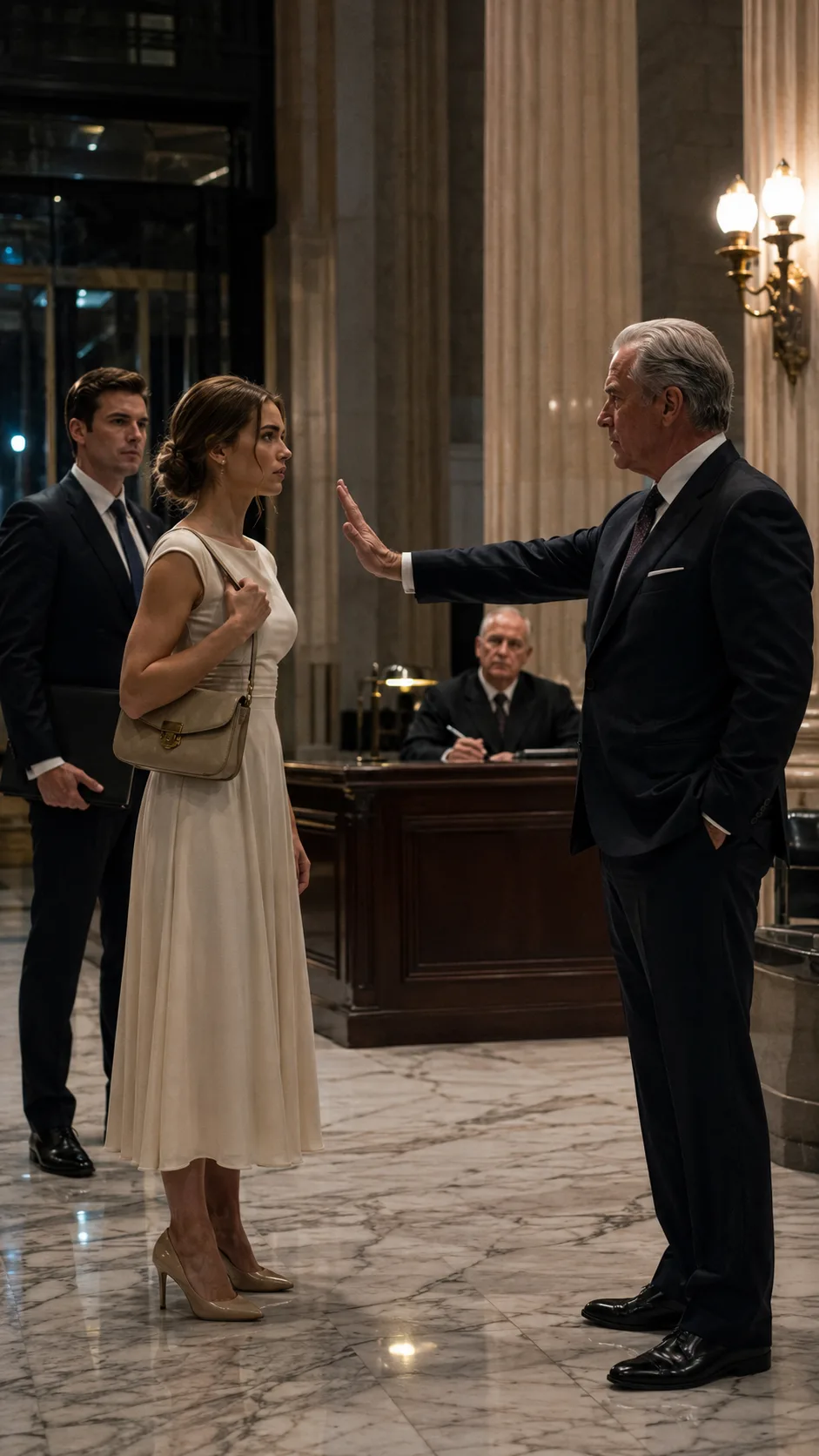
The lobby rose three stories high, all marble and brass and cold light. Every footstep carried. Every whisper became public if the room wanted it to.
Victor saw me the second I walked in.
He did not look surprised.
That annoyed me more than surprise would have.
He had planned for this too.
Lillian stood behind him with one hand on her pearl necklace. Graham leaned against a column, thumb moving across his phone. Two family advisers stood near the reception desk. A clerk sorted papers without looking up.
Judge Harlan sat behind the dark wooden desk at the far end, pen in hand, speaking quietly to another official.
Victor stepped away from the hearing room doors.
Not toward me.
In front of me.
Claire slowed beside my shoulder.
Victor raised one palm.
Just enough.
“Evelyn,” he said. “This is not necessary.”
His voice carried across the marble.
People turned before pretending they had not.
I stopped.
Claire stopped with me.
Victor’s hand stayed between my body and the doorway.
“You were not invited into this proceeding.”
“My mother’s estate concerns me.”
Lillian’s fingers tightened around her pearls.
Victor’s face did not change.
“Marianne was generous to you,” he said. “That generosity does not give you standing.”
Graham pushed off the column.
The clerk looked down at the desk.
Victor glanced at Claire.
“Your attorney can wait outside.”
Claire did not answer.
I kept my eyes on Victor’s hand.
That hand had signed birthday cards Marianne wrote. That hand had lifted champagne glasses at charity dinners where Victor called me our daughter for donors and Evelyn for staff. That hand had rested on Marianne’s coffin for exactly four seconds before he turned to discuss scheduling.
“You don’t belong in that room,” he said.
There it was.
Not softened.
Not hidden inside family language.
The sentence stood naked in the lobby.
I shifted my handbag strap higher on my shoulder.
“No,” Victor said, quieter now. “Do not make a scene.”
I looked past him at the hearing room doors.
“Move.”
A small sound came from Lillian. Not a word. More like a breath that caught on pearl and bone.
Victor stepped closer.
“You lost your place in this family years ago.”
Claire moved then.
One step.
Not fast. Not dramatic.
The heel of her shoe struck the marble once, clean and hard.
Victor turned his head.
Claire walked to the reception desk and placed the black portfolio flat on its surface.
The sound was quiet.
Too quiet.
Judge Harlan looked up.
Victor’s eyes moved to the portfolio, then to Claire’s hand resting on top of it.
“This proceeding has filing rules,” he said.
Claire opened the cover.
“Yes.”
She removed the first page and placed it in front of the judge.
“Which is why this should have been filed years ago.”
Victor’s jaw shifted.
Graham took one step forward, then stopped when Claire turned the page.
The document lay open beneath the brass desk lamp. The light caught the bottom corner first, then moved across the paragraph, then down to the signature.
Victor’s signature.
Large.
Black.
Undeniable.
Claire did not raise her voice.
“Then explain why your signature is inside.”
The room held itself still.
Judge Harlan leaned forward.
Victor reached for the portfolio.
Claire’s fingers came down on the edge of the page.
Not forceful.
Enough.
Victor’s hand stopped above the desk.
“Counsel,” Judge Harlan said, “what is this?”
“A separate family standing agreement executed after the adoption,” Claire said. “Signed by Victor Hale. Witnessed. Preserved outside the family archive.”
Lillian’s necklace slipped from her fingers.
Graham looked at Victor.
For the first time all morning, he did not look entertained.
Victor drew his hand back.
“That attachment was never accepted into the record.”
Claire turned one more page.
“The record copy was altered.”
The clerk stopped sorting papers.
Judge Harlan removed his glasses and looked at Victor over the top of them.
Victor laughed once.
It was not a real laugh. It had no breath in it.
“This is a misunderstanding.”
Claire slid another page forward.
“The witness is in the building.”
Victor looked at her.
A muscle moved near his eye.
Judge Harlan placed his pen down beside the agreement.
The sound was small.
Everyone heard it.
“Mr. Hale,” he said, “step away from the doorway.”
Victor did not move.
Not at first.
He looked at the judge, then at Claire, then finally at me.
His hand, the one that had blocked me, lowered slowly to his side.
I walked past him.
My shoulder did not touch his sleeve.
Inside the hearing room, the air felt colder. The table was long, dark, and polished to a shine that showed every handprint. Victor took the seat at the head automatically, then stopped when Judge Harlan entered behind me and looked at the arrangement.
“Ms. Hale will sit there.”
Nobody asked which Ms. Hale.
Claire pulled out the chair.
I sat at the head of the table.
Victor remained standing for a second too long before taking the chair to my right. Graham sat across from me, phone face down now. Lillian sat beside him with both hands folded so tightly her knuckles paled.
The witness arrived six minutes later.
Her name was Beatrice Cole.
I remembered her as Mrs. Cole from childhood, Marianne’s former household secretary. She had worn gray cardigans, kept butterscotch candies in her desk, and never smiled unless Marianne made her. I had not seen her in fifteen years.
She entered with a cane and a navy coat buttoned to her throat.
Victor looked at her as if she had climbed out of a locked room.
Mrs. Cole did not look at him.
She looked at me.
Then she nodded once.
Claire guided her to the witness chair.
Judge Harlan asked three questions. Name. Role. Years of service.
Mrs. Cole answered each one plainly.
Then Claire placed the agreement before her.
“Do you recognize this?”
“Yes.”
“Were you present when Victor Hale signed it?”
“Yes.”
Victor leaned forward.
“Beatrice.”
Judge Harlan looked at him.
Victor closed his mouth.
Mrs. Cole adjusted her glasses.
“Mrs. Hale kept two copies,” she said. “One for the family archive. One for Ms. Mercer.”
Claire asked, “Why?”
Mrs. Cole’s hand rested on the cane handle.
“Because Mr. Hale asked me where the archive key was the same afternoon.”
Lillian looked down.
Graham’s lips parted slightly.
Victor did not blink.
Claire placed another item on the table.
A letter.
Not cream. Pale blue.
Marianne’s stationery.
The paper had softened at the fold.
Claire did not read it aloud. She handed it to Judge Harlan first. He read in silence, then passed it to me.
My name was written at the top.
Evelyn, my bright girl,
Victor believes family is a door he can open and close. I should have taught you earlier that a door is not the same as a home.
I made arrangements because love without protection is just a wish.
You were never my charity.
You were my daughter.
The rest of the letter blurred for a second. I set it down before my hands could crease it.
Victor’s chair scraped back.
“Marianne wrote many emotional things near the end.”
Mrs. Cole turned her head toward him.
“She wrote that eleven years before she died.”
Silence took the room by the throat.
Victor stayed half-standing, one hand on the table.
Judge Harlan looked at the date on the letter.
Then at Victor.
Then at me.
“Ms. Hale,” he said, “you have standing in this matter.”
Graham pressed both palms flat on the table.
Lillian made a small sound into her hand.
Victor sat down.
He did it carefully, like the chair had become unfamiliar.
The hearing did not end quickly. Rich families do not collapse in one clean motion. They require procedures, signatures, continuances, formal notices, and men like Victor asking for private conferences after public mistakes.
Judge Harlan denied the private conference.
Claire requested preservation of all estate records.
Granted.
Claire requested restoration of my trust access pending review.
Granted.
Claire requested immediate protection of the east wing residence designation.
Victor’s head snapped up.
Judge Harlan looked at the agreement again.
Granted.
Each word landed without drama.
That made it worse for him.
By noon, Graham had stopped looking at me entirely. Lillian kept touching her necklace and finding nothing there because the clasp had come loose and the pearls lay in a small coil on the table in front of her.
Victor signed nothing that day.
He only watched as the room he had arranged began to rearrange itself without him.
When we walked back into the marble lobby, the morning crowd was gone. The brass lamps still burned. Someone had polished the floor so well that Victor’s lowered hand appeared twice, once on his body and once beneath him in the stone.
Claire handed me Marianne’s blue letter in a protective sleeve.
“Keep this copy,” she said.
“What happens now?”
“Now he fights smaller.”
Victor passed us without speaking.
Graham followed him. Lillian stayed behind for a moment near the reception desk. Her pearl necklace was in her purse now, broken clasp and all.
She looked at me.
For a second, I thought she might say Marianne would have wanted peace.
People said things like that when peace meant silence from the person they had wronged.
But Lillian only touched the edge of the desk.
“She was never unsure about you,” she said.
Then she left.
I stood in the lobby until the elevator doors closed on the last of them.
Claire waited beside me.
The portfolio was under her arm again, thinner now that its secret had been opened.
I looked at the doorway Victor had blocked.
It was just a doorway.
That was the strange part.
No flames. No thunder. No grand sign from the ceiling. Just wood, brass, and a room beyond it where I had finally been allowed to sit where Marianne had placed me years ago.
Two weeks later, the east wing was returned to my name in the household records.
Three months later, Victor resigned as trustee after Judge Harlan ordered a full review of the altered archive copy. Graham moved out before the review finished. Lillian sent one letter, handwritten, on thick white paper, apologizing without asking to be forgiven. I kept it in a drawer and did not answer.
Claire found six more documents Marianne had placed outside the family archive.
Not all of them were about money.
One was a school drawing I had made at ten, folded into Marianne’s stationery box. It showed a yellow house, a crooked sun, and three people standing in front of a door.
On the back, Marianne had written:
She drew herself in the middle.
I took that drawing back to the Hale house on a Thursday afternoon.
The staff had changed the flowers in the foyer. No lilies this time. White tulips stood in a glass vase near the staircase. The silver tray sat in the butler’s pantry, right where I had left it.
I carried it to the kitchen island and set it down.
There was still a faint coffee ring on the marble from Victor’s cup.
I found a linen square in the drawer, placed it under the tray, and stood there with one hand on the silver rim.
The house was quiet.
Not empty.
Quiet.
I opened the east wing myself.
No one stopped me.
Chapter complete
You have reached the end of this chapter.
Continue reading
A few more worlds to get lost in after this chapter.