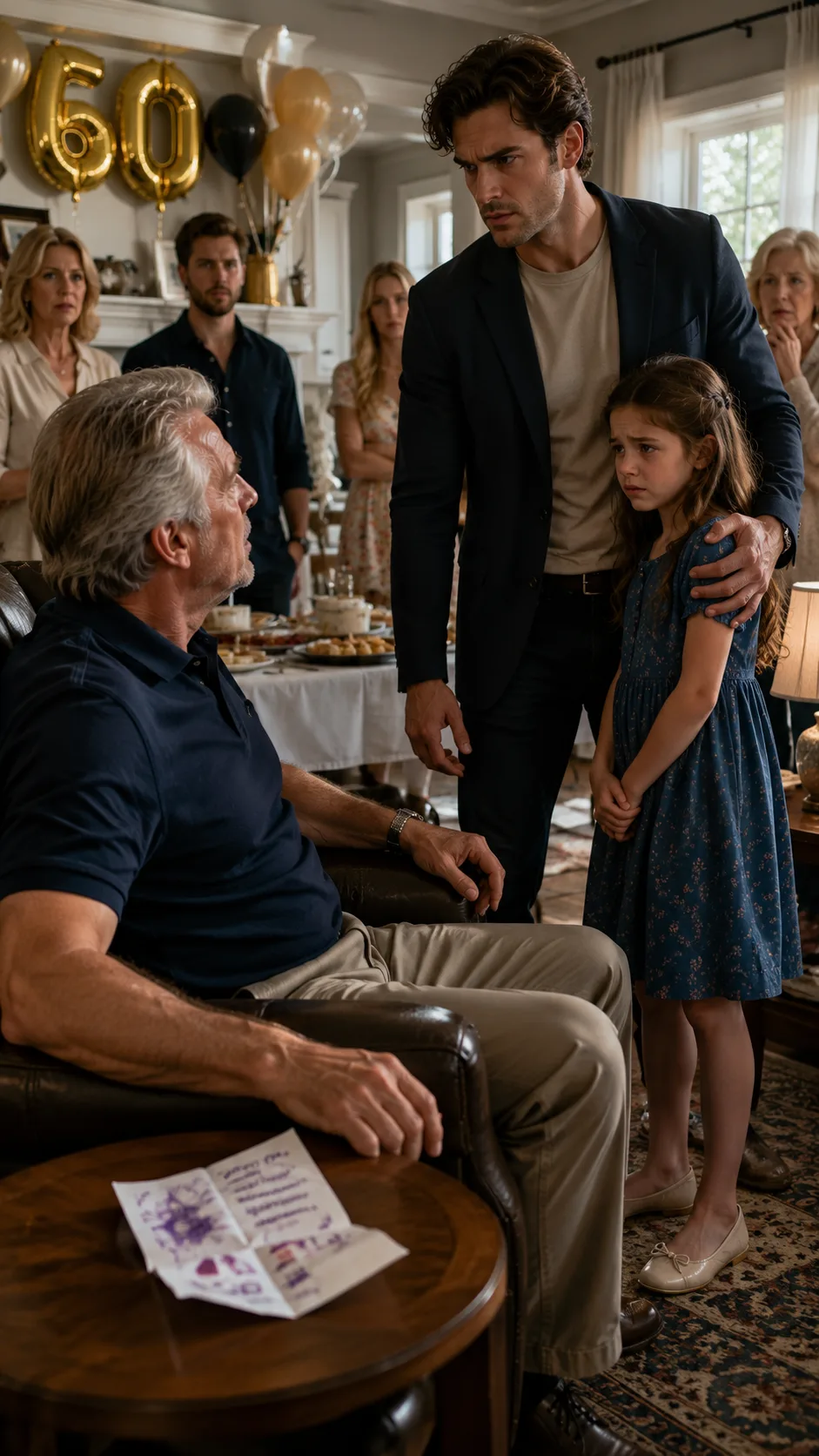
My Adopted Daughter Read A Birthday Poem For Grandpa, But His Reply Ended Our Family Forever
“We are not your family.
Chapter 1
My Adopted Daughter Read A Birthday Poem For Grandpa, But His Reply Ended Our Family Forever
“We are not your family.
I wish they had never let you leave that orphanage.”
My father said those words in the middle of his sixtieth birthday party.
He did not whisper them.
He did not mutter them under his breath.
He said them loudly, sharply, with the kind of confidence only a cruel man has when he believes the whole room will stay silent for him.
And the room did.
My eight-year-old daughter, Olivia, stood in front of his recliner with both hands still stretched toward him, holding the birthday card she had made herself. Her fingers were wrapped around the edges of the folded paper so carefully, as if it was something precious enough to break if she squeezed too hard.
Two days of work.
Two days of crossed-out lines, purple glitter ink, nervous questions, and quiet hope.
All of it crushed in one sentence.
The living room froze.
The old rock song
playing from the speaker near the kitchen suddenly sounded too cheerful, too far away. The gold balloons taped beside the fireplace shifted in the air from the ceiling vent. A banner with a giant number sixty hung above the mantel, sparkling under the warm lights. Someone had brought a cheesecake. Someone else had brought lemon bars. The whole house smelled like sugar, coffee, and furniture polish.
It should have been an ordinary family birthday.
Instead, it became the afternoon I finally understood that blood does not make a man worthy of being called family.
My name is Daniel Harper. I was thirty-seven years old when it happened, and until that day, I had wasted too much of my adult life trying to believe my father could still become better than he was.
I told myself he was old-fashioned.
I told myself he needed time.
I told myself people who were
harsh on the outside sometimes softened when they realized how much their words hurt.
But that Saturday afternoon taught me something I should have learned much earlier.
Some people do not soften.
Some people only wait for a weaker target.
And my daughter was never going to be that target while I was still breathing.
Two nights before the party, Olivia turned our kitchen table into what she called her “poem office.”
She had lined notebook paper spread out in front of her, a purple glitter pen in her hand, and at least ten crumpled drafts scattered across the table like tiny failed snowballs. The dishwasher hummed quietly behind us. Sarah, my wife, was upstairs folding laundry. Outside the kitchen window, the evening had gone dark and the reflection of the hanging light made the glass look black.
Olivia sat with one knee tucked under her, hunched over the page
with the kind of concentration children usually reserve for secret missions.
Every few minutes, she would pause, press the end of the pen to her lips, and stare at the ceiling as though the right word might be hiding up there.
I sat across from her, pretending to read emails on my laptop, though I was really watching her.
She had been our daughter for a little over a year.
Legally, completely, permanently ours.
But love does not erase fear overnight.
Before she came to us, Olivia had spent years in the foster system. She had learned the kind of habits no child should ever have to learn. She listened too closely to adult voices. She noticed changes in tone. She cleaned up after herself with almost anxious precision. She apologized for things that were not her fault. If she spilled water, her face went pale before anyone even reacted.
She was sweet, bright, funny, and painfully careful.
Too careful.
The first time she forgot to say thank you after dinner, she came back from the hallway ten minutes later crying because she thought we might send her away.
So when she decided to write a poem for my father’s birthday, I knew it meant something bigger than a handmade card.
She was not just giving him words.
She was asking a question.
Am I part of this family too?
Finally, she lifted the page from the table with both hands.
“Dad?”
That word still hit me somewhere deep every time she said it.
“Yeah, sweetheart?”
“Can I read it?”
“Of course.”
She sat straighter, cleared her throat dramatically, then began in a soft, careful voice.
The poem was simple. Sweet. Full of the kind of rhymes only children can make sound sincere. She wrote about birthdays, pancakes, stories, and how grandparents know things that kids do not know yet.
Halfway through, she stopped abruptly.
“No,” she whispered.
She scratched out a line so hard the paper nearly tore.
“What’s wrong?” I asked.
“That part sounds fake.”
She looked up at me, suddenly serious.
“Does Grandpa hate fake things?”
I paused.
There were a dozen answers I could have given her. Some honest. Some gentle. Some protective.
My father, Bill Harper, hated many things. Noise. Change. Feelings he did not control. People who expected kindness from him. Anything that reminded him the world was bigger than his own opinions.
But Olivia was eight.
So I chose the safest truth I could manage.
“Grandpa likes people to be honest,” I said.
She studied me for a moment, searching my face the way she sometimes did when she needed to know whether an adult was hiding something.
Then she nodded.
“Okay. Then I’ll write the true part.”
She bent over the paper again.
Her purple pen moved slowly, letter by letter.
When she was finished, she pushed the page toward me.
“I put family in it,” she said.
Her voice was quiet. Almost braced.
I looked down and read the final lines.
I didn’t have a grandpa before, but now I do.
Thank you for my new family.
I love you.
When I looked back up, her shoulders were tight.
“Is that allowed?” she asked.
The question hurt more than it should have.
“Olivia,” I said gently, “of course it’s allowed.”
Her eyes searched mine.
“Even if he’s not my real grandpa?”
“He is your real grandpa if he chooses to be,” I said. “And you are my real daughter. There is nothing fake about love.”
She stared down at the paper.
Then she whispered, “I just want him to know I’m good.”
I had to look away for a second.
Because no child should have to audition for love.
No child should have to prove they are worthy of being kept.
I reached across the table and covered her small hand with mine.
“You don’t have to be good to deserve family,” I told her. “You already belong.”
She nodded, but I could tell she did not fully believe me yet.
That was why the party mattered to her.
And that was why what my father did there was unforgivable.
Saturday came bright and warm in Columbus, Ohio.
My father’s house sat on a quiet suburban street, the kind of place where everyone’s lawn looked trimmed, every porch had seasonal decorations, and every neighbor knew exactly when a strange car pulled into a driveway.
By the time Sarah, Olivia, and I arrived, the party was already in full swing.
My sister Melissa had taken over the couch with her two children, Evan and Sophie. Evan was twelve and loud in the way boys become when adults laugh at everything they say. Sophie was six, wearing a yellow dress and glitter shoes, swinging her legs from the cushion while eating crackers from a paper plate.
My father sat in his recliner like a king receiving visitors.
He wore a navy polo, khaki pants, and the satisfied smile of a man who believed a birthday gave him permission to be worshiped all afternoon.
When Evan handed him a gift bag, Dad slapped him proudly on the shoulder.
“That’s my boy,” he said, grinning.
Evan beamed.
A few minutes later, Sophie climbed onto his lap with a drawing. Dad kissed the top of her head, held the drawing up for everyone to see, and announced that she had more talent than half the people he had worked with in his life.
Everyone laughed.
Olivia stood beside me near the entryway, clutching her card.
She watched it all in silence.
Sarah’s hand found mine.
I knew she saw it too.
The difference.
The easy warmth he gave Melissa’s children.
The cold politeness he saved for mine.
Melissa looked over and gave Olivia a brief smile.
“Hi, Olivia.”
That was it.
No hug. No compliment. No asking how school was. No mention of the card in her hands.
Then she turned back to Evan.
My father finally glanced at Olivia.
“Hello,” he said.
Not unkindly, exactly.
But distant.
Like she was the neighbor’s child.
Not his granddaughter.
Olivia’s fingers tightened around the card.
I leaned down.
“You okay?” I whispered.
She nodded too quickly.
When it came time for cards and gifts, everyone gathered around the living room. My mother brought coffee from the kitchen. Melissa filmed her kids giving Dad their presents. Evan gave him a baseball cap. Sophie gave him a picture frame. Dad praised both of them loudly.
Then Olivia stepped forward.
The room shifted, just slightly.
Not enough for a stranger to notice.
Enough for a father to feel.
She stood in front of my father’s recliner, small and nervous, wearing the blue dress Sarah had helped her pick out that morning. Her hair was braided neatly. Her shoes were polished. She had even asked Sarah whether “grandpas like neat hair.”
“I wrote something,” Olivia said.
Her voice trembled.
My father raised his eyebrows.
“A poem?” Melissa asked, with a thin smile that made the word sound childish.
Olivia glanced at me.
I nodded.
She unfolded the card.
Her hands shook, but she began.
“Dear Grandpa,” she read softly.
The room went quiet.
“You’re sixty now and that is true.
You tell old stories and fix things too.
I didn’t have a grandpa before, but now I do.
Thank you for my new family.
I love you.”
Her voice faded on the last line.
Then she extended the card with both hands.
For one second, she looked hopeful.
Not happy yet.
Hopeful.
That fragile space before joy, where a child waits to see whether the world will be kind.
My father leaned forward.
He took the card.
But not gently.
He snatched it.
The paper bent in his hand.
His eyes moved over the words. His mouth tightened. The smile he had worn all afternoon vanished, replaced by something bitter and hard.
Then he looked at Olivia.
Not at me.
Not at Sarah.
At Olivia.
“We are not your family,” he said. “I wish they had never let you leave that orphanage.”
The room went silent so fast it felt like the air had been pulled out of it.
Olivia did not cry immediately.
That was the worst part.
She just stood there.
Her face emptied.
Her mouth opened a little, but no words came out.
It was like her mind had stepped backward from the moment, unable to understand why the thing she had feared most had just been spoken aloud by an adult everyone else called family.
Then her lower lip began to tremble.
A small sound escaped her.
Not a sob.
A broken breath.
I moved before I thought.
I crossed the room, crouched, and pulled her into my arms.
She grabbed my shirt with both hands and buried her face against my chest. Her body shook so hard I felt it in my bones.
Behind me, nobody spoke.
Nobody told my father to apologize.
Nobody said, “Bill, that was too far.”
Nobody comforted Olivia except Sarah, who was already beside us with tears in her eyes and fury in her face.
My father leaned back in his chair.
As if he had done nothing more than state an opinion.
Melissa looked down at her phone.
My mother stood half in the kitchen doorway, pale and frozen, holding a coffee pot she had forgotten to set down.
And in that silence, something inside me changed.
For years, I had explained him away.
Not anymore.
I lifted Olivia into my arms and carried her into the hallway.
She pressed her face against my neck, sobbing quietly.
“I’m sorry,” she whispered.
The words nearly destroyed me.
I held her tighter.
“No,” I said into her hair. “No, baby. You did nothing wrong.”
She cried harder.
From the living room, I heard the clink of a plate.
Someone lowered the music.
Then, unbelievably, conversation began again.
Soft at first.
Then normal.
As if my daughter’s heart had not just been crushed in front of them.
I stood in the hallway, one hand on Olivia’s back, and understood exactly what had to happen next.
I carried her back into the living room.
The room quieted when they saw my face.
My father was holding a beer now. The card lay crumpled near his thigh, half on the arm of the recliner, half slipping toward the floor.
I walked straight to him.
“Give me the card,” I said.
My voice was calm.
Too calm.
He gave a short laugh.
“Daniel, don’t start. It was an honest comment.”
“Give me my daughter’s card.”
“She needs to learn the difference between pretending and reality.”
Sarah stepped beside me, her voice low and shaking.
“Bill, she is eight.”
He looked at her with irritation, as if she were interrupting him.
“That is exactly why she should hear it now.”
Something in the room seemed to tighten.
I held out my hand.
“The card.”
For the first time that afternoon, my father looked uncertain.
Maybe it was my voice.
Maybe it was the fact that I was no longer calling him Dad.
He tossed the card onto the side table.
I picked it up and smoothed the bent paper carefully with my thumb. The purple glitter ink had smudged slightly where his hand had crushed it.
Olivia watched from Sarah’s arms, eyes red and swollen.
I turned back to my father.
“You’re right about one thing, Bill.”
My mother flinched when I used his first name.
His jaw hardened.
“We are not your family anymore,” I said. “Because family is not a last name. It is not blood. It is not a photograph on a mantel or a chair at a holiday table. Family is what people do when someone vulnerable stands in front of them with their heart in their hands.”
I looked around the room.
At Melissa.
At my mother.
At the people who had seen everything and chosen comfort over courage.
“And every adult in this room just failed that test.”
Melissa scoffed.
“Oh, come on, Daniel. You’re being dramatic.”
I looked at her.
“My daughter was humiliated by a grown man, and you checked your phone.”
Her face flushed.
“You can’t blame me for what Dad says.”
“I can blame you for sitting there like it was normal.”
My mother finally spoke.
“Daniel, please. It’s his birthday. Don’t ruin this.”
I almost laughed.
Ruin this.
As if the party was the fragile thing in the room.
As if the cheesecake mattered more than my child.
I turned to her.
“No. He ruined it. You are just asking me to pretend he didn’t.”
My father pushed himself upright in the recliner.
“You watch your tone in my house.”
I looked at him for a long second.
Then I said, “That’s easy. We’re leaving it.”
He blinked.
“You’ll regret this.”
“No,” I said. “What I regret is bringing her here.”
The room went still again.
I turned toward the door.
My mother followed us into the hallway, whispering urgently.
“Daniel, don’t do this. He doesn’t mean things the way they sound.”
I stopped with my hand on the doorknob.
“Yes,” I said. “He does. That is the problem.”
She started crying.
“He’s your father.”
I looked back at the living room, where he sat stiff and red-faced beneath his birthday decorations.
Then I looked down at Olivia, curled against Sarah like she was trying to disappear.
“No,” I said. “He is a man who taught me exactly what my daughter needs protection from.”
We left.
I did not say goodbye.
I did not wait for an apology.
I did not let anyone kiss Olivia’s head or make some useless comment about how everything would be okay.
Some damage is not repaired by pretending it was accidental.
In the car, Olivia sat silently in the back seat.
Her card rested in my lap, bent but not ruined.
Sarah drove because my hands were shaking too badly.
For the first ten minutes, none of us spoke.
Then Olivia said in a tiny voice, “Can you still keep me?”
Sarah made a sound like she had been hit.
I turned around as much as the seatbelt allowed.
“Olivia Harper,” I said, making my voice as steady as I could, “you are our daughter. Forever. Nothing he said changes that.”
She stared at me through tears.
“But he said—”
“He said something cruel because something is wrong inside him. Not inside you.”
She looked down at her hands.
“Was my poem bad?”
“No,” I said. “Your poem was beautiful.”
Sarah wiped her cheek with the back of her hand.
“It was the best card there,” she said.
Olivia did not smile.
Not then.
The weeks after that party were hard in ways I had not expected.
I thought cutting my father off would solve the problem.
It solved one problem.
It removed him from her life.
But it did not remove his words from her mind.
Olivia stopped writing poems.
The purple glitter pen stayed in her desk drawer.
She stopped asking for pancakes on Sunday mornings because the poem had mentioned them. She became quiet at dinner. She cleaned her room with the anxious precision we had worked so hard to soften. She folded her pajamas and lined up her shoes and apologized if she laughed too loudly.
Once, I found her wiping the kitchen counter even though it was already clean.
“What are you doing?” I asked gently.
She froze.
“Helping.”
“You don’t have to clean right now.”
“I know.”
But she kept wiping.
That night, Sarah and I sat on the floor of Olivia’s bedroom with her. Not on chairs. Not standing above her. On the floor, at her level, surrounded by stuffed animals and picture books.
I held her hands.
“Can we talk about what Grandpa Bill said?”
She looked away.
“He’s not my grandpa.”
The answer came fast.
Defensive.
Like she needed to say it before the words could hurt her again.
I nodded.
“You’re right. He gave up that place.”
Her eyes filled with tears.
“He didn’t want me.”
I took a breath.
“He didn’t deserve you.”
She looked at me then.
Really looked.
“He said I should have stayed there.”
“I know.”
“Was he right?”
“No.”
I said it firmly enough that she flinched.
Then I softened my voice.
“No, Olivia. He was not right. You were never a mistake. You were never a burden. You were never someone we rescued for practice. You are our daughter because we chose you, and because we love you, and because our family became better the day you came home.”
Sarah reached over and tucked Olivia’s hair behind her ear.
“You do not have to earn your room,” she said. “You do not have to earn dinner. You do not have to earn bedtime stories or hugs or birthday parties. You are not on trial here.”
Olivia cried for a long time.
But that night, for the first time since the party, she let herself be held without apologizing.
Healing was not quick.
It came slowly.
It came through therapy appointments and patient teachers and bedtime talks. It came through Sarah putting a note in Olivia’s lunchbox every Friday. It came through me reading the same space book with her fifteen nights in a row because she liked knowing exactly what would happen next.
It came through mistakes.
The first time she left socks on the living room floor and did not panic, Sarah and I celebrated quietly in the kitchen.
The first time she complained about broccoli like a normal kid, I nearly cried into my dinner.
The first time she slammed her bedroom door after being told to turn off her tablet, Sarah whispered, “That was kind of healthy, right?”
I whispered back, “I think so.”
Months passed.
Then a year.
Then another.
We changed our numbers.
We blocked relatives who sent messages about forgiveness but never once asked how Olivia was.
Melissa tried once to write Sarah, saying Dad was “from a different generation” and that we were “teaching Olivia to be sensitive.”
Sarah replied with one sentence.
“We are teaching Olivia that love should never require silence.”
Then she blocked her too.
For two years, my father became a ghost in our lives.
Not a sad ghost.
A finished one.
We did not speak his name often. When we did, it was without anger most of the time. Anger takes energy, and eventually we had better places to put ours.
Olivia grew.
She became louder.
Messier.
Funnier.
She joined a science club. She became obsessed with stars and planets. She adopted a golden retriever puppy we named Comet, though Sarah insisted one dog was enough and then loved him more than anyone.
And slowly, the girl who once asked whether family was “allowed” began acting like she belonged without needing permission.
Then, one rainy Tuesday afternoon, my phone rang.
Unknown number.
I almost ignored it.
But something made me answer.
“Daniel?”
My mother’s voice.
Older.
Thinner.
Tired in a way that made it clear life had not been gentle with her.
I stood in my office and looked out the window at rain running down the glass.
“Hello, Mom.”
She began crying almost immediately.
“Your father had a stroke.”
I closed my eyes.
Not because I was devastated.
Because I already knew what was coming.
“It wasn’t massive,” she said quickly. “But he’s not the same. He needs help. And Melissa… well, Melissa is busy.”
Busy.
That word carried a whole story.
The daughter he praised.
The grandchildren he adored.
The family he had chosen over mine.
And now, when he needed care, they were busy.
“I’m sorry to hear that,” I said.
My mother sniffed.
“He asks about you.”
I said nothing.
“He asks about Olivia too.”
My hand tightened around the phone.
Outside, a car passed through a puddle.
“He says he wants to see her,” my mother continued. “He says he made mistakes. He says he wants to apologize while he still can.”
The room felt very still.
Through the window, I could see our backyard.
Olivia was out there in a yellow raincoat, laughing as Comet dragged a muddy toy across the grass. Her hair had escaped its ponytail. Her boots were filthy. She looked completely, wildly alive.
Safe.
Loved.
Free.
My mother’s voice softened.
“Daniel, he is lonely.”
I watched Olivia throw her head back laughing.
“No,” I said.
The crying on the other end stopped.
“What?”
“No. He will not see her.”
“Daniel, please. He is an old man.”
“He was old enough to know better when he looked at an eight-year-old child and told her she should have stayed unwanted.”
My mother inhaled sharply.
“He regrets it.”
“Good,” I said. “Then he can sit with that regret. That is his consequence, not Olivia’s responsibility.”
“He wants to make peace.”
“He wants comfort.”
“Is that so wrong?”
“It is wrong when the price is my daughter’s safety.”
“She’s older now. Maybe she should decide.”
“No,” I said. “A child does not have to decide whether to reopen a wound an adult gave her.”
My mother’s voice hardened in desperation.
“He is still your father.”
I looked at Olivia in the yard, muddy and happy and unafraid.
“No,” I said quietly. “He is a lesson. And I already learned it.”
My mother cried again.
I did not soften.
There was a time when her tears could have moved me. There was a time when I would have confused guilt with duty.
But fatherhood had changed the order of my loyalties.
My daughter came first.
Not my father’s pride.
Not my mother’s comfort.
Not Melissa’s opinion.
My daughter.
“Please don’t call again asking for Olivia,” I said.
Then I ended the call.
That evening, after dinner, Olivia sat at the kitchen table with a new pack of markers.
Comet slept under her chair, his muddy paws cleaned but still faintly damp. Sarah stood at the sink rinsing plates. The house smelled like pasta, rain, and the cinnamon candle Olivia loved.
I walked over and saw Olivia writing carefully on a sheet of paper.
“What are you working on?” I asked.
She did not hide it.
That alone felt like a miracle.
“A poem,” she said.
I smiled.
“For who?”
“Mrs. Keller at the library. She helped me find the huge book about space telescopes, and she saved it for me even though another kid wanted it.”
I leaned against the table.
“That sounds like poem-worthy behavior.”
Olivia grinned, then looked back at her page.
For a moment, her expression turned thoughtful.
“Dad?”
“Yeah?”
“Is it okay to write poems for people who aren’t blood family?”
The question was softer than it had been years ago.
Less afraid.
More curious.
I sat beside her.
“Olivia, in this house, you can write a poem for anyone you love. Blood does not own love. It never has.”
She nodded slowly.
Then she picked up a purple marker.
Not the old glitter pen.
A new one.
Bright and uncapped and ready.
She began to write.
Her shoulders were relaxed. Her feet swung under the chair. She did not look up to check whether I approved. She did not ask if the words were allowed.
She already knew.
And as I watched my daughter fill the page with careful purple letters, I realized my father had been wrong about almost everything.
He thought family was something guarded by bloodlines.
He thought love was something people had to qualify for.
He thought cruelty could protect tradition.
But Olivia had taught me the truth.
Family is not who claims you when the room is easy.
Family is who protects you when the room goes silent.
And my daughter would never again have to beg for a place in ours.
THE END.
Chapter complete
You have reached the end of this chapter.
Continue reading
A few more worlds to get lost in after this chapter.




