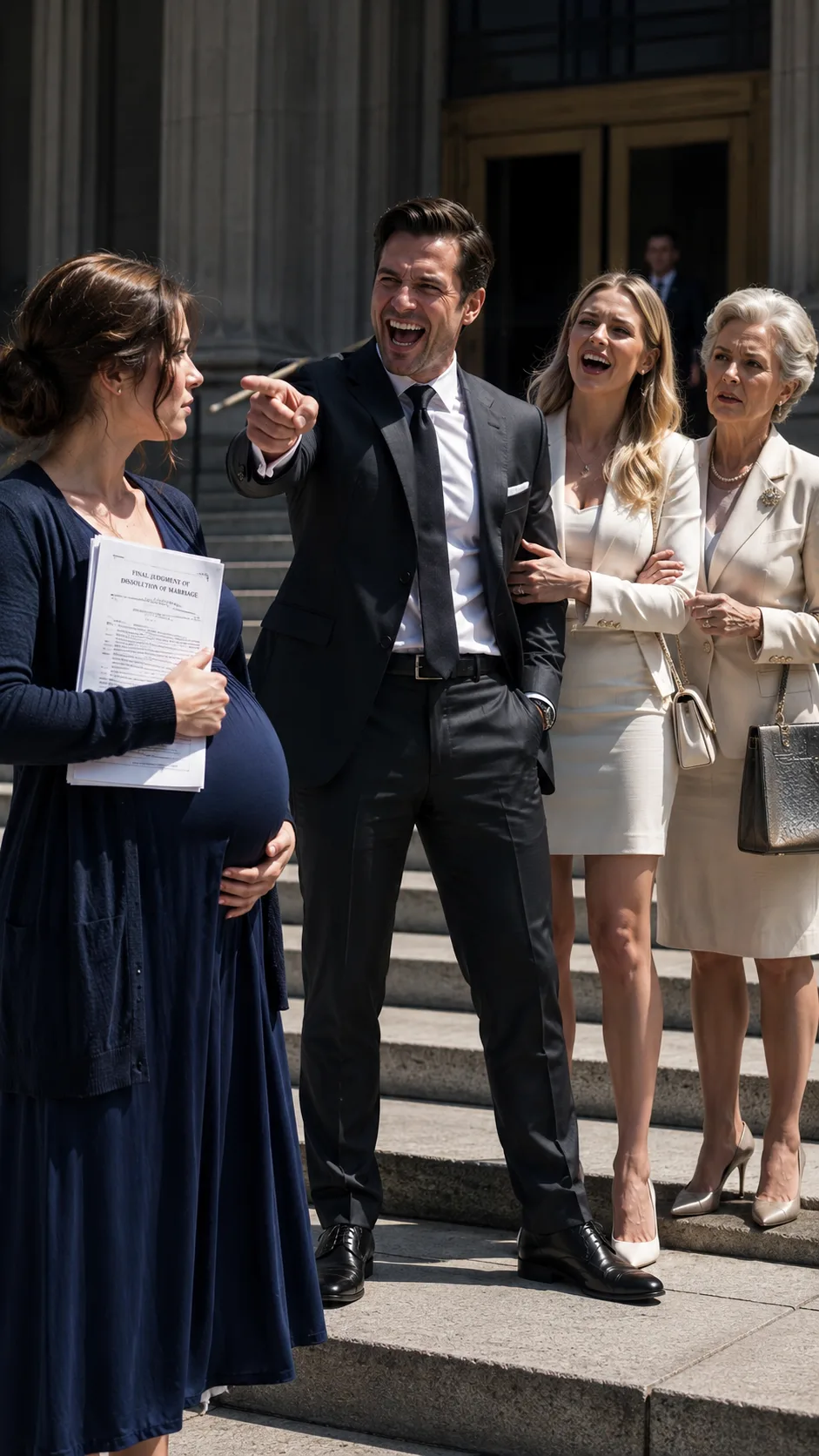
Moments after signing the divorce papers, the wife quietly walked out of their humble home—but a fleet of luxury limousines arrived to whisk her away, leaving the ex-husband paralyzed...
Chapter 1
Moments after signing the divorce papers, the wife quietly walked out of their humble home—but a fleet of luxury limousines arrived to whisk her away, leaving the ex-husband paralyzed...
Part 1:
They threw coins at her feet in the pouring rain.
Not bills. Not a check. Coins.
Quarters, dimes, pennies — little flashes of silver and copper scattering across the wet sidewalk like crumbs tossed to a stray dog.
Emma Hartwell stood there six months pregnant, soaked through a faded maternity dress from Target, with exactly $1,247 to her name and a divorce settlement that would not cover a month of rent in Seattle. Her hair clung to her cheeks. Rain ran down her neck, under her collar, across the curve of her belly where her daughter moved restlessly inside her.
Across the curb, her husband’s red Mercedes idled.
No, not her husband anymore.
Marcus Vance had made that clear less than fifteen minutes earlier, inside the 42nd-floor conference room of Sterling & Associates, where he had signed away their marriage as if cancelling a business subscription.
Now he
sat in the back seat beside Jessica Lane, the woman Emma had known about for six months. Perfect makeup. Perfect smile. Perfect teeth flashing from behind the half-lowered window like she was watching a scene from a movie and not a pregnant woman being publicly humiliated.
Victoria Vance, Marcus’s mother, stood beneath a Burberry umbrella and looked at the coins with satisfaction.
“For the bus, dear,” Victoria said. “Consider it a parting gift.”
That was when something inside Emma went quiet.
Not numb. Not broken.
Quiet.
There is a kind of silence that arrives when the pain finally goes too far. It is not weakness. It is the mind stepping back from the fire so it can learn the shape of the room.
Marcus glanced at her once through the rain.
Once.
Three years of marriage. A child growing in her body. A career she had given up because he
said he wanted a wife who supported him, not competed with him. Three years of dinner parties, false smiles, little criticisms, and lonely nights in a house where she had become less a partner than furniture.
And all she got was one glance.
“Come on, Mother,” Marcus called. “Let her figure it out.”
Victoria gave Emma one last look.
Not hatred.
Something worse.
Dismissal.
Then she folded herself into the Mercedes, and the car pulled away, red taillights bleeding into the gray Seattle afternoon. It turned the corner and disappeared.
Emma did not bend for the coins.
She stood there in the rain, one hand on her belly, the other clenched around the cheap divorce pen she had accidentally carried from the conference room. Her fingers were cold. Her shoes were soaked. She had nowhere to go, no one waiting, no plan that reached beyond the next five minutes.
This,
she thought, is what rock bottom feels like.
Not screaming.
Not collapsing.
Just standing still while the world keeps moving around you.
Then her phone buzzed.
She almost laughed. Marcus had cut off most of her accounts, but the old phone still worked for now. She pulled it from her pocket and saw a message from an unknown number.
Black car outside. Your father’s debt is paid.
Emma stared at the screen.
Her father had been dead for twenty-two years.
James Hartwell had died when she was ten. A heart attack, they said. Stress, they whispered. He had been an inventor, a quiet man with tired eyes and brilliant hands, always hunched over circuit boards and notebooks in a cluttered garage workshop. He had never had money. He had never had power. He had left Emma with memories, not debts.
So what debt?
A sound cut through the rain.
A low, deep purr — nothing like the impatience of traffic, nothing like the growl of buses or taxis. A Rolls-Royce Phantom turned the corner, midnight blue so dark it looked black. It moved slowly, deliberately, as if it had not arrived by chance but by appointment with fate.
It stopped directly in front of Emma.
The rear window lowered.
Inside sat a man with silver hair, calm eyes, and a face Emma did not know but somehow felt she had been waiting to see.
“Hello, Emma,” he said. “My name is Richard Cole. I was your father’s best friend. And I believe it is time you learned what the Vance family stole from you.”
Rain slipped from Emma’s chin.
Behind her, the coins glittered on the sidewalk.
She looked at the Rolls-Royce, then at the message on her phone, then at the place where Marcus’s car had vanished.
For three years, the Vances had taught her to apologize for existing.
For three years, they had called her lucky, ordinary, dependent, replaceable.
Emma put one hand over her belly.
Fifteen minutes earlier, Emma had still been sitting in a room designed to make people feel small.
The conference room at Sterling & Associates was all glass, steel, and dark mahogany. Forty-two floors below, Seattle moved under rain clouds, all traffic and gray water and distant ferry horns. Up there, everything looked expensive enough to erase weakness.
That was probably the point.
Emma sat alone on one side of the table. Six months pregnant. Exhausted. Wearing a maternity dress whose seams had started to protest the shape of her body. She had chosen it because it was the only clean dress left that still fit and did not make her feel like she was surrendering completely.
Once, she had owned suits.
Good suits.
She had been a corporate lawyer, the kind who walked into rooms like this and made men twice her age stop interrupting. Northwestern Law. Top of her class. A mind built for strategy, contracts, mergers, and the quiet violence of legal language. She used to love the click of her heels on marble because it sounded like purpose.
Then she married Marcus Vance.
And somehow, over three years, she had gone from arguing multimillion-dollar deals to asking for permission to use the joint credit card.
The door opened.
Marcus entered first.
Italian leather shoes. Perfect charcoal suit. Rolex Submariner shining on his wrist. He looked like a man born for magazine profiles and boardroom lighting. Handsome in the sharp, polished way that had once made Emma feel chosen.
Now it only made him look expensive.
Behind him came Arthur Higgins, his lawyer, reptilian and calm, carrying a briefcase that likely contained the paperwork of Emma’s destruction.
Then Victoria Vance swept in.
Emma had not known her mother-in-law was coming. That was the first insult. Victoria treated surprise like strategy. She wore a Hermès scarf and pale lipstick and the expression of a woman who had spent her life training servants, executives, and family members to anticipate her disappointment.
“I insisted on attending,” Victoria said, settling beside Marcus. “Someone needs to ensure this is handled cleanly.”
Cleanly.
As if Emma were a spill.
Marcus did not greet her. He did not look at the belly that carried his daughter. He checked his watch.
“Let’s make this fast,” he said. “I have dinner plans.”
The baby kicked.
Arthur Higgins slid the papers across the table with the tip of his pen.
“The terms are straightforward. Mrs. Vance receives the 2014 Honda Civic, the contents of her personal savings account, currently $1,247, and a one-time settlement of $5,000.”
Emma stared at the number.
Five thousand dollars.
That was three years of marriage to Marcus Vance. Three years of support. Three years of giving up her job because he said her ambition made him feel “competed with” inside his own marriage. Three years of hosting his investors, writing notes for his speeches, remembering his mother’s donor lists, and pretending not to know about Jessica Lane’s perfume on his shirts.
Five thousand dollars.
Marcus leaned back.
“It’s generous, Ellie. The prenup gives you nothing. I’m being kind.”
He used the nickname she had once loved. Hearing it now felt like finding mold on wedding cake.
Emma’s voice came out quiet.
“I gave up my career. I supported you. I’m carrying your child.”
Victoria’s eyes sharpened with satisfaction.
“Let’s discuss that, shall we?”
She placed a folder on the table.
“We’ll require a paternity test before further negotiations. Given the timeline, there are questions.”
The words struck like poison.
Emma looked at Marcus.
For one second, stupidly, she expected him to defend her. To say, “Mother, stop.” To say, “That’s my child.” To show even a flicker of the man who had once brought her flowers on their third date and said she was the smartest woman he had ever met.
He examined his fingernails.
“The contractor who installed your home theater?” Emma said, her voice shaking only slightly. “I spoke to him twice.”
Victoria smiled.
“Twice is enough.”
Arthur cleared his throat.
“Mrs. Vance, we don’t have all day.”
Emma looked at the papers. She knew her rights. She knew she could fight. She could drag this out, challenge the prenup, demand discovery, expose the affair. She was a lawyer, for God’s sake.
But she also knew the Vances.
She had seen Marcus destroy a competitor with litigation so vicious the man had lost his business, then his marriage, then his health. She had seen Victoria smile at a charity gala while quietly arranging to remove a board member who had questioned her authority. Money was not just money to the Vances. It was a weapon system.
If Emma fought now, unprepared, they would crush her.
So she picked up the cheap ballpoint pen.
Not the fountain pen Arthur had placed beside the papers.
The cheap one.
Her hand did not shake.
She signed.
Emma Hartwell.
Not Vance.
She had never taken Marcus’s name legally. At the time, Victoria had called it gauche. Marcus had called it “feminist stubbornness.” Now it felt like the last good decision she had made before marriage swallowed her whole.
Emma stood.
“That’s it?” Marcus asked, almost disappointed. “No speech?”
She walked to the door.
Victoria said, “She’s finally learned her place.”
Emma stopped with her hand on the knob.
Then she turned just enough for them to see her face.
And she smiled.
Not sadly.
Not bitterly.
It was the smile of a woman who, even before she understood why, knew the story was not over.
Then she opened the door and walked out.
Emma pressed her hand over her mouth.
Her father had not been a failed dreamer.
He had been robbed.
“The stress killed him,” Richard said. “Heart attack, they said. But I know the truth. Howard Vance killed your father as surely as if he’d pulled a trigger.”
The car pulled through iron gates and up a long drive toward a mansion that looked huge but somehow warm. Older stone. Soft light in the windows. Not a showpiece like the Vance estate. A home.
“Vance Tech is about to go public,” Richard said. “The IPO could value it at eight billion dollars. But if its core patents are challenged, everything stops. The whole empire freezes.”
Emma looked at him.
“Why now?”
“Because now I finally have enough proof.”
“Why didn’t you come sooner?”
“I tried.” His face softened. “The anonymous scholarship. The law firm interview. The apartment lottery.”
Emma stared at him.
“That was you?”
“I wanted to help. But you were determined to do everything yourself. I respected that.” He hesitated. “And then you married into the family that destroyed yours.”
Emma felt the words settle into her bones.
Richard handed her a thick folder.
“I’ll give you money, evidence, lawyers, protection, access. But I won’t do it for you. I promised your father I would watch over you. I did not promise to take away your choices.”
Emma opened the folder.
Patent filings. Transfer documents. Bank records. Emails. Notes. A trail of theft stretching across decades.
At the bottom was a letter.
Her father’s handwriting.
My dearest Emma,
If you are reading this, Richard found a way to give you the truth. I am sorry I could not fight harder. I am sorry I left you so young. But know this: everything I created, I created for you. My patents, my work, my dreams — they were all meant to be your inheritance. You are not the daughter of a failed dreamer. You are the heir to an empire. Go take what is yours.
All my love,
Dad
Emma read it once.
Then again.
Then a third time.
When she finally looked up, the rain had softened against the windows.
“I want Victoria to know it was me,” she said.
Richard nodded.
“She will.”
“I want Marcus to understand what he threw away.”
“He will.”
Emma placed one hand on her belly.
“And I want my daughter to inherit a name no one can steal from her.”
Richard’s eyes shone.
“Then let’s begin.”
Part 4: First Strike
Two weeks later, Emma Hartwell looked like a woman remembered by her own body.
Her hair was shorter. Not dramatically, but enough to tell the mirror something had changed. Her clothes fit. Her eyes were still tired, but the emptiness had been replaced by focus.
She stayed in a brownstone Richard owned in Capitol Hill. Not a mansion. Not a palace. Just a quiet, secure place where she could work without hearing anyone tell her she was too sensitive.
Work became air.
Legal pads covered the dining table. Patent filings were stacked by year. Financial transfer charts were pinned to a corkboard. Emma’s old professor, Margaret Porter, sat across from her most afternoons, red pen in hand, sharpening arguments and reminding Emma to eat.
“You know you could hire an army of associates for this,” Maggie said one night. “Richard would pay for it.”
Emma rubbed the base of her back. Seven months pregnant now, she felt every hour in her spine.
“I need to know every inch of this case myself.”
“You’re stubborn.”
“Thorough.”
“Both.”
Emma’s strategy was simple.
A direct lawsuit would alert Victoria too soon. The Vances would bury her in motions before she got discovery. So Emma took the quieter path.
She filed a formal complaint with the patent office, requesting review of the original Hartwell patents and the transfer documentation.
That triggered an automatic hold on any major corporate transaction involving those patents.
Including Vance Tech’s IPO.
On Monday, Emma walked into the federal building wearing a navy maternity suit and flats because her feet had become traitors. Walter Briggs, Richard’s head of security, waited in the lobby. He was a former FBI agent with the calm of a man who had seen enough chaos not to be impressed by any of it.
The filing took under an hour.
A clerk barely looked up until she saw the names.
Hartwell.
Vance.
Then her fingers slowed on the keyboard.
“Processing may take time,” the clerk said carefully.
“I understand,” Emma replied. “Just make sure it’s done properly.”
By Wednesday morning, financial news had the story.
Vance Tech IPO Hits Unexpected Snag. Patent Dispute Freezes Public Offering.
Emma sat in the brownstone living room, one hand over her belly, watching analysts speculate.
Competitor attack.
Foreign interference.
Corporate sabotage.
No one said James Hartwell’s daughter.
Not yet.
The baby kicked hard.
Emma smiled.
“We started, sweetheart.”
At Vance Tech headquarters, panic bloomed.
Marcus screamed at lawyers. Investors called. The board demanded answers. Arthur Higgins, the same lawyer who had slid her divorce papers across that table, suddenly sounded less reptilian and more nervous.
Victoria knew first.
Emma imagined that moment often later. Victoria in her cream suit, looking over Seattle from the top-floor office, realizing the past had reached the elevator.
Arthur asked, “Who would wait thirty years to challenge this?”
Victoria’s answer came like a curse.
“Richard Cole.”
Then, after a beat:
“And Emma Hartwell.”
By Friday night, Emma received a text from an unknown number.
I know it was you. This isn’t over. — V
Emma did not respond.
That was harder than it sounds. A younger version of her might have fired back, defended herself, demanded respect, tried to sound clever.
But silence, she was learning, could be a blade when held correctly.
Let Victoria wonder.
Let her imagine what Emma had.
Let her lose sleep.
That night, Emma dreamed of her father in his workshop. He stood among tools and notebooks, looking exactly as she remembered him.
“I’m scared,” she told him.
“That’s all right,” he said. “Courage isn’t the absence of fear. It’s moving while fear rides along.”
“What if they destroy me like they destroyed you?”
He placed a warm hand on her shoulder.
“You’re not alone this time. And you are not broken.”
She woke with tears on her face.
The first battle had been won.
But Victoria Vance had not survived forty years by surrendering.
The next morning, the smear campaign began.
Part 5: The Smear and the Counterfire
The first headline hit before breakfast.
Bitter Ex-Wife’s Revenge Scheme? Emma Vance Working With Rival Billionaire to Tank Husband’s Company.
Vance.
They even stole her name in print.
Emma was halfway through toast when Maggie called.
“Turn on Channel Five.”
The segment was brutal.
Grainy photos of Emma entering Richard Cole’s mansion. Speculation about their relationship. Suggestions that the pregnancy timeline was “complicated.” Anonymous sources calling Emma unstable, resentful, greedy.
By noon, the hashtag was everywhere.
#GoldDiggerEmma
Strangers who had never heard her voice accused her of cheating, lying, manipulating, trapping Marcus. People with cartoon avatars said her baby probably was not his. One woman wrote, This is why rich men need prenups.
Emma set down her phone before she threw it.
Her hands were shaking.
Maggie came over within the hour and found Emma sitting in the dark living room.
“They’re calling me everything,” Emma said.
“It’s a smear campaign.”
“It’s working.”
Richard called too.
“I can bury this,” he said. “One call.”
“No.”
“Emma—”
“If you make it go away, they’ll say I needed a billionaire to rescue me. This is my fight.”
That night, Emma broke.
For the first time since the divorce room, since the coins, since the rain, she let herself cry. She cried for her father, who died believing he had failed. She cried for her mother, whom she barely remembered but had lost because one drunk driver changed everything. She cried for the woman she had been before Marcus — brilliant, sharp, alive — and the quiet shell she had become to survive him.
Then the baby kicked.
Once.
Hard.
Emma gasped and pressed her palm to the movement.
“I know,” she whispered. “We’re not giving up.”
The next morning, she called Karen Wells at the Seattle Tribune.
Karen was known for destroying powerful liars with footnotes. Mid-forties, leather jacket, gray streak in her hair, a stare that made weak men overexplain.
They met in Ballard.
Karen sat down and said, “I’ve seen the coverage. Rough week.”
“I have a better story,” Emma said. “Not about me. About Vance Tech. About stolen patents. About a dead inventor whose work built a billion-dollar company.”
Karen’s skepticism lasted exactly twenty minutes.
Her questions were brutal. Good. Emma answered all of them. Dates. Chain of title. Patent numbers. Corporate transfers. Howard Vance’s shell company. Richard’s documentation. Her father’s letter.
When Karen finally closed the folder, her expression had changed.
“If this is real, it’s massive.”
“It’s real. And I’ll go on record.”
“You could stay anonymous.”
Emma thought of the coins hitting the pavement.
“No. I want Victoria to see my face.”
The story broke three days later.
The Vance Tech Fraud: How a Grieving Inventor’s Patents Were Stolen to Build a Billion-Dollar Empire.
This time, Emma was not a rumor.
She was a source.
Full name. Full face. Full story.
James Hartwell’s original filings. The fraudulent transfer documents. The timeline. The evidence. Karen built it like a legal brief with a human heart.
The tide turned.
#JusticeForHartwell
#VanceFraud
The same internet that had dragged Emma now praised her as brave, brilliant, relentless.
Emma did not trust the applause any more than she had trusted the cruelty.
Both came too fast.
But strategically, it mattered. Victoria’s first attack had failed.
So Victoria went lower.
Jessica Lane had contacts in Emma’s doctor’s office. For forty thousand dollars, a billing clerk accessed Emma’s prenatal records. When the real records did not contain what Victoria needed, new ones were manufactured.
The next headline was worse.
Medical Records Suggest Emma Hartwell’s Baby May Not Be Marcus Vance’s.
The documents were fake.
Detailed.
Official-looking.
Cruel.
Emma called her doctor. The receptionist’s voice trembled.
“There was a breach. Dr. Patterson has been trying to reach you.”
Then the pain came.
Sharp, low, terrifying.
Emma doubled over, one hand on her belly, reaching for her phone with fingers that would not obey. The room tilted. The floor rose.
When she woke, she was in a hospital bed.
“The baby?” she gasped.
Maggie appeared beside her.
“She’s fine. You’re both fine.”
Stress-induced blood pressure spike. A fall. Bed rest ordered. No more fighting, the doctor said.
Emma lay there for three days staring at the ceiling.
On the third day, she asked for her laptop.
Maggie protested.
Emma said, “Please.”
She did not open the news.
She opened a scanned letter from her father, written two weeks before he died.
You are the best thing I ever created. Better than any invention. Better than any patent. Be brave, sweetheart. Be smart. Be kind. And never, ever let anyone make you feel small.
Emma read it three times.
Then she looked at Maggie.
“I’ve been fighting like a victim,” she said. “I need to start prosecuting.”
The hospital breach had logs.
Logs meant names.
Names meant payment trails.
Payment trails meant leverage.
Forty-eight hours later, Emma knew the billing clerk’s name.
Brittany Hollister.
And through phone records, a burner-phone purchase, and one careless security camera, she found the woman who paid her.
Jessica Lane.
Emma called at eleven that night.
“I know what you did,” she said.
Jessica went silent.
Emma listed the evidence.
Hospital footage. Phone records. Payment trail.
Then she gave Jessica the choice.
“Turn on Victoria or explain federal medical record theft to a cellmate.”
Jessica chose survival.
By two in the morning, Emma had the files.
Recordings from Victoria’s own safe.
Victoria discussing the medical record scheme.
Victoria admitting the Heartwell documentation had been destroyed.
Victoria saying, We’ve come too far to let a dead man’s daughter destroy everything.
Emma saved the files in five locations.
Then she called Richard.
“I have her,” she said.

Part 6: The Courtroom
King County Courthouse looked like a building designed by people who believed justice should have sharp corners.
Emma arrived at 8:30 wearing a navy dress that made her look competent instead of fragile. Eight months pregnant. Back aching. Ankles swollen. Face calm.
The gallery was packed.
Reporters. Financial analysts. Spectators. Internet commentators who had spent weeks deciding whether she was villain or hero and had apparently come to see which version won.
Richard sat in the front row. Maggie beside him. Walter Briggs at the end. Daniel Cole, Richard’s son, sat close enough to help but far enough not to claim space Emma had not given him.
Daniel had appeared at the brownstone two weeks earlier, quiet and sincere.
They had dated briefly in law school before life sent him to London and Emma into Marcus’s arms. He said he was sorry he had not known. Sorry he had not helped sooner. Sorry, maybe, for disappearing from a story that might have gone differently.
“You’re here now,” Emma had said.
“Is that enough?”
“It’s a start.”
Marcus sat at the defendant’s table with lawyers on both sides. He looked older than thirty-eight. Hollowed out. A man realizing the house he had inherited might have been built over a grave.
Victoria was absent.
That worried Emma.
Judge Patricia Okonkwo entered at 9:30 exactly.
“Counsel, identify yourselves.”
David Morrison stood for Vance Tech.
Emma stood alone.
“Emma Hartwell, representing myself.”
The gallery murmured.
The judge looked at her over her glasses.
“You understand you have the right to counsel?”
“I do, Your Honor. I’m a licensed attorney. I choose to handle this matter myself.”
“Very well.”
The morning was law.
Not theatrics.
Emma walked through patent filings from 1991 and 1992. Explained chain of title. Established James Hartwell’s original work. Connected the technology to Vance Tech’s core systems. David Morrison tried every predictable attack — authenticity, relevance, motive, bitter ex-wife narrative.
Emma answered calmly.
Case law.
Dates.
Documents.
Precedent.
The old part of her woke fully in that courtroom. The lawyer. The woman who had once commanded rooms without asking permission. She had missed that woman. More than she realized.
By lunch, the momentum had shifted.
During recess, Emma sat in a quiet conference room eating a sandwich Daniel had brought when the door opened.
Victoria Vance walked in.
Cream suit. Perfect hair. Diamond earrings. Face composed, but the eyes were different.
Defeated.
“May I speak with you alone?”
“No,” Emma said. “Anything you say can be said in front of them.”
Victoria’s jaw moved once.
“I’m offering a settlement. Full recognition of your father’s patents. Complete transfer. Forty million dollars in damages.”
“In exchange for what?”
“You drop criminal referrals. The recordings never become public. My name stays out of prison.”
Emma studied her.
This woman had mocked her, smeared her, questioned her baby, tried to destroy her medical privacy, and had spent decades protecting the theft that killed James Hartwell.
“No.”
Victoria’s composure cracked.
“I am offering you everything.”
“You are offering me silence.”
“I am trying to end this.”
“You are trying to save yourself.”
Victoria stepped closer.
“I am begging you.”
For years, Emma had imagined Victoria begging. She thought it would feel good.
It did not.
It felt small.
“You should have thought about begging before you stole my father’s work,” Emma said. “Before you let him die believing he failed. Before you threw coins at my feet.”
Victoria’s eyes filled.
Emma turned to Richard.
“Let’s go back.”
At 2:00, court resumed.
Emma stood.
“Your Honor, I have final evidence to submit. Audio recordings documenting the patent theft, cover-up, and the recent conspiracy to fabricate medical records.”
Morrison objected.
Judge Okonkwo allowed it subject to authentication.
Emma connected her laptop.
Victoria’s voice filled the courtroom.
The medical record scheme needs to happen quickly before her story gains more traction.
The gallery erupted.
Then came the older recording.
Howard always said we had to protect the secret. If anyone found out where those patents really came from, we’ve come too far to let a dead man’s daughter destroy everything.
When the recordings ended, silence covered the room.
Marcus sat with his head in his hands.
Judge Okonkwo looked toward the defense.
“Any challenge to authenticity?”
Morrison looked back at Victoria, who had taken a seat in the gallery and now sat utterly still.
“No, Your Honor.”
The ruling came clean and sharp.
James Hartwell’s patents belonged to his estate.
By extension, to Emma Hartwell.
Vance Tech’s IPO remained blocked.
The matter would be referred for federal investigation, including fraud, conspiracy, and medical privacy violations.
Federal marshals moved toward Victoria.
She stood without screaming.
When she passed Emma’s table, she paused.
“You’re more like your father than I realized,” Victoria said.
Emma said nothing.
She watched Victoria Vance walk out in custody.
Outside the courtroom, reporters shouted.
Emma kept walking.
Then Marcus called after her.
She gave him five minutes in an empty conference room.
“I didn’t know,” he said, voice breaking. “About the patents. About your father. I swear.”
“I believe you.”
Hope flickered across his face.
“Then maybe we can work something out. The company, what’s left of it. You take controlling share. I handle operations—”
“No.”
He looked physically struck.
“I have nothing.”
Emma reached into her bag and placed an envelope on the table.
“What is this?”
“Five thousand dollars. And the keys to a 2014 Honda Civic. Level two of the garage.”
His face crumpled as he understood.
“You’re mocking me.”
“I’m giving you what you gave me. You called it generous.”
His eyes filled.
“The baby is mine.”
“She is a Hartwell. She will carry my father’s name.”
“You’re going to raise her to hate me?”
“No,” Emma said, standing. “I’m going to raise her not to think about you at all.”
At the door, he whispered, “Say something. Yell at me. Tell me you hate me.”
Emma paused.
Then she opened the door and left him with silence.
Part 7: Grace Hartwell
Six weeks later, Emma went into labor on a quiet Tuesday morning.
Not in a mansion. Not alone. Not under attack.
She was surrounded by people who had chosen her.
Maggie held her hand until the doctors decided a C-section was necessary. Richard paced the hallway like a man arguing privately with God. Daniel brought ice chips, then stood uselessly near the wall until Emma told him to stop looking like a nervous intern and sit down.
The baby arrived crying.
Small.
Fierce.
Perfect.
The nurse placed her in Emma’s arms.
“Congratulations, Miss Hartwell. You have a healthy baby girl.”
Emma looked down at the dark hair, tiny fists, red face, and furious little mouth.
“Hi, sweetheart,” she whispered. “I’m your mom.”
Richard came closer, eyes wet.
“What’s her name?”
Emma had considered a dozen names, but the choice had become obvious.
“Grace Catherine Hartwell.”
Grace for the future.
Catherine for the mother Emma never got to know.
Hartwell for the legacy no one would steal again.
One year later, Hartwell Technologies opened inside the building that used to belong to Vance Tech.
Emma kept as many employees as she could. She set up transition funds for those displaced by the collapse. She had never wanted innocent workers to pay for Victoria’s crimes. Her revenge had a boundary. That mattered.
The company thrived.
Not just financially, though the numbers were excellent.
It thrived because people believed in the mission. Innovation built on integrity. Credit given where it was due. Patents protected. Young inventors funded through a scholarship in James Hartwell’s name.
Grace learned to walk in the lobby.
Her first word was “Mama.”
Emma cried so hard Maggie laughed and Richard pretended not to.
Marcus came once.
He looked thinner, older, humbled by consequences that had stripped him of gloss. He was working insurance sales in Ohio. The Honda had broken down. He had taken the bus.
“I just wanted to know she’s okay,” he said.
Emma studied him.
The man she had married. The man who had hurt her. The man broken by truths he had not been brave enough to question.
“She’s healthy,” Emma said. “She’s happy. She’s loved.”
He nodded with tears in his eyes.
“That’s all I needed.”
At the door, he said, “I’m sorry. I know it doesn’t change anything.”
Emma watched him for a moment.
“Don’t come back.”
He nodded.
And didn’t.
Three years later, Daniel proposed in Emma’s office at sunset.
The ring was simple. Beautiful. Not a performance.
“I don’t want to compete with your strength,” he said. “I just want to stand beside it.”
Emma said yes.
Their wedding was small. Richard walked alone to his seat because Emma walked herself down the aisle. She was not property to be transferred. She was a woman arriving by choice.
Grace threw flower petals with grave seriousness.
A month after the wedding, Emma received a letter from Victoria in federal prison.
Victoria did not ask forgiveness. She wrote that she had been young when Howard stole James’s work, pregnant with Marcus, terrified, then complicit. She wrote that she had become the monster required to protect the secret. She wrote that Emma had won.
Completely.
Absolutely.
Emma read the letter twice, folded it, and placed it in a drawer.
She felt no triumph.
Only closure.
Ten years later, Grace Hartwell stood in her grandfather’s restored workshop.
The room had been preserved as James left it: notebooks, tools, circuit boards, half-finished ideas, the smell of dust and old coffee. Grace was thirteen, sharp-eyed and stubborn, with Emma’s determination and James’s green eyes.
“He built all this?” Grace asked.
“He did.”
“And someone stole it?”
“Yes.”
“And you got it back.”
Emma smiled.
“Yes.”
Grace ran her fingers gently along the edge of an old notebook.
“Will you teach me how to build things like he did?”
Emma felt the circle close so suddenly she had to blink back tears.
“Yes, sweetheart. I’ll teach you everything.”
Grace picked up one of James Hartwell’s notebooks like it was treasure.
“Mom?”
“Yes?”
“Thank you for fighting for him. For us.”
Emma pulled her daughter close.
Outside, Seattle glittered under evening light. The same city where James Hartwell dreamed, where Emma had fallen in the rain, where Grace would build whatever future belonged to her.
“That’s what Hartwells do,” Emma said softly. “We don’t stay down.”
THE END.
Chapter complete
You have reached the end of this chapter.
Continue reading
A few more worlds to get lost in after this chapter.




