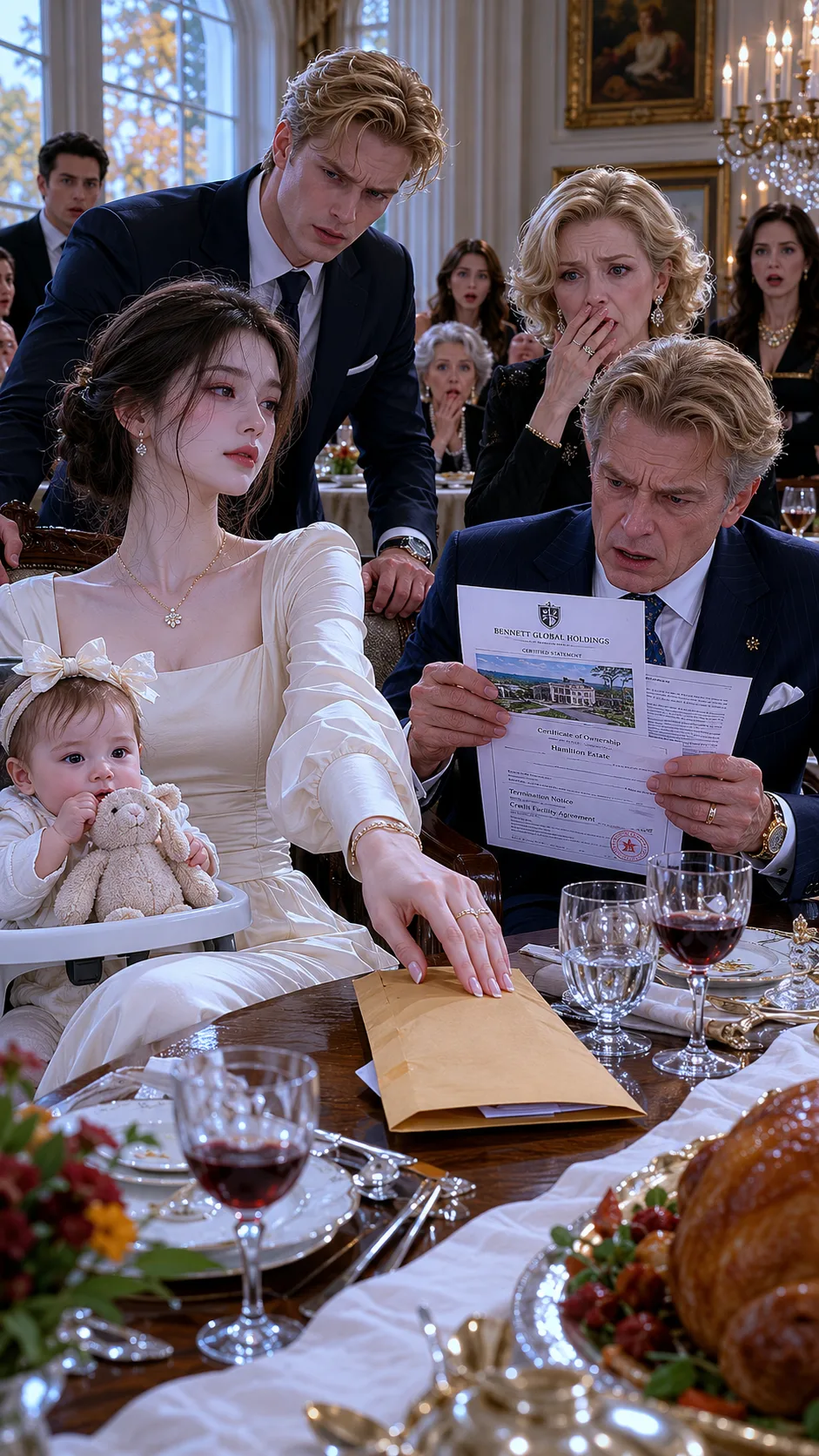
I NEVER TOLD MY IN-LAWS I OWNED A $2.1 BILLION EMPIRE.
Chapter 1
I NEVER TOLD MY IN-LAWS I OWNED A $2.1 BILLION EMPIRE.
THEY TREATED ME LIKE A POOR NURSE, THEN INVITED ME TO THANKSGIVING TO MAKE ME SIGN AWAY MY MARRIAGE. THEY SAID I ONLY WANTED THEIR MONEY. I LET THEM SAY EVERYTHING. THEN I PUSHED MY OWN FOLDER ACROSS THE TABLE.
The first full day after my daughter was born, my mother grabbed my hair like I was not her child.
Even now, some memories feel too cruel to belong to a real life. That one still does. So does the memory of my father standing in the doorway with his hands at his sides, watching as if he were observing bad weather through a window. So does the sight of my younger sister Madison holding her own newborn against her chest, her mouth curved into a quiet little smile while I struggled to stay upright.
My name is Claire Bennett. I was thirty-one, married, newly postpartum, and living in New
Jersey when my parents decided that the daughter who had just come home from surgery was less important than the daughter who wanted a brighter bedroom.
It was not even my parents’ house in the way I had always imagined it was.
At the time, I only knew it as the Paterson condo where I had spent the last years of my childhood visiting on holidays, the place with narrow hallways, old cream tiles in the bathroom, and the back bedroom that still carried traces of who I had been before life became complicated. There were faint tape marks on the ceiling from the paper stars I had hung as a teenager. One corner of the closet still smelled like cardboard boxes and old books. It was not beautiful, but it was familiar.
Ethan and I were there because our small home in Clifton had flooded two days before Lily
was born. A pipe burst in the wall behind our bedroom. By the time anyone noticed, the floor had lifted, the closet wall was damp, and the air carried that sharp, sour smell of soaked drywall and cleaner. The restoration company said the room needed more time before it would be safe for a newborn.
My parents offered their condo like it was an act of great generosity.
“Of course you can stay here,” my mother said. “You just had a baby. Family takes care of family.”
I wanted to believe her. I was exhausted enough to believe almost anything.
Lily’s birth had not gone the way anyone planned. One moment I was in a hospital bed, trying to breathe through contractions while nurses watched the monitor too closely. The next, the room changed. Voices became calmer, which somehow made everything scarier. Lights flashed overhead. Ethan appeared beside me in
a mask and gown, saying my name again and again, his voice breaking each time the doctors spoke in quick, clipped sentences.
Then Lily arrived.
Small. Furious. Loud.
That sound saved me from complete terror.
I had spent six years as a postpartum nurse before I moved into clinic administration, so I understood recovery on paper. I knew what women were supposed to do after a C-section. I knew how to stand carefully, how to hold a pillow against the incision, how to recognize the difference between normal pain and something that needed help. I had explained all of it to other mothers with a calm voice and a gentle smile.
But knowing a thing professionally does not prepare you for being trapped inside your own fragile body.
Every movement felt borrowed. Sitting up required help. Laughing hurt. Coughing felt impossible. I was swollen, slow, dizzy, and embarrassed by how helpless I felt. All I wanted was forty-eight quiet hours in a familiar room while my husband watched over our daughter and I learned how to breathe without fear.
For one afternoon, I thought that was what I had.
Ethan set up Lily’s bassinet beside the bed. My mother fluffed pillows with the dramatic care of someone who wanted witnesses. My father, Robert, stood in the hallway and asked whether it was safe for the baby to sleep near me while I was “on medication,” as if my weakness annoyed him. My mother kept glancing at her phone.
Madison had texted her three times.
My sister had given birth twelve days before me, to a baby boy named Owen. Her boyfriend had already become one of those men people described with phrases like “trying to figure things out,” which meant he was usually not there. Madison had been staying wherever someone would take her in: a friend’s place, then a cousin’s apartment, then, apparently, nowhere she liked.
In my family, Madison’s problems always became everyone else’s emergency.
Madison was tired.
Madison was scared.
Madison needed support.
Madison had been through enough.
Whenever those words were spoken, something of mine usually disappeared.
That evening, I woke to raised voices in the hallway. Ethan had gone out to bring diapers from the car. Lily was sleeping beside me, one tiny hand curled near her cheek. I remember trying to push myself up on one elbow and feeling my breath catch from the pain.
Then my mother came in.
Her face was not soft. It was not worried. It was fixed with that hard, protective anger she only ever wore for Madison.
“You need to get up,” she said.
I blinked at her. “What?”
“Madison is coming. Owen needs this room.”
For a few seconds, I thought pain medication had made me misunderstand. “Mom, I just had surgery yesterday.”
“And Madison just had a baby too.”
“She can take the couch for one night,” I said carefully. “Our apartment is still not safe for Lily.”
My mother’s mouth tightened as if I had said something selfish beyond forgiveness.
“You always think your problems are bigger,” she snapped. “You have Ethan. You have a job. You have options. Madison has nothing.”
I tried to sit higher, but pain cut across my lower abdomen and stole my voice.
“Please,” I whispered. “I can’t move like this.”
That was when her hand went into my hair.
It was quick. Ugly. Shocking in a way that made the room go silent around it. She pulled me forward just enough to make me gasp. Not enough to look dramatic to someone who wanted to deny it later. Enough to humiliate me. Enough to remind me that she still believed she owned the right to hurt me.
“You had your turn,” she hissed. “Owen needs sunlight. That room is better for him.”
My father appeared in the doorway. He did not rush in. He did not tell her to stop.
“Robert,” I said, barely able to turn my head. “Help me.”
He looked at his watch.
“The water’s off at your place,” he said. “Go home.”
“I can barely walk.”
“Then Ethan can carry you.”
Madison stood behind him holding Owen, her eyes moving over the room as if she were already deciding where to put her bags.
Then Ethan came back.
He saw my mother’s hand in my hair, saw me half-folded around my own pain, and something in him changed so sharply that even my father stepped back. Ethan dropped the diaper bag and crossed the room.
“Let go of my wife,” he said.
My mother tried to answer, but Ethan was already there, gently removing her fingers from my hair with hands that shook from fury.
His voice went low.
“If you touch her again, you will never see us again.”
Nobody spoke.
Ethan packed what he could with one hand while helping me with the other. He lifted Lily’s car seat. He wrapped a blanket around my shoulders. Outside, rain slid down the windows of the Paterson condo, turning the streetlights blurry. Madison watched us leave from the window, her newborn in her arms, her expression calm in the way only someone who believes she has won can be calm.
We did not go back to our flooded house.
We went to a cheap motel off Route 46, the kind with thin towels, humming lights, and a heater that clicked all night.
Ethan slept sitting up in a chair beside Lily’s bassinet. His head kept dropping forward, then jerking up again whenever she moved. I sat against a stack of flat pillows, aching, humiliated, and wide awake.
At 2:13 in the morning, I opened my laptop.
Not to check messages.
Not to look at medical advice.
Not to cry.
I logged into a private server hidden behind layers of security that no one in my family knew existed.
The dashboard loaded.
Bennett Global Holdings.
Net Worth: $2,142,890,412.
For six years, I had let the world think of me as Claire Bennett, postpartum nurse, then clinic administrator. Before that, I had been C.B. Bennett, the teenager who wrote hospital logistics software from a secondhand laptop, the young founder who built VitalsNet into the system half the country’s medical networks quietly depended on. At twenty-four, I sold a minority stake for more money than anyone in my family could imagine and moved the rest into trusts, holding companies, and quiet investments.
I did not hide it because I was ashamed.
I hid it because I wanted one part of my life to be honest.
I wanted someone to love me before they knew what my signature could buy.
Ethan did.
He loved me when I wore thrift-store sweaters. He loved me when I worked night shifts. He loved me when our first apartment had a bathroom door that stuck in summer and a kitchen window that whistled in the wind. He never once looked at me like a ladder.
But his parents did not know any of that.
To Richard and Eleanor Hamilton, I was the woman who had dragged their son down.
They were old-money people from Short Hills, or at least they performed old money with theatrical discipline. Eleanor could insult someone using only the way she lifted a wineglass. Richard spoke as if every sentence had passed through a boardroom first. They had never said outright that I was beneath Ethan, but they had suggested it with every dinner invitation, every birthday card addressed only to him, every pause before saying the word “nurse.”
Seven months passed.
My scar faded. Lily began crawling. Ethan and I repaired the Clifton house, though we were already quietly looking for something better. My parents never called. Madison posted photos of Owen in my old bedroom under captions about “family support” and “new beginnings.”
Then Eleanor Hamilton invited us to Thanksgiving.
Ethan did not want to go.
I did.
Not because I expected kindness.
Because three months earlier, through one of my holding companies, I had received notice that a certain Short Hills estate had fallen into financial trouble. Richard Hamilton had been borrowing against pride for years. The house, the cars, even parts of his business depended on credit lines he assumed would always be renewed.
He did not know who had quietly bought the debt.
He did not know who now held the deed.
He did not know that the woman he pitied had become his landlord before he ever passed her the gravy.
Thanksgiving at the Hamilton estate looked exactly as Eleanor wanted it to look: polished silver, crystal glasses, white taper candles, flowers arranged too perfectly to feel alive, and wine expensive enough to make ordinary people whisper before drinking it. Lily sat in a high chair beside me, chewing on a soft toy. Ethan kept his hand near mine under the table.
Eleanor smiled at my simple dress.
Not warmly.
Surgically.
“So, Claire,” she said, smoothing her napkin over her lap. “Are you still at that little clinic?”
“Yes,” I said.
“How admirable. It must be exhausting, trying to manage motherhood while working for… what do nurses make now?”
Ethan’s jaw tightened. “Mom.”
“I’m only asking,” Eleanor said. “It is not cruel to discuss reality.”
Richard leaned back in his chair. “Reality is exactly why we asked you here.”
The room changed.
It was subtle, but I felt it. The cousins stopped talking. An aunt lowered her fork. Ethan looked from his father to his mother, suddenly alert.
Richard reached inside his blazer and removed a thick leather folder. He placed it on the table and pushed it toward me.
“Claire,” he said, “we are prepared to be generous.”
Ethan stood so quickly his chair scraped the floor.
“What is this?”
“A solution,” Richard said calmly. “Your future is being limited, son. Everyone can see it.”
Eleanor looked directly at me. “Inside that folder is a dissolution agreement. Five million dollars. More security than a woman in your position could ever realistically earn. You sign, you step away, and Lily will be provided for properly.”
For one second, nobody breathed.
Then Ethan said, “You invited my wife to Thanksgiving to offer her money to leave me?”
“To prove she did not marry you for it,” Eleanor replied.
Her voice was smooth, almost bored.
“If she loves you, she will want what is best for you. If she is what we suspect, she will take the money.”
I looked at the folder.
Five million dollars.
They thought it was bait.
They thought it was power.
They thought it was enough to make me reveal myself as small.
Something inside me went very still. I thought of my mother’s hand in my hair. My father’s watch. Madison’s smile in the window. All the people who had mistaken silence for weakness because silence was easier for them to understand.
I lifted my eyes to Richard.
“You think five million is a life-changing amount of money?”
Richard gave a dry laugh.
“For someone like you, Claire, yes.”
I did not touch his folder.
Instead, I reached into Lily’s diaper bag and removed a plain manila envelope.
Eleanor’s smile faltered.
I slid the envelope across the table. It moved over the white cloth, past the silverware, and stopped beside Richard’s wineglass.
“What is that?” he asked.
“Not my signature,” I said. “Open it.”
He did.
The first page made him frown.
The second made him stop moving.
By the third, the color had started leaving his face.
Inside were three documents.
A certified summary from Bennett Global Holdings.
The deed transfer for the Short Hills estate, purchased through one of my companies after Richard defaulted quietly and repeatedly.
And a notice regarding the main credit line supporting his firm, held by a financial institution where I owned the controlling stake.
His hand trembled just enough for the paper to whisper.
“You’re C.B. Bennett,” he said.
Eleanor stared at me as if my face had rearranged itself.
I folded my hands in my lap.
“Yes.”
Richard looked around his own dining room like he was seeing it from the outside for the first time.
“You bought my house?”
“I bought a distressed asset,” I said. “You taught me tonight that reality matters.”
Ethan slowly sat back down, his expression stunned, then bright with something dangerously close to joy.
Eleanor’s mouth opened, but no sound came out.
I continued.
“You will need to move out by the first of the year. I’m converting this property into a recovery residence for postpartum mothers who have been displaced by their families. The upstairs rooms get excellent light. I know how much families seem to value that.”
Ethan made a quiet sound beside me, half disbelief, half laughter.
Richard’s eyes hardened. “You can’t do this.”
“I already did.”
Lily dropped her toy on the floor. The little thud was the only sound in the room.
I stood carefully, lifted my daughter, and turned to my husband.
“Ethan,” I said, “let’s go.”
He rose immediately.
At the doorway, I looked back one last time.
“Oh,” I added. “Your temporary apartment has been arranged. Two bedrooms. Paterson. Very modest. Very practical.”
Eleanor’s face tightened.
“And my parents?” Ethan asked quietly, already understanding there was more.
I smiled without warmth.
“They moved out this morning. I bought the building and ended their lease.”
Nobody followed us.
No one apologized.
But as we stepped outside into the cold November air, I realized I no longer needed apologies from people who only understood value when it came printed on legal paper.
Ethan took Lily’s bag from my shoulder and kissed the side of my head.
“Bora Bora?” he asked softly.
“For Christmas,” I said. “Lily should see water that isn’t coming through our bedroom wall.”
He laughed then, fully and freely, while behind us the Hamilton mansion glowed like a museum exhibit of a life that had already ended.
Some families build homes.
Some build cages and call them love.
And some doors are not meant to be reopened.
They are meant to be locked from the outside, while you walk away with your child, your husband, and the truth they never bothered to ask for.
THE END.
Chapter complete
You have reached the end of this chapter.
Continue reading
A few more worlds to get lost in after this chapter.




