The receipt was stuck to the bottom of Lucas’s coat pocket with a piece of old peppermint.
Chapter 1
The receipt was stuck to the bottom of Lucas’s coat pocket with a piece of old peppermint.
Hannah found it while shaking rainwater from his black wool coat over the laundry room sink. The paper slipped out with two coins, a dry-cleaning tag, and a bent business card from a real estate broker he had once claimed he hated.
White lilies.
Cash payment.
Friday, 2:17 p.m.
She stood with the receipt between two fingers while the washing machine clicked behind her. Lucas’s shirts turned slowly behind the round glass door, pale sleeves twisting over each other like they were trying to get loose.
He had told her he spent Friday afternoon at a client lunch.
Lucas hated lilies.
“They look like funeral flowers,” he had said the first week after she moved back into the house from the rehabilitation center. She remembered that sentence because she had been arranging a grocery-store bouquet in a blue vase and he had taken the lilies out one by one. He
had smiled while doing it. Careful. Gentle. Too careful.
Hannah folded the receipt once and put it in the pocket of her cardigan.
No reason.
That was what she told herself when she heard Lucas’s key turn in the front door fifteen minutes later. She did not move from the laundry room. She watched the washing machine finish its cycle and listened to his shoes pause in the hallway.
“Hannah?”
She pressed her thumb against the folded paper.
“In here.”
Lucas came to the doorway. His tie was loosened. His hair was damp at the edges. He looked at the coat hanging over the sink, then at her hand.
“You washed my gray shirts?”
“They were in the basket.”
He nodded.
Too fast.
A small drop of rain ran from his cuff onto the tile. He saw it. She saw him see it. He wiped it away with his shoe
as if water on tile had become evidence.
“Client meeting ran late,” he said.
“It’s only four.”
He blinked once. “Early lunch. Late paperwork.”
The dryer beeped.
Hannah opened it and pulled out warm towels, one at a time. The heat hit her face. Lucas stayed in the doorway without stepping inside.
He had started doing that after her accident. Standing near thresholds. Watching rooms before entering them. Once, when she asked why, he kissed her shoulder and said he was afraid of startling her.
She had believed that too.
A lot of her life after the accident worked that way. Lucas told her a thing. She believed it. The doctors told her memory loss could leave holes. She accepted the holes. Her mother had died years before, her father lived in Arizona and called on holidays, and Lucas knew what she liked for breakfast, which side of the bed
she slept on, which songs made her cover her ears.
He knew enough.
That was the problem.
At dinner, he served salmon with lemon and cut her portion into neat pieces before setting the plate down. He had done that since the hospital. She had never asked him to stop.
“You don’t have to do that,” she said.
His knife paused over the plate.
“Do what?”
“Cut my food.”
Lucas looked at the fork in her hand, then smiled. “Habit.”
The smile reached his mouth and stopped there.
Outside, rain tapped against the kitchen windows. On the counter, his phone lit up once. He turned it face down without reading it.
Hannah watched his fingers.
There was a thin line of dirt beneath his thumbnail.
Friday came back like a scheduled confession.
Lucas dressed before breakfast. Dark coat. Polished shoes. No tie this time. He drank coffee standing up and checked his watch three times while Hannah pretended to search for cinnamon in the spice drawer.
“You have another client today?”
He lowered the mug. “Yes.”
“Same one?”
His hand tightened around the handle. “What?”
“Same client as last Friday.”
Lucas set the mug in the sink. It made a clean, hard sound against the porcelain.
“Why are you asking?”
Hannah found the cinnamon behind the paprika. She held it for a second and put it back without opening it.
“You never tell me their names.”
“Because client privacy matters.”
“You sell insurance.”
“Private insurance.”
She looked at him then. Not long. Just enough.
Lucas smiled again, but his jaw moved first. “You always hated details before the accident.”
Before the accident.
He used that phrase like a locked gate.
Hannah took two slices of bread from the toaster and placed them on a plate. One edge had burned black. She scraped it with a butter knife until crumbs collected near her wrist.
“I don’t remember hating them.”
“That’s why I remember for both of us.”
There it was.
Small. Clean. Placed between them like a glass of water nobody would drink.
Lucas left at 1:48.
Hannah waited eleven minutes.
She wore a navy raincoat, tied her hair low, and drove her old sedan three cars behind his. The wipers dragged across the windshield with a rubber groan. At every red light, she kept one hand on the wheel and one hand in her pocket, touching the receipt.
Lucas drove through town, past the pharmacy, past the closed movie theater with half the letters missing from its sign, past the bakery where he sometimes bought almond croissants and claimed the baker knew him by name.
He turned left at the chapel road.
Hannah slowed before the cemetery gate.
The flower shop sat across from it, painted green, with a striped awning sagging under rainwater. Lucas parked at the curb and went inside. He came out with white lilies wrapped in brown paper.
No client.
No paperwork.
He crossed into the cemetery and walked like a man who knew which stones leaned, which path flooded, which shortcut passed behind the chapel. He did not check the map posted near the gate.
Hannah parked behind a maintenance shed and stepped out into wet grass. Mud grabbed at her shoes.
She followed at a distance.
The cemetery had old money in it. Marble angels. Iron fences around family plots. Names carved deep enough to survive weather and grandchildren. Near the back, behind the stone chapel, the graves became newer. Flat markers. Fresh gravel. Plastic flowers in metal cups.
Lucas stopped at a headstone half-hidden by a yew tree.
Hannah stood behind an oak trunk and watched him.
He did not kneel. He did not pray. He laid the lilies across the grass and brushed rain from the top of the stone with his bare hand. Then he took something from his coat pocket and placed it behind the flowers.
A photograph.
Hannah could not see the face.
Lucas stood there for twenty-three minutes. She counted without meaning to. Every minute sat on her tongue like a pill.
Then he left.
Hannah waited until his car passed through the gate. She waited until the sound of the engine faded. She waited until a crow landed on the chapel roof and shook water from its wings.
Then she walked toward the grave.
Her shoes slipped once. She caught herself on a neighboring stone and left a muddy handprint across someone named Eleanor.
“Sorry,” she said.
The word sounded strange out there.
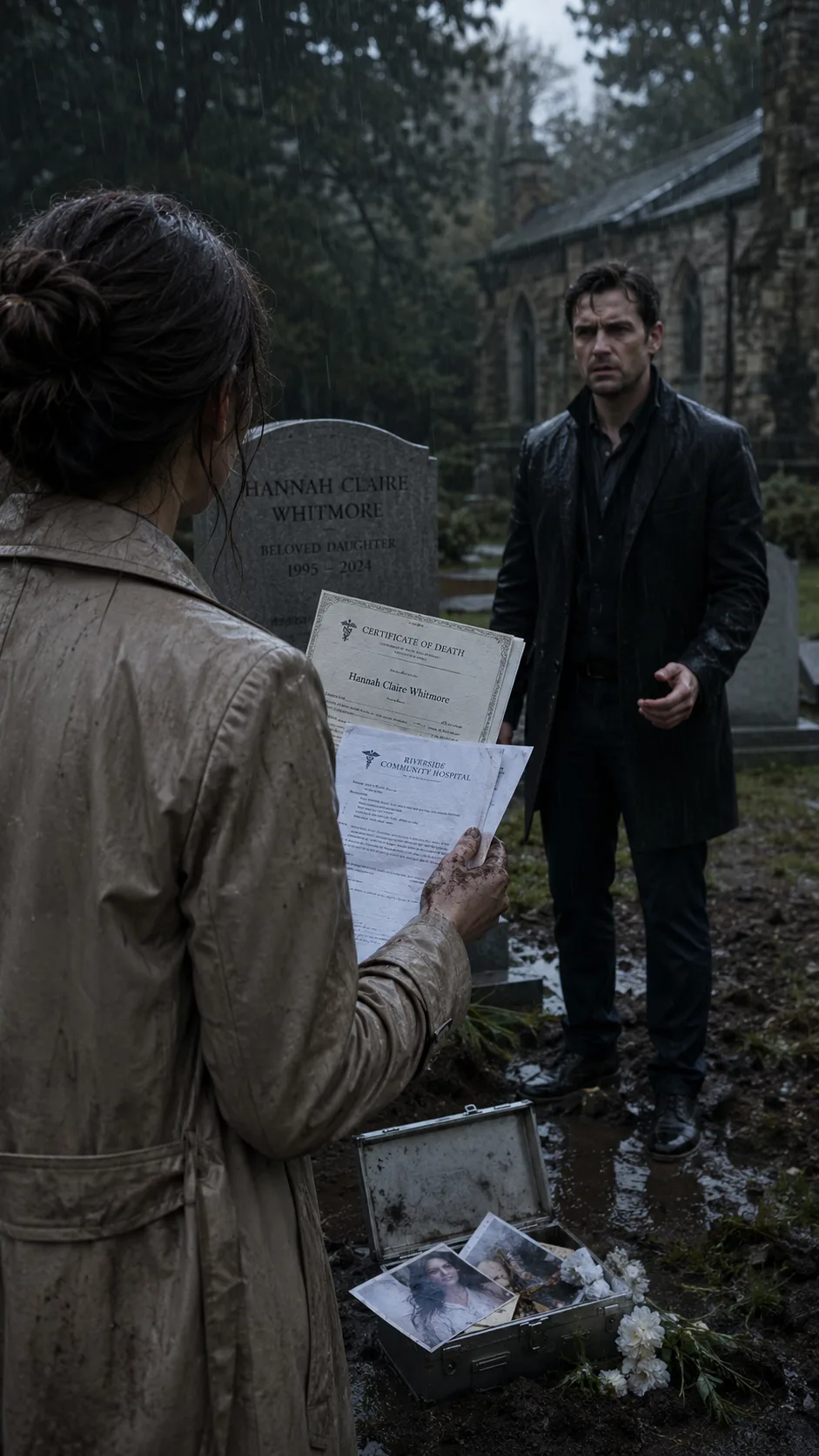
She reached Lucas’s flowers first. White lilies, fresh and open, the petals bruised by rain. The photograph had fallen face down on the grass. Hannah picked it up.
It was not another woman.
It was her.
At least, it looked like her.
The photograph showed Hannah in a hospital bed, skin pale under fluorescent light, mouth partly covered by tubes, hair shaved near one temple. Someone had written on the back in blue ink.
Day 19. No response.
Hannah’s fingers locked around the photo.
Day 19.
Lucas had told her she had been unconscious for five days.
She turned toward the headstone.
The name came into focus one piece at a time, because her eyes refused to take the whole thing at once.
Hannah Claire Whitmore.
Beloved Wife.
1994–2021.
The rain kept falling.
It ran down the carved letters. It filled the small groove between her first name and middle name. It collected in the number one at the end of 2021.
Hannah stepped back.
Her heel sank into mud.
She looked behind her, toward the road, toward the chapel, toward anywhere with living people and unlocked doors. No one stood there. Only rows of stone and a tipped watering can near the path.
She looked back at the grave.
Her grave.
The world did not tilt. It became too straight. The line of the chapel roof. The path between graves. The thin black branches pressed against the gray sky. Everything stayed exactly where it was while the name on the stone cut through the life she had been living.
She touched the scar near her hairline.
Lucas had told her the scar came from the accident.
He had told her a lot of things.
A sound came from the wet soil beside the grave.
Not a voice. Not movement.
A small metallic tick.
Hannah looked down.
Rain had loosened a patch of fresh dirt near the side of the headstone. Something silver showed beneath it.
She crouched.
Her fingers hovered above the mud.
No.
Then she dug.
The soil was soft. Too soft for an old grave. It packed beneath her nails and slid over her knuckles. She pulled at roots, gravel, wet leaves, until the silver edge became a corner, then a lid, then a small metal box the size of a lunch tin.
It had no lock. Only a clasp bent out of shape.
She lifted it from the ground and set it on the grass.
A groundskeeper’s cart rattled somewhere near the front of the cemetery. Hannah froze, one hand on the lid. The sound faded.
She opened the box.
Inside lay a stack of hospital photographs, a folded document, a plastic bracelet, and a small envelope sealed with tape yellowed at the edges.
The bracelet came first.
WHITMORE, HANNAH C.
FEMALE.
DOB 05/14/1994.
The folded document was a death certificate.
It had her name.
Her birth date.
Her supposed death date.
The doctor’s signature sat at the bottom in black ink.
Hannah knew that signature.
Dr. Samuel Voss.
The same neurologist Lucas took her to every three months. The one who never let her sit alone in the exam room. The one who asked Lucas questions while Hannah sat on the paper-covered table with her feet hanging six inches above the floor.
She opened the envelope.
There was one letter inside.
The hospital logo sat at the top. Riverside Community Hospital. The paper smelled faintly of damp cardboard and something chemical.
One sentence had been circled in blue.
“The real wife never woke up.”
Hannah did not move for several breaths.
Then wet grass crushed behind her.
Hannah turned with the letter in one hand and the death certificate in the other.
Lucas stood ten feet away.
He had come back without the car. Rain ran down his face and into his collar. His black coat had lost its shape, hanging heavy from his shoulders. He held no umbrella. The white lilies were gone from the grave now, scattered by Hannah’s knees and pressed into mud.
His eyes went to the open metal box.
Then to the photographs.
Then to her hands.
He did not look at the headstone.
That told her more than a confession would have.
“You followed me,” he said.
Hannah lifted the death certificate.
The paper bent in the rain. Ink blurred near the corner but not enough. Her name remained. His last name remained. The state seal remained.
“What is this?”
Lucas took one step forward.
She took one step back.
His shoe stopped in the mud.
“Hannah.”
“No.”
The word came out flat. It belonged to the cemetery, not her.
Lucas’s hand opened at his side. He looked older than he had that morning. Older than he had ever let himself look in their house, with its clean counters and framed wedding photo and refrigerator magnets from places she could not remember visiting.
“You were never supposed to find this.”
She laughed once, but no sound came with it. Her mouth only moved.
The groundskeeper’s cart rattled again, closer this time. It passed behind the chapel and stopped near the maintenance shed. A man in a green rain jacket climbed out, saw them, and stood still with one hand on the steering wheel.
Lucas noticed him too.
His posture changed.
Not much.
His shoulders squared, his chin lifted, and the husband returned. The careful man. The man who knew what story to tell in rooms with witnesses.
“My wife is confused,” Lucas called toward the groundskeeper.
Hannah turned her head.
The groundskeeper did not answer.
Lucas moved closer. “She had a serious accident. Memory issues.”
Memory issues.
Hannah looked down at the hospital bracelet in the box. Then at the photo marked Day 19. Then at the letter.
Her fingers stopped shaking.
She picked up the bracelet and held it beside the death certificate.
“Then explain why my grave has fresh flowers every Friday.”
Lucas’s mouth tightened.
The groundskeeper left the cart and walked nearer, slow, rain ticking against the hood of his jacket.
Lucas lowered his voice. “Give me the papers.”
“No.”
“Hannah, you don’t understand what you’re holding.”
“I understand my name.”
“It’s not that simple.”
She looked at the stone behind her. Hannah Claire Whitmore. Beloved Wife. 1994–2021.
“Was I buried here?”
Lucas glanced at the groundskeeper.
Wrong move.
Hannah saw it.
The groundskeeper saw it too. His boots stopped beside the unnamed grave.
Lucas rubbed both hands over his face and left them there for a second. When he lowered them, rain had gathered along his eyelashes.
“I tried to protect you.”
Hannah bent and took the doctor’s letter from the grass. She stepped closer, not to Lucas, but to the space between them. She held the letter up where he could read the circled sentence.
“The real wife never woke up,” she said.
Lucas looked at the words.
His face changed in pieces.
First his brows. Then his mouth. Then the hand he had lifted toward her fell back to his side.
“You weren’t supposed to see that.”
“That keeps being your answer.”
The groundskeeper took off his cap and held it against his chest, not out of respect, more like he needed something to do with his hands.
Lucas swallowed. “I just wanted to keep you one more time.”
The sentence landed on the wet grass and stayed there.
Hannah stared at him.
Keep you.
Not love you.
Not save you.
Keep you.
She could hear the dishwasher from home in her head. The washing machine. The knife cutting her salmon into careful pieces. The doctor asking Lucas whether she had been sleeping well. Lucas answering before she could.
She lifted the death certificate higher.
“Who am I?”
Lucas opened his mouth.
The groundskeeper shifted his weight.
A car passed on the road beyond the cemetery wall, tires hissing through rainwater.
Lucas said nothing.
His eyes moved away from hers.
They went to the grave beside her.
The unnamed one.
It was a narrow stone marker. Newer than the others. No carved letters. No dates. No flowers. Only a flat surface washed clean by rain, as if someone had paid for silence in granite.
Hannah followed his gaze.
The metal box sat between the two graves.
One with her name.
One with no name.
She looked back at Lucas.
His lips pressed shut.
Her phone rang.
The sound cut through the cemetery, bright and ugly. Hannah flinched, then reached into her coat pocket. Mud smeared across the screen as she pulled it out.
Unknown Number.
Lucas saw it.
His face went blank.
Not empty.
Stopped.
“Hannah,” he said.
She watched his hand rise.
“Don’t answer.”
The groundskeeper looked from Lucas to the phone.
Lucas stepped toward her.
Hannah stepped behind the open box, putting the grave between them.
The phone kept ringing.
Unknown Number.
Unknown Number.
Unknown Number.
She pressed accept.
Rain tapped the screen. The speaker crackled once.
For one second there was only weather.
Then a woman’s voice came through.
Hannah’s voice.
Not similar. Not almost. Her exact voice, with the same low edge on certain words, the same breath before the first sentence, the same slight rasp she heard when she left herself reminders in the morning.
“Don’t trust Lucas. I am the real Hannah.”
Lucas stepped back.
His heel hit the lilies.
The bouquet crushed under his shoe, and the white petals folded into the mud.
Hannah did not breathe.
The phone stayed against her ear. Her own voice had left the speaker and entered the rain, the grave, the open box, the space between three living people and two stones.
Lucas reached for her again, then stopped.
The groundskeeper took out his own phone.
“What’s going on here?” he said.
No one answered him.
Hannah lowered the phone enough to see the call still connected.
“Who are you?” she said.
The woman on the line did not answer at once.
Static filled the gap. Then a breath. A small one. Controlled.
“Ask him about the woman in Room 312.”
Lucas shut his eyes.
There.
Not guilt. Not grief. Something colder. A locked door with light showing beneath it.
Hannah turned the phone so Lucas could hear.
The woman’s voice came again.
“Ask him whose body is in the grave without a name.”
The groundskeeper’s phone was now in his hand, but his thumb had not moved. He stared at Lucas.
Lucas looked at the unnamed stone.
The rain hit harder.
Hannah crouched and picked up the hospital bracelet, then the photos, then the letter. She placed them one by one on top of the grave with her name on it. The papers darkened in the rain, but they stayed readable.
Her name.
The doctor’s signature.
The sentence.
The proof no longer belonged to Lucas’s coat pockets, locked clinics, quiet Fridays, or explanations delivered over dinner.
It sat in the open.
Lucas’s hand dropped.
The flowers stayed in the mud.
The groundskeeper called the police from under the chapel arch.
Lucas sat on the edge of the unnamed grave with his hands clasped between his knees. Rain ran from his hair onto the stone. He did not wipe it away.
Hannah stood beside her own headstone and held the phone after the call ended.
No one had said goodbye.
The woman with her voice had given an address, two towns away, and the name of a retired nurse. Then the line went dead.
The cemetery looked different after that. Not haunted. Not holy. Just used. The kind of place where people paid to put names on stone and hoped nobody asked who approved the carving.
A police cruiser arrived first. Then another. Blue lights moved across the wet chapel windows. The groundskeeper led the officers to the grave while avoiding Hannah’s eyes.
Lucas stood when they asked him to.
He did not run.
One officer read the death certificate under a plastic folder. The other photographed the metal box, the grave, the hospital bracelet, the flowers. Camera flashes turned the rain white for half a second at a time.
Hannah gave them the papers.
Her fingers did not want to let go.
Lucas looked at her once as they placed his hands behind his back.
“I was alone,” he said.
Hannah watched the officer tighten the cuffs.
The sentence did not fit anywhere.
A woman officer asked Hannah if she had somewhere safe to go. Hannah looked toward the cemetery gate, then toward the road Lucas had driven every Friday.
“My house,” she said.
The officer wrote that down.
Hannah almost corrected her.
She did not.
Near the grave, the crushed lilies had begun to separate in the rain. One petal clung to Lucas’s shoeprint. Another floated in a shallow puddle beside the metal box.
Hannah bent and picked up the hospital bracelet.
No one stopped her.
The house did not feel larger without Lucas.
It felt staged.
Hannah stood in the kitchen at 11:42 p.m. with a police card on the counter, a hospital bracelet in her coat pocket, and mud drying on the tile near the back door. The dishwasher hummed.
Same sound.
Different room.
She opened every drawer Lucas had organized for her after the accident. Utility drawer. Medicine drawer. The drawer with birthday candles, tape, and batteries. He had labeled the file folders in the study with her name in neat black ink.
Medical.
Banking.
Insurance.
Memory Care.
Memory Care had three clinic bills, two signed consent forms, and a copy of her driver’s license.
The signature on the consent forms looked like hers until she placed them beside a grocery list she had written that morning.
Close.
Not hers.
At 2:13 a.m., the retired nurse called.
Her name was Maribel Stone, and she lived in a blue duplex near the coast. Her voice had the hard edges of someone who had spent years telling families to sit down before hearing bad news.
“You need to come alone,” Maribel said.
Hannah looked at the wedding photo on the study shelf. Lucas in a navy suit. Hannah in ivory lace. Her own smile looking back from a day she did not remember.
“Is she alive?”
The line stayed quiet.
Then Maribel said, “Yes.”
Hannah closed the file.
The police took Lucas in for questioning before sunrise. By noon, Dr. Samuel Voss’s office had a sign taped to the glass door saying appointments were canceled due to an emergency. By evening, a detective called and asked Hannah not to leave town.
She left the house instead.
Not town.
Just the house.
She packed one bag. Dark clothes. Toothbrush. The hospital bracelet. No wedding photo. No cutlery. No blue vase.
In the hallway, Lucas’s black coat still hung from the hook.
Hannah reached into the pocket.
No receipts.
Only a peppermint wrapper and a bit of dried cemetery mud.
She left both there.
Outside, the rain had stopped, but water still dripped from the porch roof in slow, uneven taps. Her car smelled like wet fabric and old coffee. She sat behind the wheel and entered Maribel’s address into her phone.
The route appeared.
Forty-two minutes.
Hannah looked once at the house. Every window was dark except the kitchen, where she had forgotten to turn off the light.
She did not go back for it.
At the end of the driveway, she took the hospital bracelet from her pocket and wrapped it around the gearshift. The plastic was cracked near the clasp, but the name remained.
WHITMORE, HANNAH C.
She drove toward the coast with both hands on the wheel.
No flowers.
Chapter complete
You have reached the end of this chapter.
Continue reading
A few more worlds to get lost in after this chapter.




