I Fed a Stranger at Platform Seven — Three Weeks Later, He Exposed My Family’s Biggest Lie
The first time I saw the man who would destroy my family’s perfect reputation, he was shaking on a metal bench at Platform Seven.
Chapter 1
The first time I saw the man who would destroy my family’s perfect reputation, he was shaking on a metal bench at Platform Seven.
It was a bitter November morning in Chicago, the kind of cold that slipped under your coat and settled into your bones. The bus station smelled like wet pavement, burnt coffee, and old exhaust. People hurried past with their heads down, collars turned up, pretending not to notice anyone who looked like trouble.
I was one of them, usually.
I had learned early that looking too closely at other people’s pain could make your own harder to carry.
But that morning, I noticed him.
He sat near the far end of the bench with his hands folded tightly between his knees. His coat had once been expensive, I could tell. Navy wool, good cut, careful stitching. But now it hung loose from his shoulders like it belonged to a man who had lost too much weight too quickly. His shoes were polished but scuffed. His jaw was covered in gray
stubble. He stared at the concrete like it had answers buried inside it.
At first, I thought he was cold.
Then I realized he was hungry.
I had one paper bag in my hand. Inside was a turkey sandwich, a yogurt, and a plastic spoon. It was supposed to be my lunch. At twenty-seven, living under Martin Hale’s roof, I should have had access to everything. Money, cars, security, comfort. But in that house, generosity was never free.
My stepfather paid for things so he could own the person receiving them.
He paid for my education, then reminded me of it every time I disagreed with him. He paid for my clothes, then criticized how I wore them. He let me live in his house, then treated my presence like a favor I had to keep earning.
Outside the house, Martin Hale was a saint.
He funded hospital wings. Scholarship
programs. Children’s charities. Emergency shelters. The Hale Foundation logo appeared on banners across the city like a promise. Reporters loved him. Donors admired him. My mother smiled beside him in silver dresses and said things like, “Martin believes family is the heart of service.”
At home, family meant obedience.
I sat down on the bench, leaving one seat between myself and the man. He did not look at me.
The bus was delayed. Wind cut through the platform. My stomach growled.
Then his did too.
It was small. Almost embarrassing in its honesty.
I looked at the paper bag. Then at him.
“You should take this,” I said.
He flinched slightly, as if my voice had reached him from very far away.
“I’m sorry?” he asked.
I held out the sandwich.
“You look like you need it more than I do.”
His eyes lifted to mine.
They were startling eyes
— pale gray, tired, and intensely awake. Not the eyes of someone who was simply drifting through the world. These were the eyes of a man carrying a storm no one else could see.
“I don’t take charity,” he said.
“Then don’t,” I replied. “Take lunch.”
Something moved across his face. Not quite a smile. Not quite grief.
“I can’t pay you back.”
“I didn’t ask you to.”
His hands trembled as he accepted the sandwich. For a moment, he just held it like he had forgotten what food was for.
“What’s your name?” he asked.
“Claire.”
He repeated it softly.
“Claire.”
The way he said it made me uncomfortable. Not in a frightening way. In a familiar way. As if my name hurt him.
“And yours?” I asked.
He hesitated.
Then he looked away.
“Not yet,” he said.
I almost laughed because it sounded absurd, but there was something in his voice that stopped me.
Instead, I stood when my bus arrived.
As I stepped toward the doors, he called after me.
“Kindness has consequences, Claire.”
I turned back.
He was looking at me with the sandwich unopened in his lap.
“I hope so,” I said.
Then I got on the bus and forgot about him.
Or I thought I did.
Three weeks later, I stood in the grand ballroom of the Langford Hotel wearing a dark green evening gown I had not chosen for myself.
Martin had chosen it.
“Elegant, but not attention-seeking,” he had said when the stylist brought it to the house. “Tonight is about the foundation.”
Tonight was always about the foundation.
The Hale Foundation’s annual gala was the most important night of Martin’s year. Politicians attended. Hospital directors attended. Wealthy donors attended. There were crystal chandeliers, white roses, champagne towers, and a stage framed by velvet curtains. Every surface glittered. Every smile had been rehearsed.
My mother stood beside Martin near the entrance, greeting guests as if she had never been unhappy a day in her life.
She looked beautiful in silver.
She always looked beautiful when she was pretending.
“Claire,” she said when I approached. “Stand closer to your father for the photographs.”
“He’s not my father,” I said quietly.
Her smile did not move, but her fingers closed around my wrist.
“Not tonight.”
That was my mother’s favorite phrase.
Not tonight.
Not now.
Don’t make a scene.
Don’t embarrass us.
Don’t ask questions that make powerful men uncomfortable.
I stepped beside Martin. Cameras flashed.
“Claire has always understood the importance of service,” Martin told a reporter, placing a hand on my shoulder.
His grip looked affectionate in photographs. In real life, it was a warning.
I smiled because that was what daughters did in public.
Dinner passed slowly. Speeches began. Martin walked onto the stage to a wave of applause. He looked exactly like the man Chicago believed him to be — polished, generous, dignified. His black tuxedo fit perfectly. His white hair was combed back. His voice carried warmth like expensive cologne.
“Integrity,” he said into the microphone, “is not what we claim in public. It is what we practice when no one is watching.”
The room applauded.
I almost laughed.
Then the ballroom doors opened.
At first, only the people nearest the entrance noticed. Their heads turned. Conversations faltered. A server froze with a tray of champagne halfway raised.
A man stepped inside.
Navy suit. Clean shave. Polished shoes. Silver hair brushed neatly back.
For one impossible second, I did not recognize him.
Then he looked directly at me.
Platform Seven.
The sandwich.
The trembling hands.
My breath caught.
He walked down the center of the ballroom with calm, deliberate steps. He no longer looked lost. He looked like a man who had spent years waiting for one exact moment and had finally reached it.
Martin stopped speaking.
His expression shifted so quickly most people would not have seen it.
But I did.
Fear.
Real fear.
“Security,” Martin said, away from the microphone.
The man kept walking.
Two guards moved toward him, but he raised one hand.
“I am not here to cause violence,” he said. “I am here to return something that was stolen.”
His voice was not loud.
It did not need to be.
The ballroom went silent.
Martin forced a smile.
“Sir, this is a private event. If you need assistance, the foundation has staff who can—”
“I don’t want your assistance, Martin.”
The room changed.
It was subtle but instant. Donors leaned forward. Cameras turned. My mother’s face lost color under her makeup.
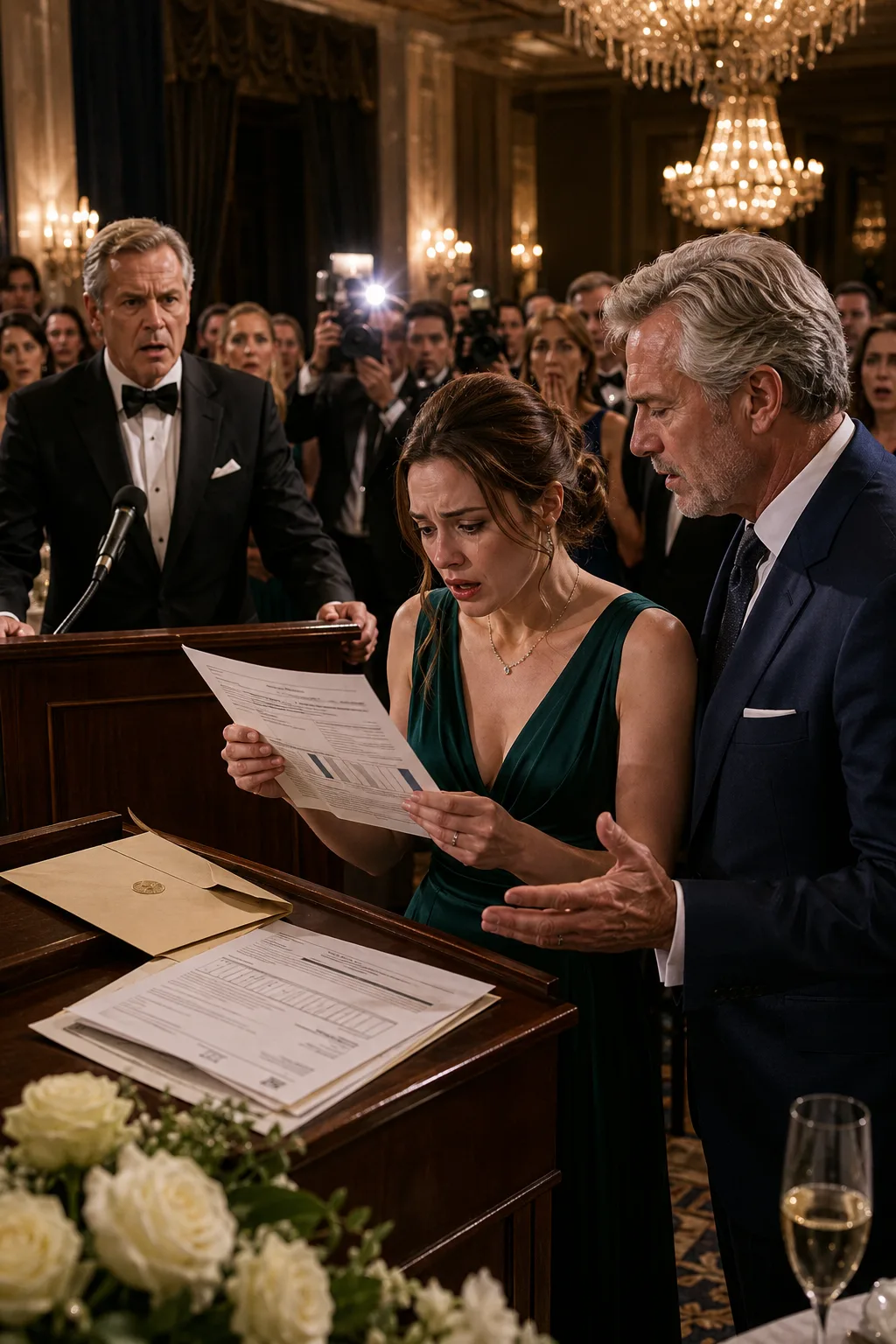
The man reached the stage and placed a sealed cream envelope on the podium.
Then he turned to me.
“Miss Donovan,” he said, “it is time you learned why your life has never fully made sense.”
My pulse thundered in my ears.
Martin stepped toward him.
“I don’t know who this man is,” he announced, “but clearly he is unwell.”
The man looked at him.
“You knew me well enough when you took my company.”
A murmur moved through the room.
“You knew me well enough when you took my wife.”
My mother made a small sound.
“And you knew me well enough,” the man said, his voice tightening, “when you took my daughter.”
The world narrowed.
For a moment, there was no ballroom. No guests. No cameras. No music. Only the envelope on the podium and the terrible feeling that my entire life was standing on a floor that had begun to crack.
“Claire,” my mother whispered, grabbing my arm. “Do not touch that.”
I looked at her hand.
Her fingers were digging into my skin.
I pulled away.
The walk to the podium felt longer than the whole twenty-seven years of my life.
When I reached the envelope, the man stepped back, giving me space. Up close, I could see the emotion he was trying to control. His jaw trembled once before he clenched it still.
“What is this?” I asked.
“The truth,” he said. “And I am sorry you have to learn it this way.”
My hands shook as I opened the envelope.
Inside were documents.
A DNA report.
A birth certificate.
A hospital discharge form.
A legal affidavit.
A photograph.
I saw the DNA report first.
My eyes moved over the words without understanding them.
Then they locked on one line.
Relationship: Biological Father. Probability: 99.9%.
I looked up.
At the man from Platform Seven.
At the stranger who had taken my sandwich.
At the man whose eyes had known my name like a wound.
“No,” I whispered.
His face broke.
“My name is Julian Vane,” he said. “And I have spent twenty-seven years believing my daughter died before I could hold her.”
Someone gasped.
A camera clicked.
Martin’s voice cut through the room.
“This is a lie.”
Julian turned toward the audience.
“Twenty-eight years ago, Martin Hale was my business partner. We built Vane-Hale Capital together. I trusted him with my company, my family, and my future.”
Martin’s face hardened.
“Enough.”
Julian did not stop.
“My wife, Elise, gave birth to our daughter in a private clinic outside Zurich. Days later, there was a fire. I was told both my wife and child were gone. Then I was accused of embezzlement using documents Martin’s attorneys helped produce. I spent fifteen years in federal prison for a crime I did not commit.”
The ballroom was so silent I could hear my own breathing.
Julian pointed to the envelope.
“Those papers show the transfer of funds that built the Hale Foundation. They show the forged signatures. They show the clinic records. And they show that the infant declared dead in Switzerland was brought to Chicago under a new identity.”
My knees felt weak.
I picked up the photograph.
It was old. Faded. A baby wrapped in a pale blanket. On the baby’s left shoulder was a small crescent-shaped birthmark.
My hand moved to my own shoulder.
I had the same mark.
My mother whispered, “Claire, please.”
I turned to her.
For the first time in my life, I saw her not as fragile, not as trapped, not as the woman I had spent years trying to protect.
I saw her as someone who had known.
“You knew?” I asked.
Tears filled her eyes.
“Martin said it was better for everyone.”
The words hit me harder than any denial could have.
Better for everyone.
Not better for me.
Not better for Julian.
Better for them.
Julian’s voice softened.
“I did not come here to hurt you, Claire. I came because you saved me.”
I stared at him.
He swallowed.
“The day you saw me at Platform Seven, I had just been released from another failed meeting with an attorney. I had evidence, but not enough. I had no money left. No family. No reason to keep fighting. I sat on that bench thinking maybe the truth would die with me.”
His eyes shone.
“And then you gave me your lunch.”
I could barely breathe.
“You treated me like a person,” he said. “That night, I went back to the shelter. A former clinic clerk finally returned my call. She had kept one copy of the discharge file because she was afraid of Martin. That copy led to the DNA test.”
Martin slammed his hand on the podium.
“This is insane. You are all listening to a convicted criminal!”
Julian faced him.
“Yes,” he said. “A convicted man. Wrongly convicted. And now pardoned pending review because three federal investigators have the same documents this room has just seen.”
The color drained from Martin’s face.
That was when everyone understood.
This was not an accusation.
This was evidence.
The donors began stepping away from Martin as if corruption were contagious. Reporters pushed forward. Phones rose. Security no longer moved.
My mother reached for me again.
“Claire, we can explain.”
I looked at the woman who had raised me in a house full of rules and silence.
“You let me call him father,” I said.
She cried then.
But her tears no longer had power over me.
Martin’s voice dropped low.
“Claire, think carefully. Everything you have comes from me.”
I turned to him.
For twenty-seven years, that sentence would have worked.
Everything you have comes from me.
The schools. The clothes. The house. The name. The protection. The carefully measured approval.
But now I knew what it really meant.
Everything he gave me had been bought with something stolen from someone else.
“No,” I said. “Everything I lost came from you.”
The cameras caught it.
The whole room heard it.
Martin looked at me as if I had betrayed him.
That was almost funny.
Julian stood a few feet away, not reaching for me, not demanding anything. He simply waited, as if he had spent half his life waiting and could survive one more second.
I looked at him.
The man from Platform Seven.
The man who had been shaking because he was hungry, yes, but also because he had been standing in the same city as the daughter he thought was gone.
“Why now?” I asked.
His voice was quiet.
“Because today is your birthday.”
My throat closed.
“And because your mother, your real mother, was twenty-seven when she died. I could not let you spend one more year as a prop in the life Martin built from our grief.”
I looked around the ballroom.
At the white roses.
The crystal glasses.
The donors with their shocked faces.
The Hale Foundation banners hanging like holy symbols over a lie.
Then I stepped away from the podium.
Martin’s expression changed.
For one second, he looked relieved.
He thought I was coming back to him.
I wasn’t.
I walked to Julian.
His hand trembled when I reached him.
This time, I held it steady.
The room exploded with questions.
“Claire, did you know?”
“Mr. Hale, are the documents real?”
“Julian, where have you been?”
“Mrs. Hale, did you participate?”
Martin shouted for security, but no one obeyed.
I turned toward the cameras.
All my life, I had been told not to make scenes.
Not tonight.
Not now.
Not here.
I lifted my chin.
“The truth deserves an audience,” I said. “And I think we are done with the performance.”
Then I walked out of the ballroom with Julian Vane beside me.
Outside, the November air hit my face, cold and sharp.
For the first time that night, I could breathe.
Behind us, the Hale Foundation began to collapse under the weight of its own beautiful lies.
Beside me, Julian stopped at the curb.
“I don’t expect you to call me father,” he said.
I looked at him.
The traffic lights changed. Wind moved through the street. Somewhere far away, a siren cried and faded.
“I don’t know what to call you yet,” I admitted.
He nodded, and somehow that made me trust him more.
“But I know what you are not,” I said.
His eyes searched mine.
“You are not a stranger anymore.”
His face crumpled, but he did not look away.
Three weeks earlier, I had given a hungry man my lunch because no one had helped me when I needed it.
I thought kindness was small.
I thought it disappeared after the moment passed.
I was wrong.
Sometimes kindness is a match.
Sometimes it survives the wind.
And sometimes, when the world has been dark for too long, it is the first small flame that leads the truth home.
THE END.
Chapter complete
You have reached the end of this chapter.
Continue reading
A few more worlds to get lost in after this chapter.




