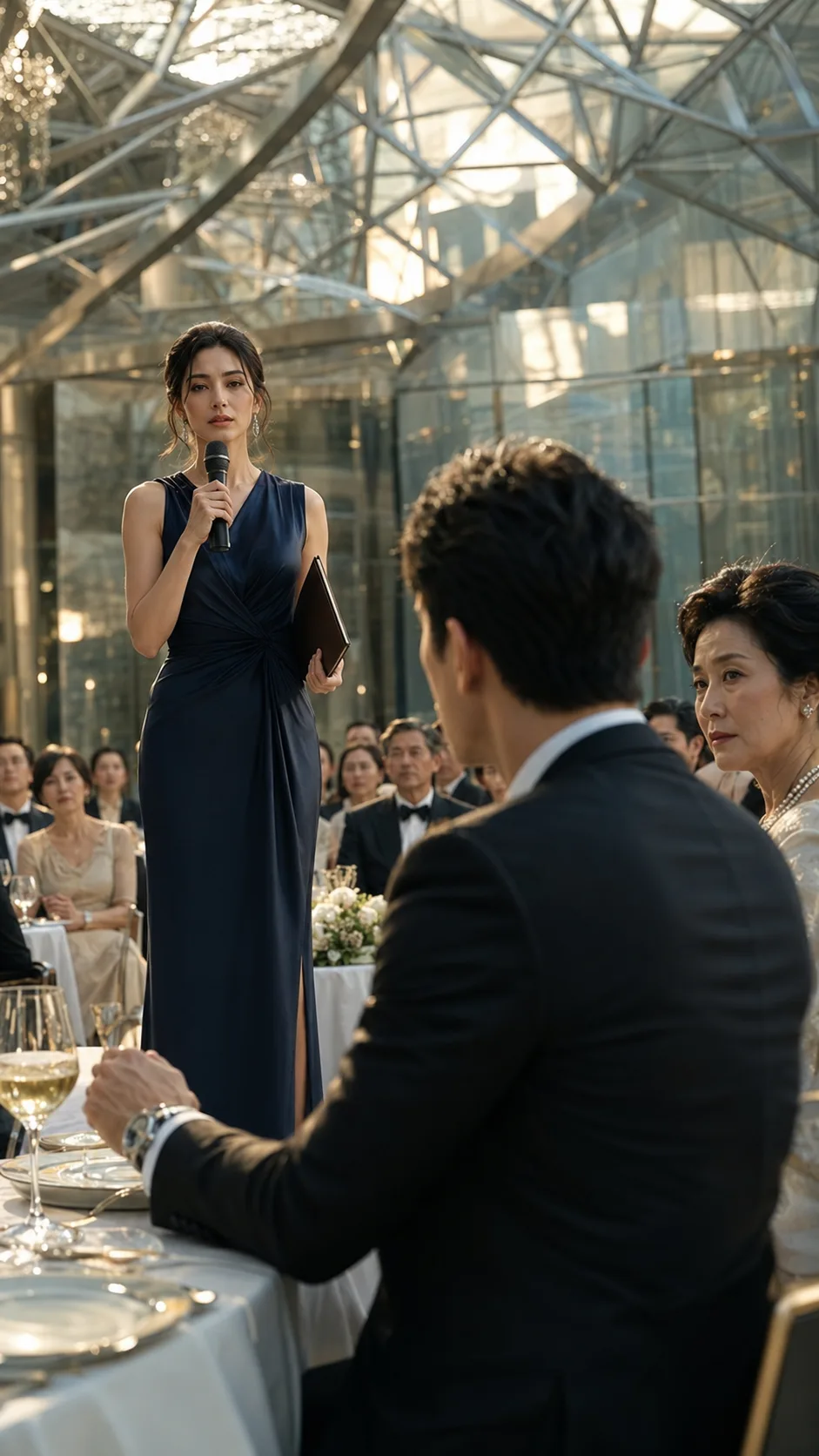
There was one meeting in March.
Chapter 2
There was one meeting in March.
We sat in a conference room with attorneys on either side of us and a long polished table between us that reflected everybody’s hands like a second, quieter argument.
Daniel looked tired.
Not cinematic-tired. Not handsome in his suffering. Just worn. A little gray at the edges. Less inhabited by certainty than I had ever seen him.
At one point, while counsel reviewed a document, he looked across at me and said, “Why didn’t you tell me?”
The attorneys both went still.
It was a fair question.
I had asked it of myself enough times that by then I knew the answer without ornament.
“Because I needed to know whether you could love me without it,” I said.
He swallowed.
“I married you.”
“Yes,” I said. “You did.”
He looked down.
I waited.
Finally he said, “That’s not fair either.”
Maybe it wasn’t. But fairness had not brought us to
that table.
I folded my hands.
“I wanted one place in my life,” I said, “where I wasn’t being handled like an acquisition, a strategy, a family name, or a number on a sheet. I thought if I loved you honestly and lived simply and never made your ambition feel smaller, then what existed between us would be ours.”
He closed his eyes briefly.
“It was.”
“No,” I said, and my voice stayed soft. “Some of it was. That’s what makes this expensive.”
He had no answer to that.
A little later he said, almost to himself, “If I had known—”
“You didn’t ask,” I said.
That landed harder than anything else I said that day.
The divorce terms were straightforward because the paper was straightforward.
Hartwell holdings remained untouched.
The West Hills apartment remained mine.
The Laurelhurst house, purchased during the marriage but largely funded through a structure tied
to my inheritance, passed into a negotiated arrangement that spared us both the indignity of a prolonged dispute.
His retirement accounts stayed his.
My inherited trust stayed mine.
Our jointly purchased artwork was divided by appraised value.
The dog, thankfully, had died two years earlier and was spared the entire business.
The furniture took longer.
Not because it was complicated.
Because furniture is where marriages hide.
The reading chair he always claimed and never reupholstered.
The sideboard from our first apartment.
The lamp we bought in Seattle and argued about for an hour in the rain.
The dishes from our registry that had outlived the people who chose them.
The pieces I had brought into the marriage from my grandfather’s estate—the carved walnut console, the bronze study lamp, two Persian runners, a set of dining chairs older than Oregon statehood—had sat in our home for years like background. Daniel had
admired them the way people admire weathered wood or good molding, never asking what history sat inside them.
I donated most of it.
Not out of spite.
Out of clarity.
A nonprofit furnishing transitional housing for families sent a truck on a Wednesday morning. Young men in work gloves carried out tables, chairs, lamps, and dressers while I stood in the doorway with a clipboard and directed traffic. There was something unexpectedly soothing about watching useful things go where they might be needed.
Destruction is lazy closure.
Usefulness is harder.
I kept only one major piece.
My grandfather’s dining table.
He had built it himself in 1974 from reclaimed fir in his garage, swearing the whole time about warped planks and bad nails and the decline of American screws. It had sat in our married house for years beneath dinner parties, bills, Sunday newspapers, and quiet resentments nobody named in time. When the movers carried it into the West Hills apartment, the room changed instantly.
Some things do not belong to the middle of your life.
They belong to the part after.
Groundwork Design Studio opened formally in April.
The paperwork was filed, the branding complete, the website restrained, the lease signed on a bright industrial space on the east side with tall windows, concrete floors, decent acoustics, and enough room for model tables, material shelves, and the kind of honest mess creative work generates when nobody is afraid of being overheard.
We launched with five people.
Priya as lead design director.
Marcus heading facade and systems.
Elena leading community engagement and public process.
Jonah in accessibility and interiors.
And me, in the role I had spent years pretending was smaller than it was—principal, financier, strategy, structure, owner.
The difference between being rich and being in charge is that the second one requires you to be seen.
I learned that slowly.
For the first month, I was in the office every day by seven-thirty. I liked unlocking the door. I liked hearing the heat come on. I liked setting out bagels and fruit and watching the place fill with the particular energy of people who have finally been given room equal to their talent.
Priya brought in three notebooks on the first day, all filled with ideas she had generated at Caldwell & Reyes and never been given space to present.
“This is the one about family housing on constrained lots,” she said, flipping pages. “This is modular civic-use space. This one is—well, this one is me being angry.”
Marcus laughed.
“The angry one is the best one.”
He was right.
Within six weeks, we had our first project: a sixty-unit affordable housing development commissioned by the city housing authority on the east side.
It was not glamorous work.
That was one of the reasons I wanted it.
Affordable housing forces a firm to reveal its ethics immediately. There is nowhere to hide behind spectacle. Every dollar matters. Every corridor width matters. Every window placement matters. If you care more about awards than people, the building shows it before the ribbon is cut.
Priya led the design.
The day we won the commission, she stood in my office doorway with the email open on her laptop and said, very carefully, “I don’t know what the professional version of losing my mind is, but I think I’m doing it.”
“Elena cried in the restroom,” Marcus called from across the studio.
“I did not,” Elena said. “I became intensely hydrated.”
Jonah raised a hand without looking up from a drawing.
“I’m documenting that phrasing for future use.”
I laughed harder than I had in months.
Not because winning fixed anything.
Because something new was finally being built from materials I trusted.
Meanwhile, the story of the gala moved through Portland’s architecture and development world the way such stories always do—half fact, half interpretation, all velocity.
I did not feed it.
I did not need to.
People do that work themselves when status, money, marriage, and public embarrassment intersect in one clean evening.
The Meridian Award was not rescinded. Nor should it have been. The building was real. The work mattered. But the narrative around Daniel changed. The self-made mythology cracked. People began asking quieter, better questions about authorship, team structure, credit, funding, and who exactly had been elevated by whom.
Two of Caldwell & Reyes’s larger clients left within a few months.
Not because I punished them.
I did not.
The firm received a standard lease renewal package at market rate and remained in the building without interference.
The clients left because investors dislike instability, donors dislike scandal, and sophisticated people dislike discovering that the polished story they were sold depended on omissions they now find embarrassing to have admired.
One of the project feature articles that had originally centered Daniel later ran a follow-up crediting Priya, Marcus, Elena, and Jonah by name for specific design elements of Meridian Tower.
Daniel’s name was still in the piece.
Just no longer alone.
That mattered.
Recognition is not everything.
But its absence leaves bruises nobody else can see.
I saw Daniel once by accident before the divorce was final.
It was early morning at a coffee shop on Northwest Twenty-Third. Pale spring light. Two people in line ahead of me arguing gently about oat milk. A man at the window in bike gear reading permit news on his phone.
Daniel was seated near the back with someone I didn’t know, a lawyer perhaps or an old friend. He looked up when I walked in, and for a moment the room became unbearably small.
Not dramatic.
Just precise.
There are former intimacies that do not vanish. They simply lose jurisdiction.
He nodded once.
I nodded back.
Then I ordered my coffee, took it to the window, opened my laptop, and spent the next two hours reviewing revised site plans for the housing project while rain moved in slow lines down the glass.
I did not feel triumphant.
I did not feel broken.
I felt occupied by my own life again.
In June, the east side project broke ground.
Portland occasionally produces warm mornings in early summer as if apologizing for the other nine months. That day was one of them. The dirt was dry enough to hold shape. Somebody from the housing authority brought pastries from a bakery on Division Street. Elena had made name tags for the community advisory group because she believed people behaved better when addressed properly. Priya wore boots she was trying and failing to keep clean. Marcus arrived with two pens clipped to his shirt pocket like a man old enough to have earned it. Jonah spent fifteen minutes making sure the temporary path from the sidewalk to the ceremony area was actually accessible and not just optimistically labeled so.
Future residents attended too.
That was the part I loved most.
A woman in a red cardigan who kept asking whether the windows would open.
A retired bus driver who wanted to know if the mailboxes would be inside or out.
A father holding the hand of a little girl in butterfly rain boots who seemed less interested in housing policy than in whether the ceremonial shovel could be borrowed for dinosaurs.
These were the people the building was for.
Which meant they were the people whose opinions mattered.
The city representative gave a speech.
Then Priya spoke.
She was nervous for the first ten seconds and excellent after that.
She talked about light, about dignity, about the difference between shelter and home. She talked about corridors that did not feel institutional, shared spaces that invited rather than controlled, materials that aged honestly, and the simple radical act of designing for people whose budgets are usually treated as justification for ugliness.
Two people cried.
One of them was Elena, despite her ongoing commitment to calling all emotional experiences hydration.
I stood a little apart from the group with coffee in my hand and dirt on my shoes and the wind moving lightly through my hair. The river was somewhere beyond the buildings. The city made its usual noise around us—trucks, brakes, distant sirens, the hollow clank of something being unloaded two blocks away.
And in that ordinary urban chorus, I felt something settle inside me that had been trying for years to land.
My grandfather used to say that the point of building wasn’t the building.
Not really.
It was the choosing.
Every beam, every corridor, every load-bearing wall, every decision about what goes where and what gets supported and what can’t be trusted without reinforcement. A structure is simply a record of those choices made visible.
He said a life was no different.
For seven years I had chosen patience, privacy, restraint, and hope.
People could argue that I chose them too long.
They would not be entirely wrong.
Silence had cost me.
But it had also taught me things I could not have learned in noise—what kind of woman I was when nobody knew my value, how long I could hold my dignity in a room determined to misread me, and what it felt like to stop asking recognition to come from the person least qualified to grant it.
That knowledge was not nothing.
That knowledge, in the end, was most of what I carried out of the marriage intact.
After the groundbreaking, I drove back to the West Hills apartment with the windows down and my sleeves rolled once at the wrists. The city looked newly legible in the afternoon light. Brick. Glass. Scaffold. Trees. A bus stop bench with an ad half peeled away. Three teenagers sharing fries outside a convenience store. A woman in scrubs smoking beside a loading dock and staring at nothing.
I stopped at a light on Burnside and thought, not for the first time, about that evening at the gala when I introduced myself properly in a room full of people who believed they already knew my place in the story.
My name is Clare Hartwell.
It had sounded, even to me, less like a declaration of wealth than a recovery of authorship.
By the time I reached the apartment, the light had shifted golden at the edges. I carried my bag upstairs, unlocked the door, and stepped into the kitchen where my grandfather’s table sat in the late sun like a piece of truth too solid to be decorative.
I set my keys down on the wood he had sanded with his own hands fifty years earlier.
Then I stood there for a long moment in the quiet.
No applause.
No witnesses.
No one to explain myself to.
The marriage had cost me exactly what it was always going to cost me once truth arrived. The rest—the title, the building, the inheritance, the applause, the lawyers, the embarrassment, the changed narrative—those were just visible consequences of invisible choices that had been accumulating for years.
I had stopped carrying the weight alone.
I had redistributed it correctly.
And for the first time in a very long while, I felt exactly like myself. THE END
Chapter complete
You have reached the end of this chapter.
Continue reading
A few more worlds to get lost in after this chapter.




