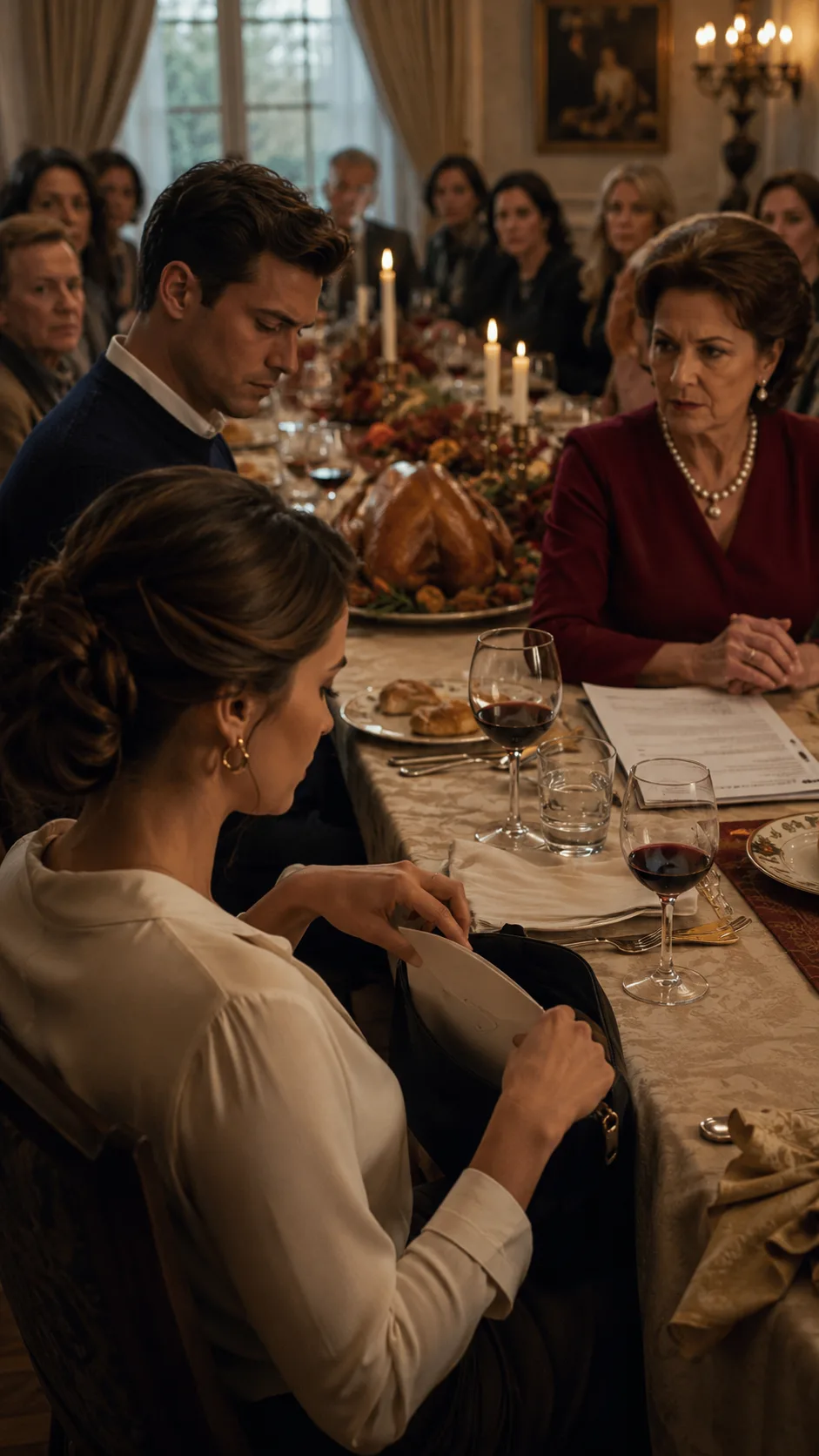
Rachel had already noticed the extra chair before Patricia asked her to move the gravy boat.
Chapter 1
Rachel had already noticed the extra chair before Patricia asked her to move the gravy boat.
It sat near the far end of the dining table, tucked between Mark’s cousin Elaine and an empty stretch of polished mahogany. A wine glass had been placed above the plate. A folded linen napkin rested in the center, shaped like a fan. The chair did not belong to anyone in the family, at least no one Rachel knew.
No coat hung over the back.
No purse sat underneath.
Still, it was waiting.
Rachel carried the gravy boat two inches to the left because Patricia had pointed with two fingers and said, “There. It looks more balanced.” The room smelled of roasted turkey, butter, sage, and the sharp perfume Patricia wore every holiday. Candles burned in silver holders along the table. Children slid across the hallway in socks while their parents pretended not to hear the thumps against the wall.
“Thank you, dear,” Patricia said.
Dear.
Rachel placed the gravy
boat where Patricia wanted it and wiped a drop from the rim with her thumb. Across the room, Mark stood near the bar cart with his father and two uncles, one hand in his pocket, the other wrapped around a glass he had barely touched. He saw Rachel look at him.
He looked away first.
That was not new.
For three years, Mark had looked away whenever his mother mentioned babies.
At first, Rachel thought it was pain. Then she thought it was embarrassment. After a while, she stopped naming it. Naming things made them harder to ignore, and Rachel had already ignored more than any woman should have had to.
She had ignored Patricia’s comments about nurseries.
She had ignored the church ladies Patricia invited over for tea after Sunday service, the ones who spoke about “a woman’s purpose” while staring at Rachel’s stomach.
She had ignored the little
ceramic baby shoes Patricia placed on the mantel last Christmas “as a symbol of hope.”
She had ignored Mark’s silence in doctor’s offices, his hand resting on his knee instead of hers.
Three years.
The number had become another person in the marriage.
Rachel adjusted a fork beside Mark’s plate. One tine was slightly bent. She pressed it down against the tablecloth, then stopped. The bend remained.
Fine.
Patricia moved behind her, checking the place cards even though everyone in the room knew where they were expected to sit. Patricia had built her life around expectations. Her house was built the same way: tall windows, cream walls, heavy curtains, portraits of stern relatives, a dining room large enough to make intimacy feel like a mistake.
“You look tired,” Patricia said.
Rachel turned.
Patricia stood close enough that Rachel could see the powder settled near the corners of her nose. Her
burgundy dress was pressed perfectly. Pearls rested at her throat. Her smile was careful and clean.
“I’m fine,” Rachel said.
“Of course.”
Patricia’s eyes dropped briefly to Rachel’s waist.
Rachel did not move.
A laugh rose from the kitchen. Someone dropped a spoon. Mark’s father called for more ice. The children ran past again, and one of them knocked a small pumpkin decoration from the side table. It rolled under a chair and stayed there.
Patricia noticed.
She noticed everything.
But she left it on the floor.
Rachel watched that small orange pumpkin under the chair for longer than she meant to. It looked ridiculous there, bright and helpless against the dark wood.
“Dinner,” Patricia called.
The family gathered with the practiced speed of people who knew Patricia did not like being kept waiting. Twenty relatives filled the room: cousins, aunts, uncles, in-laws, children with brushed hair and restless feet. Rachel sat beside Mark, as she always did, halfway down the table. Patricia took the chair opposite them, near enough to control the room without raising her voice.
The extra chair remained empty.
Rachel touched the edge of her purse with her shoe. It sat at her feet, tucked beneath the tablecloth. Inside was a white medical envelope she had carried all day.
She had not planned to use it.
Not at dinner.
Not in front of children.
Not with the turkey still steaming in the center of the table.
She had planned to tell Mark after the guests left. She had pictured the two of them in the kitchen, dishes stacked in the sink, the house finally quiet. She would place the envelope on the counter. She would say his name once. Then she would tell him the truth she had discovered two days earlier and the truth she had only learned that morning.
Two truths.
One marriage.
No easy way through either.
Mark poured wine into her glass without looking at her. The red line rose, stopped, and trembled against the rim.
“Careful,” Rachel said.
He set the bottle down.
“Sorry.”
It was the first word he had said directly to her since they arrived.
Rachel looked at his hand. His wedding ring sat loose on his finger. He had lost weight in the past month. Or maybe she had only started noticing.
Patricia tapped her knife against her glass.
Once.
The sound was small, but the room obeyed it. Forks paused. Conversations ended in pieces. A child in the hallway was pulled gently back by his mother and told to stand still for grace.
Patricia stood.
Her smile moved from face to face. She let it rest on Rachel last.
“I know we usually begin with prayer,” Patricia said, “and we will. But before we give thanks, there is a family matter that should be handled with honesty.”
Rachel felt Mark’s knee shift beside hers.
Only that.
Patricia bent slightly and lifted a blue folder from the chair beside her. Not from the table. Not from a drawer. It had been waiting there the whole time, hidden by her napkin and the angle of her body.
She placed it in front of Rachel.
The folder touched Rachel’s plate.
No one spoke.
Rachel opened it because refusing would have given Patricia the pleasure of doing it for her.
The first page was clean and white.
The word near the top was impossible to misunderstand.
Divorce.
The room did not gasp. That would have been kinder. Instead, everyone became careful. Eyes lowered. Hands folded. A fork clicked once against porcelain and then stopped.
Rachel read the first line. Then the second. She did not need the rest.
Mark sat beside her with his jaw tight.
His silence had a shape now.
Patricia placed a pen across the folder.
“My son deserves a wife who can give him children,” she said.
A child near the doorway asked his mother what that meant. The mother put a hand over his shoulder and guided him back.
Rachel looked at Mark.
He lifted his glass.
Put it down.
Said nothing.
Patricia kept standing, one hand resting on the back of her chair. “This family has waited long enough. Three years of appointments. Three years of disappointment. Three years of excuses.”
The word excuses slid across the table and landed between the wine glasses.
Rachel’s thumb pressed against the edge of the folder.
Mark’s aunt Caroline stared at her plate. Elaine reached for her water and missed the stem of the glass the first time. Mark’s father folded his napkin, unfolded it, then folded it again.
No one stopped Patricia.
That became its own answer.
“I have been patient,” Patricia said. “More patient than most mothers would be.”
Rachel almost laughed.
Not because it was funny.
Because the alternative was opening her mouth too soon.
Patricia turned slightly toward the far end of the table. “And I will not apologize for wanting grandchildren. For wanting the family name to continue. For wanting my son to have a full life.”
Mark shifted.
Rachel heard his shoe scrape once against the floor.
“Mother,” he said.
Barely.
Patricia looked at him, and whatever warning he thought he had given vanished before it reached her.
“No,” she said. “This has gone on long enough.”
The extra chair was still empty.
Then it wasn’t.
A woman stepped into the dining room from the hall.
She looked younger than Rachel by a few years, maybe twenty-six, with smooth hair pinned behind her ears and a pale green dress that did not belong to a casual family dinner. She held a small black purse in both hands. Her eyes moved from Patricia to Mark, then to the floor.
Rachel looked at Mark again.
His face had changed.
Not enough for strangers.
Enough for a wife.
Patricia gestured toward the woman with a softness she had never used for Rachel. “This is Claire. She’s been very kind to Mark during a difficult season.”
Claire did not sit.
Smart girl.
Rachel closed the folder.
The sound drew Patricia’s eyes back to her.
“Open it,” Patricia said. “We should not make this uglier than it needs to be.”
Rachel rested both hands on the folder. Her nails were pale pink. Patricia had once approved the color by saying it was “not too dramatic.”
“Did Mark know?” Rachel asked.
The room stayed still.
Patricia’s smile tightened. “This is not about blame.”
Rachel turned to Mark. “Did you know she was coming?”
Mark’s mouth opened.
Closed.
The answer sat there with the turkey and candles and folded napkins.
Rachel nodded once.
Tiny.
Patricia slid the pen closer. “Sign with dignity.”
There it was.
The public sentence. The clean little knife.
Rachel looked down at the divorce papers. She saw Patricia’s careful planning in every line. The folder, the pen, the extra chair, the audience. She saw Mark’s cowardice sitting beside her in a navy sweater, breathing shallowly, letting his mother do what he had not had the spine to do alone.
She reached for her fork.
A few eyes followed her hand.
Rachel lifted it, adjusted it beside her plate, then set it down.
Click.
Small.
Final.
She bent slightly and picked up her purse from beneath the table.
Mark’s hand moved toward her wrist, then stopped halfway.
Good.
He still knew enough not to touch her.
Patricia watched with open satisfaction. She probably expected tissues. A phone. Some fragile little object that would prove Rachel was finished.
Rachel removed the white medical envelope.
Patricia’s smile stayed in place.
Mark’s did not.
“Rachel,” he said.
Just her name.
She laid the envelope flat beside the blue folder. Her fingers pressed against the paper to smooth a crease near the corner.
“I was going to wait until after dinner,” she said.
Her voice surprised the room. Not loud. Not trembling. Just clear.
Patricia’s eyes flicked to the envelope.
Rachel looked at her. “But since you chose to discuss family matters in front of everyone…”
She opened the flap.
No one interrupted.
Even the children were quiet now. Somewhere in the kitchen, the refrigerator hummed. A candle near Mark’s plate leaned slightly to one side, its wax spilling onto the silver holder.
Rachel took out the first document.
Folded once.
She opened it and placed it beside the divorce papers.
Patricia stared at it but did not reach.
“Read it,” Rachel said.
Patricia did not like being instructed. Her chin lifted, but her hand moved anyway. She picked up the paper by the corner, as if it might stain her fingers.
Her eyes moved down the page.
Once.
Then again.
Rachel watched the muscles around Patricia’s mouth tighten.
“What is this?” Patricia asked.
“My medical report.”
“I can see that.”
“Then you can see the results.”
Patricia lowered the page.
Rachel turned to the table. “According to three specialists, there was never anything wrong with me.”
The words did not need drama. They had the documents.
Elaine’s water glass remained halfway to her mouth. Mark’s father finally looked at his son. Claire took one step back from the doorway.
Mark stood.
His chair scraped hard against the floor.
“Rachel, stop.”
Rachel took out the second document.
Mark moved around his chair, but his father’s voice stopped him.
“Sit down.”
The older man had not spoken all night. Two words from him cracked through the room harder than Patricia’s glass tap.
Mark stopped beside his chair.
Rachel placed the second document directly in front of Patricia.
Not beside the first.
On top of it.
Patricia looked down.
The page showed Mark’s name.
Her fingers curled around the paper.
Rachel did not explain. The report did that. Clinical language. Clean formatting. A truth without mercy. Mark’s test results. Mark’s condition. Mark’s hidden appointment date. Mark’s signature at the bottom.
The problem had never been Rachel.
Patricia read long enough for every face at the table to understand that something had gone wrong with her plan. She read long enough for Mark to turn red from his collar to his ears. She read long enough for Claire to quietly place her purse strap back on her shoulder.
The silence changed.
It no longer belonged to Rachel.
Mark reached for the document. Patricia pulled it back before he could touch it.
That was the first honest thing she had done all night.
“Mother,” Mark said.
Patricia did not look at him.
Rachel watched her mother-in-law’s pearls rise and fall against her throat.
“For three years,” Rachel said, “you sent me articles, prayers, doctors’ names, vitamins, and shame.”
No one moved.
“You told people I was the reason this family had no grandchild.”
Patricia’s hand lowered to the table.
“You let them believe it,” Rachel said, turning to Mark.
Mark’s eyes dropped.
There he was.
Not exposed by shouting. Exposed by gravity.
Rachel reached into the envelope one more time.
Mark shook his head once.
Small.
Desperate.
She removed a photo.
Black and white.
Glossy.
Folded inside a plain white sleeve.
Patricia saw it before Rachel said anything. Her eyes widened just enough. Mark took a step back as if the floor had shifted under him.
Rachel placed the ultrasound on the table.
Between the divorce papers and Mark’s test results.
“And I’m pregnant,” she said.
A sound moved through the room. Not a gasp from one person. A dozen little reactions, all badly hidden. Elaine’s hand went to her mouth. Mark’s father closed his eyes. One of the children whispered, “Baby?” before his mother pulled him closer.
Patricia reached for the ultrasound.
Rachel picked it up before her fingers touched it.
“No.”
One word.
Patricia froze.
Rachel stood then.
The chair moved back softly. Not like Mark’s. No scrape. No panic.
She held the ultrasound in one hand and the medical envelope in the other. The blue folder stayed on the table, open to the divorce papers Patricia had chosen to serve beside a Thanksgiving turkey.
Mark stepped toward her.
“Rachel, please.”
She looked at him for a long second.
He had said please now.
Not when his mother laid out the papers. Not when she called Rachel barren. Not when she brought another woman into the dining room. Not when twenty relatives watched his wife be reduced to a problem to be solved.
Now.
Rachel placed the ultrasound back into the envelope.
“But after tonight,” she said, “this child will not grow up in a family that uses humiliation to hide cowardice.”
The words settled over the table.
Patricia stood too quickly. Her chair bumped the wall behind her.
“Rachel,” she said, and her voice had changed so completely that several relatives looked up. “My dear, let’s not be rash.”
My dear.
Again.
But different now.
Patricia reached across the table with both hands slightly lifted, palms open, face rearranged into something soft and pleading. “You know I’ve always thought of you as a daughter.”
Rachel looked at the divorce papers.
Then at the pen.
Then at Patricia.
“No,” Rachel said.
Patricia’s mouth opened.
Rachel picked up the pen and placed it carefully on top of the blue folder.
“For the first time tonight,” Rachel said, “you gave me exactly what I needed.”
Mark’s face changed before Patricia’s did. He understood first. Maybe because he knew Rachel better. Maybe because fear made him quicker.
“Don’t,” he said.
Rachel turned toward him.
“You signed before dinner, didn’t you?”
His mouth stayed shut.
There it was.
The last answer.
Rachel took her purse from the chair. The medical envelope went inside. The ultrasound stayed in her hand.
Patricia moved around the table. “We can discuss this privately.”
Rachel stepped back before Patricia could reach her.
“You had that chance.”
Mark’s father stood, but he did not block the doorway. Claire had already disappeared from the hall. No one called her back.
Rachel walked past the extra chair.
The empty plate remained untouched.
A small pumpkin decoration still sat under the side chair near the wall. Rachel bent, picked it up, and set it on the table by the door. She did not know why. It had bothered her all night.
Maybe that was enough.
The house behind her remained silent when she stepped into the cold November air.
Her car was parked near the end of the driveway, behind two SUVs and Mark’s uncle’s truck. She stood there for a moment with her keys in her hand, the ultrasound tucked flat against her palm. Through the front windows, she could see movement in the dining room. People standing. Patricia’s burgundy dress cutting across the warm light. Mark’s shape near the table, one hand pressed to the back of his chair.
No one came outside fast enough.
Rachel unlocked her car.
The leather seat was cold. Her hands were steady until she set the ultrasound on the passenger seat. Then she gripped the steering wheel and counted the breaths she needed to start the engine.
One.
Two.
Three.
She drove away before anyone opened the front door.
Her phone began ringing before she reached the main road.
Mark.
Then Patricia.
Then Mark again.
Rachel turned the phone face down in the cup holder. At the first stoplight, she looked at the ultrasound on the seat beside her. The image was grainy and small, impossible for anyone else to understand without a nurse pointing gently at shapes on a screen.
But Rachel knew.
She knew enough.
She drove to a hotel near the river because it had underground parking and clean white bedding and a lobby where no one knew her married name. The woman at the desk asked if she needed help with her bag. Rachel said no. Her suitcase was still at home anyway.
She had her purse.
She had the envelope.
She had the baby’s first picture.
That night, Mark sent eighteen messages. The first few begged. The next ones explained. The last ones blamed his mother.
Rachel read none of them.
In the morning, she called a lawyer.
Not Patricia’s lawyer. Not Mark’s old college friend who handled property agreements. A woman named Denise with a calm voice and no patience for public cruelty. Denise listened without interrupting. When Rachel finished, there was a pause, then the sound of typing.
“Keep every document,” Denise said.
“I have them.”
“The divorce papers too?”
Rachel looked at the blue folder on the hotel desk.
Yes, she had taken it. Patricia had given it to her, after all.
“I have those too,” Rachel said.
“Good.”
The legal process did not move like a movie. It moved like a drawer full of dull knives. Emails. Calls. Bank statements. House records. Medical privacy questions. Mark tried to visit the hotel once, but Rachel had already changed locations by then. Patricia sent flowers with a card that said, We are family. Rachel left them at the front desk.
Three weeks later, Claire sent Rachel a message through social media.
I didn’t know about the divorce papers. I’m sorry.
Rachel read it twice.
Then she deleted it.
Some apologies were not hers to carry.
By Christmas, Rachel had moved into a small apartment with tall windows and a kitchen barely large enough for two people to stand in. The building’s elevator made a clicking sound before the doors opened. The upstairs neighbor played piano badly on Sunday mornings. A crooked grocery store wreath hung on the lobby door until mid-January because no one remembered to take it down.
Rachel liked all of it.
Mark’s father called once in February. He did not defend his son. He did not defend Patricia. He only asked if Rachel needed anything for the baby.
“No,” Rachel said.
A pause.
Then, “I understand.”
She almost believed him.
Patricia tried harder. Letters. Voicemails. A package of knitted blankets Rachel knew Patricia had not knitted herself. Each one used softer language than the last. Grandchild. Family. Healing. Misunderstanding.
Rachel kept the blankets because they were warm.
She threw away the notes.
The divorce was finalized in early spring. Mark signed after Denise filed the medical documents and Thanksgiving witness statements as part of the record. He did not fight for much after that. Men like Mark often folded when silence stopped protecting them.
Patricia did not attend the final meeting.
Rachel did.
She wore the same cream blouse from Thanksgiving, not because she had planned it, but because it still fit and was clean. Denise noticed and smiled without saying anything. The pen Rachel used to sign the final page had black ink and a scratch near the clip.
This time, Rachel signed first.
No audience.
No turkey.
No pearls watching from across the table.
Afterward, she walked outside and stood in the sun for a minute before calling a cab. Her reflection in the courthouse window looked tired, rounder at the stomach, and unfamiliar in a way that did not frighten her.
That evening, she bought a small ceramic pumpkin from a thrift store near her apartment. It was chipped on one side and painted too orange. She placed it on the kitchen windowsill, beside a stack of baby name books and a jar of wooden spoons.
It looked ridiculous there.
Bright.
Stubborn.
Months later, when her daughter was born, Rachel did not call Patricia from the hospital. She did not call Mark either. Denise drove her home with the baby bundled in a yellow blanket, because Denise had become the kind of person who showed up when she said she would.
The apartment was quiet when Rachel unlocked the door.
Sunlight fell across the kitchen floor. The upstairs neighbor missed the same piano note three times in a row. On the windowsill, the little pumpkin waited.
Rachel carried her daughter inside and set the hospital bag down by the door.
The baby stirred once, then settled against her shoulder.
Rachel stood in the middle of the small kitchen, surrounded by nothing Patricia would have approved of.
No chandelier.
No silver candleholders.
No perfect table.
Just light, a chipped pumpkin, and a room where no one had to beg to be believed.
Rachel kissed the top of her daughter’s head.
Then she locked the door.
Chapter complete
You have reached the end of this chapter.
Continue reading
A few more worlds to get lost in after this chapter.




