if a grown woman could treat me that way, maybe there was something about me that made it easy.
The first person who told me I was wrong was Mrs. Eleanor Davis, my English teacher.
She had silver hair, red reading glasses, and a way of looking at students like she could see the sentence they were too afraid to say.
One afternoon, after she caught me sleeping in the library with a textbook open under my face, she sat across from me and slid a paper bag over the table.
Inside was a turkey sandwich, an apple, and a note.
You are allowed to need help.
I cried in the bathroom for fifteen minutes.
The second person who helped me was Mr. George Miller, our neighbor. He was a widower in his seventies who grew tomatoes in his backyard and waved at every bus that passed like it might contain someone he loved.
He noticed I came home late from my job at the bakery. He never asked questions. He just started leaving containers of soup on his porch with my name taped to the lid.
When I tried to thank him, he shrugged.
“People fed me once,” he said. “I’m just returning the favor.”
Barbara hated him.
“She’s not your charity case,” she snapped at him once when she saw me carrying a casserole dish across the lawn.
Mr. Miller looked at her calmly and said, “No. She’s a child.”
Barbara didn’t speak to him again for two years.
At eighteen, I won a full scholarship to a college four hours away. I came home holding the acceptance letter like it was a passport to another planet.
My father smiled, but Barbara’s face hardened.
That night, she stood in the kitchen with the letter in her hand.
“So now you think you’re better than this family?”
“I think I got into college,” I said.
“You got lucky.”
“I worked.”
Barbara laughed. “You worked because I made you tough.”
“No,” I said quietly. “You made me tired.”
Her hand moved before I understood what was happening. Not to hit me. Barbara was too careful for that. She swept everything off the counter instead. My letter. A glass. A stack of bills. Everything crashed to the floor.
My father walked in right after.
Barbara immediately covered her mouth.
“She’s out of control, Robert,” she said, voice trembling. “I can’t keep doing this.”
I waited for him to ask me what happened.
He didn’t.
The next morning, my suitcase was on the porch.
Barbara stood in the doorway with her arms crossed.
“You want to be independent?” she said. “Go be independent.”
My father was inside the house. I could see his shape behind the curtains.
He didn’t come out.
I left with two bags, a scholarship letter, and two hundred dollars Mr. Miller slipped into my coat pocket at the bus station.
“Don’t spend your life trying to make people admit what they did,” he told me. “Build something they can’t deny.”
So I did.
Six years later, I sat in that glittering ballroom, watching Barbara smile at strangers who believed she had saved me.
And I told myself I could survive one more lie.
I was wrong.
PART TWO: THE SPEECH SHE STOLE
The ceremony began with music, applause, and a slideshow of smiling students my nonprofit had helped. I watched their faces appear on the giant screen and felt my chest loosen for the first time that night.
There was Jasmine, the first girl we helped get into nursing school.
There was Malik, who called me crying when he won a scholarship big enough to cover housing.
There was Rosa, who once whispered, “I didn’t know people like me got to leave,” and now sent me pictures from her college library every Sunday.
This was why I came.
Not for Barbara.
Not for my father.
Not for old wounds dressed up in expensive lighting.
The host, a polished woman named Natalie Pierce, stepped to the podium.
“Our next honoree turned personal hardship into a lifeline for hundreds of students across this state,” she said. “Please join me in celebrating Hannah Collins.”
The room rose in applause.
My heart started pounding.
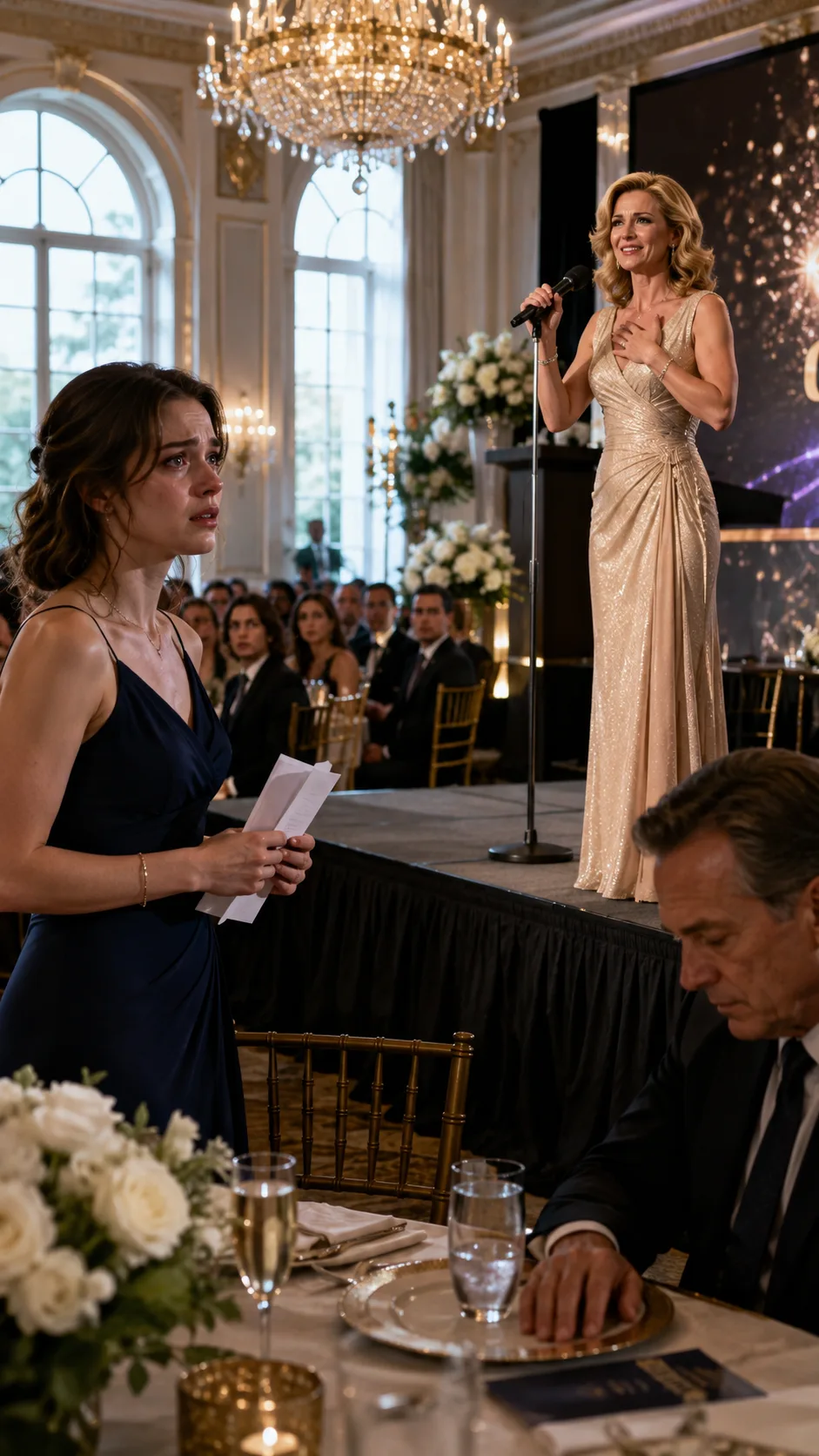
I stood slowly, smoothing the front of my navy dress. I had written my speech on small cards, though I already knew every word. I was going to thank my staff, our students, our donors, Mrs. Davis, and Mr. Miller, who were both sitting near the back because they insisted they didn’t need special seats.
Then Barbara stood up first.
For one strange second, I thought she was adjusting her chair.
But she moved toward the stage.
My father reached for her wrist. “Barbara,” he whispered.
She pulled away.
The applause faltered, confused but polite.
Barbara climbed the steps, smiling as if this had been planned. Natalie hesitated at the podium.
“I’m so sorry,” Barbara said, placing one hand over her heart. “I know this is Hannah’s moment. I just wondered if I could say a few words as her mother.”
Her mother.
The word hit me like a door slamming shut.
Natalie looked toward me, unsure.
Every face turned.
And I did what I had done my whole life.
I nodded.
Because I didn’t want to seem ungrateful.
Because I didn’t want to make a scene.
Because some part of me was still eighteen, standing on a porch with a suitcase, hoping my father would open the door.
Barbara took the microphone.
“Thank you,” she said, already breathless with fake emotion. “You have no idea what this night means to our family.”
Our family.
My hands went cold.
“When I met Hannah, she was a wounded little girl,” Barbara continued. “Angry. Lost. Closed off from the world. And I made a promise that I would raise her as my own.”
People murmured warmly.
Barbara glanced down at me, and for just a second, the sweet expression slipped. Her eyes sharpened.
Then she turned back to the crowd.
“It wasn’t easy. There were nights I cried myself to sleep, wondering if my love would ever be enough. There were years of rebellion, distance, disrespect. But I stayed. I sacrificed my youth, my peace, my comfort. I gave everything to help that child become the woman sitting here tonight.”
My vision blurred.
Not because I was surprised.
Because the lie was so complete.
She didn’t just steal credit for my success. She stole the language of my survival. She took the nights I cried alone and made herself the one who suffered. She took the hunger, the fear, the bus rides, the scholarship essays, the bakery shifts, the kindness of strangers, and wrapped them around her own shoulders like a shawl.
My father stared at the table.
Madison, Barbara’s daughter, looked uncomfortable for the first time all night.
Barbara’s voice cracked beautifully.
“So when you honor Hannah tonight, I hope you understand you are also honoring every mother who chooses love when love is not easy.”
The room erupted in applause.
Barbara bowed her head like a saint.
I couldn’t move.
A photographer came closer, aiming at my face.
I forced my lips into something that might pass as a smile.
Then Natalie returned to the podium, visibly stiff.
“Thank you, Mrs. Collins,” she said. “Before Hannah speaks, our team prepared a short interview segment recorded during the selection process.”
Barbara’s smile froze.
The giant screen behind her flickered on.
My face appeared.
Not the polished version sitting in the ballroom, but the tired version from three months earlier. Bare face. Hair pulled back. Sitting in a small office with a paper cup of coffee between my hands.
A woman off-camera asked, “Who helped you become the person you are today?”
Onscreen, I smiled sadly.
“That’s a complicated question,” video-me said.
Barbara turned slowly toward the screen.
“I used to think I became successful because I had no choice,” I continued. “But the truth is, nobody survives alone. The first person who really helped me was my high school teacher, Mrs. Eleanor Davis.”
In the ballroom, Mrs. Davis covered her mouth.
“She noticed I was exhausted,” I said onscreen. “She fed me when I was too proud to ask. She edited my essays. She wrote my recommendation letters. More than that, she made me feel like I wasn’t difficult to love.”
The room went quiet.
My father looked up.
The interviewer asked, “What about your family?”
Onscreen, I looked down at my hands.
“My father loved me,” I said slowly. “But he was not brave with that love.”
The silence in the ballroom deepened.
My father flinched as if I had spoken directly into his ear.
“And my stepmother,” I continued, “liked the story of raising me more than the work of being kind to me.”
Barbara’s face drained of color.
A soft gasp moved through the room.
“She told people I was rebellious,” video-me said. “But I was working after school. She told people I was ungrateful. But I was buying my own notebooks. When I got my scholarship, she put my suitcase on the porch and told me to go be independent.”
Someone near the front whispered, “Oh my God.”
Barbara gripped the microphone with both hands.
Onscreen, I wiped under one eye and laughed once without humor.
“The night I left, our neighbor, Mr. George Miller, drove me to the bus station. He gave me two hundred dollars and told me to build something nobody could deny.”
The camera cut to Mr. Miller in the audience. He sat very still, his old hands folded over the top of his cane, tears shining in his eyes.
“I used to be embarrassed by that story,” I said on the screen. “Now I’m not. Because the people who push you down don’t get credit for the strength it takes to stand back up.”
The video ended.
The ballroom went completely silent.
No one clapped.
No one moved.
Barbara turned toward me, her smile twitching at the corners.
“Hannah,” she said into the microphone, trying to laugh. “Sweetheart, that was taken out of context.”
I stood.
The chair behind me scraped against the floor.
The sound echoed.
Barbara’s eyes widened.
I walked up the steps slowly, every footstep louder than the last. Natalie stepped aside without a word.
Barbara leaned toward me as I reached for the microphone.
“Don’t you dare embarrass this family,” she whispered.
I looked at her hand wrapped around the microphone.
Then I looked at her face.
“You already did,” I said.
And I took it from her.
PART THREE: THE PEOPLE WHO RAISED ME
For a moment, I forgot the ballroom existed.
I forgot the chandeliers, the cameras, the donors, the reporters. I forgot the award waiting on the table and the speech cards trembling in my hand.
All I saw was Barbara.
The woman who had smiled at teachers while calling me dramatic at home.
The woman who had told my father I was hard to love.
The woman who had placed a suitcase on the porch and then spent six years telling people she gave me wings.
She leaned close, her voice sharp enough that only I could hear it.
“You will regret this.”
I almost laughed.
Because that had always been Barbara’s power. The threat of later. The punishment after guests left. The quiet cruelty once doors closed.
But there were no closed doors now.
I turned toward the audience.
“My name is Hannah Collins,” I said. My voice shook, but it did not break. “And I need to correct something.”
Barbara stepped back.
My father lowered his head.
“I was not raised by sacrifice,” I continued. “I was raised by school library lights, late shifts at a bakery, scholarship forms, and people who helped me without needing applause.”
A few people turned toward the back, where Mrs. Davis and Mr. Miller sat frozen.
“I want to thank Mrs. Eleanor Davis,” I said. “She gave me books when I had none. Food when I pretended I wasn’t hungry. Hope when I thought surviving was the same thing as living.”
Mrs. Davis began to cry.
I looked at Mr. Miller.
“And I want to thank George Miller, who left soup on his porch because he understood dignity better than anyone I knew.”
A soft wave of emotion moved through the room.
Mr. Miller shook his head, embarrassed, but he was crying too.
“He once told me to build something nobody could deny,” I said. “So I did. But tonight, I realized something. Success can be denied if the wrong person gets to tell the story first.”
Barbara’s jaw tightened.
I faced her.
“So let me say this clearly. I thank the people who lifted me. Not the people who pushed me down and then claimed credit because I learned how to stand.”
The first clap came from Mrs. Davis.
Then Mr. Miller lifted one shaking hand from his cane and clapped too.
Then Natalie.
Then a table near the front.
Then the whole ballroom rose.
The applause hit me like rain after a drought.
I didn’t smile right away. I couldn’t. I stood there with tears running down my face, breathing through years of silence finally leaving my body.
Barbara remained beside me, pale and rigid, her perfect mouth pressed into a thin line. For the first time since I had known her, she had no audience willing to rescue her.
Then my father stood.
He moved slowly, like an old man, though he was only fifty-two. When he reached the stage, Barbara grabbed his sleeve.
“Robert,” she hissed. “Do something.”
He looked at her hand.
Then he gently removed it.
The room quieted again.
He turned to me, and I saw something in his face I had wanted for eleven years.
Not love.
I always knew he loved me.
It was recognition.
“Hannah,” he said, his voice hoarse. “I’m sorry.”
The words landed softly, but they did not fix anything.
I wanted them to. I wanted to be the kind of daughter who ran into his arms and let one apology erase the nights he stayed silent. But healing did not work that way. Love did not erase absence. Regret did not rebuild childhood.
I looked at him and said, “You saw more than you admitted.”
He closed his eyes.
“I did.”
Barbara made a small sound. “Robert.”
He turned to her. “Not tonight.”
Two words.
But they changed the air.
Barbara stared at him as if he had become a stranger.
“You’re choosing this?” she whispered.
He looked at me, then at the crowd, then back at his wife.
“I’m choosing to stop pretending.”
Her face crumpled for one second before she repaired it. But I saw it. Everyone close enough saw it. Barbara didn’t just fear being exposed. She feared being ordinary. Without the story of her sacrifice, she was only a woman who had been cruel to a child and called it discipline.
Natalie stepped forward and handed me the award.
It was heavier than I expected.
The engraved glass caught the chandelier light, scattering gold across my hands.
I looked out at the students sitting near the back, the ones my organization had helped. Some were crying. Some were standing. Some were staring at me like I had given them permission to tell the truth too.
So I changed the ending of my speech.
“To every young person who has been told that pain made you successful,” I said, “please hear me. Pain does not deserve credit. You do. The people who loved you in small, quiet ways do. The teacher who stayed late. The neighbor who noticed. The friend who listened. The stranger who held a door open on the worst day of your life. Those are the people who help build us.”
I swallowed hard.
“And if someone hurt you, then stood beside your success and called it their work, you are allowed to tell the truth.”
This time, the applause came like thunder.
After the ceremony, Barbara disappeared before dinner was served.
For years, I had imagined exposing her would feel like victory. Sharp. Clean. Satisfying.
It didn’t.
It felt like setting down a suitcase I had carried for so long that my arms still ached after it was gone.
In the hallway outside the ballroom, my father found me standing near a window. The city lights blurred through the glass.
“Can I sit?” he asked.
I nodded.
He sat beside me on the bench, leaving space between us.
“I don’t know how to fix this,” he said.
“You don’t fix it tonight.”
He nodded, tears in his eyes. “I was afraid of another broken home.”
“So you let me be broken quietly?”
He covered his face with both hands.
I almost comforted him.
Then I stopped myself.
That was another thing I had learned too young: protecting adults from the consequences of their choices.
“I need time,” I said.
“I’ll give you whatever you need.”
I looked at him. “Start by calling Mrs. Davis and Mr. Miller tomorrow. Thank them. Not because cameras are watching. Because you should have known their names years ago.”
He nodded. “I will.”
The next morning, the video from the ceremony went viral.
Headlines called it a “shocking family reveal,” but that wasn’t how I saw it. To me, it was not shocking. It was simply the truth arriving late and finding a microphone.
Messages poured in from people I had never met.
My stepmother did the same thing.
My father took credit for my work too.
My aunt raised me, but my mother tells everyone she did.
I read every message until I couldn’t see through my tears.
A week later, Barbara sent me one text.
You ruined my life.
I stared at it for a long time.
Then I typed back:
No. I stopped letting you use mine.
I blocked her number after that.
Not out of anger.
Out of peace.
A month later, my nonprofit created a new scholarship fund. I named it The Quiet Helpers Fund. The first donors were people from the ballroom. The first ceremony was small, held in a school auditorium with folding chairs and bad coffee.
Mrs. Davis sat in the front row.
Mr. Miller sat beside her, wearing the same brown jacket he had owned since before I was born.
When I walked onto the stage, no chandeliers glittered above me. No reporters shouted my name. No one wore silk.
But it felt more honest than the ballroom ever had.
I looked at the students in front of me and smiled.
“My name is Hannah Collins,” I said. “And I am here because people helped me when nobody was watching.”
Mrs. Davis cried again.
Mr. Miller pretended not to.
And for the first time in my life, when I spoke about the people who raised me, nobody in the room had to lie.




