Laura found the first bouquet on the porch before the sun had cleared the neighbor’s roof.
Chapter 1
Laura found the first bouquet on the porch before the sun had cleared the neighbor’s roof.
The flowers were white. Not cream, not pale yellow, not the soft pink Michael used to buy when he forgot what she liked and chose whatever looked safest near the register. These were white lilies and white roses, wrapped in brown paper, tied with thin cotton string that had already soaked up the morning mist.
She stood in the doorway wearing one sock.
The other sock had vanished somewhere between the bedroom and the kitchen, a ridiculous small problem she had been trying to solve before coffee. There was a chipped blue mug cooling on the counter behind her. The house smelled like toast she had burned because the toaster still had Michael’s setting on it, too dark, almost black at the edges.
She looked up and down the street.
No delivery van.
No person walking away.
No neighbor pretending not to stare.
A folded note was tucked between the
stems.
Laura did not touch it right away. She bent closer, as if the paper might explain itself if she gave it enough time. The handwriting was visible through the crease. Slanted M. Tall T. The same hard pressure Michael used when he wrote grocery lists, like the pen had done something wrong and needed punishment.
She picked it up with two fingers.
I still remember.
The porch light buzzed above her head. It had been doing that for three weeks. She had meant to change the bulb, but the step ladder was in the garage, and the garage still had Michael’s tools hanging exactly where he had left them.
Laura read the note three times.
Then she stepped back inside and locked the door.
The dead did not send flowers. She knew that. Everyone knew that. Dead husbands did not remember Mondays. Dead husbands did not fold notes into
bouquets and leave them on porches before sunrise.
Michael had been dead for three years.
The fire had taken him on a Thursday night in October, the kind of cold wet night when smoke stayed low to the ground and the whole neighborhood smelled like soaked charcoal until morning. Laura had been at her sister’s apartment when the call came. By the time she reached the house, police tape had already cut across the street. Firefighters moved like shadows through steam. The windows glowed orange behind them.
Someone had held her back.
She never remembered who.
She remembered one thing clearly: Daniel standing under the maple tree, soaked through his black coat, watching the house burn without blinking.
Daniel had handled everything after.
Michael’s younger brother had always been useful in a way that made people grateful before they had time to feel uncomfortable. He spoke to the funeral director.
He called the insurance company. He found the death certificate. He sat beside Laura at the bank while she signed forms with hands that would not stay steady.
“You don’t have to look at any of this,” he had said.
So she didn’t.
That was the first mistake.
The bouquet stayed on her kitchen table until the petals softened at the edges. Laura put the note in a drawer under the dish towels, then moved it to a shoebox in the closet, then moved it again to the top shelf where she kept Michael’s passport, their old lease, and the photo booth strip from their first anniversary.
She told herself it was a prank.
Someone cruel.
Someone bored.
Someone who had seen her at the cemetery on Mondays and decided grief was a thing they could knock on like a door.
The second bouquet came exactly seven days later.
White again.
Same brown paper.
Same cotton string.
Laura opened the door with her phone already recording. Her hair was wet from the shower. Shampoo slid cold down the back of her neck. The street was empty except for Mr. Alcott across the road dragging his trash bin to the curb in a robe with one sleeve inside out.
The note was folded the same way.
You should have told them.
Laura took that one to the police.
The officer at the front desk had a silver pen clipped to her pocket and a coffee stain on the corner of her report pad. She listened carefully, which Laura appreciated until the listening became too careful.
“Mrs. Hayes,” the officer said, “do you know anyone who may have access to your husband’s old handwriting?”
Laura looked down at the note sealed in plastic.
“My husband’s dead.”
“Yes.”
The officer’s eyes did not move.
Laura’s fingers closed around the edge of the chair. There was a vending machine in the corner humming too loudly. A little boy sat beside his mother near the exit, swinging his legs and kicking the metal chair frame in a dull rhythm.
Kick. Kick. Kick.
“My husband died in a house fire,” Laura said.
“We understand.”
“No,” Laura said. “You don’t.”
The officer asked whether there had been arguments before Michael died. Whether anyone in Michael’s family disliked her. Whether she had recently changed jobs, relationships, routines. Whether she had posted anything online that might attract attention.
Laura answered each question.
No.
No.
No.
No.
Then the officer asked if Daniel Hayes had been contacted.
Laura stopped.
“Why would you ask about Daniel?”
“He was listed on several records after the fire. Next of kin for some procedural matters.”
“I was his wife.”
The officer tapped the pen once against the pad. “I’m not saying otherwise.”
Laura took the report number and left.
That evening, Daniel called.
Not texted.
Called.
Laura let the phone ring until the screen went black. Then it rang again. The second time, she answered without saying anything.
“I heard you went to the police,” Daniel said.
The refrigerator clicked on behind her.
Laura looked at the drawer where the first note had been before she moved it.
“How did you hear that?”
A small pause.
“Small town. People talk.”
“We live forty minutes from the station.”
Another pause.
“Laura, I’m just worried about you.”
She set the phone on the counter and put it on speaker.
“I didn’t tell you about the flowers.”
“You didn’t have to.”
The kitchen changed around that sentence. The sink still had a spoon in it. The blue mug still sat near the toaster. The chair Michael used to sit in still had one uneven leg that tapped if anyone leaned back too far.
But the sentence stayed in the center of the room.
“You need to stop digging at this,” Daniel said.
“I haven’t dug at anything.”
“Good. Keep it that way.”
The line clicked dead.
Laura stood there until the screen went dark.
Then she opened the cabinet under the sink, took out a trash bag, and finally threw the dead flowers away.
The third bouquet arrived the next Monday while she was at work.
Her neighbor sent a photo.
More flowers on your porch, honey. Want me to bring them inside?
Laura stared at the message until the numbers on her computer screen blurred into blocks. She worked in accounts payable for a medical supply company, which meant her days were full of invoices, purchase orders, and people pretending late payments were technical errors instead of choices.
Her supervisor, Diane, walked past with a stack of folders pressed to her chest.
“You okay?”
Laura locked her screen.
“I need to go home.”
The drive took twenty-two minutes. She knew because she counted the lights and checked the dashboard clock at each one. The bouquet was still there when she arrived. White petals. Brown paper. Cotton string.
The note was different this time.
It had been tied around the stems with black thread.
The fire did not kill me.
Laura did not go inside.
She sat on the porch step with the note in her hand while a dog barked somewhere behind the row of houses. A delivery truck rolled by without slowing. Two teenage girls walked past on the opposite sidewalk, laughing at something on one of their phones, then quieted when they saw her sitting there.
Laura folded the note once.
Then again.
Then she stood and went to the garage.
Michael’s workbench still smelled faintly of sawdust and machine oil. Daniel had offered to clear it out after the funeral. Laura had said no so quickly that he never asked again. The tools hung on pegboard in straight lines. Screwdrivers by size. Wrenches in a row. A roll of blue painter’s tape hooked over a nail.
On the back corner of the bench was a metal lockbox.
Michael used to keep receipts in it. Warranty cards. Keys he refused to label. A spare battery for a watch he never wore.
Laura found the key in the mug full of nails.
Inside the box, under two expired insurance cards and a receipt for paint thinner, was a folded envelope addressed to Michael.
It had no stamp.
No return address.
Inside was a photocopy of a bank transfer.
Laura did not understand all of it at first. Routing numbers. Company names. Policy references. A transfer from a business account connected to Hayes Property Holdings into another account with a name she had never heard Michael say.
Raven Hill Mutual.
The date was six days before the fire.
Laura took a picture of the document, then another. Her phone shook enough that the first one came out blurred.
She sat on the garage floor with the metal box open beside her.
A spider crossed the concrete near her shoe.
Tiny thing.
Still moving.
She searched Raven Hill Mutual.
Nothing useful.
Then she searched it with Daniel’s name.
One result came up.
An old archived notice from the state insurance commission. Raven Hill Mutual had been flagged in connection with staged property losses across three counties. The notice was eight years old. No charges listed. No names beyond the shell company.
But Hayes Property Holdings was Michael’s family business.
Not big enough to be famous. Big enough to own old rental houses, vacant lots, a strip of storage units near the highway, and the burned house Laura and Michael had been living in while they saved for something better.
Michael had hated that house.
“It has bones,” Daniel used to say.
“It has mold,” Michael would answer.
Laura looked at the fire report again that night.
She had not opened it since the week after the funeral. The pages smelled like dust and old paper. The official cause was listed as accidental electrical ignition near the basement service panel. No suspicious accelerants. No indication of forced entry. Victim recovered in main hallway, severe fire damage, identity confirmed through personal effects and dental comparison.
Personal effects.
Laura read that line twice.
Michael’s wedding ring had been recovered with the body.
She remembered the funeral director handing her a small velvet pouch. Daniel had been beside her. The director said some personal items had been too damaged to restore. Daniel took the pouch before Laura reached for it.
“I’ll keep it safe,” he said.
She had let him.
She called the funeral home the next morning.
The woman on the phone put her on hold for six minutes. Soft instrumental music played through the line, interrupted twice by a recorded voice thanking her for her patience.
When the woman came back, her voice had changed.
“Mrs. Hayes, according to our records, the ring was not released to you.”
Laura sat at her kitchen table.
“To whom was it released?”
“I’m not sure I’m allowed to—”
“To whom?”
Paper moved on the other end.
“Daniel Hayes signed for it.”
Laura looked at Michael’s empty chair.
The uneven leg was touching the floor.
No tapping.
The fourth bouquet arrived before dawn.
Laura had not slept.
She heard something on the porch at 5:12 a.m., a soft scrape like paper against wood. She was already dressed. Jeans. Sweater. Coat over the back of the chair. Her phone charged to one hundred percent. The old fire report and the Raven Hill photocopy were sealed in a yellow folder on the table.
She opened the door before whoever delivered it could fully leave.
No one was there.
The bouquet sat directly in front of the threshold.
White flowers again.
But this time, something hung from the string.
A ring.
Blackened, warped, but still gold underneath.
Laura crouched without touching it. There was a dent along the inner edge, small and curved where Michael had dropped it on the driveway two months after their wedding. She had been washing dishes when he came inside holding it between his fingers.
“Bad news,” he had said. “I damaged the marriage.”
She had thrown a dish towel at him.
Now the ring swung from the bouquet string, tapping gently against the paper in the cold morning air.
The note was tucked under it.
Meet me where we ended.
Laura did not call the police.
Not first.
She called Daniel.
He answered on the second ring, voice rough.
“Laura?”
“You have Michael’s ring.”
Silence.
A car passed outside, tires hissing over damp pavement.
“What?”
“The funeral home said you signed for it.”
“Laura, listen to me.”
“No.”
She heard him move. A drawer opened. Something metal clinked.
“You need to stay home.”
“Why?”
“Because whoever is doing this knows where you live.”
“You knew about the flowers before I told you.”
“Don’t start that.”
“Why did you sign for his ring?”
Daniel breathed through his nose. One slow breath. Then another.
“I was trying to spare you.”
Laura looked at the bouquet.
“From what?”
“From making yourself sick over scraps.”
She almost said his name. She almost let the old habit come up, the one where Daniel became the reasonable man in the room because Michael was gone and someone had to know what to do.
Instead she ended the call.
That afternoon, she drove to the county records office.
The woman behind the counter wore red glasses and had a bowl of peppermint candies beside her keyboard. Laura asked for property records connected to Hayes Property Holdings from the year of the fire. The woman asked if she had parcel numbers. Laura did not.
“Then we’ll be here a while,” the woman said.
Laura pushed the yellow folder across the counter.
“I have time.”
The woman glanced at the papers. Her hand stopped on the Raven Hill transfer.
“Where did you get this?”
“My husband kept it.”
The woman looked at Laura then, not at the file.
“What was his name?”
“Michael Hayes.”
The peppermint bowl sat between them, red and white twists under fluorescent light.
The woman typed for eleven minutes.
Then she printed six pages and slid them over.
Hayes Property Holdings had increased the insurance coverage on the house twenty-three days before the fire. Not by a little. By enough that the number looked wrong until Laura counted the zeros with her finger. A second rider had been added for structural loss. A third for personal liability connected to business-held residential properties.
Daniel’s signature appeared on the request.
Michael’s appeared below it.
Laura stared at Michael’s signature.
It looked right.
Almost.
The M pressed too hard. The L in Michael had the wrong loop. He never crossed the H that way. It was close enough for a busy clerk. Close enough for grief. Close enough for fire.
“Can I get copies?” Laura asked.
The woman nodded.
The printer started again.
That evening, Laura parked two blocks away from Daniel’s house and watched from behind a line of bare hedges.
She did not know what she expected to see. Maybe nothing. Maybe Daniel taking out the trash. Maybe a man who had sounded too calm for too many years doing something ordinary.
At 8:17 p.m., a black SUV pulled into Daniel’s driveway.
Daniel came out carrying a small cardboard box. A woman stepped out of the passenger side. She was older, silver-haired, wrapped in a wool coat. Laura recognized her from the funeral, though it took a moment to place the face.
Michael’s mother.
Evelyn Hayes had not spoken to Laura after the burial except to say, “He always worried about you.”
At the time, Laura thought it was grief making the words strange.
Daniel handed Evelyn the box.
Evelyn opened it under the porch light.
White petals showed at the top.
Laura’s hand tightened around the steering wheel.
Evelyn said something Laura could not hear. Daniel shook his head. Evelyn grabbed his sleeve. He pulled away, too sharply, then looked toward the street.
Laura ducked.
A bus rolled past the end of the block, blocking the driveway for three seconds. When it cleared, Daniel was alone on the porch.
Evelyn was already getting back into the SUV.
Laura drove away without turning on her headlights until the next corner.
The old house stood at the dead end of Miller Road, where the pavement cracked into gravel and the trees grew too close together.
Laura arrived after dark.
She parked behind the rusted mailbox and sat with both hands on the wheel. The house had been fenced off after the fire, but time had done what time does. One section of chain-link sagged near the side yard. The warning sign hung by one corner, tapping lightly in the wind.
KEEP OUT.
She stepped through the gap.
Her flashlight beam crossed the burned siding, the collapsed porch rail, the window frames like black ribs. Someone had been here recently. The plywood over the front entrance had been removed and leaned carefully against the wall, not torn off. Two fresh footprints marked the mud near the threshold.
One large.
One smaller.
Laura went inside.
The smell hit first. Old smoke. Wet rot. Rust. The sharp mineral scent of ash that had settled into everything and refused to leave. Her flashlight cut across the hallway where the floor dipped near the center. The walls were blackened, but not empty.
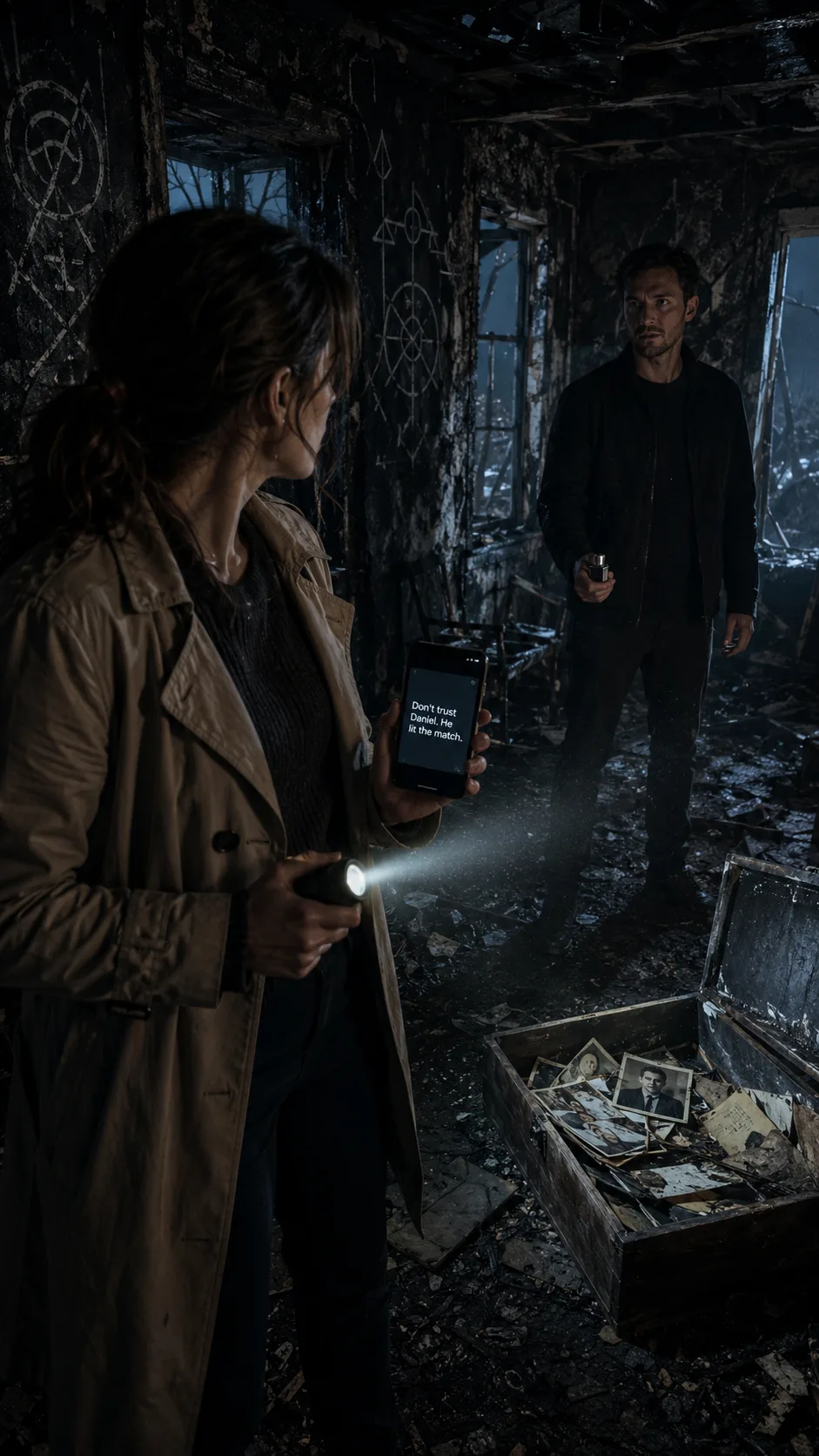
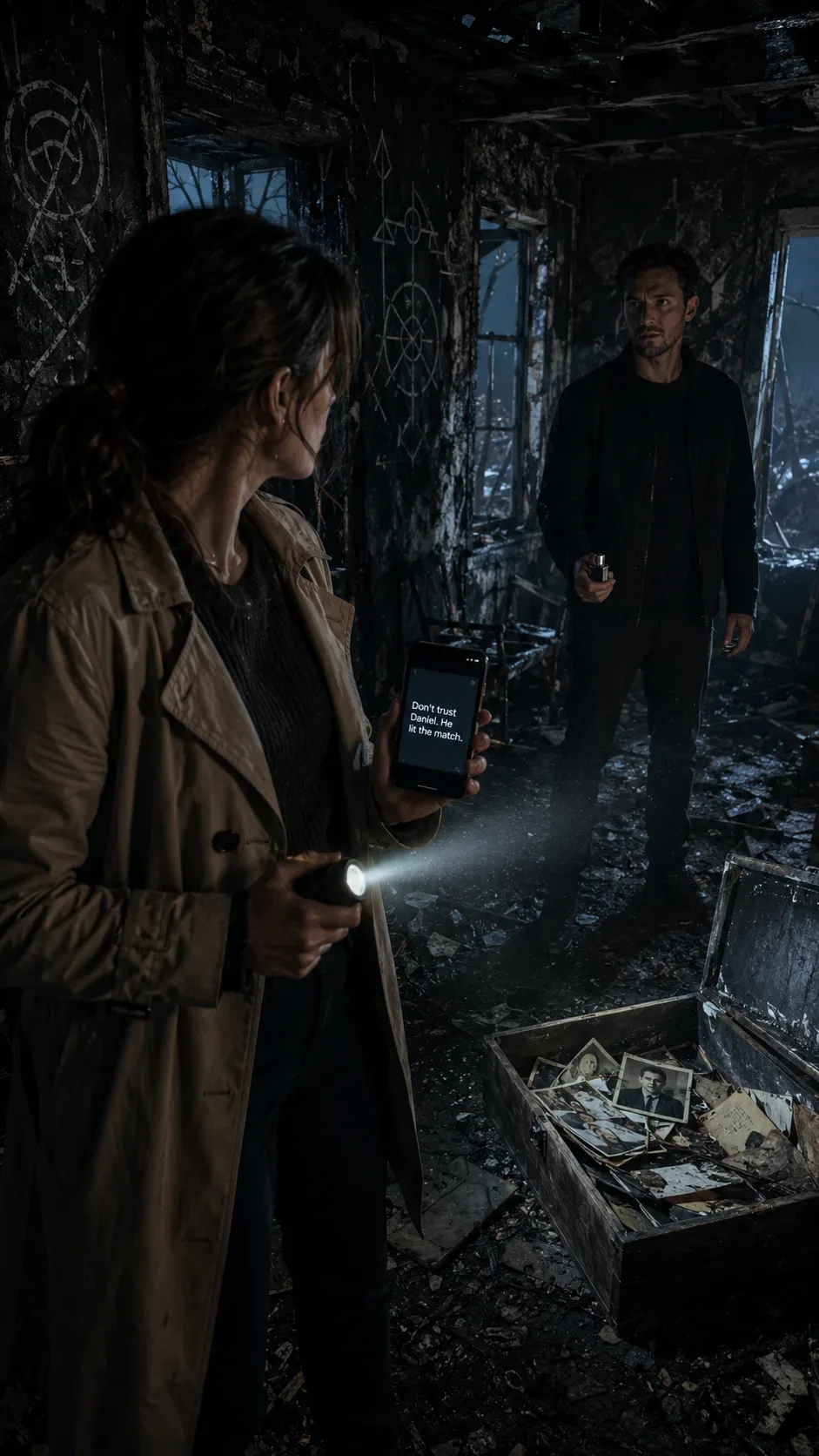
White chalk symbols covered the living room.
Circles inside triangles. Lines crossing through loops. Marks that looked deliberate but not familiar. Fresh chalk dust rested on the warped baseboards. Someone had drawn them recently, pressing hard enough to leave powder thick in the cracks of burned plaster.
Laura moved deeper into the house.
The stairs were gone. A strip of melted carpet still clung to the edge where the first step had been. In the corner, part of a kitchen chair lay on its side, one leg missing. Michael had hated those chairs. He said they looked like they belonged in a dentist’s waiting room.
Her flashlight found the fireplace.
The floorboards near it had always creaked. Michael used to joke that the house was trying to complain before they did. Laura stepped close and crouched. One board sat slightly higher than the others. Not much. Just enough.
She took the screwdriver from her coat pocket.
The wood groaned when she lifted it.
Underneath was a box.
Small. Wooden. Wrapped in plastic that had gone cloudy with dust.
Laura pulled it out and set it on the floor. The latch resisted, then snapped open with a dry click.
Photos spilled against the lid.
Michael.
Not before the fire.
After.
Michael in a hospital bed, one side of his face wrapped in white gauze. Michael sitting in a wheelchair near a window with blinds half-closed. Michael with a beard she had never seen on him, thinner than he should have been, wearing a gray sweatshirt that hung loose at the wrists.
There were papers too. Medical forms without hospital letterhead. A prescription label torn across the name. A photograph of a door with a number taped to it: 14B.
Laura picked up one photo.
Michael was looking at the camera.
Not smiling.
Alive.
A shoe scraped behind her.
Laura froze with the photo in her hand.
Daniel stood in the doorway between the hall and the living room. His dark coat was wet at the shoulders. He looked at the box first, then at the lifted floorboard, then at Laura.
“You weren’t supposed to find that,” he said.
Laura did not stand.
The flashlight lay on the floor beside the box, its beam cutting across Daniel’s shoes. Mud clung to the sides. Fresh mud.
“You followed me,” Laura said.
“I tried to stop you.”
“You sent the flowers.”
Daniel’s mouth moved once before he answered.
“Yes.”
Laura placed the photo back in the box with the others. Carefully. Edges aligned. Michael would have done it that way.
“Why?”
Daniel stepped into the room.
The house seemed smaller with him inside. He had always been broad-shouldered, taller than Michael by two inches, the kind of man people moved around in narrow hallways without noticing they had done it.
“My family did something,” he said.
Laura stood.
Her knees brushed the open box. One photograph slid onto the floor, faceup. Michael in the hospital bed. Eyes open.
Daniel looked at it and swallowed.
“Michael found out about the insurance filings,” he said. “The inflated policies. The staged damage claims. It started before him. Before me. Dad built half the company on it.”
“Michael told me he wanted out of the business.”
“He wanted more than out.”
Daniel’s voice was flat now. Practiced. Not confession. Rehearsal.
“He was going to take records to the state. Names. Transfers. Properties. He said he wouldn’t let them use your house. He said you lived there.”
Laura’s hand closed around the phone in her pocket.
Daniel saw the movement.
“Don’t.”
She stopped.
He held both hands out. Empty.
For now.
“The fire was supposed to scare him,” Daniel said. “That’s what I was told.”
Laura stared at him.
“Told by who?”
Daniel looked toward the broken window. Rain ticked against the sill.
“By my mother.”
The house answered with a soft drip from somewhere above.
“Where is Michael?”
“I don’t know.”
The answer came too quickly.
Laura took one step toward him.
“Try again.”
Daniel’s jaw shifted.
“He was taken out before the worst of it. Hidden. There was another body.”
“What body?”
“A man from one of the properties. No family. No one asking questions.”
Laura’s hand went cold around the phone.
Daniel stepped closer.
“I didn’t know that part until after.”
“You signed for the ring.”
“I was told to.”
“You called me sick for asking.”
“I was trying to keep you alive.”
Laura laughed once.
Not loudly.
The sound barely reached the walls.
Daniel flinched anyway.
He looked toward the box again. “I sent the flowers because Michael got out.”
Laura stopped.
The rain tapped harder now.
“Got out of where?”
Daniel rubbed both hands over his face, then dropped them.
“There was a private care facility up north. Not legal. Not exactly. People paid cash. People disappeared there for years if the paperwork was good enough.”
“Michael was there?”
“Yes.”
“And you knew?”
Daniel did not answer.
That was the answer.
Laura stepped back until her heel touched the raised floorboard.
Daniel moved forward.
“He escaped last week,” he said. “My mother called me before the police. She said he was unstable, that he’d come after everyone, that he’d ruin—”
“Ruin what?”
Daniel pressed his lips shut.
Laura lifted the phone from her pocket.
Daniel’s eyes went to it.
“Put that away.”
“No.”
“Laura.”
“You said he escaped.”
“Yes.”
“Then where is he?”
“I don’t know.”
Her phone buzzed.
Once.
The sound was small, almost swallowed by the rain, but Daniel’s face changed before Laura looked down.
Unknown number.
The message filled the screen.
Don’t trust Daniel. He lit the match.
Laura read it.
Then she looked up.
Daniel’s right hand was no longer empty.
A lighter rested between his fingers, low beside his thigh. Silver. Scratched. Familiar in a way she could not place until the flashlight caught the dent near the hinge.
Michael’s lighter.
The one he kept in the kitchen junk drawer though neither of them smoked, because his father had given it to him and Michael never knew what to do with gifts he didn’t want.
Daniel’s thumb rested on the wheel.
Laura did not move.
Outside, the rain hit the broken windows. Inside, the flashlight beam trembled across the open box, the photos, the lifted floorboard, the chalk marks, Daniel’s hand.
“You lit it,” Laura said.
Daniel’s eyes flicked to the phone.
“Who sent that?”
Laura turned the screen toward him.
He did not read it.
He already knew.
The lighter clicked.
No flame.
Just the metal sound.
Laura’s thumb moved across her phone screen. Daniel saw it too late.
The call connected.
A voice came through on speaker, rough, thin, and breathing too close to the microphone.
“Laura?”
Michael.
Daniel stepped back.
One step.
Not much. Enough.
Laura held the phone between them.
The ruined house seemed to lean around that voice. Rain. Ash. The old walls. The box at her feet. Michael’s face in the photographs looking up from three different angles.
Daniel stared at the screen like it had become a weapon.
Michael spoke again.
“Get away from him.”
Daniel’s hand tightened around the lighter.
Laura kept the phone raised.
“Michael,” she said.
Daniel moved fast.
He lunged for the phone, but Laura had already stepped sideways. His shoulder struck the edge of the fireplace. Loose brick cracked under his weight and fell. Laura grabbed the wooden box with one hand and dragged it back with her foot, scattering photos across the floor.
The lighter hit the ground.
It skidded near the open floorboard.
Daniel reached for it.
Laura brought the flashlight down hard across his wrist.
Not enough to break bone.
Enough.
He cursed and pulled back. The lighter spun into the dark under the remains of the staircase.
Michael’s voice came through the phone.
“Police are outside.”
Daniel stopped.
Laura heard them then.
Not sirens. Not yet.
Tires on gravel. Doors opening. Men speaking low beyond the fence. The crunch of boots near the side yard.
Daniel looked toward the hallway.
Laura looked too.
Red and blue light slid across the broken window, faint at first, then stronger.
Daniel’s face emptied.
His hand hung at his side, fingers curled from where the flashlight had struck him. Chalk dust had smeared across his sleeve. There was a black streak on his jaw where ash had brushed his skin.
“You called them,” he said.
Laura did not answer.
Michael did.
“I did.”
Daniel’s head turned slowly toward the phone.
For the first time since Laura had known him, Daniel had no ready sentence. No calm instruction. No useful hand reaching for papers. He stood inside the house he had helped turn into a grave, with Michael’s photographs on the floor and Michael’s voice in the room.
A flashlight beam swept through the doorway behind him.
“Daniel Hayes,” someone called from outside. “Step into the hall with your hands visible.”
Daniel looked at Laura.
The phone stayed between them.
“Laura,” he said.
She lowered the flashlight beam to the floor, where one of Michael’s hospital photos had landed near Daniel’s shoe.
His face looked up from the ash.
“Hands visible,” the officer called again.
Daniel slowly raised them.
The lighter was still somewhere in the dark.
Nobody moved toward it.
Two officers entered with masks over their mouths and flashlights fixed low. One took Daniel by the wrists. Another moved between Laura and the broken hallway. A third came in carrying an evidence bag and stopped when she saw the open box.
Laura kept holding the phone.
Michael stayed on the line.
No one told her to hang up.
Outside, the ruined yard had filled with light. Police tape stretched between the fence posts. A woman in a dark coat spoke into a radio near the gate. Daniel sat in the back of a cruiser with his head bent forward, wrists behind him. Evelyn Hayes stood beside another officer, her silver hair flat from the rain, her coat buttoned wrong.
Laura had not seen them bring Evelyn there.
Maybe she had come on her own.
Maybe Michael had sent more than one message.
An officer wrapped a blanket around Laura’s shoulders. It smelled like plastic and storage. Laura let it sit there without pulling it close.
The wooden box was carried out after her.
The photos went into separate sleeves. The hospital papers into another. Michael’s lighter was found beneath the staircase, wedged beside a burned strip of baseboard. One officer held it up with gloved fingers. Daniel did not look at it.
Laura stood near the ambulance while a paramedic checked her wrist. She had scraped it on a nail without noticing. The paramedic cleaned it with something cold that smelled sharp.
“You’ll need a tetanus shot,” he said.
Laura nodded.
Her phone was still in her other hand.
The call had gone quiet, but it had not ended.
“Are you there?” she asked.
A breath came through.
“Yes.”
Rain slid down the ambulance door beside her.
“You’re alive.”
Michael did not answer right away.
Then: “Not the way I was.”
Laura looked toward the house.
Through the open doorway, she could see the chalk marks on the blackened walls. Evidence lights flashed across them, turning the white lines blue, then red, then white again.
“Where are you?” she asked.
“Safe for tonight.”
“For tonight?”
“I had to make sure Daniel followed you.”
Laura closed her eyes for one second.
Then opened them.
“You used me.”
The words landed clean.
Michael’s breathing changed.
“I knew he’d come if you found the box.”
“You used me,” she said again.
The paramedic looked up, then away.
Michael said her name.
Laura ended the call.
The screen went black in her hand.
Three days later, the news called it the Hayes Property Fraud Case.
Not the Michael Hayes case.
Not the burned house case.
Fraud looked cleaner on paper. Easier to place in columns. Inflated policies. Falsified signatures. Staged losses. Private facility payments. Concealment of a living victim. Suspected homicide connected to unidentified remains recovered from the original fire scene.
The words came in rows.
Laura read them at her kitchen table.
The porch light had finally gone out.
Daniel was charged first. Arson. Fraud. Conspiracy. Obstruction. More charges pending, the article said. Evelyn was charged before the week ended. Two former employees of Hayes Property Holdings were arrested after that. A retired claims adjuster. A doctor whose name appeared on one of Michael’s unsigned medical forms.
Michael’s location was not published.
Laura did not ask Daniel.
She did not visit him.
His attorney called once. Laura listened until the man said, “Mr. Hayes hopes you’ll consider the pressure he was under.”
She hung up and blocked the number.
The flowers stopped.
On the next Monday, Laura woke before sunrise anyway. Her body had learned the hour. She stood behind the front door with her hand on the lock and waited for footsteps that did not come.
The porch was empty.
Mist on the railing.
Old leaves in the corner.
Nothing white.
She made coffee and burned the toast again. This time, she scraped the black edges into the sink and ate it standing up.
At 9:06 a.m., her phone buzzed.
Unknown number.
Laura stared at it until the screen dimmed.
Then she opened the message.
It was a photo.
Michael sat in a room she did not recognize, wearing a gray sweatshirt, a paper cup in one hand. He looked older. Thinner. One side of his face carried marks the old photographs had not fully shown. A window behind him looked out on a parking lot and three bare trees.
Under the photo was one sentence.
I won’t come near you unless you ask.
Laura set the phone facedown.
The house was quiet.
The chair across from her still had the uneven leg. She stood, went to the garage, and brought back a screwdriver. It took four minutes to fix it. One screw tightened. One felt pad pressed under the short side. She sat across from the chair and leaned her foot against it.
No tapping.
That afternoon, she drove to the cemetery.
Michael’s grave was still there, though the person in it was not Michael. The grass had grown thin near the stone from all the times she had stood in the same place. Someone had removed the old wilted flowers from the neighboring plot. A plastic angel leaned sideways in the mud.
Laura placed nothing on the grave.
She only stood there for a while, hands in her coat pockets, watching a groundskeeper push a cart of tools along the path.
Then she walked to the office and asked what had to be done to change a grave marker.
The clerk gave her forms.
Lots of them.
Laura took every page.
Two months later, the burned house came down.
She did not go to watch the demolition. Mr. Alcott sent a message saying the trucks were there, then another saying it was done. Laura thanked him and put the phone away.
That evening, she opened the shoebox from the closet.
The notes lay inside in order.
I still remember.
You should have told them.
The fire did not kill me.
Meet me where we ended.
She placed Michael’s messages in one envelope and the police copies in another. Then she took the burned wedding ring from the evidence return bag, sealed now in a small clear container, and set it on the table.
It did not look like a promise anymore.
It looked like proof.
Laura turned off the kitchen light and left it there until morning.
When the sun came up, she took the ring, the notes, and every photograph of Michael after the fire to her attorney’s office. She signed papers without Daniel beside her. Without Evelyn watching. Without anyone telling her which page mattered.
Her signature pressed hard enough to mark the sheet beneath it.
On the first Monday of spring, Laura bought white flowers.
Not lilies.
Not roses.
Small white daisies from a grocery store bucket, wrapped in plastic, with a price sticker stuck crooked near the stems. She carried them to the cemetery and placed them beside the temporary marker over the unidentified man who had been buried under Michael’s name.
The new stone had not arrived yet.
The old one was gone.
Laura stood there until the wind pushed one daisy loose from the bundle. It rolled across the grass and stopped near her shoe.
She picked it up.
Then she left.
No note.
No ribbon.
No ghosts.
Chapter complete
You have reached the end of this chapter.
Continue reading
A few more worlds to get lost in after this chapter.




