Ryan put the black funeral guest book under his arm like it belonged to him.
Chapter 1
Ryan put the black funeral guest book under his arm like it belonged to him.
He did that with everything.
The guest book. The coffee cups. The sympathy cards stacked beside Grandma’s front door. The house key on the blue ribbon. Even the silence after the burial, when the family came back to her living room and no one knew where to stand without her in the middle of it.
I watched him move through Grandma Evelyn’s house in his navy suit, thanking people for coming, touching elbows, accepting casseroles, telling distant cousins where to put their coats.
Not once did he ask me.
I stood near the kitchen doorway with a paper plate in my hand and three untouched crackers on it. The house smelled like lilies, old wood, and burnt coffee. Someone had left the percolator on too long. Grandma would have unplugged it, wiped the counter, and said, “People grieve better when the coffee doesn’t taste like punishment.”
Ryan had her keys.
That was the part I kept looking at.
They hung from his finger when he talked. A small brass ring, three house keys, one tiny grocery loyalty card she never used, and a blue plastic tag from the hardware store where she had copied a key for me when I was sixteen.
I had lost mine in college.
She never mentioned it after.
Ryan saw me looking.
He closed his fist around the keys.
“Claire,” he said, across the room, “can you help Aunt Linda with the dishes?”
Aunt Linda already had two women helping her.
Ryan knew that.
So did everyone else.
My cousin Beth looked down at her cup. Uncle Mark cleared his throat and pretended to read the prayer card again. The one with Grandma’s photo on the front, taken in her garden two summers before her knees got bad.
I carried my plate to the trash.
Three crackers.
No bite marks.
Grandma’s house had always sounded different when it was full of people. The floorboards under the hallway bent in familiar places. The radiator clicked behind the sofa. The screen door in the kitchen never closed all the way unless you lifted it first. Every sound had a history.
That afternoon, all of it sounded rented.
Ryan stood by the mantel, beneath the old family portrait, speaking to Pastor Miller and Mr. Haynes from the bank. His wife, Melissa, hovered beside him in a black dress that still had the price tag string sticking from the sleeve. She held a tissue in one hand and her phone in the other.
She did not cry.
She checked the screen every few minutes.
I rinsed a serving spoon in the sink while Aunt Linda stacked plates beside me.
“He’s handling things well,” she said.
I looked at her.
She kept her eyes on the faucet.
“Your brother,” she added.
The spoon slipped against the porcelain with a sharp little sound.
“Grandma asked me to stay with her the last four months,” I said.
Aunt Linda turned off the water.
“She also asked Ryan to handle the paperwork.”
There it was.
Paperwork.
A word people use when they do not want to say money.
I dried my hands on a towel with embroidered strawberries, the one Grandma hung only when company came. A thread had pulled loose near the bottom. I tucked it behind the rack before anyone could snag it.
“Did you see the paperwork?” I asked.
Aunt Linda moved the plates closer to the counter edge.
“He said it was settled.”
“He said.”
She picked up a wet spoon and dried it twice.
“Today isn’t the day.”
I looked through the kitchen doorway. Ryan was laughing softly with Mr. Haynes. Not a real laugh. The careful kind he used in job interviews and hospital hallways.
His hand went to his pocket.
The keys jingled.
Grandma’s neighbor, Mrs. Donnelly, came in through the back door without knocking. She had lived next door for twenty-six years and still wore garden gloves to funerals because she always forgot to take them off. Her gray hair was pinned crooked. Her shoes left two damp marks on the kitchen mat.
“Claire,” she said.
Aunt Linda turned too quickly.
Mrs. Donnelly looked at her, then at me.
“Can I borrow you?”
We stepped into the back pantry, where Grandma kept canned peaches, paper towels, and every glass jar she had ever washed out and saved.
Mrs. Donnelly shut the door halfway.
The pantry smelled like dust and lemon soap.
“She made me promise,” she said.
From her cardigan pocket, she pulled a folded tissue. Inside was a small silver USB drive, the kind Grandma used to call “computer crumbs.”
My fingers closed around it.
A piece of paper was wrapped around the metal.
Four words.
Play this with witnesses.
I did not speak.
Mrs. Donnelly’s mouth pressed flat. “She recorded it the Tuesday before she went back to the hospital.”
I looked at the pantry door.
Outside, Ryan’s voice carried through the house.
“Of course we’ll keep it in the family.”
Mrs. Donnelly’s eyes moved toward the sound.
“She said not to watch it alone.”
The paper felt thin in my palm.
“She knew?” I asked.
Mrs. Donnelly pulled off one garden glove finger by finger.
“She knew enough.”
The pantry door opened before I could answer.
Ryan stood there.
He looked first at Mrs. Donnelly. Then at my hand.
“What are you two doing back here?”
Mrs. Donnelly tucked her gloves under her arm.
“Talking.”
Ryan smiled without showing teeth. “Family needs some privacy today.”
Mrs. Donnelly did not move.
I slipped the USB into my purse.
Ryan saw it.
His eyes went from my purse to my face.
A tiny movement.
Enough.
“Claire,” he said, “we need to talk in the living room.”
“Now?”
“Yes.”
Mrs. Donnelly stepped past him first. She did not brush his shoulder, but he moved back as if she might.
The living room had changed while I was in the pantry.
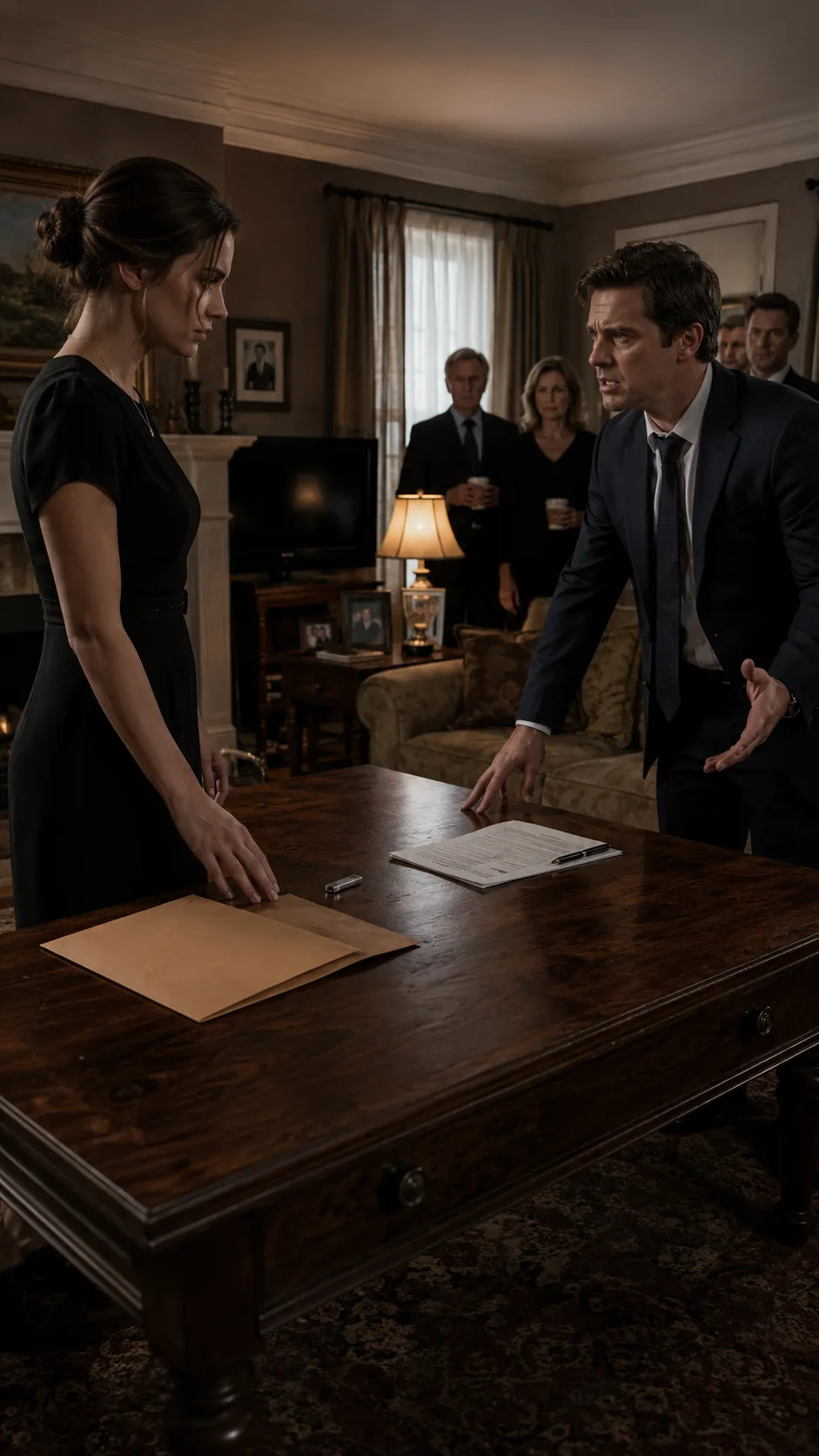
The casseroles had been pushed to the dining room. The coffee table had been cleared. The guest book was gone. In its place sat a brown folder, a stack of papers, and a black pen laid straight across the top page.
Too straight.
Like a photo for a listing.
My relatives had gathered without being called. Aunt Linda near the sofa. Uncle Mark by the fireplace. Beth and her husband behind the wingback chair. Melissa close to Ryan, arms folded, tissue still dry.
Mr. Haynes was gone.
Pastor Miller too.
Only family now.
Ryan walked to the head of the coffee table, though coffee tables do not have heads unless someone decides they do.
“I wanted to wait,” he said.
Nobody asked why he had not.
He picked up the folder and tapped it against his palm.
“Grandma made arrangements before she passed.”
Before she passed.
Not before she died. Not before she lost the strength to sit up alone. Not before she started forgetting whether she had taken her pills, then remembering every insult from 1978 with perfect accuracy.
Arrangements.
Melissa looked at the floor.
I stayed where I was, near the doorway.
Ryan opened the folder.
“The house is staying with me.”
Aunt Linda blinked once.
Beth’s husband shifted his feet.
The radiator clicked behind the sofa.
Ryan pulled out the top sheet and laid it flat on the table.
“She signed the transfer three days before she went back to the hospital. It’s already notarized. Claire just needs to sign the acknowledgment so there are no issues later.”
“There are issues now,” I said.
His face stayed smooth.
“Don’t start.”
Two words again.
Like I was twelve and he had caught me touching his baseball cards.
I walked to the table. The papers were printed on expensive cream stock. Ryan always loved little signs of importance. Heavy paper. Good pens. Raised lettering.
Grandma’s name sat near the bottom.
Evelyn Margaret Walsh.
The signature below it leaned too far right.
Grandma’s real signature had a loop in the E, a stubborn little curl she refused to change even when the bank switched to digital pads. This one had no curl.
My thumb touched the edge of the page.
Ryan snapped it back.
“Careful.”
“With Grandma’s house?”
“With legal documents.”
Aunt Linda made a small noise.
Not agreement.
Not protest.
Just enough to prove she was still there.
Ryan placed the paper down again and slid the pen toward me.
“Sign it. Grandma wanted the house to stay with me.”
The pen stopped near my hand.
Black barrel. Gold clip. His initials engraved near the cap.
R.W.
He had brought his own pen to claim a dead woman’s house.
I looked at Melissa.
She looked at the lamp.
The crooked shade tilted left, throwing a warm triangle of light across the transfer agreement. Grandma had hated that shade. She said replacing it would make the room “too pleased with itself.”
I reached into my purse.
Ryan’s posture changed before the USB appeared. His shoulders pulled back. His right hand left the folder. His mouth tightened around a breath he did not release.
I placed the silver USB beside the papers.
Small.
Bright.
Ugly against the cream stock.
Ryan stared at it.
“What is that?”
“A message from Grandma.”
His hand came down on the table.
The pen jumped.
“No.”
The room heard that.
Not the word.
The speed of it.
Aunt Linda looked up. Uncle Mark stopped rubbing the prayer card between his fingers. Beth’s husband lowered his cup. Coffee moved inside it in a dark circle.
Ryan stepped toward me.
“Claire, put that away.”
“Why?”
“Because today is not the day for one of your performances.”
I almost laughed.
A small breath, no sound.
Ryan leaned closer. “She was confused at the end. You know that.”
Mrs. Donnelly stood near the kitchen doorway. She had not left. Her garden gloves were still tucked under her arm.
“She knew my name on Tuesday,” she said.
Ryan turned his head.
“Mrs. Donnelly, this is family business.”
“She asked me to bring it.”
Melissa’s hand went to Ryan’s sleeve.
He shook it off.
That was the second crack.
I picked up the USB.
Ryan moved around the table.
“Don’t touch that TV.”
The words landed harder than he meant them to.
The TV sat beside the fireplace, dark and dusty, beneath the old shelf where Grandma kept framed photos in no particular order. My high school graduation. Ryan’s wedding. Grandpa in a fishing hat. Grandma holding a tomato the size of her fist.
I walked toward it.
Ryan followed too quickly.
His shoe struck the table leg. The papers shifted, sliding half an inch. The pen rolled once and stopped against the brown envelope still lying near my side of the table.
The envelope Grandma had hidden under her sewing basket.
I had not opened it yet.
Not there.
Not with Ryan watching.
“Claire.” Ryan’s voice dropped. “You don’t know what you’re doing.”
I reached the TV.
His hand closed around my wrist.
Not hard.
Public.
That was worse.
The whole room saw it. They saw his fingers on the black sleeve of my dress. They saw mine open, the USB pressed against my palm. They saw Melissa’s face turn toward the window.
I looked down at his hand.
Then at Aunt Linda.
Then Uncle Mark.
Then Beth.
No one moved.
Ryan let go.
“There,” he said, as if he had done something generous.
I plugged the USB into the side port.
The TV blinked blue.
Ryan stepped back.
One step.
The screen went black, then gray, then filled with Grandma’s bedroom.
Her real bedroom.
Not the cleaned-up version after hospice came. The messy one. The quilt with the blue squares. The water glass with a straw. The plastic pill organizer on the nightstand. A folded magazine on the bed. Her oxygen tube looped beneath her nose.
Her cardigan was buttoned wrong at the top.
My hand moved to my mouth and stopped halfway.
On the screen, Grandma leaned closer to the camera. Her face looked smaller than I remembered, but her eyes were sharp. She had always had eyes that could find a lie in a sealed envelope.
The audio crackled.
Then her voice filled the living room.
“Ryan lied.”
No one breathed loudly after that.
Grandma swallowed on the screen.
Her hand shook, but she lifted a page into view. “I never gave him the house.”
Ryan turned toward the TV.
His hand stayed in the air, fingers half-curled, as if he still meant to grab something.
“I did not sign that transfer with a clear head,” Grandma said. “He brought papers when I was medicated. He told me they were insurance forms.”
Melissa made a sound behind him.
Ryan did not look at her.
On the TV, Grandma lowered the page and looked straight into the camera.
“Claire, if you are watching this, open the brown envelope.”
The room moved then.
Not much.
Enough.
Heads turned toward the coffee table. Toward the envelope. Toward me.
Ryan got there first.
I was closer.
I picked it up before his hand reached it.
“Give me that,” he said.
I slid my finger under the flap.
The glue gave way with a dry tear.
Inside was a will, folded once. Not cream stock. Plain white paper. Stapled in the corner. A blue ink signature at the bottom of the first page.
The E had its curl.
Grandma’s voice continued behind me.
“My house goes to Claire Walsh. She stayed when staying was ugly. She cleaned what nobody wanted to see. She listened when I could not say things twice.”
Aunt Linda covered her mouth.
Uncle Mark’s prayer card bent in his hand.
Ryan’s face changed in pieces. First the mouth. Then the eyes. Then the careful funeral expression dropped off him completely.
“That’s not valid,” he said.
No one answered.
I walked back to the coffee table and placed the real will on top of his transfer papers. It covered his signature page completely.
Paper over paper.
Grandma over Ryan.
On the TV, Grandma inhaled with effort.
“Read the real will.”
Ryan reached for it.
I put one finger on the first page.
He stopped.
The room had been his ten minutes earlier. He had arranged the papers, chosen the table, placed himself where everyone had to look. He had spoken in the voice of the oldest son, the responsible one, the man with keys in his pocket.
Now every face pointed away from him.
Toward the TV.
Toward the will.
Toward my hand.
I looked at him.
“You stole from a dying woman.”
The words did not rise.
They landed.
Ryan’s jaw moved. Nothing came out.
Melissa stepped away from him. Just one step, but her heel clicked against the floor. Beth’s husband set his coffee cup on the bookshelf without looking, and it wobbled against the wood. Aunt Linda sat down on the sofa like someone had cut a string behind her knees.
Ryan grabbed for the transfer papers.
I held the will in place.
“Don’t,” Uncle Mark said.
One word.
Ryan froze.
Uncle Mark crossed the room slowly. He was not a large man, and he had spent most of his life avoiding arguments with people louder than him. But he came to the table and stood beside me.
“Let me see it,” he said.
Ryan laughed once.
Nobody joined him.
Uncle Mark held out his hand.
I gave him the will.
He read the first page. Then the second. His lips moved over the legal phrases, but he stopped at the signature.
The curl in the E.
He looked at the TV, where Grandma sat in her wrong-buttoned cardigan, still speaking.
“If Ryan tries to say I was confused, ask him why he would accept a house from a confused woman.”
Aunt Linda’s hand dropped from her mouth.
Ryan turned on the TV.
“That’s enough.”
He reached for the remote on the mantel.
Mrs. Donnelly picked it up first.
She held it against her chest with both garden-gloved hands.
Ryan stared at her.
She stared back.
Grandma’s voice continued.
“I asked Mrs. Donnelly to record this because my own family taught me witnesses matter.”
The old radiator clicked again.
It sounded like a lock.
Ryan pointed at me. “You planned this.”
I looked at the keys hanging from his belt loop.
“No,” I said. “She did.”
His hand went to the keys.
He unclipped them slowly, as if the room might forget what they meant if he moved carefully enough.
No one forgot.
Uncle Mark placed the will back on the table, not near Ryan, near me.
“Where is the notary on this?” he asked.
“In the envelope,” I said.
There was more inside. A notarized statement. A doctor’s letter dated the same week as the video. A list in Grandma’s handwriting of every visit, every medication, every time Ryan had come over with “forms.”
The last page was not legal.
It was a note.
Claire knows where the spare key is.
I folded that page before anyone else could read it.
Ryan looked around the room, searching for the version of the family that had always let him go first.
It was not there.
Melissa walked to the sofa and sat beside Aunt Linda. She did not touch Ryan’s sleeve again.
Beth’s husband moved away from the doorway, no longer blocking it.
Mrs. Donnelly still held the remote.
Grandma’s video ended without music or fading. The screen simply froze on her face, mouth slightly open, cardigan crooked, eyes fixed forward.
Ryan stood in front of it.
For once, he did not know where to put his hands.
The first person to leave was Melissa.
She did not announce it. She took her purse from the chair, slipped her phone into it, and walked through the front hall. The door opened. Cold air crossed the living room floor. The door closed without being slammed.
Ryan watched it.
Nobody followed her.
Aunt Linda asked for water, but she did not drink it when Beth brought the glass. She held it in both hands and looked at the coffee table, where the fake transfer papers sat beneath the real will like something buried shallow.
Uncle Mark called Mr. Haynes from the bank.
He put the phone on speaker.
Ryan told him not to.
Uncle Mark did it anyway.
Mr. Haynes answered on the fourth ring. His voice sounded too bright for the room. Uncle Mark said three sentences. House transfer. Conflicting will. Video statement.
Then silence.
Ryan picked up his coat from the chair.
“You people are unbelievable,” he said.
Aunt Linda looked at him.
That was all.
No lecture. No crying. No family speech.
Just a look.
Ryan’s fingers tightened around the coat collar. He walked to the door, then turned back toward the mantel.
The keys.
He had left them on the coffee table when Uncle Mark asked for the will.
His eyes moved to them.
So did mine.
He stepped forward.
Mrs. Donnelly moved first. She picked up the keys and placed them in my palm.
The blue plastic tag touched my skin.
Ryan’s face emptied.
“You can’t just take those.”
I closed my hand around them.
“They were never yours.”
The sentence did not sound like mine.
Maybe it was Grandma’s.
Ryan left with the transfer papers still on the table. He did not take the pen. It remained beside the folder, initials facing up.
R.W.
Grandma would have called that tacky.
After the door closed, the house made its old sounds again. Floorboards. Radiator. The kitchen screen door shifting in the wind. Someone in the dining room set down a plate too hard and said sorry to no one in particular.
The video screen still held Grandma’s frozen face.
I walked over and turned it off.
The room darkened by a shade.
No one spoke for a while.
Mrs. Donnelly came to stand beside me.
“She wanted you to have the garden too,” she said.
I nodded.
Outside the window, the late afternoon light sat on the bare rose bushes. Grandma had cut them back herself until her hands would not close around the shears. The last time I had helped, she told me to stop being careful with dead branches.
“They don’t feel it,” she had said. “Cut where the living part can breathe.”
I had laughed then.
She had not.
Two weeks later, Ryan sent a lawyer’s letter.
Three pages.
Expensive letterhead.
Big phrases.
Questionable mental capacity. Undue influence. Improper handling of estate property.
I read it at Grandma’s kitchen table while the same crooked lampshade leaned over my shoulder. The house was quieter without people in it, but not empty. Not really.
The refrigerator hummed. The hallway smelled faintly like lavender dusting spray. A grocery list still hung on the fridge: eggs, tea, batteries, peppermint.
Grandma had written peppermint twice.
Mrs. Donnelly brought over a casserole and a folder.
“The doctor gave me copies,” she said.
Inside were appointment notes, medication logs, and one signed statement from Grandma’s hospice nurse saying Evelyn Walsh was alert, oriented, and very specific about not wanting Ryan alone with paperwork.
Very specific.
That sounded like Grandma.
The case never reached a courtroom.
Ryan’s lawyer withdrew after Uncle Mark delivered the video, the doctor’s letter, the nurse’s statement, and the bank’s security footage showing Ryan bringing in transfer papers two days before the date he claimed Grandma signed them.
There were no handcuffs.
No dramatic courthouse steps.
No apology.
Just a letter from Ryan’s attorney saying he would not contest the will.
Melissa filed for separation before spring.
Aunt Linda stopped defending him at family dinners, though she still said his name carefully, like setting down chipped glass.
Ryan moved into a condo on the east side and told people the estate had been “messy.” He told one cousin Grandma had changed her mind too many times. He told another I had always been good at making people pity me.
People repeated less than they used to.
That was enough.
I kept the house.
Not untouched.
Grandma would have hated that.
I replaced the burned coffee maker. Fixed the kitchen screen door. Replanted the rose bushes, cutting hard where the stems were brown. I left the crooked lampshade exactly as it was.
The guest book stayed in the bottom drawer of the coffee table.
Ryan’s pen stayed there too.
I did not know why at first. Then one morning, I took it out, put it beside the old grocery loyalty card, and carried both to the donation box in the hall.
The blue key tag stayed on my ring.
Months later, I found the spare key where Grandma said I would.
Not under the mat.
Not above the door.
Inside an old peppermint tin in the pantry, behind twelve empty jars she had washed and saved because “good glass should not be rushed into the trash.”
I stood there holding it for a long time.
Then I locked the pantry, lifted the kitchen screen door the way she taught me, and stepped outside.
The roses had started again.
Chapter complete
You have reached the end of this chapter.
Continue reading
A few more worlds to get lost in after this chapter.