He Threw His Parents Away With an Old Comforter.
Chapter 1
He Threw His Parents Away With an Old Comforter.
But Inside It Was the Secret That Would Ruin Him Forever
Ricardo Salgado believed money could bury anything.
Poverty.
Shame.
Old promises.
Even blood.
In the wealthiest district of Guadalajara, behind iron gates tall enough to keep the rest of the world out, Ricardo lived like a man who had conquered his past. His mansion was white stone and glass, surrounded by gardens trimmed so perfectly they looked unreal. Every morning, polished cars waited in the driveway. Every evening, investors, lawyers, and powerful men called his name with careful respect.
At forty-two, Ricardo was the public face of Salgado Estates, one of the fastest-growing real estate empires in Jalisco. He wore imported suits, signed contracts worth millions, and smiled for cameras as if he had been born among marble floors and crystal chandeliers.
But he had not.
He had been born in a village house with a leaking roof.
He
had studied beside a flickering kitchen bulb.
He had eaten beans and tortillas while his father repaired chairs late into the night, and his mother saved coins in a jar so her son could one day become more than they had ever been allowed to dream.
And now, inside Ricardo’s mansion, those same two people lived upstairs like unwanted memories.
His parents.
Don Ernesto Salgado was seventy-four. His back had bent from decades of carpentry, but his eyes remained steady. His hands were cracked, scarred, and strong—the hands of a man who had built tables, doors, cabinets, and, without ever saying it aloud, his son’s entire future.
Doña Carmen was quieter. Softer. Every morning before sunrise, she brewed coffee in the kitchen the way she had done when Ricardo was a boy.
To her, coffee meant home.
To Ricardo’s wife, Laura, it meant embarrassment.
“They smell like the village,” Laura
said one evening, standing before her gold-framed mirror while servants prepared the dining room downstairs.
Ricardo adjusted his cufflinks and said nothing.
Laura turned toward him. Her blonde hair fell over one shoulder, perfect as a magazine cover. “Next week, investors are coming here. Important investors.”
“I know.”
“Then you also know what they’ll think if they see your father walking around in those shoes. Or your mother serving food like a maid.”
Ricardo’s jaw tightened. “They’re my parents.”
Laura stepped closer. Her voice lowered. “And they are damaging your image.”
The sentence should have cut him.
It should have reminded him of every cold morning Ernesto had left before sunrise to work. Every night Carmen had stayed awake while Ricardo studied. Every meal they had skipped so he could afford books, shoes, bus fare, tuition.
But ambition had grown louder than memory.
That night, Ricardo stopped outside his parents’
room. The door was half open.
Inside, Ernesto folded an old brown shirt with careful hands. Carmen sat on the bed, sewing the edge of a gray comforter.
Ricardo froze.
He remembered that blanket.
Ugly. Heavy. Faded. Ancient.
When he was a child, Carmen had wrapped it around him on cold nights while Ernesto told stories about honest men, loyal sons, and promises that mattered more than money.
Ricardo looked at the comforter for one second too long.
Then he walked away.
Before memory could make him weak.
The next morning, breakfast was silent.
Carmen placed a plate of chilaquiles in front of Ricardo.
“Your favorite, mijo.”
He did not touch it.
Ernesto looked up from his coffee.
Ricardo kept his eyes on the table. “Mom. Dad. We need to talk.”
Carmen’s hand stopped beside the plate.
Ernesto set down his cup slowly. “What is it?”
Ricardo breathed in. “The company is growing. I need more space here. A private office. A document room. Investors will be coming more often.”
Carmen blinked. “More space?”
Laura appeared in the doorway with a smile that did not reach her eyes. “We found a quieter place for you. Fresh air. Peace. You’ll be more comfortable there.”
Ernesto did not look at Laura.
He looked only at his son.
“Say it clearly, Ricardo.”
Ricardo swallowed.
Silence pressed against the walls.
“Are you throwing us out?” Ernesto asked.
Ricardo’s fingers curled against his napkin.
Then he said the sentence that would follow him for the rest of his life.
“It’s better for everyone.”
Carmen lowered her head.
No scream.
No argument.
Just that small movement.
As if something inside her had quietly folded in half.
By afternoon, their belongings were packed into a van: two suitcases, a box of old photographs, Ernesto’s worn tools, and Carmen’s gray comforter.
The drive toward Tesistán was long and silent.
The city disappeared behind them. Marble buildings became dusty roads. Gardens became dry fields. Finally, Ricardo stopped in front of a small adobe house with cracked walls, a rusted tin roof, and a broken wooden fence leaning in the sun.
Carmen stared at it.
“We’re staying here?”
“For now,” Ricardo said.
Ernesto stepped out slowly and looked at the house, then at his son.
“Your mother spent her life saving every coin for you.”
Ricardo opened the trunk. “Don’t start.”
Carmen held the comforter tightly against her chest. “At least we still have this.”
Ricardo looked at the old blanket.
Something about it irritated him.
Maybe because it remembered too much.
He snatched it from her arms, walked inside, and threw it onto the broken bed.
“There. That old rag will keep you warm.”
Carmen flinched.
Ricardo saw it.
He pretended not to.
“I’ll visit when I can,” he muttered.
Then he got into his luxury car and drove away.
Dust rose behind him like a curtain closing.
Inside the small house, Carmen sat on the edge of the bed and cried without making a sound. Ernesto stood at the window long after Ricardo’s car vanished from the road.
“What are we going to do?” Carmen whispered.
Ernesto’s face was pale, but his voice remained steady.
“Survive. Like we always have.”
Carmen wiped her cheeks and looked at the comforter.
“Let me shake it outside. It’s full of dust.”
She carried it into the yard.
The afternoon sun burned the dry earth. Ernesto followed slowly.
Carmen lifted the comforter with trembling arms and shook it once.
Something fell.
Then another.
Then many more.
A dry fluttering sound filled the yard.
Carmen froze.
Green banknotes spilled from the seams of the old blanket, scattering across the dirt like leaves in a storm.
Money.
Stacks of it.
Ernesto stared.
Carmen covered her mouth. “Madre de Dios…”
Then something else fell out.
A sealed envelope.
On the front, written in faded ink, was one name.
Ricardo.
Ernesto picked it up with shaking hands.
Carmen stared at the envelope as if it might burn them.
“Open it,” she whispered.
Inside was a yellowed letter and several legal documents.
Ernesto read the first line.
His knees almost gave way.
Carmen grabbed his arm. “What is it?”
His eyes filled with tears.
“It’s from my brother Mateo.”
Carmen went still.
Mateo Salgado had been Ernesto’s older brother, a wealthy landowner who died nearly thirty years earlier. The family rarely spoke of him. Ricardo had been too young to understand anything back then.
Ernesto kept reading.
Mateo had left a hidden inheritance, not to Ernesto, but to Ricardo—the child he believed would someday carry the family name with honor. The money had been sewn into the comforter temporarily because Mateo feared dishonest business partners. Along with it were deeds to parcels of land near Zapopan.
Land now worth millions.
Carmen trembled. “Ricardo’s inheritance?”
Ernesto nodded slowly.
Then he reached the final paragraph.
His expression changed.
The pain did not disappear.
It hardened.
“What does it say?” Carmen asked.
Ernesto handed her the letter.
Carmen read aloud, her voice breaking.
“If Ricardo grows into a man without compassion, if he abandons or dishonors the parents who raised him, this inheritance must pass entirely to Ernesto and Carmen Salgado. Blood without loyalty deserves nothing.”
The yard fell silent.
Only the wind moved.
Carmen sank to her knees among the scattered money.
For the first time that day, Ernesto did not look abandoned.
He looked awake.
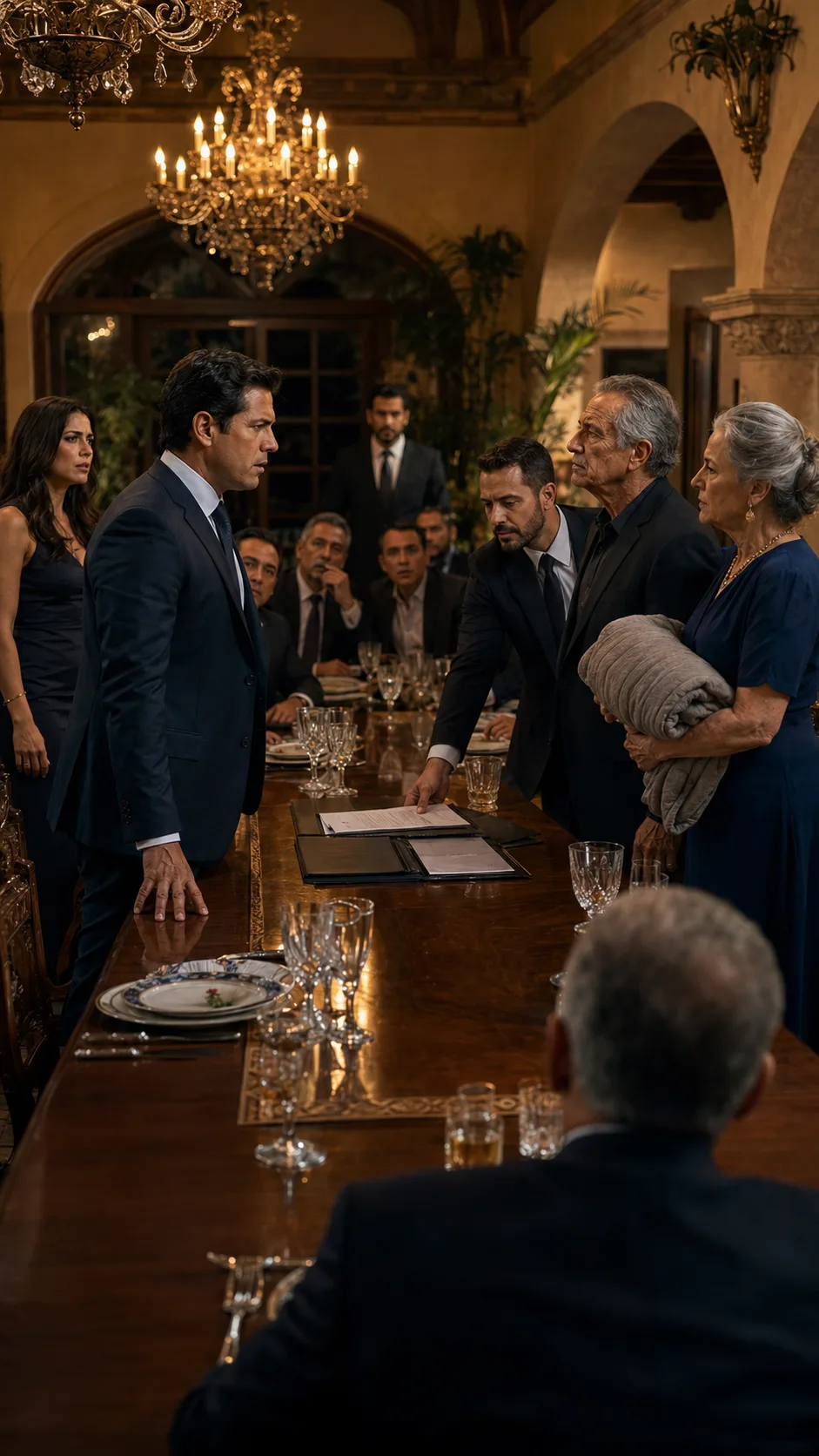
Three days later, Ricardo hosted the most important dinner of his career.
His mansion glowed under golden lights. Investors filled the dining hall. Crystal glasses shone on white tablecloths. Laura moved through the room like a queen, smiling, laughing, pretending two elderly people had never lived upstairs.
“To expansion,” one investor said, raising his glass.
Ricardo smiled. “To the future.”
Then the doorbell rang.
A maid opened the front door.
Conversation faded.
Don Ernesto and Doña Carmen stood at the entrance.
But they no longer looked defeated.
Ernesto wore a clean dark suit. Carmen wore a simple navy dress, her gray hair neatly pinned. Beside them stood a lawyer carrying a black folder.
Ricardo’s smile vanished.
Laura’s face tightened. “What are they doing here?”
Ricardo hurried toward them and lowered his voice.
“This is not the time.”
Ernesto looked past him at the investors.
“No, son,” he said. “This is exactly the time.”
The lawyer stepped forward.
“Good evening. I represent Don Ernesto and Doña Carmen Salgado regarding the estate of Mateo Salgado.”
Ricardo’s blood turned cold.
One investor frowned. “Mateo Salgado? The original owner of the Zapopan land?”
The lawyer opened the folder.
“Correct.”
Whispers moved through the room.
Ricardo forced a laugh. “There must be some confusion.”
“There is none,” the lawyer said.
Carmen looked at her son. Her eyes shone, but her voice did not shake.
“We found what was inside the comforter.”
Ricardo stared at her.
“The comforter?” Laura whispered.
Ernesto’s words landed in the room like a hammer.
“The old rag you threw at your mother.”
The lawyer placed documents on the dining table.
“Mateo Salgado’s will included a moral condition. If Ricardo Salgado abandoned or mistreated his parents, all inheritance rights would transfer to Ernesto and Carmen Salgado.”
Ricardo’s face drained.
“That’s impossible.”
The lawyer continued.
“The deeds Mr. Salgado has been using to secure several business expansions are not legally his.”
The investors turned toward Ricardo.
One of them stepped forward. “You used those lands as leverage?”
Ricardo backed away. “I didn’t know.”
Laura grabbed his arm. “Fix this.”
But there was nothing left to fix.
The lawyer’s next words broke the room open.
“We also have evidence that Mr. Ricardo Salgado presented disputed land titles in multiple investment negotiations.”
Whispers exploded.
Ricardo looked at his parents.
“Dad. Mom. Listen to me.”
Carmen stepped back.
For years, she had forgiven cold words, forgotten visits, and every insult Laura had wrapped in elegance.
But now there was something worse than anger in her eyes.
Disappointment.
“You left us in that house,” she said. “You threw my blanket like garbage. You did not even look back.”
Ricardo’s voice cracked. “I was under pressure.”
Ernesto shook his head.
“So were we, every day of our lives. But we never abandoned you.”
Laura stepped forward. “This is ridiculous. They’re old. They don’t understand business.”
Every eye turned to her.
Carmen looked at Laura calmly.
“No, hija. We understand perfectly. You thought poor people had nothing left to give.”
Laura’s face burned.
Ricardo reached for his father.
“Please. We can settle this privately.”
Ernesto pulled his hand away.
That small gesture broke Ricardo more than shouting ever could.
The investors left one by one. Some made calls before reaching the driveway. Others refused to shake Ricardo’s hand.
By midnight, the mansion felt empty.
By morning, the headlines began.
REAL ESTATE DIRECTOR ACCUSED OF USING DISPUTED FAMILY LAND IN INVESTMENT DEALS.
Contracts froze.
Banks called.
Partners vanished.
Laura packed two suitcases and left without saying goodbye.
Ricardo sat alone at the marble dining table, staring at untouched chilaquiles the cook had prepared for breakfast.
For the first time in years, the house did not smell of coffee.
A week later, Ricardo drove back to the adobe house near Tesistán.
He stepped out wearing the same navy suit, but now it looked wrinkled and heavy, almost borrowed. His face was unshaven. His eyes were red.
Carmen was sweeping the yard.
Ernesto was repairing the doorframe.
Neither looked surprised to see him.
Ricardo stood there for a long time.
Finally, he said, “I lost everything.”
Ernesto kept working.
“No. You lost money.”
Ricardo swallowed.
Carmen stopped sweeping.
“You lost us first,” she said.
Those words took the last of his pride.
Ricardo dropped to his knees in the dirt.
“I’m sorry,” he whispered. “For the house. For Laura. For the way I spoke. For the blanket. For everything.”
Carmen’s hands trembled around the broom.
A mother’s heart reaches toward forgiveness before the wound knows how to close. But pain has a memory of its own.
Ernesto looked at his son for a long time.
“You want forgiveness?”
Ricardo nodded.
“Then don’t ask for land. Don’t ask for money. Don’t ask us to save your name.”
“I won’t.”
Ernesto pointed toward the broken fence.
“Then start there.”
Ricardo looked up.
His father handed him a hammer.
“You always wanted an office,” Ernesto said. “Today, you’ll learn how to build a home.”
Ricardo took the hammer with shaking hands.
For the next several weeks, he returned every morning.
At first, neighbors stared.
The fallen millionaire in dusty clothes, carrying wood, mixing cement, repairing walls, fixing a fence under the hot sun.
His hands blistered.
His back ached.
He ate beans and tortillas at a small table with his parents.
Carmen did not hug him.
Not yet.
But every morning, she served him coffee.
And every morning, Ricardo drank it like medicine.
One afternoon, while fixing the roof, Ricardo saw his mother sitting under a tree, sewing the old gray comforter.
He climbed down slowly.
“You kept it,” he said.
Carmen ran her fingers over the worn fabric.
“Of course.”
“After what I did?”
She looked at him.
“This blanket protected you when you were a child. It protected us when you abandoned us. Some things are better than the people who misuse them.”
Ricardo lowered his eyes.
Then Carmen reached into her sewing basket and pulled out a photograph.
Ricardo took it.
It showed him as a little boy, asleep under the gray comforter, his head resting on Ernesto’s lap while Carmen smiled beside him.
On the back, written in Carmen’s handwriting, were four words.
Our greatest treasure.
Ricardo broke down.
Not like a rich man losing money.
Like a son finally understanding what he had thrown away.
Months passed.
The scandal destroyed Ricardo’s company, but the investigation later cleared him of criminal intent. He had been arrogant, careless, and reckless, but not legally fraudulent.
Still, his empire never recovered.
Ernesto and Carmen gained legal control of Mateo’s inheritance.
But they did not buy a mansion.
Instead, they restored the adobe house and turned the surrounding land into a small community carpentry school for poor young people.
They named it Casa Mateo.
Ricardo became its first instructor’s assistant.
He swept floors.
Sanded wood.
Delivered supplies.
And slowly, he began teaching young men what his father had tried to teach him long ago:
never measure a life only in profit.
One year later, at the opening ceremony of Casa Mateo, Carmen stood before the crowd holding the gray comforter folded in her arms.
Ricardo watched from the side, quiet and humble.
Ernesto stepped to the microphone.
“Many people think this school was built from money hidden in a blanket.”
The crowd laughed softly.
Ernesto smiled.
“But that is not the truth.”
Ricardo looked up.
Carmen unfolded the comforter and removed a second envelope from a seam no one had noticed.
Ricardo stopped breathing.
Ernesto opened it.
“This letter was written by Mateo before he died. We waited to reveal it until we knew what kind of man our son would become after losing everything.”
Ricardo stared at them.
Carmen began to read.
“The money in the comforter is not the true inheritance. The true inheritance is the test. Whoever chooses love after humiliation, humility after pride, and service after power shall receive the final gift.”
The crowd fell silent.
The lawyer stepped forward with another folder.
Ernesto looked at Ricardo.
“Mateo owned more than the Zapopan land.”
Ricardo’s lips parted.
“The largest part of his estate was never activated,” the lawyer said. “It was held in trust until this condition was fulfilled.”
Ricardo whispered, “What condition?”
Carmen’s eyes filled with tears.
“That you would come back,” she said. “Not for money. For us.”
The lawyer turned the document toward him.
The remaining estate was enormous.
Larger than everything Ricardo had lost.
But Ricardo did not reach for the papers.
He looked at his parents.
Then he looked at the school.
Then at the young students standing with dusty hands and hopeful eyes.
Slowly, he pushed the folder back.
“No,” he said.
The lawyer blinked. “Mr. Salgado?”
Ricardo took a breath.
“Put it all in the school’s name.”
Carmen covered her mouth.
Ernesto’s eyes shone.
Ricardo turned toward the crowd. His voice shook, but it did not break.
“I once thought inheritance meant land, money, and power. But my parents gave me something greater, and I threw it away.”
He looked at Carmen and Ernesto.
“Today, I don’t want to own this legacy. I want to serve it.”
For a moment, no one moved.
Then Don Ernesto walked forward and embraced his son.
Carmen joined them, holding both men as if trying to gather all the broken years into one embrace.
Ricardo wept against his father’s shoulder.
And beneath Carmen’s arm, the old gray comforter hung between them.
Not as a rag.
Not as shame.
Not as something forgotten.
But as the witness to everything.
The blanket Ricardo had thrown away had not destroyed him.
It had revealed him.
And in losing the fortune he worshiped, Ricardo Salgado finally found the one treasure he had never deserved…
but his parents had never stopped saving for him.
THE END.
Chapter complete
You have reached the end of this chapter.
Continue reading
A few more worlds to get lost in after this chapter.




