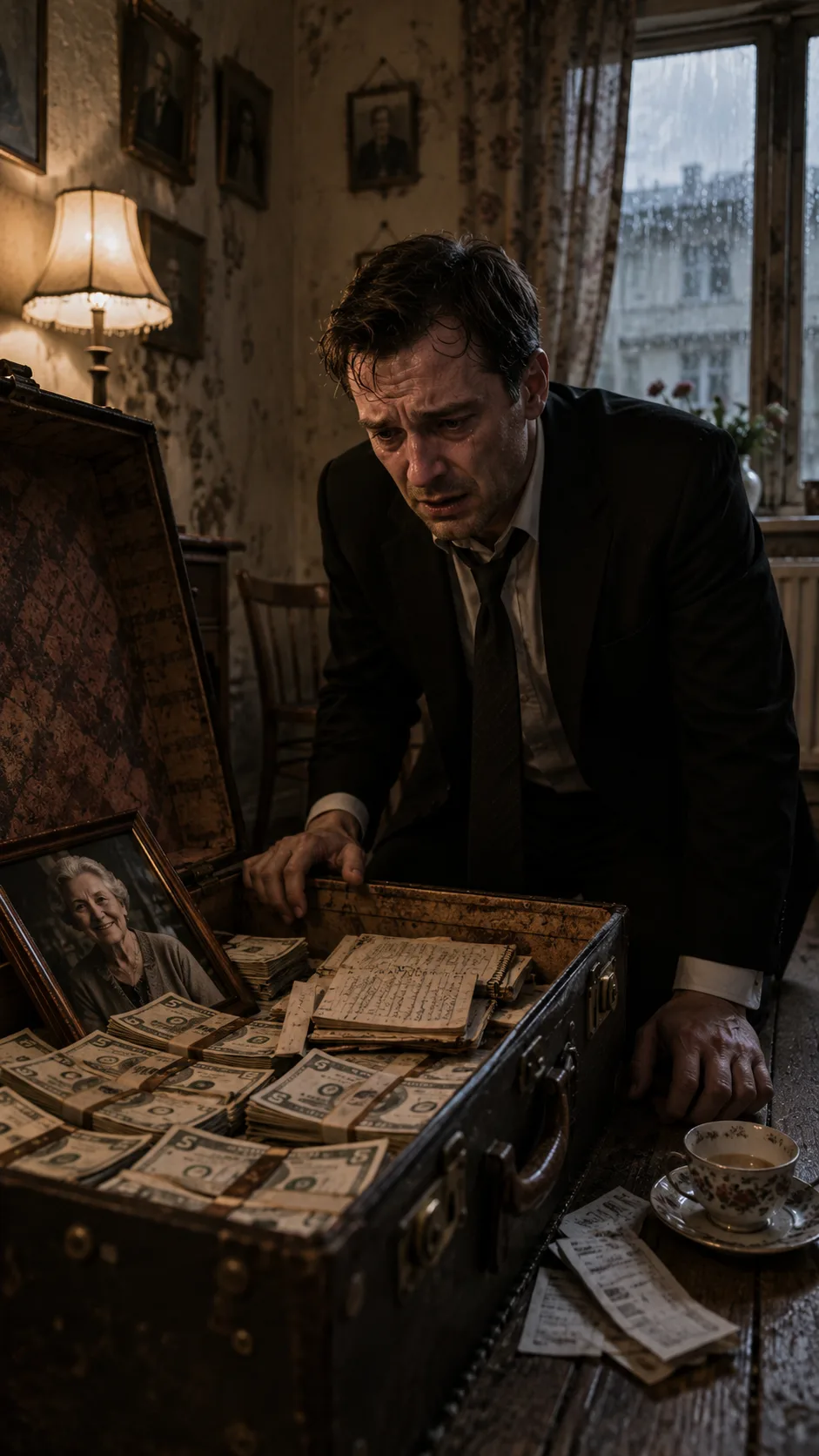
Daniel stared at the sentence until the words seemed to move.
Chapter 3
Daniel stared at the sentence until the words seemed to move.
“The money is not yours yet.”
His first reaction was confusion.
Then fear.
Then a shameful flash of anger.
Not yours yet?
After everything he had just felt, after the funeral, after the guilt split him open in his mother’s little bedroom, some ugly part of him still wanted the money to be simple. A final gift. A clean inheritance. Something he could carry away from the apartment and use to repair the life he had built on distance.
But Margaret Mercer had known her son better than he knew himself.
Daniel kept reading.
“My Danny,
If you found the trunk and counted the money before reading this, then you are still the boy who looks at the price before the person. I do not write that to hurt you. I write it because I loved you enough to tell the truth, even when you stopped wanting it from me.”
Daniel lowered his head.
Claire’s voice crackled through the phone, still connected.
“Daniel? Are you there? What does that mean, not yours yet?”
He did not answer.
He kept reading.
“I have left instructions with Mr. Callahan. You may receive this money under one condition. For thirty days, you must live in my apartment. No hotel. No house in the suburbs. No excuses. You must sleep in the bed where I waited for your calls. Eat at the table where I saved those bills. Read every notebook. And at the end of thirty days, you must decide what kind of man you are going to be.”
Claire snapped, “Absolutely not.”
Daniel looked at the phone.
“What?”
“You are not living in that apartment for thirty days. That is insane. Your mother is manipulating you from the grave.”
Daniel flinched.
Maybe yesterday he would have agreed.
Maybe yesterday he would have
laughed bitterly and called the lawyer to fight it.
But now he was surrounded by proof that his mother had spent a lifetime loving him in ways he had been too comfortable to see.
“She’s not manipulating me,” Daniel said quietly.
Claire scoffed. “Daniel, we have a mortgage. We have Sophie’s private school. We have real expenses. You’re going to risk two hundred thousand dollars because your mother wanted one last guilt trip?”
Mrs. Alvarez’s eyes narrowed.
Daniel’s voice dropped. “Don’t talk about her like that.”
Claire went silent.
He had never said that before.
Not when Claire mocked Margaret’s curtains.
Not when she called her apartment depressing.
Not when she rolled her eyes every time Margaret’s name appeared on his phone.
Daniel had always chosen peace at home over dignity for his mother.
And that peace had cost him more than he understood.
“I’ll call you later,” he said.
“Daniel—”
He ended the call.
The apartment fell quiet except for rain against the glass.
Mrs. Alvarez gave a small nod. “Good.”
Daniel laughed once, broken and bitter. “I don’t know if I did that for her or because I’m tired of hating myself.”
“Sometimes that is where change begins.”
The next morning, Daniel met Mr. Callahan, his mother’s attorney, in a small office above a bakery. The old man had kind eyes and a stack of documents prepared.
“Your mother was very clear,” he said.
“Thirty days,” Daniel replied.
“Thirty days. You may go to work, care for your daughter, handle responsibilities. But your primary residence must be Margaret’s apartment. At the end, you must submit one written statement.”
Daniel frowned. “A statement?”
Mr. Callahan slid a sealed envelope across the desk.
“She called it your final receipt.”
Daniel looked down.
“What am I supposed to write?”
“The truth,” the lawyer said. “About what the money is worth.”
So Daniel moved in.
Claire was furious.
She called him selfish. Dramatic. Immature. She said his mother had always known how to make him feel guilty. She said he was choosing a dead woman over his living family.
But Sophie asked if she could visit.
On the fourth day, Daniel picked his daughter up from school and brought her to Margaret’s apartment. Sophie stepped inside hesitantly, holding her backpack straps.
“It smells like Grandma,” she whispered.
Daniel looked around. “You remember?”
Sophie nodded. “Like cinnamon and soap.”
He had forgotten that smell.
Or maybe he had trained himself not to notice it.
They ate soup at the kitchen table from Margaret’s old bowls. Daniel opened the first notebook and read aloud. At first, he thought Sophie would get bored.
She did not.
She listened as if the pages were a treasure map.
“Five dollars, bus money saved, walked in snow.”
“Five dollars, birthday card money from Mrs. Alvarez.”
“Five dollars, skipped new glasses one more month.”
Sophie’s eyes filled. “Dad… Grandma did all that?”
Daniel nodded, unable to speak.
Sophie touched one page carefully. “For you?”
“For me.”
“And you didn’t know?”
Daniel looked at his daughter.
“No,” he said. “I didn’t want to know.”
That was the first honest thing he had said in years.
Over the next thirty days, Daniel read everything.
He found a receipt from the hospital when he broke his arm at nine.
A note about pawning her mother’s brooch to pay his SAT fees.
A grocery list where she crossed off chicken so she could buy him a winter coat.
He also found birthday cards he had mailed late.
Voicemails she had written down because she loved replaying his voice.
A calendar marked with the days he promised to visit.
Most boxes were empty.
Most Sundays were crossed out.
By the third week, Daniel stopped seeing the apartment as poor.
He saw discipline.
He saw loneliness.
He saw love with nowhere to go.
On the twenty-eighth day, Claire arrived without warning.
She stood in the doorway wearing a cream coat and irritation.
“This has gone far enough,” she said.
Sophie, sitting at the table with one of Margaret’s notebooks, looked up.
Claire’s eyes landed on the trunk.
“You need to finish this and come home.”
Daniel stood calmly. “I am home.”
Claire laughed. “This? This is not home. This is guilt with wallpaper.”
Sophie whispered, “Mom, don’t.”
Claire turned sharply. “You don’t understand adult things.”
“No,” Sophie said, her voice shaking. “I think I understand better than you.”
Daniel looked at his daughter, stunned.
Sophie held up a notebook. “Grandma saved five dollars from her own medicine so Dad could buy you flowers when you were dating.”
Claire froze.
Daniel turned to the page.
He remembered those flowers.
He had been twenty-four, broke, and desperate to impress Claire. Margaret had slipped him twenty dollars and said, “Buy something pretty. Love should feel celebrated.”
Claire looked away.
For one brief second, shame touched her face.
Then pride buried it.
“So what?” she said. “Are we supposed to worship her because she chose to suffer?”
Daniel’s answer came quietly.
“No. We’re supposed to stop benefiting from it without gratitude.”
Claire stared at him.
The marriage did not end that day.
But something false inside it did.
On the thirtieth morning, Daniel sat at Margaret’s table and wrote his statement.
He did not write about money.
He wrote about five-dollar bills as apologies.
Five-dollar bills as meals skipped.
Five-dollar bills as phone calls ignored.
Five-dollar bills as proof that poverty had never been his mother’s shame.
His shame was believing love had to look expensive before it deserved respect.
He sealed the statement and brought it to Mr. Callahan.
The lawyer read it silently. When he finished, his eyes were wet.
“Your mother said you would either become angry,” he said, “or become her son again.”
Daniel looked down. “I’m late.”
“Yes,” Mr. Callahan said gently. “But not too late for everything.”
The money was released one week later.
Daniel did not use it to upgrade his car.
He did not use it to impress Claire.
He placed half into a college fund for Sophie under Margaret’s name.
With the rest, he bought the apartment building before it could be sold to developers, repaired every unit, lowered Mrs. Alvarez’s rent to one dollar a month, and turned Margaret’s apartment into a small community room where neighbors could gather, eat, and not be alone.
On the wall, he hung her photograph.
Beneath it, he placed one framed five-dollar bill.
And under that, a small brass plaque:
“Start small. Love adds up.”
Months later, Daniel stood there with Sophie as rain tapped the same window.
Sophie slipped her hand into his.
“Dad?”
“Yeah?”
“Do you think Grandma knows?”
Daniel looked at the photo of Margaret smiling in her worn cardigan.
For years, he had mistaken that smile for weakness.
Now he understood.
It had been strength.
The kind that survives being overlooked.
The kind that keeps saving anyway.
The kind that leaves behind not just money, but a mirror.
Daniel wiped his eyes and whispered, “I think she always knew.”
Then he took one five-dollar bill from his wallet, folded it gently, and placed it beside the frame.
Not because he needed to save it.
But because, for the first time in his life, he finally understood what it was worth.
THE END
Chapter complete
You have reached the end of this chapter.
Continue reading
A few more worlds to get lost in after this chapter.




