He Thought He Was Coming Home to Silence.
Chapter 1
He Thought He Was Coming Home to Silence. Instead, He Walked Into the One Night That Would Change His Life Forever
5,690 words
Instead, He Walked Into the One Night That Would Change His Life Forever
Nathaniel Hawthorne signed the last contract at 11:47 p.m. without reading the final page.
The lawyer across from him said something about quarterly returns, market confidence, and a board vote scheduled for Monday morning. Nathaniel nodded when the room seemed to expect it. His pen moved. His name appeared where it was supposed to appear. The deal closed.
People smiled.
Nathaniel did not.
He stood from the glass conference table, buttoned his coat, and walked out before anyone could offer another careful sentence about how impressive his discipline had been.
Discipline.
That was what they called it when a man kept working after his wife died.
They did not call it running.
They did not call it cowardice.
They did not call it leaving two three-month-old sons inside a house with more staff than warmth.
Outside, snow
had begun covering Boston in thick white silence. His driver waited beside the black car, shoulders hunched against the wind, cap dusted with flakes. Nathaniel climbed into the back seat and closed the door before the man finished greeting him.
The city slid past in smears of amber light and dark glass. Nathaniel leaned his head against the leather seat and closed his eyes.
He saw Caroline’s hands.
That always happened when he was tired enough to stop defending himself. Not her face first. Not her voice. Her hands. Pale fingers with a tiny scar near the thumb from the day she had tried to assemble a crib herself because she hated waiting for anyone to do things for her. She had painted silver stars across the nursery wall while seven months pregnant, barefoot on a ladder, laughing when Nathaniel threatened to call three doctors and a structural engineer.
“You
are not serious people,” she had said, touching the wet brush to his nose.
That was before the blood.
Before the operating room doors.
Before one nurse came out holding a clipboard with both hands and another carried two babies wrapped in hospital blankets, both crying as if they knew the world had already taken something from them.
Oliver and Samuel.
His sons.
Nathaniel had held one of them for less than a minute that night. He could no longer remember which. The baby had been warm, furious, red-faced, alive. Nathaniel had stared down and waited for the thing everyone promised him would come.
Instant love.
Recognition.
A father’s instinct.
Nothing came cleanly. There was only noise. Light. A nurse asking if he needed to sit. Caroline gone behind a door he was not allowed to open.
After the funeral, he made arrangements. He hired nurses. He hired specialists. He
ordered the safest cribs, the best monitors, the most expensive formula, the private pediatrician with a waiting list full of politicians’ grandchildren.
Then he left for New York.
Then London.
Then Singapore.
Then anywhere else.
The Hawthorne estate had become a place he returned to only when exhaustion caught him. He slept there. Showered there. Changed clothes there. Signed checks there. He did not live there.
He told himself the babies were cared for.
He paid enough for that to be true.
The car turned through the iron gates at 2:18 a.m.
Nathaniel opened his eyes.
The mansion stood at the end of the long drive, white columns rising through the snow, upper windows black, lower windows faintly gold. It looked preserved. Untouched. A house from a magazine cover. A house other men would have been proud to own.
He hated it.
The driver stopped beneath the portico and came around with an umbrella. Nathaniel stepped out before it opened, snow landing in his hair, melting against his collar. He crossed the stone steps and entered through the front door with his key instead of ringing.
The entrance hall was dark except for one lamp burning on the console table. The grandfather clock ticked at the far wall, each sound crisp in the cold.
Cold.
Nathaniel paused with one glove halfway off.
The house was always cool in winter; Caroline had liked thick sweaters and fires more than central heating. But this was wrong. The marble under his shoes seemed to hold the temperature of the snow outside. The air felt thin. Still.
He looked toward the east wing corridor.
No footsteps.
No murmur from the nursery monitors.
No low hum of the heating vents.
“Mrs. Greene?”
His voice moved through the entrance hall and disappeared.
No answer.
Nathaniel removed his coat slowly. The silence grew around him.
Then something broke it.
A small sound.
Not a full cry. Not yet. A weak, uneven whimper, so faint that it could have been the wind pressing against the windows.
Nathaniel turned.
It came from the living room.
He walked faster than he meant to. His shoes struck the marble, then the hardwood, then the edge of the rug. The living room door stood open. The fire in the hearth had burned down to a few low orange coals.
On the rug near the fireplace, a young woman lay curled on her side.
For one second, Nathaniel could not place what he was seeing.
A gray uniform.
Dark hair loose against the floor.
One arm curved protectively around a baby.
Another baby tucked beneath her chin.
The twins were wrapped against her body, both under a thin blanket that looked as if it belonged on a chair, not on the floor in the middle of a freezing room. One infant’s fist was caught in the fabric of her sleeve. The other’s face was flushed, mouth open, breath coming in tiny rasps.
Nathaniel stopped breathing.
Then he dropped to his knees.
“Hey.”
The woman did not move.
“Hey.”
His voice cracked against the room.
Her eyelids fluttered. She opened her eyes with effort, brown irises clouded by exhaustion. For half a second she looked at him without understanding where she was. Then awareness struck. She tried to push herself upright, one hand immediately tightening around the baby closest to her.
“Sir.” Her voice scraped out small. “I’m sorry.”
Nathaniel stared at her.
Sorry.
The word had no place in that room.
The flushed baby cried, louder this time, a raw sound from a throat too small to carry it.
Nathaniel reached for him. “What happened?”
“The nursery heat failed.” She swallowed, and the movement seemed to hurt. “I told maintenance after lunch. It was making a sound. By evening it was freezing.”
“Where is the nurse?”
The woman’s eyes moved toward the hallway.
Nathaniel understood before she answered.
“She left early,” the woman said. “She said the second nurse was coming. No one came.”
His jaw locked.
“Mrs. Greene?”
“I called downstairs twice.” Her hand trembled as she adjusted the blanket around the second baby. “The line rang. Then stopped working. I tried carrying them to the staff wing, but Oliver was hot and Samuel wouldn’t settle, so I brought them here. The fire was still alive then.”
“You stayed all night?”
“I walked first.” Her gaze dropped to the child against her chest. “Around the room. Around the hall. I don’t know how long.”
The baby coughed.
Nathaniel’s body moved before his mind caught up. He lifted the feverish child, small and impossibly light against his dress shirt. Heat radiated from the baby’s forehead. Too much.
“Doctor,” he said.
His phone was in his hand before he remembered pulling it out.
The first call went to the estate physician. The second to the pediatrician. The third to the driver. The fourth to Mrs. Greene, whose panicked voice answered on the fifth ring and died as soon as Nathaniel spoke.
“Get every staff member awake. Now.”
The living room came alive in pieces. Lights snapped on down the hall. Doors opened. Feet moved above them. Someone gasped from the threshold and then thought better of making noise.
Through all of it, the woman on the floor tried to stand with Samuel in her arms.
She failed on the first attempt.
Nathaniel turned. “Stay down.”
“I can carry him.”
“You can’t.”
“He doesn’t like strangers.”
The words hit harder than the cold.
Nathaniel looked down at Oliver in his arms, then at Samuel pressed to the young woman’s chest. He did not know that about his own son.
She did.
“What’s your name?” he asked.
She blinked, as if the question had arrived from another room.
“Eliza Moore.”
“How long have you been caring for them?”
“I clean the east wing.”
“That is not what I asked.”
Eliza’s fingers tightened on the blanket.
“When the nurses were busy, I stayed sometimes. If they cried.”
“How long?”
“A few weeks.”
A few weeks.
Nathaniel repeated it inside his head and found no shape for it. He owned the house. He paid the staff. He signed the checks. Yet somewhere inside his own walls, his sons had been fed, soothed, held, and protected by a woman whose name he had not known until that night.
The doctor arrived twenty-one minutes later in a coat thrown over pajamas, leather bag in hand, hair still marked by sleep. He examined Oliver first while Nathaniel stood near the fireplace with his arms crossed tight enough to hurt.
“High fever,” the doctor said. “Respiratory symptoms starting. We caught it early.”
Caught.
Nathaniel looked at Eliza.
She sat on the edge of the rug now, Samuel against her shoulder, her face too pale under the warm light. When the doctor moved toward her, she tried to wave him away.
“I’m fine.”
The doctor placed two fingers at her wrist and looked at Nathaniel.
“She is not.”
Eliza lowered her eyes.
“When did you last eat properly?” the doctor asked.
She opened her mouth.
No answer came.
The doctor’s expression sharpened.
Nathaniel turned toward the doorway where Mrs. Greene stood, robe belted tight, face drained. Behind her hovered two junior housemaids, the night cook, and a maintenance man who would not meet anyone’s eyes.
Nathaniel spoke without raising his voice.
“Who received the maintenance request?”
The maintenance man shifted.
No one else moved.
“I asked a question.”
Mrs. Greene clasped her hands. “Sir, I believe a note was made.”
“A note.”
“Yes, sir.”
“A note does not warm a room.”
The grandfather clock struck three somewhere beyond the hall.
The sound seemed obscene.
By dawn, the nursery heat had been restored. Oliver’s fever had come down a little. Samuel slept in the crib with both fists near his cheeks. The nurses who should have been there were no longer employed. Two supervisors were ordered to remain available for a formal review. Mrs. Greene cried once in the pantry and returned with a tray of coffee nobody drank.
Eliza was moved to the blue guest room because the doctor insisted she needed rest.
She tried to refuse.
Nathaniel did not let her.
At nine that morning, the entire household staff gathered in the dining hall.
The room had been designed for charity breakfasts, diplomatic dinners, and Christmas photographs. Sunlight came in weakly through tall windows. Snow clung to the ledges outside. Twenty-three staff members stood around the long table, their faces arranged into careful neutrality.
Nathaniel stood at the head.
He had not slept.
That helped.
“The heating in the nursery failed yesterday,” he said. “One of my sons developed a fever. Both of them were left without proper care.”
A spoon shifted somewhere near the sideboard.
Nathaniel looked toward the sound, and it stopped.
“A member of this staff spent the night on the floor keeping those children warm because no one else did their job.”
No one looked at Eliza’s empty chair.
No one needed to.
“I want every maintenance report from the last thirty days. Every staffing schedule. Every early departure. Every ignored call. On my desk by noon.”
Mrs. Greene nodded.
“Anyone who neglected those children leaves today.”
The words sat in the room with the force of a locked gate.
Then Nathaniel added, “Send breakfast to Room Seven.”
Mrs. Greene looked up. “Sir?”
“To Eliza Moore.”
“Yes, sir.”
“Real breakfast. Not toast. And flowers.”
The staff stared at him.
Nathaniel stared back until they remembered where they were.
Later, he took the tray himself.
He did not know why until he was already outside the guest room door, holding eggs, tea, fruit, toast, and a small vase of white tulips. It occurred to him that he had carried fewer meals to his wife than to business partners in conference rooms.
He knocked.
Eliza answered after a long pause. “Come in.”
She was sitting against the headboard, hair brushed but not tied, uniform folded on the chair. Someone had given her a plain robe. She wore it like it belonged to another class of person and might be taken back if she moved wrong.
When she saw him, she tried to stand.
“No.”
She froze halfway.
Nathaniel stepped in and set the tray on the table.
“I can work this afternoon,” she said.
“You cannot.”
“I don’t want anyone to think I’m using—”
“Eliza.”
Her mouth closed.
“You will rest today. And tomorrow. You will be paid for both.”
Her gaze lifted.
“Paid?”
“Yes.”
“For not working?”
“For work already done.”
She looked toward the window.
The tulips leaned slightly in their vase.
Nathaniel placed both hands behind his back because he did not know what to do with them.
“You saved my children.”
Eliza’s chin tightened.
“I just didn’t want them left alone.”
That sentence stayed with him.
It followed him down the hallway. Into the nursery. Through the next week, when Oliver’s fever broke and Samuel began sleeping longer than two hours at a time. Through the staff restructuring and the new care schedule and the system of reports that now came directly to him.
He stayed home.
At first, the house did not know what to do with him.
The cook nearly dropped a pan when Nathaniel entered the kitchen at 6:30 a.m. holding Samuel and asking how to warm a bottle. Mrs. Greene stood frozen in the nursery doorway the first time he changed Oliver’s clothes himself. One of the junior maids pretended not to notice when he put a diaper on backward and muttered a word Caroline would have laughed at.
He learned.
Badly at first.
Then better.
He learned Oliver stretched one leg before crying. He learned Samuel’s lower lip trembled before a full wail. He learned that both boys preferred being carried near the windows in the late afternoon, when pale winter light came through the nursery curtains. He learned that a baby could look at him with Caroline’s eyes and not accuse him of anything.
Eliza recovered slowly.
She did not accept rest well. She apologized to doctors, thanked maids for water, made her bed before breakfast, and tried twice to return to cleaning before Nathaniel caught her carrying folded linens near the east wing.
“You are impossible,” he said.
She shifted the linens against her hip. “I’m useful.”
“You are feverish.”
“Less than before.”
“That is not a standard.”
“It is in my life.”
He had no answer.
She knew how to do that. End a conversation with the truth sitting plainly between them.
By the third week, Eliza was officially assigned to the nursery staff, with higher pay and fewer hours than she had worked before. She argued about both changes. Nathaniel signed the revised contract anyway.
The boys accepted the arrangement without debate.
Oliver reached for her whenever she entered. Samuel followed her voice with his whole body. If she hummed, both babies quieted as if the sound had been written into them before birth.
Nathaniel noticed the song first on a Thursday evening.
He stood in the nursery doorway with a bottle in one hand, watching Eliza rock Oliver beside the painted stars. The room glowed with low lamplight. A small sock lay abandoned near the rocking chair. Samuel slept with one hand open above his head.
Eliza hummed under her breath.
The melody was old. Simple. Uneven in a way that made it feel remembered rather than performed.
“What song is that?”
She turned her head slightly. “My grandmother used to sing it.”
“Do you know the name?”
“No. In my family, songs usually came without names.”
Nathaniel stepped inside.
Oliver slept against her shoulder, face turned toward her collarbone. Eliza’s hand moved over his back in small circles. Not for display. Not because anyone was watching. Because the child was there.
“Why did you stay that night?” Nathaniel asked.
Her hand paused.
“The others left.”
She looked down at Oliver.
For a while, the only sound was Samuel’s breathing and the heating vent working properly above them.
“Because being needed is dangerous,” she said. “Once you feel it, you can’t pretend you don’t.”
Nathaniel leaned against the crib rail.
“I don’t know how to be their father.”
Eliza looked at him then. Not with pity. That would have been easier to reject.
“You came back to the room,” she said.
“That is not enough.”
“No. But it is where most people fail to start.”
He looked at the silver stars on the wall.
Caroline had painted one crooked near the corner. She had insisted it was the best one.
“I failed them.”
Eliza adjusted Oliver’s blanket.
“They were cold,” she said. “Now they aren’t.”
That was all.
No absolution.
No speech.
No cruelty either.
Nathaniel found, over the next several weeks, that he preferred Eliza’s plainness to everyone else’s careful kindness. People treated grief like a glass object he might drop. Eliza treated it like weather. Present. Difficult. Not the only thing in the room.
Three months after the night by the fireplace, the hospital letter arrived.
It came on a Friday afternoon between a tax notice and an invitation to a charity gala Caroline used to attend. The envelope was cream-colored, formal, marked with the seal of St. Bartholomew’s Private Hospital.
Nathaniel almost set it aside.
Then he saw the handwritten note beneath the printed address.
Confidential.
He opened it standing at his study desk.
The first page was brief.
A retiring hospital administrator had found archived maternity records connected to the emergency blackout that occurred on the night Caroline Hawthorne delivered her twins. The administrator believed there had been an irregularity. He apologized for the delay. He advised immediate legal counsel. He enclosed copies.
Nathaniel read the word irregularity three times.
Then he turned the page.
There were logs. Timelines. Delivery room notes. A blackout at 9:42 p.m. Backup generator failure in the maternity wing for eleven minutes. Two emergency cesarean deliveries within the same hour. Two mothers lost. Two sets of male twins removed from adjacent recovery rooms during evacuation protocol.
Nathaniel’s fingers went cold.
He kept reading.
The copies were clinical, precise, brutal in their neatness. Baby A. Baby B. Bracelet numbers. Temporary identification tags. Nurse initials. Correction notes never finalized. One family told the infants survived. Another family told the infants did not.
At the bottom of the third page was a name.
Anna Moore.
Nathaniel sat down.
The room seemed to hold its breath around him.
Moore.
Eliza Moore.
He did not call her immediately.
For one hour, he did what men like him did when the world offered something unbearable. He called lawyers. He requested verification. He demanded original records. He spoke to the retired administrator, then to the hospital director, then to a private investigator whose number had been in his phone since an acquisition scandal five years earlier.
By evening, denial had nothing left to stand on.
The records were real.
The hospital had made a mistake during the blackout.
Oliver and Samuel were not biologically his sons.
Somewhere, perhaps nowhere now, Caroline’s biological children had been marked dead in another file. Or lost. Or adopted under names Nathaniel did not yet know. The truth had been buried beneath grief, money, incompetence, and institutional fear.
But the boys upstairs—the boys Eliza had warmed with her own body, the boys who turned toward her song—were the children of Anna Moore.
Eliza’s sister.
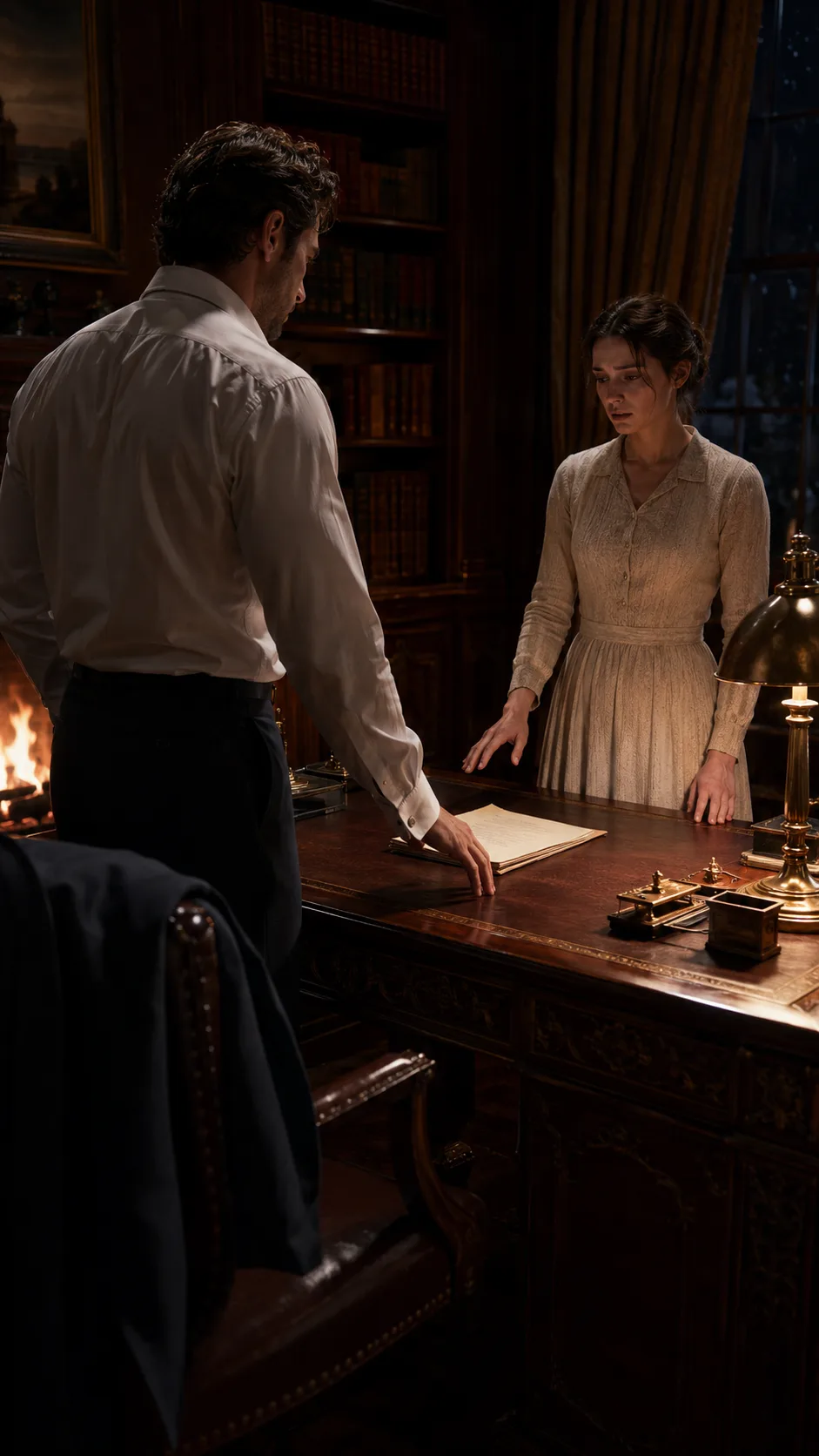
Nathaniel sat in the library after dinner with the folder closed in front of him.
He had chosen the library because it was the room farthest from the nursery and still he could hear them in his mind. Oliver’s cough. Samuel’s cry. The soft thud of Eliza’s steps in the hallway when she checked on them.
The fire burned low.
The brass lamp cast a circle of gold over the desk.
At 8:17 p.m., he sent Mrs. Greene to ask Eliza to come downstairs.
Not summon.
Ask.
Eliza entered a few minutes later, wiping her hands on the side of her dress. She had changed out of uniform into a cream knit dress Mrs. Greene had bought without admitting it was charity. Her hair was tied loosely at the back of her neck.
She stopped when she saw his face.
“Are the boys all right?”
Nathaniel stood behind the desk.
“Yes.”
The answer did not relax her.
“What happened?”
He looked at the folder.
Her eyes followed.
“Eliza, sit down.”
She did not.
“What happened?”
He touched the edge of the folder and pushed it across the desk.
The paper slid over polished wood, quiet and final.
She looked at it but did not reach.
“What is this?”
“Hospital records.”
“For the boys?”
“For the night they were born.”
Her shoulders changed. Barely. Enough.
Nathaniel’s hand remained on the desk after releasing the folder.
“Read the mother’s name.”
Eliza stared at him.
Then she reached down.
The folder opened with a soft crack of paper.
Her eyes moved across the first page. Slowly at first, then faster. She turned a sheet. Her brows drew together. She turned another.
Nathaniel watched her hands.
They were steady until they weren’t.
Her right thumb stopped beside the printed line.
Mother: Anna Moore.
For several seconds, Eliza did not move.
The fire shifted in the hearth. A coal fell. Somewhere upstairs, a floorboard creaked.
Eliza read the name again.
Her mouth opened, but no sound came.
Nathaniel waited.
He owed her that much.
“My sister died that night,” Eliza said at last.
“I know.”
“They told me her babies died.”
“I know.”
She looked up.
The folder shook once in her hands.
“No.”
Nathaniel said nothing.
Eliza looked back down. Her finger moved over the page, not touching the ink, tracing the awful path of facts she had never been allowed to know. Emergency blackout. Infant transfer. Temporary tags. Unconfirmed status. Hawthorne recovery suite. Moore recovery suite.
“No.”
This time the word had less sound in it.
Nathaniel came around the desk, then stopped before he reached her. Too close would be wrong. Too far felt worse.
“Eliza.”
She pressed the papers flat with both palms, as if the desk might move beneath them.
“Anna held them?” she asked.
“The record says both infants were placed with her briefly after delivery.”
Eliza closed her eyes.
Nathaniel saw her lips move once. A name, maybe. Or a prayer. Or nothing.
“She never knew they lived,” Eliza said.
“The hospital says the blackout caused confusion.”
Eliza let out a sound that had no shape.
“Confusion.”
Nathaniel looked toward the shelves. Leather-bound books. First editions. Awards. Objects collected by generations of Hawthorne men who believed importance could be arranged on walls.
The folder on the desk made all of it look cheap.
“My wife died that night too,” he said.
Eliza’s eyes opened.
“They gave the boys to me after Caroline was gone. I did not question it. I should have.”
“You were burying your wife.”
“That does not make them mine.”
Eliza looked at him then, and the room changed.
Not because she hated him.
That might have been easier.
She looked at him as a woman standing between two graves and two cribs, trying to understand how the same children could be lost and found in the same breath.
Upstairs, a baby cried.
Both of them turned toward the ceiling.
The sound came again. Small. Demanding. Alive.
Eliza’s hand went to her mouth.
Nathaniel stepped back.
“Go,” he said.
She did not move.
“Eliza. Go to them.”
Her fingers closed around the folder. “I can’t—”
“Yes.”
“I don’t know what I am now.”
The cry sharpened.
Nathaniel’s voice lowered.
“You are the person they already reach for.”
Eliza stood very still.
Then she left the library.
Not fast. Not dramatically. She walked with the folder held against her chest, one hand flat over Anna’s name, the other gripping the banister when she reached the stairs.
Nathaniel followed at a distance.
At the nursery door, Eliza stopped.
Inside, Oliver was awake, face red, fists moving. Samuel slept through the noise with his mouth open, one leg outside the blanket.
Eliza stepped to the crib.
Oliver stopped crying before she picked him up.
That was the worst and best of it.
She lifted him with both hands and drew him against her. The baby rooted blindly against her shoulder, then settled. His tiny fingers caught the knit fabric of her dress.
Eliza looked down at him.
Nathaniel stayed in the doorway.
For the first time since Caroline’s death, he understood that love had been moving through the house without his permission, without his knowledge, without his name attached to it.
It had slept on the floor.
It had reported broken heat.
It had hummed nameless songs.
It had known which child disliked strangers.
The legal storm began the next morning.
Hospitals fear lawsuits more than ghosts, and St. Bartholomew’s had both. Nathaniel’s lawyers arrived before breakfast. The administrator who wrote the letter agreed to a sworn statement. The hospital director used the word tragedy six times in one call until Nathaniel told him to stop speaking.
Records were opened.
Old staff were contacted.
Names surfaced.
The search for Caroline’s biological children began.
That part did not resolve quickly. Life rarely offers symmetry on command. The other twins had been transferred after the initial error into emergency foster care under sealed procedures, then moved again when the hospital’s record correction failed. One trail led to a closed agency. Another to a family in Vermont. Another to paperwork missing signatures that should have existed.
Nathaniel threw money at the search.
For once, money was useful but not enough.
Eliza did not ask what would happen to Oliver and Samuel.
Not directly.
She moved through the nursery with a new restraint, as if touching them too freely might make fate notice and take them away. She still fed them. Still changed them. Still hummed. But sometimes Nathaniel found her standing beside the crib with her hands clasped behind her back, looking at the boys like a person at a museum display of something sacred and forbidden.
One afternoon, he found her folding their blankets with unnecessary precision.
“Eliza.”
She did not look up. “Yes?”
“You are not going to be removed from their lives.”
Her hands stopped.
“I don’t know what the law says.”
“I have lawyers for that.”
“The law doesn’t always care who stayed up at night.”
“No,” Nathaniel said. “But I do.”
She looked at him then.
He took a document from the chair beside him and placed it on the changing table.
“What is that?”
“A temporary guardianship petition. It names you as a biological relative with immediate caregiving rights, pending full proceedings.”
Her face did not change quickly.
She read the top page. Then the second. Her finger paused on her own name.
“You did this?”
“Yes.”
“Why?”
Nathaniel looked at Oliver sleeping in the crib closest to the window.
“Because I tried once to let paid systems love them for me.”
Eliza lowered the page.
“I won’t do that again.”
For a while, neither spoke.
Samuel made a soft sound in his sleep, almost a sigh.
Eliza folded the document carefully and held it against her waist.
“Thank you,” she said.
The words were too small for the room, but they were all she had.
Weeks became months.
The world outside learned pieces, never the whole. A hospital scandal. A sealed lawsuit. A billionaire widower involved in a maternity ward mix-up. Reporters came to the gates twice and left after Nathaniel threatened litigation through three separate firms.
Inside the house, life became smaller and more exact.
Oliver learned to laugh first, a sudden startled noise that made Eliza drop a spoon into a bowl of mashed pear. Samuel learned to roll over and immediately hated where he had put himself. Nathaniel learned that babies could become people in increments so tiny a careless man would miss them.
He was less careless now.
Not perfect.
Some mornings he still stood outside the nursery door before entering, fighting the old instinct to turn away from whatever might need him. Some nights he still dreamed of Caroline asking where her children were, and woke with his hand clenched around the bedsheet.
He kept searching.
For Caroline’s biological sons.
For the truth.
For a way to stand inside two kinds of fatherhood without stealing either.
Eliza remained at the estate, no longer as a housekeeper. The staff had no clear title for her. Relative. Guardian. Caregiver. Family, though no one said it too loudly at first.
Mrs. Greene began setting a place for her at breakfast.
Nathaniel noticed Eliza skipping it twice and then started bringing one baby to the dining room himself at 8:00 a.m., because Eliza would follow the child even when she would not follow an invitation.
“You are manipulating me,” she said the third morning.
“Yes.”
“With an infant.”
“It works.”
Samuel slapped his hand into Nathaniel’s oatmeal.
Eliza looked at the mess.
Then she laughed.
It was not a large sound. It did not fix anything. But it made the cook turn from the stove and Mrs. Greene stop pretending to polish a spoon.
The house heard it.
Late spring came.
Snow melted from the long drive. The nursery windows opened for the first time. Fresh air moved through Caroline’s silver stars and lifted the curtains.
On the anniversary of Anna Moore’s death, Eliza asked Nathaniel to drive her to the small cemetery where her sister was buried.
He did.
They brought the boys.
No reporters. No staff. No black car with a driver. Nathaniel drove himself, badly enough that Eliza gripped the door handle twice and said nothing.
Anna’s grave stood beneath an old maple tree. The stone was modest. Her name, dates, and one line: Beloved daughter and sister.
Eliza stood before it with Oliver in her arms.
Nathaniel held Samuel a few steps back.
For a long time, no one spoke.
Then Eliza crouched and placed two small blue knitted socks on the grass in front of the headstone.
“They’re yours,” she said.
Oliver grabbed at her hair.
Eliza laughed once and caught his hand.
“They’re loud,” she added.
Nathaniel looked away.
Samuel pressed his warm face into Nathaniel’s neck.
After they returned home, Nathaniel went alone to the nursery.
The room was empty for once. Two cribs. Two blankets. A wooden rabbit on the floor. One crooked silver star near the corner, still the best one because Caroline had said so.
He stood beneath it and touched the crib rail.
He had spent months afraid that the truth would take the boys from him. That biology would arrive like a judge, point to the door, and name him fraud.
But the truth had done something stranger.
It had made the room larger.
Caroline was there. Anna was there. Eliza was there. The children he had lost before knowing them were somewhere beyond the walls, still being searched for, still unnamed in his mouth but not forgotten. Oliver and Samuel were in the garden with Eliza, alive under a bright sky, loved by more than one grief and more than one claim.
Nathaniel heard a sound from outside.
Eliza’s humming.
The old song without a name.
He crossed to the window and looked down.
Eliza sat on a blanket beneath the budding trees, one baby on either side of her. Oliver had a fistful of grass. Samuel was attempting to eat the corner of a cloth book. Eliza lifted it away from his mouth, said something Nathaniel could not hear, and smiled down at him.
The house behind Nathaniel was quiet.
Not empty.
Quiet.
He went downstairs.
At the back door, he paused for the length of one breath. Old habit. Old fear.
Then Oliver saw him through the glass and kicked both legs.
Samuel turned at Eliza’s voice.
Nathaniel opened the door and stepped outside.
The air smelled of wet earth and cut grass. Somewhere near the garden wall, a groundskeeper’s radio played a baseball game too softly to follow. Eliza looked up as he approached.
“They missed lunch by ten minutes,” she said.
“I know.”
“You’re late.”
“I know.”
She handed him Samuel.
The baby came easily, warm and solid, one hand landing against Nathaniel’s collar.
Eliza watched him adjust the child against his shoulder.
“You hold him better now.”
Nathaniel looked down at Samuel’s dark lashes, then at Oliver tugging grass from the ground with great purpose.
“I had good instruction.”
Eliza did not answer.
She reached for Oliver before he succeeded in putting dirt in his mouth.
Nathaniel sat beside them on the blanket, trousers creasing, sleeve catching on a twig. He did not care. The mansion rose behind them, vast and white and less frightening in daylight.
Above the nursery windows, Caroline’s painted stars waited unseen.
Under the maple trees, Anna’s sons breathed spring air.
No court order had settled the future yet. No hospital apology could return the dead. No amount of money could untangle every record or heal every night that should have been different.
But Samuel’s hand was wrapped around Nathaniel’s finger.
Oliver was leaning against Eliza’s knee.
And for once, no one in the garden was pretending not to need anyone.
Nathaniel looked at the children.
Then at Eliza.
Then back at the house he had once mistaken for a tomb.
It was not silent anymore.
THE END.
Chapter complete
You have reached the end of this chapter.
Continue reading
Find your next story
A few more worlds to get lost in after this chapter.




