“You’ll learn.”
Vivian Harrington said those words to me so many times over the next four years that they stopped sounding like advice and started sounding like a leash.
Chapter 2
“You’ll learn.”
Vivian Harrington said those words to me so many times over the next four years that they stopped sounding like advice and started sounding like a leash.
I heard them when I chose the wrong wineglass at a charity dinner.
When I wore silver earrings to an event where Vivian thought pearls were “more appropriate.”
When I laughed too loudly at Graham’s birthday lunch.
When I suggested changing the seating chart for a foundation gala because one donor had recently divorced another donor’s sister.
Vivian smiled each time.
Soft.
Elegant.
Merciless.
“You’ll learn, dear.”
And every time, Adil squeezed my hand under the table.
Never to defend me.
Only to remind me not to embarrass him.
By the time Mother’s Day came around that year, I had learned plenty.
I had learned that in the Harrington family, cruelty sounded better when spoken quietly.
I had learned that money did not make people generous. Sometimes it only gave them better lighting for their selfishness.
I had learned that Adil loved me most when I made him look kind,
successful, and patient.
And I had learned that my mother had been right from the beginning.
“Do not shrink to fit inside someone else’s family,” she had told me the week before my wedding.
I had laughed then.
I was young enough to mistake warning for fear.
Now I stood in the Harrington Grand Ballroom wearing a pale blue evening gown Vivian had not approved of, smiling beneath two thousand white orchids while six hundred guests raised champagne glasses to motherhood, legacy, and family values.
Family values.
That phrase nearly made me laugh into my water.
The Harrington Mother’s Day Gala was not a party.
It was a performance.
Every year, Vivian hosted it to benefit the Harrington Women’s Arts Fund, which sounded noble until you noticed every woman honored by the fund looked exactly like the women Vivian invited to lunch. Polished. Rich. Useful. Safe.
This year was bigger
than usual because Harrington Development Group was trying to close a three-hundred-million-dollar waterfront redevelopment deal. Politicians came. Donors came. Reporters came. Every person who mattered in Seattle business society seemed to be standing beneath the chandeliers, pretending not to calculate who was worth approaching first.
I stood beside Adil near the head table, holding a smile so long my jaw ached.
Vivian stood on his other side, radiant in silver silk.
She looked like a queen.
And like most queens, she believed the room existed because she had entered it.
A photographer lifted his camera.
“Mrs. Harrington, Mr. Harrington, Leila, closer together please.”
I stepped closer to Adil.
Vivian’s hand touched my elbow.
Not hard.
Just enough to reposition me.
“Angle your face slightly,” she murmured. “The lighting is less forgiving from that side.”
I froze.
Adil smiled for the camera.
The flash went off.
Inside my chest, something tired
opened its eyes.
After the photos, Vivian leaned close.
“You look tense,” she said. “Try not to appear difficult tonight.”
I looked at her.
“I’m not difficult.”
Her smile did not move.
“Of course not. You’re learning.”
There it was again.
Four years.
Same leash.
I turned away before I said something that would start a fire too early.
Dinner began at eight.
Speeches began at nine.
By nine-thirty, Vivian was at the podium, accepting applause for her “lifelong dedication to women’s dignity and opportunity.”
Dignity.
Opportunity.
I sat at the head table with my hands folded in my lap, listening to a woman who had spent years stripping me of both talk about empowering other women.
Adil leaned toward me without looking away from his mother.
“Smile.”
One word.
Quiet enough that only I heard.
I smiled.
Not because he asked.
Because I suddenly understood how tired I was of being trained like a dog at a dinner table.
Vivian’s speech moved from donors to family, from family to motherhood, from motherhood to legacy.
Then her eyes found me.
A strange stillness moved across my skin.
I knew that look.
It meant she had decided to make a point.
“My son Adil,” Vivian said warmly, “has always understood the importance of strong women.”
The guests applauded.
Adil lowered his eyes modestly.
“He grew up watching me manage this family, this foundation, and our responsibilities with grace.”
More applause.
“And when he married, I hoped his wife would come to understand what it means to carry the Harrington name.”
A small laugh moved through the room.
Not cruel yet.
Just polite.
Trained.
Vivian smiled down at me from the podium.
“Some women are born into refinement. Others must be patiently guided toward it.”
The room changed.
Not fully.
But enough.
A few guests glanced at me.
My hand tightened around my napkin.
Adil’s knee pressed mine under the table.
A warning.
Vivian continued, voice smooth as cream.
“But that is the duty of family, isn’t it? To polish what arrives unfinished.”
That was the sentence.
Not the worst she had ever said.
Not even close.
But somehow, under those chandeliers, in front of six hundred people, while reporters held notebooks and donors sipped wine, something inside me finally refused to bow.
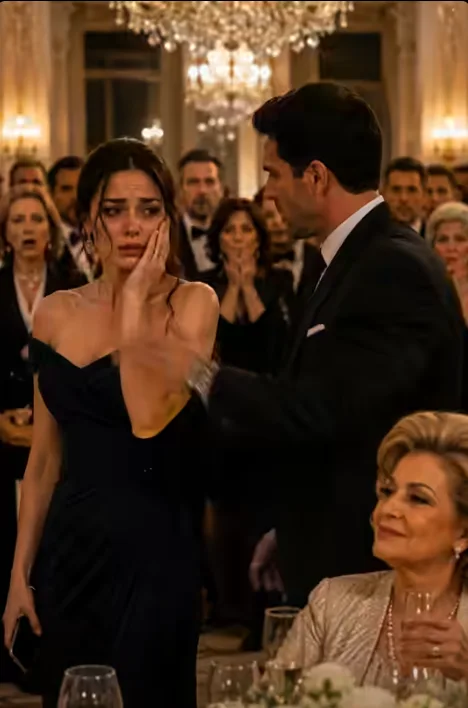
I stood.
The room went quiet.
Adil’s head snapped toward me.
Vivian paused at the podium.
Her smile remained, but her eyes sharpened.
“Yes, Leila?”
I picked up the microphone from the table.
Adil grabbed my wrist.
“Sit down,” he hissed.
I looked at his hand.
Four years ago, I would have sat.
Three years ago, I would have apologized.
Two years ago, I would have cried in the bathroom.
One year ago, I would have called my mother and pretended I had allergies.
Tonight, I pulled my wrist free.
The room noticed.
I lifted the microphone.
“My mother taught me something very different about refinement,” I said.
A ripple moved across the ballroom.
Vivian’s smile thinned.
“She taught me that grace is not making someone smaller so you can feel taller.”
Someone gasped.
Adil whispered, “Leila.”
I kept going.
“She taught me that dignity is not inherited through a last name. It is proven by how you treat people when you believe they cannot answer back.”
Vivian’s face hardened.
The room was completely silent now.
No silverware.
No glasses.
No polite laughter.
Only my voice.
“And she taught me that women who call themselves powerful should not need to humiliate other women in public to prove it.”
For one second, I felt free.
Terrified.
But free.
Then Adil stood.
He moved faster than I expected.
His hand struck my face before the sound reached me.
A bright crack split the ballroom.
My head turned with the force of it.
The microphone fell from my hand and hit the floor with a heavy thud.
Complete silence.
Not shocked murmurs.
Not gasps.
Silence.
The kind that enters a room when everyone has just witnessed the truth and no one knows whether acknowledging it will cost them something.
My cheek burned.
My eyes watered instantly.
I could taste blood where my teeth had cut the inside of my lip.
Adil stared at me.
For half a second, he looked horrified.
Then he looked around and saw the guests.
The donors.
The reporters.
His mother.
And horror became anger because that was easier than shame.
“You embarrassed my mother,” he said.
His voice shook.
Vivian descended from the podium, pearls gleaming against her throat.
“Adil,” she said calmly, “step back.”
Not because he had hurt me.
Because he had done it publicly.
That difference told me everything.
A woman near the front table whispered, “Did he just hit her?”
Another guest stood.
Someone lifted a phone.
Graham Harrington pushed back his chair, face pale, but he did not come toward me.
Nobody did.
Six hundred people.
And for five long seconds, I stood alone.
Then I wiped my tears with the back of my hand.
Slowly.
Carefully.
I picked up my phone from the table.
Adil reached for it.
“Don’t.”
I looked at him.
He stopped.
Maybe it was my face.
Maybe it was the silence.
Maybe some part of him understood that the woman he had struck was no longer the wife who would protect him from what he had done.
My fingers shook as I opened my contacts.
I pressed one name.
Mom.
She answered on the second ring.
“Leila?”
The sound of her voice broke something in me.
Not loudly.
Just enough.
I inhaled once.
Then said, “Mom… please come.”
Her voice changed immediately.
“Where are you?”
“Harrington Grand Ballroom.”
“What happened?”
I looked at Adil.
At Vivian.
At six hundred witnesses.
“He hit me.”
For one second, my mother said nothing.
Then her voice came through, calm and cold in a way I had never heard before.
“I’m coming.”
The call ended.
Vivian looked at me like I had done something vulgar.
“You should go upstairs and compose yourself,” she said.
I almost laughed.
Compose myself.
My husband had slapped me in front of six hundred people, and I was the one expected to become presentable.
“No,” I said.
Adil’s jaw tightened. “Leila.”
“No.”
The word carried.
The room heard it.
A reporter near the back lowered her pen and stared.
Vivian stepped closer, voice low.
“Do not make this worse.”
I looked at her.
For the first time, I saw something beneath all that polish.
Fear.
Not much.
But enough.
“You already did,” I said.
Security approached uncertainly.
Not toward Adil.
Toward me.
That was almost funny.
Vivian gave a tiny nod.
Two men in black suits moved closer.
Then a voice cut across the ballroom.
“Touch my daughter and I will own this building by morning.”
Everyone turned.
My mother stood at the entrance.
I do not know how she arrived so fast.
I only know that one hour had not passed yet, and somehow the room changed when she stepped inside.
She wore a black coat over a dark green dress, her hair pulled back, her face calm in the terrifying way only truly powerful women can be calm.
Beside her walked two attorneys, a security director I recognized from city news, and a man from the governor’s economic board whose photograph had been on the Harrington Development proposal.
Vivian’s face lost color.
For the first time since I had known her, she looked unsure.
Adil whispered, “Who is that?”
I wiped the blood from my lip and looked at him.
“My mother.”
My mother crossed the ballroom slowly.
Every step sounded clear against the polished floor.
The crowd parted.
Not because she asked.
Because something about her made asking unnecessary.
Vivian recovered first.
“Mrs…”
“Donovan,” my mother said. “Margaret Donovan.”
Graham stood so quickly his chair nearly fell.
That was when I understood.
He knew her.
Adil did not.
Vivian did.
Her eyes widened just slightly.
“Margaret Donovan,” she repeated.
My mother looked at me first.
Only me.
Her hand lifted to my cheek, gentle enough that I nearly cried again.
Then she saw the mark.
Whatever softness had been in her face disappeared.
She turned to Adil.
“You struck my daughter.”
Adil opened his mouth.
Vivian answered instead.
“There was a misunderstanding.”
My mother looked at her.
The ballroom temperature seemed to drop.
“I did not ask you.”
Vivian went still.
Nobody spoke to Vivian Harrington like that.
My mother had just done it as if correcting a receptionist.
Adil straightened. “Mrs. Donovan, with respect, this is a private family matter.”
“No,” my mother said. “It became public the moment you raised your hand in a ballroom full of witnesses.”
One of the attorneys stepped forward and handed a card to the nearest security officer.
“My client is requesting preservation of all surveillance footage from this event, including ballroom cameras, hallway cameras, and audio from the gala system.”
Vivian’s eyes darted toward Graham.
My mother noticed.
“Also,” she continued, “no guest is to be pressured, threatened, or paid to delete recordings. My office has already begun collecting copies.”
Adil’s face went pale.
“Your office?”
My mother looked at him with almost pity.
“You married my daughter and never bothered to learn who raised her.”
Vivian’s voice sharpened. “Your consulting firm is hardly relevant here.”
My mother turned.
There was a small silence.
Then she said, “My consulting firm currently advises the state pension board, three federal infrastructure partners, and two of the private equity groups reviewing Harrington Development’s waterfront redevelopment bid.”
Graham closed his eyes.
The room shifted.
Not emotionally.
Financially.
People in expensive suits began looking at one another with sudden interest.
Adil stared at his mother.
“You said her work was unremarkable.”
My mother’s mouth curved faintly.
“People often mistake discretion for insignificance.”
Vivian had used those words against me years ago.
Now they returned wearing teeth.
One of the men beside my mother opened a tablet.
“Mrs. Donovan,” he said, “the preliminary conflict report is ready.”
Graham stepped forward. “Margaret, please. Let’s not do this here.”
My mother looked at him.
“Why not? Your son hit my daughter here.”
A murmur passed through the guests.
The reporters were writing again.
Fast.
My mother’s attorney spoke clearly.
“Harrington Development’s pending waterfront proposal includes a family-values public benefit clause, minority partnership disclosures, and workplace conduct certifications signed by Mr. Adil Harrington.”
Adil swallowed.
Vivian whispered, “Stop.”
My mother continued, “A public assault at a charitable gala creates immediate review concerns. But that is not all.”
Vivian’s face froze.
There it was.
The second fear.
The older one.
My mother looked at me.
“Leila, sweetheart, did you know Adil transferred charitable foundation funds last quarter into a private hospitality account connected to this gala?”
I stared at her.
“No.”
Adil’s head snapped toward Vivian.
“Mother?”
Vivian did not move.
Graham sat down slowly.
My mother nodded to her attorney.
A folder was opened.
Papers were removed.
“Your daughter-in-law was not the liability in this family,” my mother said, voice calm enough to cut glass. “She was the distraction you used while your own house was rotting.”
The ballroom erupted.
Not loudly at first.
A gasp here.
A whisper there.
Then the sound grew.
Donors standing.
Reporters moving.
Security speaking into radios.
Vivian gripped the back of a chair.
Adil looked from his mother to the documents to me, as if trying to decide which betrayal mattered more: the one he committed, or the one he had not known about.
I did not care.
That surprised me.
For years, his approval had felt like oxygen.
Now I could breathe without it.
My mother turned back to me.
“Do you want to leave?”
I looked at Adil.
At the man who had once adjusted my posture in his family foyer and called it love.
At Vivian, who had spent years teaching me to shrink.
At six hundred guests who had finally seen what polish covered.
Then I looked at my mother.
“Yes.”
Adil stepped forward. “Leila, wait.”
My mother moved between us.
He stopped.
Not because she was physically stronger.
Because for the first time, someone stood in front of me before I had to ask twice.
“You will speak to her through counsel,” my mother said.
His face twisted. “She’s my wife.”
My mother looked at the red mark on my cheek.
“Not for long.”
She took my hand.
And as we walked out of the Harrington Grand Ballroom, cameras flashing behind us, I heard Vivian call my name.
Not Leila.
Not dear.
Not girl.
My name.
For once, there was no command in it.
Only fear.
I did not turn around.
Chapter complete
You have reached the end of this chapter.
Continue reading
A few more worlds to get lost in after this chapter.




