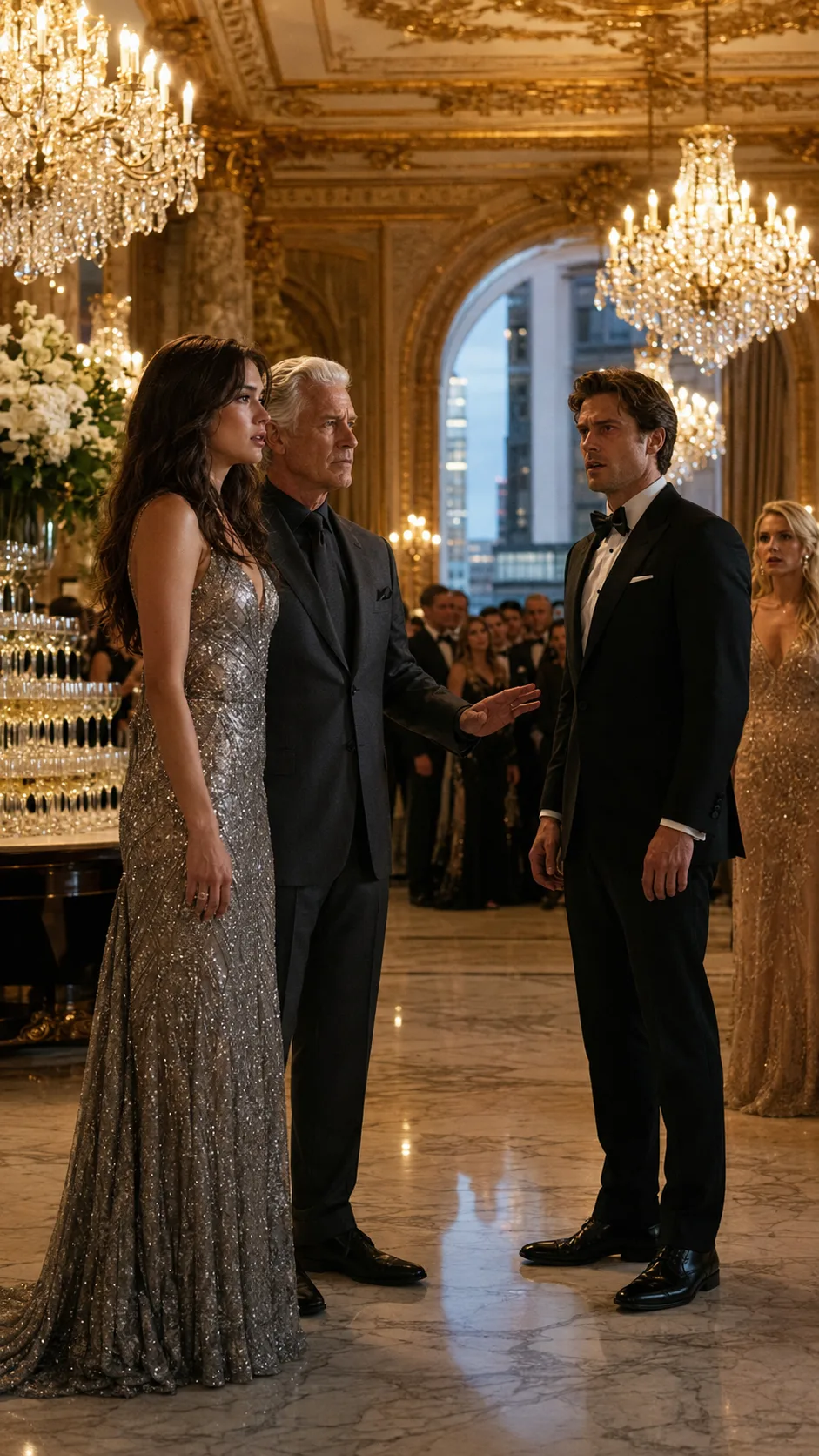
He Shamed His Wife At A Manhattan Gala, Then Her Father Revealed He Owned His Entire Future Forever That Night
Victoria Lane used to believe that silence could save a marriage.
Chapter 1
Victoria Lane used to believe that silence could save a marriage.
She had learned it slowly, the way a woman learns the temperature of a room before she speaks. She learned it at dinner tables where Julian Cross corrected her pronunciation of wine regions in front of his friends. She learned it inside black cars with leather seats, while he scrolled through messages and answered her questions with half a word. She learned it in penthouse elevators, at museum benefits, beside women in pearls who smiled at her like she was a charitable hobby Julian had picked up during a sentimental phase.
For three years, Victoria had swallowed small humiliations because Julian always knew how to make them sound reasonable afterward.
“You’re too sensitive.”
“I was joking.”
“You don’t understand how these people talk.”
“You should be grateful I’m teaching you.”
And because she had grown up in a modest blue house in Vermont, because her father had been a history
teacher who drove an old station wagon and patched the porch himself every spring, because Victoria had once sold hand-thrown ceramic bowls at farmers’ markets with windburned cheeks and clay under her nails, she had believed Julian when he said Manhattan society required a harder skin.
So she became quieter.
She closed her ceramics studio in Brooklyn after Julian said it made her look “crafty” in the wrong way. She stopped wearing the linen dresses she loved and learned to stand still in gowns that cost more than her first car. She memorized names of donors, board members, art dealers, junior partners, senior partners, wives who mattered, wives who pretended not to matter, and women who mattered precisely because they were not wives.
She became Mrs. Cross.
The name looked elegant on invitations. It opened doors. It made hotel managers straighten their backs and restaurant hosts whisper into headsets. It
wrapped around her like silk in public and like a locked chain in private.
That night, beneath the chandeliers of the Sterling Grand Hotel, Victoria finally understood that a beautiful cage was still a cage.
The charity gala was supposed to celebrate the Cross Meridian Children’s Arts Fund, Julian’s favorite public relations invention. He had created it two years earlier after a financial magazine called him “brilliant, ruthless, and almost impossible to like.” By attaching his name to children and art, Julian had softened the edges of his image. He loved being photographed beside schoolchildren holding paintbrushes. He loved speeches about opportunity. He loved saying his wife had inspired the foundation because she had been “an artist before she joined the real world.”
Victoria hated that phrase.
Before she joined the real world.
As if clay, fire, patience, failure, and beauty were imaginary things.
She stood near the ballroom entrance
in a silver evening gown that shimmered whenever she moved. Around her, three hundred guests filled the enormous room: bankers with perfect watches, society columnists hunting scandal, real estate families, museum patrons, lawyers, models, old money, new money, and people who had made entire careers pretending to be both.
Gold ornamentation climbed the ceiling. Crystal chandeliers glowed above polished marble. Champagne towers caught the light in delicate rings. White roses spilled from towering arrangements. At the far end of the ballroom, a small stage waited beneath a dark screen that would later display images of smiling children holding art supplies donated under Julian’s name.
His name was everywhere.
On the invitations.
On the banners.
On the foundation.
On her.
Victoria lifted a glass of sparkling water to her lips and tasted nothing.
Julian had barely looked at her since they arrived.
He moved through the ballroom like a man greeting subjects. He touched shoulders, shook hands, laughed too loudly at investors’ jokes, and leaned close to men whose signatures could influence deals. In his black tuxedo, he looked exactly like the version of himself magazines adored: tall, handsome, confident, just careless enough to seem dangerous.
Then Celeste Monroe crossed the floor.
Victoria saw the change instantly.
Julian’s attention sharpened.
Celeste was twenty-six, blonde, narrow-waisted, and polished to the kind of perfection that looked effortless only because other people worked hard to create it. She had planned the gala, or at least that was the official reason she had spent months inside Julian’s office, beside Julian’s car, across from Julian at late dinners, and once, when Victoria had come home early from visiting her father, standing barefoot in Victoria’s kitchen while Julian claimed they had been reviewing floral arrangements.
Celeste wore a champagne-colored gown tonight, a soft gold shade that matched the chandeliers. She moved like she knew people were watching and enjoyed giving them something to watch.
Julian saw her and smiled.
Not the smile he used for donors.
Not the smile he used for photographers.
It was smaller. Private. Familiar.
Victoria felt something inside her go cold.
A woman nearby lowered her voice. “Well. That’s bold.”
Another whispered, “I thought he would at least wait until after the speeches.”
Victoria turned slightly.
The women stopped speaking.
Their faces changed too quickly into pity.
That was when she knew.
Not suspected. Not feared. Knew.
The entire room had known before she did.
Julian reached Celeste near the champagne tower. Celeste tilted her face toward him, laughing at something he said. His hand settled at the small of her back with the ease of habit. Not a mistake. Not a slip. Not a friendly gesture.
A practiced claim.
Victoria’s fingers tightened around her glass.
She wanted to walk across the ballroom and ask him what he thought he was doing. She wanted to demand that he remove his hand. She wanted the room to stop pretending it had not seen.
Instead, she stood still.
Because that was what Mrs. Cross did.
She remained elegant.
She remained composed.
She remained silent.
Julian finally looked over and noticed her watching.
For one second, his expression held irritation, not guilt.
That hurt more.
He excused himself from Celeste and crossed the marble floor toward Victoria. Guests shifted around him, eager to appear uninterested while watching everything.
“Don’t start,” he said when he reached her.
Victoria blinked. “I haven’t said anything.”
“You don’t have to. Your face is doing enough.”
“My face?”
“You’re embarrassing me.”
A laugh almost escaped her, but it came out as breath. “I’m embarrassing you?”
Julian’s jaw tightened. He leaned closer, lowering his voice in a way that made the words feel more dangerous. “This is my night. My donors. My company. My foundation. Do not stand here looking wounded because you failed to understand your role.”
“My role,” Victoria repeated softly.
“Yes.” His eyes moved briefly over her dress, her hair, the diamonds at her ears that he had chosen because they photographed well. “Smile. Stand beside me when I need you. Say something charming if someone asks about your little art background. That’s it.”
The room blurred at the edges.
For years, Victoria had told herself that Julian was cruel only when tired. Cruel only when stressed. Cruel only when cornered. But now she saw him clearly. He was not losing control. He was showing control. This was not a fracture in the marriage.
This was the design.
“I need air,” she said.
“Victoria.”
She turned away before he could stop her.
The powder room was hidden beyond a corridor lined with antique mirrors and tall arrangements of lilies. Inside, the air smelled of expensive soap and fresh flowers. Victoria placed both palms on the marble counter and stared at her reflection.
She looked beautiful.
That somehow made it worse.
Her dress glittered. Her hair fell in dark waves over her shoulders. Her makeup was perfect. The woman in the mirror looked like someone who belonged to a life Victoria had never chosen but had somehow been trained to perform.
The door opened.
Celeste stepped inside.
Victoria did not turn.
Celeste moved to the mirror beside her and took a lipstick from a tiny gold clutch. For a moment, the only sound was the soft click of the tube opening.
“You should leave before dessert,” Celeste said.
Victoria looked at her reflection. “Excuse me?”
Celeste applied lipstick carefully, then pressed her lips together. “Julian hates messy scenes. If you go quietly tonight, he’ll be generous.”
The sentence landed with such polished cruelty that Victoria almost admired its efficiency.
“Generous,” she said.
Celeste smiled at herself in the mirror. “You’ll get a settlement. Probably the apartment for a few months. Maybe enough to reopen that pottery place, if you’re practical.”
Victoria turned then. “You don’t know anything about my marriage.”
Celeste’s smile did not fade. “I know more than you do.”
She opened her phone.
Victoria did not want to look.
But her eyes moved anyway.
Photos appeared first. Julian in shirtsleeves beside a window Victoria did not recognize. Julian holding two coffees in an elevator mirror. Julian’s watch on a nightstand that was not theirs. Then messages. Short ones. Careless ones. The kind men wrote when they did not believe they would ever be forced to explain them.
Finally, Celeste opened a document.
A lease.
West 12th Street.
Two bedrooms. Private terrace. Start date: next month.
Victoria stared until the words stopped being words and became proof.
“He signed it last week,” Celeste said gently, almost kindly now, which made it uglier. “He was waiting until after tonight. The gala needed to be clean.”
Victoria could hear her own pulse.
Celeste leaned closer. “Don’t misunderstand this. Julian didn’t keep you because he loved you. He kept you because you softened him. The small-town wife, the handmade bowls, the schoolteacher father. People liked that story. But now he’s past needing it.”
Victoria swallowed. “And he needs you?”
Celeste’s smile returned. “He needs someone who understands the world he actually lives in.”
Something inside Victoria cracked.
Not loudly.
Not dramatically.
It was more like ice splitting beneath snow.
For a moment she felt the old instinct rise: apologize, retreat, survive the evening, ask questions later in private where no one could see. That instinct had protected her for years.
But it had also imprisoned her.
She turned from Celeste, walked to the sink, and washed her hands though they were not dirty. The cold water steadied her.
Celeste watched her with curiosity.
“You’re not going to cry?”
Victoria turned off the tap.
“No,” she said. “I think I’m done with that part.”
She left the powder room.
Back in the ballroom, the speeches were about to begin. Julian stood near the stage with a glass in his hand, surrounded by men who laughed before he finished speaking. Celeste slipped in through another entrance and rejoined the crowd near the front, her expression arranged into innocent concern.
Victoria intended to walk straight to the exit.
She made it halfway across the marble floor before Julian saw her.
His eyes narrowed.
“Victoria,” he called.
She kept walking.
The room noticed.
He moved faster, cutting across her path near the base of the grand staircase. Cameras from the society press turned subtly. Guests pretended to look elsewhere but stayed perfectly still.
“Leaving?” Julian asked, his voice louder than necessary.
Victoria stopped because stepping around him would have looked like fear, and she was exhausted by the choreography of fear.
“I’m going home,” she said.
“Our home?”
“For tonight.”
A few people heard. Julian heard them hearing it.
His smile appeared.
It was the smile he used when he wanted to punish someone without seeming angry.
“Ladies and gentlemen,” he said, lifting his glass slightly. “You’ll have to forgive my wife. Victoria still hasn’t adjusted to long evenings. She used to spend her nights making clay bowls in Vermont.”
A ripple of laughter moved through the nearest guests.
Victoria’s face warmed, but she did not lower her eyes.
Julian turned the performance into a speech.
“That was part of her charm when we met. Very earnest. Very rustic. She sold things at little markets, wore linen, had clay under her fingernails.” He glanced at a banker beside him. “I thought, why not? Every empire needs a human touch.”
More laughter.
Victoria stared at the chandelier reflected in his champagne glass.
“She gave up all that, of course,” Julian continued. “Marriage requires growth. Exposure. Refinement. I like to think I rescued her from a life of uneven coffee mugs and local fairs.”
Someone coughed into his fist to hide a laugh.
Someone else whispered, “Julian.”
But no one stopped him.
That was the final truth of the room.
People disapproved of cruelty only after it became unfashionable.
Victoria set down her untouched glass on the edge of a nearby table.
“My work was never something you rescued me from,” she said.
The room quieted.
Julian’s smile tightened. “Careful.”
“No,” Victoria said, surprised by how steady her voice sounded. “I don’t think I will be.”
Celeste, standing behind him, tilted her head with interest.
Julian stepped closer. His voice dropped, but the nearest guests could still hear. “You are emotional. You are tired. And you are making yourself look unstable.”
“I’m making myself look honest.”
His eyes hardened. “You are nothing without the name I gave you.”
There it was.
Not hidden in private.
Not disguised as advice.
A sentence built like a cage.
Victoria looked at him, and for the first time in three years, she did not believe him.
“You gave me your name,” she said. “You did not give me myself.”
For one suspended second, Julian seemed almost startled.
Then embarrassment turned him cruel.
He reached as if to block her from leaving. His hand caught the edge of her hair and shoulder for an instant, not enough to injure, but enough to stop the room from breathing. Victoria gasped, more from shock than pain.
The sound moved through the ballroom like a dropped knife.
The laughter vanished.
Julian’s hand fell almost immediately, but the damage was done.
Every guest had seen the truth he spent millions polishing away.
Victoria stepped back.
She did not touch her hair. She did not give him the satisfaction of seeing her check herself for damage.
Julian’s face shifted as he realized the room had changed.
“Victoria,” he said, suddenly quieter.
The ballroom doors opened.
Not the side doors for servers. Not the glass doors to the terrace.
The main double doors.
They opened slowly, and the sound carried across the marble.
A man stepped inside.
He wore a plain charcoal suit. No designer flash. No diamond watch. No entourage of men announcing his importance. His white hair was neatly combed, his posture straight, his expression calm in a way that made louder men seem childish.
Victoria turned.
Her breath caught.
“Dad?”
Samuel Lane stood beneath the arch of the entrance, looking nothing like the retired history teacher who mailed her maple candy every October and called every Sunday evening to ask if she was eating enough. He looked like himself, yes, but also like a version of himself the world had been careful not to reveal to her.
Security did not stop him.
They moved aside.
That was the first impossible thing.
The second was the reaction around the ballroom.
A hotel director near the entrance went pale. One of Julian’s lawyers lowered his glass. A banker Victoria recognized from Cross Meridian’s last investor dinner whispered something sharp to his wife. Two men near the stage exchanged the look of people who had just seen a ghost walk into a room holding their future.
Julian noticed too.
But arrogance is a slow animal to die.
He looked Samuel up and down and laughed. “This is perfect.”
Samuel walked forward.
The crowd parted before him.
Victoria felt twelve years old for half a second. Not weak. Not childish. Just suddenly aware of what it meant to have someone arrive for her without asking what she had done to deserve it.
Samuel stopped beside her.
His eyes moved to her face, then to Julian.
“What happened?” he asked quietly.
Victoria opened her mouth, but Julian answered first.
“Your daughter is having one of her dramatic episodes.”
Samuel did not look away from him. “I did not ask you.”
The sentence was calm.
It hit harder than a shout.
Julian’s expression flickered.
Samuel turned slightly toward Victoria. “Are you all right?”
Victoria wanted to say yes because that was what she always said. Instead, she took one breath and told the truth.
“No.”
Samuel’s face did not change much.
Only his eyes did.
They became colder than winter glass.
He faced Julian fully. “Step away from my daughter.”
Julian smiled again, but now the smile was thinner. “You must be Samuel. The professor.”
“Formerly.”
“Formerly?” Julian gave a short laugh and glanced at the crowd, inviting them to join. No one did. “Wonderful. The retired schoolteacher has come to defend his little girl at a grown man’s event.”
Samuel said nothing.
Julian mistook silence for weakness, as men like him often do.
“You should be careful,” Julian continued. “This hotel is private property. This gala is invitation only. And your daughter’s comfort does not outrank my reputation.”
Victoria saw several faces in the crowd turn away.
Samuel did not.
“Your reputation,” he said, “is the least valuable thing in this room.”
A murmur spread.
Julian’s eyes narrowed. “I don’t know who you think you are.”
Samuel reached into his jacket.
He took out his phone.
Not quickly. Not dramatically. Simply as if he had decided the conversation had reached the point where facts were more efficient than words.
“I have spent many years making sure men like you did not know who I was,” Samuel said.
Julian scoffed. “Is that supposed to sound impressive?”
“No,” Samuel said. “It is supposed to sound final.”
The ballroom seemed to tighten around them.
Victoria looked from her father to Julian, unable to understand why her father’s quiet voice had made powerful people stop moving.
Samuel tapped the screen once.
Somewhere near the stage, a man cursed under his breath.
Julian heard it.
For the first time, uncertainty appeared in his face.
Samuel lifted the phone to his ear.
“Thomas,” he said. “Begin the Vale protocol.”
Julian’s smile vanished.
Samuel continued, his tone even. “Yes. Tonight. Cross Meridian Holdings. Full voting control. Notify the board that Edward Vale is exercising majority authority effective immediately. Remove Julian Cross from all executive access. Freeze discretionary corporate accounts. Secure legal review on the West 12th property. Send the notice now.”
He ended the call.
The silence that followed felt too large for the room.
Julian stared at him.
Victoria stared too.
Edward Vale.
The name moved through the ballroom before anyone spoke it.
Edward Vale was not a man people met. He was a signature on acquisition documents. A rumor behind closed-door deals. A billionaire investor who owned pieces of companies through layers of trusts, funds, and holding groups so complicated that financial journalists had spent years trying to photograph him and failed.
Edward Vale was the unseen force behind half of Manhattan’s quiet takeovers.
Edward Vale was a ghost with voting shares.
Edward Vale was her father.
“No,” Julian said.
It came out soft at first.
Then louder.
“No. That’s ridiculous.”
Samuel looked at him without pity.
Julian turned to the banker nearest him. “Martin. Tell him. Tell him that’s impossible.”
Martin did not answer.
His phone had begun vibrating.
Then another phone.
Then another.
Across the ballroom, screens lit up in pockets, purses, and palms. One by one, the people who had laughed at Victoria read the notification spreading through the business world like fire through silk.
Emergency Board Session: Cross Meridian Holdings.
Majority Shareholder Action.
Executive Removal Pending.
Edward Vale Exercises Control.
Julian pulled out his own phone.
Victoria watched his hand tremble.
He looked down.
The color drained from his face so quickly that he seemed to age in place.
“This is fake,” he whispered.
Samuel said, “It is legally executed.”
“You can’t do this.”
“I already have.”
Julian looked up, no longer performing for the crowd. “Cross Meridian is mine.”
“No,” Samuel said. “It was built with borrowed power, inflated loyalty, and people too afraid to tell you no. You were allowed to sit at the head of a table you never owned.”
Julian took one step forward. Samuel’s hand lifted slightly, calm but clear.
“Do not come closer,” Samuel said.
Julian stopped.
Not because Samuel shouted.
Because the room had chosen a side.
Or perhaps it had simply recognized the winning one.
The men around Julian moved away first. Not far. Just enough. Half a step. Then another. The shift was subtle, but devastating. These were men who had praised him, toasted him, invested with him, repeated his jokes, accepted his invitations, and looked away when he treated his wife like furniture.
Now they abandoned him with the smooth efficiency of people saving themselves.
Celeste stood behind Julian, her face no longer arranged.
For the first time all evening, she looked young.
Not innocent. Just startled by consequences she had never expected to apply to her.
Julian turned toward her, as if she might be the one person still loyal.
“Celeste,” he said.
She did not move.
His phone buzzed again.
Then hers did.
Celeste looked down, read whatever had appeared, and her mouth opened slightly. Victoria did not need to see the screen to understand. The apartment. The gala contract. The emails. The favors Julian had promised with resources that no longer belonged to him.
Celeste lifted her eyes to Victoria.
There was no apology there.
Only calculation.
Then she stepped back.
“Celeste,” Julian repeated, sharper this time.
She gathered her small gold clutch, turned, and walked toward the side exit.
Every eye followed her.
She did not look back.
That, more than anything, seemed to break him.
Julian’s shoulders dropped.
The golden man of Manhattan stood in the center of his own gala, surrounded by chandeliers, champagne, and the ruins of his name.
He turned to Victoria.
For a moment, she saw the old trick forming. The softened eyes. The lower voice. The intimate tone designed to pull her back into private where he could rewrite what had happened.
“Victoria,” he said. “Listen to me.”
She said nothing.
“Please.” He gave a strained laugh, as if they were sharing a misunderstanding. “This got out of hand. Your father is upset. You’re upset. I made mistakes tonight, but marriage is complicated. We can talk at home.”
Home.
The word landed strangely.
Their penthouse with its curated art and silent rooms.
The closet where her linen dresses had disappeared.
The kitchen where Celeste had once stood barefoot.
The studio space Julian turned into a private gym because “clay dust didn’t suit the apartment.”
That had not been home.
It had been a showroom where Victoria was displayed until she became inconvenient.
Julian stepped toward her. “I was under pressure. The company, the gala, the investors. You know how much I carry.”
Victoria looked at him.
For the first time, his excuses sounded exactly like what they were: furniture in a burning house.
“No,” she said.
He blinked. “No?”
“No, we are not going home to talk.”
His face tightened. “Don’t do this here.”
“You chose here.”
A few guests lowered their eyes.
Victoria’s voice stayed quiet, but now the quiet belonged to her.
“You chose the ballroom. You chose the audience. You chose to make my life, my work, my family, and my worth into a joke in front of people who already knew you were replacing me.”
Julian’s mouth opened, then closed.
She looked toward Celeste’s empty place near the side exit. “You chose all of it.”
Samuel stood beside her, silent.
Victoria had spent years wishing someone would rescue her from Julian’s cruelty. Now that her father had arrived with enough power to destroy him, she realized the final step had to be hers.
Not Samuel’s.
Hers.
She slipped the wedding ring from her finger.
It resisted for a second. Her knuckle had swollen slightly from the heat of the room. Then it came free.
The diamond caught the chandelier light.
Julian stared at it.
Victoria placed it on the nearest cocktail table beside an untouched glass of champagne.
The small sound of metal touching marble carried farther than it should have.
“My art was real,” she said. “My family was real. My manners were real. My love was real.”
Julian swallowed.
“You were the performance,” she finished.
Something changed in the room then.
The whispers softened.
Not into pity.
Into recognition.
People who had come for champagne and networking were now watching a woman reclaim herself in public, and even the most cynical among them understood they were seeing something rarer than scandal.
Julian looked at Samuel, desperation sharpening into anger. “You set me up.”
Samuel’s expression remained steady. “You did not need my help to reveal yourself.”
“You hid who you were.”
“Yes.”
“Why?”
Samuel glanced at Victoria.
For the first time that night, sadness entered his face.
“Because wealth attracts actors,” he said. “I wanted my daughter to know what love looked like before people began performing it for her.”
Victoria felt her throat tighten.
Samuel continued, still looking at Julian. “I built companies. I bought land. I took positions in firms whose founders never knew my real name. But none of that mattered more than giving Victoria a childhood where people came to dinner because they cared about her, not because they wanted access to me.”
Julian gave a bitter laugh. “And you let her marry me?”
Samuel’s eyes hardened again. “I let her choose. There is a difference.”
Victoria looked at him.
Samuel’s voice softened. “I asked once if she was happy. She said yes.”
Victoria remembered.
A Sunday call, two years into the marriage. Her father had asked too gently. She had stood in the penthouse laundry room while Julian entertained guests outside. She had said yes because saying no felt like opening a door she was not ready to walk through.
Samuel had heard the lie.
She knew that now.
But he had waited.
Not because he did not care.
Because he respected her enough to let the truth become hers.
Julian shook his head. “This is insane. You can’t just erase me.”
“No,” Samuel said. “You erased yourself, line by line, signature by signature, lie by lie. I only stopped protecting the illusion.”
At the far end of the ballroom, two uniformed officers entered beside hotel security.
No one gasped.
By then, the night had already become unreal enough that police seemed like the natural next chapter.
Julian saw them and stiffened. “What is this?”
Samuel answered calmly. “Questions about corporate funds, the West 12th lease, and several transfers your board apparently did not authorize.”
“That has nothing to do with Victoria.”
“It has everything to do with the way you believed rules were decorations.”
The officers approached.
Julian looked around, searching for someone to object. His lawyer avoided his eyes. His banker stared at the floor. His friends became strangers. The society wives who had laughed behind their champagne glasses now watched with the grave satisfaction of people who would later claim they had always disliked him.
One officer spoke to Julian quietly.
Julian’s face tightened. “I’m not going anywhere.”
The officer did not raise his voice.
Neither did Samuel.
That was the worst part for Julian. No one needed to shout at him anymore. His power had already left the room.
After a moment, he allowed himself to be guided toward the doors.
As he passed Victoria, he stopped.
“Victoria,” he said, barely audible. “You’ll regret this.”
She looked at him for a long time.
Once, those words would have followed her home and kept her awake until morning.
Now they sounded small.
“No,” she said. “I think regret is finally leaving with you.”
Julian’s face twisted, but he had no answer.
The officers led him across the marble floor. The path that had opened for Samuel now opened for Julian too, but differently. People moved away not in respect, but to avoid being touched by the collapse.
The ballroom doors closed behind him.
For several seconds, nobody spoke.
Then somewhere near the champagne tower, a glass was set down too hard.
The sound broke the spell.
Guests began whispering again, but now their whispers could not reach Victoria. They were part of another world. The world that had measured her by Julian’s name and found her small. The world that had confused cruelty with strength because it came dressed in a tuxedo. The world that would wake tomorrow and pretend it had always known Victoria Lane was worth watching.
She did not care anymore.
She turned to her father.
“A billionaire,” she said.
It should have sounded accusing.
Instead, it came out almost like a laugh.
Samuel’s mouth curved faintly. “Technically, that depends on how the markets open.”
Victoria stared at him.
Then she laughed for real.
Not loudly. Not freely. Not yet.
But enough.
The sound surprised her. It seemed to surprise Samuel too. His stern expression softened, and for a moment he was simply her father again, the man who burned pancakes on snow days and told stories about ancient empires as if they were neighborhood gossip.
“You were Edward Vale this whole time,” she said.
“Yes.”
“And you let me think you were grading essays in Vermont.”
“I did grade essays in Vermont.”
“Dad.”
“What? They were very poor essays. Someone had to do it.”
She pressed her fingers to her mouth, caught between disbelief and tears.
Samuel’s eyes grew gentle. “I was a teacher because I loved teaching. I was Edward Vale because your mother’s family left behind a complicated mess of assets, and I discovered I was better at protecting them than anyone expected.”
“You never told me.”
“No.”
“Why?”
“Because I wanted you to believe your hands mattered more than your inheritance.”
Victoria looked down at her hands.
They were not perfectly manicured tonight. A tiny scar still marked one finger from a kiln shelf years ago. Another faint line crossed her thumb from a broken mug she had refused to throw away. Julian had hated those marks. He said they made her hands look “unfinished.”
Now she saw them differently.
They were evidence.
Of work.
Of patience.
Of a self that had existed before him and would continue after him.
Samuel touched her shoulder. “I am sorry I did not come sooner.”
Victoria shook her head. “I don’t know if I would have left sooner.”
“I know.”
The honesty of that hurt, but it also healed something.
Around them, the gala began collapsing into logistics. Board members gathered in tight circles. The hotel director spoke urgently into a phone. Donors drifted toward exits. Reporters tried to appear casual while recording every detail. Somewhere, the screen meant to show smiling children remained dark.
Victoria looked at the stage.
The Cross Meridian Children’s Arts Fund.
Julian’s name still sat printed on programs, menus, and banners.
“Take it down,” Samuel said to the hotel director, who had appeared beside them as if summoned by thought.
The man nodded quickly. “Of course, Mr. Vale.”
Victoria almost laughed again.
Mr. Vale.
Her father, who once argued with a grocery store cashier over a coupon, was making a hotel director tremble.
Samuel noticed her expression. “You’ll get used to it.”
“I don’t want to.”
“Good.”
She looked at him.
He smiled. “That means I raised you properly.”
A woman approached hesitantly from the edge of the crowd. Victoria recognized her as the director of a children’s community arts center in Queens, one of the few people at the gala who had spoken to her earlier without scanning the room for someone more important.
“Mrs. Cross,” the woman began, then stopped. “I’m sorry. Ms. Lane.”
Victoria turned fully toward her.
The correction mattered.
The woman held a folded program against her chest. “I just wanted to say… your ceramics studio. I looked it up after we met at the spring event. Your work is beautiful.”
Victoria felt something in her chest loosen.
“Thank you.”
“I hope you make it again.”
The woman walked away before Victoria had to answer.
Samuel watched his daughter carefully. “Will you?”
Victoria looked around the ballroom one last time.
She saw the chandeliers, the marble, the champagne, the wealth, the watching faces. For years she had believed rooms like this were bigger than she was. Now she saw they were only rooms. Expensive rooms, yes. Powerful rooms, sometimes. But still only rooms.
She thought of clay.
Cold at first.
Unshaped.
Resistant until warmed by hands.
She thought of the wheel turning. The pressure needed to center a piece. The discipline of not forcing too quickly. The beauty of collapse when collapse taught you where the wall had thinned. The fire that made fragile things strong.
“Yes,” she said. “I will.”
Samuel nodded, as if that answer mattered more than all the companies he had acquired that night.
The hotel director returned with staff. Quietly, efficiently, they began removing Julian’s name from the stage.
Cross Meridian.
Julian Cross.
Mrs. Cross.
Names could be printed, polished, projected, and destroyed.
Victoria Lane remained.
She picked up her ring from the cocktail table, not because she wanted it, but because she refused to leave even that decision behind for someone else to clean up. She dropped it into her clutch.
Tomorrow, lawyers would call. Headlines would bloom. Julian’s empire would be dissected by people who had admired him yesterday. Celeste would vanish into some other circle of wealth if she could. The board would rewrite statements. The gala would become a story people told with lowered voices and embellished details.
But tonight, Victoria walked out of the Sterling Grand Hotel beside her father.
Not behind him.
Beside him.
The night air outside was cold and clean. Manhattan glittered around them, all glass and ambition. Cameras flashed near the curb, but Samuel guided her past them without hurry.
A black car waited.
Victoria paused before getting in.
Across the street, reflected in a dark shop window, she saw herself: silver dress, loosened hair, straight spine, her father beside her in charcoal gray.
She looked nothing like the woman who had entered the ballroom.
Or maybe she looked exactly like her.
Maybe this was who she had been the entire time, beneath the name, beneath the silence, beneath the careful smile Julian had taught her to wear.
Samuel opened the car door.
“Home?” he asked.
Victoria thought of the penthouse and felt nothing.
Then she thought of Vermont. Of the blue house. Of the porch. Of shelves lined with imperfect bowls. Of mornings that smelled like coffee and wet clay. Of a studio waiting somewhere, even if she had to build it again from nothing.
“No,” she said.
Samuel waited.
Victoria looked back at the glowing hotel doors, then at the city ahead.
“Take me to my studio.”
His smile was small and proud.
“Of course.”
As the car pulled away, Victoria did not look back again.
Behind her, Julian Cross’s name was being stripped from the ballroom walls.
Ahead of her, the first empty wheel waited.
And this time, when Victoria Lane put her hands to the clay, no one would ever convince her she needed rescuing from herself again.
THE END.
Chapter complete
You have reached the end of this chapter.
Continue reading
A few more worlds to get lost in after this chapter.