He Saw a Waitress Feed His Mother With Trembling Hands.
Chapter 1
He Saw a Waitress Feed His Mother With Trembling Hands.
He Never Imagined That One Small Act of Kindness Would Uncover the Greatest Secret of His Life
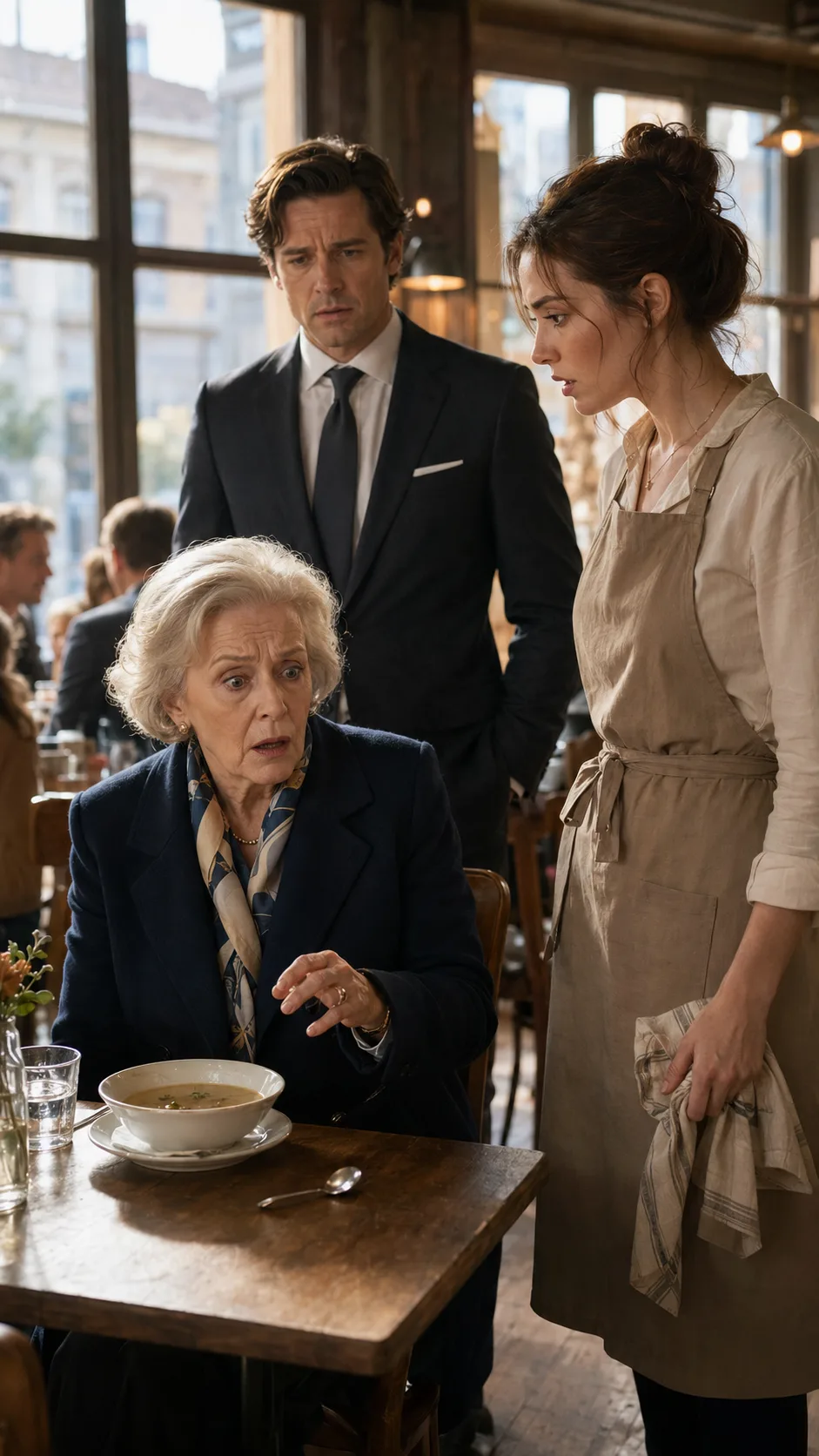
It had run in a thin orange line from the rim of the bowl onto the white napkin spread across the woman’s lap. Not much. Barely a spoonful. The kind of thing most servers learned to ignore during lunch rush because every table needed something, every voice rose at once, and every small disaster had to compete with ten bigger ones.
But Marlowe stopped.
The old woman sat alone at the corner table beneath the café’s largest window, silver hair pinned neatly above a navy coat too elegant for a casual lunch. Her scarf was silk, patterned in cream and deep blue. Her posture was perfect. Her hand was not.
The spoon trembled between her fingers.
Again, she tried to lift it.
The metal clicked softly against the bowl, then knocked against her
teeth. A little more soup slipped down, touching the scarf this time.
At the next table, a woman glanced over.
Then away.
That was what made Marlowe move.
Not the spill. Not the tremor. The looking away.
“Marlowe,” the cook called from the pass. “Table seven’s burger is dying.”
A man near the window snapped his fingers. “Miss? Ranch?”
Marlowe set down the water pitcher she had been carrying and walked to the corner table.
The old woman heard her coming. She lifted her chin before she lifted her eyes, as if dignity had to arrive first.
“Ma’am,” Marlowe said, keeping her voice low, “are you alright?”
The woman looked at her for a few seconds. Her eyes were gray and sharp, even through the tiredness.
“I have Parkinson’s,” she said. “Some days are manageable. Some days lunch becomes a negotiation.”
Marlowe nodded once.
Not too much.
People always nodded
too much when they didn’t know what to do.
“My grandmother had it,” Marlowe said. “She hated soup for exactly this reason.”
The woman blinked.
Then one corner of her mouth moved.
“I used to host charity luncheons for two hundred people,” she said. “Now I’m losing a fight to vegetable broth.”
Marlowe glanced at the bowl, then at the spoon.
“I think the spoon started it.”
The woman let out a small laugh before she could stop herself.
There.
A real sound.
Marlowe stepped back. “Give me one minute.”
The kitchen was hot enough to press sweat beneath her collar. Jorge, the line cook, had one hand on a skillet and the other on a stack of tickets.
“No,” he said before she opened her mouth.
“I need a smaller spoon and a fresh bowl of soup.”
“Marlowe.”
“And soft bread.”
“Marlowe.”
“She has Parkinson’s.”
Jorge looked past her
into the dining room. His mouth flattened. He reached for a clean bowl.
Behind Marlowe, Dennis, the manager, appeared with his laminated smile already gone thin. “You have four tables waiting.”
“One of them can wait.”
“Table seven asked twice.”
“Table seven has two working hands.”
Dennis stared at her.
Jorge lowered his head over the soup so nobody would see his face.
“Marlowe,” Dennis said, “this is not a care facility.”
“No,” she said. “It’s a café.”
She took the bowl before he could answer.
When she returned to the corner table, the old woman had folded the stained napkin with careful, shaking fingers, trying to hide the evidence.
Marlowe placed the fresh bowl down, then set the smaller spoon beside it.
“May I sit?”
The woman looked toward the dining room, then back at her.
“Won’t you be in trouble?”
“Probably.”
“That doesn’t seem wise.”
“I’ve done less wise things for worse reasons.”
Marlowe pulled out the empty chair beside her and sat.
Up close, the old woman smelled faintly of lavender, expensive soap, and something medicinal beneath it. Her hands were beautiful even with the tremor. Long fingers. Pale nails. A wedding ring she kept turning with her thumb.
“Marlowe,” she said, almost to herself, reading the name tag pinned to the apron.
“That’s me.”
“Eleanor Avery.”
Marlowe paused only long enough to be polite. Avery meant something in Asheville. It meant buildings with brass plaques. Donations. Newspaper photos. The kind of family whose last name appeared on hospital wings and museum programs.
But a last name did not lift a spoon.
“Alright, Mrs. Avery,” Marlowe said. “Let’s win this.”
She placed the spoon in Eleanor’s hand, then covered it gently with her own.
“Slowly.”
The first attempt failed.
The second almost worked.
The third reached Eleanor’s mouth without spilling.
Eleanor closed her lips around the spoon and swallowed.
She didn’t smile right away.
She looked at the bowl.
Then at Marlowe’s hand.
Then she laughed again, quieter this time, but warmer.
“There,” Marlowe said. “We’re undefeated now.”
Across the café, Callan Avery stopped reading the email on his phone.
He had arrived ten minutes late, which meant he was exactly on time by his own standards. His driver had pulled up outside. He had stepped in to escort his mother to a neurology appointment she had refused to discuss over the phone. He had expected to find her waiting at the table with that composed look she used whenever she wanted him to think she was fine.
Instead, he found a young waitress sitting beside her.
And his mother was smiling.
Not the public smile.
Callan knew every version of Eleanor Avery’s face. The gala smile. The donor smile. The polite dinner smile she wore while someone said something foolish. The brittle smile she offered him whenever he asked if she needed anything.
This one was different.
This one made him feel like he had arrived too late to something important.
He stood near the brick column with his phone loose in his hand and watched.
Marlowe wiped a tiny drop of soup from the rim of the bowl before it could fall. She spoke to his mother without speaking down to her. She did not perform kindness for the room. She did not glance around to see if anyone noticed. She simply stayed.
Callan had hired caregivers with excellent references.
He had paid for drivers, specialists, physical therapists, dieticians, medication reviews, adaptive utensils shipped from Europe, and a private nurse his mother had fired after three days.
He had built a wall of money around her decline.
He had not sat beside her in a café and steadied her hand.
The thought landed hard enough to make him put his phone away.
When Marlowe finally rose, Eleanor touched her wrist.
“What is your name again?”
“Marlowe Pierce.”
Eleanor’s fingers tightened.
Barely.
But Callan saw it.
“A beautiful name,” Eleanor said. “It sounds like someone who notices things other people miss.”
Marlowe’s cheeks colored faintly. “Mostly unpaid tables.”
Eleanor smiled, but her eyes did not move from Marlowe’s face.
For a second, something passed through her expression.
Not recognition exactly.
Something older.
Marlowe had already turned toward the kitchen, so she missed it.
Callan did not.
He crossed the dining room after Marlowe left, pulled out the chair opposite his mother, and sat.
“You know her?”
Eleanor looked at him like she had forgotten he was coming.
“No.”
“You looked like you did.”
“She reminded me of someone.”
“Who?”
Eleanor turned the ring on her finger. “No one you know.”
That was Eleanor’s way of closing a door.
Callan had grown up with closed doors. His mother used them better than locks.
He leaned back, watching Marlowe carry two plates to a table by the window. She was slim, tired, maybe twenty-six. Chestnut hair in a loose bun. Beige apron. Cheap shoes trying to survive a double shift. Her movements were efficient, but her attention kept returning to Eleanor’s table.
Dennis approached with the check, already recognizing Callan now. His smile had become painfully eager.
“Mr. Avery. I hope everything is satisfactory.”
Callan did not look at the check. “The waitress. Marlowe.”
Dennis nodded too quickly. “Excellent server. Very kind. Sometimes a little too kind during rush, but customers love her.”
“How long has she worked here?”
“Almost three years.”
“Reliable?”
“The best I’ve got.”
“Then why does she look exhausted?”
Dennis’s smile twitched. “Well. Everyone’s exhausted in service.”
Callan finally looked at him.
Dennis cleared his throat. “She works mornings here and evenings at the pharmacy on Biltmore. Covers shifts when people call out. Sends money somewhere, I think. Doesn’t talk much about herself.”
Eleanor’s hand stilled on the table.
“Send her over when she has a moment,” Callan said.
Dennis nodded.
A minute later, Marlowe arrived with a dish towel in one hand and a guarded look in her eyes.
“Yes?”
Callan gestured to the empty chair.
“Would you sit?”
“I’m working.”
“You’re on paid break.”
Marlowe looked at Dennis. Dennis made a small, frantic nod from behind Callan’s shoulder.
That made her less willing, not more.
But she sat.
Callan folded his hands.
“Did you know my mother before today?”
“No.”
“Then why did you stay with her?”
Marlowe frowned slightly.
The question seemed to annoy her.
“Because she needed help.”
“Most people saw that and kept eating.”
“I’m not most people.”
The answer came out plain. Not proud. Not polished.
Eleanor watched her with that same strange stillness.
Callan looked at the towel twisted in Marlowe’s hand. “I run a family foundation. We fund elder care programs and neurological support services. People with instinct are rare. Training can be taught. Character is harder.”
Marlowe said nothing.
“I’d like to offer you a position. Paid training. A proper salary. Benefits. If you want to study nursing or patient care, we can arrange that too.”
Marlowe stared at him.
Then she gave a small breath through her nose.
“No, thank you.”
Callan was not used to hearing no without apology attached.
“No?”
“No.”
“May I ask why?”
“You can ask.”
He waited.
Marlowe looked toward her section. A boy at table four was dropping fries into his water glass one by one. His mother hadn’t noticed.
“I work two jobs,” she said. “I have rent. I have bills. I have debt old enough to vote. I can’t step into a new life because a stranger saw me do one decent thing.”
“I’m not offering charity.”
“Rich people always say that right before they offer charity.”
Callan’s jaw tightened.
Eleanor made a sound that almost became a laugh.
Marlowe looked at her, and her face softened at once. “Sorry.”
“Don’t be,” Eleanor said. “He benefits from correction.”
Callan looked at his mother.
She did not look back.
“What debt?” Eleanor asked.
The question seemed to catch Marlowe in an unguarded place.
Her thumb moved over a loose thread in the towel.
“Medical.”
“Yours?”
“My mother’s.”
Eleanor’s face changed.
Marlowe lowered her eyes to the table. “She died when I was seventeen. Cancer. We didn’t have much before. After that, we had less.”
“Your father?”
“Gone before I knew what fathers were supposed to do.”
“Who raised you?”
“My grandmother. Ruth. Until she got sick.”
Eleanor was barely breathing now.
Callan noticed it, but he did not understand it.
“What was your mother’s name?” Eleanor asked.
Marlowe looked up.
“Lena.”
The spoon slipped from Eleanor’s hand.
It hit the bowl, then the table, then lay beside the folded napkin.
The noise was small.
Everyone at the table heard it.
Callan turned to his mother. “Mother?”
Eleanor did not answer.
Her eyes were fixed on Marlowe.
Marlowe sat very still.
“Lena what?” Eleanor asked.
Marlowe’s voice came slower now.
“Lena Pierce.”
Eleanor closed her eyes.
Her hand went to her chest, not dramatically, not for attention. Just a hand looking for something steady.
Callan stood. “What is it?”
Eleanor reached for her handbag.
Her fingers shook so badly the clasp resisted her twice. Marlowe moved to help, then stopped when Eleanor gave a tiny shake of her head.
“I can do it.”
Nobody at the table argued.
Eleanor opened the bag and pulled out a small leather wallet. Not the one she used for cards. Older. Softer. The edges were worn smooth. From inside it, she removed a photograph.
She placed it face down on the table first.
Then turned it over.
Two young women stood by a lake, hair blown across their faces, laughing at whoever had taken the picture. One was clearly Eleanor. Younger, bright-eyed, beautiful in a way that looked almost careless.
The other woman made Marlowe’s hand go slack around the towel.
She had seen that face in a dozen old photos tucked in a shoebox at home.
Her mother at twenty.
Her mother before the hospital. Before the scarves. Before the pill bottles and the late-night coughing that came through the bedroom wall no matter how loudly Marlowe played the radio.
Marlowe touched the edge of the photograph.
“Why do you have this?”
Eleanor’s mouth trembled.
Callan looked from the image to Marlowe, then back to Eleanor. He had never seen the photo. Not once. Not in the family albums, not in the framed hallway pictures, not in the locked study drawers he had opened after his father died.
“Mother,” he said.
Eleanor looked at him then, and Callan saw something he had no defense against.
Fear.
“Before your father,” she said, “before the marriage, before all of it… I had a child.”
Callan did not move.
Marlowe’s fingers left the photograph.
Eleanor kept both hands flat on the table now, as if the wood could hold her in place.
“I was eighteen. Her name was Lena.”
The café did not go silent all at once. It happened in pieces.
A fork stopped moving.
Someone at the next table lowered their glass.
Dennis froze near the counter with his mouth slightly open.
Marlowe stood so quickly the chair legs scraped the floor.
“No.”
Eleanor flinched.
“I was young,” Eleanor said. “My parents sent me away before anyone could know. They told me the scandal would ruin the family. They arranged everything.”
“No.”
“They took her from me.”
Marlowe shook her head. “No.”
Callan’s voice came low. “You had a daughter?”
Eleanor looked at him. “Yes.”
“And you never told me?”
“I tried to find a way.”
“For forty-two years?”
She looked down.
That answer was worse than words.
Marlowe backed one step from the table.
“My mother never had a mother,” she said. “She told me that. She said her birth mother didn’t want her.”
Eleanor’s face folded around the words.
“I did want her.”
“No.”
“I searched for her.”
“No.”
“I found her when she was grown. She was already married. Already carrying so much anger. She wouldn’t let me into her life.”
Marlowe’s hands closed into fists at her sides.
“Good.”
Callan looked at her.
She didn’t apologize.
Eleanor accepted the word like she had earned it.
“She said I had no right to appear after all those years. She was right.”
Marlowe swallowed. The movement was visible in her throat.
“Then how do you know about me?”
Eleanor reached back into the wallet.
This time she removed an envelope.
It was cream-colored, faded along the fold, sealed but aged. Across the front, in handwriting Marlowe knew better than her own, were the words:
For Marlowe, when she is old enough to ask about me.
Marlowe stared at it.
No one spoke.
The handwriting broke through her before the story did.
Her mother used to label everything. Spice jars. Medicine bottles. Grocery lists clipped to the fridge with a tomato-shaped magnet. Marlowe still had one birthday card with that same curling M in her name.
Eleanor pushed the envelope toward her.
“Your mother gave me this fifteen years ago.”
Marlowe did not touch it.
“She met me once,” Eleanor said. “Only once. She was already sick. She made me promise not to come for you unless life found us first.”
“Life?”
The word came out sharp enough to cut.
Eleanor’s eyes lifted.
Marlowe pointed at the soup bowl, the fallen spoon, the café apron tied around her waist.
“This is life finding us?”
Eleanor said nothing.
“This?” Marlowe said. “Me working a lunch shift while you sit here with a secret in your purse?”
Callan took one step forward. “Marlowe—”
She turned on him. “Don’t.”
He stopped.
The command came from a waitress in worn shoes to a man who owned half the skyline, and he obeyed.
Marlowe looked at the envelope again.
Then the photograph.
Then Eleanor.
“My whole life,” she said, “I thought I came from no one.”
Eleanor’s hand trembled violently now.
“I have wanted to know you every day.”
Marlowe laughed once.
It had no humor in it.
“Wanting is easy when you’re rich enough to keep it private.”
Callan’s eyes dropped.
The words hit him too.
Maybe they were meant to.
Eleanor reached toward Marlowe, but her hand stopped halfway across the table.
“I am sorry.”
Marlowe looked at that hand.
The same hand she had steadied ten minutes earlier.
The same hand that had held a secret instead of reaching for her.
She picked up the envelope at last.
Not gently.
She folded it into her palm and stepped back.
“I need air.”
She turned and walked toward the door.
Callan moved after her.
“Marlowe, wait.”
She stopped with one hand on the brass handle.
Outside, sunlight laid a bright strip across the café floor.
She did not turn around at first.
When she did, her eyes were wet, but her face had hardened into something Eleanor recognized.
Lena had looked at her that way once.
Not with hate.
With a locked door behind her eyes.
“If you’re really my family,” Marlowe said, “why did it take kindness from a stranger for you to find me?”
No one answered.
There was no answer clean enough for that question.
Marlowe opened the door and stepped outside.
The bell above it rang once.
Then again as it swung shut.
For several seconds, Callan stood where she had left him.
His mother sat behind him, one hand covering the photograph, the other shaking against the table.
Dennis finally moved.
“Mr. Avery, I—”
Callan looked at him.
Dennis stopped talking.
Callan turned back to Eleanor.
“You had a daughter.”
“Yes.”
“My sister.”
“Yes.”
“And she died.”
Eleanor nodded.
“And I never knew.”
Her eyes closed. “No.”
Callan looked toward the door.
For most of his life, he had believed his mother’s sorrow belonged to illness, widowhood, and the slow loneliness that came with age and money. Now he understood that grief had lived in the house long before Parkinson’s. It had sat at dinner tables. It had ridden in cars. It had stood in locked rooms while he passed by, too busy becoming important to ask why his mother sometimes looked at old mail and forgot the world.
He picked up the photograph.
Young Eleanor. Young Lena.
Two women laughing like the future had not been cruel yet.
“Why didn’t you tell me after Dad died?”
Eleanor wiped her cheek with the edge of her scarf. “Because I had already buried the truth for so long that digging it up felt like another betrayal.”
“It was.”
She looked at him.
He did not soften it.
“It was,” he said again.
Then he walked out.
Marlowe had not gone far.
She stood beside the café’s brick wall near the alley, one hand pressed to her mouth, the envelope clutched against her chest. People passed on the sidewalk around her. Nobody knew a family had just rearranged itself ten feet away.
Callan stopped several steps back.
“I won’t ask you to come back inside.”
“Good.”
“I won’t ask you to forgive her.”
“Also good.”
He nodded.
Marlowe looked at him then. “Did you know?”
“No.”
She studied his face for a lie.
He let her.
“I didn’t know,” he said.
“And now?”
“Now I know I failed someone I never knew existed.”
Marlowe looked away.
A delivery truck rattled down the street. Somewhere nearby, a dog barked twice. The world was rude that way. It kept including ordinary sounds in terrible moments.
Callan reached into his jacket, pulled out a business card, then stopped.
Marlowe saw it and almost smiled.
Almost.
“Don’t.”
He looked at the card in his hand.
Then put it back.
“Right.”
“She was sick,” Marlowe said.
Callan waited.
“My mother. She got thin fast. The doctors had voices like locked cabinets. They talked to my grandmother in the hall, not to me. I used to sit on the floor outside her room and count the beeps from the machine because if I counted them, it meant they were still happening.”
Callan did not speak.
“The day she died, I found a photo box under her bed. I looked through every picture. I thought maybe I’d find someone. A man. A grandparent. Some face that explained mine.”
Her hand tightened around the envelope.
“There was nothing.”
Callan lowered his eyes.
“She must have hidden this for a reason,” Marlowe said. “And I don’t know if I hate her for it.”
“You don’t have to decide today.”
“I know.”
“Or tomorrow.”
“I know that too.”
The café door opened behind them.
Eleanor stood there.
She had come without her cane.
Callan stepped toward her, but she lifted one hand.
“I’m alright.”
She wasn’t.
But she stayed standing.
Marlowe watched her.
The old woman looked smaller outside. Without the table, without the silk scarf arranged perfectly, without the last name filling the room before she entered it, she looked like a person whose past had finally caught up and placed a hand on her shoulder.
“I won’t ask anything of you,” Eleanor said.
Marlowe said nothing.
“I won’t ask you to call me anything. I won’t ask you to visit. I won’t ask you to open that letter in front of me.”
Her mouth trembled.
“I only want to tell you this without hiding behind a photograph. I wanted your mother. I was too young to fight well, and then I became too ashamed to fight loudly. That is not an excuse. It is only the shape of the cowardice.”
Marlowe looked down at the envelope.
“Did she hate you?”
“Yes,” Eleanor said.
The answer came without defense.
Marlowe’s face shifted.
Eleanor nodded once. “She had every right.”
“And you still kept this?”
“Every day.”
Marlowe looked at Callan. “And you?”
“I don’t know what I am to you,” he said. “Not yet.”
“At least that’s honest.”
“It’s all I have.”
For the first time since the spoon fell, Marlowe looked tired instead of braced.
The kind of tired that came after the body stopped preparing for impact and started counting bruises.
“I have to finish my shift,” she said.
Callan frowned. “You don’t.”
She looked at him.
He corrected himself.
“You shouldn’t have to.”
“That’s different.”
“Yes.”
She tucked the envelope into her apron pocket.
Eleanor watched the movement, but did not ask.
Marlowe opened the café door and went back inside.
Not because she had accepted them.
Not because anything was fixed.
Because table four still had fries in the water glass, table seven still wanted ranch, and rent did not pause for family revelations.
The bell rang over her head.
Dennis approached her carefully. “Marlowe, you can take the rest of the day if—”
“I’m fine.”
He knew better than to argue.
She picked up the pitcher from where she had left it.
The water had gone warm.
She dumped it, refilled it, and went back to work.
Callan and Eleanor did not sit at the corner table again. Eleanor waited near the entrance while Callan paid the bill, then paid for every open table in the café without announcing it. He left cash for the staff. Too much. Not enough. He knew both things were true.
Before leaving, he looked once toward Marlowe.
She was wiping a table with steady, practiced strokes.
The envelope made a faint rectangle in her apron pocket.
Three nights passed before she opened it.
She did not do it at home.
Home was too small for that kind of thing. Her apartment had thin walls, a humming refrigerator, and a bathroom sink that dripped when the weather changed. There was no room there for a dead woman’s secret.
So Marlowe took the envelope to the park by the river after her pharmacy shift. She sat on a bench under a sycamore tree with peeling bark and one carved initial on the armrest.
The envelope opened unevenly.
Inside was one letter.
And a photograph she had never seen.
Her mother, sick but smiling faintly, seated beside Eleanor on a porch somewhere. Between them sat a cup of tea neither woman had touched.
Marlowe unfolded the letter.
My Marlowe,
If you are reading this, then something I tried to control has finally outrun me.
She stopped there.
The river moved darkly beyond the grass.
She read the rest without stopping again.
Lena wrote that she had found Eleanor when the cancer came back. She wrote that anger had carried her for years and then abandoned her when she needed strength for other things. She wrote that she had met Eleanor once because dying had made certain questions louder.
She wrote that Eleanor had cried.
She wrote that she had not forgiven her.
Not fully.
Not cleanly.
But she had believed one thing by the end of that meeting: Eleanor had not forgotten her.
The final lines were shorter.
I kept her from you because I wanted you to grow up belonging to yourself first.
Not to her money.
Not to her guilt.
Not to the Avery name.
If life brings her to you, choose slowly.
You owe the living honesty.
You owe the dead nothing but peace.
Marlowe folded the letter along the same lines her mother had made years ago.
Then she sat until the park lights flickered on.
The next morning, she went to work.
Eleanor was not there.
Callan was.
He sat alone at the corner table beneath the window. No suit this time. Dark sweater. Coffee untouched. He looked less like a man who owned buildings and more like a man who had slept badly.
Marlowe almost turned around.
Then she walked over.
“We’re not open for another ten minutes.”
“I know.”
“Rich people struggle with signs.”
“A lifelong issue.”
She looked at the coffee.
“Dennis let you in?”
“I may have frightened him.”
“That tracks.”
Silence sat between them, awkward and breathing.
Callan reached into his coat pocket, not quickly. He placed a small notebook on the table.
“My mother wrote down everything she remembers. Dates. Names. The adoption agency. The town where Lena was born. The family who raised her. She wanted you to have it.”
Marlowe did not touch the notebook.
“And you?”
“I had our lawyers locate the records.”
Her face closed.
He raised a hand slightly. “Copies only. Nothing filed. Nothing changed. No one contacted. They’re yours if you want them.”
She looked at him for a long time.
“You really don’t know how not to solve things with paperwork.”
“No,” he said. “But I’m trying to learn.”
That made something in her mouth move.
Not a smile.
Nearer than before.
She took the notebook.
“Is she alright?”
Callan looked down.
“No.”
Marlowe nodded.
Neither was she.
That was the first honest common ground between them.
“I opened the letter,” she said.
Callan did not ask what it said.
Good.
“She told me to choose slowly.”
“Then do that.”
“I am.”
He nodded.
Marlowe tucked the notebook under her arm.
“Coffee’s cold,” she said.
“I know.”
“You want a fresh one?”
Callan looked up.
For some reason, the question struck him harder than forgiveness would have.
“Yes,” he said. “Please.”
Marlowe took the cup.
At the counter, Jorge looked from her to Callan and raised both eyebrows.
She ignored him.
When she returned, she set the fresh coffee down, along with a smaller spoon.
Callan looked at it.
“It’s for your mother,” Marlowe said. “If she comes back.”
He looked at the spoon for a long time.
“She will,” he said.
Marlowe turned to leave, then stopped.
“Tell her I’m not ready.”
“I will.”
“And tell her…”
The sentence broke.
She started again.
“Tell her I kept the photograph.”
Callan nodded.
Marlowe walked back toward the kitchen as the café lights warmed above the tables and the first customers pressed faces to the window, checking if the door was open yet.
In the corner, the spoon rested beside the coffee.
Small.
Ordinary.
Waiting.
THE END.
Chapter complete
You have reached the end of this chapter.
Continue reading
A few more worlds to get lost in after this chapter.




