Lena Hale paused with her hand on the boutique door because the glass still carried her reflection.
Chapter 1
Lena Hale paused with her hand on the boutique door because the glass still carried her reflection.
The woman staring back at her looked ordinary enough to be ignored.
Her coat was dark wool, old at the cuffs, the kind of coat that had been brushed clean more often than it had been replaced. Her hair was tied low at the back of her neck. No diamond earrings. No designer bag swinging from her wrist. No polished driver waiting at the curb behind her. Just a small black handbag, a folded invitation inside it, and the name of a charity gala embossed in gold on heavy cream paper.
She pushed the door open.
A soft bell sounded above her head.
Nobody looked pleased to hear it.
The boutique was all marble and glass, with dresses arranged under warm chandelier light like they were not clothes but rare objects that required permission to approach. Ivory gowns hung beside champagne silk. Evening bags rested under glass. A row of
black heels stood on a mirrored shelf, each one angled the exact same way.
The air smelled of perfume and leather.
Too clean.
Too controlled.
A young sales associate behind the counter glanced up. Her eyes moved from Lena’s coat to her shoes, then back to the tablet in front of her. Another employee near the scarf display adjusted a silk square that had already been folded into a perfect triangle. At the center of the boutique, a man in a tailored black suit spoke to a customer beside the mirrors. His name badge caught the light when he turned.
Evan Marsh.
Store Manager.
Lena read the name without stopping.
She had learned to read rooms before people spoke. Her late husband had taught her that, though he never called it teaching. He used to stand near the entrance of his first boutique, back when the brand had only three
employees and one rented showroom with a cracked ceiling tile, and he would say, “Watch the hands first. People hide their faces better.”
Lena watched hands now.
The employee behind the counter kept both hands on the tablet, thumbs still. Not working. Waiting.
The manager smoothed his jacket when he saw Lena. Not out of nerves. Out of irritation.
The customer beside him wore a cream blazer draped over her shoulders and a diamond bracelet that tapped against a paper coffee cup every time she moved. Two shopping bags sat on the velvet chair beside her. One ribbon had fallen onto the marble floor.
No one picked it up.
Lena walked toward the evening gowns.
She had not come for drama. She had come because six complaint letters sat on her desk, all from different customers, all about the central branch. The words had changed, but the pattern had not.
Ignored. Followed. Insulted. Refused service. Treated like thieves. Treated like props. Treated like people who had wandered into the wrong life.
So Lena had come without an appointment, without a car from the company, without the black card that would make everyone’s posture change.
She stopped in front of an ivory silk dress.
It was beautifully made. A clean line through the waist. Hand-finished seams. Soft draping at the shoulder. Her husband would have touched the inside hem first. He always checked where most people never looked.
Lena lifted one sleeve between two fingers.
The manager crossed the floor.
Fast.
“That piece is not for everyone.”
His voice stayed low. Polished. Practiced.
The customer in the cream blazer looked into the mirror and smiled.
Lena did not turn to her.
“I’m considering it for a gala,” Lena said.
The manager’s eyes moved over her coat again.
“We have a consultation process for our premium pieces.”
“I know.”
His expression tightened by a fraction.
“You know.”
The words were shaped like courtesy and built like a wall.
Lena let the sleeve fall back into place. The silk settled without a sound.
“I’d like to try it.”
The manager placed one hand on the rack. Not touching her. Not touching the dress. Just placing himself between them.
“Our fitting rooms are reserved.”
The boutique had three fitting rooms. All empty. Lena had seen the curtains hanging open when she passed.
A sales associate looked down.
Good.
She had seen it too.
The woman near the mirror turned from side to side, checking how the cream blazer sat on her shoulders. Her coffee cup shifted in her right hand. The bracelet tapped the lid once. Twice.
“Some people come in just to take photos,” the woman said.
The manager smiled in the mirror.
Lena looked at him.
“Is that your policy?”
He lifted his chin. “Our policy is to protect our garments.”
The words landed carefully. He liked careful words. They gave him room to deny the shape of them later.
Lena glanced toward the ceiling.
A black camera dome sat above the display table.
The manager noticed.
“Security is for our protection,” he said.
“Of course.”
A short silence followed. Not empty. Full.
Lena moved one step to the side, toward another dress, a champagne satin gown with pearl buttons along the back. The manager followed.
Behind him, the sales associate at the counter finally tapped her tablet. Too late to look busy.
The customer in the cream blazer took two slow steps closer to the ivory dress. Her shopping bags stayed on the velvet chair. The fallen ribbon lay on the floor, still untouched.
“I don’t understand why stores let anyone walk in now,” the customer said.
The manager gave a small laugh through his nose.
Lena turned her head.
The woman held her coffee near the ivory dress. Too near.
Lena saw the wrist angle before the cup moved.
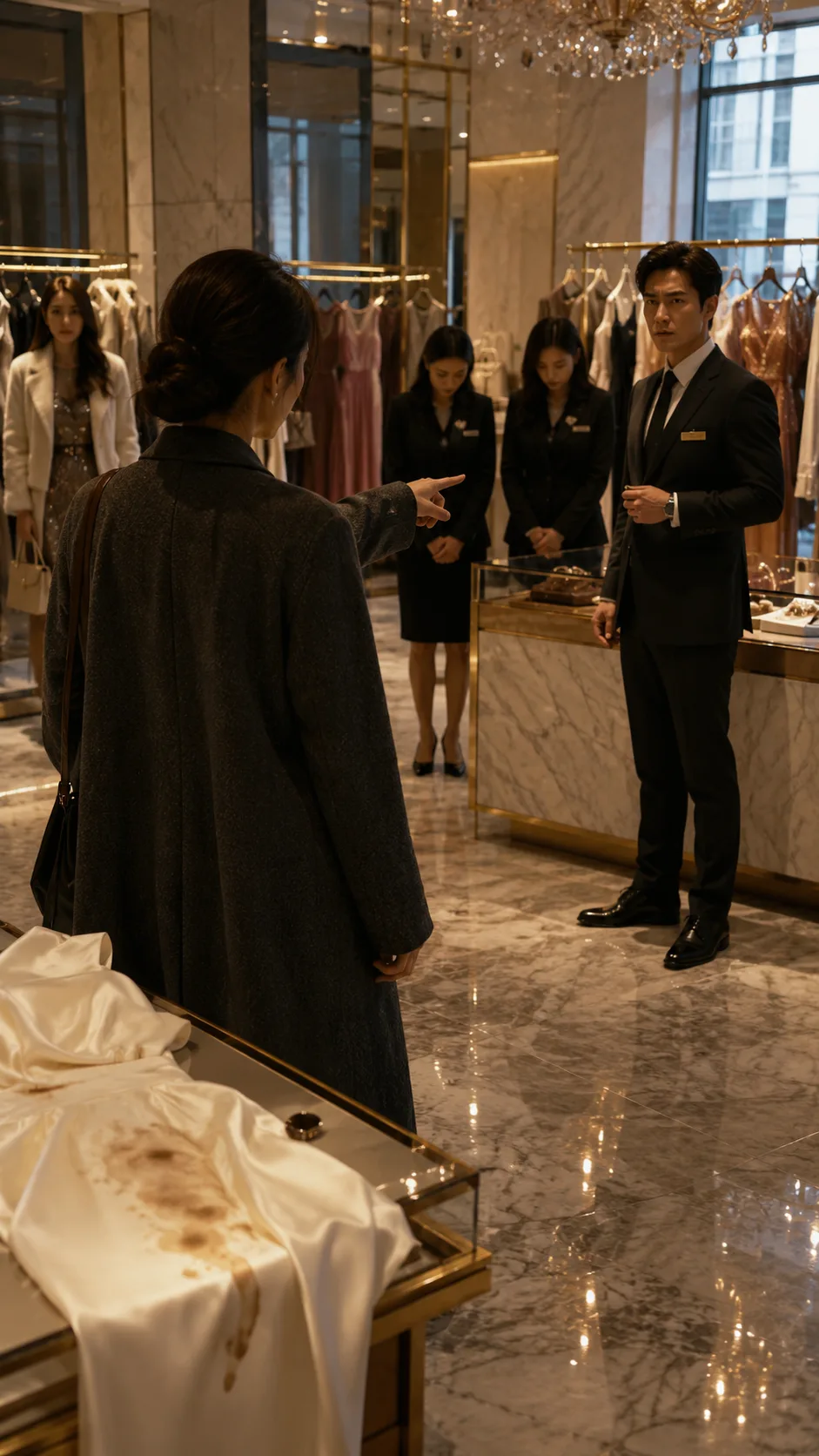
A brown line splashed across the silk.
The stain spread immediately, dark at the center and feathering at the edges. It ran down the front panel in a crooked path, ruining the clean shape of the gown. Coffee dripped from the hem onto the marble, one drop, then another.
The customer gasped first.
Then she pointed.
“She did that.”
No one moved.
Lena looked at the cup in the woman’s hand. The lid was still wet. Coffee had gathered along the rim and on the side closest to the dress.
The manager turned.
Not to the woman.
Not to the camera.
To Lena.
“You need to apologize.”
The sales associate behind the counter stopped pretending to type.
Lena said nothing.
The manager lifted the stained dress from the rack with two fingers, holding it away from himself as if the stain had a smell.
“This is a limited piece,” he said.
“I saw what happened,” Lena said.
The customer’s mouth tightened. “Excuse me?”
Lena looked at her. “You spilled the coffee.”
The woman let out a small sound. Not laughter. Something sharper.
The manager stepped forward.
“Ma’am, I advise you to be careful with false accusations.”
The choice of ma’am was deliberate. Not respect. Distance.
Lena’s hand rested against the side of her handbag.
“Then check the camera.”
The manager did not look up.
“The situation is clear.”
“It is.”
His jaw shifted.
A security guard had appeared near the entrance, broad-shouldered and uncertain, one hand near his belt. Two new customers had stopped just inside the doors, drawn by the sudden stillness. One held a phone low at her side. Not recording yet. Ready.
The customer in the cream blazer crossed her arms.
“She should pay for the dress.”
A sales associate near the scarves leaned toward the woman at the counter. Her voice dropped, but not enough.
“People like her only come here to take photos.”
There it was.
Not hidden anymore.
Lena turned slowly toward the employee.
The young woman looked down so fast her hair slipped forward.
The manager did not correct her. That mattered more than the insult.
He adjusted his cuff.
“I’ll give you a choice,” he said. “You can pay for professional cleaning and leave quietly, or we can involve security.”
Lena looked at the guard.
He looked at the stained dress. Then at the floor.
The customer lifted her chin. The diamonds at her wrist flashed under the chandelier.
Lena reached into her bag and took out her phone.
The manager smiled.
“Calling someone?”
She unlocked the screen.
No panic. No shaking thumb. One contact. One press.
The call connected on the second ring.
“I’m at the central branch. Come down.”
She ended it.
That was all.
The manager laughed once.
“Who exactly do you think can save you?”
Lena placed the phone back into her bag.
The boutique waited with her.
One minute passed.
The manager spoke to the guard near the entrance, not loudly, but with enough authority to remind everyone who was supposed to control the room. The guard nodded once and stayed where he was. The customer in the cream blazer picked up one of her shopping bags and set it down again. The fallen ribbon finally dragged under the chair leg.
Two minutes.
The air-conditioning clicked on with a small mechanical hum.
Lena noticed a loose thread on the manager’s left cuff. A tiny imperfection. Almost invisible. Her husband would have seen it immediately and sent the jacket back to tailoring.
The manager looked toward the entrance.
No one came.
His smile returned, wider now.
“Perhaps your friend is lost.”
Then the private elevator opened.
Not the glass elevator near the entrance, where customers could see their own reflections as they rose to the VIP salon.
The other one.
The one set behind a panel of pale marble, almost invisible unless someone knew where to look.
The doors parted with a soft chime.
A man in a charcoal suit stepped out first.
The boutique changed before he said a word.
The manager’s shoulders dropped half an inch. The customer in the cream blazer lowered her coffee cup. The sales associate behind the counter straightened so quickly her tablet slid against the glass.
The chairman of the brand crossed the marble floor.
Behind him came two members of the legal team. One carried a leather folder. The other held a tablet and was already looking up at the camera domes.
The manager swallowed.
“Mr. Voss,” he said.
The chairman did not answer him.
He walked straight to Lena.
Stopped.
Bowed his head.
“Madam Hale.”
The words did not echo, but they might as well have.
The customer’s fingers loosened around the cup.
The security guard stepped back from the doorway.
The employee who had spoken earlier went pale around the mouth.
Lena gave the chairman a small nod.
“Thank you for coming.”
“Of course.”
The manager still held the stained dress. The hanger tilted. Silk slid through his fingers, and he grabbed it too quickly, crushing the shoulder seam.
Lena’s eyes went to the fabric.
The chairman saw it.
His face did not move.
“Mr. Marsh,” he said.
The manager forced himself upright. “There has been an incident with a customer.”
“With a customer,” the chairman said.
“Yes. This woman damaged a limited piece and refused responsibility.”
The last word came out weaker than the first.
The legal associate with the tablet looked at Lena.
She nodded once.
The associate turned toward the counter.
“Security footage. Last ten minutes. Display camera three.”
The sales associate behind the counter stared at the manager.
“Now,” the chairman said.
She moved.
Her fingers missed the first key. Then found the next. The footage appeared on the tablet, then on the discreet wall screen above the consultation desk. No product images. No campaign video. Just the boutique from above.
Lena saw herself enter.
Old coat. Quiet steps. No jewelry.
She saw the manager watching her.
She saw his path across the floor when she touched the dress.
The footage continued.
The customer in the cream blazer moved closer. Her wrist angled. The paper cup tipped. Coffee fell across the ivory silk from her side of the display.
The room watched itself lie.
The customer went still.
The manager’s face changed in pieces. First his mouth. Then his eyes. Then the skin along his jaw.
The video showed Lena pointing toward the camera. It showed the manager refusing to look. It showed the employee near the counter leaning toward her coworker, her mouth forming the sentence everyone had heard.
People like her.
The chairman took the tablet from the legal associate and set it on the glass counter.
The sound was small.
The customer cleared her throat.
“I didn’t mean—”
Lena turned toward her.
The sentence died.
The chairman looked at Lena. “Madam Hale, would you like him dismissed?”
It would have been easy.
The manager knew it. His hand tightened on the hanger until his knuckles went pale.
The staff knew it too. Their eyes moved between Lena and the chairman, waiting for the clean cut. A public firing. A door opened. A man escorted out. The kind of ending people could repeat later in careful voices.
Lena looked at the stained dress.
Then at the staff.
Not just the manager. All of them.
The sales associate who had lowered her eyes. The one who had spoken. The guard who had waited for orders instead of truth. The customer who had expected the room to bend around her.
Lena raised one hand and pointed toward the center of the boutique floor.
“Stand there.”
The manager blinked.
No one asked who she meant.
He took one step.
The marble answered under his shoe.
Then another.
Three steps brought him to the open space between the glass counter and the display table, directly beneath the chandelier. The same place where Lena had stood while they judged her coat, her shoes, her silence.
His name badge was crooked now.
Lena turned to the counter.
“The first rule.”
The sales associate froze.
“The card,” Lena said.
The woman opened a drawer with both hands. Inside were small printed cards used for staff training, cream paper with the brand logo stamped at the top. She took one out and held it for half a second, as if paper could burn.
Then she handed it to the manager.
He did not take it at first.
The chairman said nothing.
That made it worse.
The manager took the card.
His eyes dropped to the line at the top.
Lena stood near the stained dress, her old coat falling straight around her. The chandelier light softened the worn edges of the fabric. It did not make her look richer. It made everyone else look louder.
“Read it,” she said.
The manager’s throat moved.
His mouth opened.
No sound.
The customer in the cream blazer stared at the floor. One of her shopping bags leaned sideways on the chair. The ribbon had twisted around the chair leg completely now, tight and useless.
The manager tried again.
“Never judge a customer by appearance.”
His voice came out thin.
Lena did not move.
“Again.”
His eyes lifted.
Only for a second.
She waited.
The legal associate held the tablet against her chest. The security footage was still frozen on the wall screen, the coffee suspended mid-spill, the lie caught in a perfect angle.
The manager looked back down.
“Never judge a customer by appearance.”
This time the words reached the entrance.
One of the customers near the door shifted her phone from one hand to the other, but she still did not record. Something about the room had become too quiet for that.
Lena took one step closer.
The manager kept his eyes on the card.
“You memorized the sentence,” she said. “But you never understood it.”
No one saved him from the silence after that.
His fingers bent around the policy card. A crease appeared down the center of the cream paper, cutting through the logo at the top.
The chairman looked at the legal team.
“Take statements from everyone present.”
The customer in the cream blazer lifted her head.
“I can explain.”
Lena looked at the coffee cup still in her hand.
The customer set it down on the nearest glass shelf. Too fast. A drop slid from the lid and landed beside a row of evening clutches.
A sales associate flinched.
Lena noticed.
So did the chairman.
“Ms. Vale,” he said to the customer.
She stiffened at the sound of her name.
“You will receive documentation from our office.”
“But I’m a client.”
The chairman looked at the stained dress. “Not today.”
Her face closed.
The manager lowered the policy card.
Lena held out her hand.
He hesitated, then placed it in her palm.
She looked at the crease running through the logo. Her husband had drawn that logo himself at their kitchen table with a black pen that leaked onto his thumb. He had laughed and pressed the ink mark onto a napkin, calling it the first official stamp of the company.
The memory stayed where it was.
Lena set the card on the glass counter.
“Every employee here will be retrained,” she said. “Every complaint from this branch will be reviewed. Every customer denied service on your floor will be contacted.”
The manager’s lips parted.
Lena continued.
“You are suspended pending investigation.”
His shoulders loosened then, but not with relief. With collapse.
The chairman nodded to the legal associate, who wrote something down.
The staff remained in place. No one looked at the dresses now. No one touched the scarves. The boutique had become a room full of hands with nowhere honest to rest.
The customer in the cream blazer gathered her bags. One ribbon remained trapped under the chair. She tugged once. It did not come free. She left it.
The security guard opened the glass door for her because that was his habit.
Then he seemed to notice what he had done.
He let go of the handle and stepped back.
She pushed the door open herself.
Outside, traffic moved through the late afternoon. A delivery truck passed. Someone laughed on the sidewalk. The world had not stopped to watch a woman lose the protection she thought money guaranteed.
Inside, the stain on the dress had dried darker.
Lena walked to it and touched the clean shoulder seam.
The craftsmanship was still beautiful. Ruined, but beautiful.
“Send it to restoration,” she said.
The chairman came to stand beside her.
“It may not recover.”
“I know.”
He waited.
Lena looked toward the employees. “Then display it in the training room.”
The sales associate who had made the comment looked up.
Lena did not raise her voice.
“Not as a warning. As a record.”
The woman’s eyes dropped again.
The manager stood under the chandelier until the legal associate asked for his badge. He removed it slowly. The pin caught on his lapel and pulled one thread loose from the fabric.
Lena saw it.
He handed the badge over.
No speech. No apology worth hearing. No final line that could repair what the footage had already shown.
He walked toward the staff door instead of the front entrance. Habit again. Employees leave through the back. Customers leave through the front.
Before he reached it, Lena spoke.
“Mr. Marsh.”
He stopped.
She picked up the creased policy card from the counter and held it out.
“Take it with you.”
He turned just enough to see it.
For a moment, he looked like a man deciding whether pride had any value left.
Then he came back.
Took the card.
Folded it once without meaning to.
And left through the staff door.
The boutique remained open for another hour, though no one bought anything.
The chairman offered to close it immediately. Lena refused. Not because she wanted business to continue, but because the employees needed to stand in the room after the truth had been shown. They needed to feel how long an hour could be when no one trusted the polished floor beneath them.
A woman came in near six o’clock with her teenage daughter. Both wore simple clothes. Both slowed when they saw the staff lined too neatly behind the counter.
The sales associate who had ignored Lena at the beginning stepped forward.
Not fast. Not bright. Not false.
“Good evening,” she said. “Please let me know if you’d like to see anything.”
The teenage girl looked at a blue satin dress near the window.
“Can I touch it?”
The associate’s eyes moved once toward Lena.
Lena said nothing.
The associate took the dress from the rack and held it carefully toward the girl.
“Yes.”
The girl touched the fabric with two fingers and smiled at her mother.
Lena looked away first.
The next morning, the central branch did not open on time.
A notice was placed on the door. Not an apology written by a marketing team. A plain statement. Service review. Staff retraining. Temporary closure. Customer complaints welcomed through a direct office line.
By noon, the video had spread anyway.
Not the full security footage. Not from Lena. Someone outside had caught the chairman entering, the private elevator doors closing behind him, the manager standing alone under the chandelier with a card in his hands.
The internet invented most of what it did not know.
Lena did not read the comments.
She spent the day in the old archive room at headquarters, where her husband’s first sketches were stored in flat drawers and the original staff handbook sat inside a glass case. The first rule was on page one, printed beneath the logo in simple black ink.
Never judge a customer by appearance.
Her husband had not written it because it sounded noble. He had written it because his mother had once been followed through a department store for touching a coat she had saved six months to buy. He had written it because humiliation lasts longer than stains.
The restored ivory dress came back three weeks later.
The stain had not vanished completely. A faint shadow remained along the front panel, visible only when the fabric caught the light a certain way.
Lena approved it for the training room.
The display case was simple. No dramatic plaque. No long explanation.
Just the dress.
Beside it, the creased policy card.
Evan Marsh resigned before the investigation finished. The customer in the cream blazer lost her private client status across all company branches. Three employees from the central boutique were reassigned after retraining. One left on her own.
The young associate who had finally handed the blue dress to the teenage girl stayed.
Months later, Lena returned to the central branch without warning.
She wore the same dark coat.
The cuffs had been repaired.
A new manager opened the door herself and greeted Lena before looking at the coat, the shoes, or the handbag. A small thing. The only kind that mattered.
Near the window, a woman in work shoes stood touching the sleeve of a silk dress while her daughter watched. A sales associate waited beside them with patient hands.
Lena walked past the ivory gowns and stopped at the scarf display.
One ribbon had fallen from a shopping bag onto the marble floor.
This time, someone picked it up.
Chapter complete
You have reached the end of this chapter.
Continue reading
A few more worlds to get lost in after this chapter.




